
Arrondissement 2
Numbers: 7-8
This road testifies to the internationalism of corrupt world elites as early as the mid-19th century. It was only named after an 18th century writer in 1900 but from 1853 it became part of the European estate created by Mahmoud Ben Aïad (1805-1880).
Aïad was a Tunisian who had personally benefited from his management of the finances of its Bey, Ahmed I. This role allowed Aïad to set up his own bank and along with a chateau and Parisian mansions in 1853 he also bought up the land that included the 175m long Passage du Saumon, its shops and the Théâtre Molière. and acquired French nationality.
The Passage du Saumon dated from 1763 and was first covered in 1828. It then linked the Rue Montmartre and the Rue Montorgueil.
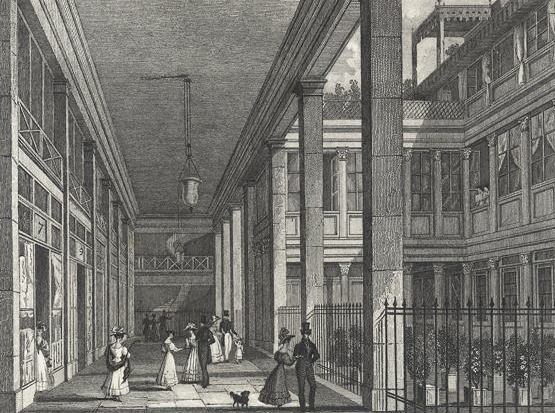
Four years later the insurrection of June 5-6 1832 on the death of General Lamarque saw a barricade erected here, described by Victor Hugo in Choses Vues and in Les Misérables, where he places the policeman Javert spying on the largely student insurrectionaries.
During the Bloody Week of the 1871 Paris Commune, cellars in the Passage du Saumon were used to hide copies of the Blanquist news sheet, Père Duchêne. It had been banned by the Versailles General Vinoy after its fifth edition but it went on to produce 68 during the Commune up until May 22 1871. It was eight pages long and up to 70,000 copies were published each time.
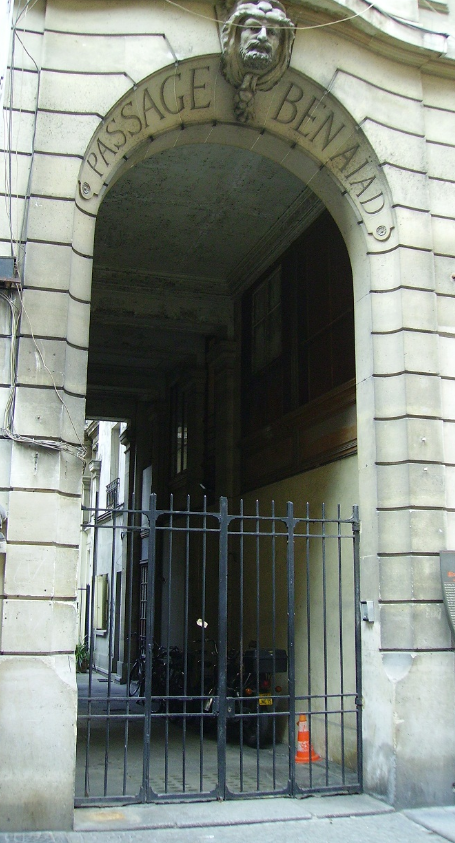
Eventually the Passage became less profitable and it was largely demolished by Aïad’s son in September 1899. The shortened 90m passage was renamed as the Passage Ben-Aïad with access at Nos. 7-8 from the new road named in 1900 after the writer Louis Petit de Bachaumont (1690-1771).


