
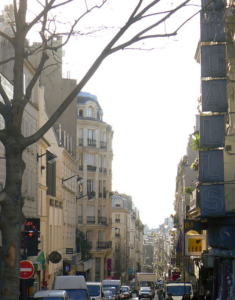
Arrondissement 9
Numbers: 1, 16, 17, 21, 28, 52,55,62,75
An unusual due North-South road for Paris it was called the Rue Royale in 1772 and during the French Revolution, first Rue de la Republique, then Rue de l’an VIII, and finally Rue Pigalle in 1803, when Napoleon was unchallenged as First Consul.
It was named after the 18th century sculptor Jean-Baptiste Pigalle, who used to live at No. 1 and had a workshop at No. 17 where he sculpted a famous bust of Voltaire. His first name was added in 2020 to balance the adding of a female first name to that of the nearby rue de la Rochefoucauld.
In 1841 to 1842 George Sand lived with her lover Frederik Chopin in one of two small houses she rented at No 16.
The road became known as affordable by many painters. Edgar Degas lived at No. 21 from 1882 to 1890. The Nabis painters Pierre Bonnard and Édouard Vuillard and later Maurice Denis shared a workshop at no. 28 in the 1890s.
Surrealists such as Louis Aragon, Michael Leiris and Jacques Baron used to frequent the Le Zelli’s Caberetat No. 52 in 1925.
Julliete Drouet had a flat at no. 55 from 1871-1874 near her lover, Victor Hugo, who stayed there with her briefly early in 1874 while his son, François-Victor Hugo, was dying aged 45 from tuberculosis.
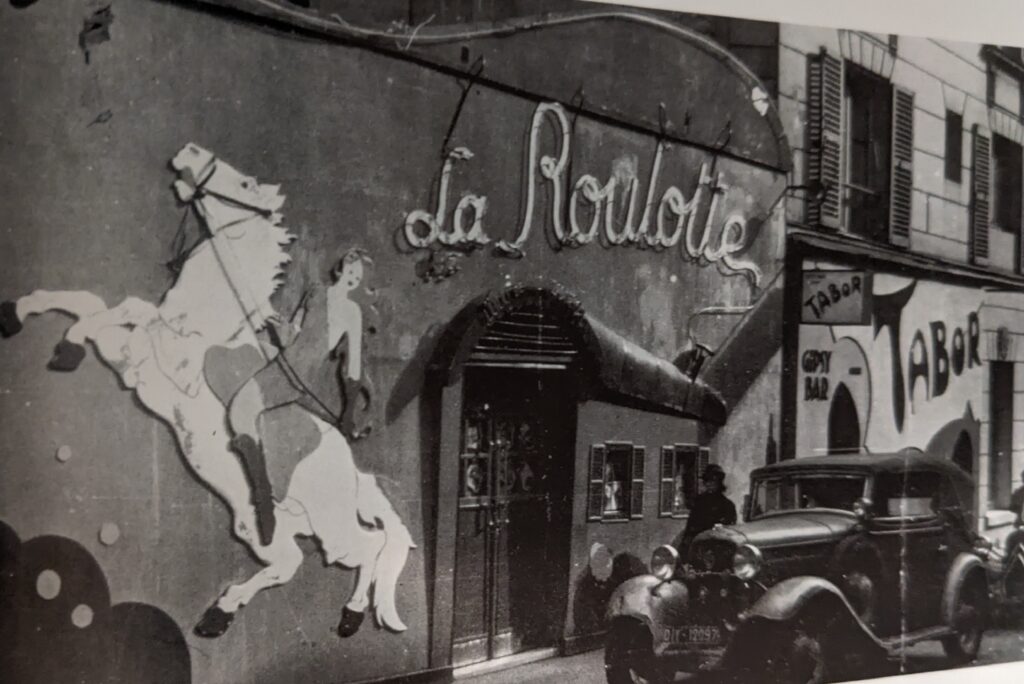
Django Reinhardt often played at La Roulette, one of several well-known jazz clubs in 1930s Paris at No. 62.
Henri de Toulouse-Lautrec famously painted Madame Armande, the owner of the lesbian-associated Hanneton Caberet at No. 75 around 1897-1898.