
Arrondissement 1
Numbers: La Place, 3, 10, 22
The small square’s name (Place des Pyramides) at the road’s southern corner with the Rue de Rivoli dates back to 1801, when named the Square was renamed (from Place de Rivoli) after Napoleon’s victory at the Battle of the Pyramids in 1798 since it was he who ordered the demolition of the old Medici stables and riding school and houses of their pages when he was France’s First Consul.
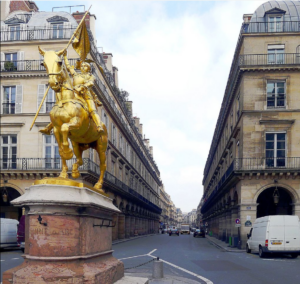
The statue of Jeanne d’Arc in golden bronze was erected there in 1874, near the spot where she was wounded during her failed attempt to take Paris. Unlike all other 150 statues erected in Paris between 1870 and 1914, this was the only statue fully paid for by the government which, after France’s defeat in the Franco-Prussian war of 1870, wished to identify with her spirit of ‘reconquest’.
As part of the celebration of the Popular Front’s election success and two days after the start of the General Strike, Danielle Casanova was one of the organisers of a victory demonstration at the Statue of Joan of Arc by the Communist Party, the Young Communists and its girls’ association (l’Union des jeunes filles de France) on May 14 1936.

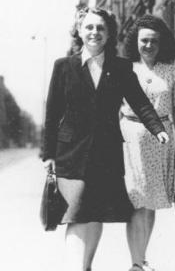
Another organiser of the 1936 demonstration was the 16-year-old Madeleine Vincent. Denounced and arrested for resistance activities at Douai station on January 9 1942, she spent the rest of the war in concentration camps in Essen, Ravensbruck and Mauthausen before being liberated in April 1945. She is shown here in 1946 on the left with Élise Fraysse another communist who had been active in the resistance.
The statue of Joan of Arc was also a point of reference for those resisting the German occupation. The five Parisian activists of the left-Catholic Young Republic League, the only party whose attending deputies unanimously voted against giving all powers to Marshal Petain on June 16 1940, formed the Valmy resistance group on September 20 1940. This was (the anniversary of the Prussian defeat at Valmy by French Revolutionary troops in 1792).
The Valmy group initially produced posters and in January 1941 distributed 50 copies of the first issue of a double-sided duplicated sheet titled ‘Only one enemy: the Invader‘. On May 11 1941 the group led by Raymond Burgard organised a resistance demonstration at the statue. By July 1941 Valmy had merged with the Zone Nord component of the Catholic-democratic Combat resistance movement but this northern group was dismantled in February 1942 by the Germans. In April 1942 Burgard was arrested and deported under Hitler’s December 1941 Night and Fog directive targeting political activists and resistance supporters in its occupied territories. Burgard was later guillotined in Cologne on June 15 1944, in the week following the D-Day landings.
The square had often been used as a meeting place for anti-Semitic demonstrations in the late 19th and early 20th century and its association between fascist-sympathisers and this area in Paris became stronger during the Occupation, fed by its proximity to the German and Gestapo headquarters in the rue de Rivoli.
In the third quarter of the 20th century the racist National Front began holding annual May 1 demonstrations at the square, where it was challenged by anti-fascists and trade unionists.
The collaborationist weekly newspaper, La Gerbe, was based at No 3 from 1940. A racist and Catholic paper, created and subsidised by the German embassy, it included ‘neutral’ writers such as Jean Anouilh and Colette, both of whom lived and worked in Paris throughout the war. In September 1944 its offices were taken over by a new weekly paper, Action, that had since 1943 been an illegal underground publication in the Southern Zone of occupied France. It was edited entirely by resistance activists, largely in the Communist Party or close to it. These included Victor Leduc, amazing humanist photographer, Robert Doisneau, the cartoonists Jean Effel and Siné and the artist and poster designer Paul Colin, whose poster of the Liberation of Paris was on page 1 of the first issue after Liberation.
The headquarters of the main French fascist party, the Parti Populaire Francais, were at No. 10 from 1936 (when it was founded by the ex-Communist Jacques Doriot) to 1945. Its opposition to the Popular Front drew in members of the nationalist right groups banned by the new left government, and anti-Semitic and eugenicist intellectuals as well as many anti-Communists.
On May 13 1961, when No 10 housed the centre-left newspaper France Observateur, it was targeted by the racist Organisation armée secrète (OAS) with a plastic explosive. The OAS mounted a desperate campaign against Algerian independence in 1961-1962.
Further along the road, No. 22 was the location of resistance meetings organised by Henri Ribière, a leader of the largely trade union and socialist Libération-Nord he helped form initially as an underground paper in December 1940.
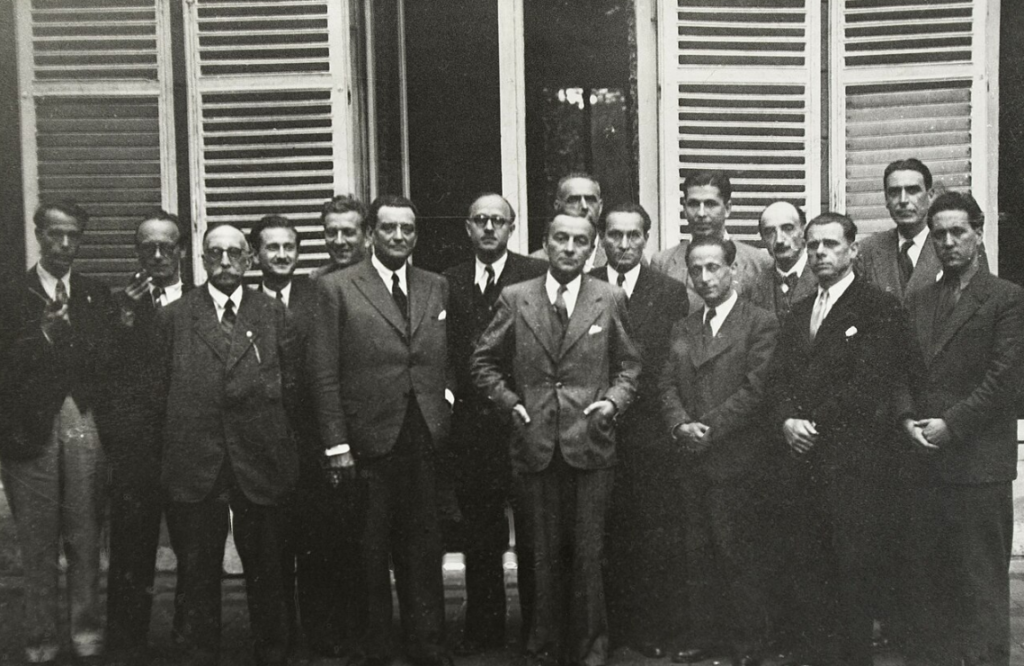
Henri Ribière (7th from the right in this September 1944 photograph of the National Council of the Resistance) was a decorated First World War veteran who had worked in the police during the inter-war years before joining a fellow socialist from Montluçon who was appointed Home Office (ministre de l’Intérieur) in the Popular Front government of 1936. Ribière had then been promoted to Prefect but was sacked by the Vichy Government in 1940 which, unaware of his resistance activity, transferred him to Caen.
In June 1942 Ribière resigned in Caen, citing health reasons, and moved back to Paris to become an underground leader in Paris of Libération-Nord, which began organising armed resistance. No. 22 was a shop called Nouveau-né (New Born) that was initially used as a letter-drop address for the network, and it became a meeting place for the Police et Patrie group Ribière set up. The address stayed secure until Easter 1944 when it as raided and many of the network were arrested by the Milice.
Ribière participated in the taking of the Hôtel de ville on August 20 1944, although he had opposed the Communist Party’s call for an early insurrection.