Arrondissement 3
Numbers 4, 14, 19
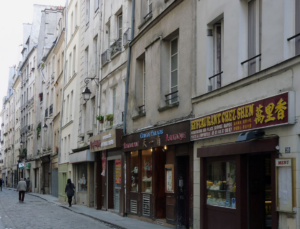
Named the Mayor’s Road after the mayoralty of the 11th century wealthy Saint-Martin-des-Champs priory, whose fortified wall it was created alongside, it was initially known as the Road from Rome, and entirely built up as early as 1280. From at least the First World War the road became known as a Chinese quarter, along with the rue du Temple and the rue des Gravilliers.
After the newly-elected President of the Second Republic, Louis-Napoléon Bonaparte, used French troops to end the Roman Republic a protest barricade was built across the road (the section then in Rue Aumaire). In the fighting on June 13 1849 seven of the protesters were killed.
When Napoleon III was defeated at the Battle of Sedan in 1870, 400 to 500 Paris members of the International Workingmen’s Association, the First International, met on September 5 at No 4, the Aumaire school. They elected Vigilance Committees and a Central Committee representing all 20 Paris arrondissements.

Raymonde Royal, the daughter of Polish Jewish immigrants, lived with her mother at No. 14. She had joined the Young Communists before the war, and was responsible for publicity in the 10th arrondissement. She hid leaflets at home, and used a team of distributors to get them spread around. On the 14 July 1941 and again on August 1 1941 she marched in patriotic demonstrations waving a red flag. She was arrested with her mother on May 11 1942. Both were deported to Auschwitz where they were murdered.
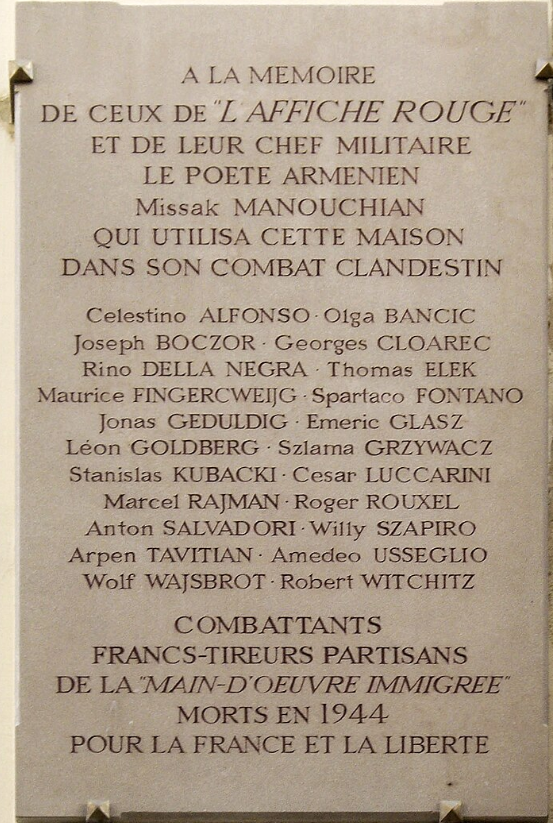
Another immigrant lived at No. 19, the Armenian Arménouhie Assoudourian, sister of Mélinée Soukémian. The sisters’ parents had been murdered in the Armenian genocide, and the two girls were rescued by a Greek-based Protestant mission that eventually got them schooling in Marseille. They both moved to Paris, where in 1934, aged 22, Mélinée met Missak Manouchian and then married him. He later became one of the leaders of the FTP-MOI and used Armène’s address as one of his hiding places. A plaque remembering the group members executed in 1944 has been placed on the wall at No. 19.