Arrondissement 5
Numbers: 15, 24, 31
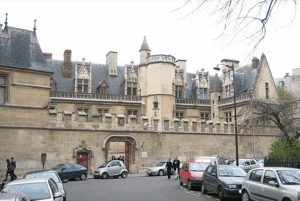
Named in 1867 after the archaeologist and art collector Alexandre du Sommerard who had lived in the Cluny 15th century mediaeval palace from 1832 until his death ten years later, when it was purchased by the government and became the Musée de Cluny. Its origins were way back in the Roman first century when it was the access road to the Cluny thermal baths.
In 1254, when it was called the Rue du Palais des Thermes, the theologian Robert de Sorbon founded a school for 20 poor students there, the origins of the Sorbonne University at No. 24.
On June 23 and June 24 1848 the road, then called the Rue does Mathurins St Jacques, was the site of violent fighting during the June uprising against the abolition of the National Workshops. At the end of the fighting the surviving insurgents were killed by the government troops.
Nearly the same place the same outcome in 1871, when Communards were killed on May 24 in the right of the Sorbonne courtyard.
The resistance fighter, Madeleine Riffaud, was staying in a small hotel, probably at No. 15, when on July 23 1944 she found out that one of her male student comrades, Charles Martini (alias Picpus) had been killed in an attack on the German occupiers. Having read earlier in the last number of the underground paper Lettres francaises of the 643 Ouradour-sur-Glane villagers murdered by the German Waffen-SS on June 10 , four days after D-Day, she decided to take revenge. She had herself spent several holidays in the neighbouring village with friends of her parents.
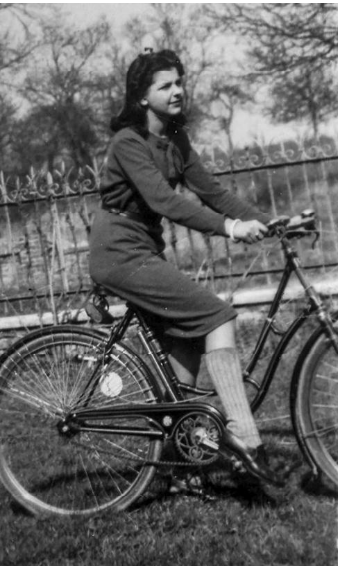
Madeleine met another resistance member in the square in front of Notre-Dame, took the bicycle and a recently acquired pistol with the code-name Oscar, and cycled to the Seine where on a beautiful Sunday afternoon she shot a German non-commissioned officer. Cycling away she was knocked down by a passing Milice (French storm-trooper), handcuffed and taken to the Gestapo headquarters in the Rue des Saussaies where she was tortured for three weeks, both by the Germans and by the Special Brigade of the French police.
Riffaud was on the point of being executed when on August 5 1944 a French policeman recognised her as having been involved in the seizure of his handgun, Oscar. So she was sent to the Fresnes Prison, that specialised in resistance fighters and communists, for further interrogation.
Tortured again there, on August 15 she was put on Convoy 57000 for Auschwitz, but with another woman jumped from the train, was recaptured and then on August 19 became one of the prisoner exchanges negotiated by the neutral Swedish consul in Paris, Raoul Nordling. Aged 20 Riffaud then participated in the Liberation battles in Paris.
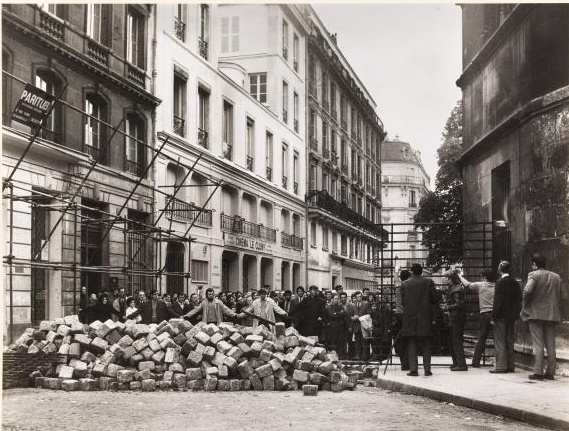
In May 1968 the road was again blockaded by a barricade crossing from the Square Paul Painleve to No 31.