
Arrondissement 3
Numbers 2, 4
The road was renamed in 1910 after Eugène Spuller, a Third Republic deputy who from being an officer under Gambetta opposed peace with the Prussians in 1871 but argued for reconciliation with the Catholic Church in the 1890s. Before then the road was a straight continuation of the Rue des Archives.
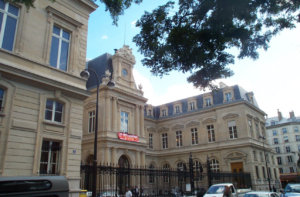
The Town Hall of the Third Arrondissement was built at No 3 between 1864 and 1867. Since 2020 it has become the Mayoral offices of the First Sector of Paris.
The Town Hall is on the site of the former Tower of the Temple prison, which before it was demolished in 1808 once held Marie Antoinette and her children, Gracchus Babeuf and Toussaint Louverture, before his imprisonment in the Joux Fort where he died (before in 1998 his name became that of the first black person to be inscribed on the wall in the crypt of the Great Men of France in the Pantheon).

Odette Pilpoul a Catholic and mother of one boy joined the Mouvement Resistance in 1942. A largely non-sectarian group it published 26 issues of an underground paper called Resistance: The New Parisian Paper between October 1942 and August 1944. From the Town Hall she helped provide additional ration cards for those living clandestinely, as well as with others providing false identity papers and false birth certificates. Her actions helped save hundreds of people, both Jewish and non-Jewish.
The demand for these increased considerably when in 1943 the Vichy government acceded to the German order to transport more ‘volunteer’ workers to Germany under Vichy’s 1942 Compulsory Work Service law. From February 1943 in addition to the quarter of a million men already working in Germany the same number was required again. So the Vichy government decided all men over 20 had to comply with the law and enforced it through conscription of all men born between 1940 and 1942. Around 200,000 men then promptly disappeared of whom about a quarter joined the resistance.

Odette also hid many people, Jews, non-Jews and British and American pilots, in her flat in the Champ-de-Mars. On March 3 1944 she was arrested by the Gestapo. Her camp card at Ravensbruck was marked ‘French political’, but after being moved on to Buchenwald she survived and returned, getting accolades as the ‘soul of resistance in the Third Arrondissement’, decorations and on December 12 2002 the title of ‘Righteous among the Nations‘.
During the bloody week of the Paris Commune, the Square du Temple adjoining the road and occupying the space of No. 4 was the scene of another massacre of defenders of the Commune on May 25 1871.
On 26 October 2007, a monument was inaugurated on the lawn of the main square of the Temple. It carries the names and ages of 85 “little ones who did not have time to attend school”, Jewish children from 2 months to 6 years living in the 3rd arrondissement and deported between 1942 and 1944 and then murdered in Auschwitz and other concentration camps. The memorial is one of several remembering the 11,400 Jewish children deported from France that were only recognised publicly after nearly all those who committed the atrocities or who were complicit in them had died. The lists of children were compiled from school and civic records by Serge Klarsfeld.


