
Arrondissement 1
Numbers: 1-2, 4, 6, 7, 8, 11-13, 24, 23-26
The Place Vendôme was built to celebrate France’s military might under Louis XIV, the Sun King. Begun in 1699 it was only finished in 1720. It was built on land that had belonged to the illegitimate son of Henry IV, the Duke of Vendôme.

During the French Revolution it was renamed the Place des Piques (Square of Pikes) and the statue was destroyed on August 16 1792 and replaced with a statue representing Liberty.
For most of the 18th century many of the flats in the square’s huge private mansions were occupied by financial speculators and/or tax farmers and relatives of the aristocracy, among whom were a handful of revolutionaries. The leadership of the 1796 Conspiracy of Equals, including Gracchus Babeuf and Philippe Buonarroti met at No. 6, the Hôtel Thibert des Martrais. This was also the address from which two years earlier the Tax Farmers Jacques Paulze and Antoine Laurent de Lavoisier were taken to the guillotine.
Another conspiracy, this time against Napoleon Bonaparte in 1812, two years after the construction of the Vendome Column, was ended when General Malet was arrested by Colonel Doucet and Lieutenant Colonel Laborde at No 7, the Hôtel Le Bas de Montargis. Among those executed a week later, on October 31 1812, was General Lahorie, the god-father of Victor Hugo and Hugo’s mother’s lover since 1802.
In 1871, under the Paris Commune, the square was renamed the Place Internationale.
Number 7 was the same mansion that under the siege of Paris saw the Versailles government’s Paris army General installing Louis d’Aurelle de Paladines as commander of the Paris National Guard against the wishes of the majority of its battalions on March 5 1871. With the failure of the Versailles attempt to remove cannons from Montmartre on March 18 1871, 2,000 men from the Batignolles and Montmartre battalions of the National Guard battalions then evicted de Paladines and took over the building.
This allowed Jules Bergeret to set up his staff headquarters at No. 7. On April 4, after being elected to the Commune’s Council, Bergeret was named Paris National Guard commander.
The square saw much blood spilt at its barricades defending these headquarters of the National Guard during the Paris Commune. On May 23 1871 a barricade at the angle between Nos 1 and 2 with Rue Saint-Honoré was finally captured after Versailles troops got into the square through No. 4 and attacked the barricade’s defenders from behind.
The Hôtel du Rhin at No. 4 was also where Louis-Napoléon Bonaparte had lived in 1848 after his return from exile in England and where he was visited by Victor Hugo who completely believed his assurances that he had no designs to become Emperor.
The second defensive barricade blocking access from the Rue de la Paix in May 1871, stretching across Nos 23-26, was also captured from behind. This was one of the just 18 barricades that had actually been defended with the Commune’s canons.
After the barricades were overwhelmed, the Versailles troops killed most of the survivors. On the following day a group of 30 Communard women were shot in the square.
The Hôtel de Chimay at No. 8 was a centre of the Saint-Jacques resistance network from the start of the 1940 occupation of Paris by the Germans. Radio communications from there to London by began in April 1941 after Maurice Duclos was parachuted into France in February.
During the French Revolution Nos 11-13 became the Ministry of Justice, with Georges Danton nominated as Minister in August 1792. A metre length was installed in the wall there in 1795. The only other remaining original metre length installed in Paris at the changeover to metric distancing is in the Rue de Vaugirard.
No 12, the Hôtel Baudard de Saint-James, was where Frédéric Chopin died supposedly of tuberculosis (although this diagnosis is now contested) on October 17 1849. He was buried in Père Lachaise cemetery. While from 1838 to 1847 Chopin had lived with George Sand, he had separated from her and spent just a month in the Place Vendôme before he died, thanks to a loan from Jane Stirling.
The former Hôtel de Gramont at No. 15 was transformed into a luxury hotel and opened by the Swiss hotelier César Ritz in 1898. During the occupation the most senior Germans lived there and had many ‘traitor lunches’ in its restaurant. On the 16 August 1944 Ernest Hemingway arrived at the Ritz and presented some American rifles to the resistance fighters who had just evicted the Germans. This was also where Coco Chanel lived for many years, including during the period she collaborated with the Germans.
The Hôtel de Boffrand at No. 24, has also become known outside France through its association with Anne Lister, the Gentleman Jack lesbian Calderdale landowner and diarist. She lived there with Maria Barlow in 1824-1825.
Changing statues
In 1806 Napoleon ordered the building of a huge column in the centre of the square to celebrate his military victory at Austerlitz. Ironically this military monument was situated at the end of the Rue de la Paix. Inaugurated on August 15 1810 it was covered in bronze plates featuring battle scenes made, it was said, from melting down foreign captured cannons.

In 1816 the Louis XVIII Restoration government melted Napoleon’s statue down to use its bronze for a new Henry IV statue on the Pont Neuf

For the following 15 years the position at the top of the column was not filled. But in 1833, after a Bonapartist demonstration on May 1 1831, the new King Louis-Philippe (the son of the executed Duke of Orléans, Philippe Égalité, a supporter of the French Revolution and a regicide), replaced Napoleon at the top. This time, however, not dressed as a Roman emperor, but as an army corporal, reflecting the new king’s desire to honour Napoleon, but not too much.
Napoleon did still not appeal to the revolutionaries of 1848, who took the corporal down and threw him into the Seine. Replacing the corporal did not appeal to nephew Louis Napoleon Bonaparte either. His third (and finally successful) military coup d’etat in 1851 led him to proclaim himself Napoleon III, Emperor of the French. In 1864 he placed a copy of the original Napoleon as Emperor statue back on the top of the column.

Karl Marx wrote one of his best political commentaries on contemporary events in 1852: The Eighteenth Brumaire of Louis Bonaparte. In it he compares Louis’ coup of 1851 with Napoleon Bonaparte’s of 1799, and presciently concluded that ‘if the Imperial mantle finally falls on the shoulders of Louis Bonaparte, the bronze statue of Napoleon will fall from the height of the Vendôme Column‘.
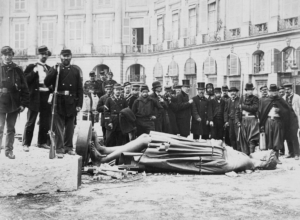
This happened on May 16 1871 during the Paris Commune after the painter, Citizen Courbet, the President of the Federation of Artists that was formed on April 15, persuaded the Commune to authorise the dismantling of the column. He described it as ‘a monument devoid of all artistic value, tending to perpetuate by its expression the ideas of war and conquest of the past imperial dynasty‘.
Courbet’s attack on the column was not universally supported by other artists. Daumier, the head of the Beaux-Arts section of the Federation, believed it should not be taken down. Perhaps this was why the 425 spiralling bas-relief bronze plates carried out by a team of 30 sculptors were removed and stored.

The column was replaced in 1874 with another copy of the imperial Napoleon at its top.


