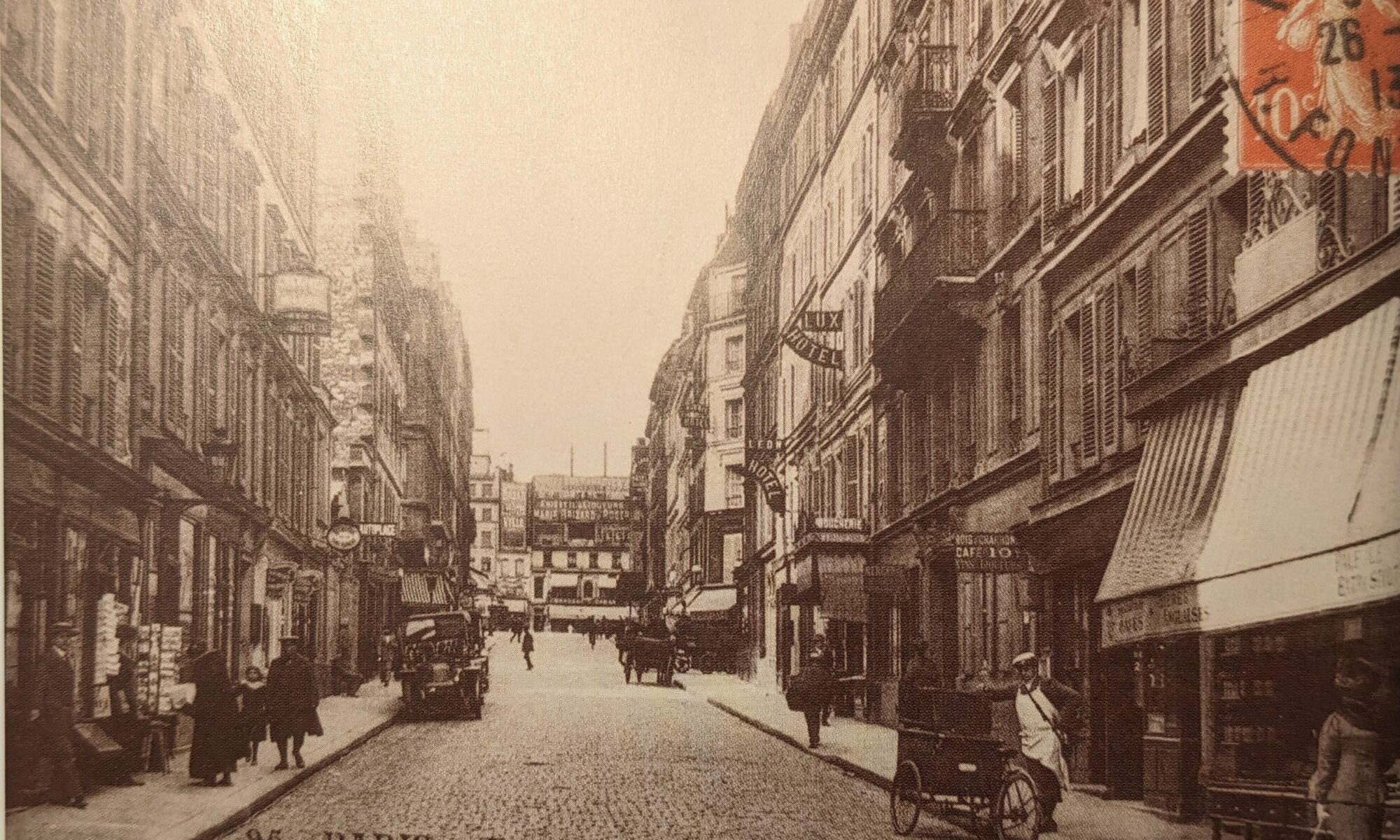
Owing its name to the transport of plaster into Paris from the Montmartre quarries it already featured on a map dating from 1672, where it was called the White Cross Road (rue de la Croix-Blanche). It got its present name in 1793.
Some 60 ‘left’ members of the National Assembly met at the Baroness Coppens’ first floor home soon after hearing of the December 2 1851 military seizure of power staged by Louis-Napoleon Bonaparte.
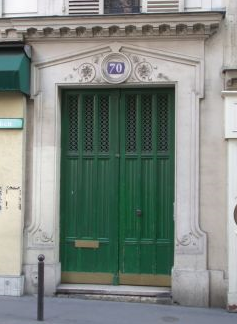
Edgar Degas, who was involved in setting up an anonymous artist cooperative, lived at No 77 between Marc h 1873 and 1876. He left when his family bank in Naples went bankrupt.
The second offices of the Independent Review, La Revue indépendante, were at No. 79. In November 1886. Félix Fénéon, organised ‘Symbolist’ meetings there that included Georges Chevrier, Georges Seurat and Édouard Desjardins.
A kilometre-long road first traced out in the 15th century had previously had 12 other names before its three main fragments (la rue des Petits-Augustins, la rue Saint-Germain-des-Prés and la rue du Pot-de-Fer-Saint-Sulpice) were joined together and given its current name by Napoléon Bonaparte’s nephew, the Prince-President Louis-Napoléon Bonaparte in 1852.
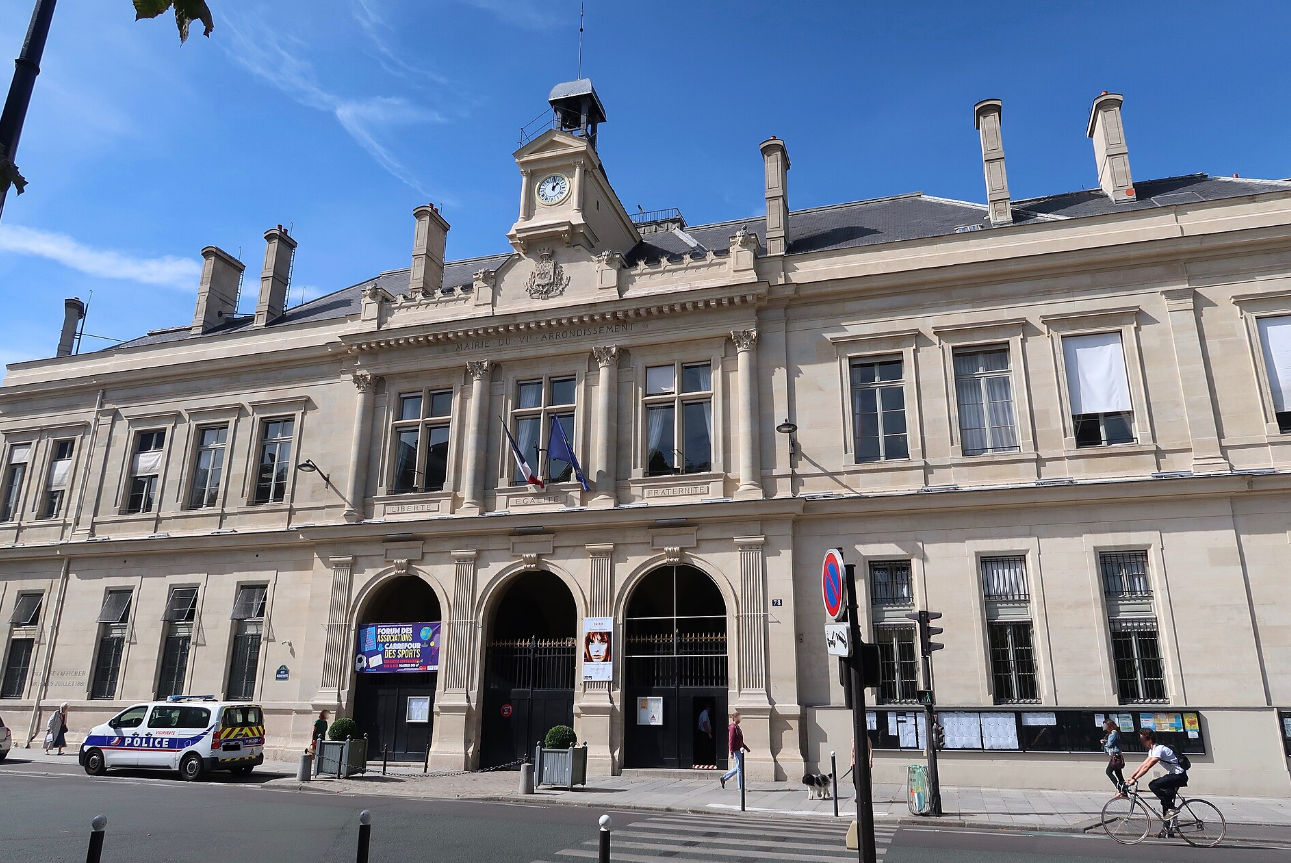
The building I have most contact with in this newly chic area is the sixth arrondissement town hall. When my father’s French employer first found him a flat in the area in 1954 it was still largely cheap student accommodation, dozens of cafes and loads of drunks and intellectuals hanging out. No 78, pictured above, is where 42 years later a motorcycle rider had to rush to for a permit to move my dad’s body out of the sixth before the 24-hour deadline for medical research on his body had passed. The mairie was built in the 1840s.
Paris is still changing, and sometimes by accident. Having a meal with Nicole (my father’s partner for over 25 years) in November 2017, we chatted about the big fire that had started near the Saint Germain church.
The famous La Hune Bookshop after the fire and in the background Sartre’s doorway at 42 Rue Bonaparte
It turned out to be the cremation of the last mortal remains of the famous La Hune bookshop. This had been set up by former resistance fighters in 1949 and had been a centre of Parisian intellectual life for thirty years. It had closed two years earlier after relocating to the corner of the Place Saint-German and Rue Bonaparte in 2012.
Hazan (WTP) remembers it as one of the key left intellectual
meetings places of the 1950s and as a street dominated by ‘realist’ art
galleries in the 1960s. When we walked past it the day after the fire and smelt
the sad pungent aroma of burnt books and wood, it looked as if the fashion shop
with which it shared its premises had mysteriously been largely spared.
Across Rue Bonaparte was where Jean-Paul Sartre used to live in number 42 (third window above the balcony). He moved there to be with his mother after the death of her second husband in 1948. The editorial team of his philosophical journal, Temps modernes, used to meet in the flat. Simone de Beauvoir, with whom he lived there for a while, Raymond Aron and Maurice Merleau-Ponty were among the many Left Bank intellectuals who made up its editorial board.
Rue Bonaparte in January 1962 after an OAS plastic bomb exploded in the doorway outside Sartre’s house
Number 42 was the address where Sartre’s political support for Algerian independence was rewarded on January 7 1962 with the signature plastic bomb used by the OAS – the Organisation armée secrete – whose music I had first heard out with my father on the Champs Elysée celebrating New Years’ Eve just a week earlier. The traffic jam of cars blocking the street appeared nearly all to be honking ‘Algerie Française’ – da da da, daa, daa. A week later we were walking home when we heard the huge bang when the Rue Bonaparte bomb went off – targeted along with another 16 other addresses that night.
There were no injuries, but Sartre promptly moved
out to the much more public Boulevard Raspail.
The 40-year-old French composer of Spanish origins, Francisco Salvador Daniel (1831-24 May 1871) was summarily shot in Rue Bonaparte
Further down the Rue Bonaparte, at the crossroad with Rue Jacob, another story did not end quite so happily. In 1871 the Commune defenders built a barricade between numbers 21 and 28 in Rue Bonaparte and from 29 to 32 in Rue Jacob. There, on May 24 1871 Francisco Salvador-Daniel, the musicologist son of a Jewish refugee from Spain, who had been defending the barricade was captured, and taken back to the barricade and shot by the Versaillais soldiers. He had taught the violin in Algeria and translated and adapted Arabic songs from North Africa for European musical instruments.
Félix Vallotton, the graphic artists and painter sympathetic to anarchism, frequent contributor to La Revue Blanche, where he drew the enigmatic portrait of anarchist and art critic Félix Fénéon, and associated with the Nabis movement, lived in 1886 at No. 21.
The painter, Édouard Manet, was born in the mansion belonging to his family at No. 5. His mother was the goddaughter of the only French general who remained a king (of Sweden) after the defeat of Napoleon and his father was a French judge.
Louis Hélié, one of the rare 60-year-old resistance fighters killed by the Germans in the 1944 liberation struggle in Paris, lived at No. 3, found at the Northern end of the Rue Bonaparte.
The existing Bourbon Palace that has been used as the Chamber of Deputies or National Assembly ever since 1815 was originally built between 1722 and 1728. It was then enlarged considerably between 1771 and 1789 under the neo-classical architect Marie-Joseph Peyre (who also designed the Odeon Theatre) before being nationalised in 1792 after its then princely owner had fled France.
Under the Directory the Council of Five Hundred began to meet in the Palais Bourbon. from January 21 1798. By then it had been modified to include a hemicycle theatre. Napoleon’s powerless Corps Legislatif also met there in a building that was now adorned by a new Corinthian facade facing the Seine and on the opposite bank at the end of the Rue Royale, Napoleon’s Temple to the Glory of the Great Army (now the Church of the Madeleine).
At what is now the back, or south-facing side of the Palais Bourbon is the Square (Place du Palais Bourbon). In 1883 and 1884 Félix Fénéon published poetry by Paul Verlaine and the Illuminations by Arthur Rimbaud from No. 8 in the Libre revue.
Many of those in LeftinParis were deputies in the National Assembly at one point or other in their lives: Jean Zay, Leon Blum, Ledru-Rollin,
A 12 metre-wide street originally built in 1826 under a royal decree, it was initially named rue Mademoiselle because of its proximity to the building that became the Matignon Palace/Hôtel , now the official residence of France’s prime ministers. The owner of the huge Hôtel at 55 rue de Varenne at that time was Mademoiselle Louise-Eugenie, the younger sister of Louis-Philippe. The name was changed to rue Vanneau (with two nn’s) in the initial democratic phase of King Louis-Philippe in October 1830.
The street was again renamed in 1873, as the right-wing Republican government sought to use name changes to reinforce its shaky legitimacy. So from rue Vanneau it became rue Vaneau (with one n) in honour of a student killed attacking the Babylone barracks during the Glorious Revolution on July 29 1830.
Although Karl Marx lived at both No. 38 and No. 23 in 1843-1844 and his first daughter, Jenny (who later married Charles Longuet), was born at No. 38 there is no commemorative plaque on either address. The offices of the review that had brought Marx to Paris, Annales franco-allemandes, were at No. 22.
The socialist senator and first female Senate vice-president Gilberte Brossolette (Bruel) was born at No. 24 in 1905. She married Pierre Brossolette in 1926 and worked as a journalist for the socialist paper, Le Populaire. From the autumn of 1940 the couple secretly held meetings in their home to create the first resistance group in Paris. In May 1942 after French police searches led to their teenage son being taken to Gestapo HQ, they crossed the demarcation line with their two children. Gilberte then sailed with the boy and girl to Gibraltar and from there took a cargo vessel to London, where she worked as the liaison between De Gaulle and the BBC.
Another left literary figure to have lived in the road was Félix Fénéon. He was still living with his parents at No. 26 when he got his first job at the Ministry of War in 1881 and soon afterwards began writing art criticism, book summaries, short stories and even a first draft of a psychological novel for a monthly journal that ran from October 1883 to March 1884.
The photograph above is from 1905, some 60 years after the Marx family lived a little further down the street.
You will see a plaque on 1b, rue Vaneau, where André Gide lived on the sixth floor from 1928 and died in 1951, and where he hid Albert Camus in another flat in the building in 1944.