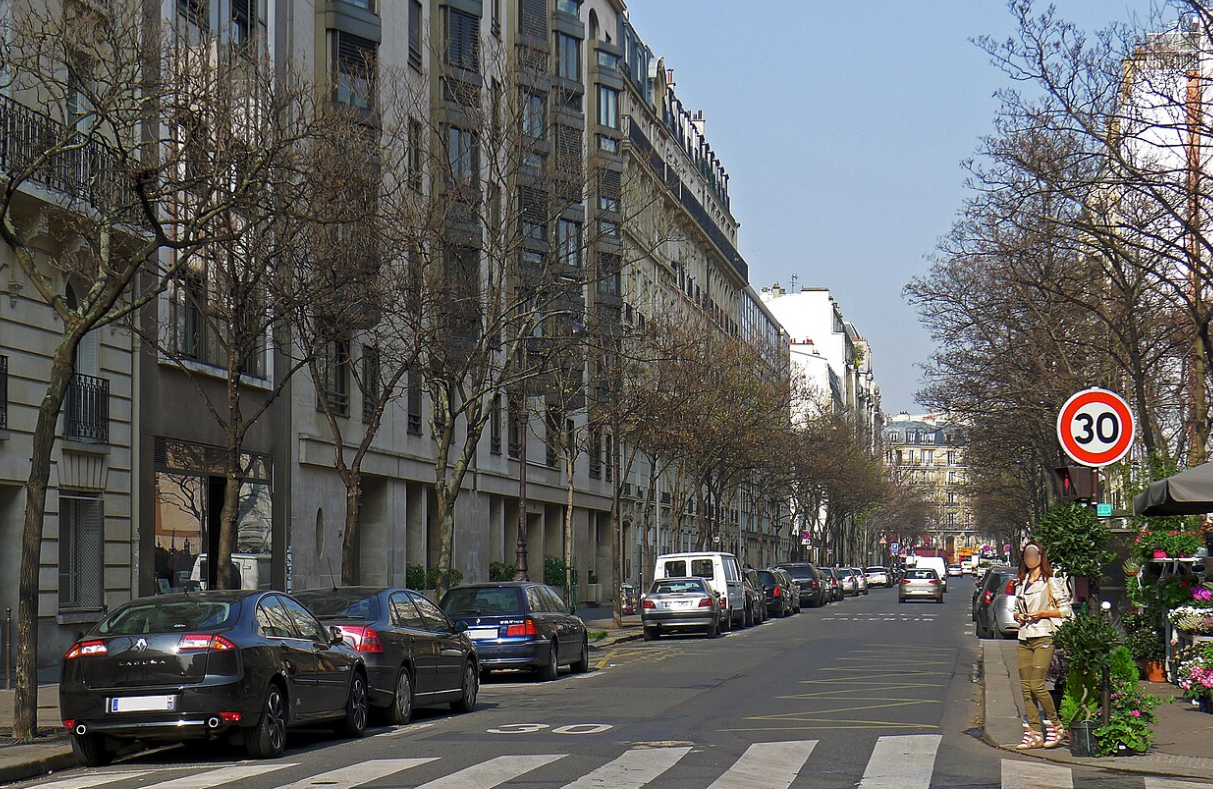
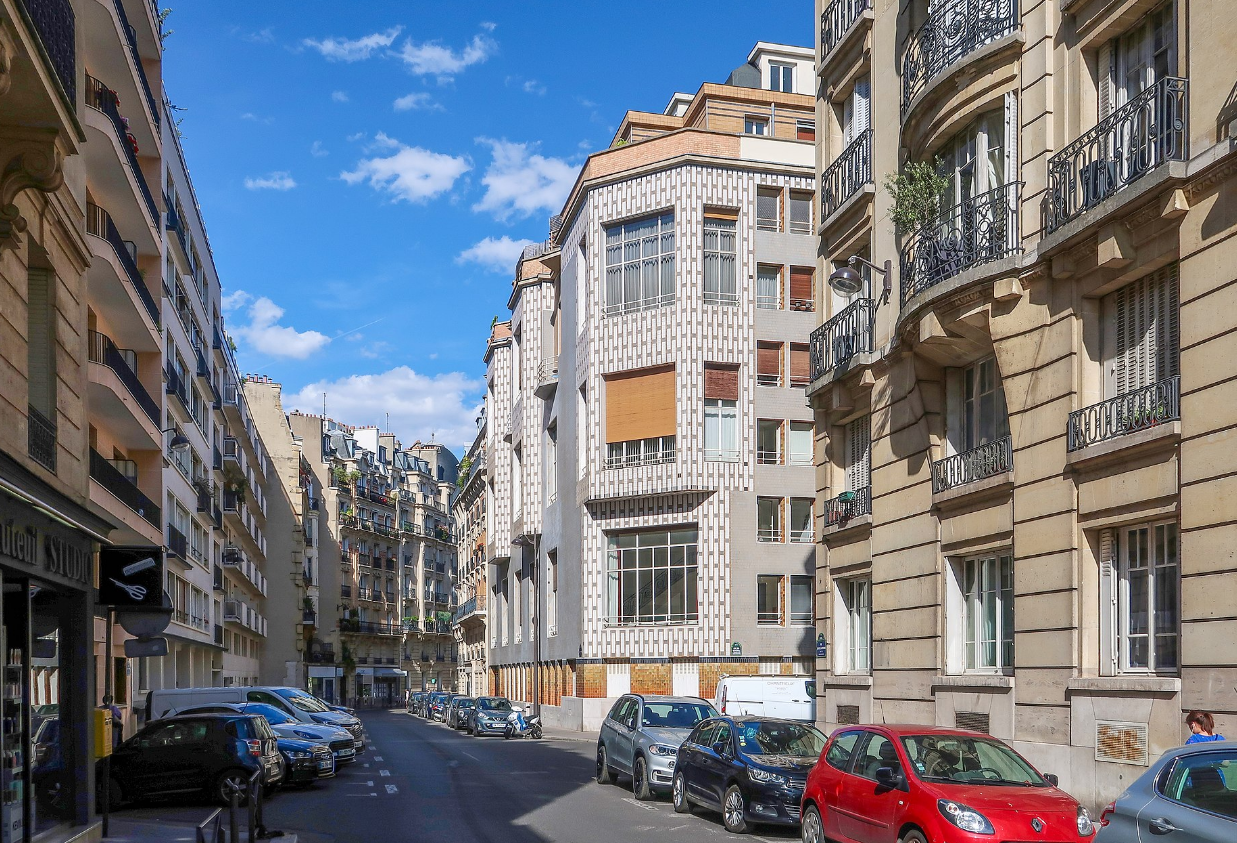
Built in 1862 the road was named after Michelangelo in another Haussmannian grandiose attempt to glorify Napoleon III’s Second Empire.
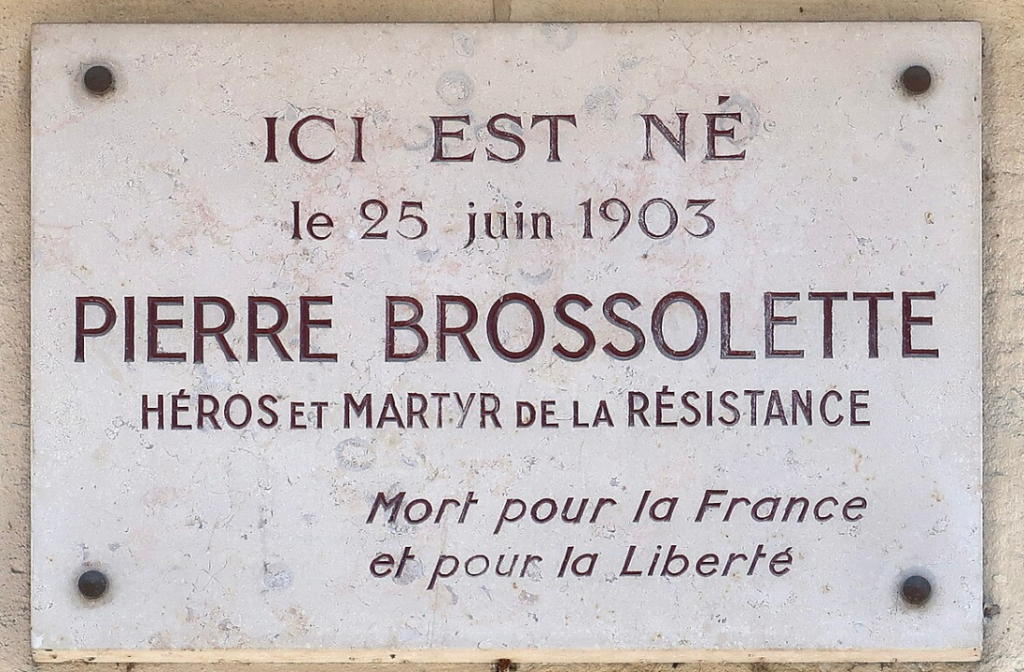
One of France’s most renowned resistance organisers, Pierre Brossolette, was born in No. 77bis in 1903. An active socialist and resistant from 1940 as was his wife, Gilberte, he was a key figure in uniting the resistance movement after the Communist Party started to support struggles against the occupier after Hitler launched the invasion of Russia in June 1941.
Pierre Brossolette chose to end his life by jumping out of a window in the SS security building at 11 Rue des Saussaies on March 22 1944 rather than risk revealing his extensive knowledge of the French resistance. He had given just one name, his own.
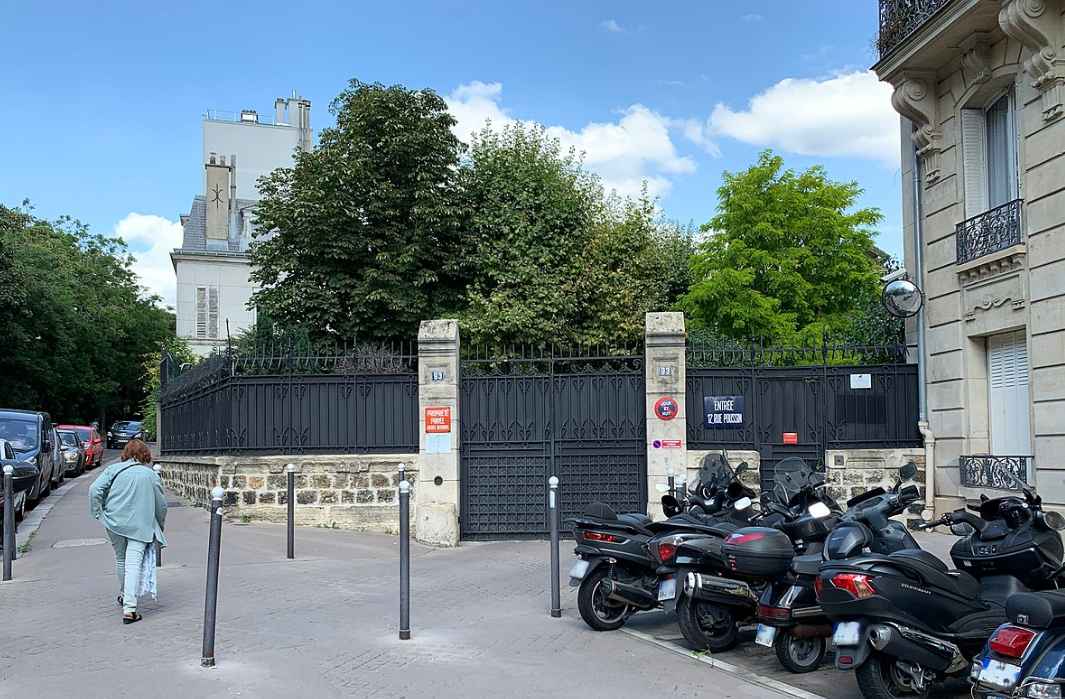
The road now bears the shame of hosting at No. 114 bis the Paris headquarters of the re-badged neo-fascist National Front, since 2021 calling itself the Rassemblement National.
Arlette Humbert-Laroche, resistance activist and poet, was living lived at No. 127 when she was arrested on January 14 1943. Before the war she had been working helping place unemployed workers, and had joined the Communist party in her early 20s. Aged 25 when the Germans occupied Paris she became a liaison person with the Communist Party’s underground network that the Germans described in all occupied countries as the ‘Red Orchestra‘.
Arrested by the Gestapo she was tortured before being sent to Fresnes prison and then deported to Silesia and then transferred first to Ravensbruck concentration camp, then to Mauthausen and finally to Bergen-Belsen, where she died aged 29 a few days after the arrival of British troops.
This is one of six private roads within the gated Villa Montmorency 120-VIP-houses estate that was planted originally with sycamore trees when it was within the park of the 16th century Boufflers Chateau that was sold off in 1852 with the building of the Auteuil station.
Victor Hugo moved into No 5 with his son François-Victor in 1872, who died there of tuberculosis on December 26 the following year.
The road was named in 1865 after the 17th century French poet, Jean de la Fontaine, famous for his Fables and one of the quartet of authors with Racine, Boileau and Molière based around the Rue du Vieux Colombier.
Juliette Drouet was living at No. 54 in 1846, the year her daughter Claire died.
Two members of the Resistance network CND Castille, René and Jeannette Drouin lived at No 13. They both died during the war, René in 1942 and Jeannette in 1945.
Under its earlier name of the Grande rue d’Auteil, No. 24 was the private house of Mme Helvétius , whose salon from 1772 to 1800 was visited by Diderot, Turgot, Benjamin Franklin, Thomas Jefferson and Thomas Paine as well as by Napoléon Bonaparte.
The Auteuil hamlet was close to the vast forest of Rouvray of which today the only remains are the Bois de Boulogne.
Under the Second Empire the house at 59 rue d’Auteuil was owned by the Emperor’s cousin, Pierre Bonaparte, and was where he shot and killed the unarmed young journalist Victor Noir on January 10 1870. Pierre Bonaparte was quickly found not guilty after a trial heard from several conjured up witnesses, while Noir was buried in Neuilly – and only removed as a Republican symbol to Paris’ Père-Lachaise in 1891.
Dalou sculpted the 21-year-old’s tomb for the Père-Lachaise cemetery to where the remains were taken in 1891
Tens of thousands of outraged republicans, including Louise Michel dressed as a man and carrying a knife, marched in his funeral cortege.
Nothing remains of the superb original building, which was burnt to the ground by the Communards in May 1871. There is now only a huge apartment block at the spot.
However, somewhat ironically, the chemist shop at No. 27, just down the street, where Noir finally died at 2 pm in the afternoon, is now called ‘Body Minute’.
Living further up the street in 1848, at Nos. 63-73, was Louis-Philippe’s vehemently anti-Republican prime minister, François Guizot,.
The convent that took over the old country mansion on the hill overlooking the Seine in 1651 at the prompting of Henriette-Marie de France, the widow of the executed English king Charles I, was abandoned by them in 1789.
The former Chaillot Palace that became a convent in 1651 shown in this print in 1774
On 31 August 1794 the gunpowder factory at Grenelle on the left bank of the Seine exploded with such force that a wing of the palace collapsed. This was France’s most murderous industrial accident, officially killing 536 people but likely to have killed or wounded up to 1,360. The whole palace was then demolished.
Photographed here in 1900, the Trocadero Palace was incorporated into the supposedly temporary Palais de Chaillot for the 1937 Universal Exhibition. It then reflected more strongly the ‘totalitarian’ style of architecture particularly associated with interwar Germany and Russia.
The square after which the new palace was named in 1823 followed the capture of the Spanish fortified Trocadero island outside Cadiz, when Louis VIII sent French troops to help put down a revolt against the Spanish Bourbon monarchy.
Through the first half of the 19th century at least 5 major projects were proposed for the site but none realised. Then the hill was flattened for the Universal Exhibition of 1867.
This became a National Guard post during the Commune. Around 1,200 Communard soldiers were killed or captured when Versaillais troops took the battery of canons there on 21 May 1871. From there big artillery pieces were then used to shell the Batignolles and Madeleine areas two days later.
The 1937 Universal Exhibition saw the Russian (Hammer and sickle) and German (Swastika) pavillions facing each other across the Palais de Chaillot gardens.
In 1878 the Trocadero Palace was built on the hill for that year’s International Exhibition and this was then extended to become the Palais de Chaillot for the 1937 event.
Hitler at the Trocadero on June 23 1940
After the German occupation of Paris in June 1940 a resistance group was created among the staff of the Humanity Museum (Musée de l’Homme) based since 1937 in the Chaillot Palace, producing an underground paper, Résistance. Its anti-fascist director, Paul Rivet, posted Rudyard Kipyard’s poem, If, on the Museum’s front door.
The museum’s librarian, Yvonne Oddon, was instrumental in launching the resistance network, which helped several prisoners of war to escape and provided information on German troop movements.
During this period the group was joined by others outside the museum, including Germaine Tillion, who took over leadership of the network after February 1941, when nearly all of its members were denounced, arrested and ten sentenced to death. While her husband was executed, Oddon and two other women had their sentences suspended and they were deported to German concentration camps.
Immediately after the Second World War, on 25 September 1945, the Palais de Chaillot was the venue for the first congress of the World Federation of Trade Unions, bringing together trade union delegates from 56 countries.
It was next the venue for two sessions of the newly-created United Nations. The 3rd session of the General Assembly took place here from September to December 1948, and the 6th from November 1951 to February 1952.
The Universal Movement for a World Confederation founded in August 1947 in Switzerland campaigned powerfully in Paris during the famous UN 3rd Session. Garry Davis, a former US pilot who announced he had abandoned American nationality in favour of World Citizenship, was visited at his tent outside the Palais de Chaillot by Sartre, Breton, l’abbé Pierre, Gide and many other left celebrities. André Gorz moved to Paris in June 1949 to work in the international secretariat of the Movement for World Citizenship.
The Universal Declaration of Human Rights agreed by the General Assembly of the United Nations meeting in Paris at the Palais de Chaillot was drafted by Eleanor Roosevelt.
On 10 December 1948 this was where the United National General Assembly adopted the Universal Declaration of the Rights of Man. 50 countries voted in favour. Six abstained: Saudi Arabia, opposing gender equality, South Africa, opposing racial equality, while the Soviet Union alongside Poland, Czechoslovakia and Yugoslavia, opposed its definition of universality. Honduras and Yemen did not participate in the vote.
In the 1860s Narcisse Diaz was often at Étretat, partly for health reasons and partly to paint with his friend Courbet.
Originally called the ‘Sentier des Arches’ (the arches pathway) and the ‘Rue de Seine’, it next became a section of the rue Wilhelm before finally in 1894 being renamed in honour of the painter Narcisse Diaz (1807-1876), a friend of Gustave Courbet, next to whom in the 1860s he painted several scenes on the Normandy coast.
Lev Sedov with his father
At No. 7 the street hosts the Clinique Mirabeau founded in 1929 where Trotsky and Natalia Sedov’s activist son, Lev Sedov, showing signs of appendicitis was advised to go in 1938 by his secretary, a secret agent of the Russian NKVD. The clinic’s director an informer for the NKVD was in charge of anaesthetising Sedov. Four days later, on February 18 1938, Sedov (born 1906 in Saint Petersbourg) was dead.
The opened records of the Stalin’s secret police show them congratulating themselves on his death, but some suggest it was not planned, and was due merely the incompetence of the surgeon.
Already an important shopping street in the Passy village in the 19th century, by 1860 its wealthy residents not only had the usual shops selling basic foods, but also clothing and furniture shops, a chemist, an optician and a bookshop.
Proudhon lived at No. 12 from 1861 until his death here on 19 January 1865. There is a rare now very faded plaque above the entrance to a smartphone shop.
The rather faded plaque to Pierre-Joseph Proudhon is now above a smart-phone shop in the still busy Rue de Passy
This very long street now linking the very wealthy Avenue du President-Kennedy with the Boulevard de Beauséjour was originally part of the Commune of Passy. Named after the nearby Ranelagh Garden it was opened when the lawyer for the estate agent who demolished the Boulainvilliers Château sold off the land in 1825. It was then successively extended between 1854 and 1877.
Building speculation was rife throughout 19th century Paris. The highest prices for land were reached as the Westward expansion of the city exploded in the 1820s. The Roëhn firm and its lawyer did very well.
From the age of two in 1844, Stéphane Mallarmé lived at No. 44 before being sent to a Christian boarding school between the ages of 10 and 13.
On May 22 1871 captured Communards were lined up against a wall in rue Ranelagh and summarily shot.
In the school year following the Popular Front election victory and strike wave of 1936, Simone de Beauvoir spent a year teaching at the Lycée Molière at No. 71.
The lycée Molière in the early 20th century. Designed by the architect Vaudremer and opened in 1888 it had taken two years to build. The Figaro and other right winters denounced the use of Molière’s name, arguing that he would only have wanted women to be taught morality and housekeeping.
This secondary school for 14-18 year-old was opened in 1888, the third for young women in Paris. its openinig followed the Camille Sée law, passed in 1880 and given the name of the Jewish deputy for Saint-Denis who succeeded Louis Blanc.
Based in the wealthy west of Paris, attending the Lycée Molière provided an education for many of the French female intellectual and political elite in the first half of the 20th century. It became a mixed school in 1973.
Under the Occupation in 1941, No. 97 was where Jean Mazeline, working with the Alsace-born lycee teacher and subsequent academic, Robert Schilling, as part of the Guédon resistance group printed a newspaper, Unter Uns, aiming to deliver counter propaganda to German soldiers.
The street still possesses an illustration of its earlier wealth, an elaborate mosaic street name and number.The last section of the Petite Ceinture railway was finally closed in 1985, and the rails taken up in 1993. Since then it has become a 1.2 km green walk way.
At the very end of the street is a green space that was opened on the land that was once used by the Petite Ceinture railway line whose 32 kilometers used to circle Paris.
The road got its name from an 18th century Irish peer, Lord Ranelagh, who built a domed dance hall rotunda in his Chelsea garden in 1742 that was copied near the Château de la Muette in 1774 and then called ‘le petit Ranelagh’. The Jardin Ranelagh, was created on the lawn of the royal Château by Haussmann in 1860.
Jean Jaurès lived at 96 bis villa de la Tour from 1899 until his assassination in July 1914
Built in 1874 as an offshoot to the Rue de Tour (part of the old rue du Moulin de la Tour at Passy), where he lived briefly at No. 8, Jean Jaurès lived at 96 bis, villa de la Tour from 1899 until his assassination ion 31 July 1914. His body was brought back there that same evening.
This, the second longest of the twelve roads leading out from what is since 1970 the Place Charles-de-Gaulle (previously the place de l’Étoile), was renamed three times before Victor Hugo moved and died there. In 1840 it was simply called Departmental Road 64, and then after land speculators took over in 1850 it was the avenue de Saint-Cloud and subsequently, at the time Victor Hugo moved in, the Avenue d’Eylau. This name dated from the Third Empire and was its attempt to associate itself with Napoleon I’s military successes, even including the inconclusive Battle of Eylau of 1807.
As a continuation of the same attempt to weaken the anti-Republican monarchists and Bonapartists by celebrating France’s biggest-ever Republican celebrity, the road’s present name was adopted on Victor Hugo‘s 79th birthday in 1881.
Number 14 was where Guy de Maupassant, the author of Boule de Suif (The Dumpling), lived from 1889-1890.
The office organising the recruitment of French citizens into the Waffen SS was based at No. 60. Pierre Laval signed the decree, which led to some 2,740 French joining up by 1944. Laval was one of just three French men executed by the French High Court in 1945.
In August 1940 Laval ordered the arrest of Georges Mandel, who had lived at No. 69. A Radical Party deputy in the National Assembly he had opposed the Vichy regime and was deported to Buchenwald. Returned to Paris as a hostage in 1944 he was seized by the French Milice and shot in the Fontainbleau Forest on July 7 1944. The Milice’s leader, Joseph Darnand, was tried and executed in 1945. Thousands of other Milice members were never caught or tried.
The former fascist founder of the resistance Hector escape network and the Civil and Military Organisation, Jacques Arthuys, lived and was arrested at No. 72. He was killed in December 1941 at the Hinzert concentration camp.
Hugo on the lintel above 124 avenue Victor Hugo, sculpted by Marcel Fonquergne from a photograph
The building at No. 124 was built in 1907 on the site of the previous home of Hugo and Juliette Drouet, who moved there together in 1878. This was where Juliette died on May 11 1883.
On February 28 1882, on the initiative of a journalist and political exile from 1871 to 1877, Edmond Bazire, a huge 600,000 strong celebration of Hugo’s 80th birthday took place outside his home. Victor Hugo died there on 22 May 1885.