Opened only in the mid-19th century, the road’s name derives from its leading to the railway station, the Gare de Rennes (now renamed Paris-Montparnasse), whose trains traveled to Brittany.
Haussmann‘s original design was to extend it to the Seine, but because this would have involved knocking down the prestigious French Institute and creating a giant X at the eastern end of the île de la Cité it never happened. The road’s numbering thus only starts at 41 and 48 just south of the boulevard Saint-Germain. Its buildings mainly represent the classical Haussmann-Second Empire style, while No. 140b is attributed to Gaudi and Ausher in the Art nouveau style, and dated 1904.
During the Paris Commune the offices of one of the most successful daily newspapers, le Cri du Peuple , whose contributors included Gustave Courbet, were based at No. 61. It printed up to 100,000 copies and published 82 issues between 22 February and May 23 1871. Initially banned on March 11 it was reissued on March 21 and then continued daily until the ‘bloody week’ at the end of May.
18 issues appeared between 22 February 1871 and 12 March, when it was banned by the Army’s Commander in Chief in Paris, General Vinoy. Another 65 issues appeared from March 21.
Jules Vallès, its editor in 1871, returned from exile in 1880. The journal was given a new lease of life between 1883 and 1889 by Vallès and Séverine (Caroline Rémy), with Jules Guesde. One of its first articles describing students as ‘idot children of a rotten bourgeosie’ led to students demonstrating outside the offices.
In 1919 Simone de Beauvoir‘s family moved into No 71, a small sixth floor flat without a lift and without running water. She lived here until 1929.
There is no plaque in the street for her. But at No 128 there is one for Colonel Robert Fouré (1875-1945). He was retired after the June 22 1940 armistice and at the end of 1940 made contact with the new clandestine Socialist/SFIO resistance. This initially produced a Libération-Nordunderground newspaper, and then in November 1941 it moved into organised resistance.
Between the end of 1943 and May 17 1944, Fouré was its military head. Arrested by the Gestapo he was deported to Buchenwald and died at its offshoot, the Mittelbau Dora concentration camp a few days after the arrival of US troops in April 1945.
A plaque commemorating one of the leaders of the clandestine SFIO resistance movement who lived at 128 rue de Rennes
Another plaque at the Art Nouveau No. 140bis rue de Rennes was laid by President François Mitterrand to remember the seven killed and 55 wounded by a bomb planted in a dustbin outside the Tati shop there. This was the last, and the most dangerous, of the ‘Black September’ 14 bombings. These were claimed by a Lebanese Hezbollah-linked group aiming to secure the release of three of their jailed members and to stop France supporting Sadam Hussein in the Iraq invasion of Iran.
The street was named after Saint Benoît, the founder of the Benedictine religious order that created the Saint-Germain-des-Prés abbey (and whose first church dates from 558).
During the Orléans monarchy the oppositional clandestine newspapers Moniteur Républicain (the Republican Instructor) and L’Homme libre (The Free Man) were printed by the Blanquist concierge of No. 26, Antoine Fomberteaux, who was arrested there for possession of gunpowder in October 1838.
In 1839, Etienne Cabet also lived in the street after his return from exile in England.
During the Commune the mainly Proudhon-influenced Paris members of the International Working Men’s Association used to print leaflets at the Claye printshop at No. 7.
The same address was used by Lucien Rameau in 1941-1942. He clandestinely printed anti-Vichy leaflets in the secret Communist Party bookshop and print works based there.
The buildings at No. 16-18 used to be a girls’ school and are now a mixed nursery and primary school. In 1871 it was the meeting place of the ‘Union des Femmes pour la défense de Paris et les soins aux blessés ‘ (The Women’s Paris Defence and Wounded Relief Union), attended by Elisabeth Dmitrieff and Nathalie Le Mel.
In 1935 Jacques Prévert lived with Jacqueline Laurent on the 7th floor in the Hotel Montana at No. 28.
A third floor apartment at 5, Rue Saint Benoît became Marguerite Duras‘ permanent home and the 20th century equivalent of a ‘salon’ for intellectuals and artists from 1942 to 1996.
In 1943 Duras’ flat was where Francois Mitterrand turned towards the resistance, joining the network the Antelme and Duras were involved in.
This was also the address where her husband, Robert Antelme, was arrested and deported by the Germans on 1 July 1944.
In February 1948 Boris Vian began converting the French to Be Bop at the Club St Germain at No. 13. Americans who played there included Miles Davis, Charlie Parker and Duke Ellington.
In 1842 Gustave Courbet‘s first workshop was at 89 Rue de la Harpe which, after the Southern part of the Rue de la Harpe was knocked down, was approximately at the location of 31 Boulevard St Michel. This was where Courbet got to know Proudhon.
One of Baron George Haussmann’s objectives in tearing up much of old Paris after the 1848 Revolution was to try and eradicate the possibilities of street barricades and open resistance, or at least to ensure that the army and police would find suppressing it easier. The Latin Quarter and its student and poor working class inhabitants were a key target.
Hazan (IOP) quotes Haussmann as acknowledging his aim was to restructure Paris ‘strategically’:
“I read, in a book which enjoyed great success last year, that the streets of Paris had been enlarged to permit ideas to circulate, and, above all, regiments to pass. This malicious statement (which comes in the wake of others) is the equivalent of saying that Paris has been strategically embellished. Well, so be it . . . I do not hesitate to proclaim that strategic embellishments are the most admirable of embellishments.”
In 1851 Paris comprised 30,770 houses; by 1860, when he expanded Paris to include all the land within the 33km-long Thiers Wall, built between 1840 and 1844, he had already demolished 14% of them. Between 1852 and 1868 a grand total of 18,000 houses had been demolished.
Among the old narrow streets pulled down to make way for the Boulevard St Michel was part of the Rue Cujas. The Café Musain at No 22, then on the corner with the Boulevard, doubled as the headquarters of the Société des Amis du peuple (Society of the People’s Friends). This was the secret society run by Auguste Blanqui that played a part in the 1830 Revolution.
Victor Hugo in Les Misérables modelled his secret society, the ‘Friends of ABC‘ on the Blanqui club, suggesting it was their initiative to use the appearance of a red flag at the funeral of General Lamarque on June 5 1832 as the signal for that uprising.
Haussmann’s first idea for the Fountain at
the Place St Michel, on the new North-South axis he had constructed through
Paris, was for a giant Napoleon Bonaparte. Finally, the architect Gabriel
Davioud designed the ‘Victory of Good over Evil’, with Saint Michael defeating
the devil (or Louis-Napoleon Bonaparte defeating the 1848 Revolution) that was
put in place in 1860, hiring nine different sculptors to sculpt its different
elements.
Strategically, though, Boulevard Saint-Michel may be considered to have been more successful than the dreadful fountain. In May 1871 it took little time for the fragile barricades in the broad street to be broken.
On August 21 1944, the Boulevard
Saint-Michel was again a key strategic route for the German occupiers to move their
troops from the garrison at the Luxembourg Gardens to the right bank in the
North.
The resistance built a barricade across it to
the Café Cluny on the corner with the Boulevard Saint-Germain, on whose
pavements in 1995 I first met Sylvie, a French doctoral student who became very
close to me over the following two decades.
In August 1944 the strategic crossroad
there quickly became known as the ‘crossroad of death’. In one account I read there
was a suggestion that some Germans tied French men and women to the front of
their tanks as human shields to go up Boulevard Saint-Michel.
Insurgent Paris rarely sleeps long. On May 13 1968 ten years to the day after the Algerian generals’ coup d’état toppled the Fourth Republic, a one million strong trade union and student demonstration protesting police violence against students on the night of the barricades (May 10) marched down the Boulevard Saint-Michel and past the Place Saint-Michel over to the right bank. The following day factory occupations started to spread throughout France.
Back in London at the LSE in May 1968, we Socialist Society activists organised a sit-in in solidarity with French students and workers on the one day that week when we didn’t have exams. From the sublime …
The road was initially built on part of the moat around the city of Paris walls leading up to the River Seine, and briefly called the Rue du Sénat from 1867 until the fall of Napoleon III.
It’s well known partly because of the Jacques Prévert poem of the same name.
Maximillien Luce, the anarchist sympathiser and friend of Félix Fénéon, had a flat at No. 16 that he lived in when in Paris.
George Sand lived at No 31 in 1831, soon after she embraced republicanism
1830 was a life-changing time for many. George Sand lived at No. 31 in 1831.
After she was excluded from earning a living by teaching in June 1943, Simone de Beauvoir moved with Sartre to live at the Hotel La Louisiane at no. 60. She lived in room 58, Sartre in room 10. They spent their days (when Sartre wasn’t teaching) at the Cafe de Flore.
As early as the 14th century the 1.5km-long road from central Paris towards the village of Sèvres six miles away (nearly 10km) got its name. The name was later made famous by the Manufacture nationale de Sèvres (the porcelain factory) moved there in 1756 at the demand of Madame de Pompadour, mistress of Louis XV, and then bought by the king three years later.
One of the largest underground newspapers circulating in the Northern Zone, Défense de la France, during the German Occupation was printed at No. 11. It was printing 450,000 in January 1944. The niece of Charles de Gaulle, Geneviève de Gaulle-Anthonioz, was one of its supporters. One of those involved in the printing, Jacques Grou-Radenez, was arrested and died in deportation on November 12 1943.
Marc Bloch the Left historian who founded the Economic and Social History Annales lived in a flat at No. 17, above the then Lutetia swimming pool, from 1936 to 1940. Initially used exclusively by the adjoining hotel it was requisitioned by the Gestapo in 1940. In 1945 it became a centre for returning concentration camp inmates and then a public swimming pool. until it was closed in the 1970s. The Lutetia swimming pool is now a Hermes shop.
A rare plaque for the Leftist was put on the first floor wall of the building because of his wartime role leading the resistance in Lyon, after he was sacked from his job as Professor at the Sorbonne University for being a Jew.
On the right, above the Hermes shop at No. 17, a plaque remembers Marc Bloch
The huge establishment at No. 22-24, Le Bon Marche, the French equivalent of Harrods, has been catering to wealthy French Parisians and tourists since 1852, just 11 months after the December 1851 coup d’état when Charles-Louis Napoléon Bonaparte seized power.
Jacques Prévert worked as a salesman there in March 1916, before being fired for having ‘turned a salewoman from the right path’.
This Paris street widens as you walk up it towards the Luxembourg Palace in the Rue Vaugirard. It was once the home of several of France’s wealthiest people who built small palaces outside the confines of the inner Paris wall.
But it also has a left history. André Gide lived at No. 2 for eight years, from 1875-1883.
Ledru-Rollin lived at the Hotel de Montmorocy in June 1848. Alphonse de Lamartine stayed in the same mansion.
Next door, Alexandre Ledru-Rollin at the Hôtel de Montmorency at No. 4, was followed to his home from the assembly on June 24 1848 and threatened with death after he was denounced for being too supportive of the workers’ insurrection. Sharing the same address at the time was Lamartine, another leading campaigner for the extension of the suffrage.
Jacques Prévert moved to the fifth floor of No. 5 for a year in the winter of 1910 when he was ten years old. Fifteen years later he married Simone Dienne, three years younger than him, whose family lived on the ground floor in 1910.
In 1840 Charles Fourier, the early utopian socialist, edited the revue in the offices of La Phalange (sucessor paper to the Phalanstère) at No 6.
During the 1848 revolution, the anarchist Bakunin stayed at the Republican Guard barracks at No. 10.
In May 1871 the barracks offered a different menu: it was where some Communards fighting in Paris’ National Guard were court-martialed during the bloody week.
The Foyot Restaurant at 33 Rue de Tournon before its demolition in 1938 was a favourite haunt of senators and Parisian personalities. It had been bombed in 1894 with the damage visible in the Rue de Condé on the other side of the restaurant shown in this photograph.
The Foyot restaurant that was bombed in 1894 where Laurent Tailhade, ironically a supporter of the ‘propaganda by the deed’ anarchist movement, lost an eye was also used by the painter Gustave Courbet and other Commune supporters in 1871.
A scandal broke out at Foyot shortly before Verlaine died when in rags he was invited to dine there by a symbolist poet and dandy.
Initially bits of the boggy land on a narrow country lane through Abbey land were sold by Saint-Germain-des-Prés Abbey to builders, and it was called the Saint Sulpice lane in 1517. The road was soon renamed Rue de Tournon in 1541, after Cardinal François de Tournon (1489-1562) who ran the abbey.
Under the Second Republic in 1849 the government decided to allow the road to take its current unique bell-shaped dimensions, running from 13.5 meters wide up to double that when opening up to the Luxembourg Palace.
The Luxembourg Palace (Nos. 15-17) is the most well-known building in the old Roman road that is the longest street in Paris. The road now stretches 4.360 Km westwards from the Boulevard Saint Michel to the junction of the Boulevards Lefebvre and Victor on the inner ring-road called the ‘Petite Ceinture‘ on which route a small train used to run round Paris.
Rue Vaugirard is so well known that it also features as a possible building or hotel site in the French version of Monopoly.
The western end of the road was where, at Nos. 393 and 399 barricades were built across the street in March 1871 to prevent the Versaillais troops from entering.
The road’s name comes from the ancient village of Vaugirard, called after the mid-13th century owner of the land there, ‘Val du Girard’.
Among the tens of thousands who have lived in this old road are some who we feature in Left in Paris, often living alongside forgotten bits of left history.
The Trianon-hôtel, for example, at No. 1- 3 witnessed one of the first attacks by the resistance against a hotel requisitioned by the German army. The bombing took place on 14 November 1942 organised by thelargely foreigner and Jewish Francs-tireurs et partisans – main-d’œuvre immigrée(Fighters and partisans – Migrant Workers) group.
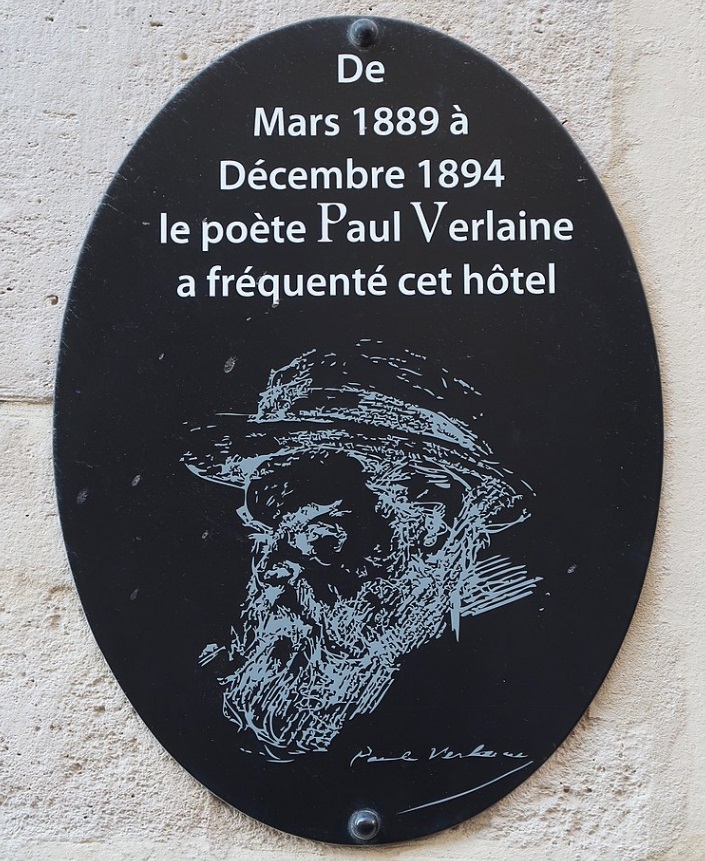
At No. 4, then called the Hôtel Lisbonne, Paul Verlaine lived off and on between periods in hospital from 1889 to 1894.
Today the hotel boasts of its earlier desperately poor and severely ill guest, and calls itself the Hôtel Fontaines du Luxembourg.
From 1906 Jacques Prévert lived at No. 7 and went to the school next door, No. 9.
I’ve very fond memories of the Vaugirard school where my son Michael spent a happy four months when he was ten. The area has completely changed since then. The school was constantly complaining about the bourgeois dog owners who allowed their absurdly small animals to deposit all over the surrounding streets as they walked them to the Luxembourg Garden. The disappearance of less well off and younger residents has led the authorities to close the whole school down in 2019.
The only good news is that the building hasn’t been sold off to developers. In 2023 the school is being occupied by the Cité Audacieuse and the ground floor and playground of the school is being run four days a week as a cafe by a feminist collective.
Émile Zola lived in rooms at No 10 in 1866 with Alexandre Meley whom he married in 1870.
After the5 metre high and 24km long tax wall was built under Louis XVI there were two customs posts across Rue Vaugirard. One was at No. 102 and another (la barrière du Maine) from Nos. 111-132. While unused during the Revolution, they were reinstated after the 1815 Restoration and only finally largely demolished in 1860 with the expansion of Paris to the Thiers walls, built in the early 1840s roughly 5km from the city centre.
Victor Hugo and his wife Adèle lived together at what was 90 rue de Vaugirard before the Rue de Rennes was built (after sharing with the in-laws in the Rue du Cherche-Midi). they lived from 1824 to 1827 in the bit of the road now numbered 86-88. This period of his life followed the anonymous publication of the 21-year-old’s first novel, Han d’Islande set in 17th century Norway.
In 1826 Hugo wrote and published his second romance novel, Bug Jarval, featuring exceptionally for the time a black slave insurrectionist in St Domingo as its hero who falls passionately in love with a white women.
Lenin sat for Naoum Aronson in his studio at 93 rue Vaugirard on December 10 1904. The bust was subsequently displayed in the Soviet pavilion at the 1937 World Fair in Paris.
On December 10 1904 Lenin sat for the Russian sculptor, Naoum Aronson (1872-1943) at his studio in No. 93.
When she first arrived in Paris around 1860, the feminist bookbinder and Communard Nathalie le Mel mother of three worked at Pasquier et Vigneau’s bookbinding works at No. 150 (in the 15th arrondissement).
A long way along the road was also where Michel Foucault lived, at no. 289 from 1970 until his death in 1984.
French measurementsof distance
MËtre Ètalon par Chalgrin
For the real historical nerds among us, in the wall at No. 85 is an early 18th century ‘half-league stone’. The Fleur de Lys on it was removed during the French Revolution. The marker (borne) indicates the first half-league (lieue) – that is 500 toises.
A toise was the distance between a man’s outstretched arms, approximately 6 feet) or 2 Km from the entrance to Notre-Dame cathedral. 1 lieue = 1,000 toises, or approximately 4 Km. A toise is the equivalent of the fathom in English, but in France it was used both on land and at sea.
At the French Revolution France still used hundreds of different weights and measures, originally derived from Roman units where the leuga (lieue/league) was the distance that a man can run in an hour. King Charlemagne (742-814) had added the pied du Roi (the King’s foot) and the toise. The pouce (inch) was the width of a human thumb, and was 1/12th of the pied du roi. The ligne (line) was 1/12th of a pouce, and the point (Truchet point in English) was 1/12th of a ligne.
After Charlemagne the fragmentation of France and of Europe accelerated. So distances varied from town to town, with the variation in 1 league (lieue) being from 3.268 km to 5.849.
On August 4 1789 a successful resolution from the Jacobin Club at the Constituent Assembly abolished all the privileges of the Crown, including its right to determine measures of distance and weight.
In 1790 Talleyrand proposed the drawing up of a Universal Measure, and the National Assembly proposed doing this jointly with the United Kingdom, who refused.
In 1791 a law established a Commission to establish the universal measure. They decided it should be based on a quarter of the length of a meridian and gave two geographers the task of measuring it exactly. They took seven years to measure the distance between Barcelona and Dunkerque.
This exercise was considered too long-winded for both military and political reasons. So on August 1 1793 the National Convention passed a decree determining the ‘provisional’ length of what in 1795 was named the metre. This was based on a millionth of the 1739-1740 distance measured by Lacaille from the North Pole to the Equator. It was exactly 3 pieds, 11 lignes and 44 hundredths of the principal toise then used in Paris.
Finally, on 7 April 1795, the new system of weights and measures adopted by the French National Convention were named: metres and grams. A metal metre-long yardstick embedded in marble was then placed in the wall at no. 36 rue de Vaugirard. And in a shop window at No. 215 there is an 1840 cast iron kilometre stone marking 3.5 km from the centre of Paris.
The old and new systems were used concurrently in France over the next half century. Metric leagues were used from 1812 to 1840 with one metric lieue = 4000 metres or 4 Km. The use of the old system was finally ended across the whole of France by the law of 1837.
But when in 1988 Joe, Joan and I bought a half-finished farm/barn in the Haute Savoie, and I had to finish off the plumbing, I can still remember the plumbing shop in Thonon-les-Bains where the width of copper pipes and joints were still in pouces (inches). In the UK metrication became government policy under Wilson in 1965 and in 1973, with accession to the European Economic Community, the UK was given 5 years to adopt metric units and by 1980 virtually no schools continued to teach in feet and inches.
Built in 1831 on an old path called the ‘Passage de l’Ouest‘ and owned by Alexis Vavin, a lawyer who became a politician and moved from being a liberal in the 1840s to becoming a monarchist in 1849, the street now runs from the Luxembourg Gardens to cut across the Boulevard Raspail and end on the Boulevard du Montparnasse.
An architectural draughtsman, Eugène Chemalé (1838-?), a mutualist and supporter of Proudhon, lived at No. 10. He was elected to the Paris committee of the International Working Men’s Association (IWMA) established in France in January 1865. At its first 1866 congress held in Geneva, he successfully opposed giving the State authority to educate children, unless their father could not do it. In February 1868 he was arrested and fined for participating in an illegal organisation.
During the Bloody Week of May 1871 a barricade was built and defended for two days against the Versaillais troops between Nos. 16 and 17. On 23 May, when forced to reteat, the Communards blew up their stock of ammunition.
Living in the Hotel Danemark in an exceptionally cold winter in 1940-41 gave more heat than Simone de Beauvoir’s grandmother’s flat.
After Sartre was called up in October 1939, Simone de Beauvoir moved to the Denmark Hotel at No. 21. Along with many other Parisians she fled the city in June 1940 and, after spending July to September back in her grandmother’s flat in the Avenue Denfert-Rochereau, she returned to the Danemark there during the harsh winter of 1940-41 because it provided a little heat.
This 1941 photograph shows the original step-like 1926 building at No 26 Rue Vavin that was declared an Historical Monument in 1975. It was designed by Charles Sarasin and Henri Sauvage, the leading art nouveau and modernist architect..
One of the few Communards with extensive military experience, the Polish General Jaroslaw Dombrowski (1836-1871) who was mortally wounded on the Rue Myrha barricade on May 23, lived at No 45. He too was a member of the IWMA. He had been given command over the Commune’s defences on the right bank.
The American leftist feminist and journalist, Louise Bryant, who married John Reed in 1916, and covered the Russian Revolution and aftermath, died in No 50. on January 6 1936.