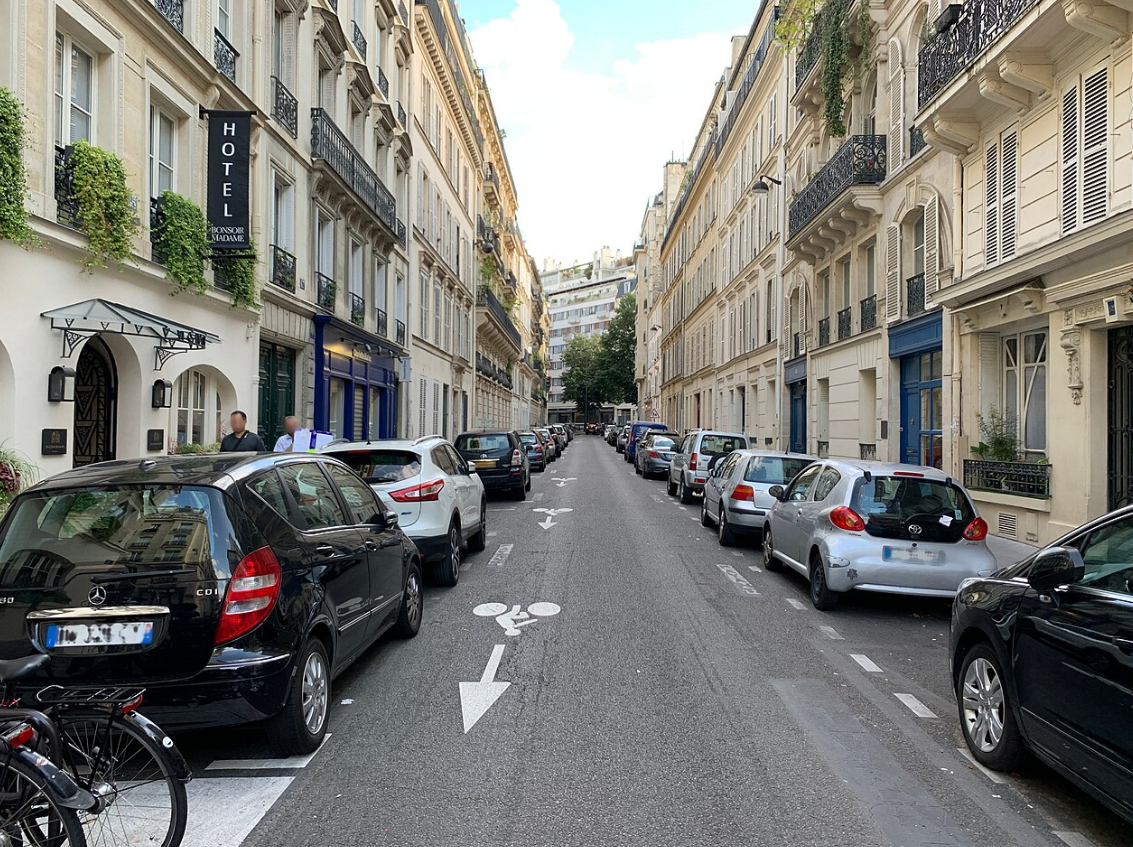
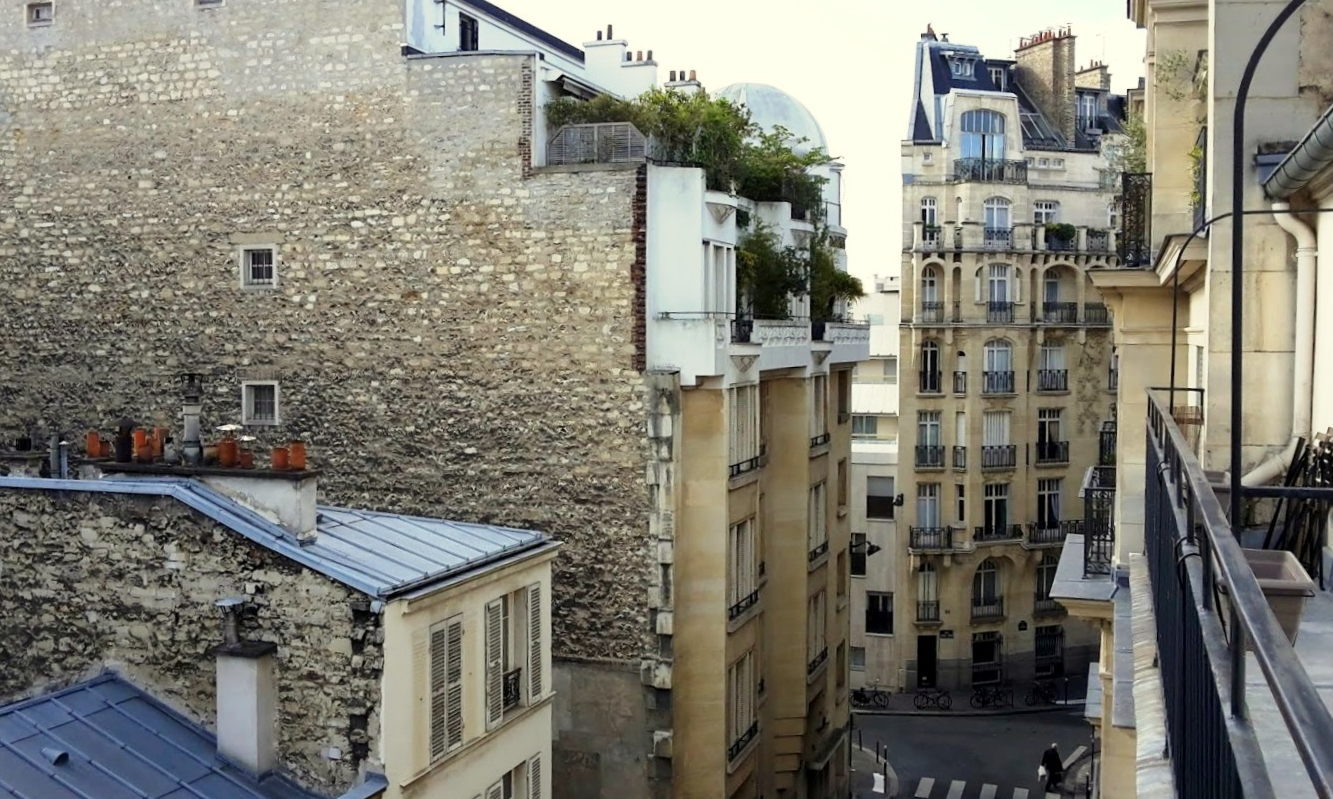
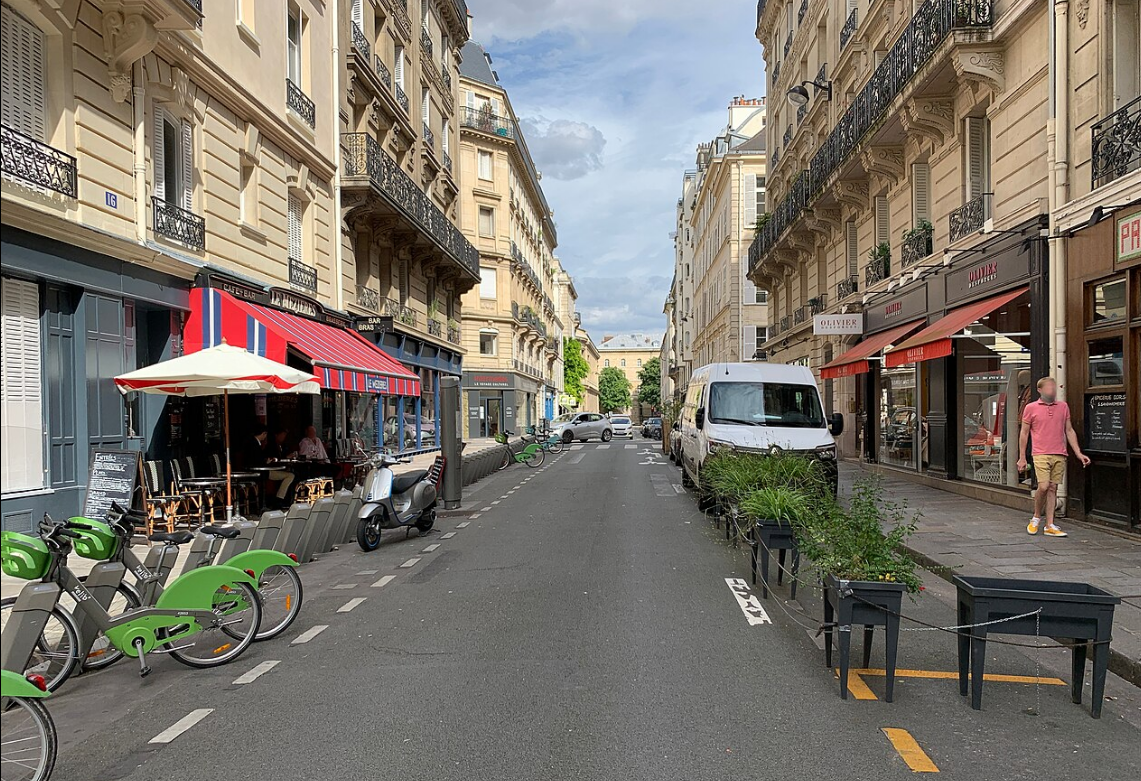
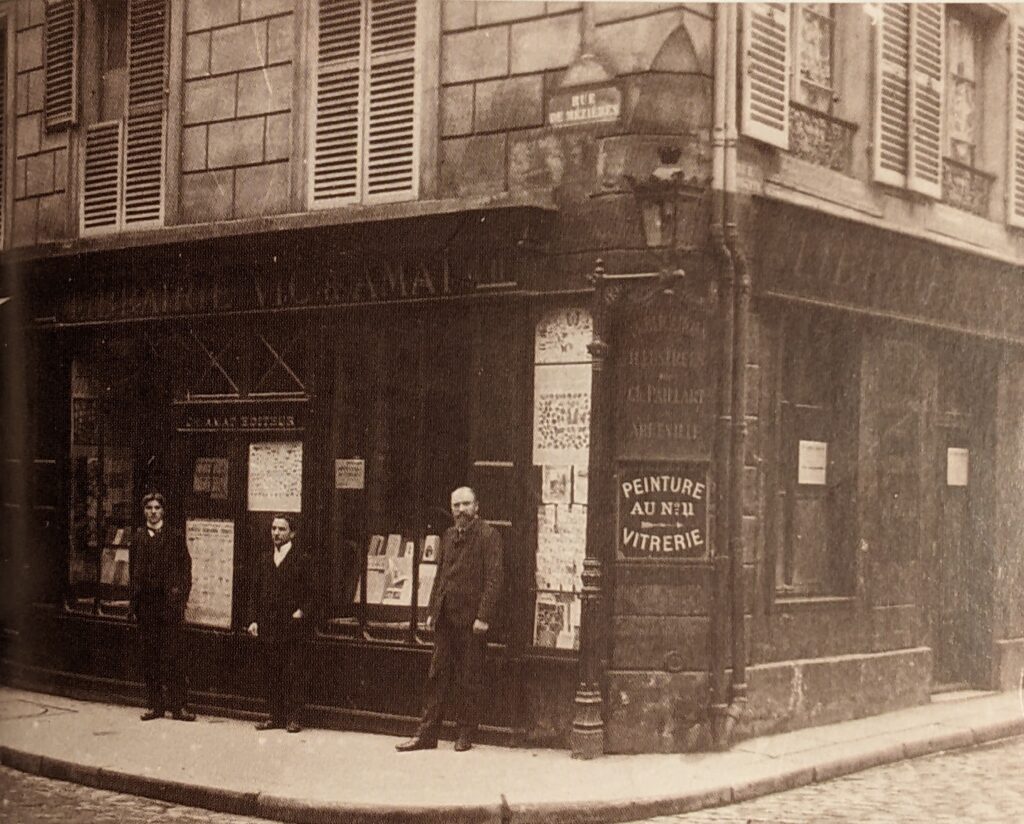
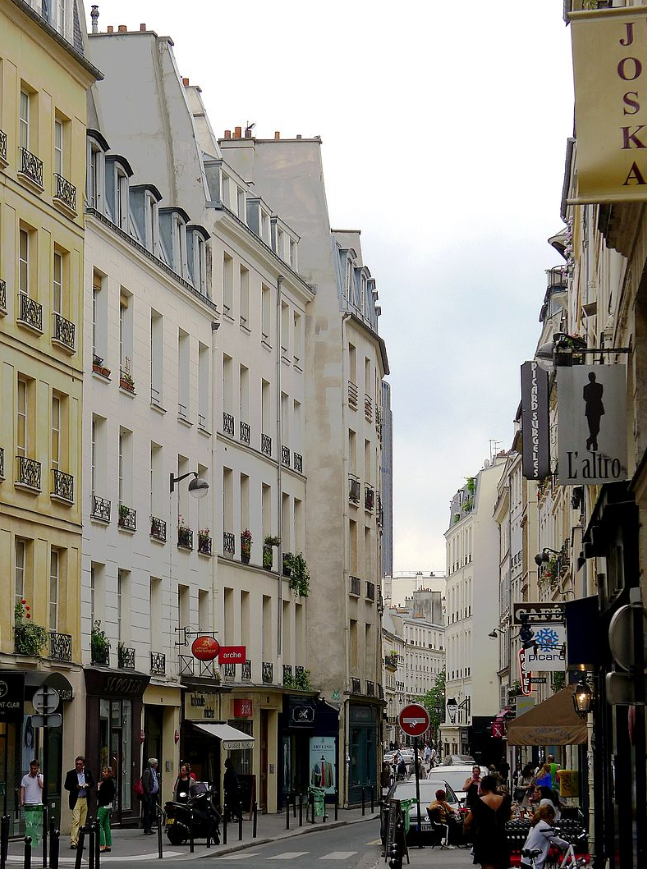
Named in 1790 after the title of the wife of Louis XVI’s brother (who eventually became Louis XVIII) whose sale of part of the Jardins de Luxembourg had been used to extend the road up to the Rue Vaugirard, it was rapidly renamed in 1793 La rue Des Citoyennes (The street of women citizens) as the French Revolution radicalised. Its earlier name was restored under the Directorate dominated by First Consul Napoléon Bonaparte in 1800.
Jean Jaurès lived at No. 15 when he first moved to Paris in 1893, staying seven years and leaving in 1899.
The poet Jacques Prévert attended the local school at No. 42 in 1908.
Sabine Chwast hated Poland’s anti-Semitism and aged 18 she migrated from Warsaw to Nancy to study art history where she met and in 1927 married Miron Zlatin, a Russian Jewish migrant studying agriculture . They were naturalised French in 1939 after Miron had won a gold media at the French national agricultural show, where he was congratulated by the French President, Albert Lebrun, who proposed his naturalisation.
Sabine Zlatin responded to the outbreak of war in September 1939 by training as a military nurse at the Lille Red Cross but in 1940, fleeing to Montpellier she got a nursing job at a hospital from which she was then sacked under the Vichy anti-Semitic employment laws. She then became a volunteer at the Children Help Society, which led her with the support of the Catholic priest Charles Prévost to start rescuing Jewish children from deportation, and getting many of them into Switzerland.
In January 1943 after the Germans occupied the Vichy zone of France Sabine and her husband moved 17 children with them to a refugee centre in the ‘safer’ Italian-occupied zone at Izieu. On April 6 1944, however, Klaus Barbie and the Lyon Gestapo raided the house and took away all 44 children and five teachers, including Miron Zlatin. Sabine was not there at the time. Miron was shot on the way to Auschwitz where all the children were murdered.
Sabine Zlatin lived at No. 46 after the war and testified against Barbie at his trial. The photograph above dates from 1987, when she founded an association based on the Izieu home that campaigned successfully to persuade President Mitterrand to support making that house a memorial to the French victims of the Holocaust.
The art-collecting couple, Michael and Sarah Stein lived on and off at No. 58 from 1903 to 1928, visited by many famous artists including Henri Matisse and Picasso.
From 1864 the name Gozlin for today’s very short road was chosen by Baron Haussmann and Napoleon III to commemorate the 9th century Paris Bishop Gozlin. He (or his son or brother) defended the city during the 885 year-long siege by the Vikings.
After the moat around the extensive Saint-Germain-des-Prés abbey was filled in and built over in 1635, the road that ran along the southern length of its walls was known as Rue Sainte-Marguerite. Number 1 was the Sainte-Marguerite door to enter the Abbey.
This was where Victor Hugo and his brother Eugene lived at No. 41 in the Cordier Boarding house from 1815 to 1818, and from where they walked daily to the secondary school, the Lycée Louis-le-Grand in the Rue Saint-Jacques.
Named after René Duguay-Trouin, an 18th century Breton aristocrat, naval officer, pirate and slave trader, it was opened in the 1790s and initially called the rue Thimeray and given its present name under Napoleon in 1807.
The road was initially used to access the quarries, and even after they were no longer used major collapses took place in 1813, 1848 and 1879.
Victor Hugo lived in a house at Nos. 9-11 from 1827 to 1830. The main entrance was in the rue Notre-Dame des Champs, but the house also had a door that opened out onto the Luxembourg Gardens. While he lived there he wrote Hernani, the play that saw fighting break out between the young romantics and supporters of the classicists.
First mapped in the 14th century, the road had five changes of name before it finally took the name Notre-Dame-des-Champs after the church of that same that in 1604 became the Carmelite Monastery of the Saint-Jacques area. During the French Revolution it was renamed La Montagne des Champs, in an attempt to exorcise the religious reference.
For three years, 1827 to 1830, Victor Hugo lived at the address 11 rue Notre-Dame des Champs, today in the area covered by Nos 23-35 but No. 27 was pulled down in 1904 when Bouevlard Raspail was built. While at No. 11 his wife, Adèle, had an affair with Augustin Sainte-Beuve, and Hugo wrote Hernani and Cromwell.
Sainte-Beuve lived at No. 19 in 1830.
Auguste Renoir had a studio at No. 34 from 1871 to 1873, while the art dealer Wilhelm Uhde’s gallery at No. 73, showed paintings by Braque, Dufy, Delaunay, Rousseau and Picasso between 1908 and 1910. The artists James Whistler (1892-1902) and Fernand Léger (1924) were among many artists who had studios at No. 86.
On his second trip to Paris in 1923 with his first wife Hadley, Ernest Hemingway lived at what is today No. 115, and was numbered No 113. They lived with their son John (known as Bumby) in a house within the courtyard where Hemingway wrote Paris est une Fête.
The road was first referred to in the 16th century as a muddy track running alongside the gardens of a private mansion, l’Hôtel-de-Mézières, which originally occupied the land now making up 78, Rue Bonaparte, the Mairie (Town Hall) of the Sixth arrondissement.
Victor Hugo lived briefly at No. 10 in 1820-21 with his mother and his older brother, Eugène, in an apartment rented on their behalf by Abel Hugo, his eldest brother. His mother, Sophie Trébuchet, died there on June 27 1821.
The Catholic bookshop Le Procure has been based at No. 3 since 1919. The photograph below is of the corner with Rue Cassette taken around 1910.
In 1808 the road was renamed at the request of its inhabitants from the morbid-sounding rue du Sépulcre. The choice followed the road’s association with the Dragon’s Courtyard that led into it where an 18th century statue of a dragon had been commissioned by Paul-Ambroise Slodtz for the new house built by the powerful Toulouse financier and slaver, Antoine Crozat.
A photograph of the Dragon’s Courtyard taken in 1908 by Eugène Atget
The actress Simone Signoret, whose Polish-Jewish father’s origins led him to join the Free French in London in July 1940, while she stayed in Paris with her mother, remembered the Gestapo visiting No. 7 in the search for a resistance letter box.
This was also the huge private residence occupied by Homeless Squatters in December 1994. Organised by the Droit au logement association it was supported by the now disgraced Henri Groues (l’Abbé Pierre and many other campaigners against social injustice.
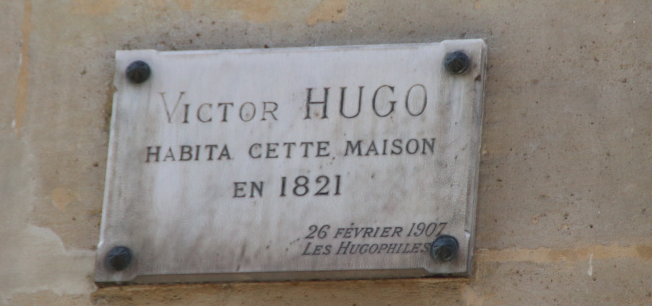
No. 30 has a plaque dedicated to Victor Hugo, who lived in a sunless top (4th at the time) floor two-room flat there briefly in 1821-22 that he shared with a cousin. He had just published the poem Moses on the Nile, in which he refused to amend the words ‘chaste pleasures’ in his first poetry collection, Odes et poésies diverses, that included nearly all his largely monarchist prize-winning poetry.
Hugo lived in No.30 before his marriage to Adele Foucher when he moved to his in-laws’ home in the nearby rye du Cherche-Midi.
Renamed in 1864 under Haussmann and Napoleon III to commemorate the 9th century Bishop of the Saint-Germain-des-Pres Abbey, who was known as the defender of Paris during the Vikings’ siege of Paris from 885 to 887, from 1637 it had been called rue Sainte-Marguerite or rue Sainte-Marguerite-Saint-Germain. No. 1 in the road then was the Porte Sainte Marguerite into the Abbey.
In January 1815 General Leopold Hugo got his sister to board his two youngest sons, Eugène et Victor-Marie, in the Pension Cordier at No. 41 in the then much longer rue Sainte-Marguerite. From there they used to walk to the lycée Louis-le-Grand in the Rue Saint-Jacques.
In 1885 this section of the Rue de l’abbé de L’Epée was given the name of the French mathematician and founder (1798-1857) of the positivist philosophical school
A flat in the imposing No. 3 belonged to the parents of Simone Weil, and this was where she met with Trotksy on 30 December 1933 and hid him for a few days during a clandestine visit to Paris. Trotsky took the decision that night to move to found the Fourth International.
A plaque on the wall states only that Simon Weil lived there from 1929 until 1940 and that she was a philosopher.
The property at No. 3 where Simone Weil’s parents owned a flat now has a plaque commemorating her presence there.
A kilometre-long road first traced out in the 15th century had previously had 12 other names before its three main fragments (la rue des Petits-Augustins, la rue Saint-Germain-des-Prés and la rue du Pot-de-Fer-Saint-Sulpice) were joined together and given its current name by Napoléon Bonaparte’s nephew, the Prince-President Louis-Napoléon Bonaparte in 1852.
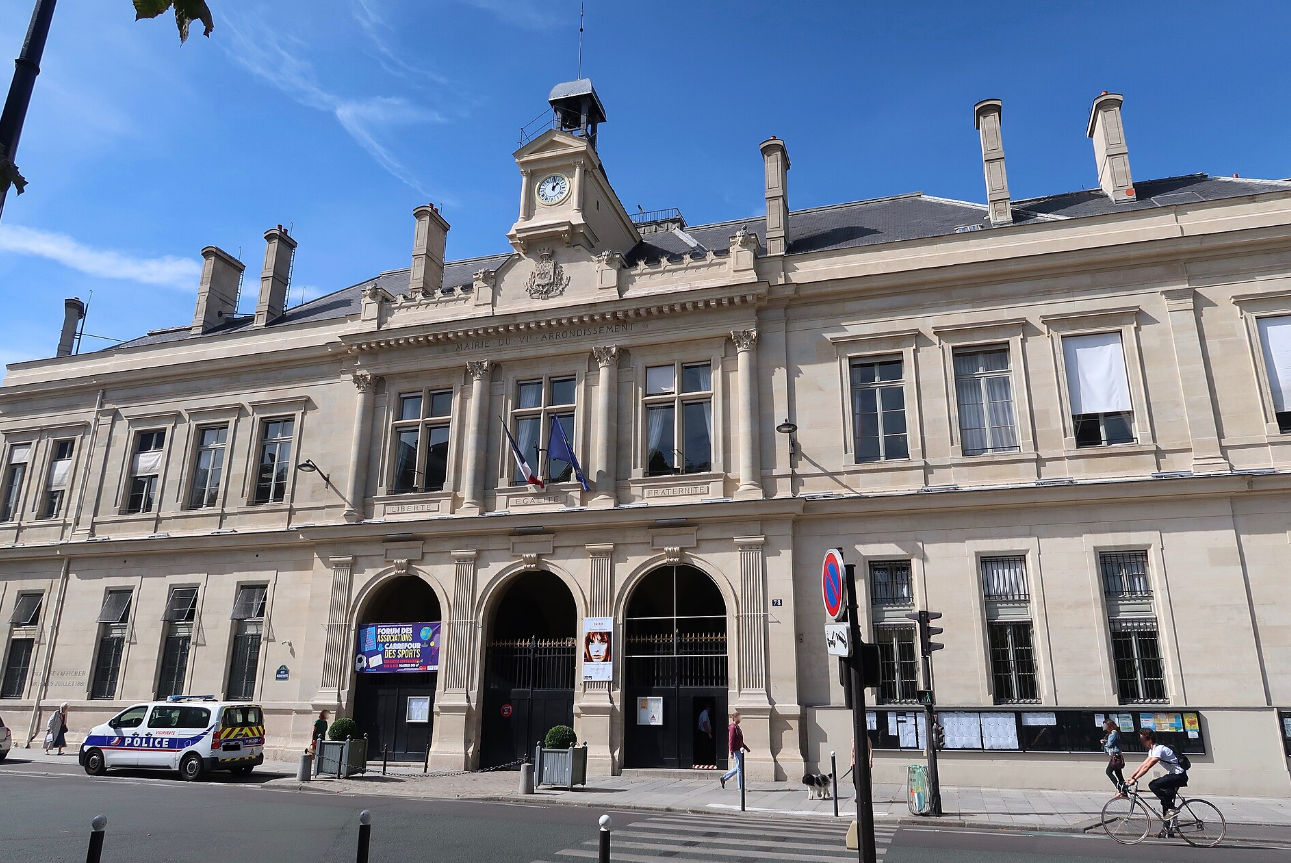
The building I have most contact with in this newly chic area is the sixth arrondissement town hall. When my father’s French employer first found him a flat in the area in 1954 it was still largely cheap student accommodation, dozens of cafes and loads of drunks and intellectuals hanging out. No 78, pictured above, is where 42 years later a motorcycle rider had to rush to for a permit to move my dad’s body out of the sixth before the 24-hour deadline for medical research on his body had passed. The mairie was built in the 1840s.
Paris is still changing, and sometimes by accident. Having a meal with Nicole (my father’s partner for over 25 years) in November 2017, we chatted about the big fire that had started near the Saint Germain church.
The famous La Hune Bookshop after the fire and in the background Sartre’s doorway at 42 Rue Bonaparte
It turned out to be the cremation of the last mortal remains of the famous La Hune bookshop. This had been set up by former resistance fighters in 1949 and had been a centre of Parisian intellectual life for thirty years. It had closed two years earlier after relocating to the corner of the Place Saint-German and Rue Bonaparte in 2012.
Hazan (WTP) remembers it as one of the key left intellectual
meetings places of the 1950s and as a street dominated by ‘realist’ art
galleries in the 1960s. When we walked past it the day after the fire and smelt
the sad pungent aroma of burnt books and wood, it looked as if the fashion shop
with which it shared its premises had mysteriously been largely spared.
Across Rue Bonaparte was where Jean-Paul Sartre used to live in number 42 (third window above the balcony). He moved there to be with his mother after the death of her second husband in 1948. The editorial team of his philosophical journal, Temps modernes, used to meet in the flat. Simone de Beauvoir, with whom he lived there for a while, Raymond Aron and Maurice Merleau-Ponty were among the many Left Bank intellectuals who made up its editorial board.
Rue Bonaparte in January 1962 after an OAS plastic bomb exploded in the doorway outside Sartre’s house
Number 42 was the address where Sartre’s political support for Algerian independence was rewarded on January 7 1962 with the signature plastic bomb used by the OAS – the Organisation armée secrete – whose music I had first heard out with my father on the Champs Elysée celebrating New Years’ Eve just a week earlier. The traffic jam of cars blocking the street appeared nearly all to be honking ‘Algerie Française’ – da da da, daa, daa. A week later we were walking home when we heard the huge bang when the Rue Bonaparte bomb went off – targeted along with another 16 other addresses that night.
There were no injuries, but Sartre promptly moved
out to the much more public Boulevard Raspail.
The 40-year-old French composer of Spanish origins, Francisco Salvador Daniel (1831-24 May 1871) was summarily shot in Rue Bonaparte
Further down the Rue Bonaparte, at the crossroad with Rue Jacob, another story did not end quite so happily. In 1871 the Commune defenders built a barricade between numbers 21 and 28 in Rue Bonaparte and from 29 to 32 in Rue Jacob. There, on May 24 1871 Francisco Salvador-Daniel, the musicologist son of a Jewish refugee from Spain, who had been defending the barricade was captured, and taken back to the barricade and shot by the Versaillais soldiers. He had taught the violin in Algeria and translated and adapted Arabic songs from North Africa for European musical instruments.
Félix Vallotton, the graphic artists and painter sympathetic to anarchism, frequent contributor to La Revue Blanche, where he drew the enigmatic portrait of anarchist and art critic Félix Fénéon, and associated with the Nabis movement, lived in 1886 at No. 21.
The painter, Édouard Manet, was born in the mansion belonging to his family at No. 5. His mother was the goddaughter of the only French general who remained a king (of Sweden) after the defeat of Napoleon and his father was a French judge.
Louis Hélié, one of the rare 60-year-old resistance fighters killed by the Germans in the 1944 liberation struggle in Paris, lived at No. 3, found at the Northern end of the Rue Bonaparte.
Named in 1832 after a shop sign showing a painted mediaeval sun dial with people looking for midday at 2 pm in the afternoon, the road brought together three shorter streets.
The headquarter building of the French Army War Council was at No. 37, known as the Toulouse Mansion. This was where the ‘girl next door’ Adèle Foucher was living when Sophie Trebuchet, Victor Hugo‘s mother, moved with her sons into No. 44 in 1813.
Victor (20) and Adèle (19) married on October 12 1822 at the third largest church in Paris, Saint-Sulpice, after Sophie’s premature death in 1821 removed her opposition. With very little money the young couple moved into the Foucher family apartment in the Army War Council’s linked house at No. 39 and shared the flat with them for the next 18 months.
The Cherche-Midi military prison on the opposite side of the road at No. 38 (at the angle with 54 Boulevard Raspail) had originally been the convent of the Daughters of the Good Shepherd (built on land sequestrated from a Calvinist by Louis XIV in 1688. The sisters’ religious order, whose mission aimed to house and rehabilitate up to 200 ‘fallen’ but penitent women, was suppressed at the Revolution in 1790. It then became a factory making army uniforms and then a supply depot for troops based in Paris.
It was largely demolished in 1847 although the trials of many of those arrested in the workers’ uprising of June 1848 still took place there.
A new army prison with 200 individual cells was built there in 1853. Prisoners were forced to work in silence during the day and were isolated in their cells at night. On May 30 1871 several Communard prisoners were murdered in the cellars there during the Bloody Week suppression of the Paris Commune. Those killed were mainly soldiers and foreigners who had fought for the Commune.
The Cherche-Midi Prison was also where Captain Alfred Dreyfus was imprisoned for four months in solitary confinement from his arrest on October 15 1894 to February 20 1895 when he was deported.
The French Army’s War Council used to meet on the other side of the street at No. 37 and this was where on December 22 1894 after a three day trail held in secret before the Army Council unanimously found Dreyfus guilty of treason. Since he refused to confess any guilt, the Army then ordered a public spectacle of his degrading to be held outside the École militaire on January 5 1895.
On November 11 1940 the students arrested at the Armistice Day demonstration at the Place de l’Étoile were imprisoned here by the Germans who had taken the prison over.
In a bad state of repairs it stopped being used for military prisoners in 1947, after which it was only used for military tribunals. On 22 September 1949 a demonstration outside the prison took place in support of the 16 court-martialed and jailed conscientious objectors, who refused to fight in the French army.
On September 5 1960 the court martial took place here of six Algerian FLN fighters and 18 members of the Jeanson French support network.
The prison was finally demolished in 1966 and the Human Sciences building finished in 1970, which it now shares with the School for Advanced Studies in Social Science.
Paul Lafargue and Laura Marx moved into No. 47 on December 1 1868 soon after their marriage. Karl spent six days with them in July 1869 under the false identity of Alan Williams. This address was where the couple committed suicide together in 1911.
Between 1889 and 1895 French supporters of ‘propaganda by the deed’ mounted a series of bomb and knife attacks on ‘class enemies’ – of which the most notorious were the assassination of the President of France, Sadi Carnot, and the bombing of the National Assembly’s Chamber of Deputies.
A lithograph of the moment of the explosion at the Restaurant Foyot at 36 Rue de Condé on April 4 1894
On April 4 1894 a bomb inside a flower vast exploded next to a
Foyot Restaurant window looking onto Rue Condé.
The Foyot restaurant, on the corner of Rue Conde and Rue de Tournon opposite the Luxembourg Palace, was popular with Senators and other wealthy diners.
Laurent Tailhade was a satirical poet and anarchist who had defended Vaillant’s 1893 bombing of the Chamber of Deputies
Only one man was permanently injured: Laurent Tailhade lost an eye. He was an anarchist sympathiser, a poet and a good friend of the art critic, dandy and War Office administrator presumed by the police to have planted the bomb, Félix Fénéon.
Others thought Tailhade
might have been targeted by a jilted lover.
Felix Fénéon (1861-1944) was arrested, imprisoned and tried for conspiracy with 29 other anarchists and some known criminals after detonators and mercury were found in his office at the Ministry of War, where he was then a Chief Clerk. The trial in August 1894 found all except three not guilty.
The senators’ favourite local Restaurant Foyot was bombed by an anarchist on April 4 1894
The Restaurant Foyot, the upper part of which was the Emperor Joseph II hotel, was demolished in 1937. Paris magistrates had decided it was structurally unsound, possibly as a result of the bombing 33 years earlier. There is now a tiny garden and paved area opposite the Luxembourg Palace.
Seeing it every time I’m in Paris, just below the window of my late father’s flat, and buying Le Monde there from the elderly, usually grumpy kiosk owner, it was only in reading Hazan (WTP) that the corner’s actual history was brought to life for me.
George Sand and Ledru-Rollin in an engraving called ‘The Handsome Candidate’ from 1848
Further up Rue de Condé, at Number 8, George Sand lived in Maurice’s (her son’s) flat from March to May 1848 when she was editing political texts and posters for Alexandre Ledru-Rollin (1807-1874) at the Luxembourg Palace.
Rue de l’Égalité
Appropriately, in 1792 the Rue de Condé was renamed Rue de l’Égalité. Not too happy a name, however, for Lucile Desmoulins who lived at Number 22 or for Jean-Baptiste le Rebours who was living at Number 28 . Both were executed in 1794.
Lucile Desmoulins married the French revolutionary and journalist Camille Desmoulins in 1790 at the Saint Sulpice church five minutes walk away. Robespierre, who had been briefly engaged to her sister, attended the wedding. On April 5 1794 Lucile was arrested for plotting to release her husband from the Luxembourg Palace, where he had been on trial with Georges Danton: both men were guillotined the same day.
Lucile’s execution followed a week later. She was 24, Camille was 34, Danton was 35, and his statue stands a minute’s walk north up Rue Condé to what is now the Boulevard St Germain, marking the site of his flat before Haussmann demolished it (and a big chunk of the neighbourhood).
Le Rebours, in contrast, was Lord of Saint Mard, a village and estate to the north of Paris. He had been chair of the Royal Court’s Committee of Requests under Louis XVI. Le Rebours was guillotined four days after Robespierre introduced the ‘Great Terror’ law of June 10 1794. This law removed prisoners’ rights to be defended, and determined there should be no delay between accusation and punishment. From then until Robespierre’s own arrest and execution on July 28 1794 the numbers of executions increased to 50 a day.
Inevitably, the Rue de Condé resumed its aristocratic reference to a junior branch of the Bourbons in 1805, just a few months after Napoleon had crowned himself Emperor on December 2 1804.
The 1896 Congress of the Feminist International took place in the recently completed Hôtel des sociétés savantes (elite Knowledge Societies – ranging from Sociology to Zoology and Astronomy) at No. 8.
This was also the venue for a thousand-strong meeting to hear Trotsky speak on December 6 1907 about ‘The stages of the Russian Revolution and the Current Political Situation‘.
Lenin spoke more than once at the Knowledge Societies meeting hall. On May 12 1908 he spoke there on ‘Our Tasks’ and on November 29 1909, just after he came to live in Paris, he spoke on ‘Counter-Revolutionary Liberal Ideology’. He gave a lecture on Leon Tolstoy who had died two months earlier on 18 January 1911, and in June that year spoke on’ Stolypin and the Revolution’.
The Italian socialist Pietro Nenni spoke there at an advanced Socialist school on January 8 1935.
On 16 January 1955 Pierre Lambert and Marceau Pivert organised a meeting demanding the release of Messali Hadj in the same huge meeting room.
The building was bought by the Sorbonne in 1985 and since 2005 is the Research Centre of Paris IV – Sorbonne university.
About where No. 10 now stands in 1865 was No 1 Rue Larrey, where Nathalie Le Mel lived with her three children and organised the cooperative kitchens of the Marmite association. This was also an address where the International Working Men’s Association continued to organise after it was banned by Napoleon III.
The short street was only built between 1888 and 1895 and was named after the French revolutionary Danton from the start.
Built in 1607 to link the first stone bridge (the Pont Neuf) across the Seine funded from the king’s purse with the Philippe Auguste wall, it was named after the Dauphin (eldest son) of Henri IV. This peculiar name (meaning dolphin in French) dated from 1349 when King Philippe bought land from the Count of Vienna on condition that all heirs to the French throne be named after the dolphin emblem on the count’s coat of arms.
The royal connection didn’t survive revolutionary France. From 1792 to 1814 it was renamed Rue de Thionville to honour the victorious two-month resistance of the town of that name to the 1792 siege by 36,00 Austrian and French Royalist troops. At the next challenge to the Bourbons a barricade thrown up between Nos. 1 and 2, opposite the Pont Neuf bridge, saw heavy fighting with Charles X’s soldiers defending the Louvre Palace on July 27 1830.
On May 25 1871 a barricade in the same place was taken without great difficulty by the Versaillais troops.
Outside No. 7 there is a plaque on the wall. This is where in 1937Picasso painted Guernica in his roof-top studio for the Spanish Republic’s hall in that year’s Paris International Exhibition. In vain Picasso left a will stating that the work would only be returned to Spain when it was again a Republic.
Picasso painted his most famous painting in his studio at the corner of Rue Dapuhine and the Quai des grands Augustins in just a month before the 1937 International exhibition where it was first shown.
A big arms cache of the FTP resistance group on the mezzanine floor of Staircase D of No. 18 was found by the anti-resistance Special Brigade of the Paris Police in June 1943.
Marat, Danton and Desmoulins used to attend the Cordeliers Club meetings at No 18 from 1792-1795. The club was dominated by the Herbertists
Martin Bernard, a typographer and member of Barbès and Blanqui‘s republican ‘Family Association’ (Société des Familles) conspiracy that subsequently became the Société des saisons and staged the May 12 1839 insurrection set up an ammunition workshop at No. 24. He was arrested there on June 2 1836.
In 1942 Simone de Beauvoir was staying at the Hôtel d’Aubusson, also at No. 33, when she was forced out of teaching. The left/existentialist intellectual bar, Le Tabou, that had been the Bar vert in the Rue Jacob was reopened in the basement by Juliette Greco for rehearsals in 1946 before opening to the public the following year.
After his marriage, Jacques Prévert lived at No. 39 on the fifth floor beneath the roof with his wife Simone Dienne in 1931-1932.
A fortnightly, La Vie ouvriére‘s subscribers numbered 550 in the first issue of December 1909 and rose to 1,350 in January 1911, the year its office moved to the Librarie du Travail on the Quai Jemappes, closer to the CGT’s main offices.
Rue Dauphine was Paris’ widest street in the 17th century, No 42 housed the editorial offices of the influential CGT revolutionary syndicalist fortnightly paper, La Vie Ouvriere.
Rue Dauphine (9 metres wide) was the widest street in early 17th century Paris. It also, arguably, holds one of the keys to Paris’ tradition of uniformity of architectural design.
Hazan (IOP) reports Henry IV writing to Sully in 1607: ‘My friend, following what I have told you that work is beginning on the buildings that are in the new road going from the end of the Pont-Neuf to the Porte de Bussy, I wanted to send you this word to tell you that I would be very happy if you would explain to those who start building in this road that they should make the front of their houses entirely in the same order, for it would be a fine ornament to see from the end of the bridge this road with one and the same façade.’
No 7 rue Dupuytren is where Louise Michel opened a girls’ industrial art school weeks before the Paris Commune was crushed.
A short street now full of hair salons, in May 1871 it was where Louise Michel organised a school to teach young women draftsmanship, industrial art. It had previously been the girl’s school annex of the free Royal Decorative Arts School, next to the old Cordeliers Monastery, where girls had been taught only four skills: drawing figures, ornaments, animals and flowers.
The road was named by a decree on 9 April 1851 under the Prince-President Louis Napoleon. He gave the nod to the skilled surgeon who successfully treated his uncle’s haemorrhoids. Guillaume Dupuytren had also subsequently served the last Bourbon kinds, Louis XVIII and Charles X. Louis XVIII have him the hereditary title of Baron. He was the surgeon who attempted, unsuccessfully, to save the life of Charles’ son, the Duc de Berry, the third in line to the French throne, after he was knifed at the Opera in February 1820.
Baron Guillaume Dupuytren (1777-1835) treated haemorrhoids for Napoleon Bonaparte, amassing a fortune in the process
In 1832, when cholera was sweeping France and Paris in particular, Louis-Philippe added to his honours collection. Thanks to his 10,000 annual consultations he was then one of the richest men in France and his daughter Adeline married one of the pretenders to the Imperial throne, Louis Napoléon Bonnin de La Bonninière, Comte de Beaumont.
The free-mason and atheist surgeon also gave his name to the ‘bent finger’ or ‘Vikings’ disease I’ve already had three operations to straighten out. His article about the disease was published in the Lancet in 1834. Its highest incidence is in Iceland, but 10% of Norwegian men and 3% of Norwegian women also have the ‘contracture’.
The rue Dupuytren leads up to one of Paris’ amazing 17th century carved doors in rue Monsieur le Prince.
The short road was the site of an attack by resistance fighters attached to the FTP-MOI on a German patrol in March-April 1943. The three men linked to the attack were Wolf Wajsbrot, Thomas Elek and Marcel Rajman, one of its leaders, who was shot aged 20 in February 1944.
Named after the Medical School which now occupies much of its length, it received its current name for the first time in 1792 after the nationalisation of the huge Cordeliers monastery complex of the Capuchin Franciscan friars. Before then it was the Rue des Cordeliers.
One branch of the Franciscan (followers of St Francis of Assisi) friars, the hood and beard wearing Minor Capuchins, was particularly important in pre-revolutionary France where it had 284 monasteries. In Paris their Couvent des Cordeliers monastery (possibly so-called after the cords the friars tied around their stomachs) was one of the biggest. It covered an area that stretched from today’s Rue Racine and Rue de La Harpe to approximately 15-21 Rue de l’École de Médecine.
Briefly, between 1793 and 1794 the road was renamed Rue Marat, after the revolutionary who lived and was assassinated there in July 1793. At the overthrow of Robespierre it was immediately renamed the Rue de l’École-de-Santé and then from April 20 1796 it regained its earlier (and current) name.
No. 5 was the location of Louis XV’s free boys’ Royal School for Art and Design from its inception in 1767 until 1928. From 1810 it was funded by the State. Fernand Léger studied there in 1901-1902 after he had stopped studying architecture. the school was built on a medieval Jewish cemetery.
The School of Art and Design at No. 5 and the amphitheatre at No. 7 it was allocated after the new medical school was finished on the other side of the road.
The road’s medical connection dates back to 1255 and in 1763 the Barber-Surgeons Guild funded the building of a small amphitheatre where students could watch them carry out operations at No. 7. The building was given its present columns and courtyard and extended in 1794.
The area became known as the Cordeliers district, and even before 1789 already had a radical tradition. Danton, Desmoulins and Marat all lived in the area. Marat in the Hôtel de Cahors roughly where Nos. 18-20 would have stood. This was where he was murdered on July 13 1793.
All of the Cordeliers monasteries were closed in 1790 and so, when the Paris Council abolished the Cordeliers district in the municipal reoganisation, Danton and other area leaders founded a club there in the monastery’s refectory on April 27 1790.
The refectory of the Cordeliers monastery at No 15 is the largest surviving building of the huge religious complex.
The club’s official name was Société des Amis des droits de l’homme et du citoyen (Friends of the Rights of Man and of the Citizen), but it was known as the Club des Cordeliers. Its motto, proposed by Antoine-Francois Momoro, became Liberté, égalité, fraternitéor Death. On June 21 1791 it was the first club to call for the Constituent Assembly to proclaim a republic.
On July 17 1792 this was where, after the failure of Louis XVI’s escape bid, Marat proposed a petition declaring ‘royalty incompatible with freedom’. That night, after the Champs de Mars massacre, the constitutional monarchists ordered the closure of the Cordeliers club and its leaders went into hiding.
A year later, on July 16 1793, after his assassination, the monastery garden was where Marat was first buried.
The School of Medicine’s amphitheatres at No. 7 and No. 12 were used as meeting places by several revolutionaries in 1848. These included those involved in the Club des Homme lettrés , the Club central de l’Agriculture, the Club de l’École de Médecine and the Comité électoral du 11ème arrondissement.
The School of Medicine was not only used for anatomical observation. On January 19 1868 Nathalie Le Mel, Eugène Varlin and others met in the small amphitheatre to hold the General Meeting that created the food cooperative called ‘La Marmite‘ (the cooking pot).
The large amphitheatre at No. 12 witnessed the General Assembly of Lithograph Printers on 29 August 1869 when they decided to affiliate to the International Association of Working Men.
From October 1870 more and more meetings took place at No. 12. On April 12 1871Gustave Courbet was one of 400 artists who met there to elect an Artists’ Committee for the Commune’s Republic (Comité des Artistes pour la République communale). Courbet and 46 others were elected.
A very old street that first appears on the records in 1267. It finally got its present name (‘spur’ in English) from a shop sign in 1637.
Its principal claim to fame is at No. 2, theLycée Fénelon. This was the first secondary and higher school for girls in Paris. It was set up in 1892 in 19th century buildings used to prepare young men to enter the competition for the elite École normale supérieure.
It was named after the Archbishop of Cambrai (François de Salignac de La Mothe-Fénelon known succinctly as Fénelon, 1695-1715) who had written extensively on women’s education.
The Lycée became entirely mixed in 1979.
Among its better known students was Simone Weil and while some sources suggest Simone de Beauvoir was a student there, others (more probably in my view) suggest this was one of the Lycées where she taught. Another teacher there, notable for the wrong reasons was Marcel Déat (1894-1955), the fascist whose political career ended up as Minister of Labour and National Solidarity under the Vichy government in 1944.
Unemployed marchers stole bread from three bakeries here in 1883. In 1943 No. 48 witnessed the first full meeting of the united French resistance under Jean Moulin.
The communal bread oven (four) belonging to the Abbey Saint-Germain was situated at what is now No. 43, and so gave its name to this 13th century road. In 1470 under King Louis XI (‘Louis the Prudent’) all the inhabitants were required to use this oven.
François-Vincent Raspail published his newspaper, L’Ami du Peuple (‘The People’s Friend’) at No 40 between February and May 1848.
On 9 March 1883 the street witnessed the end of the unemployed march led by Louise Michel with a black, anarchist flag. Three bakeries were entered and bread stolen. Michel was later sentenced to 6 years in jail as a result, while Emile Pouget, who supported her and (allegedly) took a pistol away from her before her arrest, was too.
In 1943 Jean Moulin organised the National Resistance Council bringing together the main groups from the Occupied and Vichy halves of France. Its first meeting was in rue du Four in Paris.
On May 27 1943 the National Council of the Resistance met secretly at No. 48 in the flat belonging to René Corbin . Those attending were: Jean Moulin (1899-1943), Roger Ginsburger (Pierre Villon, FN), Roger Coquoin (Ceux de la Libé), Jacques Lecompte-Boinet (Ceux de la Rés), Charles Laurent (Libération-Nord), Jacques-Henri Simon (OCM), Eugène Claudius-Petit (Franc-Tireur) and Claude Bourdet (Combat).
This quay was Paris’ first. It was built to prevent continuous flooding by the Paris merchants on the orders of King Philippe and finished in 1389.
George Sand lived on the fifth floor at No. 21 when she first arrived in Paris in 1831.
No. 35 (at the time No. 40) is the site of the bar run by Pierre Leroux‘s parents and where the future first author of the word ‘socialism‘ was born on April 7 1797.
In 1871 the Communard delegates from the Police Headquarters used to meet at the Lapérouse restaurant at No. 51 that dates from 1766 and had been a favourite haunt of Victor Hugo before he went into exile in 1851.
The Communist poet, Paul Éluard spent part of the German occupation of Paris in hiding in the flat belonging to Michel Leiris at No. 53 bis. The flat was also where Picasso‘s surrealist farce, ‘Desire caught by the Tail‘ was first performed on March 19 1944, with the parts being read by de Beauvoir, Sartre, Queneau and Picasso, while being directed by Camus.
In 1828 the young Proudhon was working briefly at the Gauthier printworks in No. 55, the site of the old Augustin monastery that gave the quay its name. This was where Proudhon met Charles Fourier and became aware of his ideas.
The entrance to No. 55, within which in 1828 Proudhon worked briefly as a proof reader and typesetter
Léon Blum moved in to No 36 Rue du Luxembourg in 1896 upon his marriage to Lise Bloch. In 1898 the young lawyer began to support the Dreyfus campaign.
Léon Blum lived here in 1898, helping Émile Zola’s defence team, as the Dreyfus campaign was at its height. A qualified lawyer, Blum carried out legal research for Zola’s defence and also wrote a column on each day’s events. He lived here with his wife, Lise Bloch, whom he had married two years earlier.
The street was called the rue du Luxembourg when Blum and Lise Bloch lived here. It was renamed in 1918 in honour of Georges Guynemer, a 23-year-old French fighter pilot killed in combat in 1917.
A more interesting World War 1 fighter pilot for the left than Guynemer was the first black fighter pilot, Eugene Jacques Bullard. Despite being awarded the Legion d’Honneur (Chevalier) in 1959 for service to France in two world wars, there is no street named after him that I can find in France. I have found, however, a reference to him drinking and deciding to become a pilot at the Coupole brasserie on the Boulevard du Montparnasse in 1916.
A more realistic photograph of the World War 1 fighter pilot Bullard appears in Aviation History
Gustave Courbet‘s workshop from 1848 up to the Paris Commune was based at No. 32. Among those who visited him here were Charles Baudelaire, who was born at No. 13 in a building that was knocked down when the Boulevard St Germain was driven through the Latin Quarter, and Emile Zola.
Painted between 1854 and 1855 in the former medical school in the Rue Hautefeuille,it’s full title is: ‘The Artist’s Studio, a real allegory summing up seven years of my artistic and moral life’. Rejected for the 1855 Paris World Fair, it now hangs in the Orsay Museum.
The outside of the Cours Desir during the great flood of 30 January 1910
This old narrow street running parallel to the Seine has both an international and a significant left history. It also used to flood when the Seine got very high, as it did in 1910.
In 1783 the British embassy was located at No. 44, and this was where Benjamin Franklin negotiated the American Independence Treaty from Britain. He refused, however, to sign it on British territory, so on September 3 1783 he and John Adams signed the treaty at the York Hotel where Franklin was staying at No. 56.
No. 44 became the Hôtel d’Angleterre and then the Hôtel Jacob, and this was where Hemingway and his wife Hadley stayed at first on their arrival in Paris on 22 December 1921.
Anne Pingeot used to live at No 40, where she was visited very regularly by the French deputy and future president, François Mitterrand.
Louise Michel spent her last years from 1897 to 1904 at No. 2. The Cronstadt hotel was then demolished in 1944 leaving a little garden.
Louise Michel lived in the building that once occupied this small garden site from 1897 until leaving for her last speaking tour in 1905.
In 1832 the independent Saint-Simonien, Pauline Roland lived in a flat at No. 10 with Pierre Leroux, who was then a foreman at the Panckoucke printers where the paper he helped found, Le Globe, was being printed.
After returning from exile in Belgium in 1862, Pierre-Joseph Proudhon returned to Paris and lived in an apartment at the back of the courtyard of No. 14 rue Jacob. An earlier resident, Richard Wagner, who stayed there from 1841-1842, has a plaque to his memory on the wall.
A view of an old entrance into No. 10 rue Jacob taken from the courtyard inside No. 12
At the end of the Second World War some leftist writers who had organised together before the war in the October Group led by Jacques Prévert, set up ‘Le Bar Vert’ (Green Bar) at No. 10. The first ‘American bar’ in Paris it stayed open all night, and it attracted many literary names including Raymond Queneau, Roger Vailland, Maurce Merleau-Ponty Juliette Greco and occasionally Jean-Paul Sartre.
The inside court of the Cour Desir during the great flood of 30 January 1910
Simone de Beauvoir went to the private Catholic secondary school at the Institut Désir at Nos. 37, 39, 41 and 45. The school’s buildings were partly taken over to build a new Medical Faculty in the the early 1950s and it moved away.
No. 60 used to host the Restaurant Michaud (later known as the Comptoir des Saints Pères), frequented by the ‘Lost generation’ of the 1920s such as Hemingway, Joyce and Scott Fitzgerald.
The very short road was opened and named in 1912 after the engraver, Jacques Callot, who lived for about a year in Paris in 1629. It was built on an old alley-way to the Pont Neuf opened in 1823.
Its principal feature is the Café La Pallette (shown above) whose second back room is decorated with ceramics from the 1930s. Close to the Beaux-Arts de Parisinstitution the doorway next to it at No. 16 included the office of the review Le Paria edited by Ho chi Minh who, in respone to the police watching him, wrote to the Minister of the Colonies in August 1922 telling him what he was doing there.
No 16
In the early 1920s No. 16 was also the address of the literary review, Clarté, founded in 1919 by Henri Barbusse.
On October 15 1925 Clarte published the surrealist manifesto drafted by Breton called ‘The Revolution First and Always’ in response to French involvement in the Moroccan war. It was also signed by Aragon and Éluard
In the Spring of 1926 Breton and Aragon and Naville opened the Surrealist Gallery in the former office of the Clarté. And in December that year Pierre Naville described Breton bringing Léona Delcourt (Nadja) there at the end of Breton’s relationship with her.
A wonderful park in central Paris it also has a darker side. It was a place of summary trial and execution in 1871 and witnessed the final battle of the Liberation of Paris in 1944.
This garden is where I’ve spent many hours watching speed-chess and slow-boules (pétanque – from the old Occitane word meaning feet planted on the ground). I have even once waded in January into the half-frozen circular basin to rescue my ten-year-old’s sinking electronically-controlled boat (I hadn’t followed all the assembly instructions entirely correctly).
Hazan (WTP) writes ‘Few places in Paris have inspired so many writers and poets, not to mention cineastes’.
The Medicis Fountain dates back to 1630, but it was remodeled in 1864. Venus was removed and replaced by Ottin’s statues of the giant Polyphemus discovering the lovers Acis and Galatea. Perhaps that’s why couples enjoy the basin’s cool and calm.
The Medicis Fountain on the west side of the Palace that is now the French upper chamber, the Senate, can be a beautiful spot when it’s not overflowing with tourists.
The Luxembourg Gardens also have a darker side. On December 7 1815 it was where Marshal Ney was shot for having supported Napoleon during the hundred days before the defeat at Waterloo.
That was nothing compared to the hundreds murdered there by government troops in the final ‘bloody week’ of the Paris Commune.
A drawing of the executions in the Luxembourg Garden during the Bloody Week of May 21 to May 28 1871
On 29 November 2016, the French National Assembly (Parliament) passed a resolution to pardon all ‘the victims of the repression of the 1871 Paris Commune‘ – the 10-25,000 people who were shot, imprisoned, exiled, deported or otherwise punished by the French Government for their part in the Paris Commune between May 1871 and 1877.
There is no reference to Dr Tony Moilin or any other individuals murdered here by the Versaillais army in 1871
Sadly, commemorations appear to be about the only positive thing that Hollande’s socialist government did from 2012 to 2017.
There is now one very small plaque referring to the thousands killed in the Paris Commune. Not at all obvious, it is on the wall facing the Palace to the South-East of the basin, often obscured from view in the Spring and Summer by couples profiting from the Luxembourg’s reclining chairs in the warmth of the sun.
I wrote what follows after walking for perhaps the thousandth
time through the Luxembourg Gardens. It is strange what you don’t see when you
don’t look.
‘This time I quite quickly found the tiny memorial plaque
beneath the Queens’ Terrace for those shot in the terrible week 21 May to 28
May 1871 that I’d first seen online two days ago. There were three burial pits
dug in the gardens, where perhaps a third of the estimated 2,000 summarily
executed prisoners across Paris were buried.
One of those given a military trial on the spot was a doctor, Tony Moilin, who had been jailed by Napoleon III for writing a futurist socialist book titled Paris in the Year 2000. Released with other political prisoners with the abdication of the Emperor in 1870, Moilin briefly became mayor of the 6th arrondissement. Taken prisoner on the 27th May he admitted helping the wounded on the barricades.
A few hours before he was shot on the 28th, he was allowed to
marry his pregnant partner. His body was never recovered. The inscription on
the plaque doesn’t even get the dates of the murders right.
A postcard of the Cornice of Kisses in the Luxembourg Gardens around 1910
Michel had given the funeral oration to Blanqui in 1881 and Derré was an anarchist sympathiser and pacifist. In 1906, when he first exhibited it the sculpture, Derré (1867-1938) called it Dream for a House of the People. The column was then placed in the Luxembourg Gardens.
Louise Michel is shown kissing goodbye (and death) to Auguste Blanqui. The three other kisses sculpted represent maternal instincts, love and consolation
After being lost for several years it is now in the square in front of the Roubaix town hall in France’s old northern mining area that used to be a stronghold of socialism.
Émile Derré’s column shown in its new home in Roubaix in 2017. It was found, broken in three pieces, in the yard of the 400-year old St Gobelins tapestry and carpet works.
I too have a soft spot for Pierre Mendès-France (1907-1982). The university named after him in Grenoble was where I first did any teaching in France. He did end France’s Vietnam War in 1954, and then began decolonialisation in Tunisia.
In 1984 Mitterrand preferred to dump Derré’s column for Louise Michel and install his friend and mentor Pierre Mendès-France in the garden
Mendès-France was also a consistent opponent of De Gaulle’s 5th Republic constitution, that concentrates power very dangerously (as Macron began demonstrating in 2018) in the hands of the President. He had also served in Leon Blum’s Popular Front government of 1936.
From 1896 to 1898 the future Jewish first minister of France, Blum (1872-1950), lived at No. 36 rue Guynemer (then rue de Luxembourg) on the western edge of the Garden.
But the Mendès-France statue is far from being about dreams of social change. Surely Mitterrand could have moved one of the hundreds of memorials to France’s ruling class power in the Jardin du Luxembourg rather than take away the beautiful and romantic Louise Michel column.
Mitterrand’s easier option was to replace one politically ‘left’
public object by another. Sad.
The Luxembourg Palace was also the site of the last armed German resistance in Paris at Liberation in August 1944. All round the Latin Quarter there are memorial plaques to the courageous French men and women who died in the uprising between August 19 and August 29. Altogether some 1,500 Parisian resistance fighters were killed, including some 600 civilians.
Looking towards the Luxembourg boating pond past the occupying German tanks on August 25 1944 shows the gardeners kept putting out the palm trees during the Germany occupation of the Luxembourg Palace.
On August 25 1944 Pierre Georges (Colonel Fabien), who had fought in the International Brigade in Spain, commanded 300 resistance fighters around the Luxembourg Palace. Fighting was intense and the SS, who were concentrated there, only finally surrendered when given an hour’s notice of an aerial bombardment.
The garden still displays some sculptures that remind us of some key personalities and movements in French left history.
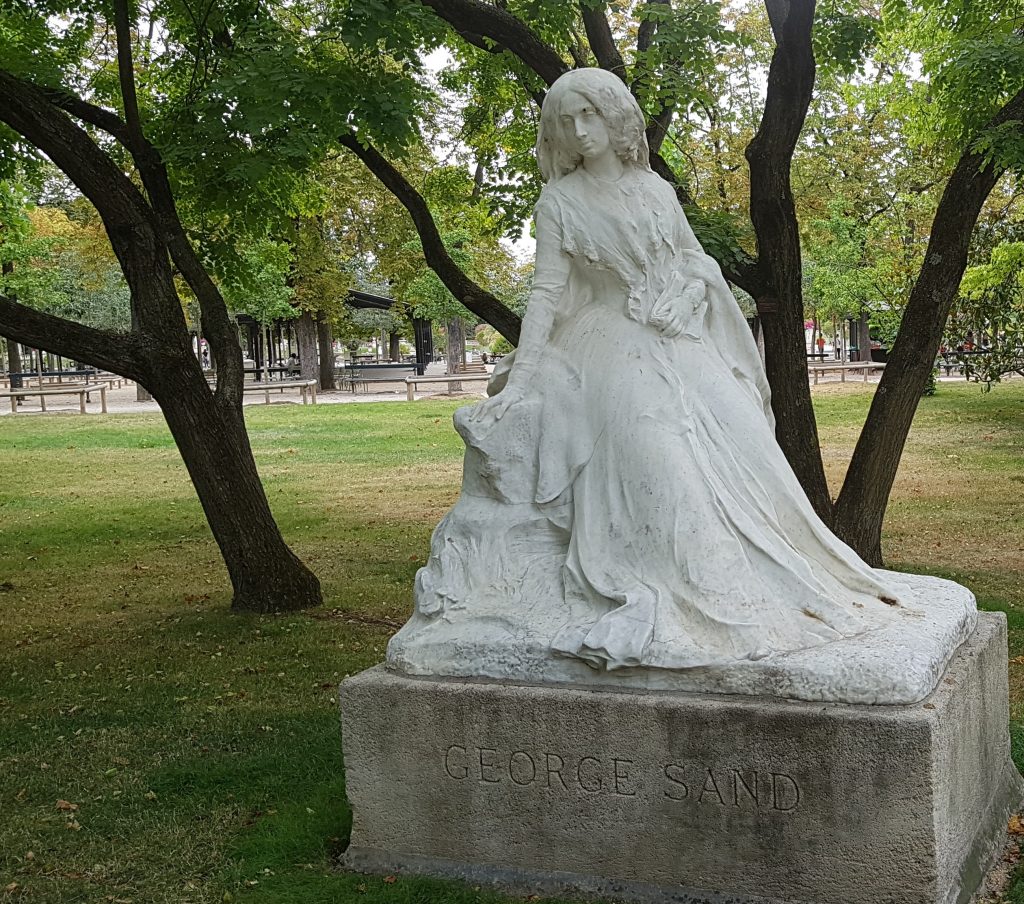
George Sand, sculpted by Francois Sicard was inaugurated in 1904 on the centenary of her birth. Not at all the image of the male-clothed self-declared communist.
Jules Dalou‘s three commissions all come from the same period from the 1890s through the 1900s when liberal republican governments fought off the right and sought to strengthen republican imagery and values. different and all interesting.
In 1890 Dalou’s Monument to Eugene Delacroix – the painter whose most famous work, Liberty leading the people was kept hidden by King Louis-Philippe from 1832 until 1848, and that we have borrowed characters from in designing LeftinParis – was inaugurated in the garden.
Dalou produced a bust of Delacroix but also comments on his belated recognition. Delacroix had died 27 years earlier, so Dalou shows him being given a palm and crown by Glory, lifted up by Time and applauded by Apollo, the god of genius.
In our brief biography of Dalou we show his two other sculptures present in the garden:The Triumph of Silenius, finished in 1885 but only erected in 1898 and the Monument to Scheurer-Kestner, installed in 1908.
A statue referencing surrealism and poetry, dedicated to Paul Eluard, a founder of surrealism who then joined the Communist Party, was erected in 1954, just two years after Eluard’s death. It was sculpted by Ossip Zadkine.
During the Revolutionary Terror (April 6 1793 to July 28 1794), the Palace became an overflow prison, holding among others Danton and Desmoulins who were both executed on April 5 1794.
In December 1830 a demonstration against the clemency shown to Charles X’s former ministers, was violently put down outside the Palace.
The Palace was the location of the Workers’ Commission set up after the February 1848 revolution. Workers had demanded a Minister of Labour, calling the post a ‘Minister of Progress’, but this had been turned down and Louis Blanc accepted the position of President of the Commission instead.
Others nominated to the Commission included Albert and the followers of Fourier, Victor Considerant and François Vidal.
Pierre Marie de Saint-Georges, the Minister responsible for the National Workshops set up in 1848 was also based at the Palace. On June 22 Louis Pujol was nominated spokesperson of the 56 delegates chosen by a workers’ meeting at the Panthéon to negotiate with Pierre Marie.
The meeting took place at the Luxembourg Palace, and Pierre Marie’s attack on the delegation, asking if they were ‘slaves’ to Pujol, fueled an anger that observers credited with sparking the huge June 1848 workers’ uprising.
In May 1871 the military tribunal set up in the Palace summarily sentenced hundreds of Communard fighters and supporters to be shot in the Luxembourg Garden at the back of the palace, just below the statues of French queens.
On July 3 1880 Victor Hugo finally got the amnesty for the Communards through the Senate, based at the Palace more or less continuously since 1805.
After the Germans occupied Paris in 1940 they made the Palace the headquarters of the Luftwaffe, where it was visited by Hermann Goering. His Luftwaffe Field Marshal was also given a luxurious apartment there. It also served as an administrative centre covering prisoners of war.
The Palace was one of the last bastions of German opposition at Liberation in August 1944. Its soldiers only finally surrendered on August 25 to the resistance fighters led by Colonel Fabien, when they were faced with 5 tanks detached by General Leclerc and the threat of air strikes.
The road was named in 1687 after the nearby Four Nations College founded by the chief minister to Louis XIII and Louis XIV, Cardinal Mazarin. This is now the Institute of France, whose dome is seen at the end of the street.
It runs along the length of the Philippe August 13th century city wall, the base of one of whose towers can still be seen in the courtyard of the Institute of France at No. 5.
The Mazarin College, now the Institute of France at the end of the road shown here in the early 20th century, was where the revolutionaries of July 28 1830 distributed gunpowder before the assault on the Hotel de Ville.
The first of several cooperative Marmite restaurant was opened by Nathalie Le Mel at No. 34 in 1868. Associated with the Paris section of the International Workingmen’s Association, it offered food and political discussions
Proudhon had a long association with Rue Mazarine. He roomed in No 36 in 1844 and 1845, when he had several discussions with Marx there.
By 1847-1848 Proudhon was living in a cheap top floor room in the house built at No. 70, the same address as the novelist of Parisan poverty, Henri Murger..
Rue de Médicis viewed through the arches at the rear of the Odéon Theatre.
The road was created in 1860 under the impetus of the changes being brought about by the Prefect of Paris, Haussmann. Here it involved moving the fountain ordered by Marie de Médicis by 30 metres and restricting the size of the Luxembourg Garden on the east.
The Médicis fountain in Autumn. The basin in front of it used to be 50 metres long before it was moved to make room for the Rue de Medicis and a lot of property speculation behind.
The Italian Renaissance style fountain was built on the instructions of Marie de Médicis, the widow of King Henri IV and regent of King Louis XIII in 1630. The problem of a lack of water on the Left Bank of Paris to feed it was solved by the building of the acqueduct of Arcueil, which then enabled the expansion of Paris to the South to take off.
The decaying grotto was restored on the instructions of Napoleon Bonaparte in 1811 and then rebuilt in 1864. At the back of the Médicis fountain is the Fontaine de Léda, a fountain scuplted in 1809 and depicting the story of Leda and the swan.
Just opposite, in the mid-1880s, Félix Fénéon was editor in chief of La Revue indépendante art and literary journal at 7 rue de Medicis, where among many others he published Verlaine.
The impressive door to No 7 rue de Medicis in a building built in 1867-8 was where Felix Feneon worked in 1884 as a founding editor of Le Revue Independant
Rue Monsieur le Prince viewed from the Boulevard St Michel
Until the 1960s the narrow road climbing up from the Boulevard St Germain towards the Boulevard St Michel was much as it had always been in the 19th and 20th centuries: a very low-cost area for students, artists and revolutionaries to live amid cafes and bookshops.
The road originally skirted the Charles V city wall and was called after the court title of the Prince of Condé, whose palace grounds bordered the road. From 1793 to 1805 during the French Revolution the road was renamed ‘Rue de la Liberté’.
The triangle of land, mansion and estate occupied by the House of Condé between the Rue Monsieur le Prince, the Rue de Condé and the Rue de Vaugirard in the Turgot plan of Paris in 1740
To get an idea of the wealth and stature of the Condé branch of the Bourbon family, you can take a look at the door to No. 4 – built on the site of the stables of the Condé town house.
The wonderful door and window above it at 4 Rue Monsieur le Prince are all that remain of the private Hôtel de Bacq, built in 1750 for Pierre Darlons, the secretary of the Prince of Conde
The black American writer Richard Wright lived at No. 14 from 1948 to 1959, the year before he died in Paris aged 52. A plaque has been put up to his memory, not mentioning the reports he gave to the American embassy on Nkrumah and French communists he met, arguably doing so to ensure the renewal of his passport. The building has another interesting door built under the Second Empire.
The wooden sculpted entrance to the four-floored building at No. 14 is in the Napoleon III style. On the right the libertine, on the left the student.
Next door, at No. 16, there used to be a very long-lasting anarchist bookshop. It survived from 1908 to 1932 and before the First World War was a regular meeting place for anarchist trade unionists.
A couple of doors further up the road, the Communist Party owned the Racine/Social publications bookshop at No. 20 in 1938.
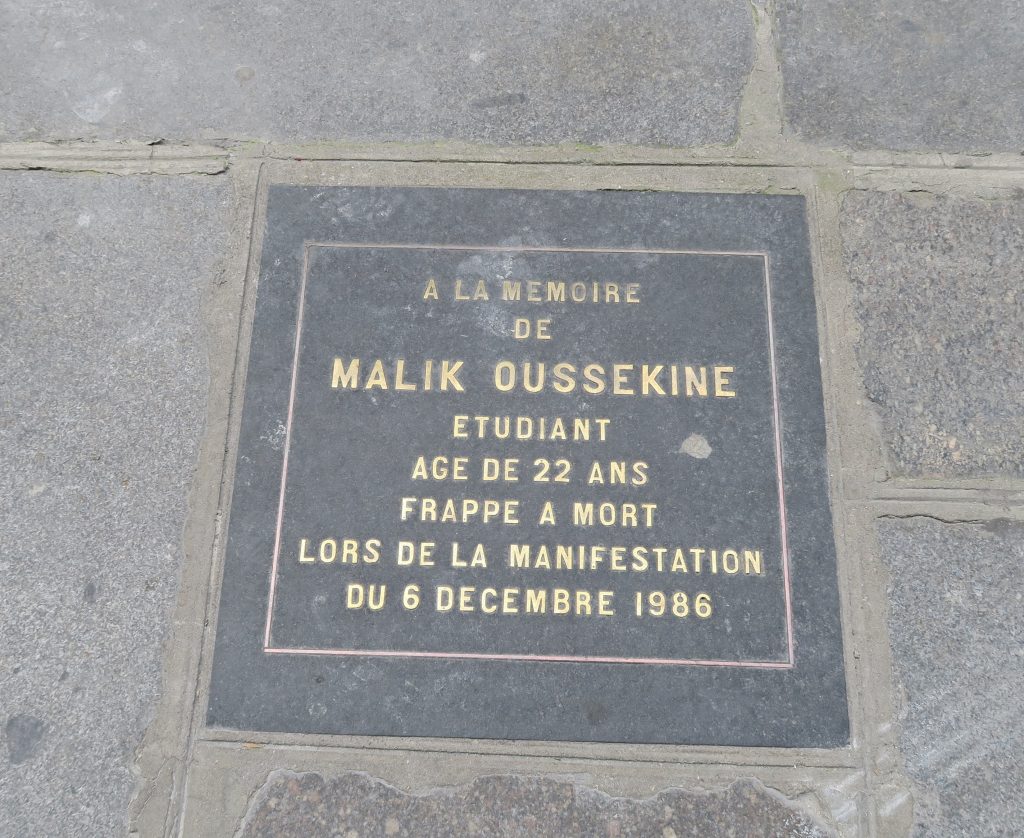
No. 20 was also where, after midnight on December 5 1986 a young student, Malik Oussekine, coming out of a jazz club, was chased down the road to the entrance where he was beaten to death by riot police who attacked him because he was an Algerian and young. The previous day hundreds of thousands of young people had taken part in the day’s demonstrations against the Devaquet election reform. The police tried to cover the murder by calling an ambulance that took the dead body to hospital. Three years later two of the three police were found guilty of wounding Oussekine so badly that he died, and given suspended sentences of five and two years in prison.
On December 6 2006, 20 years later, a memorial plaque was put in the pavement outside No. 20 at a ceremony led by the Paris Mayor, Betrand Delanoë. The sister of the victim found it strange that it wasn’t on the wall. Others criticised the reference to a demonstration that had occurred on December 4, and that it didn’t say that two policemen had been found guilty of his murder.
Paul Verlaine, moving frequently in the last years of his life, lived in No. 21 in 1894, while much earlier, Arthur Rimbaud had a room at No. 41 in May 1872.
Over the years Verlaine and many other writers and artists like James Joyce, Hemingway and Max Ernst used to eat at the Polidor restaurant on the ground floor of No. 41. Until recently its old style benches on which basic French food is served was commanded over by a stereotypical in-your-face French waitress. Now, however, it has even expanded and set up a wine shop.
In 1920, Nguyên Ai Quôc, the future Ho Chi Minh, lived at No. 56. He would have been not at all pleased by the coincidence that led the Indochinese section of the Trotskyist Communist League to meet at No. 65 in 1930.
The first cheap room where the teenage Émile Zola lived on arriving in Paris in 1858 was at No. 63.
The terrace of Le Dôme reflects the Metro station and La Rotonde café on the uneven numbered side of the boulevard du Montparnasse
The boulevard du Montparnasse crosses three arrondissements. The odd numbers on the north side are all in the 6th; the even numbers from 2 to 66 are in the 15th; and from number 68 onwards the addresses are all in the 14th. It was named with reference to the Greek residence of the muses by 17th century students after a tiny hillock in the area.
One excellent source on the left in Paris, the website Parisrévolutionnaire suggests that both Lenin and Trotsky were at the Dôme in 1905. Hazan (IOP), however, insists the Dôme… should never have been allowed to call itself the café of Trotsky and Kertész.
What is certainly true is that in the early years of the 19th century, the Dôme at No 108 became a major intellectual centre, and attracted many left political and artistic people.
Pablo Picasso as well as Modigliani, Utrillo and Apollinaire all drank or ate at le Dôme(No. 108) and la Rotonde(No. 103). The owner of La Rotonde was denounced by Aragon on July 13 1923 for having been a police informer on Lenin before World War One. Other neighbouring well-frequented intellectual and artist cafes of the interwar years included la Coupole (No. 102-104) and le Select (No. 99) .
The wounded black Foreign Legion corporal, Eugene Bullard, is reported as having decided while at the Coupole in the Spring of 1916, to become a pilot in the French air force.
Simone De Beauvoir lived in a flat above the Rotonde for the first ten years of her life before the father’s family lost most of its wealth in World War 1.
Diego Rivera was also part of this leftish Montparnasse scene in the early 20th century.
Léon Blum moved to the group of artists studios and flats soon after it was built in 1908 at 126 boulevard Montparnasse.
Léon Blum saw himself primarily as a writer before 1914, moving into the artists’ block of flats and studios at No. 126 boulevard Montparnasse. Henri Matisse lived and worked at No. 132 in 1927.
From 1865 to 1866, after the publication of his first novel, Émile Zola lived in a room at No. 142.
In the 1920s Le Dôme became a meeting place for many English-language writers like Ernest Hemingway, Sinclair Lewis and Sylvia Beach. In 1924 John Dos Passos joined other American writers at No. 171 the La Closerie des Lilas bar.
La Closerie des Lilas used to be a cheapish outside bar with dancing visited by lots of poets, artists and philosophers from the first half of the 20th century is now a big pricey restaurant
At the eastern end of the Boulevard near the Port Royal, this famous restaurant is where in June 1941 Simone De Beauvoir and Jean-Paul Sartre organised a clandestine ‘Socialism and Freedom’ meeting of about 50 intellectuals, including Maurice Merleau-Ponty. Yet in the face of increasing repression they did not do much more, and in September 1941 Sartre agreed to take the job of a secondary school teacher who had been fired for being Jewish.
Hemingway was also known to eat frequently in the years 1924-1926 at the Le Nègre de Toulouse restaurant at No 159.
Louis Aragon met Mayakovsky for the first time at the Coupole on November 5 1928. The Coupole was requisitioned between 1940 and 1944 for German-only events
Earlier, under the Second Empire that he satirised so brilliantly, Émile Zola lived at No 142 in 1865 to 1866.
Rue de l Odeon photographed in 1905 from the steps of the Theatre. The bust of the playwright Emile Augier in the centre of the square was melted down in 1942 to be turned into German guns
The gently climbing slope from the crossroads with the Boulevard St Germain up to what is now called the Odéon-Théâtre de l’Europe, was opened up in 1779 as the rue du Théâtre Français. The theatre at the southern top of the slope was built between 1779 and 1782 in the garden of the huge Hôtel de Condéprivate house, owned by a junior branch of the Bourbons.
Thanks to the opening of the theatre, in 1782 the road was the very first in Paris to be given pavements with gutters running next to them. It was given its current name in 1797 under the Directorate.
A watercolour and ink painting by a contemporary JD Periel of the fire at the Odeon Theatre on March 20 1818
The surrealist poets André Breton and Louis Aragon first met each other in 1917 at No. 7, the bookshop called ‘The Friends of Books’ (Maison des Amis des Livres). This bookshop was also frequented by Jacques Prévert. On March 19 1918 Breton and Aragon launched their magazine, Littérature, from there. Among the other literary left figures who wrote for it were André Gide and Paul Valéry.
The bookshop’s owner, Adrienne Monnier, held a launch party at No. 7 for James Joyce‘s novel Ulysses on December 7 1922.
No. 10 was where Thomas Paine lived from 1797 to 1802, when, describing Bonaparte ‘as the biggest charlatan the world as ever seen’, he took the opportunity of a brief peace with England to leave Paris for America.
Tom Paine lived for five years at No. 10 Rue de l’Odeon. While initially hoping Bonaparte would spread freedom throughout Europe he quickly became disillusioned, and left France at the earliest opportunity in 1802.
Next door was another famous bookshop. No 12 was the first site of the English-language bookshop Shakespeare & Company. Owned by an American, Sylvia Beach, it became a major draw for radical writers living in Paris in the interwar years such as Hemingway, James Joyce and Simone de Beauvoir.
Shakespeare and Co at No 12 with Sylvia Beach and Ernest Hemingway on the right around 1922
Further up the street, on March 31 1794, this was where at No. 22 rue du Théâtre Français that Camille Desmoulins was arrested. He had lived there since 1782. He was executed with Danton on April 5. His wife, Lucile, was executed a week later. They had married in 1790 with Robespierre a witness who in 1792 became their son’s godfather.
The street was named, it is believed, after the large numbers of students from Poitou who lived in the 13th century street. It became known as the Rue Poitevine in 1448.
In 1824 Pierre Leroux worked in the printshop belonging to Charles-Louis Panckoucke and founded the newspaper The Globe, that became the organ of the Saint-Simoniam utopian socialists from 1830. The printshop at No. 4 was in the Hotel de Thou, where Jacques Auguste de Thou, a president of the Paris parliament, had first established a major library there in 1587.
Rue des Poitevins photographed by Charles Marville in the early 1850s, a few years after Courbet roomed in the street in the early 1840s..
No. 6 was a lodging house and restaurant set up in 1840 and called the pension Laveur. It was based in a wing of Thou’s Paris mansion. Gustave Courbet, Elisee Reclus and many other 19th century political figures stayed and/or ate there as students or while first living in Paris – either at this address or at 20 Rue Serpente, where the pension Laveur moved to later.