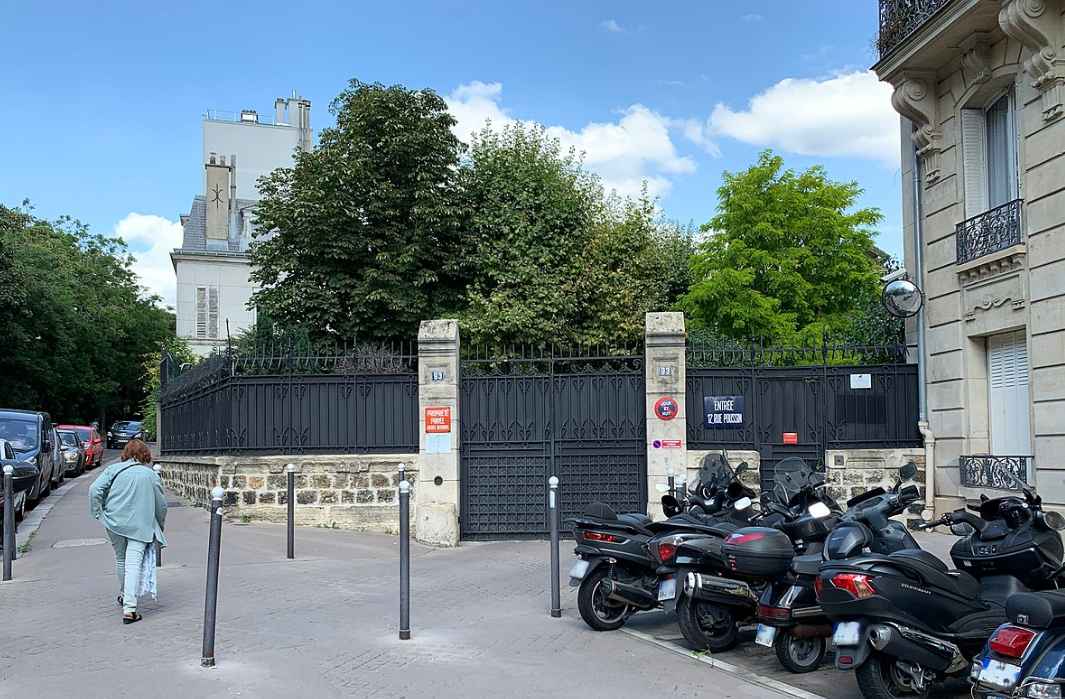
This is one of six private roads within the gated Villa Montmorency 120-VIP-houses estate that was planted originally with sycamore trees when it was within the park of the 16th century Boufflers Chateau that was sold off in 1852 with the building of the Auteuil station.
Victor Hugo moved into No 5 with his son François-Victor in 1872, who died there of tuberculosis on December 26 the following year.
From Popular Front to the Spanish Civil War and World War Two
Spanish Republic, International Brigade, Munich, Hitler-Stalin Pact, Phoney War – in progress
A Communist march in 1937 demands (unsuccessfully) that France supplies the Spanish Republic with guns and aircraftStriking workers at the Samaritaine Department store in Paris at a meeting in June 1936
In June 1848 Rue Clovis was the site of one of the dozens of workers’ barricades defending the national workshops that were attacked by troops
The Lycée Henri-IV at No. 23 stands on the site of the Abbaye-Sainte-Geneviève canteen, cellar and garden hut which, after the fall of Robespierre in 1794, became home to the Panthéon Club. This was established on 17 November 1795 as a broad assembly of those who wished to carry forward the revolutionary spirit. Babeuf and Buonarroti were among those who took part.
On February 28 1796 the club was closed down by the authorities, with General Bonaparte personally supervising the operation. Babeuf and Buonarroti then pursued the struggle through less legal channels.
The Abbey became the Lycée Napoléon from 1804 to 1815 and again from 1848 to 1870. During the Commune it became a workshop for making uniforms for the National Guard that was defending Paris.
The swish Hotel Pont Royal occupies much of this short street opened in 1913 off the Rue de Bac leading to the Pont Royal. It was given this name in 1924, after a theoretician of liberal Catholicism, Charles de Montalembert (1810-1870).
In October 1944 this hotel was where Lucie Aubrac was lodged with her children while a delegate to the National Consultative Assembly, before moving to the Rue Marbeuf in January when her husband Raymond was abruptly fired from his job as Commissioner of Marseilles because of his pronounced left leanings.
From the 1930s the basement bar at the Hotel Pont-Royal was used by Gaston Gallimard (1881-1975), head of the Gallimard publishing house as a discrete meeting place with intellectuals and writers such as Hemingway, Malraux, Gide, de Beauvoir, Camus, Sagan, Sartre and many more in the 1930s and 1950s.
in 1928 Gallimard purchased the effectively adjacent 5, Rue Sébastien-Bottin (at the time 43 Rue de Beaune) as his new headquarters. As managing editor of La Nouvelle Revue française (NRF) from, 1911 to 1940, Gallimard gave Gide the literary editorship and was the first publisher of Malraux and Sartre.
In June 1940 Gallimard moved to the South of France trying to please the Germans by leaving a writer, Drieu la Rochelle, who espoused ‘Socialist Fascism’ as Editor of the NRF. Accused by the Germans of employing Jews and communists La Rochelle fired them.
The Gallimard press was accused of collaborationism during the Occupation and La Rochelle committed suicide in March 1945.
In 2011, on the 100th anniversary of the founding of the Gallimard publishing house, the section of the street Rue Sébastien-Bottin that included No 5 was renamed Rue Gaston-Gallimard.
Two minutes from the Hotel Pont Royal is the publishing house Gallimard, now in a street named after its founder
The street was named after Saint Benoît, the founder of the Benedictine religious order that created the Saint-Germain-des-Prés abbey (and whose first church dates from 558).
During the Orléans monarchy the oppositional clandestine newspapers Moniteur Républicain (the Republican Instructor) and L’Homme libre (The Free Man) were printed by the Blanquist concierge of No. 26, Antoine Fomberteaux, who was arrested there for possession of gunpowder in October 1838.
In 1839, Etienne Cabet also lived in the street after his return from exile in England.
During the Commune the mainly Proudhon-influenced Paris members of the International Working Men’s Association used to print leaflets at the Claye printshop at No. 7.
The same address was used by Lucien Rameau in 1941-1942. He clandestinely printed anti-Vichy leaflets in the secret Communist Party bookshop and print works based there.
The buildings at No. 16-18 used to be a girls’ school and are now a mixed nursery and primary school. In 1871 it was the meeting place of the ‘Union des Femmes pour la défense de Paris et les soins aux blessés ‘ (The Women’s Paris Defence and Wounded Relief Union), attended by Elisabeth Dmitrieff and Nathalie Le Mel.
In 1935 Jacques Prévert lived with Jacqueline Laurent on the 7th floor in the Hotel Montana at No. 28.
A third floor apartment at 5, Rue Saint Benoît became Marguerite Duras‘ permanent home and the 20th century equivalent of a ‘salon’ for intellectuals and artists from 1942 to 1996.
In 1943 Duras’ flat was where Francois Mitterrand turned towards the resistance, joining the network the Antelme and Duras were involved in.
This was also the address where her husband, Robert Antelme, was arrested and deported by the Germans on 1 July 1944.
In February 1948 Boris Vian began converting the French to Be Bop at the Club St Germain at No. 13. Americans who played there included Miles Davis, Charlie Parker and Duke Ellington.
This Paris street widens as you walk up it towards the Luxembourg Palace in the Rue Vaugirard. It was once the home of several of France’s wealthiest people who built small palaces outside the confines of the inner Paris wall.
But it also has a left history. André Gide lived at No. 2 for eight years, from 1875-1883.
Ledru-Rollin lived at the Hotel de Montmorocy in June 1848. Alphonse de Lamartine stayed in the same mansion.
Next door, Alexandre Ledru-Rollin at the Hôtel de Montmorency at No. 4, was followed to his home from the assembly on June 24 1848 and threatened with death after he was denounced for being too supportive of the workers’ insurrection. Sharing the same address at the time was Lamartine, another leading campaigner for the extension of the suffrage.
Jacques Prévert moved to the fifth floor of No. 5 for a year in the winter of 1910 when he was ten years old. Fifteen years later he married Simone Dienne, three years younger than him, whose family lived on the ground floor in 1910.
In 1840 Charles Fourier, the early utopian socialist, edited the revue in the offices of La Phalange (sucessor paper to the Phalanstère) at No 6.
During the 1848 revolution, the anarchist Bakunin stayed at the Republican Guard barracks at No. 10.
In May 1871 the barracks offered a different menu: it was where some Communards fighting in Paris’ National Guard were court-martialed during the bloody week.
The Foyot Restaurant at 33 Rue de Tournon before its demolition in 1938 was a favourite haunt of senators and Parisian personalities. It had been bombed in 1894 with the damage visible in the Rue de Condé on the other side of the restaurant shown in this photograph.
The Foyot restaurant that was bombed in 1894 where Laurent Tailhade, ironically a supporter of the ‘propaganda by the deed’ anarchist movement, lost an eye was also used by the painter Gustave Courbet and other Commune supporters in 1871.
A scandal broke out at Foyot shortly before Verlaine died when in rags he was invited to dine there by a symbolist poet and dandy.
Initially bits of the boggy land on a narrow country lane through Abbey land were sold by Saint-Germain-des-Prés Abbey to builders, and it was called the Saint Sulpice lane in 1517. The road was soon renamed Rue de Tournon in 1541, after Cardinal François de Tournon (1489-1562) who ran the abbey.
Under the Second Republic in 1849 the government decided to allow the road to take its current unique bell-shaped dimensions, running from 13.5 meters wide up to double that when opening up to the Luxembourg Palace.
A 12 metre-wide street originally built in 1826 under a royal decree, it was initially named rue Mademoiselle because of its proximity to the building that became the Matignon Palace/Hôtel , now the official residence of France’s prime ministers. The owner of the huge Hôtel at 55 rue de Varenne at that time was Mademoiselle Louise-Eugenie, the younger sister of Louis-Philippe. The name was changed to rue Vanneau (with two nn’s) in the initial democratic phase of King Louis-Philippe in October 1830.
The street was again renamed in 1873, as the right-wing Republican government sought to use name changes to reinforce its shaky legitimacy. So from rue Vanneau it became rue Vaneau (with one n) in honour of a student killed attacking the Babylone barracks during the Glorious Revolution on July 29 1830.
Although Karl Marx lived at both No. 38 and No. 23 in 1843-1844 and his first daughter, Jenny (who later married Charles Longuet), was born at No. 38 there is no commemorative plaque on either address. The offices of the review that had brought Marx to Paris, Annales franco-allemandes, were at No. 22.
The socialist senator and first female Senate vice-president Gilberte Brossolette (Bruel) was born at No. 24 in 1905. She married Pierre Brossolette in 1926 and worked as a journalist for the socialist paper, Le Populaire. From the autumn of 1940 the couple secretly held meetings in their home to create the first resistance group in Paris. In May 1942 after French police searches led to their teenage son being taken to Gestapo HQ, they crossed the demarcation line with their two children. Gilberte then sailed with the boy and girl to Gibraltar and from there took a cargo vessel to London, where she worked as the liaison between De Gaulle and the BBC.
Another left literary figure to have lived in the road was Félix Fénéon. He was still living with his parents at No. 26 when he got his first job at the Ministry of War in 1881 and soon afterwards began writing art criticism, book summaries, short stories and even a first draft of a psychological novel for a monthly journal that ran from October 1883 to March 1884.
The photograph above is from 1905, some 60 years after the Marx family lived a little further down the street.
You will see a plaque on 1b, rue Vaneau, where André Gide lived on the sixth floor from 1928 and died in 1951, and where he hid Albert Camus in another flat in the building in 1944.