Rue Japy

Arrondissement 11

Number: 2

The Salle Japy on the left photographed about 1900

Opened in 1870 the road was named after the paternalist industrialist Frédéric Japy. In the late 18th century he invented machine tools that could make some parts of clocks and built workers’ housing to keep his skilled home workers close. Some of his workshops were nearby.

No. 2 was built in 1870 as a covered market, but it was then converted in 1884 into a gym that could also hold political meetings and was known as the Salle Japy. In the 1900 photograph above the Salle is on the left.

The Salle Japy was where the first steps towards unity of the different French socialist organisations took place between December 6 and 9 1899. Jaures, Guesde and Allemane were all present.

At the end of this meeting the new version of l’Internationale was sung together by the different groups for the first time, becoming the anthem of French socialism. The song’s words had been written in June 1871 by the Communard Eugène Pottier to the tune of La Marseillaise, but they were set to the currently-known melody in 1888 by the Belgian socialist Pierre De Geyter.

Many other significant left meetings took place in the Salle Japy. On April 22 1920 the Third Federal Congress of the Railway workers there decided to call an unlimited strike from May 1st for the nationalisation of the railways. On March 7 1925 Marcel Cachin told a Communist meeting there ‘It shouldn’t be that women have two bosses: their employer and their husband’.

But under the German Occupation the hall was also first used as an internment centre for around 5,000 ‘migrant’ Jews. ‘Foreign’ Jews were the first to be rounded up on May 14 1941 and then deported to their deaths.

On July 16 1942 when René Bousquet, Secretary-General to the Police for the Vichy Regime, ordered the partially autonomous French police to round up Jews in Paris, women and children were interned in the Salle Japy before being deported.

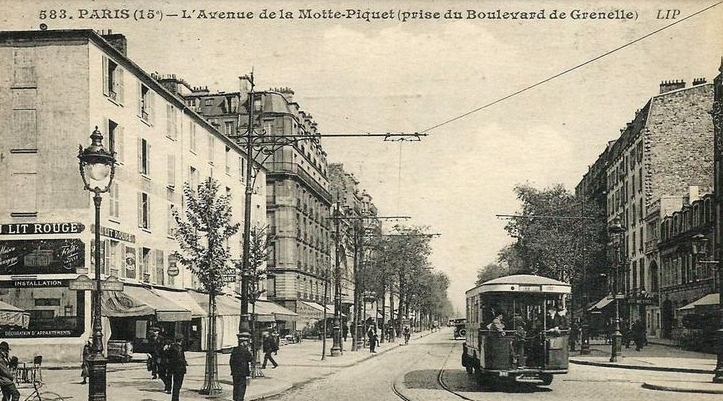
Avenue de La Motte Picquet

Arrondissements 7, 15

Numbers: 2, 19, 48, 52

The more than one kilometre-long road was named in 1884 after Toussaint-Guillaume Picquet de La Motte, admiral under Louis XV and Louis XVI who played parts in both the Seven Years War and the American War of Independence. It was first opened as the Avenue de l’Ecole Militaire in 1680.

The Chilean embassy is in a prime location at No. 2. It had previously been the private mansion of the Tour-d’Auvergne family.

Built in 1907 for Prince Henri de La Tour-d’Auvergne it was rented to the US Embassy until 1929 and then sold to Chile to become its Embassy

The Chilean Embassy was where Louis Aragon was allowed to take refuge for a few days on August 28 1939 by fellow poet and Communist, but also a diplomat there at the time, Pablo Neruda. Aragon had been attacked in the street by the extreme right-wing after the French Communist Party had been banned on August 25, two days after the 1939 Hitler-Stalin ‘Non-aggression Pact’.

Between 1971 and 1973 Neruda was made Chili’s Ambassador to France by Salvador Allende. Back in Chili Neruda witnessed the September 11 1973 Pinochet coup d’etat (protests outside the Paris embassy pictured here). But 12 days later Neruda died of ‘heart failure’. 21st century scientific analysis has suggested he could have been murdered in hospital through being injected with botulism.

Jean Jaurès, the leader of the Socialist Party before World War I, lived at No 19 for a period of time according to Paris Revolutionnaire, but we still need to check out the source for this and the time he spent there.

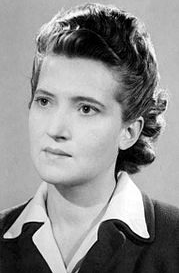
The French Jewish 20-year-old Louise Alcan lived at No. 48 and became a supporter of resistance in 1940. She later moved to Vichy France but was denounced and arrested in December 1943 in Marseille after the Germans moved to occupy the whole of France.

Louise was first taken to the Drancy transit camp and then deported in Convoy 64 to Auschwitz-Birkenau in February 1944. She later escaped from the Ravensbruck Death March of April 1945.

Further down the road at No. 52 there are several connections to the resistance. This was where the leading Catholic resistance organiser from De Gaulle’s secret service in London, Gilbert Renault known as Colonel Rémy, lived from December 1941 to June 1942. With a month of the 1940 defeat he returned from London and with Louis de La Bardonnie set up the Confrérie Notre-Dame (later called the CND-Castille). Two of Renault’s sisters, Maisie and Madeleine, also joined the CND and were arrested at No. 52 on June 13 1942. But they were able to ensure Gilbert’s escape.

Maisie Renault (1907-2003) was first taken to the Santé prison and then to Fresnes until March 1943. She was next moved to the Romainville Fort and on August 15, after D-Day, she and her married sister Madeleine were deported with 550 others to Ravensbruck. They were among the 17 from that convoy who survived to be liberated on April 22 1945.

Outside No. 52 Roland Abon, a resistance fighter aged 19 was killed fighting for the liberation of Paris on August 25 1944.

PLACES

Rue Portefoin

Arrondissement 3

Number: 17

Rue Portefoin

A short, narrow road, in 1282 it was first opened by the Knights Templar as the Rue Richard-des-Poulies. Soon afterwards a wealthy man Jean Portefin built a private mansion there and its name was changed to Portefin, and in the 17th century to Portefoin.

No. 17 is the house where Honoré de Balzac lived in 1819, just up the road from Madame de Berny, his mistress at No. 3. Shown on the left of the Google Streetview image above, No. 17 became the agreed meeting place of the French Socialist Unity Committee after the Second Unity Congress held in the Salle Wagram in September 1900.

In January 1902 Allemane finally left the committee because Jaurès‘ daughter had gone to communion, and Alexandre Millerand had attended the September 1901 reception for the Russian Tsar Nicholas II.

PLACES

Rue d’Ulm

Arrondissement 5

Number: 45,

The Ecole Normal Superieure in 1905

The Rue d’Ulm, going south from the Panthéon, was opened on January 6 1807. It was named after the crushing defeat of the Austrian army by Napoléon at the Battle of Ulm between October 15 and 20 1805.

It is largely known because since November 4 1847 it hosted France’s most prestigious higher education selective university, the École normale supérieure (ENS) at No. 45. This special institution was initiated by Napoléon on March 17 1808 when he created a ‘standard boarding school’ (Pensionnat normal) within Paris university to train arts and science teachers. The students had to follow military rules and wear uniforms and were chosen from those who performed best in the secondary schools.

Louis Pasteur‘s laboratory was based there from 1864 to 1888, and was where he discovered a vaccine for rabies. The photgraph above shows the ENS in 1905.

From 1888 to 1926 the socialist Lucien Herr was the director of the ENS general library, with one of the students he influenced being Léon Blum. Herr also convinced Jaures there in 1898 of the innocence of Captain Dreyfus.

Students who studied at ENS included Maurice Halbwachs (who died at Buchenwald), Marc Bloch (executed by the Gestapo on June 16 1944), Raymond Aron, Jean-Paul Sartre, Simone Weil, Georges Pompidou, Aimé Césaire, and Alain Touraine.

Perhaps the ENS’ most well-known left resident was Louis Althusser. He entered the ENS in 1945. Having passed the final exams with the highest marks, he began to work there from 1948, living in a staff flat provided by the ENS. This was where in 1980 in a fit of manic depression Althusser strangled his partner of 54 years.

In the aftermath of 1968 the Maoist group, La Gauche Prolétarienne (The Proletarian Left), held regular meetings in the Cavaillès lecture theatre. Among their leaders was Benny Levy. On October 21 1970 they used the ENS building to make Molotov cocktails.

PLACES