Daniel Stern, her pseudonym, was a republican whose salon was visited by Marx in 1844. She lived with Lizst and wrote the History of the 1848 Revolution.
Daniel Stern (Marie d’Agoult)


Daniel Stern, her pseudonym, was a republican whose salon was visited by Marx in 1844. She lived with Lizst and wrote the History of the 1848 Revolution.
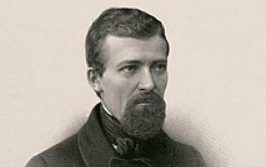
Revolutionary • Socialist
Alexandre Martin, known to everyone in Paris as the ‘Worker’ Albert, was the first working class man to enter a French Government in February 1848.
Revolutionary and socialist, ‘Worker Albert’ served on the 1848 Labour Commission before being jailed in May 1848.

Song-writer * Constitutional monarchist * Republican
Pierre-Jean Béranger was the most influential French song-writer of the 19th century.
He was born at 50 Rue Montorgueil on August 19 1780, but was brought up by his grandfather, a tailer who lived at an address unknown in the Rue du Faubourg Saint-Antoine. There, as a small child he witnessed the storming of the Bastille.
By the time he was 20 he was living in a shack at 50 Rue René Boulanger.
He began writing patriotic songs that were appreciated both under Napoleon and initially under Louis XVIII. But by 1821 his songs began to bite at the Bourbons and in December 1821 he was jailed in the political wing of the Ste Pélagie prison whose entrance was at nos 2-8 Rue du Puits de l’Ermite. Released after winning an appeal three months later, he found his popularity greatly enhanced.
In the mid-1820s under the Restoration Béranger lived at 27 Rue des Martyrs. On August 24 1827 he took part in the funeral at Père Lachaise cemetery of his friend from up the road, Jacques-Antoine Manuel, alongside whom Béranger himself would be buried thirty years later. An elected deputy Manuel had been thrown out of the National Assembly in 1823 for opposing the Bourbons sending troops to support the Spanish king Ferdinand VII against a popular uprising.
In March 1828 Béranger was jailed for the second time. On this occasion he spent nine months at the La Force prison for publishing another collection of his anti-Bourbon patriotic songs.
His songs helped shape the cultural background for the widespread support for the 1830 July Revolution.
From 1833 to 1835 Béranger lived in an attic room on the 2nd floor of 42 Rue Raynouard in the 16th arrondissement. In 1839 he published two poems reflecting the influence on him of Saint-Simon and Cabet, one of which, ‘Madmen‘ has been described (in the Maitron) as ‘publicly showing his sympathy for all forms of socialism’. The other, the Old Tramp, confirms his humanism.
A few years later from 1841 up to 1848 he lived in another 16th arrondissement flat at 19 Rue Vineuse. He made much of his ordinary background, writing of how ‘low’ he was in his 1847 poem ‘Villain’.
Viewed as France’s ‘national poet’, his songs with their indirect critique of the Bourbons led him to imprisonment. He appealed to liberals, republicans, Bonapartists and socialists. Under the Second Empire he was criticised for having in part helped build up the Napoleonic myth that allowed Louis-Napoleon to take power.

Béranger died on July 16 1857 in the top floor of No 5 Rue Vendôme, that was renamed Rue Béranger in 1864. When he lived there the regency mansion built between 1720 and 1725 was called the Hotel de la Haye. It is now the Pierre-Jean-de-Béranger Secondary School while the mansion next door is the Béranger Primary School.


Poet • Monarchist • Republican • Exile
Republican, poet, dramatist and novelist of the Romantic movement, Hugo is considered to be one of the greatest French writers, but he was also a major political opponent of Napoleon III, the opportunistic nephew of Louis-Napoléon Bonaparte who had seized power himself on November 9 1799 (the 18th Brumaire of Year 8 in the revolutionary calendar) and then crowned himself Emperor in 1804.
In the 21st century Hugo remains globally famous for Notre-Dame de Paris (renamed The Hunchback of Notre Dame by its English publisher) and for Les Misérables, a novel turned into plays, films, TV series and the French (1980) and English language (1985) musical, which is still running in London at the time of writing (2024).
Hugo’s life was a journey, both physical and political. He was not born in Paris but lived there for the two-thirds of his life when he was not in exile in the Channel Islands or Belgium. Politically he moved from being a teenage monarchist to a Napoleon Bonaparte sympathiser and finally in the second half of his 83-year-long life to becoming a republican who chose to be taken to his grave at the Panthéon in Paris in a pauper’s coffin.

Elected a Delegate from Paris to the Second and Third Republic national assemblies in 1848 and in 1870, Victor Hugo’s larger than life politics, locations and loves were a journey that dovetailed with the history of France through most of the 19th century.
One of Hugo’s English biographers began his 700-page study describing his life as full of contradictions: ‘the militant monarchist and the revolutionary socialist; the symbol of a corrupt aristocracy and defender of the misérables; a repressor of revolts and instigator of riots‘ (Graham Robb, 1997). An American detective story writer (Cara Black, 1999) appears disappointed to find his flat in the Place des Vosges didn’t reflect his supposed politics: ‘The room captured his essence, dark and narcissistic. The only touch that could be called socialist was the heavy peasant glassware on a mahogany sideboard‘.
Calling Hugo a ‘socialist’, a ‘revolutionary’ and ‘instigator or riots’ is inaccurate. He was never a socialist, if wanting wealth and power to be distributed more equally is in anyway defined as socialism. But Hugo’s life, his two decades-long exile, his poetry and his novels ultimately helped embed France’s republican system of government in a way that involves a more or less explicit acknowledgement of the need for greater equality.
Despite having long-term relationships simultaneously with two women in addition to his wife whom he married when aged 21, and for the last thirty years of his life using vulnerable and accessible maids as well as prostitutes for sexual gratification, both his two most well-known novels feature strong women and his final novel explicitly argues for gender equality.
Victor-Marie Hugo was born in his captain father’s then garrison town, Besançon, on February 26 1802. This was exactly nine months after the convict number 24 06 01 Hugo later assigned to Jean Valjean, his principal character in Les Misérables. Victor was not baptised, and his first name was that of his godfather, General Victor Fanneau de La Horie, who in 1800 had secured his father’s (Léopold Hugo) posting to Besançon. Marie was the name his parents had chosen if the baby had been the hoped-for girl after Victor’s mother, Sophie Trébuchet, had already had two boys.
The future novelist and poet was born into an internally combative and dysfunctional family: he was the son of a soldier eventually promoted to General under Napoleon I and of a Catholic mother who had opposed the execution of Louis XVI. His godfather was executed for plotting against Napoleon after having been hidden for months from Napoleon’s police by his lover, Victor’s mother Sophie.
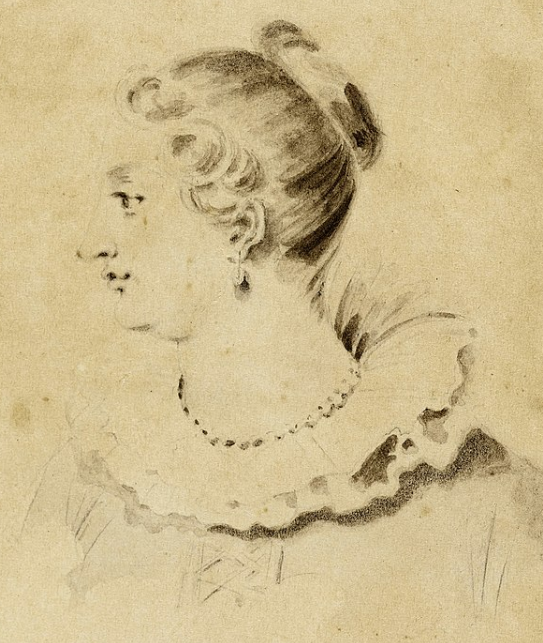
Eight months after his birth Sophie left Victor and his two elder brothers with their father and returned to Paris to lobby Lahorie and Joseph Bonaparte for a still better posting (and salary)
Sophie stayed at the Hotel de Nantes in the Rue Neuve-des-Petits-Champs (now renamed the Rue Danielle Casanova) near where the now out-of-favour Lahorie was living. Refined with nobility airs and six years older than her, a relationship developed that lasted until Lahorie’s execution in 1812.
For Major Hugo, Sophie’s lobbying didn’t work out. From Besançon the out of favour career officer was transferred with his boys to Marseille then relocated to Corsica and next to the Isle of Elba. This was where Sophie eventually rejoined her husband and children to find him with a mistress and living in rough army accomodation. A month later, in November 1803, she left Elba with her three boys and three months later arrived back in Paris where she moved into 24 Rue de Clichy.
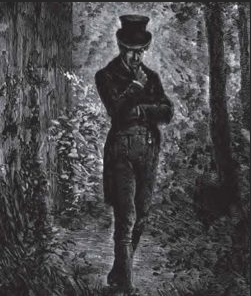
The apartment there soon became his godfather’s hiding place. In 1804 General Lahorie, sketched left, was under suspicion of supporting opponents of Napoleon’s decision to become Emperor. Lahorie moved out when rumours about him and Sophie grew, but he returned frequently, even walking the boys to school. In 1808 after Sophie moved into the Rue des Feuillantines, the old monastery’s huge garden proved an excellent hiding place for her lover, whom she called M. de La Courlandais and who taught her boys Latin until his arrest there on December 29 1810.
Within days of this arrest Sophie left Paris, taking her three boys (and two servants) on an unannounced three months journey to Madrid where, thanks to his military prowess in killing Spaniards who were resisting the French invasion, Léopold was promoted General and made Count of Siguenza by the country’s newly installed King, Joseph Bonaparte. Living in a Guadalajara palace with his mistress, Léopold wanted a divorce. This had been legalised in France under the Revolution in 1792. When Sophie received money to travel back to Paris from Lahorie she undertook the long journey home with her two younger sons, Eugène and Victor. The 13-year-old Abel remained with his father as a page to Joseph Bonaparte.
Back in Paris by April 2012 Sophie saw her lover Lahorie in the Vincennes dungeon and got him transferred to the less harsh Prison de la Force in the Rue du Roi de Sicile. She visited frequently. On June 24 1812, however, Napoleon crossed the Niemen River at Alexioten in Poland to invade Russia. Soon afterwards Sophie learned from Lahorie that a coup d’etat had been hatched by General Malet against the absent Napoleon using a forged message saying the Emperor had died in Russia on October 7, shortly after beginning his winter retreat from the burnt-down Moscow.
On October 22 1812 Malet donned his former General’s uniform and went straight to the Prison de la Force and ordered Lahorie’s release. Lahorie and others then spread the word of Napoloeon’s death and of forged order papers. A few hours later the plot collapsed when another senior officer who had received a letter actually dated by Napoleon October 7 promoting him realised Malet’s document must be a forgery. Three generals including Lahorie and 19 others were tried by a military court for treason on the morning of October 29 and shot in the afternoon on the Grenelle Plain, the open, boggy land that stretched west from the military hospital the Hôtel des Invalides.
Victor, a ten-year-old boy, had seen much more of Lahorie than he had of Leopold Hugo. His mother told him to read the poster announcing the death sentence on the traitors who included the godfather he knew as a teacher and close friend of his mother’s. He was going to witness still greater familial stress and conflict, mixed with major political changes over the next few years.
Lahorie’s death coincided with the recapture of Madrid in the Peninsula War and the subsequent restoration of the lower French grades and salaries of Army officers like Léopold Hugo who had fought in it. Hugo’s father then cut the allowances he sent to Sophie and on December 31 1813 she moved to the smaller ground-floor flat at 2 Rue des Vielles-Tuileries (now 44 Rue du Cherche-Midi).
On April 12 1814 Hugo was on the streets to cheer the arrival in Paris of the executed Louis XVI’s youngest brother, the Comte d’Artois (and future Charles X) five days after Napoléon I abdicated. A month later Sophie accompanied by Abel left Victor and Eugene in Paris to travel to Thionville, where Leopold Hugo had been made General and military commander in January. He had successfully defended the town from the Austrians until learning of Napoleon’s abdication and then pledging his allegiance to the restored Louis XVIII.
Victor’s mother had expected to be welcomed in Thionville by the newly-converted Royalist but the opposite was the case. Léopold, still living with his mistress, was looking for a divorce – first legalised on September 20 1792 under the French Revolution, before being abolished under the Restoration in 1816 and only finally re-established in 1884. General Hugo initially secured legal rights over the education of the two boys in Paris and arranged for his sister there to enrol them in a boarding school, the Cordier boarding house at 41, rue Sainte-Marguerite (now Rue Gozlin).
Huge celebrations were held in Paris on 28 February 1882 to celebrate Victor Hugo’s 80th birthday. An estimated 600,000 people paraded beneath his windows at 124, avenue Victor Hugo, that had been renamed in his honour the year before. This was where he died on 22 May 1885.
Hugo’s entry into the mausoleum for ‘the great men of France’ was the first in half a century. The beleaguered Republican government of the day resisted the protests of the Catholic Bishop of Paris who complained not only that Hugo had refused to go through the last rites with a Catholic priest, but also that the building was still a consecrated Church.
, Victor’s mother.
The young Victor and his two older brothers Abel and Eugene, went to live with their mother at 24 Rue de Clichy in 1804.
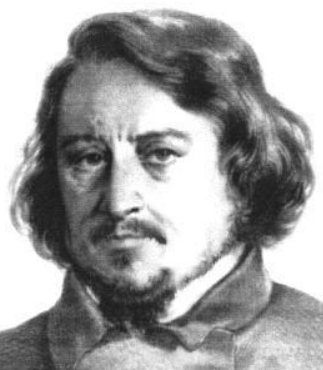
Leroux evolved from the elitist Saint-Simon movement to socialism, the term he was the first to coin in 1834. He saw fraternité as being central but being challenged by both liberté and égalité. He fought for mutualist and associationist socialism. Lived in exile from 1851 to 1860.
He died under the Paris Commune in April 1871 and was buried in the Montparnasse cemetery.


Human rights • Anti-slavery campaigner • Republican
This revolutionary republican campaigner against slavery was born in Paris in what was then the 5th arrondisement and is now in the 10th, at 60 Rue du Faubourg-Saint-Denis.
His father was a wealthy owner of a porcelain factory who was well able to afford to send his son to the Lycée Condorcet that opened in 1803 in what is now 8 Rue du Havre, the monastery built just before the Revolution in the 1780s. When Schoelcher was there it changed its name. It had been called the Lycée impérial Bonaparte from 1805 to 1815 and then became the Collège royal de Bourbon from 1815 until February 1848.
As a wealthy young man Schoelcher entered the circles where got to know George Sand, Hector Berlioz and Franz Liszt. In 1828 his father sent him off to represent the business in Mexico and the United States and then to Cuba in 1829 where he found slavery absolutely abhorrent.
Returning to France in 1830 Schoelcher became a journalist and art critic and well as a lifelong campaigner against slavery. In 1832 he sold the business he inherited from his father to enable him to concentrate on journalism and politics.
In 1833 his first book, On the slavery of Black people and Colonial Law was an indictment of slavery and called for its abolition. It also argued that although the workers had made the 1830 Revolution, they were being deprived of their rights.
In 1834 he was one of a large number of young republicans who were jailed at Sainte-Pélagie prison after the Rue Transonain massacre in April.
Elected to the National Assembly after the 1848 February Revolution he drafted the bill abolishing slavery.
On December 3 1851 he went to the barricade at the corner of the then Rue Sainte-Marguerite (now Rue Trousseau) with the Rue du Faubourg-Saint-Antoine. He and other deputies such as Alphonse Baudin wanted to strengthen the mobilsation of workers protesting Louis-Napoleon Bonaparte’s coup d’État of the previous day.
Schoelcher then led several of the unarmed deputies out to talk with the soliders sent to suppress the revolt. Alphonse Baduin, jumped up to the top of barricade with a flag and was immediately shot dead.
Exiled from 1851 to 1870 during the Second Empire of Napoleon III, he later wrote a biography of Toussaint Louverture, the inspirational leader of the Saint-Domingue (Haiti) slave revolution who was captured, forcibly taken to France where he was imprisoned and effectively murdered in April 1803 by Napoleon I. Finally, it took until 1998 before France finally recognised Toussaint. A few bits of dust taken from the Jura’s Fort de Joux prison chapel burial area were placed downstairs in the Pantheon. No mention is made on the plaque of his imprisonment and his being frozen to death.
After his return to France in 1870 Schoelcher was elected to the National Assembly and sat on the extreme left of the deputies in Versaillais during the Commune. In 1875 he was elected a senator for life.


