Rue St Antoine

Arrondissement 4

Numbers: 99-101, 104, 117, 133

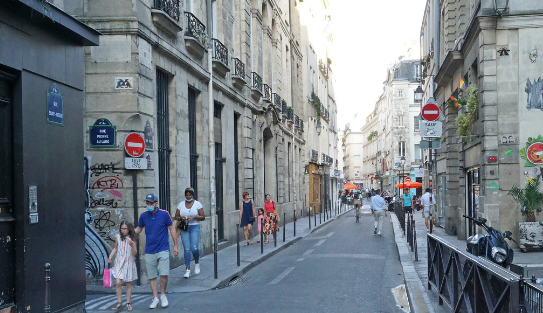
A long old Roman road across Paris leading from the Bastille west towards the Saint-Antoine abbey that became a hospital in 1796. It now continues under the name Rue de Rivoli up to the Place de la Concorde.

The first office of the ‘German Pilot’ journal (Der deutsche Steuermann), a review produced by the Prussian Embassy in 1844 as a competitor to Marx and Engels’ bi-weekly Vorwärts was at No 100. At the time there were around 60,000 German workers in Paris.

In June 1848 a barricade across the road at No. 100 in front of the St Paul church saw considerable fighting as workers fought to defend the National Workshops established shortly after the February Revolution.

The president of the Luxembourg Commission that established the 1848 National Workshops for the unemployed, Jean-Baptiste Lagarde, a watchmaker, lived at No 99 (previously No. 124). He was sentenced to deportation for having participated in the June insurrection.

The Church of St Paul-St Louis was where Victor Hugo‘s daughter, Léopoldine, married Charles Vacquerie on February 15 1843. In thanks Hugo gave the Church two holy water fonts (although only one appeared to be present when we visited in October 2024). The couple tragically drowned together the following year, and in 1862, when he published Les Misérables, Hugo placed the marriage of Cosette and Marius in the same church iten years earlier in 1833.

The Saint-Louis-des-Jésuites Church at No. 101 had hosted the training school of the Jesuits between 1580 and 1764, but in the Revolution in 1793 it became the storage centre of 1.2 million books confiscated from the monasteries and convents, and one of the major contributors to the National Library.

In 1802 with the re-establishment of the Catholic religion in France following the Concordat with the Vatican, the church was renamed the Saint-Paul-Saint-Louis Parish Church.

In 1818 Louis-August Blanqui attended the Charlemagne’s Royal School at No. 101. It had been renamed in 1815 after being refounded in 1804 as the lycée Charlemagne, and was again closely associated with the Church.

In May 1871 the Church was used to host the revolutionary Club Paul-Louis and saw the funeral of the commander of the 120th Batallion of the National Guard. The current

In 1870 Louise Michel attended public anarchist meetings in the White Queen room of the Rivoli Rooms at No. 117, the same venue that hosted a meeting of the Socialist Republican Alliance (ASR) on December 10 1880.

The Alliance socialiste républicaine (ASR) was made up of many surviving Communards and former followers of Proudhon who returned to Paris after Hugo and Louis Blanc‘s success in securing the 1879/1880 Amnesty. These including Albert Theisz, one of the witnesses to the 1872 marriage of Charles Longuet with Jenny Caroline Marx, as well as Charles Longuet himself and Georges Clemenceau. The ASR later split between various socialist groups and the Radical-Socialists led by Clemenceau.

The office of the Former Communards Mutual Aid Society (Société de secours mutuel des anciens combattants de la Commune) was set up in May 1882 at No 133.

Pont Notre-Dame

Arrondissement 4

Bridge over the Seine from the Quai de Gesvres to the Quai de la Corse

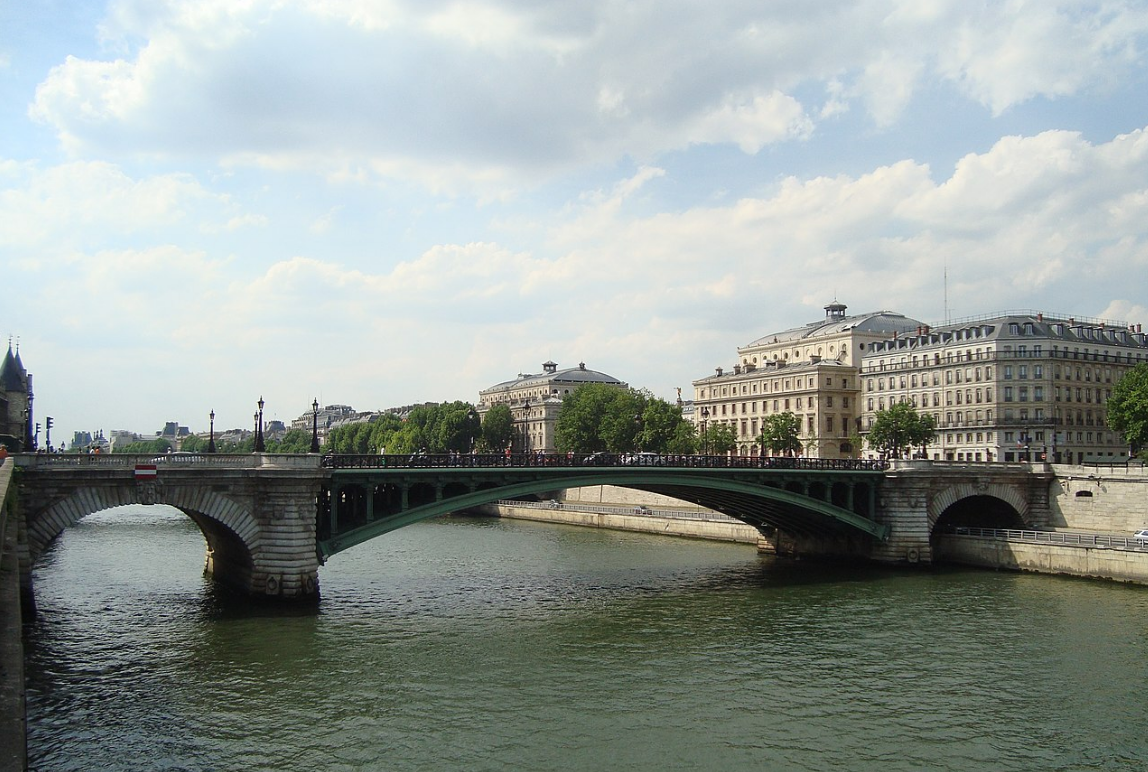
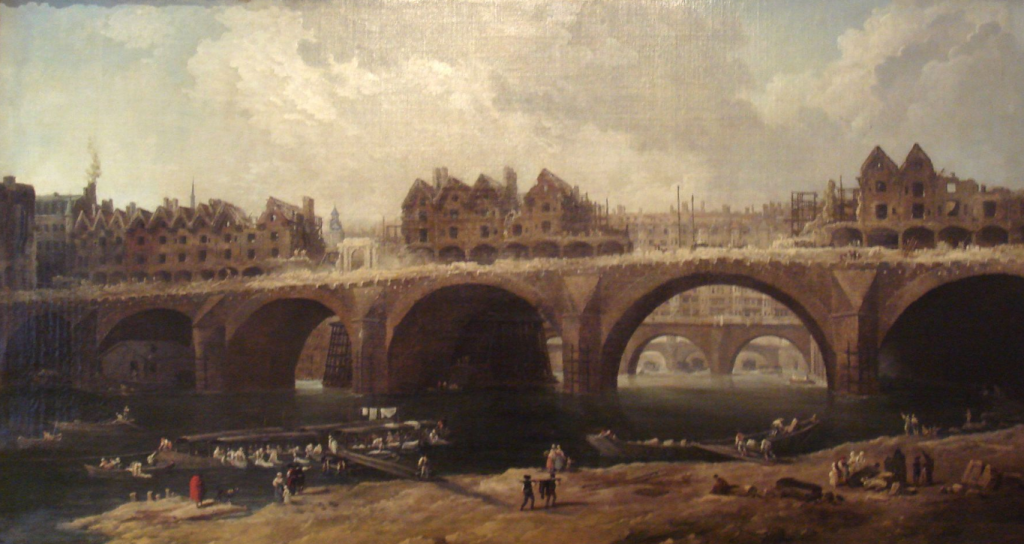
Today’s Notre-Dame bridge was built in 1853, and reduced from five to three arches in 1912. But the Romans built the first bridge here as part of their North-South axis across the Seine. That bridge lasted until 886, when it was replaced by a bridge built on wooden piers, to which were attached flour mills. This survived until the floods of 1406, and its wooden replacement until the flood of 1499. Its stone pier follow-up was finally completed in 1512, and its 61 six-story houses became the most sought-after in Paris for shops, stores and prestigious living.

By 1786 the houses on the bridge were in such a bad state of repair that Louis XVI ordered their demolition. This did not make the bridge any safer for those on the river. The five arches were obstacles that gave the bridge its nickname: ‘Devil’s bridge‘.

It’s no surprise, then, that the end of the Bridge on the right bank (near the Town Hall) is where Victor Hugo decided to stage the suicide of Javert, the fictitious representative of law and order without any humanity, in Les Misérables.

Rue St Merri

Arrondissement 4

Numbers: 49

Built shortly after the construction of the Philippe Auguste wall around Paris in 1210, it was named after the nearby Saint-Merri church.

Charles Jeanne was one of the leaders of those defending the last barricade across the road at No. 49 to fall in the 1832 insurrection. His memoir of the revolt written in letters to his sister from his prison on Mont Saint Michel was used by Hugo in Les Misérables.

He had been awarded the July Medal by the government of Louis-Philippe for his bravery during the July Revolution of 1830.

Place de la Bastille

Arrondissements 4, 11, 12

Numbers: 12

Called after the ‘small fort’ originally built next to the St Antoine gate into Paris and then turned into a stone fort in 1370, the Bastille soon became a six tower fortress with thick walls and a moat. By 1553 it was an eight-tower fortress with a copper-bottomed moat. In the 17th century it was turned into the prison that was eventually taken by Paris’ newly-formed militia and local people on July 14 1789.

One of the wine merchants, Claude Cholat, who participated in the storming of the Bastille sketched the scene from memory a few days later

Demolition began almost immediately. Voltaire’s coffin was symbolically brought there on its way to the Pantheon on July 11 1791.

In 1792 it was decided to turn it into a huge square, the Place Antoine. The Marseillais volunteer national guardsmen arrived there singing the song that became the national anthem on July 30 1792.

From June 9 to June 14 1794 the guillotine was installed in the ruins of the fort. But after killing 73 people in less than three days the local shopkeepers complained so much (about the smell and those who had come to watch) that it was moved to what is now called the Place de la Nation, and was then the Square of the Overthrown Crown.

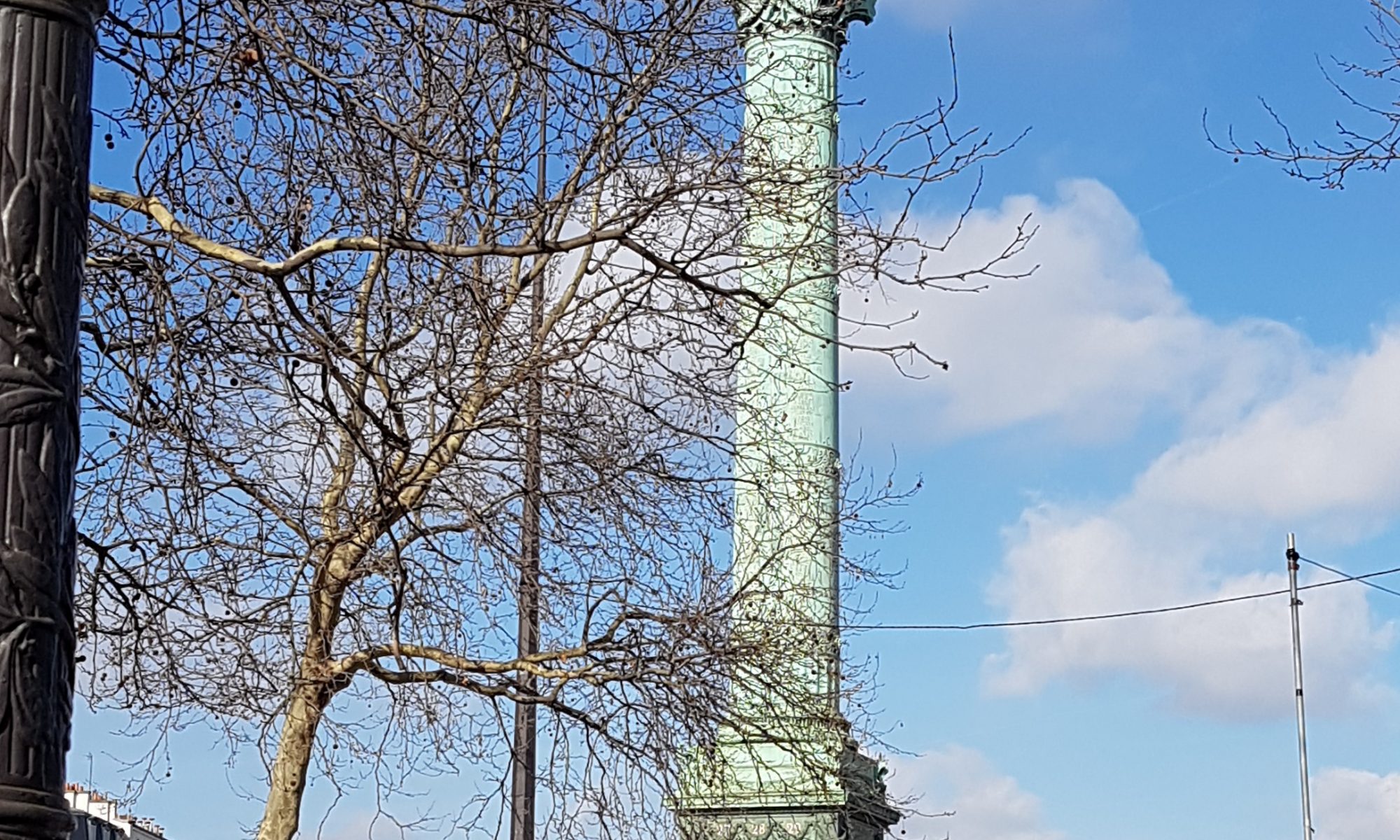
After the 1830 Revolution the new King Louis-Philippe decided to erect a column in the middle of the square to honour the 615 victims of the ‘Trois Glorieuses‘ Revolution – the Three Glory Days. It was inaugurated in 1840.

On April 13 1834 barricades went up in the square as local workers rioted in support of the silk workers’ insurrection in Lyon.

On February 24 1848 Louis-Philippe’s throne was taken from the Tuileries Palace and ceremoniously burnt at the foot of the July column. Three days later the 196 dead in the February Revolution were buried in the crypt beneath the column, and the Second Republic was officially proclaimed there.

On June 24 1848, when the new right-wing government announced the dissolution of the National Workshops, the Bastille square was entirely circled by barricades, and a red flag placed in the hands of Dumont’s 1836 allegorical statue le Génie de la Liberté flew briefly from the top of the July Column to accompany the flame of freedom and the broken chains of despotism.

Dumont’s statue is of a winged male god – chosen probably precisely because it was not the traditionally feminine revolutionary with a phrygian gap – in keeping with the rightward direction of the Orleans monarchy. The names carved on the column are of the dead of 1830.

A red flag flew again on top of the column on February 24 1871, when 14 battalions of the National Guard marched by in a commemoration of the 1848 revolution. The government’s attempt to replace the flag by the Tricolour on February 26 and March 9 1871 both failed.

During the 1871 Paris Commune three local sections of the International Workingmen’s Association used to meet in the Cour Damoye at No. 12.

On May 25 1871 when the Versaillais troops entered Paris the Communards tried to blow up the column by setting fire to five oil delivery barges in the tunnel that runs beneath it. This failed, and the column was also missed by shells fired at it, although nearby buildings were hit.

The Communards fought hard to defend the symbol of revolutionary liberty, but were eventually overrun by the Versaillais. During the bloody week of May 1871 nearly all were killed in the fighting or shot afterwards.

The Place de la Bastille became the symbol of left and republican resistance.

The first Parisian demonstration of Communards after the suppression of the Commune took place at the Bastille square on May 9 1880.

In 1935 two major demonstrations took place there. On International Women’s Day 1935, feminists led by Louise Weiss and Cecile Brunschvicg symbolically burnt chains of male dominance in the square.

On July 14 1935 a demonstration that brought together both Socialists and Communists marched from the Bastille to Vincennes. This was called under the name of ‘People Together’ (Rassemblement populaire) that became the Popular Front that won the 1936 parliamentary elections.

On May 29 1968, the day De Gaulle temporarily left France, the CGT trade union organised a mass demonstration against his government, shown here in a police surveillance photograph passing the Place de la Bastille

Since 1991 the Marche de les Fiertes have usually begun or ended at the Place de la Bastille. In the 21st century they have usually attracted at least half a million people. There were certainly about that number when Marian and I watched for hours as the marchers went by.

The 50th anniversary Paris gay pride march June 24 2017
The first Gay Pride march in Paris in 1981 passed through the Place de la Bastille.

PLACES

Rue Charlemagne

Arrondissement 4

Number 13-14

A short very old street that used to run along the Philippe Auguste wall around Paris, it was once named ‘the street of the Priests of Saint-Paul’. It was renamed under Louis-Philippe in 1844 after King Charlemagne, the French king who became Roman Emperor in 800 AD. Bits of the old wall remain at numbers 9 and 15.

Among the men who attended the Lycée Charlemagne at Nos. 13 and 14 were Blanqui, Blum, Ledru-Rollin , Leroux, Jospin and in 1816 Honoré de Balzac.

PLACES

Rue des Francs-Bourgeois

Arrondissements 3, 4

Numbers: 14-16, 25, 43, 50, 60, 61

The road gets its name from the alms houses for the respectable poor whose income was too low to pay taxes – the ‘road of the well-to-do who were too poor to pay taxes’. They were built where Nos. 32 to 36 are today, probably in the 17th century. Before then it was called the road of old pulleys (Rue des Viez-Poullies). Part of the road was renamed the Rue des Francs-Citoyens during the French Revolution.

The road still shows off several of Paris’ oldest buildings and now separates the third and fourth arrondissements. At Nos. 14-18 you find the Carnavalet Museum of Paris’ historical collections the museum’s official address is at No. 23 Rue de Sévigné.

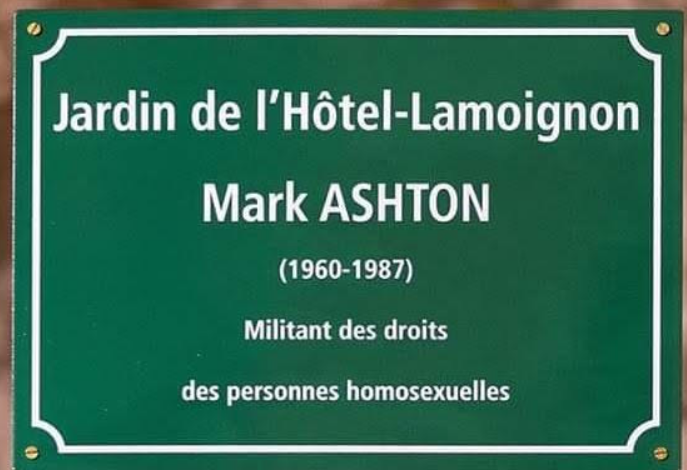
No. 25 is the best-preserved huge aristocrats’ town house, the Hôtel de Lamoignon. It is now a public library of the history of Paris, and its garden, first opened to the public in 1969, was renamed on September 25 2018, my life-long friend Rich Clarke points out, the Jardin de l’Hôtel-Lamoignon – Mark-Ashton.

Most of Ashton’s admirers overlook his strong Communist beliefs and his being active in Red Wedge and then becoming virtually the last General Secretary of the British Young Communist League in 1985.

Mark Ashton was a member of the Islington Branch of the CPGB before the 1984-5 miners’ strike, when he founded Lesbians and Gays Support the Minters the British founded. The garden at No. 25 was renamed in his honour by the Paris Municipal Council on a motion moved by its French Communist Party members.

The street displays vestiges of the Philippe August wall at Nos. 31-33 and No. 57 and several other grand town houses.

On May 12 1839 what was then the Town Hall of the 7th arrondissement at No. 43 was caputred by the Society of Seasons insurrectionaries. Barbès, Blanqui, Martin Bernard and Albert Laponneraye are all linked to its seizure.

When the SFIO and then PCF theoretician Charles Rappoport first arrived in Paris from Russia in 1895 he lived at No. 50.

The magnificent private mansion built on the site of the Hôtel de Guise at No. 60 was known as the Hotel de Soubise. It became the National Archives in 1794 and was saved from being burnt down by shell fire from the Versaillais troops attacking the barricade at No. 61, and by the 125th battalion of the National Guard of the on May 25 1781 by Louis-Guillaume Debock and André Alavoine. They were later pardoned for their support of the Commune because of their actions that day.

While he was studying at the Lycee Charlemagne in the 1880s, Leon Blum lived as a boarder in the Rue des Francs-Bourgeois.

PLACES

Quai d’Orléans

Arrondissement 4

Number 6

The Polish Library at No 6 Quai d’Orleans was used by Rosa Luxemburg.

This is the Polish Library on the Île  du Cité where between 1893 and 1897 Rosa Luxemburg spent time researching her doctoral thesis on the ‘Industrial Development of Poland’. 

Visiting it in 2018 with Marian I couldn’t find any references to Luxemburg’s presence, and none to the relevance of Poland and international solidarity for France in 1848. It has a small Chopin exhibition includes some images of his French lover, George Sand. It also contains an historical exhibition with an account of key 19th century Polish nationalist figures.

PLACES

Rue Quincampoix

Arrondissement 3, 4

No-one knows reliably the origin of the name of this really old road. It was already called the rue Quiquempoist in 1292.

Looking up rue Quincampoix from the corner with rue aux Ours, where Blanqui was shot in the neck in 1827

From a left point of view it is notable simply because you can imagine Blanqui and other young men using the narrow street to their advantage when fighting the cavalry and soldiers in November 1827. That was where, on the corner with the rue aux Ours that Blanqui was shot in the neck at the demonstration against Charles X that took place celebrating the high vote for Republican candidates in the Paris elections.

This was also the street where in preparation for the 1839 Four Seasons insurrection,
Barbès had left a trunk of cartridges with a friend, Mme Roux. She wasn’t at home on the afternoon of Sunday May 12 when the insurrection was launched, so Barbès broke down the door to get hold of it. He then led a few hundred of the insurrectionists down the street and to the banks of the Seine shouting ‘Down with Louis-Philippe – Long live the Republic‘.

Looking to the West along the rue Quincampoix from the rue des Lombards. This is the direction from which Barbès and his column of armed insurrectionists marched down on May 12 1839. This photograph was taken by Brassai in 1932

PLACES

Rue Rambuteau

Arrondissements 1, 3, 4

Numbers: 19, 54, 102, 108

Rambuteau around 1900

The road runs West to East from the Sainte-Eustache church (shown above at 6 am in the morning in 1900 looking up the road from the northern edge of Les Halles) to the Rue des Archives.

Building began in 1838 and in 1839 it was formally named the Rue Rambuteau to honour the Seine department Prefect from 1833 to 1848. Claude-Philibert Barthelot de Rambuteau who initiated its construction with the widening of streets in central Paris to 13m.

The kilometre-long east-west was conceived after the 1832 cholera epidemic had proved the case made by the hygienists to pull down many of the Paris’ narrow medieval streets. Its tearing up a sizeable area of old Paris stimulated one of the first Parisian housing speculation spikes.

One of the original Rambuteau-prescribed street number tiles (white numbers on a blue background) is still above the door at No. 58

One of the streets knocked down and merged into the road was the Rue de la Chanverrerie where, at the junction with Rue Mondétour, at approximately No. 102 Rue Rambuteau, a barricade was built on June 6 1832. This was where Victor Hugo placed the Caberet Corinthe and the death of Enjoiras in Les Misérables.

Several other barricades appeared in the road in the early days of the February Revolution and again during the June days of 1848. Fighting also broke out on December 3 1851 as some tried to resist the seizure of power by Louis-Napoléon Bonaparte. 

The cafe on the corner with the Rue du Temple at No. 19 used to be a favourite restaurant of Russian Nihilist exiles in the late 19th century. Trotsky and Lenin met there early in 1903.

On April 28 1848, after the shift against radical republicanism, Armand Barbès held a meeting of the Club de la Revolution at No. 54, the home of Citizen Furet. Barbès had set up as a more ‘moderate’ alternative to Blanqui‘s more insurrectional Société républicaine centrale, and this meeting discussed the election results and set in motion the attempted insurrection of May 15.

A personal interest of mine is that No. 108 was built on the birthplace of the adventurer cum comic poet Jean-François Regnard. On August 10 1779 his name was given to the second shortest-street in Paris next to the newly-built Odéon Theatre. This street was where my father James Jefferys (1914-1996) lived nearly half his life.

Plus d’informations

PLACES

Rue Le Regrattier

Arrondissement 4

Number: 1, 22

On the St Louis island this very narrow street was built between 1614 and 1646 and named after François Le Regrattier, the wealthy treasurer of the Swiss Guards, the mercenary soldiers who served the kings of France from 1471 to 1830. He and two developers were awarded the contract to build on the Island. Its current length was decreed in 1868 when it incorporated the ‘Headless Woman Road’ (La rue de la Femme sans Tête).

1 Rue Le Regrattier

No. 1 at the southern side of the Island, in a prime location with a view of Notre-Dame, contained the apartment belonging to the heiress of the Cunard Lines, Nancy Cunard. She had many lovers and from 1925 to 1928, Louis Aragon was largely living there with her.

Jules Guesde has one of the rare plaques for leftists in Paris, probably because he moved from being a ‘doctrinaire’ Marxist to joining the war government in 1914.

The founder of the French Workers’ Party. Jules Guesde (then Jules Bazile), was born in No. 22 on November 11 1845.

PLACES

Rue de Rivoli

Arrondissements: 1, 4

29, 31, 39-86, 39-41, 66-68, 98, 172, 182, 228, 248, 254

Rue de Rivoli about 1900

A lengthy 3 kilometre-long street, it was initially opened under Bonaparte in 1802 and 1804 and then extended by Haussmann between 1852 and 1860 to provide a major east-west axis for troop movements – as well as to attract high-priced speculative building developments.

It was first created and named in 1804 after Napoleon Bonaparte’s success over Austria at the January 14 1797 battle of Rivoli in Northern Italy and runs the whole way alongside the Louvre Palace and Tuileries Gardens.

The road’s most significant building is the Paris Town Hall at No. 29, the Hôtel de ville de Paris, which on several occasions over the last 250 years has also doubled as the location of the French government.

Blanqui’s headquarters on October 31 1870, when he unsuccessfully attempted to capture the Town Hall virtually opposite, was the National Guard’s Café, then called the Café du Gaz at No. 31.

His second, equally unsuccessful attempt on January 22 1871 was also headquartered at the same Café du Gaz. Under the Commune this was also the meeting place of the Central Committee of the National Guard.

When working in the Hotel de Ville in September 1871, Paul Verlaine describes using the Café as an ‘annex’ to his office and meeting Arthur Rimbaud there.

An important barricade was built across the street between Nos. 39 and 86 when the Versaillais troops entered Paris. The area saw considerable fighting on May 24 1871. In its aftermath some 200 Communards were shot without trial, and many were buried in quicklime at the Lobau (or called the Napoleon) barracks at Nos. 39-41.

Opposite, in the Square St Jacques, the surrealists led by André Breton and Paul Éluard used to meet after the publication of Breton’s L’Amour fou (Mad love) in 1937.

Where Nos. 66-68 stand today another barricade was erected in June 1848 on the now demolished Rue de la Tixanderie. The fighting there saw the Garde Mobile’s General, Duvivier, mortally wounded, as he defended the Hotel de Ville against workers protesting the government’s closure of the unemployed workshops.

On May 22 1871 there were some 900 barricades in Paris. This one, built in a day at No. 98, was 6 meters high, part of the defence of the Town Hall.

The history of No. 172 is pretty gruesome. During the Occupation the Hotel du Louvre there was the headquarters of the Heydrich’s SS Death Squads.

Perhaps in order to make detection less likely, two meetings of the National Resistance council took place at No. 182 in the spring of 1944 after the assassination of Jean Moulin and after several other resistance leaders had been arrested.

On the railings of the Tuileries gardens opposite No. 228 there is a plaque that marks the location of the National Assembly that met in the Salle du Manege (the riding school) there through the revolutionary days from 1790 to 1794.

Opposite No 228 Rue Rivoli is the plaque showing the approximate location of the old Salle du Manege riding school where delegates voted to execute the King and declare a republic. Some locate the riding school as covering the area between Nos. 230-232.

Ironically, No. 228 was also from 1848 to 1854 the home of Harriet Howard, the English red-haired mistress and financial backer of Louis Napoleon who, when he was Emperor, was given the title of Comtess de Beauregard, and ownership of the accompanying chateau.

During the Occupation of Paris the Hotel Meurice at No. 228 was also the headquarters of the German High Command. It was besieged briefly on August 25 1944 before its commander, Dietrich von Choltitz, surrendered.

On November 26 1941 the Youth Battalion resistance fighters of the French Communist Party exploded a bomb outside the offices of the German military bookshop at No. 248.

Among the first barricades built in both June 1848 and May 1871 were at the corner of No. 254 with the Rue St Florentin. Under the Commune it was one of just 18 that had canon defending them, and it was the only one not taken from behind.

The Versaillais troops used canon and mortars to clear the barricades on the Rue de Rivoli in May 1871

MAP

Rue de Roi de Sicile

Arrondissement 4

Numbers 2-4

The only physical remains of the Prison de la Force in the rue de Roi de Sicile. Many aristocrats were placed before their executions in September 1792. Later it was a holding prison for opposition figures on short sentences such as Pierre-Jean Béranger and Blanqui .

In 1780 the huge 16th century town house at numbers 2-4 that had once belonged to the Duc de La Force was bought by Louis XVI and rebuilt as a modern prison in two sections, one for men and the other for women. Under the French Revolution it became a holding prison, and from 1815 to 1828 a prison used mainly for prostitutes.

In 1828-29 Pierre Jean de Béranger, the Georges Brassens of his day, a highly popular song-writer critical of Charles X was jailed there.  In 1831 this was where Blanqui entered his first prison.

Falling down and dirty and disease-ridden the prison was demolished in 1845, with just one wall still surviving in the rue Mahler, where it now joins the Historical Library of the city of Paris.

PLACES

Boulevard de Sébastopol

Arrondissements 1,2,3,4

Numbers 3, 48, 62-64 (site of 22 Rue du Bourg l’Abbé), 83

In 1854 the boulevard was initially built as part of Haussmann‘s redesign of Paris as the Boulevard du Centre. Half-way between the Rue Saint-Denis and Rue Saint-Martin roads that were closely associated with barricades and insurrections, it involved relatively little demolition of existing buildings and created a 30m wide road along which troops and canons could be easily moved.

Almost immediately it was renamed Sébastopol after a year-long seige finally ended in the successful storming of Sebastopol on September 8 1855 by a joint Franco-British force during the disastrous Crimea War.

The pharmacy shop Cannone at No. 48 on the corner with the Rue aux Ours was the main distribution centre for the underground resistance papers Valmy et Résistance. Initially, from the autumn of 1940 one of the staff, Roger Lardenois, used its huge storage area to hide and then distribute Valmy.

64-66 Boulevard Sebastopol is the location of the Lepage Frères arms depot, before 1854 it was 22 Rue du Bourg-l’Abbé. The warehouse was pillaged by a few hundred men from the secret Seasons Club set up by Blanqui and Barbès for weapons and ammunition on May 12 1839. Many carried three or four pistols and rifles out with them. .

The Lepage Brother’s gun shop in the 1830s just round the corner from their store room in the now disappeared road Bourg-l’Abbé
The site of the Lepage Frère armoury at 22 rue du Bourg de ‘Abbb , now 62-64 Boulevard ~Sebastopol

PLACES

Rue du Temple

Arrondissements 3, 4

Numbers: 63, 79, 106, 158, 191

From the junction of Rue-du Temple and Rue de Turbigo looking at the Place de la Republique

One of Paris’ oldest streets it now runs for 1.3 km from the Rue Rivoli up the the Place de la Republique, with the Square du Temple garden created in 1857 leading off it at No. 158.

The name Rue du Temple comes from the Templars district, a large area of land given to the Knights Templar military religious order around 1170. In 1240 the 50 metre high keep was built within a walled enclosure. It initially housed the king’s treasure, and then became a prison. Its most famous occupants from August 13 1792 were Louis XVI and his family.

On December 18 1795 Marie-Thérèse Charlotte de France, their daughter, was the only Bourbon to leave the Tower alive and without a trip to the guillotine. Louis XVI was guillotined on January 21 1793. Marie-Antoinette on October 16 1793. Elisabeth, the king’s sister, on May 10 1794. Louis, the king’s son, died from tuberculosis in the keep on June 8 1795.

On June 29 2017 the Square’s name was changed to Square du Temple – Elie-Wiesel in honour of the human rights campaigner and Holocaust survivor.

In 2007 the incumbent Socialist mayor from a Jewish Polish family erected a Stele in the Square to commemorate the 85 Jewish children of the Third Arrondissement who, under the age of six, had been arrested by the French police and deported to Auschwitz, never to return.

The Templar Tower was knocked down by Napoléon Bonaparte in 1808 partly to prevent Royalist pilgrimages to the site and partly, some argue, to spare his future wife, the sight of her aunt’s last address. The garden and Square was one of 24 laid down under Haussmann’s plan for giving Parisians a little more air.

On February 27 1871 the Square at No 158 was the meeting point of the National Guardsmen on their way to the Champs-Élysées to try and stop the Prussians from entering Paris. Every Saturday during the Commune the band of the National Guard played there to raise funds for the widows and children of men who had died in the war.

Former soldiers who had joined the Commune and foreigners were the first to be executed in the Square on May 25 1871.

The statue by Amadee Doublemard of the popular anti-monarchist poet Pierre-Jean de Béranger that was placed in the Square at its inception was melted down in 1942, but replaced by one in stone by Henri Lagriffioul in 1953.

Women Communards such as Elisabeth Dmitrieff and Nathalie Le Mel used to meet in a women’s club at the Grand café de la Nation  at No. 79, the 17th century Hotel de Montmor. On International Women’s Day March 8 2007 under the recently elected Socialist Paris mayor, a small triangular square at the meeting point of the Rue du Temple and the Rue de Turbigo was named the Place Elisabeth Dmitrieff. It is just outside the entrance to the Temple metro station.

In October 1870 Blanqui was in hiding at No. 191. The flat belonged to Eugène Cléray, a clockmaker and follower of Blanqui who was deputy mayor of the Third arrondissement during the Siege of Paris. Blanqui stayed in the flat on October 31 before going to the Hotel de Ville to see how the insurrection against the new republican government’s indifferent handling of the war with Prussia was going.

Despite 15,000 demonstrating outside the Hotel de Ville for the resignation of the government and then occupying it, by the early hours of the next day it had failed. Blanqui then returned to No. 191.

Where the rue Rambuteau crosses the Rue du Temple at No. 63 there was a restaurant where the Russian Nihilists met in the late 19th century. Trotsky and Lenin also met there early in 1903.

During the occupation of Paris the Central Telephone Archives at No. 106, built in 1927-1928, was taken over by the Germans, and was one of their remaining strong-holds in August 1944.

Plus d’informations

MAP

Rue Vieille-du-Temple

Arrondissements 3, 4

Numbers: 87, 131

The road dates back to 1250 when it led from the north towards the gardens of the Knights Templar fort and its tower on the inside of the Philippe-August wall. After the Charles V wall was built both parts of the road, inside and outside the old wall became the Old Temple Road.

Like many during the workers’ insurrection of June 1848, the road was barricaded without anyone today knowing its exact location.

On December 2 1851 the workers in the National Printworks at No. 87 were forced by the army supporting Louis-Napoleon’s Coup d’Etat to print the poster announcing the dissolution of the National Assembly.

The 1705 Rohan Private Mansion on the left was nationalised under the French Revolution and turned into the National Printworks by Napoleon in 1808. This use by the state ended in 1924, and after being used by the National Archives for many years at the time of writing (2020) its interior is being restored to 18th century style.

On March 18 1871 the tables were turned. The 86th battalion of the National Guard took over the National Printworks to defend the Paris Commune and Louis Debock, a typesetter, took over the directorship at No. 87.

The Worker Albert was arrested at his home in No. 131 in January 1841 following police enquiries into the assassination attempt on Louis-Philippe on 15 October 1840. Finding communist pamphlets at the house he was jailed for a month for belonging to a Communist club.

Parisrevolutionnaire

PLACES

Hôtel de Ville / Paris Town Hall

Arrondissement 4

Number 10 Place de l’Hôtel de Ville

Jean-Victor Schnetz‘s painting of the July 28 1830 battle outside the symbolic Paris Town Hall shows both the Tricolor and a Red flag – with the words’ ‘Long Live the Charter’ on it. The July Revolution was about restoring a semblance of democratic bourgeois rights, with the threat of workers’ rights behind it.

Lamartine rejecting the red flag on 25 February 1848 in favour of the Tricolor representing the Bourbons (white), the Empire (blue) and the Republic (red).

At the next successful insurrection on February 25 1848, Henri Philippoteaux painted the republican Lamartine outside the Town Hall rejecting the Red flag and endorsing the Tricolor.

Citizens, for me, the red flag, I am not adopting it, and I’ll tell you why I’m against with all the strength of my patriotism. It’s that the tricolor has toured the world with the Republic and the Empire with your freedoms and your glory, and the red flag was that around the Champ-de-Mars, dragged into the people’s blood.

Alphonse Lamartine

On March 22 1848 a delegation of women activists from the ‘Women’s voice’ group went to the Town Hall to demand women have full citizens’ rights including the right to vote.

On May 15 1848 demonstrators against French intervention in Poland, including Blanqui, the worker Albert, Blanc, Cabet, Leroux and Raspail occupied the Town Hall and declared a new provisional government before being arrested.

Lamartine went on to order the brutal suppression of the June 1848 workers’ insurrection sparked by the government’s closing of the world’s first unemployment system with national workshops offering work paid by the state.

On September 4 1870, after Napoleon III’s capture at the battle of Sedan, Léon Gambetta stood on the Town Hall balcony and announced the end of the Second Empire and proclaimed the creation of a new Republic.

On 31 October Blanqui and others demonstrated in front of the Town Hall demanding more action against the Prussian army from the new government led by Jules Favre. A supporter on the inside unlocked the doors and the demonstrators occupied it.

On January 22 1871 Louise Michel was one of many who protested outside the Town Hall at the government’s inertia in face of the Prussian siege of Paris. the demonstrators were fired on and Louise Michel later wrote that this was the first occasion that she had fired back with her rifle.

On March 18 1871 the Thiers government first placed a regiment loyal to to it into the Town Hall overnight, and then attempted to seize all the canons in Paris. These events sparked the creation of the Paris Commune by the Central Committee of the National Guard on March 29 1871.

Retreating before the murdering Versaillais troops the Communards carried out their warning that they would burn down several of Paris’ historic buildings, including the Hotel de Ville

More Info / Plus d’informations

PLACES

Place des Vosges / Place Royale

Arrondissement 4

Numbers: 6, 14

When this impressive square was first built under Henri IV between 1605 and 1612 in the then fashionable aristocratic Marais part of Paris, it was called la Place Royale. The King’s mansion on the south side and the Queen’s on the north (although they never lived in them) were higher than the 36 private mansions around the rest of the square . All of the other houses had similarly designed fronts.

During the French Revolution the square was renamed several times. The names changed from the Fédérés  square (after the 1790 Federation celebration on the first anniversary of the storming of the Bastille), to « place du Parc-d’Artillerie and then Place de la Fabrication-des-Armes, and then Place de l’Indivisibilité (referring to the administrative unification of four Paris districts in 1795).

Finally, in 1800 it was given its current name Place des Vosges in honour of the French Vosges Department that had been the first in 1792 to send the taxes it owed to the republican government. During the Restoration (1815-1830) and under Louis-Napoléon’s Second Empire (1852-1870) the name went back to Place Royale, and from March 20 1848 until 1852 it was known as the Place de la République.

In February 1871 several canon were moved for safe-keeping by the National Guard into the square. On March 11 1871 Jean Allemane persuaded the National Guard not to allow the Versailles troops to take the artillery back under their control. The same thing happened again on March 14 and on March 16.

Victor Hugo lived at No. 6, now a fascinating museum, from October 1832 until 1848. The American author with an amazing knowledge of Paris, Cara Black, reproduces a common error concerning Hugo. In her opening tour of Paris novels, Murder in the Marais, her super impressive detective Aimée Leduc hides in the museum at No. 6. Black writes: ‘The (dining) room captured his essence, dark and narcissistic. The only touch that could be called socialist was the heavy peasant glassware on a mahogany sideboard’. Hugo was actually a royalist who converted to becoming a principled republican. His wife Adèle Foucher (1803-1868) lived at No. 6 with him. On February 16 1833 he began a life-long relationship with Juliette Drouet (1806-1883).

The town hall (from 1793 to 1860) at No. 14 of what was in 1848 the 8th arrondissement was taken over by the insurrectionaries on February 24 1848, supported by the local National guard. They disarmed the municipal police.

Four months later, on June 23 during the workers’ insurrection against the closure of the National Workshops, the insurrectionaries again took over the Town Hall and raised a Red Flag over it. Some 350 regular soldiers put down their weapons.

My father, whose dying wish was to for me to get him a copy of a late Georges Simenon novel that had finally appeared in paperback, probably didn’t know that before the Second World War when Simenon had lived at No. 21 (first on the ground and then on the first floor), his neighbour was called Maigret.

On June 8 1942 two members of the Second Jewish Section of the FTP-M.O.I, Léon Pakin and Élie Wallach, were arrested in the Square as they prepared to sabotage a furrier’s workshop who was supplying the German army. Pakin and Wallach were shot on July 27 at the Mont-Valérien prison fort.

Plus d’informations

PLACES