This Paris street widens as you walk up it towards the Luxembourg Palace in the Rue Vaugirard. It was once the home of several of France’s wealthiest people who built small palaces outside the confines of the inner Paris wall.
But it also has a left history. André Gide lived at No. 2 for eight years, from 1875-1883.
Ledru-Rollin lived at the Hotel de Montmorocy in June 1848. Alphonse de Lamartine stayed in the same mansion.
Next door, Alexandre Ledru-Rollin at the Hôtel de Montmorency at No. 4, was followed to his home from the assembly on June 24 1848 and threatened with death after he was denounced for being too supportive of the workers’ insurrection. Sharing the same address at the time was Lamartine, another leading campaigner for the extension of the suffrage.
Jacques Prévert moved to the fifth floor of No. 5 for a year in the winter of 1910 when he was ten years old. Fifteen years later he married Simone Dienne, three years younger than him, whose family lived on the ground floor in 1910.
In 1840 Charles Fourier, the early utopian socialist, edited the revue in the offices of La Phalange (sucessor paper to the Phalanstère) at No 6.
During the 1848 revolution, the anarchist Bakunin stayed at the Republican Guard barracks at No. 10.
In May 1871 the barracks offered a different menu: it was where some Communards fighting in Paris’ National Guard were court-martialed during the bloody week.
The Foyot Restaurant at 33 Rue de Tournon before its demolition in 1938 was a favourite haunt of senators and Parisian personalities. It had been bombed in 1894 with the damage visible in the Rue de Condé on the other side of the restaurant shown in this photograph.
The Foyot restaurant that was bombed in 1894 where Laurent Tailhade, ironically a supporter of the ‘propaganda by the deed’ anarchist movement, lost an eye was also used by the painter Gustave Courbet and other Commune supporters in 1871.
A scandal broke out at Foyot shortly before Verlaine died when in rags he was invited to dine there by a symbolist poet and dandy.
Initially bits of the boggy land on a narrow country lane through Abbey land were sold by Saint-Germain-des-Prés Abbey to builders, and it was called the Saint Sulpice lane in 1517. The road was soon renamed Rue de Tournon in 1541, after Cardinal François de Tournon (1489-1562) who ran the abbey.
Under the Second Republic in 1849 the government decided to allow the road to take its current unique bell-shaped dimensions, running from 13.5 meters wide up to double that when opening up to the Luxembourg Palace.
A broad tree-lined road just to the south of the Farmers’ general tax wall, it was opened by a royal decree in 1833, and named after an early 18th century peer of the realm who had a rare reputation for honesty in his post as Prévôt des marchands de Paris (Paris’ Prefect for Commerce, the equivalent of today’s Mayor of Paris).
Its most remarkable building is a huge, historic secondary school, the Collège-lycée Jacques-Decour, where Lucie Aubrac was nominated to teach in 1946.
The Collège-Lycée Jacques-Decour viewed from the North, with the Boulevard des Batignolles in front of it and the Avenue Trudaine on the other side.
The school was originally founded in the 15th century as the Sainte-Barbe college of Paris University. Its current building was moved there by Haussmann and constructed between 1867 and 1876 on the site of the old Montmartre abattoir.
The name was changed in 1944 from Rollin (the name of an 18th century historian) to Jacques Decour, the resistance pseudonym of Daniel Decourdemanche (1910-1942), who had taught German at the Lycée since 1937.
Decourdemanche had joined the Young Communists and then Communist Party. His first book called Philisterburg after teaching in 1932-33 in Germany denounced the risks of nationalism and racism.
Every year his goodbye letter to his parents is read in the school where his parting words were:
I consider myself a little like a leaf that falls from a tree to help become soil. The quality of the soil depends on that of the leaves. I am talking about French young people.
Daniel Decourdemanche’s headstone in Montmatre Cemetery
The Tuileries Garden shown in the foreground of this 1615 map. The Salle de Menage whose location today is on the Rue Rivoli is at the bottom left.
Like the Tuileries Palace (built in 1564) the garden was named after the tile-making factories that were established there in 1372 next to the 15-20 (300-bed) Quinze-Vingt hospice on the Rue Saint-Honoré. Its blind pensioners’ principal job was to pray for the souls of the donating royals.
The Tuileries Palace photographed in 1850 from the courtyard of the Louvre before it was burnt down in 1871 and the ruins removed in 1883. The Arc du Carrousel (1808) is in front of it and the Arc du Triomphe in the distance
Paris’ oldest and largest garden was established by Catherine de Médicis after she had ordered the building of the Tuileries Palace. Redesigned by André Le Nôtre in 1664 it was opened to ‘good people’ by Louis XIV.
Effectively abandoned by Louis XIV for Versailles from 1672, the Palace was used only briefly by Louis XV from 1716 to 1722, so much of the garden has been used as a public space for over 350 years.
On Sunday July 12 1789 Paris learned that Louis XVI had dismissed his finance minister, the constitutional monarchist banker Jacques Necker. Within hours the king’s Swiss Guard were ordered to disperse a demonstration in the Tuileries Garden.
The storming of the Bastille is triggered by the charge of the dragoons on people in the Tuileries Garden, painted here in 1789-1790 by Jean-Baptiste Lallemand
The grand basin in the Garden was the setting for Robespierre to torch a floating monster called Atheism on June 8 1794 to reveal the statue of Wisdom at the start of the Festival of the Supreme Being. During the French Revolution the Garden was called ‘The National Garden’.
Before his coup d’ État overthrowing the Directorate on November 9 1799 (18 Brumaire an 8) Napoléon Bonaparte bivouacked his troops in the garden. This was also where the Austrian and Russian occupying troops set up their encampment in 1814.
Beneath the South side of the garden running parallel to the Seine, what is now the Terrasse du Bord de l’Eau, there were tunnels beneath the Palace. This was where prisoners were murdered both during the suppression of the June 24 1848 uprising and again after Louis Napoléon’s coup d’ État of December 4 1851.
On May 15 1871 during the Paris Commune a battalion of 2,000 armed women paraded through the garden.
On May 23 1871 the Communards carried out the threat they had made to set fire to several historic buildings in Paris if the Versaillais troops continued their advance. 12 men set the Tuileries Palace, Napoléon III’s Paris base and the location for the National Convention in 1793, on fire. Using petroleum and liquid tar it didn’t take long to burn down. The Flore pavilion on the right partly survived and is now a part of the Louvre museum. The remains of the Palace were finally removed in 1882.
Several defenders of the Commune were then killed on the Terrace next to the river on May 24.
During the Second World War the Jeu de Paume museum was used by the Germans as a storage depot for seized artworks. Between November 1940 and November 1942 Göring visited the museum 20 times to pick and choose paintings. On July 29 1943 the Germans burnt around 600 paintings seized from Jewish families on the Tuileries terrace.
The Rue d’Ulm, going south from the Panthéon, was opened on January 6 1807. It was named after the crushing defeat of the Austrian army by Napoléon at the Battle of Ulm between October 15 and 20 1805.
It is largely known because since November 4 1847 it hosted France’s most prestigious higher education selective university, the École normale supérieure (ENS) at No. 45. This special institution was initiated by Napoléon on March 17 1808 when he created a ‘standard boarding school’ (Pensionnat normal) within Paris university to train arts and science teachers. The students had to follow military rules and wear uniforms and were chosen from those who performed best in the secondary schools.
Louis Pasteur‘s laboratory was based there from 1864 to 1888, and was where he discovered a vaccine for rabies. The photgraph above shows the ENS in 1905.
From 1888 to 1926 the socialist Lucien Herr was the director of the ENS general library, with one of the students he influenced being Léon Blum. Herr also convinced Jaures there in 1898 of the innocence of Captain Dreyfus.
Perhaps the ENS’ most well-known left resident was Louis Althusser. He entered the ENS in 1945. Having passed the final exams with the highest marks, he began to work there from 1948, living in a staff flat provided by the ENS. This was where in 1980 in a fit of manic depression Althusser strangled his partner of 54 years.
In the aftermath of 1968 the Maoist group, La Gauche Prolétarienne (The Proletarian Left), held regular meetings in the Cavaillès lecture theatre. Among their leaders was Benny Levy. On October 21 1970 they used the ENS building to make Molotov cocktails.
A 12 metre-wide street originally built in 1826 under a royal decree, it was initially named rue Mademoiselle because of its proximity to the building that became the Matignon Palace/Hôtel , now the official residence of France’s prime ministers. The owner of the huge Hôtel at 55 rue de Varenne at that time was Mademoiselle Louise-Eugenie, the younger sister of Louis-Philippe. The name was changed to rue Vanneau (with two nn’s) in the initial democratic phase of King Louis-Philippe in October 1830.
The street was again renamed in 1873, as the right-wing Republican government sought to use name changes to reinforce its shaky legitimacy. So from rue Vanneau it became rue Vaneau (with one n) in honour of a student killed attacking the Babylone barracks during the Glorious Revolution on July 29 1830.
Although Karl Marx lived at both No. 38 and No. 23 in 1843-1844 and his first daughter, Jenny (who later married Charles Longuet), was born at No. 38 there is no commemorative plaque on either address. The offices of the review that had brought Marx to Paris, Annales franco-allemandes, were at No. 22.
The socialist senator and first female Senate vice-president Gilberte Brossolette (Bruel) was born at No. 24 in 1905. She married Pierre Brossolette in 1926 and worked as a journalist for the socialist paper, Le Populaire. From the autumn of 1940 the couple secretly held meetings in their home to create the first resistance group in Paris. In May 1942 after French police searches led to their teenage son being taken to Gestapo HQ, they crossed the demarcation line with their two children. Gilberte then sailed with the boy and girl to Gibraltar and from there took a cargo vessel to London, where she worked as the liaison between De Gaulle and the BBC.
Another left literary figure to have lived in the road was Félix Fénéon. He was still living with his parents at No. 26 when he got his first job at the Ministry of War in 1881 and soon afterwards began writing art criticism, book summaries, short stories and even a first draft of a psychological novel for a monthly journal that ran from October 1883 to March 1884.
The photograph above is from 1905, some 60 years after the Marx family lived a little further down the street.
You will see a plaque on 1b, rue Vaneau, where André Gide lived on the sixth floor from 1928 and died in 1951, and where he hid Albert Camus in another flat in the building in 1944.
This street is best known for No. 57, the Matignon Palace. The hôtel Matignon has been the official home of French prime ministers since 1922. In 1914, then the Austrian Embassy, it had been sequestered by the government who then bought it and what was Paris’ largest private garden in 1922.
Louis Aragon and Elsa Triolet rented a flat at No. 56, the Hôtel Gouffier de Thoix, from 1960 until Aragon’s death in 1982. The town house was built for the sister of the mistress of England’s Charles II between 1719 and 1727. Nationalised as the goods of foreigners during the French revolution, and then rented out, today it is used by the prime minister’s office.
From 1960 Louis Aragon and Elsa Triolet used their flat in the Hôtel Gouffier de Thoix at No. 56 as their Paris base, while spending much of their time at the old Villeneuve watermill that Aragon bought for Elsa in 1953 in the ancient Rambouillet forest to the West of Paris.
Under the Occupation, the German Military Court was based at No. 12.
Nearly a kilometer long this street is filled with huge 18th century private houses that have become government buildings, embassies and the house at No. 77, now a museum, where Rodin lived, in the hôtel Biron. This was built for a former wig-maker who became a housing speculator in 1727-1728, and was sold to the hero of the 1745 battle of Fontenoy, the General Biron in 1753. His nephew ended up on the guillotine in 1793.
Under the restoration the building was given to the catholic girls school, the Ladies of the Sacré-Cœur, and then taken back by the state in 1905. By then it was nearly falling down and scheduled for demolition.
77 rue de Varenne around 1900,. It was then a convent school. This was shortly before it was returned to the French state after the 1905 legal separation of the Church from Government.
Several artists then moved in temporarily, including Matisse and Jean Cocteau, as well as Isadora Duncan’s Dance School.
In 1908 Auguste Rodin moved in. In 1916, the year before his death, he promised to give his entire works to the state if it transformed the building into the Musée Rodin, and this was then voted on by the National Assembly and by the Senate. Rodin died in 1917.
Most probably the street’s Varenne name comes from a corruption of the French word garenne meaning a hunting reserve, suggested also by the nearby Rue de Bellechasse (the ‘great hunting’ street. In the 16th century the area was part of the forest attached to the Louvre Palace. it was originally cut through in the early 17th century, got its name in 1651 and was extended to its present length in 1850.
The Luxembourg Palace (Nos. 15-17) is the most well-known building in the old Roman road that is the longest street in Paris. The road now stretches 4.360 Km westwards from the Boulevard Saint Michel to the junction of the Boulevards Lefebvre and Victor on the inner ring-road called the ‘Petite Ceinture‘ on which route a small train used to run round Paris.
Rue Vaugirard is so well known that it also features as a possible building or hotel site in the French version of Monopoly.
The western end of the road was where, at Nos. 393 and 399 barricades were built across the street in March 1871 to prevent the Versaillais troops from entering.
The road’s name comes from the ancient village of Vaugirard, called after the mid-13th century owner of the land there, ‘Val du Girard’.
Among the tens of thousands who have lived in this old road are some who we feature in Left in Paris, often living alongside forgotten bits of left history.
The Trianon-hôtel, for example, at No. 1- 3 witnessed one of the first attacks by the resistance against a hotel requisitioned by the German army. The bombing took place on 14 November 1942 organised by thelargely foreigner and Jewish Francs-tireurs et partisans – main-d’œuvre immigrée(Fighters and partisans – Migrant Workers) group.
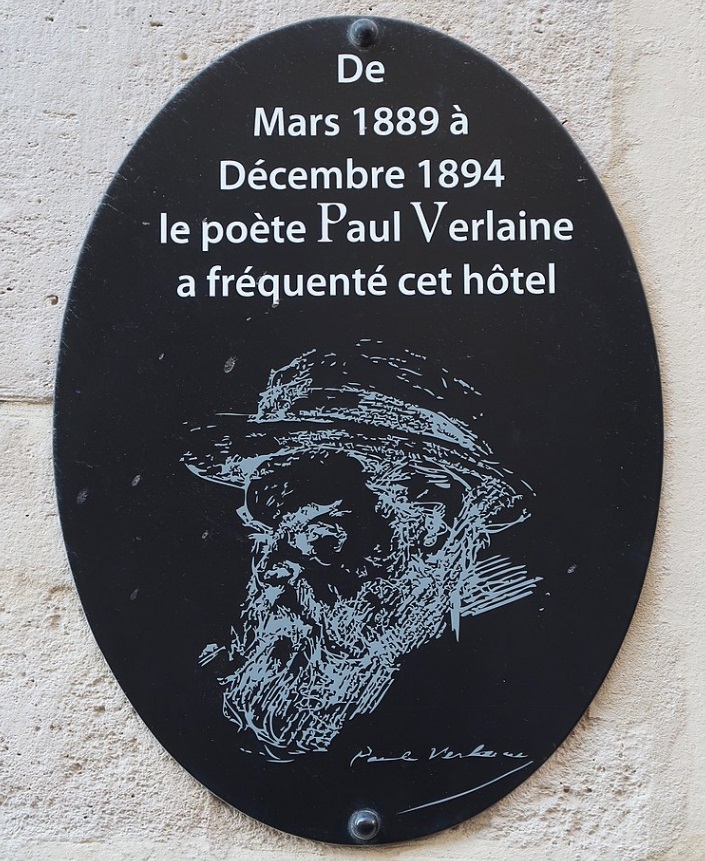
At No. 4, then called the Hôtel Lisbonne, Paul Verlaine lived off and on between periods in hospital from 1889 to 1894.
Today the hotel boasts of its earlier desperately poor and severely ill guest, and calls itself the Hôtel Fontaines du Luxembourg.
From 1906 Jacques Prévert lived at No. 7 and went to the school next door, No. 9.
I’ve very fond memories of the Vaugirard school where my son Michael spent a happy four months when he was ten. The area has completely changed since then. The school was constantly complaining about the bourgeois dog owners who allowed their absurdly small animals to deposit all over the surrounding streets as they walked them to the Luxembourg Garden. The disappearance of less well off and younger residents has led the authorities to close the whole school down in 2019.
The only good news is that the building hasn’t been sold off to developers. In 2023 the school is being occupied by the Cité Audacieuse and the ground floor and playground of the school is being run four days a week as a cafe by a feminist collective.
Émile Zola lived in rooms at No 10 in 1866 with Alexandre Meley whom he married in 1870.
After the5 metre high and 24km long tax wall was built under Louis XVI there were two customs posts across Rue Vaugirard. One was at No. 102 and another (la barrière du Maine) from Nos. 111-132. While unused during the Revolution, they were reinstated after the 1815 Restoration and only finally largely demolished in 1860 with the expansion of Paris to the Thiers walls, built in the early 1840s roughly 5km from the city centre.
Victor Hugo and his wife Adèle lived together at what was 90 rue de Vaugirard before the Rue de Rennes was built (after sharing with the in-laws in the Rue du Cherche-Midi). they lived from 1824 to 1827 in the bit of the road now numbered 86-88. This period of his life followed the anonymous publication of the 21-year-old’s first novel, Han d’Islande set in 17th century Norway.
In 1826 Hugo wrote and published his second romance novel, Bug Jarval, featuring exceptionally for the time a black slave insurrectionist in St Domingo as its hero who falls passionately in love with a white women.
Lenin sat for Naoum Aronson in his studio at 93 rue Vaugirard on December 10 1904. The bust was subsequently displayed in the Soviet pavilion at the 1937 World Fair in Paris.
On December 10 1904 Lenin sat for the Russian sculptor, Naoum Aronson (1872-1943) at his studio in No. 93.
When she first arrived in Paris around 1860, the feminist bookbinder and Communard Nathalie le Mel mother of three worked at Pasquier et Vigneau’s bookbinding works at No. 150 (in the 15th arrondissement).
A long way along the road was also where Michel Foucault lived, at no. 289 from 1970 until his death in 1984.
French measurementsof distance
MËtre Ètalon par Chalgrin
For the real historical nerds among us, in the wall at No. 85 is an early 18th century ‘half-league stone’. The Fleur de Lys on it was removed during the French Revolution. The marker (borne) indicates the first half-league (lieue) – that is 500 toises.
A toise was the distance between a man’s outstretched arms, approximately 6 feet) or 2 Km from the entrance to Notre-Dame cathedral. 1 lieue = 1,000 toises, or approximately 4 Km. A toise is the equivalent of the fathom in English, but in France it was used both on land and at sea.
At the French Revolution France still used hundreds of different weights and measures, originally derived from Roman units where the leuga (lieue/league) was the distance that a man can run in an hour. King Charlemagne (742-814) had added the pied du Roi (the King’s foot) and the toise. The pouce (inch) was the width of a human thumb, and was 1/12th of the pied du roi. The ligne (line) was 1/12th of a pouce, and the point (Truchet point in English) was 1/12th of a ligne.
After Charlemagne the fragmentation of France and of Europe accelerated. So distances varied from town to town, with the variation in 1 league (lieue) being from 3.268 km to 5.849.
On August 4 1789 a successful resolution from the Jacobin Club at the Constituent Assembly abolished all the privileges of the Crown, including its right to determine measures of distance and weight.
In 1790 Talleyrand proposed the drawing up of a Universal Measure, and the National Assembly proposed doing this jointly with the United Kingdom, who refused.
In 1791 a law established a Commission to establish the universal measure. They decided it should be based on a quarter of the length of a meridian and gave two geographers the task of measuring it exactly. They took seven years to measure the distance between Barcelona and Dunkerque.
This exercise was considered too long-winded for both military and political reasons. So on August 1 1793 the National Convention passed a decree determining the ‘provisional’ length of what in 1795 was named the metre. This was based on a millionth of the 1739-1740 distance measured by Lacaille from the North Pole to the Equator. It was exactly 3 pieds, 11 lignes and 44 hundredths of the principal toise then used in Paris.
Finally, on 7 April 1795, the new system of weights and measures adopted by the French National Convention were named: metres and grams. A metal metre-long yardstick embedded in marble was then placed in the wall at no. 36 rue de Vaugirard. And in a shop window at No. 215 there is an 1840 cast iron kilometre stone marking 3.5 km from the centre of Paris.
The old and new systems were used concurrently in France over the next half century. Metric leagues were used from 1812 to 1840 with one metric lieue = 4000 metres or 4 Km. The use of the old system was finally ended across the whole of France by the law of 1837.
But when in 1988 Joe, Joan and I bought a half-finished farm/barn in the Haute Savoie, and I had to finish off the plumbing, I can still remember the plumbing shop in Thonon-les-Bains where the width of copper pipes and joints were still in pouces (inches). In the UK metrication became government policy under Wilson in 1965 and in 1973, with accession to the European Economic Community, the UK was given 5 years to adopt metric units and by 1980 virtually no schools continued to teach in feet and inches.
Built in 1831 on an old path called the ‘Passage de l’Ouest‘ and owned by Alexis Vavin, a lawyer who became a politician and moved from being a liberal in the 1840s to becoming a monarchist in 1849, the street now runs from the Luxembourg Gardens to cut across the Boulevard Raspail and end on the Boulevard du Montparnasse.
An architectural draughtsman, Eugène Chemalé (1838-?), a mutualist and supporter of Proudhon, lived at No. 10. He was elected to the Paris committee of the International Working Men’s Association (IWMA) established in France in January 1865. At its first 1866 congress held in Geneva, he successfully opposed giving the State authority to educate children, unless their father could not do it. In February 1868 he was arrested and fined for participating in an illegal organisation.
During the Bloody Week of May 1871 a barricade was built and defended for two days against the Versaillais troops between Nos. 16 and 17. On 23 May, when forced to reteat, the Communards blew up their stock of ammunition.
Living in the Hotel Danemark in an exceptionally cold winter in 1940-41 gave more heat than Simone de Beauvoir’s grandmother’s flat.
After Sartre was called up in October 1939, Simone de Beauvoir moved to the Denmark Hotel at No. 21. Along with many other Parisians she fled the city in June 1940 and, after spending July to September back in her grandmother’s flat in the Avenue Denfert-Rochereau, she returned to the Danemark there during the harsh winter of 1940-41 because it provided a little heat.
This 1941 photograph shows the original step-like 1926 building at No 26 Rue Vavin that was declared an Historical Monument in 1975. It was designed by Charles Sarasin and Henri Sauvage, the leading art nouveau and modernist architect..
One of the few Communards with extensive military experience, the Polish General Jaroslaw Dombrowski (1836-1871) who was mortally wounded on the Rue Myrha barricade on May 23, lived at No 45. He too was a member of the IWMA. He had been given command over the Commune’s defences on the right bank.
The American leftist feminist and journalist, Louise Bryant, who married John Reed in 1916, and covered the Russian Revolution and aftermath, died in No 50. on January 6 1936.
On May 16 1871 Gustave Courbet endorsed the proposal by Félix Pyat to demolish the column in the centre of the Vendome Square and to melt down the bronze to use in making canon.
The statue of Napoleon had become the symbol of Napoleonic imperialism. It was first put up on August 15 1810 and was then taken down in 1814, replaced in 1831, thrown into the Seine in 1848 and finally restored by Napoleon III.
The column had been decorated in bronze melted down from the canons captured at the battle of Austerlitz. Its crowning figure, Napoleon, had not survived the Bourbon restorations of 1814-1815. Louis XVIII replaced it with the white Bourbon flag and then with the Fleur de Lys. He melted down Napoleon’s statue on top of the column to create the horse-backed Henry IV, founder of the Bourbon dynasty, on the Pont Neuf where it crosses the Island of the Cité.
Citizen Courbet pushing over the Vendome column as seen at the time by the latest version of the revolutionary satirical paper Le Pere Duchesne
During the defence of the Paris Commune in May 1871 a barricade defending the Headquarters of the National Guard at Nos. 11-17 was put up from No. 1 to No. 2 and across the Rue St. Honoré. The Versaillais troops took the barricades from the back by getting through the Hotel du Rhin at No. 4.
Félix Lepeletier, an aristocratic revolutionary, lived at No. 6 and allowed Babeuf, Buonarroti and others involved in leading the Conspiracy of Equals to meet there in March 1796. Félix’s older brother, Louis-Michel Lepeletier de Saint-Fargeau, had cast the deciding vote on the execution of Louis XVI, and that same evening, 20 January 1793, he was stabbed with a sword by one of the king’s former bodyguards.
Louis-Michel Le Peletier died soon after at his family house at No. 8 Place Vendôme. and his body was then draped over the pedestal of Louis XIV’s statue that had been pulled down in 1792. Louis XVI was guillotined the following morning.
The Jacobin painter, Jacques-Louis David, painted LePeletier on his death bed, and one of his students then produced this lithograph print of it. The sword pierces a piece of paper on which is written “I vote the death of the tyrant”, and as a tribute at the bottom right of the picture David placed the inscription “David to Le Peletier. 20 January 1793′
On 18 March 1871, when the Versaillais troops tried and failed to capture the canons stored on the Montmartre and Belleville hills, four battalions of National Guardsmen from Batignolles and Montmartre marched on the National Guard Headquarters at No. 7 and threw out the commanding officer put in place there on March 5, and installed their own commanders.
Jaroslaw Dombrowski, the Polish commanding National Guard General at its headquarters in the Ministry of Justice in Nos. 11-13, was mortally wounded on May 23 1871, when all the defenders were summarily killed.
One of the only 18 Paris barricades in May 1871 that was fortified with canons crossed from Nos. 23 to 26, the Barricade of the Rue de la Paix. It was defended by the 88th, 113th and 182nd National Guard battalions. Very few of the more than one thousand defenders survived the battle.
Chopin, the former lover of George Sand, died in his first floor flat overlooking the court at No. 12 in 1849.
The Ritz Hotel at No. 15, the former Hôtel de Gramont, was colonised by senior Germans and Vichy collaborators under the Occupation and its bar was famously liberated by Ernest Hemingway on August 26 1944, when he gave some American rifles to the arriving FTP. This was also where Princess Diana and Dodi Al-Fayed had their last meal together on August 31 1997.
The road was named after the Duke Henri de Bourbon-Verneuil, a son of Henry IV who was Abbott of the nearby St Germain-des-Pres abbey in 1640 when the road was first opened.
Jean Zay lived in a flat at No. 46 from 1934. His eldest daughter was born there in 1936, the year he became Minister of Education and Culture in the Blum Popular Front government.
There is now a rare plaque to a leftist on the wall outside the flat.
After facing increasing threats from La Cagoule, the undergorund fascist organisation, the Zay family moved to the Rue de Bourgogne.
This is a street that has witnessed many barricade battles. With the Sorbonne University at No. 1, it was the site of confrontations between the police and students in 1968 and 2006.
After the Sorbonne was forcibly evacuated by the police in May 1968The remains of the barricade across Rue Victor Cousin where it crosses Rue Cujas. On the right of the street the Pantheon Cinema was showing Albert Finney, Billie Whitelaw and Liza Minnelli in Charlie Bubbles.
In March 2006, after Sarkozy’s government introduced a law to force those under 26 to take whatever job they were offered and over the following two years, if they were dismissed by their employer, they would have no entitlement to unemployment benefit. University and secondary school students mobilised massively against the law, with demonstrations beginning at the Sorbonne. The law was withdrawn by the prime minister, Dominique de Villepin in April.
After dislodging students occupying the Sorbonne from March 10 to March 10 2006, fighting took place in the nearby streets. The riot police then closed off the Rue Victor Cousin, the Sorbonne Square and several other streets until April 24. A key symbol for the opponents of the new employment contract, during this period the police were attacked several times, with railings and molotov cocktails.
Further up the street, after it crosses the rue de Cujas is the independent Cinéma du Panthéon (there since 1907). It is opposite the nursery school at No. 14 where Lucie Bernard/Aubrac worked part-time in 1936.
An uninspiring facade and French and European flags outside the school at No. 14 where in the 1930s Lucie Aubrac taught in the nursery school
Originally called the rue de Cluny after an ancient abbey, in 1864 the short street south of the Rue de la Sorbonne was renamed in honour of the educational reformer, Victor Cousin (1792 – 1867). Forced into exile in 1821 for his liberalism, he became a Professor at the Sorbonne University after the 1830 Revolution.
Cousin helped structure French education in the 1840s inserting the history of philosophy into the French secondary school curriculum. This is still taught to all French school students up to the age of 18.
Cousin’s philosophy of eclecticism, merging British empiricism with French idealism, dominated mainstream philosophy from the 1830s to the 1880s. But it was not without its critics.
In his 1839 ‘Refutation of Eclecticism‘ Pierre Leroux wrote: ‘M Cousin is an excellent translator of phrases, but a dreadful translator of ideas‘. Bakunin in 1882 wrote that ‘This superficial pedant, without a single original idea… this illustrious philosopher has cleverly prepared for the the use of the student youth of France, a metaphysical dish whose consumption, made compulsory in all the schools of the State has condemned several successive generations to indigestion of the brain‘
Much earlier, in 1741, a much more serious contributor to French philosophy and left thought, Jean-Jacques Rousseau, lived at the St Quentin hotel (finally demolished in 1892) that was on the present location of 7 rue Victor Cousin, but was then 14 rue des Cordiers. In 1744-45 Rousseau stays there again, marrying his mistress, Thérèse Levasseur.
You won’t find this hotel because the rue des Cordiers used to link the rue Victor Cousin and the rue St Jacques but was built over by the southern section of the Sorbonne.
This, the second longest of the twelve roads leading out from what is since 1970 the Place Charles-de-Gaulle (previously the place de l’Étoile), was renamed three times before Victor Hugo moved and died there. In 1840 it was simply called Departmental Road 64, and then after land speculators took over in 1850 it was the avenue de Saint-Cloud and subsequently, at the time Victor Hugo moved in, the Avenue d’Eylau. This name dated from the Third Empire and was its attempt to associate itself with Napoleon I’s military successes, even including the inconclusive Battle of Eylau of 1807.
As a continuation of the same attempt to weaken the anti-Republican monarchists and Bonapartists by celebrating France’s biggest-ever Republican celebrity, the road’s present name was adopted on Victor Hugo‘s 79th birthday in 1881.
Number 14 was where Guy de Maupassant, the author of Boule de Suif (The Dumpling), lived from 1889-1890.
The office organising the recruitment of French citizens into the Waffen SS was based at No. 60. Pierre Laval signed the decree, which led to some 2,740 French joining up by 1944. Laval was one of just three French men executed by the French High Court in 1945.
In August 1940 Laval ordered the arrest of Georges Mandel, who had lived at No. 69. A Radical Party deputy in the National Assembly he had opposed the Vichy regime and was deported to Buchenwald. Returned to Paris as a hostage in 1944 he was seized by the French Milice and shot in the Fontainbleau Forest on July 7 1944. The Milice’s leader, Joseph Darnand, was tried and executed in 1945. Thousands of other Milice members were never caught or tried.
The former fascist founder of the resistance Hector escape network and the Civil and Military Organisation, Jacques Arthuys, lived and was arrested at No. 72. He was killed in December 1941 at the Hinzert concentration camp.
Hugo on the lintel above 124 avenue Victor Hugo, sculpted by Marcel Fonquergne from a photograph
The building at No. 124 was built in 1907 on the site of the previous home of Hugo and Juliette Drouet, who moved there together in 1878. This was where Juliette died on May 11 1883.
On February 28 1882, on the initiative of a journalist and political exile from 1871 to 1877, Edmond Bazire, a huge 600,000 strong celebration of Hugo’s 80th birthday took place outside his home. Victor Hugo died there on 22 May 1885.
In 1817 under the Restoration the Rue Ferrand (after the landowner on which it was built in 1777) was renamed the Rue Laval after the 71-year-old aristocrat Abbess of Montmartre (Marie-Louise de Laval-Montmorency) executed on July 24 1794. In 1887 it took its present name to honour the composer and music teacher Victor Massé who had died three years earlier.
In the 1920s and 1930s, No. 6 housed the People’s Bookshop (Librairie Populaire) run by the Communist Party. You could buy not just books and pamphlets there, but also busts of great people, badges, red flags and also red liberty caps (Phrygian bonnets).
No. 9 Rue Victor Massé
No. 9 was a key address for French socialists. On April 11 1918 Léon Blum, Jean Longuet and Paul Faure published the first daily issue of the evening paper, Le Populaire, from there.
The offices of Le Populaire and of the French Socialist Party were at No. 9 through the interwar years
Close to Montmartre several artists had workshops and/or lived in the road. Edouard Manet had studied at Thomas Couture’s workshop at No. 23 in 1850. Pierre Bonnard lived at No. 18 in 1890. During his second stay in Paris Vincent van Gogh lived with his brother at No. 25 in March 1886. Berthe Weill had a gallery at that address too, where in 1901 she held a joint exhibition of paintings by André Derain, Maurice de Vlaminck and Henri Matisse. This was also where Diego Rivera opened his first solo exhibition on April 21 1914.
Maurice Ravel also lived in the street between 1880 and 1886 at No. 29, while Edgar Degas lived at No 37 from 1890 to 1912 with his workshop in the attic.
The street was opened in 1894 when part of the land owned by the Montparnasse Cemetery was sold by Paris for housing development. It was named in honour of the republican campaigner against slavery who died in 1893. Schoelcher drafted the abolitionist decree of April 27 1848 and then lived in exile throughout the Second Empire.
In 1913 Picasso moved in to No. 5bis, next to the No. 5, now a building classified as an official historical monument. Picasso lived there until 1916. No. 5 is now the Giacometti Institute in Paris, including a recreation of the Swiss sculptor’s studio.
From 1913 to 1916 Pablo Picasso lived in No 5bis. The building next door, No 5 is classified as a Historical Monument and from 2018 hosts the Giacometti Institute.
In 1955, shortly after winning the Concourt prize for literature with her 1954 book, The Mandarins, Simone de Beauvoir moved in to a ground floor flat at No. 11bis with Claude Lanzmann, the left Jewish editor of Les Temps Modernes and film-maker 18 years younger than her. She fell in love with him when he was in his late 20s, and lived there with him until her death in 1986.
The street overlooking the Montparnasse Cemetery only has odd numbers, including No. 11 shown on the rightThe plaque honouring Simone de Beauvoir on the wall at 11bis Rue Victor Schoelcher, close to where she and Sartre lie together in the Montparnasse Cemetery.
The road dates back to 1250 when it led from the north towards the gardens of the Knights Templar fort and its tower on the inside of the Philippe-August wall. After the Charles V wall was built both parts of the road, inside and outside the old wall became the Old Temple Road.
Like many during the workers’ insurrection of June 1848, the road was barricaded without anyone today knowing its exact location.
On December 2 1851 the workers in the National Printworks at No. 87 were forced by the army supporting Louis-Napoleon’s Coup d’Etat to print the poster announcing the dissolution of the National Assembly.
The 1705 Rohan Private Mansion on the left was nationalised under the French Revolution and turned into the National Printworks by Napoleon in 1808. This use by the state ended in 1924, and after being used by the National Archives for many years at the time of writing (2020) its interior is being restored to 18th century style.
On March 18 1871 the tables were turned. The 86th battalion of the National Guard took over the National Printworks to defend the Paris Commune and Louis Debock, a typesetter, took over the directorship at No. 87.
The Worker Albert was arrested at his home in No. 131 in January 1841 following police enquiries into the assassination attempt on Louis-Philippe on 15 October 1840. Finding communist pamphlets at the house he was jailed for a month for belonging to a Communist club.
It is noteworthy here solely because it was where Louis Aragon‘s mother gave birth to him at No. 11bis, being ‘modernised’ in the Google Street picture of 2019 shown above, but still looking quite ‘posh’.
It is quite probable that Louis’ 57-year-old politically important father, the politician, prefect and deputy judge, Louis Andrieux, paid for the 24-year-old Marguerite Toucas to live there in 1898 to give birth to his illegitimate son.
Jean-Victor Schnetz‘s painting of the July 28 1830 battle outside the symbolic Paris Town Hall shows both the Tricolor and a Red flag – with the words’ ‘Long Live the Charter’ on it. The July Revolution was about restoring a semblance of democratic bourgeois rights, with the threat of workers’ rights behind it.
Lamartine rejecting the red flag on 25 February 1848 in favour of the Tricolor representing the Bourbons (white), the Empire (blue) and the Republic (red).
At the next successful insurrection on February 25 1848, Henri Philippoteaux painted the republican Lamartine outside the Town Hall rejecting the Red flag and endorsing the Tricolor.
Citizens, for me, the red flag, I am not adopting it, and I’ll tell you why I’m against with all the strength of my patriotism. It’s that the tricolor has toured the world with the Republic and the Empire with your freedoms and your glory, and the red flag was that around the Champ-de-Mars, dragged into the people’s blood.
Alphonse Lamartine
On March 22 1848 a delegation of women activists from the ‘Women’s voice’ group went to the Town Hall to demand women have full citizens’ rights including the right to vote.
On May 15 1848 demonstrators against French intervention in Poland, including Blanqui, the worker Albert, Blanc, Cabet, Leroux and Raspail occupied the Town Hall and declared a new provisional government before being arrested.
Lamartine went on to order the brutal suppression of the June 1848 workers’ insurrection sparked by the government’s closing of the world’s first unemployment system with national workshops offering work paid by the state.
On September 4 1870, after Napoleon III’s capture at the battle of Sedan, Léon Gambetta stood on the Town Hall balcony and announced the end of the Second Empire and proclaimed the creation of a new Republic.
On 31 October Blanqui and others demonstrated in front of the Town Hall demanding more action against the Prussian army from the new government led by Jules Favre. A supporter on the inside unlocked the doors and the demonstrators occupied it.
On January 22 1871 Louise Michel was one of many who protested outside the Town Hall at the government’s inertia in face of the Prussian siege of Paris. the demonstrators were fired on and Louise Michel later wrote that this was the first occasion that she had fired back with her rifle.
On March 18 1871 the Thiers government first placed a regiment loyal to to it into the Town Hall overnight, and then attempted to seize all the canons in Paris. These events sparked the creation of the Paris Commune by the Central Committee of the National Guard on March 29 1871.
Retreating before the murdering Versaillais troops the Communards carried out their warning that they would burn down several of Paris’ historic buildings, including the Hotel de Ville
In 1791 the owner of the huge house at No. 27, the Marquis de Villette, a gay friend of the enlightenment philosopher and writer who had died there in 1778 , renamed the street Quai Voltaire. Villette had supported the 1789 Revolution and renounced his nobility. Elected to the Convention in 1792, Charles Villette argued for the banishment of Louis XVI, but died of what was then described as ‘melancholia’ (langeur) aged 57 in July 1793.
Alongside the plaque on No. 27 remembering Voltaire is another recalling the meetings that took place there of the leaders of the national and local police groups of Résistance Libération-Nord. This was initially the name of a clandestine newspaper, established after SFIO and non-Communist CGT trade unionists signed the Declaration of Twelve opposing the Vichy regime and the dissolution of the trade unions on November 15 1940. It became a resistance organisation in November 1941 and in 1943 was one of the eight resistance movements represented on the National Resistance Council.
29, Quai Voltaire is where Daniel Stern (Marie d’Agoult) lived in the Hôtel de Mailly-Nesle after her 1839 breakup with Franz Liszt. She ran a republican literary salon there, and in 1844 Karl Marx used to attend.
No 7 Quai Voltaire is another well-plaqued house (three). It was the home of Hubert de Lagarde, founder and head of the Resistance Eleuthère network of the Forces Françaises Combattantes . A plaque tells how he was arrested by the Gestapo on June 15 1944. This was only a few days after he had protested against the appointment of a Communist to head up the now merged FFI (French Forces of the Interior). He was tortured and then deported to Buchenwald before dying of dysentery on January 25 1945.
When this impressive square was first built under Henri IV between 1605 and 1612 in the then fashionable aristocratic Marais part of Paris, it was called la Place Royale. The King’s mansion on the south side and the Queen’s on the north (although they never lived in them) were higher than the 36 private mansions around the rest of the square . All of the other houses had similarly designed fronts.
During the French Revolution the square was renamed several times. The names changed from the Fédérés square (after the 1790 Federation celebration on the first anniversary of the storming of the Bastille), to « place du Parc-d’Artillerie and then Place de la Fabrication-des-Armes, and then Place de l’Indivisibilité (referring to the administrative unification of four Paris districts in 1795).
Finally, in 1800 it was given its current name Place des Vosges in honour of the French Vosges Department that had been the first in 1792 to send the taxes it owed to the republican government. During the Restoration (1815-1830) and under Louis-Napoléon’s Second Empire (1852-1870) the name went back to Place Royale, and from March 20 1848 until 1852 it was known as the Place de la République.
In February 1871 several canon were moved for safe-keeping by the National Guard into the square. On March 11 1871 Jean Allemane persuaded the National Guard not to allow the Versailles troops to take the artillery back under their control. The same thing happened again on March 14 and on March 16.
Victor Hugo lived at No. 6, now a fascinating museum, from October 1832 until 1848. The American author with an amazing knowledge of Paris, Cara Black, reproduces a common error concerning Hugo. In her opening tour of Paris novels, Murder in the Marais, her super impressive detective Aimée Leduc hides in the museum at No. 6. Black writes: ‘The (dining) room captured his essence, dark and narcissistic. The only touch that could be called socialist was the heavy peasant glassware on a mahogany sideboard’. Hugo was actually a royalist who converted to becoming a principled republican. His wife Adèle Foucher (1803-1868) lived at No. 6 with him. On February 16 1833 he began a life-long relationship with Juliette Drouet (1806-1883).
The town hall (from 1793 to 1860) at No. 14 of what was in 1848 the 8th arrondissement was taken over by the insurrectionaries on February 24 1848, supported by the local National guard. They disarmed the municipal police.
Four months later, on June 23 during the workers’ insurrection against the closure of the National Workshops, the insurrectionaries again took over the Town Hall and raised a Red Flag over it. Some 350 regular soldiers put down their weapons.
My father, whose dying wish was to for me to get him a copy of a late Georges Simenon novel that had finally appeared in paperback, probably didn’t know that before the Second World War when Simenon had lived at No. 21 (first on the ground and then on the first floor), his neighbour was called Maigret.
On June 8 1942 two members of the Second Jewish Section of the FTP-M.O.I, Léon Pakin and Élie Wallach, were arrested in the Square as they prepared to sabotage a furrier’s workshop who was supplying the German army. Pakin and Wallach were shot on July 27 at the Mont-Valérien prison fort.
Looking up the Avenue to the Arc de Triomphe around 1900
One of 12 broad radial roads that leaves the Arc de Triomphe from what used to be called the ‘Square of the Star’ (Place de l’Étoile) and was renamed Place Charles-de-Gaulle in 1970. The road was first opened on January 16 1789 when the section of the Farmers’ tax wall was completed between the Etoile (Neuilly) and Roule (Ternes) customs posts. It became de Wagram on March 2 1864 during the Second Empire to honour Napoleon I’s significant victory over the Austrians at the Battle of Wagram on July 6 1809.
The Salle Wagram at No. 37/39 witnessed some key meetings in the history of the Left in France. On the site of a guingette (open air café) run by a Napoleonic war veteran since 1812 on a country lane outside the city walls (and so providing cheap wine), under the restoration he developed it into dance hall, the Bal Dourlans.
In 1865 a new covered hall designed by Fleuret was inaugurated surrounded by two rings of seats. In 1899 the hall was given in a legacy to one of the five academies grouped within the Institut de France, which continued to run it as a dance hall, concert hal, exhibition halll and venue for political meetings.
Immediately after the 5th Congress of the Second Socialist International was held at the Salle Wagram from September 23 to 27 1900, leading to the establishment of a permanent international committee, an even more important development took place.
The entrance that led to the Salle Wagram around 1900
On March 28 1910 Vera Figner presided at a fund-raising concert at the Salle Wagram to support Russian revolutionaries escape from prison. Among those who attended were Lenin and Maxime Gorky, although Lenin avoided meeting Gorky since he didn’t wish to have a political argument with him.
Shortly before Lenin left Paris he attended an event at the Salle Wagram on April 15 1912 to honour the centenary of the birth of Alexander Herzen, the founder of Russian socialism.
On the third anniversary of the Russian Revolution, November 7 1920, Pierre Monatte, the anarchist Caroline Rémy and Boris Souvarine were among those who attended a celebration meeting at the Salle Wagram.
Caroline Remy, the anarchist journalist who joined the Communist Party in 1921 shown here painted by Pierre-Auguste Renoir
André Malraux attended at least two meetings organised by the Communist Party in the Salle Wagram. One in 1933 was support of ErnstThälmann, the jailed leader of the German Communist Party, and on December 23 1935 he spoke at the second anniversary of Dmitrov’s acquittal of setting fire to the Reichstag.
On July 30 1936 Malraux was given huge applause at the Salle Wagram when, returning from Spain, he spoke at the first major solidarity meeting with Republican Spain.
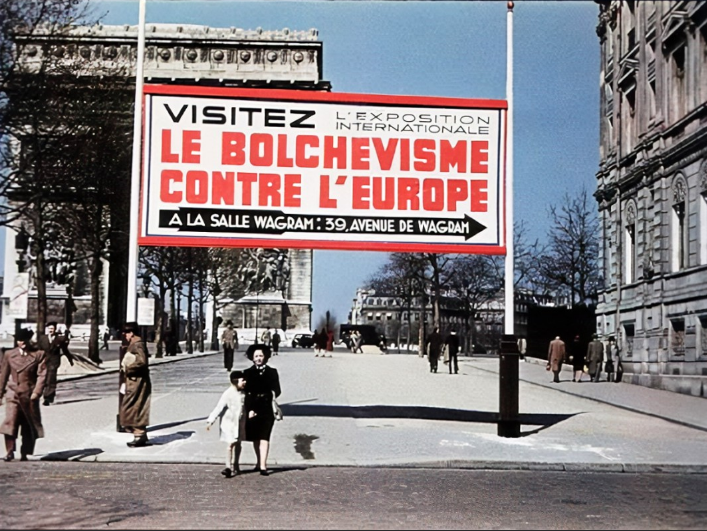
Under the Occupation the fascist French Popular Party mounted a ‘Bolshevism against Europe’ exhibition at the Salle Wagram that opened on March 1 1942
On March 8 three resistance fighters failed to set off a bomb in the exhibition. The Romanian-born Jew André Kirschen (aged 15 and a half), Karl Schoenhaar and Georges Tondelier were arrested. They were tortured and the two older men were executed after the German court martial of 27 resistance fighters from April 7-14 1942. Also found guilty of shotting at a German soldier in September 1941, Kirschen was sentenced to ten years imprisonment because of his youth, then deported to Germany and, fortunately, survived.
After the Second World War the Salle Wagram was hired by the extreme right on October 28 1948 to hold a meeting for ‘Peoples oppressed by the Bolsheviks’. A counter demonstration by 12,000 communists was attacked by the police, involving 1 death and 300 wounded.
After the war it was also the major Paris jazz venue, with musicians such as Louis Armstrong, Duke Ellington, Lionel Hampton, Bud Powell and Django Reinhardt all playing there. Sidney Bechet performed his last concert there in 1958.
On September 1 1950 a communist meeting in support of the Vietnam liberation movement was held at the Salle Wagram. Its principal speaker was Léo Figuères, a resistance fighter who had visited Vietnam and whose arrest had been ordered by the military.
The Algerian liberation movement whose president was Messali Hadj, the Mouvement pour le Triomphe des Libertés Démocratiques, held huge meetings at No. 37 on June 13 1950 and, in protest against police violence on May Day, on May 5 1951.
The Algerian war for independence that began in 1954 saw a joint protest meeting of the SFIO and Marceau Pivert‘s recently founded (June 1955) Mouvement pour la justice et les libertés outre-mer (Movement for Justice and Freedom in the Colonies) taking place at the Salle Wagram on October 7 1955. The meeting called on the government to stop sending military reinforcements to Algeria.