Rise of the Communist Party

Nationalism, Reparations, Imperialism, Socialist split, Communist Party, Class against Class to Popular Front – in progress


Nationalism, Reparations, Imperialism, Socialist split, Communist Party, Class against Class to Popular Front – in progress


By 1930 the growing advance of Taylorist management in France’s larger workplaces against the backdrop of the 1919 48-hour week law meant that their workers’ annual hours had fallen to about 2,300, a reduction echoed elsewhere in Europe. Working time then, however, dropped dramatically and uniquely in France by another 400 hours a year between 1935 and 1937.
This was the result of a wave of mass factory occupations, that were legitimated by the Matignon agreements and the Law of June 24 1936. What was significant about this reduction was that while it reflected the temporary weakening of the hold of French employers, it was essentially politically-driven rather than the outcome of worker demands.
Election, Factory occupations, Matignon agreement, Blum Popular Front Government – in progress
The factory occupations that followed the 1936 Popular Front election victory initially called upon local mayors to arbitrate the reinstatements of workers fired for striking on the May Day that fell between the two rounds of elections. Other workers then used the same defensive tactic (to prevent non-strikers from working) over wages.
Factories occupying – in progress
As the movement spread occupying workers began first to call for trade union rights and the recognition of shop stewards and, less frequently, for two weeks’ paid holiday and, even more rarely, for the 40-hour week. The reduction of the working week without loss of pay, however, had been included in the Popular Front’s 1936 election programme.
What difference did the factory occupations make?
The reformist CGT leader, Jouhaux, had campaigned vainly for years for a 40-hour week agreement, and in 1935 a measure proposing two weeks’ annual paid holiday was brought before the Senate. But these were not major rallying issues for French workers devastated by the loss of 1.3 million industrial jobs between 1931 and 1936. Between 1919 and 1935 only 1.3% of single-issue strikes and 13.1% of multi-issue strikes recorded in France concerned a shorter working week.
When faced with employers who, even as thousands of their factories were being occupied, still refused to negotiate with the unions, the new prime minister Léon Blum saw the opportunity to go considerably further than had the 1919 Law in reinforcing the collective bargaining machinery that had been increasingly ignored since the mid-1920s by the employers.
The 1936 Law gave the Minister of Labour powers to convene ‘joint commissions’ of ‘the most representative’ of employers’ associations and trade unions in a regional or national ‘branch’ of any industry to negotiate collective agreements. It reintroduced a First World War procedure whereby the Minister could order all the employers in the branch to comply with the agreements – whether or not they had participated in them – if their workers were trade union members.
And it prescribed a minimum substantive content (the 40 hours, two weeks’ paid leave, minimum wages for different job classifications and periods of notice) and minimum procedures (recognising workers’ rights to trade union membership, the election of workplace delegates). Labour inspectors were, however, also granted powers to make exemptions, powers that were used more and more frequently as the slow economic growth from 1937 was blamed by the employers on the 40-hour week.
The law of June 24 1936 was the most important pre-Second World War advance in state intervention on wage formation. It specified that the collective agreements negotiated should lay down minimum wages for each level of worker in the sector and included the possibility that the agreements reached between the negotiating parties could be extended by Ministerial order to all firms within the particular industry or region. It thus created a state mechanism for generalizing standard minimum rates for all workers.

Spanish Republic, International Brigade, Munich, Hitler-Stalin Pact, Phoney War – in progress


Occupation, Collaboration, Resistance, Liberation, De Gaulle, Communist Party – in progress
Victims
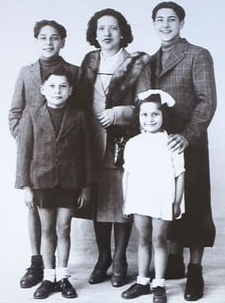
Malika Opalek and her children Aaron (14), Joseph (13), Benjamin (8) and Nina (5) lived at 67, rue des Amandiers in the 20th arrondissement. They were sent to Germany on Convoy 26 on August 31 1942, following Gedalin, husband and father, deported on Convoy 5 by the French police. They never returned.


Liberation, Women’s suffrage, Fourth Republic, Elections, Nationalisations, Social Security – in progress
The Provisional Consultative Assembly was originally based in Algiers from November 1943 to July 25 1944 with 102 delegates. Lucie Aubrac was nominated to sit on it in after her arrival in London in February 1944, but having just given birth was unable to get to Algiers, where she was replaced by her husband Raymond. who flew straight there, and also sat as a representative of the resistance group, Libération-Sud.
On 24 March 1944 a Communist resistance fighter and deputy for Saint-Denis, Fernand Grenier, moved the successful amendment carried by 51 votes to 16 that became article 17 signed by De Gaulle on 21 April 1944. It stated: ‘Women are electors and eligible to vote on exactly the same conditions as men‘.
The Consultative Assembly moved with the Provisional Government to Paris after its liberation, and its membership was then increased to improve its representativity. From November 1944 its 248 delegates represented both the resistance movement and political parties. Among the Communists represented were the former deputies André Marty and Gaston Monmousseau and the CGT leader, Ambroise Croizat..
Its meeting at the Luxembourg Palace in Rue Vaugirard initially only included 12 women such as Lucie Aubrac although this was later increased to 16.. Its sessions there ran from November 7 1944 to August 3 1945.

Cold war in France, Trade union split, Indo-Chinese war, European Economic Community, Suez, Algerian War – in progress


De Gaulle, Coup d’état, Nuclear weapons, Algerian War, Miners’ strike – in progress


Nanterre, Barricades, Factory occupations, Strikes, Grenelle agreement – in progress

Pompidou, Giscard d’Estaing, Maoism, Trotskyism, Left Union – in progress


Mitterrand, Nationalisation, Co-habitation, Far right, Maastricht – in progress

Chirac, Juppé, Strike wave, Jospin, Le Pen – in progress

Sarkozy, Hollande, Macron, Migration, Nationalism – in progress
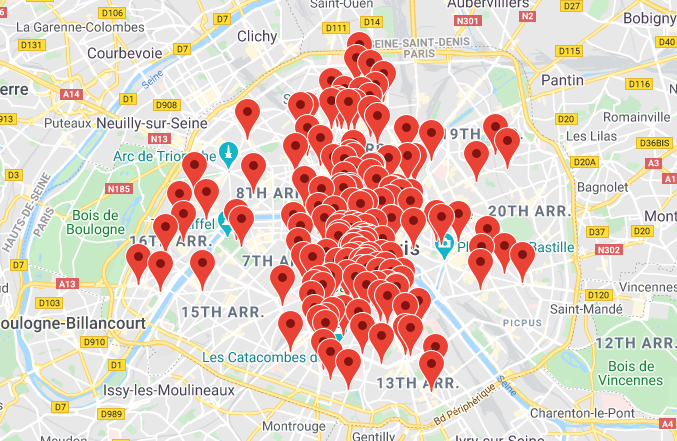
This map shows all the Places featured in Left in Paris. Using the zoom in or out feature allows you to see Places near you. You can choose More Details and Directions for each one (setting Directions for walking, cycling or Transit – Public transport).

Number 12
Named in 1846 after the priest Charles-Michel de L’Épée (1712-1789) who founded the Deaf and Dumb Institute (Institution des sourds-muets ).

No. 12 is where the command headquarters of the French resistance against the Luxembourg Palace and gardens was based in August 1944 under the leadership of Colonel Fabien, the alias of Pierre Georges. A very rare plaque naming a Communist is on the right of the entrance.

On 21 August 1941 Georges, an International Brigade fighter in Spain from 1936 to 1939, then using the alias Frédo, was the first Young Communist to kill a German soldier during the occupation of Paris.
The attack was mounted at the Barbès–Rochechouart metro station after Hitler invaded Russia on June 22 1941 by a PCF member.
Saint-Lazare prison
The present square includes the chapel of the Saint-Lazare prison. It started as a leper colony run by monks in the 17th century and then as a special prison for the well-to-do. 165 prisoners were executed here over the three days before Robespierre’s arrest on 27 July 1794 at the height of the terror. It became a women’s prison later that year. After being rebuilt in 1834 and closed in 1935 to become a hospital, it was also closed in its turn in 1998.

Saint-Lazare had dual roles: medical treatment and jail. After the 1802 law requiring prostitutes to have regular medical check-ups, the Saint-Lazare prison became one of the first prison hospitals in France, with many women undergoing treatment. They would not be released until they were given a ‘clear card’. Those who didn’t have a card at all could simply be locked up in the prison side of the establishment. This law continued in force until 1946, when all women’s detention centres in France were finally closed.
Saint-Lazare was rebuilt by the architect Louis-Pierre Baltard as a special women’s hospital in 1834 after the old Saint-Lazare church collapsed.

In 1838 the Paris police chief made the Sisters of Marie-Joseph responsible for guarding the prisoners.
In 1857 Saint-Lazare had about 1,300 prisoners in three sections: those convicted or waiting trial; those undergoing treatment or refusing it; and girls between 7 and 16 or 20 who were deemed to be vulnerable.

Records show some 11,000 women and girls passed through the Hospital/Prison in the single year, 1885. This was two years after Louise Michel was imprisoned there.
In 1935 the old prison was demolished but the special hospital continued to treat women prostitutes until 1975, the international year of women.
The only remaining bits of the prison are the Chapel in the Square and the old hospital’s wings, now associated with the Françoise Sagan media centre.
Number 17, La Révolution prolétarienne

Named after a 16th century Italian painter in 1880, the old Montmartre street was originally called the rue Saint-André. Its biggest claim to fame, apart from hosting Monatte‘s oppositional publication, La Révolution prolétarienne, at No. 17 in 1925 is the recent discovery (in 1988) of one of the last wells found in Montmartre – at 17b.
Numbers: 15, 39, 46
Named either after a draper’s street sign showing a tree without leaves or from the hangman’s scaffold a the street’s northern end, on the corner with the Rue Saint-Honoré, in the 13th century it was the north-south road crossing the 10th century city walls.
Friedrich Engels lived at No. 15 (formerly No. 11) in 1844 when he came to visit Marx in Paris. The building is now a primary school, previously for girls.

After the First World War, the pioneers of Algerian national independence used to meet at No. 39, the ironmonger’s shop belonging to Hadj-Ali Abdelkader. In 1926 he was both a member of the Central Committee of the French Communist Party and first president of the North-African Star movement created that year.
The German ‘League of the Just‘ formed largely of exiled German skilled workers used to meet in 1836 at No. 46 led at that time by Wilhelm Weitling.
Pierre Lambert ran the Parti communiste internationaliste also at No. 46 in 1950-1951, producing the newspaper, La Vérité, from 1946 until 1958 when it was turned into a journal.
Numbers: 48, 58, 76
The Brasserie du Commerce and its Auger Restaurant at No. 48 were a regular meeting place for left groups in the mid and late 1930s. The Young Socialists (Jeunesses socialistes), ‘Bolshevik-Leninists around ‘Truth‘, and the Communist-dominated Secours Rouge (Red Cross) that changed its name to Secours populaire (People’s Help) all used to meet there.
It was at the Brasserie du Commerce that Marceau Pivert, Daniel Guérin and the Luxemburgist René Lefeuvre drew up the constitution of the ‘Revolutionary Left’ tendency within the SFIO on September 25 1935.
No 48 was also the place where Pivert’s new left revolutionary socialist party, the PSOP, decided to exclude the small numbers of Trotskyists including Lambert who had started to ‘enter’ it in 1939.

In 1808 the National Archives were placed in the Hôtel de Clisson at No. 58. It was built first in 1371 (its turreted gateway survives) and then acquired by the Duke of Guise who changed the name to the Hôtel de Soubise.
One of the barricades erected during the brief insurrection of May 12 1839 by the Seasons Club led by Blanqui and Barbes was based at No. 76, across the road at what was then the junction of 18 Rue du Grand Chantier with the Rue Pastourelle.
Number 25
Blanqui lived at No. 13 from 1878 until his death in 1881. At that time his address was in the Boulevard d’Italie, which was renamed in 1905

Number 3
In 1885 this section of the Rue de l’abbé de L’Epée was given the name of the French mathematician and founder (1798-1857) of the positivist philosophical school

A flat in the imposing No. 3 belonged to the parents of Simone Weil, and this was where she met with Trotksy on 30 December 1933 and hid him for a few days during a clandestine visit to Paris. Trotsky took the decision that night to move to found the Fourth International.
A plaque on the wall states only that Simon Weil lived there from 1929 until 1940 and that she was a philosopher.


Number 24, 27, 59, 63-73
Under its earlier name of the Grande rue d’Auteil, No. 24 was the private house of Mme Helvétius , whose salon from 1772 to 1800 was visited by Diderot, Turgot, Benjamin Franklin, Thomas Jefferson and Thomas Paine as well as by Napoléon Bonaparte.
The Auteuil hamlet was close to the vast forest of Rouvray of which today the only remains are the Bois de Boulogne.
Under the Second Empire the house at 59 rue d’Auteuil was owned by the Emperor’s cousin, Pierre Bonaparte, and was where he shot and killed the unarmed young journalist Victor Noir on January 10 1870. Pierre Bonaparte was quickly found not guilty after a trial heard from several conjured up witnesses, while Noir was buried in Neuilly – and only removed as a Republican symbol to Paris’ Père-Lachaise in 1891.

Tens of thousands of outraged republicans, including Louise Michel dressed as a man and carrying a knife, marched in his funeral cortege.
Nothing remains of the superb original building, which was burnt to the ground by the Communards in May 1871. There is now only a huge apartment block at the spot.
However, somewhat ironically, the chemist shop at No. 27, just down the street, where Noir finally died at 2 pm in the afternoon, is now called ‘Body Minute’.
Living further up the street in 1848, at Nos. 63-73, was Louis-Philippe’s vehemently anti-Republican prime minister, François Guizot,.
Numbers: 12
Called after the ‘small fort’ originally built next to the St Antoine gate into Paris and then turned into a stone fort in 1370, the Bastille soon became a six tower fortress with thick walls and a moat. By 1553 it was an eight-tower fortress with a copper-bottomed moat. In the 17th century it was turned into the prison that was eventually taken by Paris’ newly-formed militia and local people on July 14 1789.

Demolition began almost immediately. Voltaire’s coffin was symbolically brought there on its way to the Pantheon on July 11 1791.
In 1792 it was decided to turn it into a huge square, the Place Antoine. The Marseillais volunteer national guardsmen arrived there singing the song that became the national anthem on July 30 1792.
From June 9 to June 14 1794 the guillotine was installed in the ruins of the fort. But after killing 73 people in less than three days the local shopkeepers complained so much (about the smell and those who had come to watch) that it was moved to what is now called the Place de la Nation, and was then the Square of the Overthrown Crown.
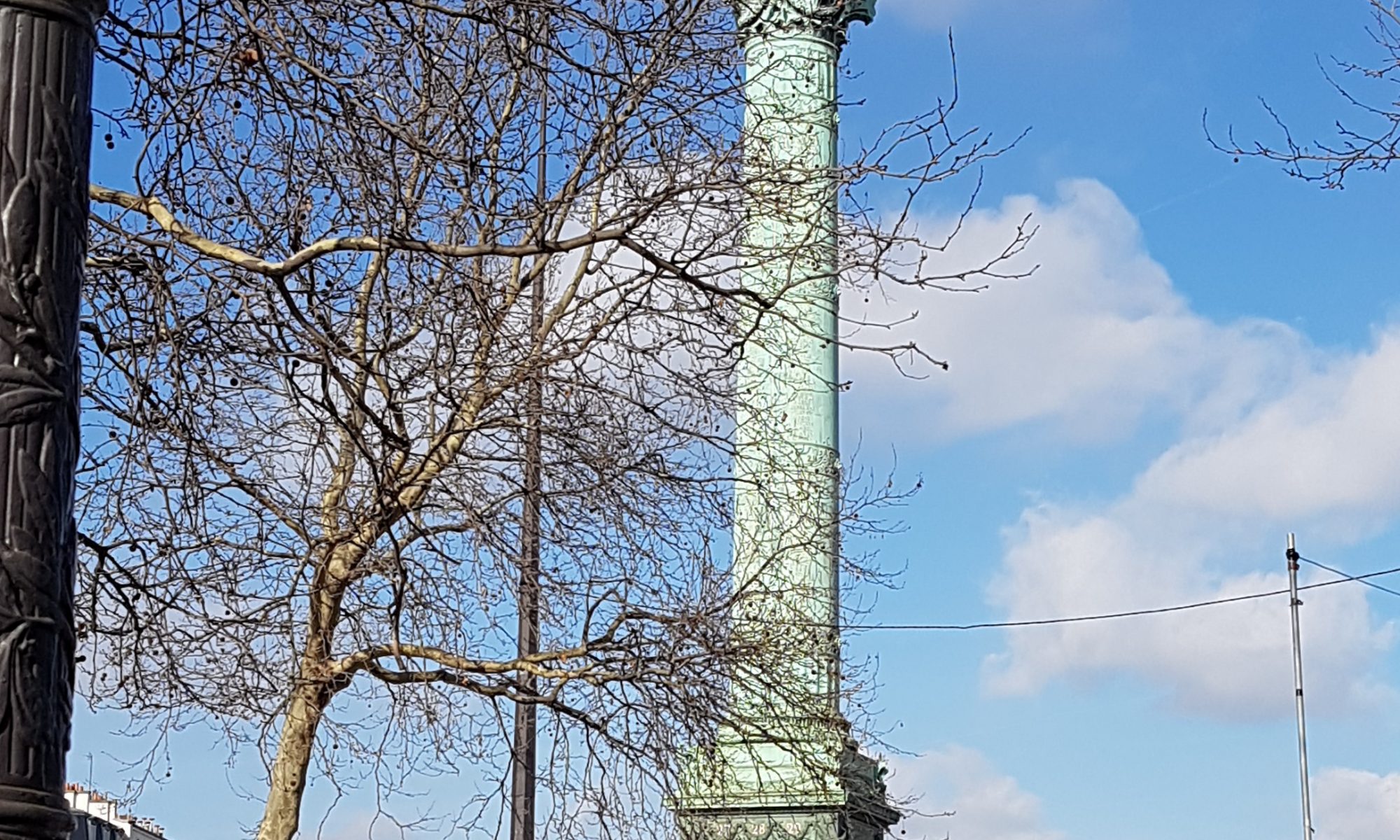
After the 1830 Revolution the new King Louis-Philippe decided to erect a column in the middle of the square to honour the 615 victims of the ‘Trois Glorieuses‘ Revolution – the Three Glory Days. It was inaugurated in 1840.
On April 13 1834 barricades went up in the square as local workers rioted in support of the silk workers’ insurrection in Lyon.
On February 24 1848 Louis-Philippe’s throne was taken from the Tuileries Palace and ceremoniously burnt at the foot of the July column. Three days later the 196 dead in the February Revolution were buried in the crypt beneath the column, and the Second Republic was officially proclaimed there.
On June 24 1848, when the new right-wing government announced the dissolution of the National Workshops, the Bastille square was entirely circled by barricades, and a red flag placed in the hands of Dumont’s 1836 allegorical statue le Génie de la Liberté flew briefly from the top of the July Column to accompany the flame of freedom and the broken chains of despotism.

A red flag flew again on top of the column on February 24 1871, when 14 battalions of the National Guard marched by in a commemoration of the 1848 revolution. The government’s attempt to replace the flag by the Tricolour on February 26 and March 9 1871 both failed.
During the 1871 Paris Commune three local sections of the International Workingmen’s Association used to meet in the Cour Damoye at No. 12.

The Communards fought hard to defend the symbol of revolutionary liberty, but were eventually overrun by the Versaillais. During the bloody week of May 1871 nearly all were killed in the fighting or shot afterwards.
The Place de la Bastille became the symbol of left and republican resistance.
The first Parisian demonstration of Communards after the suppression of the Commune took place at the Bastille square on May 9 1880.
In 1935 two major demonstrations took place there. On International Women’s Day 1935, feminists led by Louise Weiss and Cecile Brunschvicg symbolically burnt chains of male dominance in the square.
On July 14 1935 a demonstration that brought together both Socialists and Communists marched from the Bastille to Vincennes. This was called under the name of ‘People Together’ (Rassemblement populaire) that became the Popular Front that won the 1936 parliamentary elections.

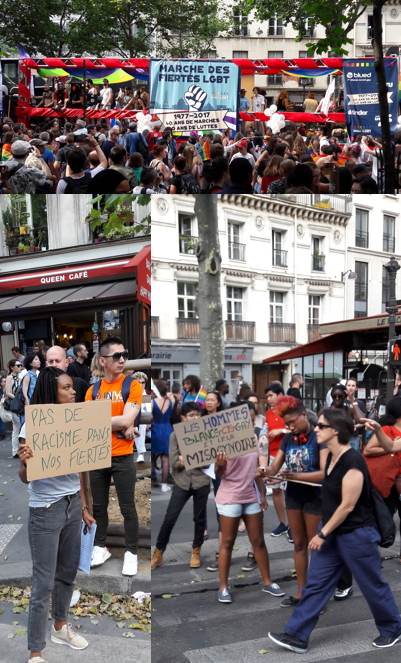
Since 1991 the Marche de les Fiertes have usually begun or ended at the Place de la Bastille. In the 21st century they have usually attracted at least half a million people. There were certainly about that number when Marian and I watched for hours as the marchers went by.


Louise Michel lived on the Boulevard just outside Paris proper for a few months in 1856 in a flat opposite the Farmers-General wall. It was then a low rent, strongly working-class district. It is now one of the circle of broad boulevards created when that wall was demolished. To the North-West of Batignolles lies Levallois-Perret where Michel is buried.

The word Batignolles comes either from ‘bastillole’ meaning little country house, or from ‘batagliona‘, the Latin for a battle. In medieval France the rural commune of Batignolles-Monceau belonged to the Benedictine nuns of Montmartre. It was used by the Bourbons for hunting.

Batignolles lay just to the North, outside the Farmers-General Wall around Paris built between 1784 and 1791 by the corporation of hugely wealthy tax farmers (paid by Louis XVI to collect taxes on goods entering Paris), 28 of whom were guillotined in 1793.
The 24km long wall with 64 toll barriers had boulevards on the outside. The Boulevard des Batignolles was one of these boulevards. Today the line of the wall is roughly followed by the Metro lines 2 and 6.
Anger at Paris being ‘put in jail’ by the wall was a big factor in making the Bourbon rule highly unpopular. The tolls were abolished on 1 May 1791, although restored by the Directorate in 1798.
In 1860 the Batignolles district was incorporated into Paris by the Paris Prefect, Baron Haussmann, and the remaining sections of the wall destroyed, leaving just a handful of the classical designed custom houses.

A working-class area with low rents through the second half of the 19th century, Paul Verlaine (1844-1896) lived here as a child. Édouard Manet lived at No. 34 from 1864 to 1866. Émile Zola (1840-1902) supported him when Manet’s paintings were rejected for the 1866 Salon.
One of Paris’ very old boulevards, first called the boulevard Saint-Antoine and renamed boulevard Beaumarchais in 1831, after the important Enlightenment musician and poet. Two of its buildings (Nos. 23 and 28) are classified as historic monuments.

No. 10 isn’t. For good reasons. It’s now an ugly modern building. But from 1855 it was the entrance to a major cafe and music hall. The old entrances to the space behind the facade on the street are still there at Nos. 12 and 8.

Initially opened as a dance hall called le Grand Concert de l’Époque, it became a theatre in 1905 and then a cafe-concert hall, Chansonia, in 1908. In 1925 another name change to Concert Pacra lasted until 1962, when for its last decade it became the Théâtre du Marais and then Music-Hall du Marais and finally a cinema.
Among those who appeared at the Concert Pacra were Charles Aznavour, Edith Piaf and the anarchist Georges Brassens.
In May 1968, while all the other shows in Paris stopped with the strike on the metro and the street battles in Paris, a concert of folk music took place there in support of the French Global Campaign against Famine.
Number 62 (site of 12 Rue Transnonain)

In 1830 Louis-Philippe was presented the crown of France by the timid reformers who had been pushed into presiding over the downfall of Charles X. But they were not able to suppress the republican pressure to get rid of the monarchical system of privileges and power that was particularly strong in urban areas.
In Lyon on 9 April 1834 a demonstration protesting against new authoritarian laws inhibiting press freedom that was organised by the Society for the Rights of Man and by the Executive Committee of the local workers friendly societies led to mass rioting that appeared to be building up to an insurrection.
Barricades started to appear in Paris on 13 April 1834 and Louis Philippe’s government decided on savage repression. After an infantry captain was wounded by a shot from a window near a barricade in the Rue Transnonain every person found in the house from which the soldiers thought the shot had been fired was killed (12) or wounded (24) (with the victims including old men and women as well as children).
The ‘butchery of Rue Transnonain’ was captured, famously, by Honoré Daumier in a print that could not be censored and became an instant success as well as a tribute to Daumier’s art and politics.

Numbers: 3, 5, 25-26

Renamed in 1864 under Napoleon III in honour of the song-writer Pierre-Jean de Béranger whose songs under the Bourbons had often praised the achievements of Napoleon 1, Béranger himself had lived and then died in a top floor flat at No. 5 when the road was called the Rue de Vendôme.
The name Vendôme used from about 1694 was because Philippe de Vendôme was the head of the Order of Saint John of Jerusalem that ran the nearby huge Templar Knights estate and tower.
Ironically, the 1964 renaming took place in the same year that one of the main figures with Henri Tolain behind the ‘Manifesto of 60 Working Men, Joseph Perrachon, was living at No. 3. The Manifesto was describe by Marx as ‘The first Class charter by a French working class movement on the way to becoming adult‘. Perrachon was one of those who then founded the International Workingmen’s Association.
Fierce fighting took place in the road on May 24 1871, when a barricade from Nos. 25 to 26 was finally taken by some Versaillais troops approaching it from the Boulevard du Temple.
A bustling square on the 1791-1860 northern boundary of Paris at the old tax gate into Paris to the south of the Montmartre hill. Its barricade in May 1871 involved fighter from the Women’s Union. Today it is home to Le Moulin Rouge that opened in 1889 and dozens of tacky strip bars and sex shops.

The Place Blanche (White Square) was named after a café called the ‘White Cross’. It got its name from the showers of white flour and gypsum whose mills and quarries often covered those working on and near the Montmartre hill.

The tax collectors’ building in the Farmers-General Wall at the Place Blanche was burnt down here on 11 July 1789 in a protest by quarry workers against the taxes on the carts they had to pay to enter neighbouring inner Paris. It was one of the many sparks that ignited in Paris three days later on July 14 1789.
The tax wall was first abolished by the Constituent Assembly in 1791 and in November 1793 32 of its wealthy tax collectors were arrested and 28 guillotined. After the tax wall’s reintroduction by the Directorate in 1798, it and its gates survived until 1860, when Montmartre was incorporated into Paris.

The halfmoon-shaped square was laid out in 1803 as La Place de la Barrière Blanche, and only became La Place Blanche in 1864.

On the morning of 23 May 1871 it was the site of a major battle at the barricade across the southern end of Rue Lepic. The barricade was defended by Elizabeth Dmitrieff, Nathalie Le Mel, Louise Michel and between fifty and 120 fighters from the Women’s Union for the Defence and Care of the Wounded of Paris.
The women fighters had already retreated from the Batignolles barricade, and after the Versaillais took this barricade they were then forced to retreat again to the next barricade at the Place Pigalle.
Numbers 21, 28, 42 and La Hune Bookshop
A kilometre-long road first traced out in the 15th century had previously had 12 other names before its three main fragments (la rue des Petits-Augustins, la rue Saint-Germain-des-Prés and la rue du Pot-de-Fer-Saint-Sulpice) were joined together and given its current name by Napoléon Bonaparte’s nephew, the Prince-President Louis-Napoléon Bonaparte in 1852.
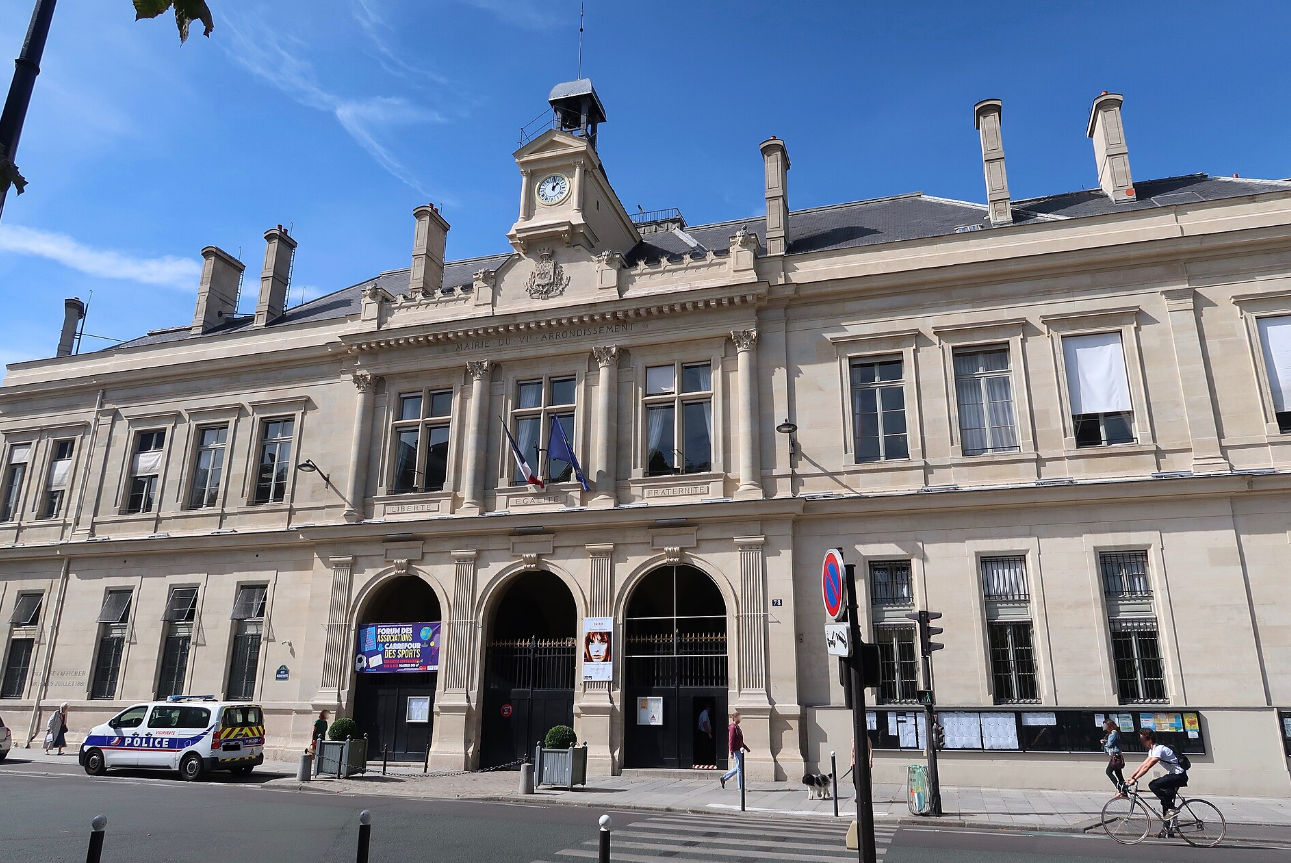
The building I have most contact with in this newly chic area is the sixth arrondissement town hall. When my father’s French employer first found him a flat in the area in 1954 it was still largely cheap student accommodation, dozens of cafes and loads of drunks and intellectuals hanging out. No 78, pictured above, is where 42 years later a motorcycle rider had to rush to for a permit to move my dad’s body out of the sixth before the 24-hour deadline for medical research on his body had passed. The mairie was built in the 1840s.
Paris is still changing, and sometimes by accident. Having a meal with Nicole (my father’s partner for over 25 years) in November 2017, we chatted about the big fire that had started near the Saint Germain church.

It turned out to be the cremation of the last mortal remains of the famous La Hune bookshop. This had been set up by former resistance fighters in 1949 and had been a centre of Parisian intellectual life for thirty years. It had closed two years earlier after relocating to the corner of the Place Saint-German and Rue Bonaparte in 2012.
Hazan (WTP) remembers it as one of the key left intellectual meetings places of the 1950s and as a street dominated by ‘realist’ art galleries in the 1960s. When we walked past it the day after the fire and smelt the sad pungent aroma of burnt books and wood, it looked as if the fashion shop with which it shared its premises had mysteriously been largely spared.
Across Rue Bonaparte was where Jean-Paul Sartre used to live in number 42 (third window above the balcony). He moved there to be with his mother after the death of her second husband in 1948. The editorial team of his philosophical journal, Temps modernes, used to meet in the flat. Simone de Beauvoir, with whom he lived there for a while, Raymond Aron and Maurice Merleau-Ponty were among the many Left Bank intellectuals who made up its editorial board.

Number 42 was the address where Sartre’s political support for Algerian independence was rewarded on January 7 1962 with the signature plastic bomb used by the OAS – the Organisation armée secrete – whose music I had first heard out with my father on the Champs Elysée celebrating New Years’ Eve just a week earlier. The traffic jam of cars blocking the street appeared nearly all to be honking ‘Algerie Française’ – da da da, daa, daa. A week later we were walking home when we heard the huge bang when the Rue Bonaparte bomb went off – targeted along with another 16 other addresses that night.
There were no injuries, but Sartre promptly moved out to the much more public Boulevard Raspail.

Further down the Rue Bonaparte, at the crossroad with Rue Jacob, another story did not end quite so happily. In 1871 the Commune defenders built a barricade between numbers 21 and 28 in Rue Bonaparte and from 29 to 32 in Rue Jacob. There, on May 24 1871 Francisco Salvador-Daniel, the musicologist son of a Jewish refugee from Spain, who had been defending the barricade was captured, and taken back to the barricade and shot by the Versaillais soldiers. He had taught the violin in Algeria and translated and adapted Arabic songs from North Africa for European musical instruments.
Félix Vallotton, the graphic artists and painter sympathetic to anarchism, frequent contributor to La Revue Blanche, where he drew the enigmatic portrait of anarchist and art critic Félix Fénéon, and associated with the Nabis movement, lived in 1886 at No. 21.
The painter, Édouard Manet, was born in the mansion belonging to his family at No. 5. His mother was the goddaughter of the only French general who remained a king (of Sweden) after the defeat of Napoleon and his father was a French judge.
Louis Hélié, one of the rare 60-year-old resistance fighters killed by the Germans in the 1944 liberation struggle in Paris, lived at No. 3, found at the Northern end of the Rue Bonaparte.
Numbers 20, 38,

This is a wide Parisian street built in 1631 on the line of the obsolete 16th century city wall. It was one of what are called the ‘Grands Boulevards’ on the right-bank of the city. Its even numbers are in the 10th arrondissement and its odd numbers in the 2nd.
Named after the local ‘Our Lady Good News’ church (Notre-Dame-de-Bonne-Nouvelle) It is well used to demonstrations. On June 9 1820 Louis XIII’s cavalry charged demonstrators on the Boulevard chanting ‘Long Live the Charter’, killing several of those demanding that the King keep his 1814 promises of acting as a constitutional monarch.
The next time it was King Louis-Philippe’s troops who forcibly cleared the boulevard of republican demonstrators on 15 June 1831.
A major barricade across the boulevard at No. 38 saw the monarchist Odilion Barrot booed by the republican crowd on February 24 1848 when he argued for a regency under Louis-Philippe’s wife to take over from the King. The 2,000 troops sent to demolish the barricade ended up fraternising with the crowd.
On June 23 1848 three of the first barricades in the workers’ insurrection challenging the end of the National Workshops were erected in the short stretch of the boulevard between the Porte St-Denis and the Rue de Mazagran. The flags on the barricades carried the slogan, ‘Bread or Death‘.

Many political meetings used to take place during the 1848 Revolution at No. 20, in the concert hall Bonne-Nouvelle. The Women’s Club attended by Désirée Gay and Pauline Roland met there regularly.
On June 13 1849 Ledru-Rollin and Raspail were arrested after organising a demonstration against the government’s decision to besiege the Roman Republic and restore the Pope to the Vatican. Marx, who had observed the demonstration on the Boulevard, was expelled immediately afterwards.
18 months later, 280 opponents of Louis-Napoleon’s coup d’etat of 4 December 1851 were massacred by canon fire at the junction of the Boulevard with the Rue St Denis.
On September 3 1870 it was the police who fired from the police station at No. 23 on demonstrators angry at the announcement of the defeat of Napoleon III at the battle of Sedan.
On Bastille Day, July 14 1941, after Hitler’s invasion of Russia, the Young Communists (Jeunesses communistes) organised a demonstration in the Boulevard that was attacked first by the Paris police and then by the German army.
The Théâtre du Gymnase, also at No. 38, was where Jean Cocteau’s wartime play, The Terrible Parents, was first performed and then banned in 1942.
On 23 August 1927 fighting broke out in the boulevard when the police attacked the demonstration called by the Communist Party against the executions that day in America of the framed Italian migrants Sacco and Vanzetti.
Another street battle between demonstrators and police took place on 16 December 1972, when a protest march against a police murder of a young Algerian man two weeks earlier was broken up, with its leaders, including Michel Foucault, being arrested.
Numbers: 36, 46
Built in 1838 in the Montrouge commune and absorbed into Paris in 1863 it was named after Michel-Jacques Boulard, Josephine’s official Imperial tapestry-maker, who. He spend the last three years of his life in a hospice and left a huge amount of money to build the new St-Michel Hospice that opened in 1830.
No. 36 was opened on 17 April 1871 as a recruitment office for the National Guard during the Paris Commune.
Proudhon lived at No. 46 with his family for several years in the 1850s. Having been rebuilt or built in the late 19th century as a local boys school, this address is now an elementary school .

Proudhon, of course, would not have approved of the state deciding how to educate children. He believed this could lead to brainwashing. He argued instead that each family (father) should be responsible for the education of their children.


