A militant feminist and left political activist, from a Jewish communist family she helped campaign for abortion rights.
Maya Surduts


Albert Thomas became the first director of the International Labour Office in Geneva after having served as a socialist minister organising war production from 1914 to 1918.
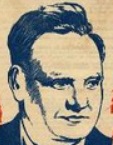
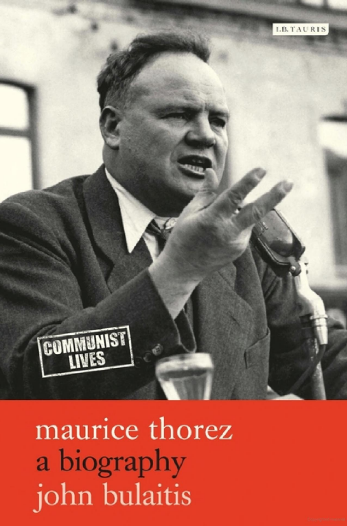
Communist • PCF General Secretary 1930-1964
Maurice Thorez was the working class General Secretary of the French Communist Party from 1930 to 1964. Throughout this period he closely followed the twists and turns of the Russian Communist Party.

Germaine Tillion was arrested as a member of a resistance network in 1942 and deported to Ravensbruck in 1943, from where she was transferred to Sweden in April 1945.

Albert Treint was one of the first speakers at the Tours 1920 Congress of French Socialists (SFIO) to propose French affiliation to the Communist Third International and proposed the formation of the SFIC (Section Française de l’Internationale Communiste). At 31, he was then head of the Paris Federation of the SFIO.
The son of a Parisian bus conductor, at 17 Treint won a three-year scholarship to train as a primary school. He then did two years’ military service before teaching for three years near Nanterre from 1910 to 1913. He joined the SFIO in 1914, the year he was called up. In the 21st Infantry regiment he was promoted captain.
Wounded in the Somme in both 1915 and 1917, in 1919 he was teaching again at Belleville’s rue Ramponeau boys’ primary school. From outside the school there is an amazing view all over Paris. Treint did not enjoy it for long.

Shortly after his December 30 1920 election to the steering committee of the brand new SFIC he was first arrested in May for a speech calling on French soldiers to disobey orders to fight in Russia, and then fired from his teaching post in September 1921.
A key participant in the internal Communist faction fights between those like Monatte, arguing for greater unity with other revolutionary syndicalists, and those defending the Third International’s anti-unity and disciplinary positions, Treint’s hard-line faction won.
In November-December 1922 at the first enlarged executive meeting of the Third International he defended the United Front in these terms:
‘We get closer to and then further away from (reformist leaders) alternating in the same way as the hand gets closer to and further away from the chicken it is plucking.
Albert Treint 1922
In 1923-24, on behalf of his left faction he shared the General Secretaryship of the PCF with a centrist, first Frossard (who left the PCF on January 1 1924) and then Sellier. He then spent four months in jail with Gaston Monmousseau (1883-1960) and others for having attended a conference with German communists calling for opposition to the French occupation of the Ruhr in January 1923.

In Moscow representing the PCF from 1924 to 1927, he transited politically from supporting Stalin to supporting Trotsky and Zinoviev and the Left Opposition. In 1928 he returned to live in Belleville. He was expelled from the Central Committee of the PCF and then from the PCF itself. For the next ten years Treint tried to build left opposition groups in France, before adopting the view of a tiny minority fringe of the communist left that saw the Soviet Union as a form of ‘state capitalism’ rather than as the Trotskyist sects did, as a ‘degenerated workers’ state’.
Treint rejoined the SFIO after the threat of a fascist coup d’etat in February 1934. As a virulent anti-Stalinist he opposed the Popular Front between the SFIO and PCF. Yet with the return of the 1936 Popular Front government headed by Léon Blum, he was reinstated in his teaching post by Jean Zay, the new Jewish minister of Education and Culture.
With the outbreak of the Second World War, the PCF was dissolved by the Daladier government on September 26 1939 for supporting the August 1939 Hitler-Stalin pact. 317 town councils controlled by the PCF were shut down. 2,800 councillors were declared illegal. 620 trade union branches were immediately closed by the now right-wing majority controlling what had been a reunited CGT since 1934.
On 18 November 1939 the government adopted a decree allowing internment of anyone considered dangerous to national defence or public safety. Treint aged 50, was fired again along with tens of thousands of other communists and those suspected of communist leanings.
Treint sought safety about 100 miles south of Paris, and probably (although this is uncertain) joined the resistance. After the war he played no part in political life, dying at the age of 82 in 1971.
Expelled from the giant French Communist Party; far too left-wing for the French Socialists (SFIO and PS); too troublesome for the Trotksyist sects; suspected of allowing three anarchists to be killed while they were trying to break up an early PCF meeting; married with one son born in 1914… it’s perhaps not surprising I can’t much about where this Parisian lived in Paris, except that in 1928, when he was expelled from the PCF he was living at 3, rue Carducci.
But it is a pity that so many socialists who spent their lives trying their best to change the world and achieve international workers’ unity are largely unremembered. So for them, this beautiful red poppy photographed by Ivor Penn in 1968 (and then photographed by me in another Paris museum).


In 1843, at the time the young Karl Marx was living in Paris, Flora Tristan published a small pamphlet called ‘The Workers’ Union’ (L’Union ouvrière).
In it the 40-year-old Parisian woman made the case that workers were a single social class. Workers must organise themselves as such. She aimed to bring all men and women workers into a giant working class party, the Workers’ Union.
She was totally original at the time: she focused on the working class, all who worked without any property other than their labour power, and stressed the need for men and women workers as well as national and foreign workers to come together in a common project of social change.

Tristan was also a determined feminist.
In the booklet’s section called ‘Why I mention women’, Tristan denounced the way women were either ignored or treated as persona non grata by the Church and all political parties. Only if male workers recognized the need for unity could they share their different experiences and create real common objectives.
‘Workers, without women, you are nothing!’, she explained.
And, just as subversively, Tristan stressed that only if workers organised work themselves could they ever win liberty.
After the Workers’ Union pamphlet was published she set off on a national tour to promote local committees of the Union. Between April and November 1844 Flora Tristan criss-crossed France selling her pamphlet and holding meetings.
‘With my union project in my hand, from town to town, from one end of France to the other, to talk to the workers who do not know how to read and to those who do not have the time to read….I will go find them in their workshops; in their garrets and even, if needed, in their taverns.’
The campaign effectively killed her. She died in Bordeaux, probably of typhoid, just 41 years old.

Eight thousand people attended her funeral in Bordeaux. In the aftermath of the 1848 revolution, workers throughout France gave donations to erect a monument to Flora Tristan. It was inaugurated on 22 October 1848 in the Bordeaux Cimitière de la Chartreuse. The monument, a broken column, circled by a garland of oak and ivy, has a copy of her most important book, The Workers’ Union, at its top.
She was an extraordinary woman. Brought up by a mother widowed when Flora was four, the pair eventually had to live in one of the Restoration’s worst Paris slums in the Latin quarter’s Maubert area. Tristan lived in the Rue du Fouarre from 1815 to 1821.
She started work as an engraver and porcelaine painter. In 1821, aged 17, she married her employer, the painter and lithographer André François Chazal. Four years later, pregnant with Aline, and already mother of two children, she moved out of Paris back to her mother’s, near the Jardins du Roi (now the Jardins des Plantes), and began a life-long struggle for the right to divorce.
She lived working as a maid and lady’s companion, experiencing this as humiliation, but enabling her to visit England.
She visited London in 1826 and again in 1839, where she heard about the Grand National Consolidated Union and the Tolpuddle martyrs of 1834. In Paris, she became influenced by the Christian socialism of Saint Simone and others. She became a committed feminist socialist. and writer.
She criticised George Sand for hypocrisy. While applauding her use of ‘the novel as a medium to call attention to the harm done to women by our laws’, nonetheless Sand ‘has signed her works with the name of a man. How effective can accusations be when they are disguised as fiction?’ Tristan wanted to know.
In 1838, after she published a denunciation of her abusive marriage and a call for the right to divorce her violent husband stalked, and then shot her. Only then did the wounded Tristan get a legal separation, while the ex-husband got a 20-year prison sentence.
Tristan’s early death during her campaign for working class unity meant she could play no part when radical feminists put up a woman candidate in the 1849 male-only suffrage presidential election under the Second French Republic. And we will never know what she would have thought about the first Socialist president of the Fifth French Republic creating a Flora Tristan stamp in 1984.

But we can be pretty certain she would still be fighting for Socialism and Feminism. She would also be quite surprised and probably particularly upset that an 1892 painting titled ‘When will you marry?’ by her grandson, Aline’s son, Paul Gauguin (1848-1903), would fetch prices of over £200m in 2017.


Trotsky (the alias Lev Davidovitch Bronstein adopted to replace his earlier one of Pero in 1902) first stayed in Paris for a few months in the Autumn of 1902 after his solo escape from Siberia on his way to London. This was where he first met the Ukrainian Natalya Sedova, three years his junior.

He had been exiled to Siberia with Alexandra Sokolovskaïa (1872-1938), whom he married in a Moscow jail in 1899 when he was 20 and she 27. Already a Marxist she was one of the leaders of the Southern Russian Workers’ Trade Union that Trotsky had worked with. In Siberia the couple had two daughters, Zinaida Volkova (1901-1933) and Nina Nevelson (1902-1928).

In 1902, the Russians living in Paris associated with Iskra, the occasional paper of the Russian Social Democratic Labour Party, used to meet in the flat rented by Natalya Sedova at 4 Rue Lalande, near the Montparnasse Cemetery in the 14th arrondissement.
In Autumn 1902 the 21-year-old Natalya was asked to find a flat for an incoming revolutionary from Vienna, whom she had not met and whose name she was not told.
That revolutionary was Lev Bronstein. And they spent many hours walking Paris together before living together in 1903.
Lenin was also lecturing in Paris in 1902-3 accompanied by Nadezhda Krupskaya. In December 1902 the two couples went to see a show at the Comic Opera in Rue Favart. Lenin lent Trotsky a pair of shoes for the occasion since his were not presentable. Trotsky later complained they were too small:
I suffered awfully, and Lenin kept making fun of me the whole time.
Shortly afterwards, Leon and Natalya moved to London to support and then break with Lenin, and then reunite and then…
In 1905, before leaving for Russia and the Revolution taking place there, Trotksy was again briefly in Paris and is supposed to have visited the Café Le Dôme at 108 Boulevard du Montparnasse.
The couple’s first son, Lev, was born while Trotsky was in jail in Moscow after the 1905 Russian Revolution. Escaping from exile to Siberia in 1907 Trotsky spent seven years in Austria and Germany, with perhaps a visit to Paris to meet Lenin in 1910.
This meeting took place at a Montmartre artists’ café where it is suggested they also may encountered the poet Guillaume Apollinaire.
The police informer who ran the Café de la Rotonde on the other side of the Boulevard also reported Lenin and Trotksy meeting with other Russian exiles there in 1910.
That same year, another report suggests Lenin was playing chess with Trotsky and with Apollinaire at the Closerie des Lilas restaurant cum corner street café at the Port Royal/eastern end of the boulevard du Montparnasse.

Trotsky was back in Paris from 1914 until his deportation in 1916. He was then
editing an internationalist socialist paper, ‘Our Word’ (Nashe Slovo) whose editorial offices were at 17 rue des Feuillantines. He also met many French anti-war activists such as Pierre Monatte at the revolutionary syndicalist bookshop located at 96 Quai de Jemmapes.

While in Paris this time he lived for several months at the Hotel d’Odessa at 28 Rue d’Odessa which now has the only semi-public plaque to Trotsky in Paris (next to the reception) and met Diego Rivera at the nearby Café de la Rotonde.
He then moved to 23 Rue de l’Amiral Mouchez and invited Natalya and his family to join him before moving to 27 Rue Oudry. The French police used to spy on Trotsky from the cafe Le Petit Bar at 57 Boulevard St Marcel.

On March 31 1916 Trotsky was arrested at Rue Oudry and taken by the police to the Spanish border, from where he was deported to the US. He got back to Russia in May 1917… and despite being white-washed out of the official Soviet history under Stalin, became, arguably, the second most important leader of the Russian Revolution after Lenin until his death in 1924.
The next time Trotsky was in Paris was 1933. This was the year that began with Hitler being nominated Chancellor of Germany. It also saw Trotsky’s eldest daughter, Zina, both of whose two husbands would soon be executed in Stalin’s Great Purges, committing suicide in Berlin aged 32. His youngest daughter, Nina, had already died from tuberculosis in Russia in 1928.
On December 30 1933, while in hiding at Simone Weil‘s parents’ third-floor flat in the Rue Auguste Comte Trotsky made the absurdly unrealistic decision to launch a ‘Fourth International’ – because, logically he considered, something had to be done to mobilise against the fascists. It was not because there were real people out there wanting or waiting for his leadership.
After leaving Simone Weil’s flat Trotksy stayed at the Carlton Hotel at 207 Boulevard Raspail.
Both of Trotsky and Natalia’s two sons were killed on Stalin’s orders. Their youngest son, Sergei, was killed in 1937 in Russia. His first wife, Alexandra Sokolovskaïa, was executed in 1938 during Stalin’s Great Purges.
Natalia and Leon’s eldest son, Lev Sedov, was advised (by one of Stalin’s agents acting as his secretary) to go to a private Clinique Mirabeau at 7, rue Narcisse-Diaz for appendicitis. Shortly after the operation, carried out by an incompetent doctor and an anaesthetist who also worked for Stalin, he died of complications in 1938.
After breaking the heart-rending news to Natalya, Trotsky wrote: ‘Everything that was young in us died with our son’. Lev had been looking after Zinaida’s son, Vsevolod (Sieva), who, accompanied by Alfred and Marguerite Rosmer, then joined his grandfather in Mexico in 1939, aged 13. Sieva was present at one failed assassination attempt on his grandfather. Trotsky was finally assassinated there in 1940.
Natalya, who broke with the Fourth International in 1951 because its leadership insisted on still seeing Stalin’s Russia as a ‘workers’ state’, lived on until 1962 in France. She died in Corbeil-Essonnes, part of what was then the municipal Communist ‘red belt’ just South-East of Paris. The last Communist mayor there was defeated by the reactionary industrialist Dassault in 1995.
In October 2016, walking south between the two halves of the Montparnasse Cemetery towards 46 rue Gassendi, where in 1902 the 20-year-old Natalya had found the 27-year-old Trotsky a Paris room to rent, and they became lovers, I counted six homeless tent shelters attached to the trees and cemetery wall. It was rather sad to see after so many people had fought and died and loved over the previous hundred years for a world that wouldn’t treat people out like that.


Edouard Vaillant was a major figure during the Paris Commune and in the rebuilding of French socialism at the end of the 19th century.
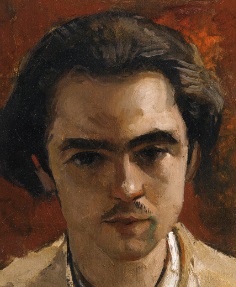
Since the 1880s recognised as a major French poet, earlier he sympathised with the Paris Commune and worked for it as a press attache. In 1873 he was jailed for wounding Rimbaud with a pistol shot.

A doctor whose radical research on prisons in 1820 and work on working class poverty from 1834 led to the 1841 law abolishing child labour under the age of 8.

A trade union lawyer, a rare supporter of women’s suffrage and an independent socialist in the 1890s. He co-founded L’Humanité with Jean Jaurès in 1905 but in 1906 he left the SFIO and, after becoming a minister and identifying as a republican-socialist, he led the government of ‘holy union’ in 1914.

A young, left republican lawyer, he became Interior Minister in 1882, and was largely responsible for the 1884 law legalising trade unions in France. In 1899 he became Prime Minister and in 1901 passed the law giving associations legal status.
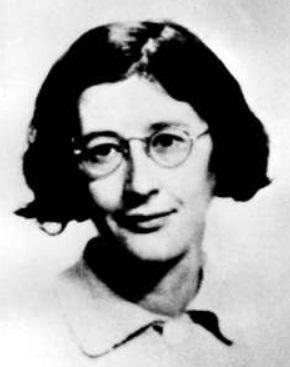
A brilliant student of philosophy and committed revolutionary pacifist and anti-colonialist, she welcomed the workers’ occupations of 1936 but criticised the timidity of the Popular Front government.
The New Left Review introduced one of her essays it published with this brief (edited by me) biography:
‘Of the three most remarkable women thinkers born in the last century, Simone Weil (1909–43) was a year younger than Simone de Beauvoir, herself a little over a year younger than Hannah Arendt. From a secularized Jewish family in Paris, she declared herself a Bolshevik at the age of ten, and proved a brilliant student, first at the elite Lycee Henri IV and then at the École normale supérieure.
She wanted to teach in an industrial town but was dispatched instead to Le Puy, a rural backwater. There, nevertheless, she was soon active in solidarity work with the local trade unions and writing in La Révolution prolétarienne, a libertarian journal of the left edited by militants expelled from the Communist Party.
In 1932 she made a trip to Germany on the eve of the Nazi takeover, and on her return composed a ten-part report on the political situation in the country. In condemning the passivity of the spd and the sectarian blindness of the kpd in the face of the rise of fascism, her judgement of it corresponded closely to Trotsky’s warnings of the time, but was more clear-sighted in questioning the notion that Hitler was little more than a tool of big capital, and doubting whether the German working class was still in a position to resist his seizure of power, a fait accompli by the time her last instalment appeared in late February 1933.
Six months later she published a pessimistic balance-sheet of the prospects for proletarian politics at large. Capital had reached the limits of its reproduction. But the Russian Revolution had given birth to a bureaucratic regime that had nothing to do with Socialism, Nazism was triumphant in Germany, and the New Deal in America offered no more than a technocratic variant of authoritarian capitalism. To a friend, she had written after returning from Berlin: ‘Insurrections on the order of the Commune are admirable, but they fail (true, the proletariat is much stronger than it was then; but so is the bourgeoisie). Insurrections of the October 1917 type succeed, but all they do is reinforce the bureaucratic, military and police apparatus. And at this moment nonviolence à la Gandhi seems simply a rather hypocritical species of reformism. And we do not yet know any fourth type of action.’
Now she concluded: ‘No workers’ state has ever yet existed on the earth’s surface, except for a few weeks in Paris in 1871, and perhaps for a few months in Russia in 1917 and 1918. On the other hand, for nearly fifteen years now, over one sixth of the globe, there has reigned a state as oppressive as any other, which is neither a capitalist nor a workers’ state. Certainly, Marx never foresaw anything of this kind. But not even Marx is more precious to us than the truth.’
Yet she continued to give classes in Marxism at the nearest Trade Union offices even as Trotsky denounced her for regression to an individualistic liberalism, attacking the ‘revolutionary melancholics’ among whom she had now to be numbered. Weil took no offence, arranging two months later for Trotsky to hold a secret meeting in the Paris flat in the Rue Auguste Comte owned by her parents, at which the two continued to argue fiercely. Trotsky nevertheless told the Weils on his departure: ‘You can say that the Fourth International was founded in your home.’
An admirer of Rosa Luxemburg, Weil had never shared her confidence in the spontaneity of the proletariat, and by 1934 had ceased to believe that the trade unions she had helped were sources of much hope. Deciding to withdraw from all political activity, she took leave from her teaching to become a factory worker, not only in order to experience the proletarian condition at first hand, but to see if there were other ways than those tried hitherto in which it could be transformed.
Before doing so, she composed the long essay she would ironically call her testament, ‘Reflections on the Causes of Liberty and Social Oppression’, conceived as a critical balance-sheet of Marx’s theory of history and the movements it had inspired, as well as a theory of struggles for power, not simply for property, which he had neglected, and of contemporary tyrannies of bureaucracy and technology that he could not have foreseen. She was just 25.
The turn to factory work left her disappointed, and the advent of a Popular Front government in 1936 politically cold. But when the great wave of factory occupations exploded a few months later, she was filled with joy, reporting from the Renault plant where she had been employed and kept a journal. In the summer, she joined the cnt militia in the Spanish Civil War, but after an accident was invalided out.
Back in France, she attacked her country’s colonial record in Indochina, Madagascar, North Africa as almost no one on the left cared to do at that time. In the last years before the Second World War, grappling with the growing threat of the Third Reich she first adopted and then relinquished a pacifism that, after Munich, could no longer be grounded in the lessons of 1914. When the Wehrmacht entered Paris in 1940, she escaped with her parents to the south, finding precarious refuge in Marseille.
While working as a farmhand, and later for the Resistance, her intellectual energies now turned to questions of religion—not only Christian, but Egyptian, Hindu, Buddhist texts—and philosophy, where as an accomplished Hellenist her range extended from the pre-Socratics to Plato, not to speak of Homer and Pythagoras; alongside an aversion to Judaism—did the Old Testament not celebrate the extermination of the Amalekites and others?—that would be a thorn to her posthumous admirers.
In the spring of 1942, she and her parents got visas to the US, arriving in New York via Casablanca in July. There she fretted till the autumn, impatient to join Free French operations in England, a wish she achieved in November with the help of Maurice Schumann, an old classmate from the Lycee Henri IV, future Prime Minister and progenitor of European integration. In London she served in the exile equivalent of the Interior Ministry, under the Socialist André Philip, generating summaries of reports from France and drafting political proposals for its future after Liberation, constitutional schemes including a spirited critique of the ideology of human rights that was just coming into fashion. Working round the clock, at home and in the office, in four months Weil produced a prodigious volume of writing before expiring at the age of 34—from tuberculosis or anorexia?—in the summer of 1943. All but a handful of her texts lay unpublished when she died.

Radical • Education • Popular Front • Assassination
There are 126 schools in France named after Jean Zay. But few now know much about the 40-year-old Radical Party Jewish deputy who became Minister of Education and Fine Arts in Blum‘s Popular Front government of 1936, and kept that position until 1939.
First elected a deputy to the National Assembly for his home town of Orleans in 1931, from 1934 to 1937 Zay lived in the Rue de Verneuil, and then, in the Rue de Bourgogne until his resignation to join the Army on September 2 1939.
After four years a prisoner of the Petain government, he was murdered by revengeful score-settling anti-Semitic Petainist French uniformed Milice exactly two weeks after D-Day in June 1944.
His body was eventually found in 1946 in a ravine where the Milice had shot and hid him. From 1948 to 2015 he was buried in Orléans cemetery and then, under the Hollande presidency, his remains were placed in the Pantheon with three others who had opposed the Vichy Government.
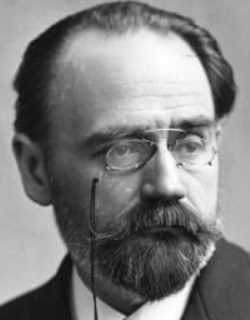
In 1898 Émile Zola, the pre-eminent 19th century social realist novelist, helped change the course of French history when he took up the cause of Captain Dreyfus, the Jewish army officer framed for treason.
From that moment onwards the republicans divided between those on the left who were internationalist and opposed racism and sought to improve the conditions of the vast majority of French people, and those on the political right who sided with the monarchists and Bonapartists and unconditionally supported the army and ‘strong government’.
Unlike most significant left figures in French history, Zola’s magnificent literary output followed by his premature death meant he has three plaques to him around Paris as well as an avenue named after him.
One plaque confirms his place of birth on the fourth floor of 10 Rue St Joseph, even though the family moved away when he was three years old.
Most Parisians rented their homes throughout the 19th and 20th centuries. Like them, Zola moved around a great deal when he first arrived in Paris to study for a Bac diploma in science (following in his father’s footsteps), staying primarily in the cheap Latin Quarter.
In 1858 to 1859, Zola lived first at 63 Rue Monsieur le Prince and then moved a short distance to 241 Rue St Jacques. After failing to get a Bac in science he gets a job as a clerc on the docks for two months before moving again in 1860 to 35 Rue St Victor. Evicted from there for non-payment of his rent his next move was to 4 Rue Rollin and then to 11 Rue Soufflot – all within a short distance of each other.
On March 1 1862 Zola starts a job at the Hachette bookshop thanks to an offer by its owner, Louis, and on October 31 1862 is naturalised French.
He is then living at what is now 7 Impasse Royer-Collard. Still employed at the bookshop, after a short stay with his mother at 5 Rue des Feuillantines, he then moves back to Rue St Jacques, this time to No. 278. This is where he was living in 1864 when his first novel was published, Contes à Ninon (Stories from Ninon).
In late 1864 Zola started a relationship with Éléonore-Alexandrine Meley, a seamstress also called Gabrielle, whom he married in 1870. The couple first lived together in 1866 in a sixth floor room with a view of the Luxembourg Garden from the terrace of 10 Rue de Vaugirard.
On 12 January 1898 Zola wrote ‘j’acccuse‘, a letter to the French President, Felix Faure, at his marital home since 1889 at 21 Rue de Bruxelles. He then took it to the offices of the ‘Aurore’ newspaper edited by Georges Clemenceau at 144 Rue Montmartre, now remembered by a plaque. It was published the following day.

Zola died of carbon monoxide poisoning from an alleged faulty heater in September 1902.


Paris is at the fulcrum of left struggles in France. Absolutist regimes were repeatedly burst apart and then restored. Having forcibly imposed a constitutional monarch on France in 1789 Paris and France were then ruled by committees, monarchs or emperors with little or no constitutional basis for the next 90 years.
Opposition and popular resistance to the Bourbons, to the Empire, to the German occupations, and to a particularly vicious capitalist class and state fed into and stimulated the Left.
Paris, unlike any other capital city, experienced five major revolutionary moments (1789, 1830, 1848, 1871, 1968) and many more insurrectionary protests over the past 250 years. Why?
Left in Paris suggests three interconnected answers:
1. The contrast between a rigid centralised political and social system and its rapidly changing economy creates periodic revolutionary explosions in France’s most industrialised city, Paris.
2. The memory of dramatic revolutionary change is widely embedded as an always present possibility. Its cosmopolitan, radical history and almost daily protests against nearly all manifestations of capitalism inspired and inspire artists, writers, revolutionaries.
3. The preserved beauty of the city attracts lovers and dreamers beneath its bridges.

Charm
In 1991 one of France’s greatest twentieth century historians, Fernand Braudel, asked:
‘Is it perhaps both France’s tragedy and the secret of its charm that it has never really been won over to capitalism?’
There are still unresolved struggles between market freedom and social freedom, between social equality and market inequality and between class solidarity from below and top-down Jacobin fraternal reformism.
Sometimes it is easy to forget that central Paris remains small by international capital city standards, growing only five-fold during the 19th century to its less than 3 million population maximum in 1921, despite its expansion to 20 arrondissements in 1861.

Hazan (IOP, 2009) reminds us therefore that since the 1980s ‘what has changed is not so much the mineral and vegetable setting as the way in which the city is inhabited’.
The Right Bank is as divided as ever, between the bourgeois centre and west and the still working class east and especially northeast. A sizeable section of the city’s manual and white collar working classes, particularly those from migrant backgrounds, now occupy the former ‘red belt’ suburbs, the banlieu ringing Paris from Ivry and Vitry in the south to Saint-Denis and Aubervilliers in the north.

On the Left Bank the Chinatown in the 13th arrondissement continues to grow, but Hazan writes that everywhere else ‘the population has remained almost uniformly white and bourgeois. The Blacks are street sweepers, the Arabs are grocers, the police are rarely seen and the historic streets are as clean as in the pedestrianized zones of the provinces’.

The central city streets remain the locus of much Left political action. After each demonstration passes a huge mechanised clean-up operation takes place, sweeping up and repairing the broken bus-shelter glass, and turning the city’s huge recycling containers the right way up.
Bridges
Paris means many things to many people. A catchy love song about Parisian bridges was doing the rounds in the mid-1950s when I became a teenager.
How would you like to be
Down by the Seine with me
Oh, what I’d give for a moment or two
Under the bridges of Paris with you…
I’d make your dreams come true

In this song Eartha Kitt (1953) and Dean Martin (1955) presented Paris as pure romance. I have felt this too, with each of Stevie, Joan, Sylvie and Marian who have shared my life, dreams and Paris walks at different times and ages from 17 to my present 74+.

But the original 1913 French lyrics accompanying the Vincent Scotto score tells a much more nuanced tale. Both songs are available on You Tube.
After work in a factory, Rodor’s young lovers, Julot and Nini, exchange kisses near the river, but at night, when everyone else is sleeping…
All sorts of types sneak under the bridges
Happy to find there a berth in the
Hotel of the Open Air,
Where you don’t pay much
The odour and the water cost nothing, my lord,
Under the bridges of Paris…Under the bridges of Paris,
A mother and her kids
Come to lie there close to the Seine
Where in their sleep they will forget their pain
If we would help them a little
All these really vulnerable people
There wouldn’t be any more suicides or crime in the night
Under the bridges of Paris
Sous les ponts de Paris, Jean Rodor 1913
The Paris sung about in the words written in 1913 is how I remember its feel and smell in 1956 when I first visited, and still again in 1964, when I first lived in the city for eight months.
There are now 37 bridges spanning the Seine, at least five more than when I first walked beneath them.
Unfinished Story
Rodor’s call for action over Parisian homelessness and poverty and migrants over a hundred years ago remains just as important today, even if central Paris has been largely cleansed of its visible poor.
We on the Left, our hopes, ideas and actions are still needed to build a society ‘in which all women and men irrespective of sex or nationality will enjoy the wealth produced by the work of all workers’ (Call for the Second International founding conference held in Paris from July 14 to July 21 1889).
Left in Paris is an unfinished story.
From this historical sweep to broad overviews and detailed periods
Three broad overviews of the context in which the Left emerged in Paris cover the nearly 250 years since the first French Revolution: 1750-1914 Revolutionary Questions, 1914-1962 War War and More War, and 1962-2020 Left challenges.
Closer views of the Left histories within each of these periods can be found in the PERIODS menu and at the end of each overview.
Brief discussions of the political ideas, culture and organisations of the Left since roughly 1830 can be found in the POLITICS menu. Although they all overlap, we have presented them in ten groups: Anarchism, Art, Communism, Cooperatism, Ecology, Feminism, Human rights (including national liberation struggles and struggles for the vote), Literature, Socialism and Trade Unionism.
The people who brought these histories to life are present through the PEOPLE menu, and the locations of their lives and activities can be found in the PLACES menu.


Paris is the spiritual and material home of nearly every variation of socialist, communist, anarchist, cooperative, feminist, trade unionist, human rights and environmentalist thought.
If Left thought and action didn’t originate in Paris it was certainly influenced by it.
Why? Keeping a centralised and absolutist tiny elite stranglehold over France from the late-16th to the last quarter of the 19th century was like shaking a bottle of champagne until the cork blows off.
Absolutism’s political survival under the Bourbons, their Orléans cousin, and the two Napoleonic Empires until 1870 largely blocked mechanisms that might enable gradual social change to reflect and smooth France’s economic and technological evolution.
Absolutism created a particularly self-pitying, aggressive and nasty capitalist class and an indomitable working class, sections of which had an exceptional readiness to both resist capitalist dehumanisation and to struggle for freedom.
Enlightenment
Enlightenment France was not just modern ideas in the field of science. It also saw Voltaire (1694-1778) publish Freedom of thought in 1763 and Republican Ideas in 1765. Nearly the whole Parisian population joined the celebratory procession taking his remains to the Panthéon in 1791. Paris, with about 600,000 inhabitants, was then the second-largest city in Europe after London.
Jean-Jacques Rousseau (1712-1778), a citizen of the Geneva Republic who had lived in Paris for several years, published Discourse on the Origin and Basis of Inequality Among Men in 1755, and On the Social Contract or Principles of Political Rights in 1762.
Rousseau was highly thought of by members of the club that started meeting in the canteen of the Jacobin monastery in the Rue Saint-Honoré in October 1789. From 1792 the club was called the Société des Jacobins, amis de la liberté et de l’égalité (Society of the Jacobins, Friends of Liberty and Equality).
The Jacobin lawyers and intellectuals forged a temporary alliance with the Parisian poor. They did so to bring the numbers and revolutionary fervour they needed to overwhelm the ancien regime and its very strong aristocratic, clerical and military support. In doing so they forged a Jacobin legacy of minority-led, centralised, top-down reform.
Bernie Moss (1994) suggested this Jacobin alliance first destroyed the old State-Church economic privileges in the name of economic liberalism and then ‘pushed liberalism to the limits of socialism in 1794’. In so doing the Jacobins made a deadly enemy of the Catholic Church, with its still considerable powers of mobilisation among the peasantry, but without securing a permanent ally of equal weight among the rural workers or urban tradesmen.
Napoléon
While the Bourbon absolutist cork suppressing freedom and equality had exploded off in 1789, it was pushed back down by Napoléon Bonaparte’s military coup of 1799. His alliance of army generals and state administrators offered central control over the decentralised peasant-worker economy and gave wealthy merchants comparative stability of interest payments.
The vengeful Bourbons took up the task of holding the cork down from 1814 until 1830, when the July Revolution burst it off again.

Reinserted by the Bourbon’s cousin Louis-Philippe d’Orleans, the cork was again expelled in 1848, when Paris’ population was close to one million.

For three months liberté and égalité flourished.

Then, in June 1848 the closure of the National Workshops sparked resistance in working-class Paris. The new bourgeois government brutally suppressed it. Some 5,000 died on the barricades and another 1,500 were summarily executed. 11,000 other leftists and resistance fighters were then jailed or deported.

From 1851 to 1870 the new Emperor, Louis-Napoléon, kept liberty and equality bottled up before losing his freedom to the Prussians, his imperial crown and Paris to the short-lived and viciously-suppressed 1871 Commune.
The Commune

The ‘Bloody week’ began on May 21 1871 with the Versailles army ‘hacking their way into Paris in the bloodiest and most brutal fashion, executing anyone they suspected of having played an active role in the Commune’ and leaving ‘more than 20,000 Communards dead, nearly 40,000 imprisoned, and countless others in flight’. It took out over 3% of Paris’ two million population.
Harvey (2003) goes on to quote a letter from the ageing bourgeois Republican responsible, Adolpe Thiers, detailing the ruling class agenda: ‘The “reds”, totally vanquished, will not recommence their activities tomorrow; one does not engage twice in fifty years in such an immense fight as they have just lost.’

‘The Commune was produced out of a search to transform the power and social relations within a particular class configuration constituted within a particular space of a capitalist world that was itself in the full flood of dramatic transition. We have much to learn from the study of such struggles. And there is much to admire, much that inspires there, too.’
Paris: Capital of Modernity, David Harvey
Third Republic
Over decades from the 1870s Republican governments balanced liberalism and the construction of a centralised modern capitalist state with peasant protectionism. The growth of endemic inequality alongside the shaping of a nationally dispersed industrial working class enabled the emergence of increasingly popular socialist currents.
While the working lives of at least half of France’s nineteenth century population were dominated by the weather, most of the rest experienced lives of job insecurity, job mobility and/or immigration.
The migrants (from poverty-ridden rural areas) and immigrants (from Belgium, Italy and Germany) who found themselves in coal mining, factory work or in desperate urban poverty, alternated between moments of total passivity when they believed these experiences were only temporary, and violent rebellion when they realised they were trapped.
Along with the more coherent and socialistic attitudes of the urban artisans, migrant worker responses to industrialisation made up the disparate and rebellious workers’ movement of what should be seen as a ‘long’ French nineteenth century that began in 1789 and only ended around 1918.
Fear of the poor and their potential to revolt was a constant concern. The sociologist Robert Castel (1995) argues that ‘what can properly be called an anti-worker racism was spread right through the nineteenth century bourgeoisie’.
Republicanism redefined itself as support for an elected head of state with limited powers combined with strong elements of both nationalism and secularism, defined largely as opposition to Catholic influence over government, education and social policy. It was only in 1892 that Pope Leon XIII finally asked French Catholics to recognise the reality of the Third Republic.
The Dreyfus affair in which a Jewish army captain was framed for treason in 1894 divided France politically between most of the socialists (increasingly influenced by Marxist ideas) and some left republicans and on the other side conservative Catholics and right republicans and anti-Semites who had never become fully reconciled to a democracy that allowed workers to influence government actions.
Gradually left and right-wing Republican formations emerged. In the early twentieth century the left Republicans increasingly faced competition for working class votes first from the Socialists and after the First World War also from the Communists, while right Republicans competed for votes among the Catholic, peasant and small business electorates.

Living under trade union illegality between 1791 and 1884, with both occasional counter-revolutionary repression and constant harassment of worker organisations and activities, deep divisions appeared among the slowly cohering working class.
Most workers with the courage to conduct illegal workplace organising were strongly anti-capitalist but there was little unanimity about what this meant.
Some rejected party-political activity in favour of trade union militancy pure and simple. But these activists were divided between those who wished to organise to overthrow capitalism, and those who used militancy to negotiate advantageous collective agreements with the employers.
In 1906 the CGT (Confédération générale du travail) trade union called its first General Strike to try and impose an eight-hour day on the employers. Later the same year it adopted the Amiens Charter, a programme embodying the key elements of revolutionary syndicalism – the rejection of the political process as a means of advancing workers’ conditions, and the adoption of the view that the trade union movement itself provides the organising framework for a new society.
Among those who believed it was possible to capture political power for the workers, there were different divisions. Broadly these were between revolutionary syndicalists, those who wished to orchestrate a revolutionary seizure of power, and the socialists who believed in forming electorally-oriented workers’ political parties to represent their interests and who in 1905 establlshed the French Section of the International Workers Association (SFIO).
In 1914, however, nearly all the socialists and trade unionists chose to support a ‘Holy Union’ against the German invaders rather than carry out their promises to mobilise in support of peace and internationalism.
1787-1794: The French Revolution
1794-1815: Directorate and Napoleon’s First Empire
1815-1830: Bourbon Restoration and Revolt
1830: Glorious Revolution from one monarch to another
1830-1848: Republicans and Socialists under the Orléans monarchy
1848: Revolution and insurrection
1848-1870: Coup d’État, Second Empire and military defeat
1871-1914: Between one war and another, socialism and trade unionism

The French left was as divided as ever in 1914 at the onset of France’s half century of devastating and divisive wars.
There were those in the footsteps of Blanqui and Babeuf who wished to orchestrate a revolutionary seizure of power and use the state to dispossess the capitalist class; many of Proudhon‘s supporters believed workers should take state power and then run society through the workers’ own organisations; and there were those like Jaures who believed that workers’ political parties could represent their interests and change capitalism without a bloody revolution.
None of these strands had fully anticipated the damaging impact war would have on their hopes and organisations. Most of the Left, with the notable exception of the then-assassinated Jaures, began by supporting the war as a war against ractonary Prussian imperialism and as an opportunity to recover Alsace-Lorraine.
World War 1

By the end of World War 1, however, several of the different socialist strands came together after under the influence of the 1917 Bolshevik revolution. This coincided with the eclipse of the peasant-worker economy and emergence of a mass working class, particularly strong in Paris and other growing cities. The 20 arrondissements of central Paris attained their all-time peak population of 2.9 million in 1921.
France was then staggering under the loss of 1.25 million soldiers with half a million civilian casualties and three-quarters of a million permanently injured in World War 1 out of a total population of 39 million. The horrific experience gave new impetus to the still present ideas of class conflict and fraternité.
In 1919 the passage of new laws to enforce sectoral collective negotiations in industry and the eight-hour working day to ‘reward’ workers for their wartime sacrifices led French employers to set up the first national multi-industry employers’ organisation, the General Confederation of French Production (CGPF).
In the ”soldier blue’ national election of November/December 1919, two -thirds of the Parisian National Assembly deputy seats were won by the anti-Communist nationalist Bloc National. In the Municipal Elections held at the same time the Parisian socialists of the SFIO won 20 seats to the Bloc National’s 47.
The Left that survived the war was totally reshaped by World War 1 and the Russian Revolution. A French Communist Party (PCF) was formed in December 1920 by the majority of delegates at the French Socialist Party (SFIO) congress at Tours. However, only 13 of the then 68 Socialist deputies joined the new party.

In the 1924 Paris municipal elections the now divided left won just 15 seats, with eight being won by the Socialists and seven by the Communists. By the 1928 municipal elections the Communists were doing better than the Socialists, but both were doing much worse than four years earlier: the PCF won five seats, the SFIO just two, and in addition there were two radical-socialists compared to the centre-right Union National’s 30 seats.
While some of the left supporters of the PCF quit it in the mid and late 1920s, largely in sympathy with the Russian Left Opposition, the PCF declined more significantly in the early 1930s. This decline largely resulted from its adopting the ‘Third Period’ policy of Stalin’s Communist International. Social democrats everywhere were attacked as ‘social fascists’. In France this meant attacking the socialist SFIO, both politically and sometimes physically.
Fighting for the 39 municipal councillor seats in the elections of 1932 the Communists won just one, a far left Party of Proletarian Unity (Parti de l’Unité Prolétarienne, PUP) won three, and the Socialists won 12.
Popular Front
The Communist Party’s sectarianism ended after a French fascist demonstration on February 6 1934 caused a massive riot outside the National Assembly, leaving 15 dead and 1,500 wounded. The reformist-led CGT called a one-day general strike and the Communist-led CGTU trade union confederation and PCF joined in, demonstrating together against the semi-military fascist groups being created.
Militants from both the SFIO and the PCF took up the slogan ‘Unity’ on the march and within months negotiations had begun that led to an agreement between the Socialists, Communists and Radicals not to split the vote in the Second Round of the next elections.
In the 1935 Paris municipal elections the Left won a majority of votes and 23 of the 39 seats.

The following year saw the elections for the National Assembly. In the first round on April 26 1936 the Communists, Socialists and Radicals won 57% of the vote on a programme calling for Bread, Peace and Freedom. All the conservative parties offered was anti-communism. But many of the Radicals and some of the Socialists who were elected could only be described as ‘of the Left’ if the term was stretched a very long way.

Leon Blum became the new prime minister of France. And working class militancy was once again uncorked.

Huge joyful demonstrations on the Friday 1 May 1936 led many employers sacking some of the strikers. This was followed by mass protest strikes and factory occupations. Many of the two million workers taking part occupied their workplaces to prevent the employers from introducing strike-breakers.
Under this pressure Léon Blum’s first Popular Front government brokered an agreement between the employers and the CGT that introduced the 40-hour week, two weeks’ annual paid holidays and granted trade union recognition and limited employee representation in large firms. The government then passed these measures into law.
Blum’s government of Socialists and Radicals and Left Republicans was immediately faced with the crisis created by German and Italian support of General Franco in the Spanish Civil War. Non-intervention became its official policy, although it turned a blind eye to the work the Communist Party did to facilitate Russian weapons transiting France to support the Republican government.
French employers also sharpened their teeth after the strike wave and factory occupations of 1936. They then changed their organisation’s name to the General Confederation of French Bosses (Confédération générale du patronat français), most of whom collaborated more or less closely with Vichy and spurned De Gaulle’s Free French resistance movement during World War 2.
In June 1937 Blum, faced by an intransigent right-wing Senate, was forced to resign and was succeeded first by one Radical-Socialist and then by another before the Popular Front was dissolved in the autumn of 1938.
Occupation
In 1940 the German occupation of Paris and Northern France and the Vichy government in the South put the cork back in the bottle.

Vichy fascism and German economic demands played an important role in preparing French capitalists for post-war state direction of the economy. The Vichy Government, through its local préfets, not only directly dictated wage rates, but also required all employers to join the ‘family’ corporatist trade organisation relevant to their sector.

Communist Party

From the May 1941 northern coalminers’ strike until the Liberation the PCF played a major role within the resistance movement inside France. This cost the left dear: up to 75,000 of its members and sympathisers were executed.

But the PCF massively broadened its support. In the October 1945 elections for the Constituent Assembly of the Fourth Republic the PCF attracted 25% of the vote. It won 28% of the first ballot vote for the National Assembly in 1946. Communist Party members then entered the government.
On April 29 1945 the first municipal elections took place with women voting. Nine were among those elected. In Paris, where there were then 90 salaried councillors, voting was for 108 lists drawn up by different groups.
The Communists won 27 council seats, the Socialists 12, the Radicals 5, the ‘Resistance’ list 8, the Christian-Democrat MRP 14 and the right-wing ‘Moderates’ 22. A socialist Parisian deputy who had defended Blum at his 1942 trial, André le Troquer, was elected to chair the council.
After the Second World War
The presence of a substantial Communist party articulating a discourse of capital-labour conflict made it more difficult after 1944 for those sections of the employers who were looking for dialogue to find accommodating worker representatives, and reinforced anti-trade union attitudes among the employers.
It also strengthened workers’ sense of class identity and kept up pressure on the Socialists and centre-left Republicans to promise significant reforms. There was (and remains) a constant threat of strikes and street demonstrations if workers’ distinct interests are overlooked.
In 1947 the right consolidated its hold on Paris. Voters chose from 74 lists this time/ De Gaulle’s conservative RPF won an absolute majority with 52 seats. The Communists won 25, the Socialists 8 and the MRP just 5. De Gaulle’s brother, Pierre, became president of the largely powerless municipal council.
After 1950, the size of the PCF and the growing strength of the conservative right outside and inside the National Assembly after it had recovered from its collaborationist role during the Second World War, created considerable government instability.
The 1953 Paris municipal elections showed the continuing hold of the Communist Party over most of working class Paris. They were against the largest party with 28 elected alongside 9 Socialists, but the independents and right-wing parties held a clear majority.
None of the political parties were prepared to dismantle the French empire at the speed with which the colonised peoples of Asia, the Middle East and Africa were demanding it.
Military attempts under the Fourth Republic (1945-1958) to preserve France’s empire and influence in Vietnam, Algeria and Egypt all failed.
Coup d’État

In 1958 the French Army staged a pre-emptive military coup in Algeria to prevent a new French government from negotiating French withdrawal. The colony had faced a nationalist liberation struggle since 1954.
In the subsequent stalemate, when the Algerian-based officers were not sure enough of their conscripts to invade France and the French government lacked the authority to do anything about the military uprising, General de Gaulle announced he would respond to a ‘legal’ summons to return to power.

Despite some left opposition, De Gaulle was voted Premier in the National Assembly on June 1 1958 on his condition that he could rule by decree for six months. In September 1958 he submitted the constitution of a new Fifth Republic to a referendum and won a 78% Yes vote.
Effective legislative power was then transferred from the Assembly to a seven-year term President, who became responsible for nominating the Prime Minister.
In Paris the 1959 six-yearly municipal elections saw Communist (29) and Socialists (9) representation unchanged while the new Gaullist party, the UNR (25), and the less dirigiste right-wing CNI (19) and MRP (6) had a majority.
The cork went back in the bottle.
Fifth Republic
The establishment of the Fifth Republic partly represented the reassertion of the old state bureaucracy over the broader democratic political process. But De Gaulle’s new governing alliance was not just between the right-wing generals, the senior civil service administrators and technocratic modernisers. It also embraced a significant part of the traditional Catholic conservative right.
While initially receiving considerable support as a way of ending the chaos of Fourth Republic politics and the Algerian War, the Fifth Republic was increasingly experienced as a mechanism for freezing French social relations at the very moment when economic growth was threatening to burst them apart.

In October 1961 a huge peaceful Algerian demonstration in Paris was attacked by the Paris police.

Dozens of Algerian demonstrators drowned when thrown by the police into the Seine. Many on the left gave unconditional support to Algerian independence. Henri and Clara Benoîts, for example, were CGT trade union activists at the Renault-Billancourt factory. There, they carried out solidarity actions with Algerian workers and on October 17 were asked to be official observers for the FLN.
De Gaulle finally recognised that Algeria could not be forcibly retained as a French colony. So France’s last major war ended with the Evian Peace Agreements signed on March 18 1962.
1918-1936: Rise of the Communist Party
1936: Popular Front Factory Occupations
1936-1940: From the Spanish Civil War to World War Two
1940-1944: Occupation and Resistance
1944-1948: From Liberation to the Marshall Plan

1962 was the year France lost its last major colonial war. This was a key material and emotional turning point that unlocked modern France without removing either its right-wing nationalist or its left-wing social justice historical inheritances.
Both inheritances are still present as LeftinParis is being written. So this overview sketches a continuing story who end is still being struggled over.
In 1962 De Gaulle organised two referendums. The first on April 8 endorsed the Evian agreements, ending the Algerian War with 91% voting yes. The second, on October 28, introducing the election of the president by universal suffrage was carried by 62% voting yes.
De Gaulle’s Bonapartism was endorsed in the first Presidential election in 1965. He received 55.2 percent in the second round compared to Mitterrand’s 44.8.
These results were mirrored In the Paris 1965 municipal elections, the first in the capital to take place over two rounds. The Gaullist UNR (L’Union pour la nouvelle République) party won 27 seats and its allies another 12. There were 13 centrists elected and on the Left, 25 Communists, 9 Socialists, 2 from the ‘new left’, the PSU (Parti socialiste unifié), and 2 Radicals.
But De Gaulle’s absolutist time was running out. De Gaulle’s new governing alliance was not just between the right-wing generals, the senior civil service administrators and technocratic modernisers. It also embraced a significant part of the traditional Catholic conservative right. Thus while initially receiving broad support as a way of ending the chaos of Fourth Republic politics, it was increasingly experienced as a mechanism for freezing French social relations at the very moment when economic growth was threatening to burst them apart.
The 1967 National Assembly elections saw the Communist Party taking 6 of the 31 parliamentary seats in Paris, with the Socialists taking just one and the Union Progressiste, an alliance of left-socialists close to the PCF, also winning one.
In 1968 the cork blew off again, triggered by the vicious militarised police response to student demonstrators.

May 1968 involved a massive challenge to De Gaulle and the bureaucratic, conservative and aloof Gaullist regime. Anger came particularly from students and younger workers, the sign that the first post-Second World War generation born and raised in an era of full employment and job security had reached maturity.

Like their equivalents elsewhere in much of Western Europe, the new generation of largely middle class university students clashed with administrators used to dealing only with the children of the elite. In the factories and offices, experiencing near full employment for the first time, the new generation of more educated young workers clashed with the authoritarianism and arrogance of their managers.
What made a big difference in France, taking its revolt further than elsewhere in Europe, was the combination of the spark created by the state-absolutist repression of student demonstrators with the presence of a discourse of class conflict that harked back to the achievements under the 1936 Popular Front.

At its peak some nine million workers were on strike and hundreds of thousands of ‘new’ manual and white-collar workers participated actively in workplace occupations and street demonstrations.
While some on the Left considered the strikes could have led to a socialist revolution, the employers and government backed down. On May 27 they conceded a 35% increase in the minimum wage and what amounted to a 10% wage rise for most workers.
De Gaulle then dissolved the National Assembly and subsequently won an overwhelming majority in the ‘preserve law and order’ election of June 30 1968. In Paris the Gaullist party, the UDR, won 28 of the 31 National Assembly seats, with three being taken by other right-wing parties.
While nothing structural in terms of administrative power had changed, everything intangible had. Workers gained enormously in confidence. The Communist Party, the left socialists and the Trotskyist, Maoist and anarchist left groups all grew significantly in the aftermath of ’68.
In 1969 De Gaulle resigned after losing a referendum he did not have to call. He was succeeded by his prime minister, Georges Pompidou, who died in 1974. The more neo-liberal Valéry Giscard d’Estaing then narrowly beat François Mitterrand by less than 2% in the second round of that year’s election.
The Union of the Left‘s Common Programme – bringing the Communists and Socialists into an alliance from 1972 to 1977 – began to make headway. In the 1973 National Assembly elections, the Communist Party regained the seats it had lost in Paris in 1968 and also took two more to achieve a total 8 out of the 31 seats.
The 1970s and 1980s brought in huge social welfare reforms under both right and left governments. French inequality declined significantly.
Trade union membership in the 1970s averaged one million more than it had in the 1960s.
In 1977 for the first time since the Paris Commune, Paris was able to elect a mayor and a municipal council with power rather than be governed directly by a prefect. Still divided between the left-leaning Eastern manual workers’ areas and the rightist West, the large conservative majority elected Jacques Chirac as its mayor. He had been Giscard d’Estaing’s first prime minister from 1974 to 1976 and stood in Paris as the highest profile job he could win and hold while waiting for a chance to stand for President.

The Communist Party pulled out of the Left Union in 1977, and as a result the Socialists took seats from it in the 1978 National Assembly elections: the Socialists secured two deputies to the PCF’s four.
By 1981 it was Mitterrand’s turn to beat Giscard d’Estaing by over 3.5%. Three months later the National Assembly elections saw the Socialists route the Communists in Paris. Not a single PCF deputy was elected compared to 12 Socialists. This was the beginnings of the recapture of Paris for the Left that continued through the next three decades.

Mitterrand served two terms until dying of cancer in 1995 shortly before the end of his second term of office.
When in the autumn of 1995 President Chirac‘s first government tried to take away the protected pensions of railway workers and others in the public sector a mass strike movement was unleashed., eventually forcing the Juppe government to do a u-turn.
It was not just trade unions who felt empowered by the evidence that direct action through strikes and political demonstrations could influence government policies. According to police estimates some 6.25 million people participated in political street demonstrations in Paris alone between 1993 and 1999.
In 2002 around a million marched on May 1 calling upon voters to reject the Front National fascist candidate Jean-Marie Le Pen and to vote for Chirac in the second round of that year’s presidential election.

Most on the left held their noses and voted back in the clearly corrupt Gaullist Chirac. He got 82% of the vote. After his second term as president, another financially dubious but significantly much further to the neo-liberal right politician, Nicolas Sarkozy, was elected to succeed him. He won 53% in the second ballot to a leading Socialist woman, Segolene Royal.
In 2012 Sarkozy, who had largely failed in converting the French voters to accepting his neo-liberal agenda, was in turn defeated by Royal’s former partner, Francois Hollande. The colourless secretary ‘fixer’ of the Socialist Party secured just over 51% of the vote in an election whose result demonstrated disquiet with the corruption and flamboyance of Sarkozy rather than confidence about the incoming Socialist.
Hollande failed dreadfully as President, being persuaded to attack the trade unions and promote new attempts to cut public sector workers’ pensions, as if this would somehow restore the French economy to some previous glory. He also made a young banker his minister of finance, and it was this person of no fixed political abode, Emmanuel Macron, who was elected by just 66% of the vote against Marine Le Pen in May 2017.
Hollande did not stand for a second term in office. The Socialist Party vote in Paris collapsed. It was left with just one deputy in the National Assembly compared to the ten out of 18 who had been elected in 2012. Since 2002 presidential elections and National Assembly ballots have taken place at the same time.
Macron’s brand new political party, En Marche (LREM – The Republic on the move), took six of the Socialist Party’s 10 Parisian seats in the National Assembly. One of the others was taken by the further left Jean-Luc Mélenchon’s La France Insoumise (Untamed France – LFI). One other went directly over to the still neo-Gaullist right-wing Republicans (LR), and one was captured by the centrist ModDems (Democratic Movement). The Greens lost both of their National Assembly seats.

1958-1967: Coup d’État and Fifth Republic
1968 Student revolt and Mass strikes
1968-1981: Reforms from the right

This gouache painting of the storming of the Bastille on 14 July 1789 was by Claude Cholat, one of 31 wine merchants actively involved
Revolutions take time to ferment. This was as true in France as it was in America, site of the first successful 18th century Revolution. In America decades of resentment followed by revolutionary defiance took place before the ‘colonial’ residents finally forced the British Crown to sign the 1883 Treaty of Paris giving the 13 colonies their independence.
The American Revolution was essentially about the right of property-owners to govern without outside interference. The French unrest started with the same demands, but very quickly it became a revolution about the right of everyone (at least all adult males) to consent to government.
For the American colonials the 17th century philosopher John Locke justified self-government. As early as 1689 Locke opposed absolute monarchy and argued that individual consent (of property-owners) must be the basis of political legitimacy. His political theory argued that property precedes government and, an investor in slavery himself, that slaves were a form of property.
So, after 1763 when the British secured all of France’s North American territories east of the Mississippi River, the colonials resented having no control over new British taxes imposed on them. Resistance grew. In 1775 the British attempted to use force to impose taxation and the war with American militiamen began.
In 1776 the English migrant, Thetford-born Thomas Paine, published a pamphlet called Common Sense. He argued the 13 colonies should form a republic independent of the British crown. Hugely influential, the pamphlet sold around 100,000 copies to the then 2.5 million population of the North American colonies.

The struggle leading to American Independence in 1783 was for individual property rights against a distant Crown.
American property-owners were untrammelled by peasant ties to local aristocrats or by an ideologically authoritarian property-owning Catholic Church. In the American Revolutionary War the property-owning colonials saw little need to appeal for support to the slaves or Native Americans. After being promised a little freedom only 9,000 slaves did so on the American side, while the British with a stronger offer saw just 20,000 slaves enrol for them. At the time there were half a million slaves.
In the name of property rights, the 1787 American Constitution only awarded seats in the House of Representatives on the basis of the numbers of ‘free men’. But in the southern states 40% of the population were slaves to the Constitution gave the white male voters additional seats on the basis of three-fifths of the headcount of their slaves. Their property taxes stayed the same. The Constitution also endorsed the slave trade for the next 20 years and required fugitive slaves be returned to their ‘owners’.
The aspirations of the wealthy professional and merchant upper classes (an emerging bourgeoisie) were initially not dissimilar to those of the American colonists. They detested the arbitrarily imposed capitation poll tax from which the 400,000 nobility and 100,000 clergy were exempt. They resented being obliged to support the Church by paying tithes of up to 10% of their income or produce, often directly to absentee abbots and bishops.
The concentration of wealth and power among the half-a-million noble elite, the Crown’s tax farmers and the Catholic Church hierarchy that owned 10% of France was extraordinary.
Income inequality in France at that time was between the level of Britain and ‘substantially higher than elsewhere in Europe at about the same period’. Its Gini coefficient has been calculated to be 0.66 (the level of inequality reached in Africa’s most unequal country in 2006-7) – where a score of 1 means the entire income of the country goes to just one person.
Braudel found there were then around two million professionals and three million shopkeepers and skilled tradesmen out of a total French population of about 28 million.
The wealthy French were largely town-dwellers. In the 1780s half a million people lived in Paris, second only to London’s 800,000. Six of Europe’s largest cities were French.
Between 1784 and 1787 the immensely wealthy 40 Paris tax farmers of the Ferme générale cabal built a 5 metre high, 24 km long wall round the city to make it much more difficult to escape the customs taxes levied on all goods entering the city. They held leases from the king and organised their own special private armies to capture smugglers who could be sentenced to hard labour or hanging.
Alongside, France’s new wealthy professionals and merchants read Voltaire and Rousseau. They questioned nearly everything – including whether the monarchy was an ideal method of government and even the existence of god. Many looked to England, where absolutism had apparently ended, and to America where a Republic had been established.
The conflict of interests in France was between the 2% of nobles and clerics, the 20% of wealthy merchants, educated professionals and rich peasants, the 65% of poor peasants and the 10+% growing body of landless workers. Either another class would break the feudal dictatorship and establish its own dictatorship, or cross-class alliances would do it. Either way, direct centralised control from the capital would continue in a country where as late as 1863 the French spoken in Paris was still the first language of just three-quarters of the people.
The Seven Years’ War (1756-1763), French support for the American War of Independence (1775-1783), the huge costs of building and maintaining the Versailles palace and court (up to 25% of all government income) and the conspicuous consumption of the Queen, Marie-Antoinette, meant that within ten years of his coronation Louis XVI was faced with an almost empty money chest.
Despite getting over half of the total public revenue from internal customs taxes, Crown expenditures (including massive interest payments on loans) considerably exceeded income. So in February 1787 the king called an advisory Assembly of Notables for the first time in 161 years.
The 144 nobles and richest men in France who attended were all hand-picked by the King. However, they would not support new tax laws that could mean most might have to pay taxes for the first time. The Assembly was dissolved in May.
Opposition to additional taxes was strongest among the 1,100 nobles and wealthy commoners who sat as judges in 13 courts known as Parlements covering France. These were both local final legal appeal courts and they they had the power to rule on whether laws issued by the King (including taxes) should apply within their local area.
The King’s attempt to get his new tax laws registered by these Parlements failed dismally. The Paris Parlement refused to do so, despite being surrounded by the king’s troops. Riots took place in Paris on May 5 and 6 as the Parlement argued that only the Estates-General had the power to allow the King to impose taxes in this way.
On May 8 1788 the Brittany Parlement unanimously refused to approve the new taxes. Street fighting took places in Rennes and the delegation sent to Paris to lobby the king was jailed in the Bastille. Anti-royalist Bretons in Paris then founded the Breton Club, which after the National Assembly moved to Paris began meeting in the canteen of the Jacobin Monastery in the Rue St Honoré, eventually becoming known as the Jacobins.
On June 7 1788 a major riot took places in Grenoble after the government moved troops there to try to force its Parlement to register the new tax law.
Right across France the failure of the 1788 harvest led to food riots and attacks on wholesalers and abbeys with stocks of corn. In face of riots and resistance the King backed down.
Louis’s final attempt to secure legitimacy for new tax increases was announced on January 24 1789. He called for elections to the Estates-General that would then convene its first meeting since 1614. This was the only body with the power to advise the King (effectively giving him permission) to bypass the parlements and raise taxes directly.
Around 1,200 delegates eventually attended the 1789 meeting of the Estates-General. The First Estate, representing the clergy, had 303 elected delegates with only 51 bishops and many impoverished local priests; the Second, representing the nobility, had 282 delegates, of whom about a third were nobles with minor holdings.

The Third Estate (supposed to be representing 95% of the French population) was exceptionally allowed 578 elected delegates, since Louis XVI believed its delegates would be more likely to support him against the intransigent nobles on the issue of taxation. The Tiers Etat were predominantly made up of magistrates and lawyers but including a handful of more progressive nobles.
The election to the Third Estate was only open to those men who were 25 years and older, property owners and registered taxpayers.

In Paris one candidate for the Third Estate was the Royal wall-paper manufacturer, Jean-Baptiste Réveillon. His mansion and workshops on the Rue de Montreuil were looted on April 28 1789 after he argued that deregulating the price of bread would allow lower wage costs. Some 25 people were killed by the troops restoring ‘law and order’.
On their arrival at Versailles on May 5 1789 delegates of the Third Estate were told they had to wear only black clothes and to enter the Versailles palace hall by a side door. Still more insulting they were informed that each Estate would only be allowed one, collective, vote, so decisions would rest in the hands of a minority of those present.
By May 27 1789 the Third Estate started to call itself the Communes (Commons) and to discuss the organisation of the legislative process on its own. This nomenclature followed the 14th century bifurcation in England of the earlier single chamber Parliament into a House of Lords and Clergy, and a House of Commons (made up of knights and burgher) representing the boroughs.
On June 17 1789 the decisive moment came when the Third Estate voted by 490 to 90 to declare themselves a National Assembly. It elected the man who had topped the Paris elections to the Third Estate, the astronomer who discovered Jupiter’s satellites Jean-Sylvain Bailly, as its president. No longer did the delegates see themselves as a bourgeois ‘estate’ owned by the Crown. Instead they were the representatives of ‘the people’.
Two days later the clergy of the First Estate voted to join them. Louis XVI then ordered the closure of the Assembly’s Versailles meeting place. On June 20 1789 the delegates adjourned to a nearby Tennis Court, where its delegates swore not to disperse until they had settled a new French Constitution.
In Paris on June 25 1789 the 12 Paris representatives of the Estates General joined the existing Paris municipal council and soon set up an Assembly of Voters.
On July 9 1789 in response to continuing harassment by the King they changed their name again to National Constituent Assembly.
As Louis XVI began to move troops into Paris and around Versailles, the Assembly requested the King remove the foreign-origin mercenary troops who made up half of the 25,000 soldiers in or near the capital. The King refused to do so. Following minor skirmishes between Parisian crowds and the Swiss and German troops loyal to the King, however, some rank and file soldiers of the Gardes Françaises infantry regiment that garrisoned Paris, began defecting.
On July 13 1789 the Paris Assembly of Voters (wealthy Parisians) created a Permanent Committee, which decided to establish a ‘bourgeois militia’ of 48,000 men from the voting tax districts of Paris to maintain order (and their property). They wore identifying badges of blue and red, the colours of the 14th century Paris coat of arms.
On the morning of Tuesday July 14 1789 members of the embryonic National Guard militia invaded the Hôtel des Invalides looking for weapons. They found muskets but the gunpowder had been taken to the formidable Bastille fort for safety. They marched to the Bastille and demanded entry.
By the late afternoon, after 98 of the approximately 1,000 attackers of the fort were killed, the governor of the Bastille surrendered to avoid still more bloodshed. He was immediately killed and In the evening the Paris Provost of the Merchants, was killed on the steps of the Town Hall (Hotel de Ville).

The capture of the Bastille, the defection of the Gardes Francaises and the arming of the new Paris bourgeois militia effectively transferred real power in France away from the Crown.
In Paris the Paris Assembly of Voters elected Jean-Sylvian Bailly as Mayor on July 15 1789. They also appointed Lafayette, a wealthy officer who had served in America’s Continental Army, and had been a delegate to the Second Estate, Commander of the new National Guard.
On July 17 the King travelled to the Hotel de Ville to review ‘his’ new National Guard. He is met at the city wall by 25 of the Paris Assembly Electors who travel with him to the Town Hall. There, Bailly received the King and gave him the three-coloured cockade badge signifying Paris’ victory. Lafayette had added the white of the Bourbon royal flag to the old red and blue coat of arms of Paris.
On July 20 each of the 60 Paris tax districts elected two delegates to form a 120-strong Paris Municipal Assembly. It comprised a majority of lawyers, doctors, merchants, along with some skilled workers and nobles. From July 25 1789 they formed the Paris Commune’s General Assembly of Representatives.
Across France the news the Bastille was being demolished sparked peasant attacks on aristocratic and church property. Law and social order appeared to have broken down. The days were called ‘The Great Fear‘. In Paris and across the country those with property (and some foresight) could see It was time to abolish feudalism.
On August 4 1789 the National Constituent Assembly passed the first of 19 August decrees it agreed within a week. Decided often without debate the first decree ended the privileges of the nobility. Other laws abolished the First Estate of the clergy and ended tithe payments to the Church. The wealthy men (including nobles and bishops) who voted to end feudalism and in many cases their own privileges did so partly to quieten peasant revolt and partly because many genuinely believed it was necessary for France to have a constitutional monarchy like that in England.

Three weeks later, on August 26 1789, the National Assembly approved the preamble and 17 articles of the Declaration of the Rights of Man and of the Citizen.

The Declaration extended ‘Active citizenship’ to French men aged over 25 who paid taxes equivalent to three days’ work a year, and who were not servants. The vote was thus given to 4.3 million men out of the 28 million population (this compares to the 220,000 male electorate out of the nearly 11 million British population in 1780).
Liberal words did not deal with continuing hunger and concerns about the price of bread. On October 5 1789, days after the news hit Paris that the King had held a lavish banquet at Versailles, up to 10,000 women marched for six hours in the pouring rain to the king’s palace there.
After a testing stand-off at the Palace Louis XVI realised he had to comply with their demand that he move from Versailles back to Paris. On October 6 the marchers accompanied the Royal family on their way back to Paris where they entered the Tuileries Palace, virtually unused for over a century by either Louis IV or Louis XV.
From November 9 1789 National Constituent Assembly began meeting in the covered riding ring (the Salle du Manège) on the western side of the Tuileries gardens. It was the largest indoor space in the city. There is a plaque on the Tuileries railings on Rue Rivoli marking the site of the Riding Ring where, on September 21 1792, the National Assembly declared France a Republic.

The decrees the Constituent Assembly passed transformed France. On November 2 1789 representatives voted to nationalise the wealth of the Church to solve the problem of the nation’s effective bankruptcy. This included land, buildings and goods that had been given to the clergy by believers over preceding centuries.

Wealthy peasants and professionals throughout France saw the opportunity to buy land at the auctions that followed.
On February 13 1790 the Constituent Assembly banned monastic vows and suppressed religious societies to get rid of the approximately 100,000 clergy who were not ‘useful’ to local parishes. The monasteries were closed immediately.
On May 21 the Constituent Assembly replaced the 60 Paris tax constituencies with 48 administrative sections, each of which had its own administrative committee, a revolutionary committee and a locally controlled armed guard. Each section also elected three delegates to the Paris Commune, the new municipal government of Paris. The electorate was made up of ‘active citizens’ – males aged 25 and over who paid taxes).
June 19 1790 saw the Constituent Assembly complete the abolition of hereditary peerages, honorary titles and of the entitlements associated with them.

July 12 1790 saw Jansenite-influenced ‘primitive Catholic’ priests and lawyers in the Assembly successfully propose a new Civil Constitution for the Clergy. It justified the temporal role of the National Assembly, and introduced elections for Bishops and Priests within the French church, promoting cooperation rather than subordination within the church hierarchy. It also required an oath of fidelity to France, effectively recognising the nation’s authority over most religious matters.

Already condemned by Pope Pius VI, Louis XVI delayed signing the new decree but eventually did so. On January 16 1791 about half of all priests swore the oath, while nearly all the bishops and the other half of priests refused, being called ‘non-jurors’ or ‘refactory’.
Rousseau had argued that the ‘general will’, individual rights and the Nation were undermined by intermediate ‘associations’. Chief among these he identified as the Catholic Church. But there were also the guilds. So it was still in the name of liberté that on March 2 and March 17 1791 the Constitutional Assembly passed the Allarde decree. This outlawed price-fixing anti-competitive corporations and guilds.
In June, when Parisian printers and carpenters were striking for higher wages, the Constitutional Assembly went further still. On June 14 1791 it passed the Le Chapelier law, moved by Isaac René Guy le Chapelier. Trade unions and any form of collective worker organisation such as ‘discussions’, ‘posters’, ‘round Robins’ and ‘pressure against those who would work for a lower wage’ were banned.

The anti-collective organisation law went through without any debate at all. The only attack on it came from Jean-Paul Marat in L’Ami du peuple. Marat criticised the law as ‘usurping the sovereign rights of the people’. [The ban on trade unions and strikes was only finally removed in 1884.]
While the Constitutional Assembly was liberalising France in the direction of free enterprise and capitalism, Louis XVI and those close to him begin to attempt to plot an end to what he saw as his imprisonment within a constitutional monarchy.
Late at night on June 20 1791 he escaped from the Tuileries Palace, hoping to get abroad to raise an army to recapture France. Marie Antoinette’s carriage getting lost on the Left Bank of the Seine after crossing the Pont Royal bridge she had never used before probably added the hour’s delay that scuppered their attempt to meet up with royalist forces.
The failed escape ended in Varennes, close to the border with the Austrian Netherlands and 30 miles only from a supportive Royalist army. The escape bid triggered a surge of republicanism in France. Many who had considered Louis XVI as genuine in his approving the range of liberalising laws, changed their minds.
Initially the constitutional monarchist-dominated Constituent Assembly issued the fake news that the King had been kidnapped. Then, on June 25 after the truth came out, it temporarily removed him from the throne. A minority called for the King to be put on trial.
Soon afterwards on July 15 and 16 the Constituent Assembly restored Louis XVI to the throne conditional on his approving the still-in-draft new Constitution.
More radical liberal revolutionaries, led by Danton and Marat, then organised a petition demanding Louis XVI abdicate. The wealthy businessmen and lesser nobility who made up the bulk of the ‘soft’ ‘constitutional monarchist’ revolutionaries then split from the Friends of the Constitution club that met in the Jacobin monastery. The leavers began meeting in the other now unused Feuillant monastery building in the Rue St Honoré and became known as the Feuillants.
One significant distinction with the few remaining radicals who met in the Jacobin monastery was that they allowed ‘passive citizens’ – those who did not pay taxes – to attend their meetings and to speak. The new Feuillant c;ub supporters did not.
The following afternoon, Sunday July 17 1791, up to 50,000 people gathered on the Champs de Mars on the Left Bank of the Seine to sign the petition demanding the king abdicate permanently. The Feuillant-supporting Paris mayor, Bailly, then declared martial law and Lafayette ordered the National Guard of wealthier Parisians to open fire. Up to 50 unarmed people were killed.
Nearly all the dead were workers known as the ‘sans-culottes‘ as an insult because they wore full length trousers without the silk knee-length shorts and stockings of wealthy men. This attack on poorer people and workers spread distrust of the new ‘soft revolutionary’ elite more widely.

Lameth, Bailly and Lafayette then blamed the Jacobins associated with the petition for the deaths. They arrested many and closied their newspapers and printworks.
Danton fled to London for a few weeks. Marat also stayed there from December to April 1792. Robespierre secretly moved house to avoid arrest to Maurice Duplay‘s house in a courtyard off the Rue St Honore.
The hundred republicans arrested were eventually amnestied on September 14, on the same day as the King, when he was also amnestied for his escape bid after he had agreed to the Constitution.
Some historians trace the radicalisation of the French Revolution back to this first major blood-letting between opponents of absolutism. It split the Jacobins and persuaded many workers that they were being betrayed not only by the King but also by the constitutional monarchists.
The French Constitution was finally voted through on September 3 1791. It was endorsed by Louis XVI on September 13 1791, who then had his executive powers restored to him. He accepted with the qualification that ‘it would be judged by what happened next’. He was no longer ‘King of France by God’s grace’, but instead ‘King of the French by God’s grace and the State’s Constitution’.
The written Constitution gave executive power to the King. He had the power to nominate the six ministers who ran the country and who could not be members of the Assembly and was also head of the army. Legislative power, including the declaration of war and the setting of budget and taxation, based on Rousseau’s principles of popular sovereignty, was given to the National Assembly.

The National Constituent Assembly finally dissolved itself on September 28 1791. Most of its delegates considered they had completed the Revolution: they had established a Constitutional Monarchy on the basis of the Declaration of the Rights of Man. The radical left, of perhaps 30 representatives, did not.
Maximilien de Robespierre, originally a Third Estate delegate, had argued without success in the Assembly for the extension of full democratic citizenship to Protestants, Jews, blacks and servants. Ironically as things turned out, on May 30 1791 he had also proposed that France abolish the death penalty, but was equally unsuccessful.
Two-tier elections took place across France between August 25 and September 5 1791. Thanks to a proposal by the 33-year-old lawyer Robespierre, anxious to renew as much as possible France’s political elite, no person who had participated in the Constituent Assembly was eligible to stand for the Legislative Assembly.
Participation in the Legislative Assembly elections was low: in Paris only 10% of those eligible voted; elsewhere participation rates varied between 25% and 40%. Yet coming soon after the July 17 massacre, the more sceptical candidates linked to the Jacobin network of clubs did well.
The 745 deputies to the National Legislative Assembly met on October 1 1791 in the Salle du Manège in the Tuileries garden close to the Palace where the King was now forced to live.
The Legislative Assembly was divided between the 264 ‘moderate right’ members of the Feuillants and the 136 ‘left’ Jacobins. The leadership of the Feuillants was partly outside the Assembly, including Lafayette, Lameth, Barnave, Duport and Le Chapelier.

The political, religious as well as social and economic divisions in France deepened in the early 1790s.
One divide was between those wanting constitutional monarchy and those wanting to restore absolutism. The wealthy bourgeoisie and enlightened nobility were convinced that a British-style monarchy in which power was shared between themselves and the King was the best solution. That view was not shared by the absolutist Bourbon court. And, rightly, many educated professionals just did not believe the King could be trusted to share anything. Nor were many disenfranchised workers and peasants convinced that keeping a monarchy would change their lives for the better.
Another divide concerned the real external threat to the liberalising French Revolution of 1789-91. Counter-revolutionary opponents were already being encouraged by Europe’s existing royal families and an army of emigres was just on the other side of the border . On August 27 1791 Leopold II, Austrian Emperor, and Frederick-William II, Prussian King, at the request of Louis XVI’s youngest brother, the future Charles X, issued a declaration that they would do what they could to ‘free the King of France’.
This ‘external intervention’ in French affairs infuriated the French. The Feuillant deputies were divided over whether they should respond by going to war. Lafayette believed war would allow him as a great general to enlist the Legislative Assembly behind him and put the Constitutional Monarchy onto a secure footing. Other Feuillants, like Lameth, believed the shock of an external war could strengthen the outright republicans.
Learning from Machiavelli, Louis XVI and Marie-Antoinette encouraged this anti-Austrian war sentiment. Their logic was that because most aristocratic army officers had emigrated, the French army was so weak it would lose and the Queen’s brother (Leopold II) would win and restore Bourbon absolutism in France.
The Jacobins were also deeply divided. The majority of them, whom historians later described as the Girondins, saw war as an opportunity to spread the revolution militarily. Jacques Pierre Brissot‘s newspaper The French Patriot had a wide circulation. Brissot argued that the oppressed peoples of Europe would rise up to support the ideals of the French Revolution.
Robespierre and a minority of Jacobin deputies, subsequently called the Montagnards because they sat on the highest benches in the Salle du Manège Assembly meetings, disagreed with prioritising war against Austria. They believed dealing with internal challenges to the Revolution and extending it to benefit the working class was more important.
Robespierre also argued perceptively that ‘no-one appreciates armed missionaries’ and that war would be a threat to French freedom. His opposition was supported by Danton, Marat, Hébert, Sylvain Maréchal and Camille Desmoulins.
A third dividing line encouraged by the Pope and by the royalists was between those who agreed that the clergy should be paid by the state and swear allegiance to the country, the law and the king, and those who refused to accept the Church’s new civil status. Rome was particularly angered by the annexation by France on September 14 1791 of the papal city state of Avignon and a large part of the surrounding Vaucluse.

On November 11 1791 the King vetoed a law passed in the Assembly requiring the emigres to return to France or face the nationalisation of their property. On December 19 he did the same for a law requiring the clerical refuseniks swear a new oath recognising civil law or face being evicted from their parishes.
Another division was between highly urbanised Paris and still 90% rural France. In Paris, after the resignation of Bailly, Jérôme Pétion de Villeneuve, a leading Jacobin lawyer and supporter at that time of Robespierre, defeated Lafayette and was elected by Mayor of the Paris Commune. He won 6,708 votes out of 10,632 on November 14 1791.
The King became known as the ‘Mr Veto’, opening himself and the 1791 Constitution itself up to increasing attacks in the National Assembly from the Montagnards.
On April 20 1792, after dismissing the Feuillant ministers who opposed war and replacing them with Girondin pro-war ministers, Louis XVI proposed a declaration of war on Austria to the Legislative Assembly. It was passed by a massive majority with only seven votes against war out of 750.
Early defeats with soldiers then fleeing as soon as the Austrians came into sight exacerbated the divisions in Paris. Lafayette got the King to ask the Austrians for a three months’ truce. The Montagnard Jacobins feared Lafayette would then march on Paris to suppress the revolution.
The Royal Family then lost all remaining credibility when the King vetoed a law to create a 20,000-strong National Guard to defend Paris.
June 22 1792 saw a demonstration organised by the Cordeliers club against the King’s vetos and his dismissal of a pro-war minister. The armed demonstrators went first to the Salle du Manège and then on to the Tuileries Palace, where the King was forced to put on a Phrygian bonnet and drink drank a toast to the Nation.
With Austrian and Prussian armies getting closer to the frontiers, the Assembly took to issuing Decrees rather than laws that risked the King’s veto. One decree invited all national guard volunteers to come to Paris for the 14 July celebration of the seizure of the Bastille.
On July 11 1792, after Prussia had also declared war on France, the Assembly decreed that the country was in danger (‘Citoyens, La Patrie est en danger‘). On July 15 many of the national guard who had arrived in Paris for the Batille Day commemoration decided not to go home.
The King kept refusing to sign laws. He was waiting for the Austrian and Prussian armies to arrive in Paris and then restore his Bourbon absolutism.
On July 25 the commander of the Prussian army, the Duke of Brunswick, after secretly consulting the Royal Couple, put his name to a Manifesto to the people of Paris. It emanated from the French royalist emigres at the prompting of Marie Antoinette and possibly included wording drafted by Louis XVI.
On July 30 1792 the national guard volunteers from Marseille who had answered the Assembly’s call to defend Paris finally marched in to Paris. They were singing a song called the Rhine Army marching song that had been written after the declaration of war on Austria.
The Marseillais arrived in time to read the Brunswick Manifesto that threatened summary execution to anyone in Paris who harmed or insulted the royal family. This was published in Paris on August 3.
Instead of intimidating Parisians and the national guardsmen who were still there, the Brunswick Manifesto had the opposite effect. Meetings on August 9 1792 in 47 of the 48 Paris constituency sections voted to depose the King at midnight. Initially voting had been restricted to ‘active’ tax paying citizens. It had been extended to include the ‘passive’ trousered workers known as the sans-culottes. Twenty-eight of the sections nominated Commissioners to whom they gave unlimited powers.
The Commissioners then occupied the Hôtel de ville and set up what has become known as the ‘Insurrectional Paris Commune’ led by Danton, Desmoulins and Hebert from the Cordeliers Club. On August 10 1792 an assault on the Tuileries Palace by two columns of insurrectionaries from different parts of Paris was organised. It was supported by many National Guard soldiers. After killing around 300 of those assaulting the palace very few of the 900 Swiss Guards survived the battle and the retreat ordered by Louis XVI.

Under pressure from the angry crowds who had entered the Assembly and from the new Paris Commune, the deputies present then agreed to call for elections to a ‘National Convention’ by universal male suffrage, to sack all the government ministers, to nominate a Provisional Executive Council of six new ministers (including Danton), and to suspend the King.
The Convention’s purpose, aping the American 1787 Philadelphia Convention, was to design a new French constitution to govern France without a King.
Louis XVI and his family were then taken as prisoners to the Knights Templar Tower (destroyed by Napoleon in 1808 after it became a place for royalist pilgrims to visit, and then turned into the Square du Temple garden by Haussmann in 1857).
The Austiran and Prussian armies occupy more of France in August 1792 and with more rumours circulating of royalist treason, a panic gripped many revolutionaries.
Between September 2 and September 7 1792 a group of 200-300 people travelled round Paris’ nine jails murdering some 1,300 people on the basis that many of them were plotting to restore the King to full power. The reality was that most of those killed were common law prisoners rather than political or royalist prisoners and the event became known as the September Massacres.
Initially the Girondins accused the Montagnards (the leftist ‘Mountain’ deputies) and the Paris Commune of being responsible for the bloodletting. Later, the Montagnards accused the Girondins of having provoked ir.
The elections to the Convention also started on September 2 and lasted until September 19 1792. For the first time they were held by universal male suffrage with 21 years of age, living in the area for a year, earning income and not being a servant the eligibility criteria. While the electorate doubled by comparison with September 1791, participation only rose from 10% to just below 12%.
Voting took place at mass meetings held throughout the country in areas not occupied by the Prussians and Austrians. The delegates elected for two-year terms came from different political tendencies, according both to their local notoriety and their national political positions.
One of the exceptions who was elected was Thomas Paine. In London on February 16 1792 he had published the Rights of Man in London. This pamphlet sold half a million copies denouncing Edmund Burke’s critique of the French Revolution. As a result he had been given French nationality by the Assembly and was then elected to the Convention from the Pas-de-Calais department. Prosecuted for sedition in England he fled to France on September 13, shortly before his trial was due to begin.

On September 20 1792, the day before the National Convention opened in Paris, French troops won their first major victory over the Prussians. The Battle of Valmy, 200 kilometres to the East of Paris, gave the Convention the psychological boost it needed to declare the end of the constitutional monarchy and to establish the Republic.

The vote to abolish the monarchy on September 21 1792 was unanimous. The next day the Convention declared France a Republic and decided to rename September 22 1792, ‘The Day of Reason’, the first day of a new Republic calendar, 1er vendémiaire of Year 1. In the Occitan language, which was spoken throughout the southern part of France, the word vendemiaire meant a person who participated in the grape harvest. Fortuitously, this was the first day of the Autumnal equinox.
Arguments began immediately about whether to put the King on trial. The Girondins initially opposed this, since they feared it would provide fuel to the counter-revolution in France and in France’s neighbouring monarchies.
On November 20 1792, however, the results of a search of the Tuileries Palace that had found a hidden iron safe behind a sliding panel were shown to the Convention. Some of Louis and Marie-Antoinette’s correspondence and evidence of the Royals’ attempt to bribe deputies and leaders of revolutionary clubs became public knowledge. Louis’ trial then became inevitable.
The trial of Citizen Louis Capet for treason and conspiracy against the State began on December 10 and ended on December 26 1792.
On Tuesday January 15 1793 the National Convention delegates formulated the first two questions it would put to the vote:
(1) Is Louis guilty of conspiracy against public freedom and of of acting against the State, yes or no? 673 voted yes to 45 abstentions or other statements. 31 deputies were absent out of the 749.
(2) Should the National Convention’s decision be submitted for ratification to the people, yes or no? 286 voted yes, of whom 109 explained why; but 423 voted no, with 116 giving explanations.
Then the deputies turned to the key question: (3) What punishment should Louis suffer?
Voting and speeches took place for over 24 hours, from 6 pm on January 16 to 7 pm in the evening of January 17 1792. 361 then voted unconditionally for the death penalty; 26 for death but with a discussion first of its timing; 44 voted for death but for it to be suspended; 290 voted for other penalties.
Finally, a fourth question was put. (4) Should the judgement on Louis be suspended? 310 voted yes, while 380 voted no. Louis was then executed in the Place de la Revolution on January 21 1793.
Initially the enthusiasm of the new Republic’s national guard volunteers allowed the French armies to mount offensives on all fronts. Nice was taken and after the victory at Jemappes the key European port of Anvers, followed by the Savoie.

Yet once France had executed the King the anti-French coalition broadened. The French ambassador to London was told to leave on January 24 1793, and on February 1 1793 the Convention declared war on Great Britain. France especially wanted to control the major European currency exchange bank, the Bank of Amsterdam.
On February 23 1793 the Convention decided to conscript 300,000 single men aged 18-25. France then had only 200,000 soldiers in ten armies. the conscription aimed to replenish the losses that had already incurred and the return to their homes of many of the volunteers who felt the job was done once the invaders had been pushed back beyond the frontiers.
Conscription worked. By July the army had 500,000 men. But the first six months of 1793 saw the Convention back on the defensive. And there was a price to pay.
Yet the first mass conscription was opposed by large numbers of peasants and triggered a civil war in the strongly Catholic north-west, especially the Vendée, but also where royalists were still influential. Rioting by young men at the balloting meetings to decide who would be conscripted broke out in several other towns throughout France.
Britain then waged a land war by proxy, hiring continental armies to do its fighting while using its naval power to blockade France and to seize French colonies. Spain withdrew its ambassador and the Convention declared war on it on March 7 1793.
After rioting in Paris against food shortages, on March 10 1793 the Convention voted narrowly to re-establish an extraordinary legal Revolutionary Tribunal. Supported by Robespierre, Danton argued against the danger of a repeat of the September massacres of 1792: ‘Let us be terrible, so that the people will not have to be‘. Comprising five judges and 12 jurymen it began sitting at the Justice Palace on April 6.
In the following 15 months in 4,021 cases it condemned 2,585 to death and acquitted 1,306 people.
The external military situation also turned against revolutionary France in the spring of 1793 . After General Dumouriez, a supporter of the Girondin leaders of the Convention, lost the Battle of Neerwinden on March 18, Dumouriez and the young future King Louis-Philippe, the son of the king’s cousin, the Duke of Orléans Philippe Égalité, defected to the Austrians.
Immediately after learning of Dumouriez’s threat to march on Paris and unseat the Convention, on April 6 1793 its Girondin and Montagnard wings united to set up a Comité de salut public. But on the proposal of the centrists, they decided to elect nine of its members to a governing executive. The nine included the Montagnard Georges Danton (with the fifth highest vote). There were four other Montagnards, two Girondin members and two centrists from what was called the Maraisard (The Plain).

Dumouriez’s treachery took place in a recession when unemployment was rising with inflation hitting the roof. In Paris a radical priest, Jacques Roux denounced the Convention for failing to fulfill the promise of the French Revolution for ordinary workers. The group of which he was a figurehead became known as the Enragés (The Furious). They mobilised working class men and women demanding controls on the price of bread and other necessities and for action against ‘treasonable’ speculators and monopolies.
Many of the most radical workers and political activists joined the Cordeliers club that from 1791 met in the large hall of the Paris Museum in the Rue Dauphine in left-bank Paris. Called the Cordeliers after the monastery of that name in the Rue de l’École-de-Médecine where they met until the repression that followed the Champ de Mars massacre.
Most Montagnards, including Marat, opposed the enragés for their ‘subversive’ demands. Similarly to the Girondin, the Montagnards believed private property was sacred. Only after thousands of sans culottes demonstrated outside the Convention on May 4 1793 did the Montagnards support the introduction of price controls on grains and flour.
Danton, meanwhile, secretely used his position as responsible for foreign affairs in the Committee of Public Safety to try and negotiate a peace with the invading Coalition. He was prepared to offer the release of Marie-Antoinette, but not the withdrawal from the conquered lands. The coalition monarchies were not interested: they believed they could dismantle France.
In the growing tensions over price rises and the direction of the war, on May 13 1793 two supporters of the Enragés, Pauline Léon, a chocolate maker, and Claire Lacombe, an actress, founded the Women’s Revolutionary Republican Society. They led a delegation to the Convention on June 2 demanding women be admitted.

On May 10 1793 the Convention moved its meeting place from the over-crowded Salle du Manège to the now vacant Tuileries Palace’s Salle des Machines. This was a huge theatre hall with room for at least 6,000 people, including public galleries. The presence and participation through heckling and applause of the Paris working class public exercised a new form of democratic influence over debates.
For the nine months since the September 1792 massacres the ‘left’ Montagnards had been continuously challenging the Girondin constitutional monarchist ‘right’. The Girondin stepped up their attacks on the enragés as ‘anarchists’. On May 24 1793 they won a Convention majority to arrest the radical journalist Jacques-René Hébert. He was a supporter of the Montagnard with a huge following among the Parisian working class, and a member of the Paris Commune.
On May 26 1793 the Girondin leadership of the Convention threatened repression in Paris rather than release Hébert. From prison Hébert then drafted a poster for his paper, le Père Duchesne, that was plastered throughout Paris calling for working people to rise up against the Girondin deputies.
Robespierre then called on the Montagnard Jacobins to organise an insurrection. On May 31 a 25-strong central revolutionary committee was formed from delegates of the Paris Commune sections, with an additional 15 representatives from the Commune and the Departments. It organised a massive show of strength outside and inside the Convention. A petition calling for the Girondin leaders to be excluded, suspects to be arrested and the creation of a revolutionary army was presented. Its demands were largely rejected.
On Sunday June 2 1793 some 80,000 national guard and citizens surrounded the Convention and trained canon on it. This time those present agreed to the arrests of 39 leading Girondins. Other Girondin deputies still at liberty then called for ‘federalist’ uprisings against the Montagnards. They were called ‘federalist’ because the Girondins, hating the significance of Paris in shaping central policy, argued that the 83 French departments should carry equal weight within a French Confederation.
Faced with insurrections organised by the Girondins (federalists), by the war in the Vendée, which occurred intermittently from 1793 to 1796, by military defeats fighting the First Coalition, assassination attempts on Robespierre and on Jean-Marie Collot d’Herbois as well as an economic recession, the Montagnards decided to create a dictatorship.
In near absolute power after the coup of June 2 1793 the Montagnards initially tried to win broader support. They began to legislate in the interests of the Paris workers and poor peasants, but without making any concessions on their support for economic liberalism.
On June 3 1793 the purged Convention passed a law stating that the auctions of property seized from the emigrés should be done in small bits so that poorer peasants could buy them and that they could have up to 10 years to pay for them. Later, on July 26 1793 it voted to introduce the death penalty for those monopolisers who hoarded food to sell it later at a higher price.
Danton soon came under increasing criticism from Marat and Robespierre for his apparent inaction on the governing Committee of Public Safety. On June 10 the Convention added 3 Robespierre supporters and one of Danton’s friends to the Committee. This Committee, re-elected every month, was France’s government for the next year.
On June 24 1793 the Convention agreed a new French Constitution. This saw insurrection as a right and a duty if the government violates the rights of the people. It also abolished slavery. It also declared that people have social and economic rights to associate, meet, work, to have assistance and education.
Political power over law-making was to be devolved in an entirely radical way. Government would be direct and by universal male suffrage. Primary assemblies of between 200 and 600 voters who had lived in the locality for at least six months would vote on all laws to be put to the National Assembly. Only those laws winning a majority of all departments in which no more than 10% of primaries had rejected the proposal would be enacted. These primary assemblies would also annually delegates to the national assembly.
Put to the first ever French referendum in July 1793, it was endorsed. But there were over 5 million abstentions men who did not attend the mass meetings where voting took place – out of the estimated 7 million electorate. This bottom-up constitution was, however, never given the time to be implemented.
On July 10 a new governing Committee was elected. Danton does not defend his record in office and steps down. Of the new Comité de salut public six were Montagnards and three ‘centrists’ from the ‘Plain‘. Two weeks later Robespierre took the place of one of the Plain members.
Forced to stay at home by his illness, Marat no longer played an active part in the Convention. However, his assassination by Charlotte Corday, a supporter of the Girondins on July 13 1793, created enormous anger and intensified the sense of paranoia felt by the Montagnards leading the Convention. Peter Brooks‘ 1966 musical captured well this intensity.

The war was going badly that summer. On August 27 Toulon was captured by Royalists supported by the French and British navies. This military disaster took place just a few days after a new mass conscription was ordered on August 23. Every single or married man without children between the ages of 18 and 25 was required to join the army, increasing its size to three-quarters of a million men.
Working-class riots in Paris also kept up the pressure on the Montagnards to intervene in the economy. On July 26 the Convention voted for the death penalty to be carried out on speculators in food. After another people’s invasion of the Convention on September 4 and September 5 1793, the Convection agreed to raise a Parisian revolutionary army, to requisition stocks of flour and the means of transporting it to Paris.
The Convention also voted to strengthen the Montagnard numbers on the governing Committee of Public Safety.
From September 5 1793 the third Committee of Public Safety (Comité de salut public) centralised government power in its hands. It was initially made up of ten Montagnard and two Plain members. Bertrand Barère, a surviving Feuillant who had also voted to execute the king was one of these. He had a reputation for running with whoever was likely to win a vote. The average age of this French governing committee was just over 30, and Robespierre became its principal spokesman.
The radical priest Jacques Roux was arrested immediately, and the other leading Enragés speakers like Claire Lacombe went into hiding.
On September 17 1793 a Law of Suspects formally installed terror in France. Suspects of treason now included all the enemies of the Revolution and people in their families: aristocrats, emigres, priests who refused to take the oath of allegiance to the French nation, the Federalists (Girondins) and speculators.
The terror was initially implemented by the Committee of General Security and Surveillance (Comité de sûreté générale et de surveillance). All of its 12 members were Montagnards, most of them sympathetic to the radical workers’ demands for government intervention in favour of the poor and to Hébert.
The Comité de sûreté générale had responsibilities for investigations, arrests, interrogations, prisons and ‘revolutionary justice’. The Law of Suspects also required local Committees of Revolutionary Surveillance present in most local areas to regularly send it the files of all people arrested.
Some 130 people worked in the offices of the Committee of General Security in the Brionne town house (demolished in 1808). The Hotel Brionne was connected by a covered passageway to the Tuileries Palace, where the National Convention now met. The governing Committee of Public Safety was based in the former apartments of Marie-Antoinette on the Palace ground floor facing the garden.
There was just enough physical separation between the two most important Convention committees to allow political and power tensions between them to emerge when the external threat that had united them in 1793 began to diminish.
On September 11 the Convention established maximum prices for flour and grain and on September 29, after another food riot, it fixed maximum prices for 39 commodities in daily use.
With newly mobilised men joining the army the war situation began to improve. As early as September 8 the Republican victory at the battle of Hondschoote relieved Dunkirk and slowed the Coalition invasion. This was a turning point. On October 15-16 another battle was won at Wattignies and the northern frontier of France was effectively secured.
The ex-Queen Marie-Antoinette was executed on October 16 for high treason after a two-day trial by the Revolutionary Tribunal. During the trial Hébert, as Paris municipal official responsible for the prisoners in the Temple, claimed on the strength of an interrogation of her nine-year-old son by the Committee of General Security that she had committed incest.
Growing in confidence, the government began to deal with its political rivals. The Girondins (to the ‘right’) who had largely opposed executing Louis VI had been evicted from the Convention and their rebellion suppressed. Twenty-two Girondins were guillotined on November 1 1 793. They went to the guillotine singing the Marseillaise. The leading Enragés figures who demanded action against poverty were in prison or in hiding.
In the last three months of 1793 the Revolutionary Tribunal sentenced 177 to death.
Other victories in December 1793 against the Austrians and Prussians, as well as against the Spanish, put the Coalition armies on the defensive in the winter of 1793/1794.
At the same the internal revolts ran out of steam. Marseille was retaken in August, Bordeaux in September, Lyon in October and Toulon, finally, in December. The Vendee royalist revolt was also suppressed, but with an even greater level of brutality that it refuelled outbreaks of resistance that recurred over the next three years. Several thousand rebels and priests were drowned or shot in Nantes alone.
The remaining internal threats within the Convention to Robespierre’s government all came from Jacobin Montagnards. There were those like Danton who believed the Revolution no longer needed the Terror to survive. They were called the ‘indulgents’. And there were those demanding the Revolution go much further in attacking wealth and privilege. Called the ‘exaggerators‘ they were now mainly sans culottes and supporters of Hébert, Marat’s successor in terms of radical revolutionary popularity.
Robespierre moved to consolidate the revolutionary bourgeois regime in three ways. He reduced the power of the sans culottes workers to force anti-property measures through the Convention. This meant curbing or suppressing the mobilising capacity of Paris’ working class districts and then beheading (literally as well as figuratively) the Hébertists and other critics.
Robespierre also challenged the widespread deChristianisation agitation he considered was both a cover for the corrupt practices of its promoters, and a fuel for wider external and internal opposition to the Revolution. This led Robespierre to try to resurrect belief in God and Providence creating the Cult of the Supreme Being as an alternative belief system both to the Catholic Church and to atheism and the Hébertists’ Cult of Reason.
After Danton and Desmoulins had supported Robespierre’s attacks on the Hébertists, Robespierre then turned on the ‘indulgents’.
The elimination of most of the leading Montagnard Jacobins took nearly six months and required the increased centralisation of power in the nine-men Committee of Public Safety where Robespierre’s dominant personality held sway.
On October 10 1793 the Convention suspended the new constitution until peace was restored. Until then France would be run by its revolutionary war-time government, the Comité de salut public.
On October 30 1793 all women’s clubs were dissolved after the Society of Revolutionary Republican Women became more critical of the Montagnards for not implementing more of the Enragés’ demands. Only one deputy to the Convention, the Montagnard Louis-Joseph Charlier, spoke against the law banning women-only associations.
In November 1793 after the guillotining of the Girondins disagreements surfaced about the direction and pace of revolutionary change.
Hébert and his supporters were very influential within the Paris Commune, supporting the Cult of Reason. On November 10 the elected Paris prosecutor, Pierre-Gaspard Chaumette, organised a ‘Festival of Reason’ in Notre-Dame Cathedral. On November 23 the Paris Commune decreed that all the Churches in Paris should be closed. Notre-Dame became the ‘Temple de la Raison‘.

Robespierre then formed a temporary and fragile political alliance with Danton and Desmoulins. They, like Robespierre, were strongly opposed to Hébert’s ‘ultra-revolutionary’ demands and to the DeChristianisation movement.
Danton also began to speak out against the Terror. On December 2 1793 he argued ‘we must save men’s blood’ and proposed setting up a ‘leniency’ committee to review sentences. Believing it was time to end the terror and make peace, he and his supporters became known as the ‘indulgents’.
On December 4 1793 the Comité de salut public introduced a provisional constitution that disbanded the ‘revolutionary departmental armies’ and local revolutionary tribunals. This deprived the much more radical Hebertists of their local military strength and legal power. The Provisional Constitution also made the Convention the only governing power, thereby emasculating the power of the Paris Commune and other municipal governing bodies.
With the support of Danton on December 6 the Convention confirmed its support for religious freedom and a few days later two leading Hébertists were arrested.
On February 4 1794 (16 pluviose an II) the Convention passed a law abolishing slavery in the colonies considered ‘a crime against humanity’, although it said nothing about the slave trade. This law followed the August 29 and September 21 1793 local decisions by the Girdondin Civil Commissioners in Saint Domingue, Sonthonax and Polverel, to decree the freedom of the slaves in France’s richest colony. At that moment the island was on the verge of falling to the English and Royalist forces and many of its slaves were already fighting for their freedom under Toussaint Louverture.
Abolition was supported by all three Montagnard factions in the Convention, Robespierre’s, Danton’s and Hébert’s. Robespierre had been the only delegate to condemn the earlier ‘compromise’ of May 15 1791 that had given free-born colonial men full political rights, but had denied them to slaves and had maintained the slave trade.
At the time food shortages were widespread in a freezing cold Paris. The peasantry and shopkeepers had reacted to price controls by watering wine and diluting flour with other ingredients. The Convention, which had abolished Lent a year earlier, introduced a ‘civic fast’ using the argument that it was good for the individual and the Revolution not to eat fatty foods in February and March.
In the Cordeliers club Hébert argued for extending the terror from wholesalers to shop keepers and for sending out a revolutionary army to requisition food. Robespierre responded with accusations of corruption against the Cordeliers leaders and prepared to undermine working class opposition to their arrests by passing laws ensuring that the property of traitors would be sold and given directly to ‘poor patriots’.
In February and March the Hébertists first tried to win over the Jacobins to take even stronger action, and then to convince the Convention. Failing in both, on March 4 they called for a sans-culottes insurrection against the inaction of the Committee of Public Safety. but could not win the support of the Paris Commune.
On March 13 a report by Louis Antoine de Saint-Just, at 26 the youngest representative elected to the Convention, accused the Hébertists of creating a false famine in order to seize power led to the arrests of 20 of their leaders. All except one (who had provided inside information) were executed on March 24 (4 Germinal An II) after a rigged trial in which they were accused of plotting with the English.
On March 23 another report by Saint-Just was passed by the Convention. It denounced factions supporting France’s enemies, without listing names, and was described as the last purge of the Convention that would be needed. It was clearly aimed at the ‘indulgents’, the remaining opposition faction challenging Robespierre.
On March 30, the Hébertists on the Committee of General Security demanded and got the arrests of the ‘moderates’. Danton, Desmoulins and another 13 were accused of speculation and guillotined after another rigged trial on April 5 (16 Germinal An II) .
On April 13 the final act of Germinal ended with the executions of the widows of Desmoulins and Hébert and another 27 assorted condemned oppositionists. In total around 60 were executed during the Germinal purge, including nine Convention deputies.
Robespierre and the Committee of Public Safety thus executed the entire leadership of the Cordeliers Club, which had been the most steadfast supporter of workers’ rights and the radicalisation of the Revolution. Perhaps unintentionally, it thus cut its links with the popular base that had mobilised in August 1792 to bring the Jacobins to power, to establish the Republic and to execute the King.
Without opposition, Robespierre then set about ending the deChristianisation agitation. On May 7 1794 his report to the Convention was adopted. It created a calender of republic festivals that would substitute for Catholic holidays. asserting his own deism and the Cult of the Supreme Being.

The painter and member of the Committee of General Security, Jacques-Louis David, organised the only festival that was actually held, the one on June 8 1794. In Paris it began at the round basin at the eastern end of the Tuileries Garden. A huge monster portraying Atheism floated in the centre, surrounded by figures representing Ambition, Egoism, Discord and False Simplicity. Robespierre dressed in a sky blue suit covered by a tricolour scarf, set fire to the display which, when it had burnt down, revealed a statue of Wisdom.
Robespierre, as President of the Convention from June 4 to June 19, then led the deputies across the Seine to the Champs de Mars. Many commentators present recorded how some of the deputies refused to walk in step, chatted and sneered at Robespierre. Some of the public heckled. Although the event attracted possibly more than one in five of Paris’ population of 600,000, the impression it gave of Robespierre as ‘Pope’ to the ‘supreme being’, helped undermine support for him.

In the absence of organised factional opposition the Republic was under threat. This was despite the continued success of the revolutionary armies, and the massacres in the Vendee of at least 20,000 people with hundreds of villages burnt to the ground.
Robespierre further concentrated power within the governing Committee of Public Safety by creating a Police Bureau separate from the Committee of General Security.
On June 10 1794, as the prisons in Paris began to overflow as a result of the decision to scrap local revolutionary Tribunals, Robespierre introduced the Law of 22 Prairial. After some hesitation this was passed, considerably shortening trials and sentencing.
In future no witnesses could appear. The jury would decide its verdict after hearing only the accusation and the accused’s self-defence. This was presented as introducing equality into the justice system, ensuring that people without money to employe lawyers would have the same rights as aristorcats.
The Tribunal’s verdict could only be either aquittal or death. And of greatest concern to the Convention deputies, their protection from summary arrest was removed. Previously they could only be arrested after a debate at the Convention.
The execution rate increased immediately. In the month of Germinal 155 death sentences were announced. Over the next three months the numbers went up from 354 to 509 and 796, and in the first ten of the 30 days of Thermidor, before Robespierre’s arrest, there were 342 executions.
So many, indeed, that four days after the Law of the Great Terror, the guillotine was moved there from the Place de la Revolution to the Place du Trône-Renversé. The average of 30 bodies a day were thrown into communal graves in the nearby Picpus Cemetery dug for the purpose at the end of a Convent garden. The names of the 197 women and 1,109 men buried there, half of them ordinary people, many of whom had participated in demonstrations and strikes against rising prices and starvation, are now on plaques in the chapel now on the site.
A lengthy debate has taken place about whether the ‘great terror’ was Robespierre’s sole or principal responsibility. Some evidence suggests it was not. When called a dictator, Robespierre stormed out of the Public Safety Committee on June 27 after it refused to support his demand for the recall of the main prosecutor, Antoine Foughier-Tinville. Robespierre felt he was too close to the Public Security Committee, still showing the influence of the Hebertists. Robespierre did not return to a meeting of the government until July 23 1794, 5 Thermidor.
He only spoke once more at the Convention. On July 26 he admitted responsibility for the June 10 law, but argued that it had been taken too far by his opponents. He called for purging of the Committee of General Security and of certain members of the Committee of Public Safety. In the same speech he opposed proposals to abolish the life insurance revenues that many wealthy men received when they loaned out money, arguing that this would set several ‘good citizens’ against the Revolution.
Robespierre had effectively forged an unholy alliance against himself. The Jacobin sympathisers with the executed Danton and Hébert as well as the Girdondins opponents of the Montagne all felt they were being targeted. During the night of 8 thermidor an alliance was created with a strategy to prevent Robespierre and his supporters from speaking to the Convention.
The next day, 9 thermidor an II (July 27 1794) a Danton supporter Louis Louchet moved a motion to arrest Robespierre. The Marais/La Plaine deputies, tired of the terror and no longer concerned about external threats to the Revolution following the June 26 French victory at the battle of Fleurus, voted in favour.
At 5 pm the news of the arrests broke and at the Hotel de Ville the Paris Commune voted for an insurrection and forbade all Paris prisons from holding Robespierre, his brother Augustin, Saint-Just, Couthon and another eight deputies who had associated themselves with those arrested.
Initially several of those arrested were freed by the troops that rallied to the Commune and made their way to the Hotel de Ville. But only a small number of sans-culottes mobilised alongside them, and Robespierre himself did not participate in an ‘illegal’ insurrection until it was too late.
Two columns of National Guard sent by the Convention arrived at the Hotel de Ville at 2 am in the morning, by which time most of its defenders had gone home. One of Robespierre’s supporters committed suicide. Robespierre was wounded, losing half his jaw. They are all taken to the Conciergerie, the prison of the former palace on the Isle du Cite.
At 4.30 pm in the afternoon of July 28 1794 (10 thermidor) Robespierre and another 20 supporters were taken in carts to the Place de la Revolution. When they passed the address where Robespierre lived in the Rue St Honore, blood is sprayed onto the house. The guillotine started to fall at 6.15 pm. Maximillien Robespierre was the second to last to die.
The next day another 71 supporters, largely those who formed the Insurrectional Paris Commune, were also guillotined. Three more supporters died between then and early September. Then the Terror ended.

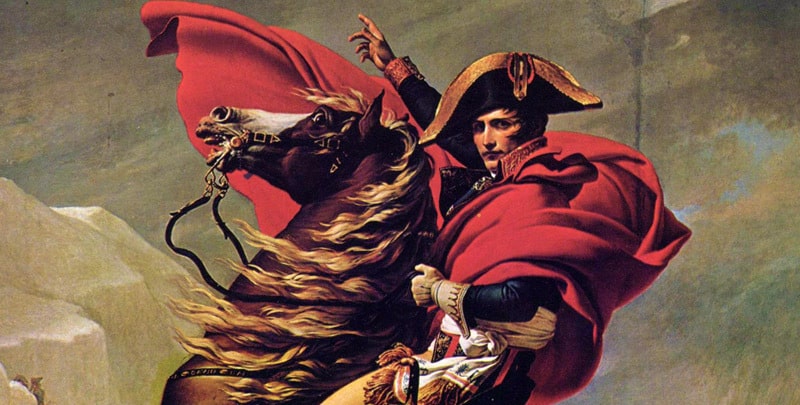
Napoléon Bonaparte gains a reputation as a successful general in the defence of the French Revolution, and then takes personal power and declares himself Emperor
Paris was also standardised under Napoléon Bonaparte. On February 4 1805 the State Council decreed that within 3 months every house in Paris would be given a street number. The numbers would be of two colours according to whether they were perpendicular or parallel to the Seine and even if they were on the right, and uneven on the left. The numbers in perpendicular streets would increase as they went away from the Seine and in parallel streets would rise with the flow of the river towards the sea.

On Sunday June 18 1815 Napoléon Bonaparte was overwhelmingly defeated at the battle of Waterloo, a village just south of Brussels. By dawn on Wednesday 21 June he reached the Elysée Palace in Paris where, for the second time, he abdicated the next day.
Napoléon left France for the last time on July 15, to sail to the harbour in Torbay, England. On August 7 he was transferred to a British warship for the two-month-long journey to Britain’s remotest island colony, St Helena. The man who had shaken up Europe over the previous 15 years died there aged 51 on May 5 1821.
The 1814 Restoration of the Bourbon dynasty in the figure of Louis XVIII and his reinstatement after Waterloo saw the near disappearance of the French left. Accounts of the egalitarian ideals of the Revolution were kept alive by handfuls of teachers, defrocked priests and former revolutionaries. It was only in the late 1820s that historical studies of the French Revolution started to be published.
In April 1814 Louis XVIII, brother of the executed Louis XVI, rejected a constitution drafted by the provisional government set up after Napoleon’s first abdication. The Charter of 1814 he then imposed was only implemented after foreign troops again occupied Paris after the June 1815 battle of Waterloo. The Charter reaffirmed the idea that the French King was the central authority by divine (birth) right. Nevertheless, it also endorsed some of the elements introduced since 1795.
The 1815 Constitutional Charter was a decree issued by Louis XVIII. It declared that all French men are equal before the law and that their individual freedom is guaranteed, including the right to religious choice – while declaring France’s state religion to be Roman Catholic. It offered to overlook the opinions and votes given before the Restoration (excepting those of the Regicides who had voted to executive Louis XVI and Marie Antoinette).
The Charter left in place most of the administrative and legal changes introduced by Napoléon.
The new constitution closely and consciously mimicked the British monarchical structure. Louis XVIII shared legislative power with a Chamber of Peers made up of aristocrats nominated by the King, and a Chamber of Deputies.
The Chamber of Deputies was made up only of men aged over 40 who paid over 1,000 francs a year in direct tax, and who were elected by men aged over 30 who paid over 300 francs a year in tax. Just 15,000 very rich Frenchmen were eligible to become deputies and only about 94,000 wealthy Frenchmen were enfranchised (out of a French population of approximately 35 million).
Opposition to the authoritarian regime came from both republicans and Bonapartists. In 1821 the poet songwriter Pierre-Jean Béranger was jailed in Sainte-Pélagie prison for three months for publishing political song lyrics.
In 1822 four soldiers who were allegedly members of the French Carbonari were executed for plotting to overthrow the king.
In 1824 Louis XVIII died and his younger (67-year-old) and still more reactionary brother, Charles X, became king. Still a firm believer in the divine right of kings he claimed the right to rule by decree whenever he felt it necessary.
In 1827 Parisian protests became more frequent. Demonstrations took place against the growing influence of the Jesuits, for greater press freedom and when the opposition to Charles X won a majority among the Paris deputies. Blanqui was wounded three times that year.

In 1829 Béranger was jailed again for nine months, this time in La Force prison, for publishing songs advocating freedom of speech.
To try and win nationalistic support Charles X ordered his army to seize Algeria on July 5 1830. At the same time, refusing to respond to growing pressure for political influence from the few wealthy voters, his government issued four new decrees on July 26 1830.
Charles X banned freedom of the press, dissolved parliament, halved the numbers of deputies and gave the richest 25% of electors in each constituency a veto over which deputies would actually sit in parliament. The July Revolution broke out the next day.

On 27 July 1830, the day after Charles X’s four decrees were printed, four newspapers appeared illegally. Print workers resisted the seizure of their presses by the police. In that afternoon’s protest riots, encouraged by republicans like the student, Auguste Blanqui, broke out near the Palais-Royal. In the early evening troops shot and killed some of the demonstrators.
The next morning, 28 July, barricades appeared across the centre and East of the city. An estimated 10,000 protestors raided local armouries. The Hôtel de Ville (Town Hall) was seized. The French revolutionary anthem, La Marseillaise, that had been the official national song from 1795 to 1804, was sung everywhere. The plain white Bourbon French flag was pulled down and the Tricolour flag raised. Charles X still rejected any compromise and called on his troops to stand firm.
On the morning of 29 July 1830 many new barricades appeared. But the 5th and 53rd foot soldier regiments at the Place Vendôme) went over to the people. The royal Tuileries Palace (finally destroyed in 1848) came under attack. Charles X’s remaining troops left Paris to defend the king at the Chateau of Saint-Cloud.
Over the next two days Charles X slowly realised he could not continue and tried instead to get his young grandson endorsed by the parliamentary deputies to reign under a regent. The republican deputies were few in number, and the majority of deputies, constitutional monarchists, played upon the fear of a new republic.
Not trusting Charles X, some deputies then entered negotiations with the 57-year-old Louis-Philippe, Duke of Orléans, Charles’ cousin. On July 31 Charles X fled from Saint-Cloud and – seeing the throne vacant – Louis-Philippe d’Orléans agreed to accept the Tricolour flag and to rule as a constitutional monarch as ‘king of the French’ rather than as ‘king of France’.
Roughly 800 Parisians and 200 soldiers were killed during the three July days of riots, barricades and fighting. Delacroix painted his famous Liberty leading the People soon afterwards.
One reason for the small number of troops (8,000) at Charles X’s disposal in July 1830 was his decision to send soldiers to take over Algeria through seizing Algiers on July 5 1830. The invasion succeeded, but still failed to win him rapidly enough the popular support that he craved in France. What it did was to initiate a military pacification campaign that lasted the following 45 years before the struggle for national independence was renewed in the 1950s.

The 1830 July Revolution transformed a generation and the next two hundred years of French history.
Many of the largely young men and women who had risen up against Charles X and absolutism lived the rest of their lives with the certainty that revolutionary change was possible. They knew that direct action by the few and supported by the many could change the course of history.
If the Bourbon family dynasty whose first king had been crowned in 1272 could be overthrown by popular revolt, then why couldn’t women achieve equality with men?
Why couldn’t wealth and privilege be abolished? Why couldn’t both political and economic democracy replace elite rulers everywhere?
The next eighteen years saw Paris become the centre of European left thinking. The great left movements of the later 19th and most of the 20th centuries, women’s liberation, mass unionism, communist utopianism, insurrectionism, internationalism, anarchism and socialism, were all conceived and theorised in Paris during these electrically charged two decades.
Bakunin, Blanc, Blanqui, Buronarroti, Buchez, Cabet, Engels, Leroux, Marx, Proudhon, Roland, Sand, Tristan and Veret-Gay along with thousands of lesser known social optimists from Paris, France and the whole of Europe met and discussed together how the world could be made better now it was clear that the old order could and should be overthrown.
From revolution to repression
On August 7 1830 Louis-Philippe agreed to a new Constitutional Charter. This promised freedom of the press and declared that censorship would never be re-established. Within weeks there was an explosion of papers with political cartoons.
On November 4 1830 Charles Philipon launched a weekly newspaper, La Caricature, whose four pages of text were accompanied by two of lithographs.
A month later the government reacted. On December 4 1830 it restored the stamp duty tax on newspapers and re-introduced censorship. Philipon’s response in the Foam of July cartoon above showed Louis-Philippe blowing bubbles of many of the unfulfilled promises in the Charter: popular elections, mayoral elections, an end to ‘jobs for the boys’.
Philipon was acquitted for this cartoon but was arrested again. On November 14 1831 he first drew Louis-Philippe as an image transformed into a pear. He was jailed for a year in January 1832 at Sainte-Pelagie prison, where he was joined by Daumier for his cartoon, Gargantua.

The Orléans monarchy deceived those who had hoped the relatively bloodless July Revolution would lead to a constitutional monarchy and deeply angered the Republicans who had been sceptical from the outset. At the same time, industrialisation was beginning to transform small bits of France, particularly its major towns and Paris. The scene was being set for the re-emergence of French radical republicanism and its more edgy components, socialist and feminist thought and organisation.
The slow growth of an increasingly impoverished urban working class, the much more rapid growth of a wealthy upper class of merchants, financiers and of the lawyers on whom they depended, coupled with the spread of literacy and connectivity through railway travel all occurred against living memories of revolutionary democracy, secularism and of Napoleonic modernity.
The young who had been the first to support the insurrection and even to die in 1830 were the first to experience disillusion. The change of King had neither removed aristocratic privilege nor did it guarantee a free critical press.
Many workers were resisting the commodification of their lives that followed the development of huge workplaces in which they had no rights to collectively resist or to make collective demands.
Many young middle and working class women not only experienced the same disenfranchisement that their male peers did, but considered that the enlightenment and French Revolutionary calls for full male franchise, freedom and democracy should also apply to their gender.

Key Dates


Coup d’état, Second Empire, Haussmann, Colonialism, Sedan, National Government – in progress
The topography of Paris changed dramatically under the Second Empire. Driven by dual needs to re-engineer whole areas to facilitate military intervention against resistors and to create and sustain housing speculation, Louis-Napoléon’s Paris prefect, Georges-Eugène Haussmann, invested public funds massively in renovating Paris.
Near the very beginning of this process, the realisation by some commercial entrepreneurs that the developing railway system made it possible to put on sale together a wide variety of national and international manufactured products and foodstuffs led to the establishment of what we now call Department stores. Huge stores that sold many different products rather than just one type of good or service catered for Paris’s growing wealthy upper and middle classes.
On November 18 1852 the Bon Marché store opened its doors on the Rue de Sèvres. With its fixed prices, acceptance of returns and advertising it revolutionised the shopping habits of well-to-do Parisians.
Four years later the second oldest surviving department store was opened on the rue Rivoli. At first it was called ‘The Parisian Bazar’, and from 1856 it was renamed the ‘Bazar Napoléon’ before the end of the Second Empire in 1870 led to its current name BHV (Bazar de l’Hôtel de Ville). In 1865 Le Printemps was opened on the corner of the Boulevard Haussmann and the Rue du Havre, close to the busy Gare St Lazare, the capital’s first railway station built in 1837.
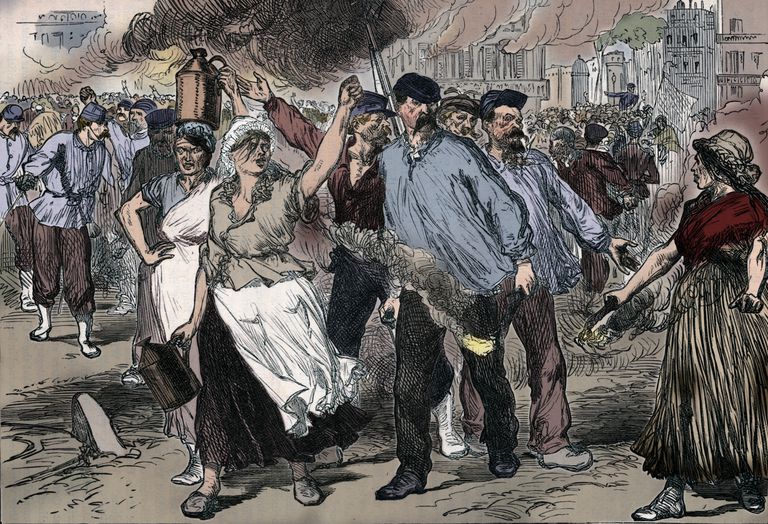
Siege of Paris, Versailles government, Local representatives, Women, Barricades – in progress


Anarchism, Socialism, Paris Exhibition, Dreyfus, Revolutionary syndicalism – in progress


Union Sacrée, Pacifist opposition, Women strikers, Mutineers – in progress


