This is a street that has witnessed many barricade battles. With the Sorbonne University at No. 1, it was the site of confrontations between the police and students in 1968 and 2006.
After the Sorbonne was forcibly evacuated by the police in May 1968The remains of the barricade across Rue Victor Cousin where it crosses Rue Cujas. On the right of the street the Pantheon Cinema was showing Albert Finney, Billie Whitelaw and Liza Minnelli in Charlie Bubbles.
In March 2006, after Sarkozy’s government introduced a law to force those under 26 to take whatever job they were offered and over the following two years, if they were dismissed by their employer, they would have no entitlement to unemployment benefit. University and secondary school students mobilised massively against the law, with demonstrations beginning at the Sorbonne. The law was withdrawn by the prime minister, Dominique de Villepin in April.
After dislodging students occupying the Sorbonne from March 10 to March 10 2006, fighting took place in the nearby streets. The riot police then closed off the Rue Victor Cousin, the Sorbonne Square and several other streets until April 24. A key symbol for the opponents of the new employment contract, during this period the police were attacked several times, with railings and molotov cocktails.
Further up the street, after it crosses the rue de Cujas is the independent Cinéma du Panthéon (there since 1907). It is opposite the nursery school at No. 14 where Lucie Bernard/Aubrac worked part-time in 1936.
An uninspiring facade and French and European flags outside the school at No. 14 where in the 1930s Lucie Aubrac taught in the nursery school
Originally called the rue de Cluny after an ancient abbey, in 1864 the short street south of the Rue de la Sorbonne was renamed in honour of the educational reformer, Victor Cousin (1792 – 1867). Forced into exile in 1821 for his liberalism, he became a Professor at the Sorbonne University after the 1830 Revolution.
Cousin helped structure French education in the 1840s inserting the history of philosophy into the French secondary school curriculum. This is still taught to all French school students up to the age of 18.
Cousin’s philosophy of eclecticism, merging British empiricism with French idealism, dominated mainstream philosophy from the 1830s to the 1880s. But it was not without its critics.
In his 1839 ‘Refutation of Eclecticism‘ Pierre Leroux wrote: ‘M Cousin is an excellent translator of phrases, but a dreadful translator of ideas‘. Bakunin in 1882 wrote that ‘This superficial pedant, without a single original idea… this illustrious philosopher has cleverly prepared for the the use of the student youth of France, a metaphysical dish whose consumption, made compulsory in all the schools of the State has condemned several successive generations to indigestion of the brain‘
Much earlier, in 1741, a much more serious contributor to French philosophy and left thought, Jean-Jacques Rousseau, lived at the St Quentin hotel (finally demolished in 1892) that was on the present location of 7 rue Victor Cousin, but was then 14 rue des Cordiers. In 1744-45 Rousseau stays there again, marrying his mistress, Thérèse Levasseur.
You won’t find this hotel because the rue des Cordiers used to link the rue Victor Cousin and the rue St Jacques but was built over by the southern section of the Sorbonne.
This, the second longest of the twelve roads leading out from what is since 1970 the Place Charles-de-Gaulle (previously the place de l’Étoile), was renamed three times before Victor Hugo moved and died there. In 1840 it was simply called Departmental Road 64, and then after land speculators took over in 1850 it was the avenue de Saint-Cloud and subsequently, at the time Victor Hugo moved in, the Avenue d’Eylau. This name dated from the Third Empire and was its attempt to associate itself with Napoleon I’s military successes, even including the inconclusive Battle of Eylau of 1807.
As a continuation of the same attempt to weaken the anti-Republican monarchists and Bonapartists by celebrating France’s biggest-ever Republican celebrity, the road’s present name was adopted on Victor Hugo‘s 79th birthday in 1881.
Number 14 was where Guy de Maupassant, the author of Boule de Suif (The Dumpling), lived from 1889-1890.
The office organising the recruitment of French citizens into the Waffen SS was based at No. 60. Pierre Laval signed the decree, which led to some 2,740 French joining up by 1944. Laval was one of just three French men executed by the French High Court in 1945.
In August 1940 Laval ordered the arrest of Georges Mandel, who had lived at No. 69. A Radical Party deputy in the National Assembly he had opposed the Vichy regime and was deported to Buchenwald. Returned to Paris as a hostage in 1944 he was seized by the French Milice and shot in the Fontainbleau Forest on July 7 1944. The Milice’s leader, Joseph Darnand, was tried and executed in 1945. Thousands of other Milice members were never caught or tried.
The former fascist founder of the resistance Hector escape network and the Civil and Military Organisation, Jacques Arthuys, lived and was arrested at No. 72. He was killed in December 1941 at the Hinzert concentration camp.
Hugo on the lintel above 124 avenue Victor Hugo, sculpted by Marcel Fonquergne from a photograph
The building at No. 124 was built in 1907 on the site of the previous home of Hugo and Juliette Drouet, who moved there together in 1878. This was where Juliette died on May 11 1883.
On February 28 1882, on the initiative of a journalist and political exile from 1871 to 1877, Edmond Bazire, a huge 600,000 strong celebration of Hugo’s 80th birthday took place outside his home. Victor Hugo died there on 22 May 1885.
In 1817 under the Restoration the Rue Ferrand (after the landowner on which it was built in 1777) was renamed the Rue Laval after the 71-year-old aristocrat Abbess of Montmartre (Marie-Louise de Laval-Montmorency) executed on July 24 1794. In 1887 it took its present name to honour the composer and music teacher Victor Massé who had died three years earlier.
In the 1920s and 1930s, No. 6 housed the People’s Bookshop (Librairie Populaire) run by the Communist Party. You could buy not just books and pamphlets there, but also busts of great people, badges, red flags and also red liberty caps (Phrygian bonnets).
No. 9 Rue Victor Massé
No. 9 was a key address for French socialists. On April 11 1918 Léon Blum, Jean Longuet and Paul Faure published the first daily issue of the evening paper, Le Populaire, from there.
The offices of Le Populaire and of the French Socialist Party were at No. 9 through the interwar years
Close to Montmartre several artists had workshops and/or lived in the road. Edouard Manet had studied at Thomas Couture’s workshop at No. 23 in 1850. Pierre Bonnard lived at No. 18 in 1890. During his second stay in Paris Vincent van Gogh lived with his brother at No. 25 in March 1886. Berthe Weill had a gallery at that address too, where in 1901 she held a joint exhibition of paintings by André Derain, Maurice de Vlaminck and Henri Matisse. This was also where Diego Rivera opened his first solo exhibition on April 21 1914.
Maurice Ravel also lived in the street between 1880 and 1886 at No. 29, while Edgar Degas lived at No 37 from 1890 to 1912 with his workshop in the attic.
The street was opened in 1894 when part of the land owned by the Montparnasse Cemetery was sold by Paris for housing development. It was named in honour of the republican campaigner against slavery who died in 1893. Schoelcher drafted the abolitionist decree of April 27 1848 and then lived in exile throughout the Second Empire.
In 1913 Picasso moved in to No. 5bis, next to the No. 5, now a building classified as an official historical monument. Picasso lived there until 1916. No. 5 is now the Giacometti Institute in Paris, including a recreation of the Swiss sculptor’s studio.
From 1913 to 1916 Pablo Picasso lived in No 5bis. The building next door, No 5 is classified as a Historical Monument and from 2018 hosts the Giacometti Institute.
In 1955, shortly after winning the Concourt prize for literature with her 1954 book, The Mandarins, Simone de Beauvoir moved in to a ground floor flat at No. 11bis with Claude Lanzmann, the left Jewish editor of Les Temps Modernes and film-maker 18 years younger than her. She fell in love with him when he was in his late 20s, and lived there with him until her death in 1986.
The street overlooking the Montparnasse Cemetery only has odd numbers, including No. 11 shown on the rightThe plaque honouring Simone de Beauvoir on the wall at 11bis Rue Victor Schoelcher, close to where she and Sartre lie together in the Montparnasse Cemetery.
The road dates back to 1250 when it led from the north towards the gardens of the Knights Templar fort and its tower on the inside of the Philippe-August wall. After the Charles V wall was built both parts of the road, inside and outside the old wall became the Old Temple Road.
Like many during the workers’ insurrection of June 1848, the road was barricaded without anyone today knowing its exact location.
On December 2 1851 the workers in the National Printworks at No. 87 were forced by the army supporting Louis-Napoleon’s Coup d’Etat to print the poster announcing the dissolution of the National Assembly.
The 1705 Rohan Private Mansion on the left was nationalised under the French Revolution and turned into the National Printworks by Napoleon in 1808. This use by the state ended in 1924, and after being used by the National Archives for many years at the time of writing (2020) its interior is being restored to 18th century style.
On March 18 1871 the tables were turned. The 86th battalion of the National Guard took over the National Printworks to defend the Paris Commune and Louis Debock, a typesetter, took over the directorship at No. 87.
The Worker Albert was arrested at his home in No. 131 in January 1841 following police enquiries into the assassination attempt on Louis-Philippe on 15 October 1840. Finding communist pamphlets at the house he was jailed for a month for belonging to a Communist club.
It is noteworthy here solely because it was where Louis Aragon‘s mother gave birth to him at No. 11bis, being ‘modernised’ in the Google Street picture of 2019 shown above, but still looking quite ‘posh’.
It is quite probable that Louis’ 57-year-old politically important father, the politician, prefect and deputy judge, Louis Andrieux, paid for the 24-year-old Marguerite Toucas to live there in 1898 to give birth to his illegitimate son.
Jean-Victor Schnetz‘s painting of the July 28 1830 battle outside the symbolic Paris Town Hall shows both the Tricolor and a Red flag – with the words’ ‘Long Live the Charter’ on it. The July Revolution was about restoring a semblance of democratic bourgeois rights, with the threat of workers’ rights behind it.
Lamartine rejecting the red flag on 25 February 1848 in favour of the Tricolor representing the Bourbons (white), the Empire (blue) and the Republic (red).
At the next successful insurrection on February 25 1848, Henri Philippoteaux painted the republican Lamartine outside the Town Hall rejecting the Red flag and endorsing the Tricolor.
Citizens, for me, the red flag, I am not adopting it, and I’ll tell you why I’m against with all the strength of my patriotism. It’s that the tricolor has toured the world with the Republic and the Empire with your freedoms and your glory, and the red flag was that around the Champ-de-Mars, dragged into the people’s blood.
Alphonse Lamartine
On March 22 1848 a delegation of women activists from the ‘Women’s voice’ group went to the Town Hall to demand women have full citizens’ rights including the right to vote.
On May 15 1848 demonstrators against French intervention in Poland, including Blanqui, the worker Albert, Blanc, Cabet, Leroux and Raspail occupied the Town Hall and declared a new provisional government before being arrested.
Lamartine went on to order the brutal suppression of the June 1848 workers’ insurrection sparked by the government’s closing of the world’s first unemployment system with national workshops offering work paid by the state.
On September 4 1870, after Napoleon III’s capture at the battle of Sedan, Léon Gambetta stood on the Town Hall balcony and announced the end of the Second Empire and proclaimed the creation of a new Republic.
On 31 October Blanqui and others demonstrated in front of the Town Hall demanding more action against the Prussian army from the new government led by Jules Favre. A supporter on the inside unlocked the doors and the demonstrators occupied it.
On January 22 1871 Louise Michel was one of many who protested outside the Town Hall at the government’s inertia in face of the Prussian siege of Paris. the demonstrators were fired on and Louise Michel later wrote that this was the first occasion that she had fired back with her rifle.
On March 18 1871 the Thiers government first placed a regiment loyal to to it into the Town Hall overnight, and then attempted to seize all the canons in Paris. These events sparked the creation of the Paris Commune by the Central Committee of the National Guard on March 29 1871.
Retreating before the murdering Versaillais troops the Communards carried out their warning that they would burn down several of Paris’ historic buildings, including the Hotel de Ville
In 1791 the owner of the huge house at No. 27, the Marquis de Villette, a gay friend of the enlightenment philosopher and writer who had died there in 1778 , renamed the street Quai Voltaire. Villette had supported the 1789 Revolution and renounced his nobility. Elected to the Convention in 1792, Charles Villette argued for the banishment of Louis XVI, but died of what was then described as ‘melancholia’ (langeur) aged 57 in July 1793.
Alongside the plaque on No. 27 remembering Voltaire is another recalling the meetings that took place there of the leaders of the national and local police groups of Résistance Libération-Nord. This was initially the name of a clandestine newspaper, established after SFIO and non-Communist CGT trade unionists signed the Declaration of Twelve opposing the Vichy regime and the dissolution of the trade unions on November 15 1940. It became a resistance organisation in November 1941 and in 1943 was one of the eight resistance movements represented on the National Resistance Council.
29, Quai Voltaire is where Daniel Stern (Marie d’Agoult) lived in the Hôtel de Mailly-Nesle after her 1839 breakup with Franz Liszt. She ran a republican literary salon there, and in 1844 Karl Marx used to attend.
No 7 Quai Voltaire is another well-plaqued house (three). It was the home of Hubert de Lagarde, founder and head of the Resistance Eleuthère network of the Forces Françaises Combattantes . A plaque tells how he was arrested by the Gestapo on June 15 1944. This was only a few days after he had protested against the appointment of a Communist to head up the now merged FFI (French Forces of the Interior). He was tortured and then deported to Buchenwald before dying of dysentery on January 25 1945.
When this impressive square was first built under Henri IV between 1605 and 1612 in the then fashionable aristocratic Marais part of Paris, it was called la Place Royale. The King’s mansion on the south side and the Queen’s on the north (although they never lived in them) were higher than the 36 private mansions around the rest of the square . All of the other houses had similarly designed fronts.
During the French Revolution the square was renamed several times. The names changed from the Fédérés square (after the 1790 Federation celebration on the first anniversary of the storming of the Bastille), to « place du Parc-d’Artillerie and then Place de la Fabrication-des-Armes, and then Place de l’Indivisibilité (referring to the administrative unification of four Paris districts in 1795).
Finally, in 1800 it was given its current name Place des Vosges in honour of the French Vosges Department that had been the first in 1792 to send the taxes it owed to the republican government. During the Restoration (1815-1830) and under Louis-Napoléon’s Second Empire (1852-1870) the name went back to Place Royale, and from March 20 1848 until 1852 it was known as the Place de la République.
In February 1871 several canon were moved for safe-keeping by the National Guard into the square. On March 11 1871 Jean Allemane persuaded the National Guard not to allow the Versailles troops to take the artillery back under their control. The same thing happened again on March 14 and on March 16.
Victor Hugo lived at No. 6, now a fascinating museum, from October 1832 until 1848. The American author with an amazing knowledge of Paris, Cara Black, reproduces a common error concerning Hugo. In her opening tour of Paris novels, Murder in the Marais, her super impressive detective Aimée Leduc hides in the museum at No. 6. Black writes: ‘The (dining) room captured his essence, dark and narcissistic. The only touch that could be called socialist was the heavy peasant glassware on a mahogany sideboard’. Hugo was actually a royalist who converted to becoming a principled republican. His wife Adèle Foucher (1803-1868) lived at No. 6 with him. On February 16 1833 he began a life-long relationship with Juliette Drouet (1806-1883).
The town hall (from 1793 to 1860) at No. 14 of what was in 1848 the 8th arrondissement was taken over by the insurrectionaries on February 24 1848, supported by the local National guard. They disarmed the municipal police.
Four months later, on June 23 during the workers’ insurrection against the closure of the National Workshops, the insurrectionaries again took over the Town Hall and raised a Red Flag over it. Some 350 regular soldiers put down their weapons.
My father, whose dying wish was to for me to get him a copy of a late Georges Simenon novel that had finally appeared in paperback, probably didn’t know that before the Second World War when Simenon had lived at No. 21 (first on the ground and then on the first floor), his neighbour was called Maigret.
On June 8 1942 two members of the Second Jewish Section of the FTP-M.O.I, Léon Pakin and Élie Wallach, were arrested in the Square as they prepared to sabotage a furrier’s workshop who was supplying the German army. Pakin and Wallach were shot on July 27 at the Mont-Valérien prison fort.
Looking up the Avenue to the Arc de Triomphe around 1900
One of 12 broad radial roads that leaves the Arc de Triomphe from what used to be called the ‘Square of the Star’ (Place de l’Étoile) and was renamed Place Charles-de-Gaulle in 1970. The road was first opened on January 16 1789 when the section of the Farmers’ tax wall was completed between the Etoile (Neuilly) and Roule (Ternes) customs posts. It became de Wagram on March 2 1864 during the Second Empire to honour Napoleon I’s significant victory over the Austrians at the Battle of Wagram on July 6 1809.
The Salle Wagram at No. 37/39 witnessed some key meetings in the history of the Left in France. On the site of a guingette (open air café) run by a Napoleonic war veteran since 1812 on a country lane outside the city walls (and so providing cheap wine), under the restoration he developed it into dance hall, the Bal Dourlans.
In 1865 a new covered hall designed by Fleuret was inaugurated surrounded by two rings of seats. In 1899 the hall was given in a legacy to one of the five academies grouped within the Institut de France, which continued to run it as a dance hall, concert hal, exhibition halll and venue for political meetings.
Immediately after the 5th Congress of the Second Socialist International was held at the Salle Wagram from September 23 to 27 1900, leading to the establishment of a permanent international committee, an even more important development took place.
The entrance that led to the Salle Wagram around 1900
On March 28 1910 Vera Figner presided at a fund-raising concert at the Salle Wagram to support Russian revolutionaries escape from prison. Among those who attended were Lenin and Maxime Gorky, although Lenin avoided meeting Gorky since he didn’t wish to have a political argument with him.
Shortly before Lenin left Paris he attended an event at the Salle Wagram on April 15 1912 to honour the centenary of the birth of Alexander Herzen, the founder of Russian socialism.
On the third anniversary of the Russian Revolution, November 7 1920, Pierre Monatte, the anarchist Caroline Rémy and Boris Souvarine were among those who attended a celebration meeting at the Salle Wagram.
Caroline Remy, the anarchist journalist who joined the Communist Party in 1921 shown here painted by Pierre-Auguste Renoir
André Malraux attended at least two meetings organised by the Communist Party in the Salle Wagram. One in 1933 was support of ErnstThälmann, the jailed leader of the German Communist Party, and on December 23 1935 he spoke at the second anniversary of Dmitrov’s acquittal of setting fire to the Reichstag.
On July 30 1936 Malraux was given huge applause at the Salle Wagram when, returning from Spain, he spoke at the first major solidarity meeting with Republican Spain.
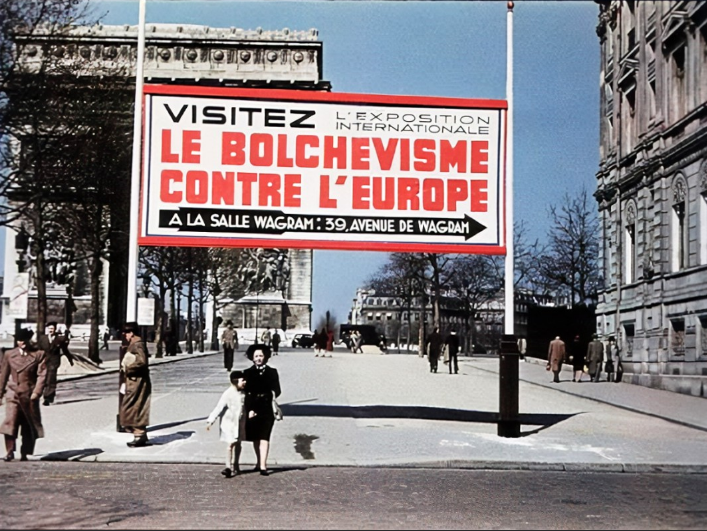
Under the Occupation the fascist French Popular Party mounted a ‘Bolshevism against Europe’ exhibition at the Salle Wagram that opened on March 1 1942
On March 8 three resistance fighters failed to set off a bomb in the exhibition. The Romanian-born Jew André Kirschen (aged 15 and a half), Karl Schoenhaar and Georges Tondelier were arrested. They were tortured and the two older men were executed after the German court martial of 27 resistance fighters from April 7-14 1942. Also found guilty of shotting at a German soldier in September 1941, Kirschen was sentenced to ten years imprisonment because of his youth, then deported to Germany and, fortunately, survived.
After the Second World War the Salle Wagram was hired by the extreme right on October 28 1948 to hold a meeting for ‘Peoples oppressed by the Bolsheviks’. A counter demonstration by 12,000 communists was attacked by the police, involving 1 death and 300 wounded.
After the war it was also the major Paris jazz venue, with musicians such as Louis Armstrong, Duke Ellington, Lionel Hampton, Bud Powell and Django Reinhardt all playing there. Sidney Bechet performed his last concert there in 1958.
On September 1 1950 a communist meeting in support of the Vietnam liberation movement was held at the Salle Wagram. Its principal speaker was Léo Figuères, a resistance fighter who had visited Vietnam and whose arrest had been ordered by the military.
The Algerian liberation movement whose president was Messali Hadj, the Mouvement pour le Triomphe des Libertés Démocratiques, held huge meetings at No. 37 on June 13 1950 and, in protest against police violence on May Day, on May 5 1951.
The Algerian war for independence that began in 1954 saw a joint protest meeting of the SFIO and Marceau Pivert‘s recently founded (June 1955) Mouvement pour la justice et les libertés outre-mer (Movement for Justice and Freedom in the Colonies) taking place at the Salle Wagram on October 7 1955. The meeting called on the government to stop sending military reinforcements to Algeria.
While anarchism may contain extreme individualism, in France it emerged as a bottom-up collective ideology alongside communist thought as a major mutualist strand within early French socialism.
Jean-Jacques Rousseau argued that ensuring freedom was a key moral obligation on the organisation of society
Peter Kropotkin (1842-1921) suggested anarchism emerged out of the ‘naturalist philosophy’ of the enlightenment.
Pierre-Joseph Proudhon (1809-1865) considered that in putting individual human rights at the legal heart of the social order, the French Revolution itself was the start of doing everything differently. Justice became possible in political, economic and social life within a peaceful transition to an anarchist world he described as ‘Anarchy is Order Without Power’.
Proudhon, who many see as the ‘father’ of anarchism, regarded property as a means of exercising authority.
He rejected it, god and government – whether elected or imposed by
revolutionaries. He opposed both reformists and utopians.
For Proudhon, only the
workers themselves could achieve freedom. And they could only do so through exercising
direct control over their daily work.
Proudhon, Perry Anderson (The New Old World) reminds us, also believed in a European confederation of federations – a bottom-up association of mutually supportive workshops.
A postcard of the founding meeting of the First International Workingmen’s Association in London in 1864 attended by Marx and many French Proudhonists
In the 1850s and 1860s Proudhon’s writings reached a wide audience among the growing numbers of skilled French workers, who often found themselves in workshops alongside their working employer. The French delegates to the First International, founded in London in 1864, were largely Proudhonist, without their belonging to a specific anarchist organisation.
The suppression of the 1871 Paris Commune killed (literally) the Proudhonist collective bottom-up dynamic.
It took the return of the amnestied Communards in 1879 and 1880 for anarchism to re-emerge. But its form was then quite different.
Louise Michel led an unemployed demonstration in 1883 wearing a black veil. This became the anarchist colour
The now-marginalised Proudhonists increasingly wished to differentiate themselves from the socialists. In 1882Louise Michel (1830-1905) argued ‘
No more flags dyed red with the blood of our soldiers. I will carry the black flag to mourn our dead and all illusions.
In 1884 in a regular meeting place, the Salle de la Réunion, at 8, Rue de Lévis, the anarchist grouplet, the ‘Batignolles Panther‘ (la Panthère des Batignolles) held one/two meetings that ended in street battles with the police and monarchists. This was a period of rising monarchist agitation. Either on 23 November or 7 December 1884, or on both dates, the meetings included speakers such as Louise Michel,Jules Favre, Henri Rochefort and Léon Gambetta.
The Panther of the Batignolles anarchist group was set up in October 1882. A police spy reported that they had ‘quiet’ meetings with a lot of reading of scientific books on how to make explosives
Propaganda by the deed
Many anarchists reflected their frustration with the conservatism of the strongly liberal and anti-socialist Third Republic by turning to what became called ‘Propaganda by the Deed’.
Breaking with Proudhon’s moderation as well as with Mikhail Bakunin’s (1814-1876) anti-authoritarianism, the new generation of libertarians increasingly considered that a social revolution could only occur if sparked by insurrectional acts.
At the right moment, the
‘spirit of revolt’ inherent in the working masses would spontaneously lead to a
revolution.
This ideology justified violence directed against individual capitalists and their supporters on the grounds that capitalism itself was founded on violence. ‘Individual seizures’ of bourgeois goods and possessions were justified as helping to destabilise the bourgeois order.
A lithograph of the moment of the explosion at the Restaurant Foyot, 36 Rue de Condé on April 4 1894
The ‘propaganda by the deed’ anarchists denounced
attempts to create lasting organisations, as well as strikes (reforming the
system) and any joint work with the socialists.
Their public presence grew,
as their ideas attracted many intellectuals and artists who detested the authoritarianism
and conformity of 1880s French society.
Felix Fénéon (1861-1944) and some of his artistic and literary friends like Maximilien Luce started attending anarchist meetings. Anarchism also attracted younger workers angry at continuing massive poverty and inequality.
Anarchist papers were selling 20,000 copies a week in Paris by the mid-1880s. The papers edited by Jean Grave(1854-1939), successively le Révolté, La révolte and Les Temps nouveaux (New Times) and supported by Kropotkin and Élisée Reclus, were the most influential.
Bombings
On May Day 1891 nine demonstrators for the 8-hour day were shot dead by police at Fourmies near the Belgian border.
On the same day at another demonstration at Clichy in Paris three anarchists were arrested and badly beaten up after the police decided to seize the red flag at the march’s head. Gunfire was exchanged. One anarchist and some police slightly wounded.
Two of the anarchists were jailed by the judges
for five and three years.
As an individual act of reprisal for this
injustice, the 32-year-old François (Koenigstein) Ravachol then bombed the homes
of two judges involved in the Clichy trial. He was caught and guillotined on 11
July 1892.
Émile Henry was captured close by the Café Terminus after his February 1894 bombing
On November 8 1892, five days after the end of the 10-week Carmaux miners’ strike in the south of France, Émile Henry, the 20-year-old son of a Spanish communard, planted a time-bomb at the Carmaux company’s Paris office. It was found and taken to a police station where it exploded killing five gendarmes.
On 9 December 1893 August Vaillant threw a bomb into the Chamber of Deputies from the public gallery in protest against political corruption. It wounded 20 deputies and Vaillant was guillotined on 3 February 1894.
Nine days after Vaillant’s execution, the 22-year-old Henry carried out a revenge bombing at the Café Terminus at the Paris Gare St Lazare. It killed one man and wounded another 19. Henry was caught at the scene and guillotined on 21 May 1894.
On 24 June 1894 an Italian 20-year-old anarchist knifed the French president in Lyon. Sadi Carnot died a day later and Caserio was tried and guillotined in August.
Under new anti-anarchist laws passed in December 1893, 426 anarchists were rounded-up in April 1894 of whom 30, including Fénéon, the anarchist journalists Jean Grave and Émile Pouget(1860-1931), and a burglar, Philippe Léon Ortix, were also put on trial in August 1894 for ‘criminal conspiracy’.
The prosecution aimed to
prove that the anarchist anti-capitalists were working closely with known
criminals. After Fénéon’s brilliant appearance in the dock, and Bernard Lazare
‘s committed legal defence, only three were finally jailed.
Later in 1894 a few anarchists, including Bernard Lazare and Fénéon, were among the first to denounce the silence on the left in front of the national anti-Semitic lynch mob atmosphere after Captain Dreyfus was arrested for alleged treason on October 29.
Earlier that year Lazare had published Anti-Semitism, its History and Causes, and Lazare became the key figure in exposing the framing of Dreyfus with a pamphlet published in November 1896.
Direct action
Criticism of the ‘propaganda
by the deed’ ideology, the repression targeting anarchist newspapers and
individuals, as well as the clear failure of these terrorist acts to stimulate revolution,
led many anarchist sympathisers to turn towards trade union and socialist
alternatives.
As early as 1893 Michel, Kropotkin and others in the Avant-Garde group of anarchists began to argue against the individualist-isolationism of ‘propaganda by the deed’ and for a return for anarchism to the workers’ movement as a component of socialism.
Their object, inside the
trade unions and socialist sects, was to attack the advocates of state
socialism through parliament and to argue for extra-parliamentary action,
particularly the general strike as a means of achieving emancipation. Entering
unions that were only legalized in 1884 and working with the socialists there
would end the isolation fueled by the failures of ‘propaganda by the deed’.
It would also dovetail with the understandings of the very small numbers of trade unionists. They rationalised their minority status in relationship to their fellow workers as proving their responsibility was to lead by example. If a minority took direct action on an important issue, then the majority might join in.
Direct action and the General Strike as opposed to political action were adoped by the founding conference of the CGT in 1895
‘Direct action’ was thus democratic – it offered workers the possibility of participating in their own liberation – and it did not involve a dependency upon either the state or the employers. Neither party politics nor collective bargaining could be relied on to improve workers’ conditions; workers could only rely on what was gained through direct action.
In September 1895, albeit paradoxically, the founding conference of the Confédération Générale du Travail (CGT) trade union centre at Limoges voted to ‘stay outside of all political schools’. The paradox is that this apolitical stance was adopted by the majority of delegates made up of Jean Allemane supporters, anarchists and Blanquists in order to scupper the influence of Jules Guesde‘s French Workers’ Party.
Revolutionary syndicalism
‘Revolutionary
syndicalist’ trade unionism tended to place a greater emphasis upon the
‘general strike’ for longer-term goals of social transformation and
internationalism, and to stress the importance of generalising actions against
the employing class as a whole. It took a deep
hold on the unskilled worker activists whose uncertain, irregular and very low
paid work meant they were effectively excluded from the widespread
state-supervised mutual savings societies (mutualités)
with the requirement of regular payments before benefits could be accrued.
Revolutionary
syndicalists were sometimes politically close to the still sizeable body of anarchists.
They often came from smaller firms and trades where the prospects of reactionary
paternalist employers ever agreeing to trade union recognition and collective
bargaining were highly remote.
They defended direct action, confrontation with the employers, the General Strike and sabotage such as ‘go slows’. In the CGT’s 1906 agitation for the Eight Hour Day, it therefore called neither for legislation on working time nor for negotiations: its aim was to have enough workers take strike action to convince everyone to simply impose the eight hour day on the employers.
The anarchist Émile Pouget (1860-1931), author of Le Sabotage (1898), became Joint-General Secretary of the CGT from 1901 to 1908. In 1906 he helped draft the Amiens Charter that is still a cornerstone of much French trade unionism with the cobbler, Victor Griffuelhes (1874-1922).
It was largely thanks to
Griffuelhes’ organizational talents as General Secretary that the CGT grew from
around 100,000 members in 1901 to the near 500,000 claimed when he was forced by
the 1908 reformist coup to resign.
World War 1
50 years after the start of World War 1 French anarchists were still dealing with the reality that many leading anarchists supported their countries in the war
Anarchism, like the whole revolutionary left, took a big hit in 1914. All belief that class interests would trump national interest crashed. Worse still for the anarchists than for the social democrats who wanted to win state power, and had already seen some former socialists move into ministerial positions, Kropotkin and Grave and a handful of other leading anarchists argued that workers should support the Entente alliance against the greater evil of German militarism.
The 1917 Russian Revolution
was experienced by the revolutionary syndicalists as an emotional
roller-coaster. Revolutionary inspiration turned quickly to the sad
confirmation of their greatest fears and predictions about the consequences of a
single party state.
Anarchist insistence that workers
could and would seize a revolutionary opportunity to overthrow the state was shattered.
The defeat of the 1919 German revolution and the arrival of the successful
fascist counter-revolution in Italy added to their demoralisation.
The shrinking numbers of anarchists began to see anarchism as first needing to educate the masses and even to organise to ensure this happens.
In 1936 Spanish anarchism briefly appeared to demonstrate that anarcho-communism from below was possible
The ‘anarchist summer’ of 1936 in France and particularly in Spain, with agricultural collectives being formed bottom-up across whole regions, and with revolutionary syndicalists dominant in the trade union refuelled the anarchist belief that they could make history and not just be subjected to it.
Yet by November 1936 the choice between making the revolution and defending the Spanish Republic had to be made: the anarcho-syndicalist CNT trade union confederation decided to enter the Spanish Republican government and was backed by the Iberian Federation of Anarchists (FAI).
After World War Two
In the 1940s and 1950s some French libertarians tried to resuscitate anarchism from its identification with violence by renaming it ‘libertarian socialism’ or ‘libertarian humanism’. Most kept defending the earlier anti-state mantra, and failed to support growing anti-colonial struggles.
George Brassens was a leading anti-authoritarian rebel in the 1950s and 1960s
The most prominent sympathisers in this period, like the surrealist André Breton (1896-1966) and poet/singer George Brassens (1921-1981), remained individualist rather than collectivist. Brassens was one of the editorial collective behind the revival of Le Libertaire, which resumed production in December 1944 and came out on a weekly basis until 1956, when the fragmenting anarchist movement suspended its production.
A libertarian renaissance started in the early 1960s, inspired partly by the experiments in self-organisation in Tito’s Yugoslavia and in Ben Bella’s (1916-2012) Algeria.
May 1968
In May 1968 the Odéon Theatre was occupied by the students and next to the banner saying ‘Odeon is Open’ a Black anarchist flag flew alongside a Red one
May 1968 saw an explosion of radical libertarianism. Spontaneous and anti-authoritarian it denounced the bureaucratised trade unions and Communist Party.
For a time a black flag was raised over the Odéon Theatre. This was occupied by the students, and became a centre of debate about the future of the movement. My step-mother recalled how the teargas used by police in 1968 to end the occupation wafted up into the flat 50 metres from the theatre that I’m now lucky enough to be able to use to follow the footsteps of the French Parisian left.
May 1968 generated a new
mass feminist movement in France. It relaunched the ecology environmental
movement. It led to the formation of hundreds of experimental self-governing
collectives and a large squatting movement.
Direct Action
Among those radicalised by 1968 were many French anarchists. A journal, Camarades, was launched in 1974. It was influenced both by increasingly the militaristic Italian ‘Autonomous Workers’ organization (of whom many members fled to France in 1979) and by Spanish anti-Franco activists in the Groupes d’action révolutionnaires internationalistes (GARI) who believed it necessary to continue an armed struggle against the state.
In 1976, Jean
Bilski, an anarchist acting alone, murdered the chief executive of the giant
Credit Lyonnais bank, and then killed himself.
In 1977 a group of Maoists belonging to the Armed Units for Mass
Self-organisation (Noyaux armés pour l’autonomie populaire) carried out 7 bombings on their own and
another series of attacks on nuclear targets with anarchists belonging to GARI.
The first ‘General meeting
of Parisian self-organised groups’ (Assemblée générale parisienne des groupes
autonomes – AGPGA) is held in October 1977,
after the July 31 brutal police attacks on the anti-nuclear demonstration in
the ‘Battle of Malville’. Some of those there created a loose ‘internal armed
political coordination network’ within the wider group.
A month later on the night
of 19 November 1977, 23 coordinated attacks (bombings, Molotov cocktails) on
the French electricity company (EDF) and the nuclear industry took place across
France.
The leaders of Directe Action were tracked down to a farmhouse and arrested in 1987
While most French anarchists considered the time was not ripe for mounting similar attacks and robberies to those associated with the Red Brigades in Italy from 1975 to 1979, a tiny minority clearly did.
Some of them formed Action Directe, borrowing the name from
the revolutionary syndicalists. This group’s first action was on May Day 1979.
They machine-gunned the headquarter offices of the Patronat (the largest French
employers’ organization, then called the Conseil
national du patronat français).
The group followed this up with another 80 bombings,
bank robberies, acts of sabotage, machine-gunning and assassinations over a
nine-year period. In 1987 its four remaining leaders were jailed for life. The
last one, Jean-Marc Rouillan, aged 66 was released in May 2018 after spending
28 years in prison, of which ten were in isolation, and then published his
account of Ten years of Direct Action.
21st century
Most ‘new’ anarchists resumed
involvement in the major struggles of the late 20th century –
against racism, for equality, against unjust laws, and even for workers’
rights. In the 1970s and 1980s a ‘workers’ control’ movement appeared.
Many are involved in
‘alternative world’ movements, often working closely with radical environmentalists.
Eco-anarchists, following Élisee Reclus, generally argue that mankind should
stop attempting to dominate nature.
These groups usually stress key libertarian themes such as direct democracy, task rotation, anti-authoritarianism, solidarity and federalism.
A march against the Macron trade union reforms on 19 April 2018 was hijacked by 250 young men under a black-red flag wanting to confront police eager to tear gas them
The black and red flag of French anarchism is now mainly carried by a few hundred young men at the margins of demonstrations. They are often primarily interested, it would seem, only in confronting the police or in being attacked by them.
Yet the conviction that a radically different way of organizing economic and social relations to contemporary capitalism is both possible and necessary remains alive and kicking. And French anarchism reminds us that this cannot be achieved without also ensuring individual freedom.
Gustave Courbet sketched this self-portrait at Sainte-Pélagie prison after the defeat of the Paris Commune in 1871. He was one of many artists who supported the Commune and is in a line of socialist, anarchist and communist artists who lived and/or worked in Paris and contributed their visions of a world transformed
References to include: Eugène Delacroix
In 1895 Toulouse-Lautrec painted one of a series he had begun in 1889 commissioned by the Moulin Rouge at the Place Blanche. In it he inserted (bottom right) tributes to the editor of La Revue Blanche, Félix Fénéon, and to his friend, Oscar Wilde (second bottom left), whom he had met and painted in London the day before Wilde was jailed for indecency.Portrait of Felix Feneon by his former fellow political prisoner charged with anarchist sympathies Maximilien Luce. This was pained in 1901
Communism as an international struggle for freedom. This 1951 socialist realist painting by Boris Taslitkzy shows French dockers fighting to stop arms going to French Indochina
What is shared between those who define themselves or are defined by others as ‘communist’? And how may ‘Communism’ be distinguished both from French anarchism and French socialism, with which it shared much common history and ground?
Babeuf was guillotined on 27 May 1797 as leader of the Conspiracy of Equals against the Directorate
Manifesto
of Equals
The 1795 Paris revolutionary ‘Manifesto of Equals’ inspired by François-Noel Babeuf and rescued from oblivion by Philippe Buonarroti (1761-1837) summarised what remained (and remains) common to nearly all those who described themselves as communist across the following two hundred and some years:
‘We need not only that equality of rights written into the Declaration of the Rights of Man and Citizen; we want it in our midst, under the roofs of our houses… We lean towards something more sublime and more just: the common good or the community of property! No more individual property in land: the land belongs to no one. We demand, we want, the common enjoyment of the fruits of the land: the fruits belong to all.
We declare that we can no longer put up with the fact that the great majority work and sweat for the smallest of minorities. Long enough, and for too long, less than a million individuals have disposed of that which belongs to 20 million of their kind, their equals.
Let it at last end, this great scandal that our descendants will never believe existed! Disappear at last, revolting distinctions between rich and poor, great and small, masters and servants, rulers and ruled.’
After agreeing to this general statement of belief, communists had much more to disagree with each other upon.
We have divided the considerable history of Communism in France into five periods:
From setting an example and insurrections to state communism
Early French intra-communist debates were primarily around ‘How to achieve communism?’ Some 19th century French communists answered: By example and education. Some: By a revolution to destroy state power. And others: By seizing state power and using it.
1. Exemplary communism
The example of communism could lead others to follow. Society could be transformed by establishing ideal communities within the existing order. Utopian communist ideas and projects flourished during the first half of the 19th century. Many built upon egalitarian Christian beliefs to give them wider legitimacy, often looking to messianic figures to offer leadership.
Etienne Cabet (1788-1856) initiated the most influential of these experiments with his ‘Travel and Adventures of Lord William Carisdall in Icaria’, popularised in a French translation as Voyage en Icarie in 1840. It was Cabet whose pamphlet ‘Le crédo communiste’ first drew the word communist into the political vocabulary.
Cabet founded the Icarian colony at Nauvoo in 1849 but died in 1856. The last Icarian group dissolved itself in 1898
By the mid-1840s Icarian communist groups existed in several French cities as well as in Paris. After trials for conspiracy in 1847, Cabet argued his supporters should emigrate to Texas to establish communist communities:
The community suppresses egoism, individualism, privilege, domination, opulence, idleness and domesticity, transforming divided personal property into indivisible and social or common property. It modifies all commerce and industry. Therefore the establishment of the community is the greatest reform or revolution that humanity has ever attempted.
2. Insurrectionary communism
Other 19th century communists considered the revolutionary insurrection itself to be the principal way of preparing for a new society. It would overthrow private property and the state. Once the old power structures were removed the new world could be built by the working classes themselves.
For insurrectionary communists the barricade was the way the state would be defeated. This 1871 photograph is of the barricade in the rue de Charonne
Barricades appeared in Paris for 3 days in 1830, 2 days in 1832, 1 night in 1834, a few hours in 1839, 2 days in February 1848, three days in June 1848, one day in December 1851 and for a week in May 1871.
Eric Hazan’s History of the Barricade begins by pointing out:
We could say that this is only a succession of defeats – some immediate, on the ground, others delayed – in which the forces of domination end up reversing the gains of an ephemeral victory. But thanks to Baudelaire, Blanqui, Hugo and Lissagaray, this is a history that is still living, a source of inspiration for those unresigned to the perpetuation of the existing order.
After the bloody suppression of the 1871 Commune the next Parisian barricades were only erected in 1944 and 1968, but the inspirational idea of a great event-led transition remained embedded in left French thought.
Direct action and the General Strike as opposed to political action were adoped by the founding conference of the CGT in 1895. This photograph is of the 1906 campaign for a general strike to bring about the 8-hour day
During the third quarter of the 19th century the barricade was gradually replaced by the General Strike as the hoped-for transformative event that would ensure the transition to a communist society.
The term ‘anarcho-communist’ covers those who held, like Pierre-Joseph Proudhon (1809-1865) and Victor Griffuelhes (1874-1922), that after the great event and the overthrow of the national government, the state and authority of the employers, the existing workers’ organisations would be able to democratically run society.
3. State communism
The third way of achieving communism borrowed from Babeuf and Robespierre in seeing the role of the state as key to achieving a new world.
Drawn to Babeuf’s ideas by Buonarroti, Auguste Blanqui (1805-1881) aimed to seize state power and use it to suppress the ruling elite. All the decisions on behalf of the Parisian workers and the French provinces should be taken by a handful of dedicated revolutionaries.
A proclamation was read on the steps of the Paris Town Hall on May 12 1839 in the names of the ‘Provisional Government’ including Blanqui (who was named ‘Commander-in-Chief’ of the republican army) and Armand Barbès (1809-1870).
Their self-constituted Provisional Government called for support from Parisian workers to:
‘Perish finally the exploitation, and may equality sit in triumph on the mingled ruins of royalty and aristocracy’.
On May 15 1848 in the aftermath of a protest march against the new government’s lack of support for the Polish revolution, Barbès announced a new government from the steps of the Town Hall. 15 men and were tried in July 1849. Barbès and Alexandre Martin /Albert (1815-1895) were sentenced to deportation, Blanqui to ten years and the republican scientist François-Vincent Raspail (1794-1878) to six. Louis Blanc (1811-1882) was acquitted.
The 15 arrested after the May 1848 protests against government inaction over the Polish revolt against the Russian colonisers included insurrectionary revolutionaries like Barbes and Blanqui alongside socialist republicans like Blanc and Raspail.
The Blanquists wished to seize state power without any democratic mandate from the workers who they believed would then follow the revolutionary leadership.
Marx’s influence
In the third quarter of the 19th century the political meaning of ‘communist’ and ‘communism’ in France shifted to specifically highlight the need for the whole working class (and not a handful of conspirators) to capture and use state power to rule on behalf of their class and so ensure a transition to a better world.
This evolution was to a large extent due the work of Karl Marx (1818-1883) and Friedrich Engels (1820-1895). Their Communist Manifesto was published in German in February 1848.
Its first French translation appeared in Paris just before the June 1848 workers’ uprising. Yet hardly anyone read the Manifesto or knew it existed in Paris in 1848.
Although both Marx and Engels had already lived some time in Paris before 1848, the small influence they did have on the dominant Proudhonian anarcho-communism in France only began to appear from the late 1860s. Two of Marx’s daughters, Laura in 1868 and Jenny in 1873, married French socialists who had come to London to learn from Marx, Paul Lafargue(1842-1911) and Charles Longuet (1839-1903).
Engels and Marx with Jenny, Eleanor and Laura photographed about 1865
The next French version of the Communist Manifesto only appeared after the defeat of the Commune in 1872 in a New York-based French-language paper, Le Socialiste. Volume 1 of Capital was translated under Marx’s direction and published in Paris in 48 sections between 1872 and 1875.
Marx’s view of working-class rule involved rule of the whole class rather than of a few revolutionaries. Friedrich Engels specifically attacked the Blanquist understanding of ‘dictatorship’ in 1874:
From the fact that Blanqui conceives of every revolution as the coup de main of a small revolutionary minority, what follows of itself is the necessity of dictatorship after its success – the dictatorship, please note, not of the entire revolutionary class, the proletariat, but of the small number of those who made the coup de main and who themselves are organized beforehand under the dictatorship of one person or a few. One can see that Blanqui is a revolutionary of the previous generation.
Hal Draper’s Dictatorship of the Proletariat also quotes Marx in 1875 as arguing that:
‘Freedom consists in transforming the state from an organ set above society into one thoroughly subordinated to it’.
From the mid-1870s, after the return of the thousands of those deported and jailed after the Commune, Marx’s ideas, challenging both Blanquism and Proudhon, began to get a wider French audience.
Marxist-influenced parties
Jules Guesde (1845-1922), the founder with Lafargue of the small Workers’ Party (Parti Ouvrier) sect in 1882, was introduced to Marxism in student discussions at the Café Soufflet on the corner of the rue des Écoles with the Boulevard St-Michel after returning from exile in 1876.
In 1880 Guesde and Lafargue travelled to London, where Marx drafted the preamble to the Workers’ Party programme, and Guesde and Lafargue detailed its specific political and economic sections.
The French Workers Party was very small but it was the first to claim to be Marxist
It was not long before Marx fell out with Guesde and Lafargue (as he did with many others). In response to their ‘revolutionary phrase-mongering’ he wrote: ‘What’s certain (if that is Marxism), is that I’m no Marxist’.
In the 1890s after 20 years of economic depression and rising inequalities, Marx’s ideas spread rapidly and widely on the French socialist left.
His scientific analysis of the instability of emerging capitalism and acute political observations on 1848 and the rise of Louis Napoléon as well as of the Paris Commune made him a key point of reference for
The founding of the French Section of the Workers’ International in 1905 to create the SFIO brought together France’s more rhetorically revolutionary groups like Guesde’s Parti Socialist de France and the more reformist groups and independent socialists such as Jaurès.
Within ten years, however, Jaurès had been assassinated by a pro-World War 1 French nationalist and Guesde was Minister without Portfolio in the National Unity (Union Sacré) Government.
World War 1
August 2 1914 outside the Gare de l’Est saw a popular mass mobilisation for the war against Germany
Nearly the entire French ‘Marxist’ left supported the war effort arguing that aggressive German military imperialism was the biggest threat to French workers. Three days after Jaurès’ murder, Vaillant argued he was ‘For the Country, for the Republic and for the Revolution’.
Unlike several British and Russian socialists, on August 4 1914 every single French SFIO National Assembly deputy voted in favour of war credits. They included Marx’s grandson, Jean Longuet (1876-1938). And, unlike the situation in Germany, Russia and Britain, a government of National Unity (Union sacrée) was established the same day. Socialists and radicals were incorporated in the war effort from the very start.
Virtually the whole CGT (Confederation générale du travail) leadership also supported the war. Opposition to World War 1 was at first limited largely to a handful of revolutionary-syndicalists.
Pierre Monatte (1881-1960) of the CGT’s La Vie Ouvrière monthly, Alphonse Merrheim of the metalworkers’ federation and Alfred Rosmer (1877-1964) met Leon Trotsky (1879-1940) in a left bookshop on the Quai de Jemmapes near the CGT’s offices to plan their anti-war campaign. This was soon after Trotsky was deported to France from Austria in November 1914.
Zimmerwald Conference
Half of those attending the September 1915 Zimmerwald Conference called on the initiative of the Italian Socialist Party
In 1915 Merrheim attended the September 1915 Zimmerwald conference. With Lenin and 16 other delegates he signed the final compromise Manifesto drafted by Trotsky:
Workers of Europe… Since the outbreak of the war you have put your energies, your courage, your steadfastness at the service of the ruling classes. Now the task is to enter the lists for your own cause, for the sacred aims of Socialism, for the salvation of the oppressed nations and the enslaved classes, by means of the irreconcilable working-class struggle. It is the task and the duty of the Socialists of the belligerent countries to begin this struggle with all their power…
Never in the history of the world has there been a more urgent, a more noble, a more sublime task, the fulfilment of which must be our common work. No sacrifice is too great, no burden too heavy, to attain this end: the establishment of peace between the nations.
Working men and women! Mothers and fathers! Widows and orphans! Wounded and crippled! To all who are suffering from the war or in consequence of the war, we cry out over the frontiers, over the smoking battlefields, over the devastated cities and hamlets: “Workers of all countries unite”
This call fell largely on deaf ears in France where the pacifist opposition to World War 1 grew very slowly. The anti-war trade unionists linked up withLouise Saumoneau (1875-1950) and Hélène Brion (1882-1962) campaigning for working women’s rights.
In January 1916 Merrheim and Saumoneau set up the Committee for restoring International Relations (le Comité pour la reprise des relations internationals – CRRI).
Women sewing machinists striking in Paris in 1917 were supported by the growing numbers opposing the war and its slaughter
Russian Revolution
Following the first 1917 Russian Revolution the Committee published a leaflet calling for support for a May Day strike and a Russian call to ‘The Proletarians of all countries’ to unite against the War.
Conscious of growing support for the Russian soviets, in December 1917 the CGT congress passed a resolution nearly unanimously that welcomed both President Wilson’s April decision that the US would enter the War as an ally, and the Russian Revolution.
The anti-war movement grew in 1917, but it was still a minority. In June 1918, when Gaston Monmousseau (1883-1960), a member of the CRRI, moved a motion at the CGT Railway workers’ conference denouncing the ‘union sacrée’ and calling for the ‘energetic pursuit of the class struggle’, he rallied just one third of the votes.
French communism, by 1917, was a very broad spectrum. It included the followers of Marx, of Proudhon, of Blanqui, and of the handful of revolutionary syndicalists who had opposed World War 1, as well as socialist pacifists, feminists, anarchists and anti-authoritarian writers and artists.
The only communist tendency that had disappeared since 1830 were the utopian communists.
Over the next 70 years French communism would be transformed. It would be reshaped and reorganised into a generally monolithic force driven largely by the consequences of the Bolshevik Revolution.
From the Fourth to the Fifth Republics (to be finished)
France remained firmly on the American side in the Cold War and
became a major recipient of Marshall Aid after the Communists were expelled
from the centre-left government in 1947.
The presence of a substantial PCF articulating a discourse of
capital-labour conflict continued, however, to have significant consequences.
It made it more difficult for those sections of the employers who
were looking for dialogue to find accommodating worker representatives, thereby
reinforcing anti-trade union attitudes among the employers.
But it also reinforced workers’ sense of class identity and kept up
pressure on the Socialists and progressive Republicans to promise significant
reforms, while presenting a constant threat of strikes and street
demonstrations if workers’ interests were overlooked.
The PCF’s focus on extra-parliamentary pressure was reinforced by
its exclusion from government between 1947 and 1981, despite it being the
largest left party for all except the last few years of this period.
The overshadowing of the PCF
by the Socialists took a long time. In 1971 at the founding conference of the
Socialist Party François Mitterrand, who had joined just a few days earlier and
became its First Secretary, famously declared that
Anyone who does not accept the rupture … with the established order, … with capitalist society, cannot, I say, cannot be a member of the Socialist Party
(Quoted in Le Monde, May 10 2001).
Emphasising his social
democratic face, Mitterrand went on to create a Common Programme with the PCF
and the MRG (Mouvement des Radicaux de Gauche) that lasted until 1977.
His unity strategy was successful. For the first time since 1936, in the
National Assembly elections of 1973 the Socialist 21 percent of the vote nearly
equalled that of the Communists; in 1976 the PS became the single biggest
left-wing party. From then, despite the emergence of both a Green and a Far
Left vote, the hegemony of the Socialist Party appeared assured. Mitterrand
outmanoeuvred the long-standing PCF leader Georges Marchais by constantly
appealing for socialist unity between 1977 and 1981, making Marchais appear
sectarian and responsible for dividing the left. Then Mitterrand offered the
PCF a place in government, a tactic Jospin used again in 1997. The result was
that the PCF became identified with the Socialist government’s policies and
found it more difficult to mobilise independently of it and against it. It
pulled out of the government in 1984 after Mitterrand’s ‘u-turn’ towards
monetarism, but it became increasingly dependent upon the PS’s electoral
largesse. Subsequently, the fall of the Berlin Wall in 1989 and the end of the
Soviet Union and its satellite regimes, the changes to its traditional manual
working class constituency and growing political competition from both the
racist FN and the Trotskyites, saw both the PCF’s vote and its
membershipdecline.
At the end of 1999 although
the PCF was still France’s largest membership party, it claimed only 203,600
members. By June 2001 Robert Hue’s own estimate was around 150,000 (Le
Monde, June 19 2001). Its vote in cantonal (local government) elections
fell from 13.3 percent in 1988 to 9.8 percent in both 1998 and 2001, and even
more critically, in the 2001 municipal (town council) elections it lost 23 of
the 74 Communist mayors who had been elected in 1995 in towns with more than
15,000 inhabitants. This compared to a PS loss of just seven from a total of
177 Socialist mayors (Le Monde March 17, 20 2001). The PCF has been
reduced, through its own inadequacies as well as through Mitterrand and
Jospin’s absorption strategies, to a small core within the wider Socialist
front. In the legislative elections of 2002, as many left voters who had used
the first round of the presidential elections to protest against the Jospin government’s
failing, returned to casting a ‘useful vote’, the PCF vote also fell below five
percent. This percentage is critical for any French political party, because it
is the level that triggers state funding. The collapse is shown in Table 4.5,
although as a result of its electoral pact with the PS and the Greens, the PCF
was still able to secure 21 deputies to the 138 for the PS, seven for the PRG
and three for the Greens in the 2002 National Assembly.
.
One investigation found that many full-time union activists were actually on
mutual fund payrolls and, in the case of the Concierge Pension Fund, the late
General Secretary of the Communist Party as well as a former General Secretary
of the CGT, were both found to be receiving pensions despite never having paid
any money in (Le Monde, 8 January
2000).
the Communist Party ended up securing only one third of the votes in
the first round of the 2002 presidential elections of the two main Trotskyist
candidates combined.
Mitterrand outmanoeuvred the long-standing PCF leader Georges Marchais by constantly appealing for socialist unity between 1977 and 1981, making Marchais appear sectarian and responsible for dividing the left. Then Mitterrand offered the PCF a place in government, a tactic Jospin used again in 1997. The result was that the PCF became identified with the Socialist government’s policies and found it more difficult to mobilise independently of it and against it. It pulled out of the government in 1984 after Mitterrand’s ‘u-turn’ towards monetarism, but it became increasingly dependent upon the PS’s electoral largesse. Subsequently, the fall of the Berlin Wall in 1989 and the end of the Soviet Union and its satellite regimes, the changes to its traditional manual working class constituency and growing political competition from both the racist FN and the Trotskyites, saw both the PCF’s vote and its membershipdecline.
At the end of 1999 although the PCF was still France’s largest membership party, it claimed only 203,600 members. By June 2001 Robert Hue’s own estimate was around 150,000 (Le Monde, June 19 2001). Its vote in cantonal (local government) elections fell from 13.3 percent in 1988 to 9.8 percent in both 1998 and 2001, and even more critically, in the 2001 municipal (town council) elections it lost 23 of the 74 Communist mayors who had been elected in 1995 in towns with more than 15,000 inhabitants. This compared to a PS loss of just seven from a total of 177 Socialist mayors (Le Monde March 17, 20 2001). The PCF has been reduced, through its own inadequacies as well as through Mitterrand and Jospin’s absorption strategies, to a small core within the wider Socialist front. In the legislative elections of 2002, as many left voters who had used the first round of the presidential elections to protest against the Jospin government’s failing, returned to casting a ‘useful vote’, the PCF vote also fell below five percent. This percentage is critical for any French political party, because it is the level that triggers state funding. The collapse is shown in Table 4.5, although as a result of its electoral pact with the PS and the Greens, the PCF was still able to secure 21 deputies to the 138 for the PS, seven for the PRG and three for the Greens in the 2002 National Assembly.
. One investigation found that many full-time union activists were actually on mutual fund payrolls and, in the case of the Concierge Pension Fund, the late General Secretary of the Communist Party as well as a former General Secretary of the CGT, were both found to be receiving pensions despite never having paid any money in (Le Monde, 8 January 2000).
the Communist Party ended up securing only one third of the votes in the first round of the 2002 presidential elections of the two main Trotskyist candidates combined.
The French Revolution’s legacy of a strong small farmer base coupled with influential skilled artisans was fertile ground for Saint Simon and in particular for Proudhon‘s advocacy of cooperative working or mutualism.
Early socialists such as Buchez and Leroux also called for cooperation to replace capitalism. After the defeat of the Commune cooperatives appeared the only way of keeping up the fight for equality.
Cooperatives today still associate tens of thousands of small producers across France.
13 mechanics formed a cooperative in Belleville in 1877 where producers and consumers met and the cooperative organised educational and social activities. One of the many responses by Proudhon-influenced workers to the defeat of the Commune.
The French story of environmental politics is a chequered one.
Individual pioneering initiatives took place in 1769, 1854 , 1858 and 1874.
From 1876 to 1894 the anarchist geographer Elisée Reclus wrote 19 volumes on Univesral Geography and 6 volumes of ‘Man and the Earth’.
In 1972, the year the first big green demonstration took place in France, a Ministry of protection of nature and the environment was set up.
A Green candidate first stood in a presidential election in 1974.
A leading environmentalist resigned from Macron’s government in 2018 concerned about the lack of muscle behind its green intentions.
Reclus was the major geographer of the late 19th century focusing on ecologyJacques Élisée Reclus (1830-1905), a Communard, libertarian geographer and active anarchist
Women ready to fight at a barricade in the Rochechouart district in May 1871
From 1791 French feminists argued for their natural rights. In the 1830s and 1840s many women campaigned for equality and the vote. Many saw the 1871 Commune as a route to equality and fought on the barricades. In 1909 a French women’s suffrage movement was established. France’s senate rejects giving women the vote in 1922 , 1935 and 1936. The vote was finally given by the 1945 Fourth Republic constitution. In 1975 women win the right to have an abortion. In 2017 French women’s average wage was still 24% less than men’s, and their pensions are 42% lower.
Marthe Bigot
1878-1962, Montargis (Loiret)
Teacher, feminist, and anti-war activist
during World War I. Founder member of the Communist Party, which she left in
1926. A campaigner for female suffrage, she organised women’s candidacies at
elections, taking up a pre-war tradition, and in March 1922 presented her own
“symbolic candidacy” in the Paris municipal elections; unable to hold her own
meetings she demanded speaking rights at those of other candidates, and despite
being ineligible as a woman came third in the vote.
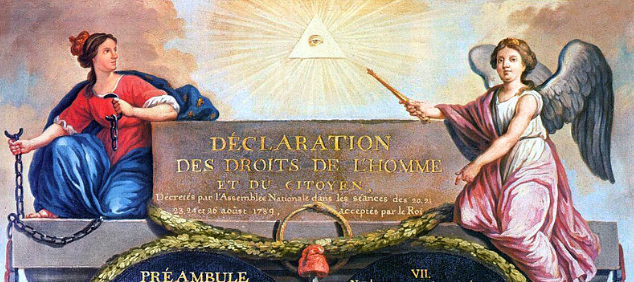
In 1789 Le Barbier painted the Declaration of the Rights of Man and of the Citizen overseen by the ‘Eye of Providence’ in the triangle. Its 17 articles were adopted by the National Assembly on 26 August 1789 and they became the preamble to the Constitutions of 1789 and 1792.
Accused of being drunkards in several areas of France the early SFIO campaigned against alcoholism as well as against capitalism
French socialism began to distinguish itself both from Proudhon’s anarchistic appeal to humanity’s moral responsibilities and from Blanqui’s insurrectionism in the 1890s. Founded by Blum, Jaures and Vaillant in 1905 in the aftermath of the Dreyfus affair, the SFIO united left reformist republicans and Marxist sectarians. The alliance broke up in 1920 when a majority at the Tours Conference voted to affiliate to the new Communist International.
Despite being a minority at that SFIO conference, the SFIO of left reformist socialism became the leading left political current through nearly all the interwar period. After the Communist Party ended Stalin’s ‘class against class’ propaganda against the Socialists and proposed a Popular Front alliance, Blum became prime minister in 1936.
Under the Fourth Republic its internal divisions over Algerian independence, with Mendes France and the challenge of the stronger Communist Party allowed De Gaulle to take power. In 1981 Mitterrand won a decisive majority on a left platform that he abandoned three years later. From then the Socialist Party became largely a party of elected national and local officials, without any real mass membership. In 2017, following five politically disastrous years under Hollande, the Socialist Party suffered a major defeat in both the presidential and National Assembly elections. A new left party, La France Insoumise (France untamed), did relatively well, with the Left Front’s presidential candidate getting 19.6% of the vote in the first round.
The vote for the La France Insoumise leader Mélenchon in the first round of the 2017 presidential elections shows stronger support in the less wealthy parts of Paris
Like the Socialists, though, Melonchon’s La France Insoumise has still virtually no local membership base. In the European elections of 2019, its share of the vote fell to 6%.
The one who believed in heaven The one who didn’t Both loved the beauty Imprisoned by soldiers Which climbed the ladder? And which stood guard below?
The one who believed in heaven The one who didn’t? What matters the name of This light on their steps? that one was of the church And the other baulked from it?
The one who believed in heaven The one who didn’t? Both were faithful with their lips, heart, arms And both said that she will live, time will tell
The one who believed in heaven The one who didn’t When the wheat is under the hail Fool who is fussy Fool who think of his little quarrels In the heart of the common combat?
The one who believed in heaven The one who didn’t From the height of the citadel The sentinel shot Twice and one staggers the other falls who will die?
The one who believed in heaven The one who didn’t? They are in prison Who has the sadest pallet Who freezes more then the other Who prefers the rats?
The one who believed in heaven The one who didn’t? A rebel is a rebel Two sobs make a single knell And when the cruel dawn arrives They pass on
The one who believed in heaven The one who didn’t Repeating the name of the beauty Neither of the two betrayed And their blood runs red Same colour same vividness
The one who believed in heaven The one who didn’t It runs, and runs, and mingles Into the earth it loved So in the new season Muscat grapes would ripen
The one who believed in heaven The one who didn’t One runs and the other flies From Brittany or Jura And raspberries or plums Crickets will sing again Flute or cello, tell the story of This double love that burnt The lark and the swallow The rose and the reseda
Here in this gutter let me die: Weary and sick and old, I’ve done. “He’s drunk,” will say the passers-by: All right, I want no pity–none. I see the heads that turn away, While others glance and toss me sous: “Off to your junket! go!” I say: Old tramp,–to die I need no help from you.
Yes, of old age I’m dying now: Of hunger people never die. I hoped some almshouse might allow A shelter when my end was nigh; But all retreats are overflowed, Such crowds are suffering and forlorn. My nurse, alas! has been the road: Old tramp,–here let me die where I was born.
When young, it used to be my prayer To craftsmen, “Let me learn your trade.” “Clear out–we’ve got no work to spare; Go beg,” was all reply they made. You rich, who bade me work, I’ve fed With relish on the bones you threw; Made of your straw an easy bed: Old tramp,–I have no curse to vent on you.
Poor wretch, I had the choice to steal; But no, I’d rather beg my bread. At most I thieved a wayside meal Of apples ripening overhead. Yet twenty times have I been thrown In prison–’twas the King’s decree; Robbed of the only thing I own: Old tramp,–at least the sun belongs to me.
The poor man–is a country his? What are to me your corn and wine, Your glory and your industries, Your orators? They are not mine. And when a foreign foe waxed fat Within your undefended walls, I shed my tears, poor fool, at that: Old tramp,–his hand was open to my calls.
Why, like the hateful bug you kill, Did you not crush me when you could?
Or better, teach me ways and skill To labor for the common good?
The ugly grub an ant may end, If sheltered from the cold and fed.
You might have had me for a friend: Old tramp,–I die your enemy instead.
Hear the poem read in French by Yvon Jean https://www.youtube.com/watch?v=LqkdoIdaT64
Pauline Roland Poète : Victor Hugo (1802-1885) Recueil : Les châtiments (1853).
Elle ne connaissait ni l’orgueil ni la haine ; Elle aimait ; elle était pauvre, simple et sereine ; Souvent le pain qui manque abrégeait son repas. Elle avait trois enfants, ce qui n’empêchait pas Qu’elle ne se sentît mère de ceux qui souffrent. Les noirs événements qui dans la nuit s’engouffrent, Les flux et les reflux, les abîmes béants, Les nains, sapant sans bruit l’ouvrage des géants, Et tous nos malfaiteurs inconnus ou célèbres, Ne l’épouvantaient point ; derrière ces ténèbres, Elle apercevait Dieu construisant l’avenir. Elle sentait sa foi sans cesse rajeunir De la liberté sainte elle attisait les flammes Elle s’inquiétait des enfants et des femmes ; Elle disait, tendant la main aux travailleurs : La vie est dure ici, mais sera bonne ailleurs. Avançons ! — Elle allait, portant de l’un à l’autre L’espérance ; c’était une espèce d’apôtre Que Dieu, sur cette terre où nous gémissons tous, Avait fait mère et femme afin qu’il fût plus doux ; L’esprit le plus farouche aimait sa voix sincère.
Tendre, elle visitait, sous leur toit de misère, Tous ceux que la famine ou la douleur abat, Les malades pensifs, gisant sur leur grabat, La mansarde où languit l’indigence morose ; Quand, par hasard moins pauvre, elle avait quelque chose, Elle le partageait à tous comme une sœur ; Quand elle n’avait rien, elle donnait son cœur. Calme et grande, elle aimait comme le soleil brille. Le genre humain pour elle était une famille Comme ses trois enfants étaient l’humanité. Elle criait : progrès ! amour ! fraternité ! Elle ouvrait aux souffrants des horizons sublimes.
Quand Pauline Roland eut commis tous ces crimes, Le sauveur de l’église et de l’ordre la prit Et la mit en prison. Tranquille, elle sourit, Car l’éponge de fiel plaît à ces lèvres pures. Cinq mois, elle subit le contact des souillures, L’oubli, le rire affreux du vice, les bourreaux, Et le pain noir qu’on jette à travers les barreaux, Edifiant la geôle au mal habituée, Enseignant la voleuse et la prostituée.
Ces cinq mois écoulés, un soldat, un bandit, Dont le nom souillerait ces vers, vint et lui dit — Soumettez-vous sur l’heure au règne qui commence, Reniez votre foi ; sinon, pas de clémence, Lambessa ! choisissez. — Elle dit : Lambessa.
Le lendemain la grille en frémissant grinça, Et l’on vit arriver un fourgon cellulaire. — Ah ! voici Lambessa, dit-elle sans colère. Elles étaient plusieurs qui souffraient pour le droit Dans la même prison. Le fourgon trop étroit Ne put les recevoir dans ses cloisons infâmes Et l’on fit traverser tout Paris à ces femmes Bras dessus bras dessous avec les argousins. Ainsi que des voleurs et que des assassins, Les sbires les frappaient de paroles bourrues. S’il arrivait parfois que les passants des rues, Surpris de voir mener ces femmes en troupeau, S’approchaient et mettaient la main à leur chapeau, L’argousin leur jetait des sourires obliques, Et les passants fuyaient, disant : filles publiques !
Et Pauline Roland disait : courage, sœurs ! L’océan au bruit rauque, aux sombres épaisseurs, Les emporta. Durant la rude traversée, L’horizon était noir, la bise était glacée, Sans l’ami qui soutient, sans la voix qui répond, Elles tremblaient. La nuit, il pleuvait sur le pont Pas de lit pour dormir, pas d’abri sous l’orage, Et Pauline Roland criait : mes soeurs, courage ! Et les durs matelots pleuraient en les voyant.
On atteignit l’Afrique au rivage effrayant, Les sables, les déserts qu’un ciel d’airain calcine, Les rocs sans une source et sans une racine ; L’Afrique, lieu d’horreur pour les plus résolus, Terre au visage étrange où l’on ne se sent plus Regardé par les yeux de la douce patrie.
Et Pauline Roland, souriante et meurtrie, Dit aux femmes en pleurs : courage, c’est ici. Et quand elle était seule, elle pleurait aussi. Ses trois enfants ! loin d’elle ! Oh ! quelle angoisse amère ! Un jour, un des geôliers dit à la pauvre mère Dans la casbah de Bône aux cachots étouffants : Voulez-vous être libre et revoir vos enfants ? Demandez grâce au prince. — Et cette femme forte Dit : — J’irai les revoir lorsque je serai morte. Alors sur la martyre, humble cœur indompté, On épuisa la haine et la férocité. Bagnes d’Afrique ! enfers qu’a sondés Ribeyrolles ! Oh ! la pitié sanglote et manque de paroles. Une femme, une mère, un esprit ! ce fut là Que malade, accablée et seule, on l’exila.
Le lit de camp, le froid et le chaud, la famine, Le jour l’affreux soleil et la nuit la vermine, Les verrous, le travail sans repos, les affronts, Rien ne plia son âme ; elle disait : — Souffrons. Souffrons comme Jésus, souffrons comme Socrate. — Captive, on la traîna sur cette terre ingrate ; Et, lasse, et quoiqu’un ciel torride l’écrasât, On la faisait marcher à pied comme un forçat. La fièvre la rongeait ; sombre, pâle, amaigrie, Le soir elle tombait sur la paille pourrie, Et de la France aux fers murmurait le doux nom. On jeta cette femme au fond d’un cabanon. Le mal brisait sa vie et grandissait son âme. Grave, elle répétait : « Il est bon qu’une femme, Dans cette servitude et cette lâcheté, Meure pour la justice et pour la liberté. »
Voyant qu’elle râlait, sachant qu’ils rendront compte, Les bourreaux eurent peur, ne pouvant avoir honte Et l’homme de décembre abrégea son exil. « Puisque c’est pour mourir, qu’elle rentre ! » dit-il. Elle ne savait plus ce que l’on faisait d’elle. L’agonie à Lyon la saisit. Sa prunelle, Comme la nuit se fait quand baisse le flambeau, Devint obscure et vague, et l’ombre du tombeau Se leva lentement sur son visage blême.
Son fils, pour recueillir à cette heure suprême Du moins son dernier souffle et son dernier regard, Accourut. Pauvre mère ! Il arriva trop tard.
Elle était morte ; morte à force de souffrance, Morte sans avoir su qu’elle voyait la France Et le doux ciel natal aux rayons réchauffants Morte dans le délire en criant : mes enfants ! On n’a pas même osé pleurer à ses obsèques ; Elle dort sous la terre. — Et maintenant, évêques, Debout, la mitre au front, dans l’ombre du saint lieu, Crachez vos Te Deum à la face de Dieu !
Jersey, le 12 mars 1853.
Victor Hugo. À découvrir sur le site https://www.poesie-francaise.fr/victor-hugo/poeme-pauline-roland.php
Allons enfants de la Patrie, Le jour de gloire est arrivé ! Contre nous de la tyrannie L’étendard sanglant est levé, (bis) Entendez-vous dans les campagnes Mugir ces féroces soldats ? Ils viennent jusque dans vos bras Égorger vos fils, vos compagnes !
Refrain : 𝄆 Aux armes, citoyens, Formez vos bataillons, Marchons, marchons ! Qu’un sang impur Abreuve nos sillons ! 𝄇
Que veut cette horde d’esclaves, De traîtres, de rois conjurés ? Pour qui ces ignobles entraves, Ces fers dès longtemps préparés ? (bis) Français, pour nous, ah ! quel outrage Quels transports il doit exciter ! C’est nous qu’on ose méditer De rendre à l’antique esclavage !
Refrain
Quoi ! des cohortes étrangères Feraient la loi dans nos foyers ! Quoi ! Ces phalanges mercenaires Terrasseraient nos fiers guerriers ! (bis) Grand Dieu ! Par des mains enchaînées Nos fronts sous le joug se ploieraient De vils despotes deviendraient Les maîtres de nos destinées !
Refrain
Tremblez, tyrans et vous perfides L’opprobre de tous les partis, Tremblez ! vos projets parricides Vont enfin recevoir leurs prix ! (bis) Tout est soldat pour vous combattre, S’ils tombent, nos jeunes héros, La terre en produit de nouveaux, Contre vous tout prêts à se battre !
Refrain
Français, en guerriers magnanimes, Portez ou retenez vos coups ! Épargnez ces tristes victimes, À regret s’armant contre nous. (bis) Mais ces despotes sanguinaires, Mais ces complices de Bouillé, Tous ces tigres qui, sans pitié, Déchirent le sein de leur mère !
Refrain
Amour sacré de la Patrie, Conduis, soutiens nos bras vengeurs Liberté, Liberté chérie, Combats avec tes défenseurs ! (bis) Sous nos drapeaux que la victoire Accoure à tes mâles accents, Que tes ennemis expirants Voient ton triomphe et notre gloire !
Refrain
Couplet des enfants:[c] Nous entrerons dans la carrière Quand nos aînés n’y seront plus, Nous y trouverons leur poussière Et la trace de leurs vertus (bis) Bien moins jaloux de leur survivre Que de partager leur cercueil, Nous aurons le sublime orgueil De les venger ou de les suivre.
Refrain
Arise, children of the Fatherland, The day of glory has arrived! Against us stands tyranny Her bloody standard has been raised, (repeated) Do you hear, in the countryside, The roar of those ferocious soldiers? They come right into your arms To tear the throats of your sons, your wives!
Refrain: 𝄆 To arms, citizens, Form your battalions, Let’s March, let’s march! So that an impure blood waters our furrows! 𝄇
What does this horde of slaves Of traitors and invented kings want? For whom have these vile chains These irons, been long prepared? (repeated) Frenchmen, for us, ah! What outrage What furious action it must arouse! It is for us they dare plan A return to the old slavery!
Refrain
What! Foreign cohorts! Would make the law in our homes! What! These mercenary phalanxes Would strike down our proud warriors! (repeated) Great God! By chained hands Our brows would yield under the yoke Vile despots would themselves become The masters of our destinies!
Refrain
Tremble, tyrants and you traitors The shame of all parties, Tremble! Your parricidal schemes Will finally receive their prize! (repeated) Everyone is a soldier to combat you, If they fall, our young heroes, Will be produced anew from the ground, Ready to fight against you!
Refrain
Frenchmen, as magnanimous warriors, Bear or hold back your blows! Spare those sorry victims, For regretfully arming against us (repeated) But these bloodthirsty despots These accomplices of Bouillé All these tigers who, mercilessly, Tear apart their mother’s breast!
Refrain
Sacred love of the Fatherland, Lead, support our avenging arms Liberty, cherished Liberty Fight with your defenders! (repeated) Under our flags may victory Hurry to your manly accents So that your expiring enemies See your triumph and our glory!
Refrain
Children’s verse: We shall enter the (military) career When our elders are no longer there There we shall find their dust And the trace of their virtues (repeated) Much less keen to survive them Than to share their coffins We shall have the sublime pride To avenge or follow them.
Refrain
A shortened version of the bloodthirsty words of this xenophobic song can be heard on https://www.youtube.com/watch?v=5rrxEpoLhPc
A walk around working class Montmartre known to Michel alongside the Paris tax wall finally removed in 1860
Arrondissements 17 – 18
Ferré – Dmitrieff
The walk takes us from the 17th arrondissement, where Michel first lived on coming to Paris in 1856 to the places she taught, and fought on barricades defending the Paris Commune before May 23 1871 when she surrendered to the Versaillais forces in exchange for her mother. The walk passes through what is now the Square Louise Michel as we climb up the Montmartre hill below the Catholics’ revenge on the Commune, the Sacré-Coeur Basilica. This was built near where Michel raised the alert that the Versaillais were about to seize the Commune’s artillery canons, and where a Versaillais general and a retired general who had directed some of the June 1848 massacres were both killed by the angry crowd.
A nearly circular walk that glances at the early Louise Michel but focuses on her life from 1880 to 1905
Arrondissements: 6 – 7 – 8 – 10 -12
Émile Pouget
The walk focuses mainly on some of the Parisian places Michel was associated with after her return from exile in 1880. It starts at an address near today’s Place République and Bourse du Travail where she lived in the 1860s. It then passes the Gare St Lazare prison (now Square Alban-Satragne) where she was jailed in 1883 and the Gare St Lazare railway station at which huge crowds met her in 1880. It continues on to the Left Bank, following the route of the 1883 unemployed march that saw her carry a black piece of cloth on top of a broom for a flag. Further on there is the site of the flat where she lived for the last 9 years of her life as well as the site of the Women’s Technical Drawing School she set up during the 1871 Commune. Finally, the walk passes through the Luxembourg Gardens, where Mitterrand exchanged a remembrance column featuring her and Blanqui for a statue of his mentor, Pierre Mendès-France, and goes on to the Gare de Lyon. In 1905 some 120,000 mourners accompanied her remains from there on the two-hour walk to the Levallois-Perret Cemetery in north-west Paris. We won’t follow her that far…