Fourth Republic

Cold war in France, Trade union split, Indo-Chinese war, European Economic Community, Suez, Algerian War – in progress

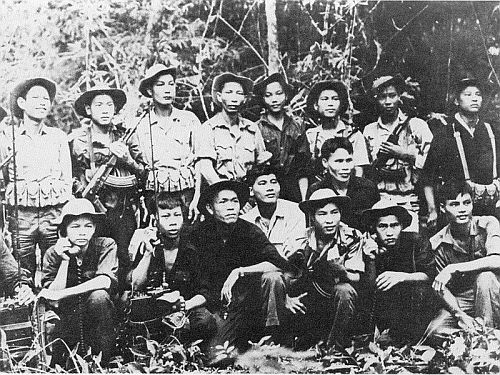
Cold war in France, Trade union split, Indo-Chinese war, European Economic Community, Suez, Algerian War – in progress
Gardens with a darker side

This garden is where I’ve spent many hours watching speed-chess and slow-boules (pétanque – from the old Occitane word meaning feet planted on the ground). I have even once waded in January into the half-frozen circular basin to rescue my ten-year-old’s sinking electronically-controlled boat (I hadn’t followed all the assembly instructions entirely correctly).
Hazan (WTP) writes ‘Few places in Paris have inspired so many writers and poets, not to mention cineastes’.

The Medicis Fountain on the west side of the Palace that is now the French upper chamber, the Senate, can be a beautiful spot when it’s not overflowing with tourists.
The Luxembourg Gardens also have a darker side. On December 7 1815 it was where Marshal Ney was shot for having supported Napoleon during the hundred days before the defeat at Waterloo.
That was nothing compared to the hundreds murdered there by government troops in the final ‘bloody week’ of the Paris Commune.

On 29 November 2016, the French National Assembly (Parliament) passed a resolution to pardon all ‘the victims of the repression of the 1871 Paris Commune‘ – the 10-25,000 people who were shot, imprisoned, exiled, deported or otherwise punished by the French Government for their part in the Paris Commune between May 1871 and 1877.

Sadly, commemorations appear to be about the only positive thing that Hollande’s socialist government did from 2012 to 2017.
There is now one very small plaque referring to the thousands killed in the Paris Commune. Not at all obvious, it is on the wall facing the Palace to the South-East of the basin, often obscured from view in the Spring and Summer by couples profiting from the Luxembourg’s reclining chairs in the warmth of the sun.
I wrote what follows after walking for perhaps the thousandth time through the Luxembourg Gardens. It is strange what you don’t see when you don’t look.
‘This time I quite quickly found the tiny memorial plaque beneath the Queens’ Terrace for those shot in the terrible week 21 May to 28 May 1871 that I’d first seen online two days ago. There were three burial pits dug in the gardens, where perhaps a third of the estimated 2,000 summarily executed prisoners across Paris were buried.
One of those given a military trial on the spot was a doctor, Tony Moilin, who had been jailed by Napoleon III for writing a futurist socialist book titled Paris in the Year 2000. Released with other political prisoners with the abdication of the Emperor in 1870, Moilin briefly became mayor of the 6th arrondissement. Taken prisoner on the 27th May he admitted helping the wounded on the barricades.
A few hours before he was shot on the 28th, he was allowed to marry his pregnant partner. His body was never recovered. The inscription on the plaque doesn’t even get the dates of the murders right.
Moving on through the Gardens I found the Pierre Mendès-France statue that Mitterrand had preferred to Émile Derré’s Column of Kisses cornice featuring the anarchists Louise Michel, Auguste Blanqui and Élisée Reclus.

Michel had given the funeral oration to Blanqui in 1881 and Derré was an anarchist sympathiser and pacifist. In 1906, when he first exhibited it the sculpture, Derré (1867-1938) called it Dream for a House of the People. The column was then placed in the Luxembourg Gardens.

After being lost for several years it is now in the square in front of the Roubaix town hall in France’s old northern mining area that used to be a stronghold of socialism.

I too have a soft spot for Pierre Mendès-France (1907-1982). The university named after him in Grenoble was where I first did any teaching in France. He did end France’s Vietnam War in 1954, and then began decolonialisation in Tunisia.

Mendès-France was also a consistent opponent of De Gaulle’s 5th Republic constitution, that concentrates power very dangerously (as Macron began demonstrating in 2018) in the hands of the President. He had also served in Leon Blum’s Popular Front government of 1936.
From 1896 to 1898 the future Jewish first minister of France, Blum (1872-1950), lived at No. 36 rue Guynemer (then rue de Luxembourg) on the western edge of the Garden.
But the Mendès-France statue is far from being about dreams of social change. Surely Mitterrand could have moved one of the hundreds of memorials to France’s ruling class power in the Jardin du Luxembourg rather than take away the beautiful and romantic Louise Michel column.
Mitterrand’s easier option was to replace one politically ‘left’ public object by another. Sad.
The Luxembourg Palace was also the site of the last armed German resistance in Paris at Liberation in August 1944. All round the Latin Quarter there are memorial plaques to the courageous French men and women who died in the uprising between August 19 and August 29. Altogether some 1,500 Parisian resistance fighters were killed, including some 600 civilians.

On August 25 1944 Pierre Georges (Colonel Fabien), who had fought in the International Brigade in Spain, commanded 300 resistance fighters around the Luxembourg Palace. Fighting was intense and the SS, who were concentrated there, only finally surrendered when given an hour’s notice of an aerial bombardment.
The garden still displays some sculptures that remind us of some key personalities and movements in French left history.
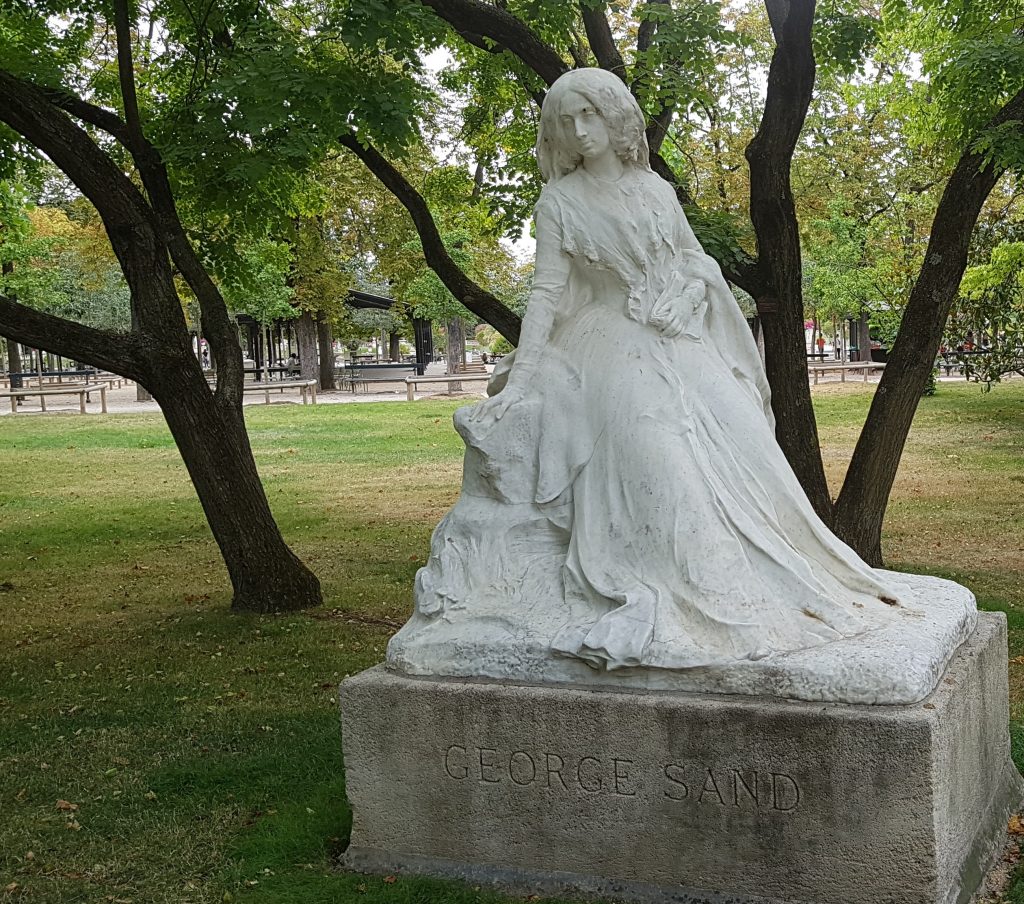
Jules Dalou‘s three commissions all come from the same period from the 1890s through the 1900s when liberal republican governments fought off the right and sought to strengthen republican imagery and values. different and all interesting.
In 1890 Dalou’s Monument to Eugene Delacroix – the painter whose most famous work, Liberty leading the people was kept hidden by King Louis-Philippe from 1832 until 1848, and that we have borrowed characters from in designing LeftinParis – was inaugurated in the garden.

In our brief biography of Dalou we show his two other sculptures present in the garden:The Triumph of Silenius, finished in 1885 but only erected in 1898 and the Monument to Scheurer-Kestner, installed in 1908.

Numbers 12, 24, 56, 57, 77
This street is best known for No. 57, the Matignon Palace. The hôtel Matignon has been the official home of French prime ministers since 1922. In 1914, then the Austrian Embassy, it had been sequestered by the government who then bought it and what was Paris’ largest private garden in 1922.
The left’s prime ministers are few in numbers: only Léon Blum, Pierre Mendès France, Michel Rocard reported on in Left in Paris spent a few years there.
Louis Aragon and Elsa Triolet rented a flat at No. 56, the Hôtel Gouffier de Thoix, from 1960 until Aragon’s death in 1982. The town house was built for the sister of the mistress of England’s Charles II between 1719 and 1727. Nationalised as the goods of foreigners during the French revolution, and then rented out, today it is used by the prime minister’s office.

Under the Occupation, the German Military Court was based at No. 12.
The painter Eugène Delacroix lived at No. 24 in 1820.
Nearly a kilometer long this street is filled with huge 18th century private houses that have become government buildings, embassies and the house at No. 77, now a museum, where Rodin lived, in the hôtel Biron. This was built for a former wig-maker who became a housing speculator in 1727-1728, and was sold to the hero of the 1745 battle of Fontenoy, the General Biron in 1753. His nephew ended up on the guillotine in 1793.
Under the restoration the building was given to the catholic girls school, the Ladies of the Sacré-Cœur, and then taken back by the state in 1905. By then it was nearly falling down and scheduled for demolition.

Several artists then moved in temporarily, including Matisse and Jean Cocteau, as well as Isadora Duncan’s Dance School.
In 1908 Auguste Rodin moved in. In 1916, the year before his death, he promised to give his entire works to the state if it transformed the building into the Musée Rodin, and this was then voted on by the National Assembly and by the Senate. Rodin died in 1917.
Most probably the street’s Varenne name comes from a corruption of the French word garenne meaning a hunting reserve, suggested also by the nearby Rue de Bellechasse (the ‘great hunting’ street. In the 16th century the area was part of the forest attached to the Louvre Palace. it was originally cut through in the early 17th century, got its name in 1651 and was extended to its present length in 1850.
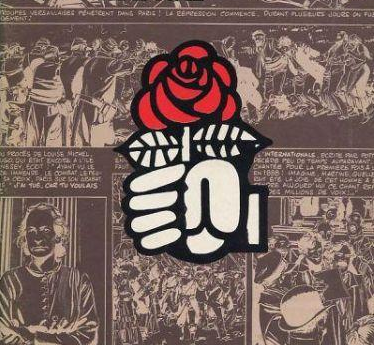

French socialism began to distinguish itself both from Proudhon’s anarchistic appeal to humanity’s moral responsibilities and from Blanqui’s insurrectionism in the 1890s. Founded by Blum, Jaures and Vaillant in 1905 in the aftermath of the Dreyfus affair, the SFIO united left reformist republicans and Marxist sectarians. The alliance broke up in 1920 when a majority at the Tours Conference voted to affiliate to the new Communist International.
Despite being a minority at that SFIO conference, the SFIO of left reformist socialism became the leading left political current through nearly all the interwar period. After the Communist Party ended Stalin’s ‘class against class’ propaganda against the Socialists and proposed a Popular Front alliance, Blum became prime minister in 1936.
Under the Fourth Republic its internal divisions over Algerian independence, with Mendes France and the challenge of the stronger Communist Party allowed De Gaulle to take power. In 1981 Mitterrand won a decisive majority on a left platform that he abandoned three years later. From then the Socialist Party became largely a party of elected national and local officials, without any real mass membership. In 2017, following five politically disastrous years under Hollande, the Socialist Party suffered a major defeat in both the presidential and National Assembly elections. A new left party, La France Insoumise (France untamed), did relatively well, with the Left Front’s presidential candidate getting 19.6% of the vote in the first round.

Like the Socialists, though, Melonchon’s La France Insoumise has still virtually no local membership base. In the European elections of 2019, its share of the vote fell to 6%.
Work in progress


