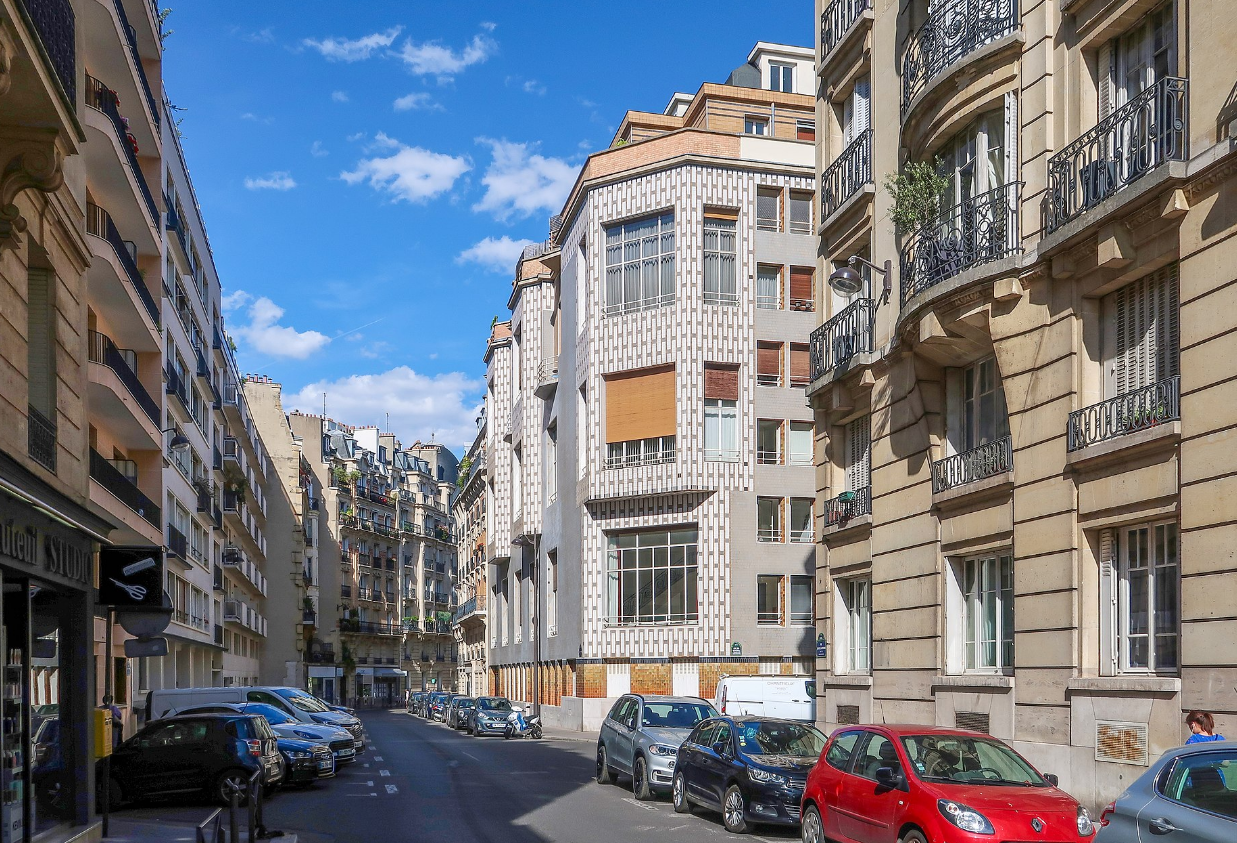
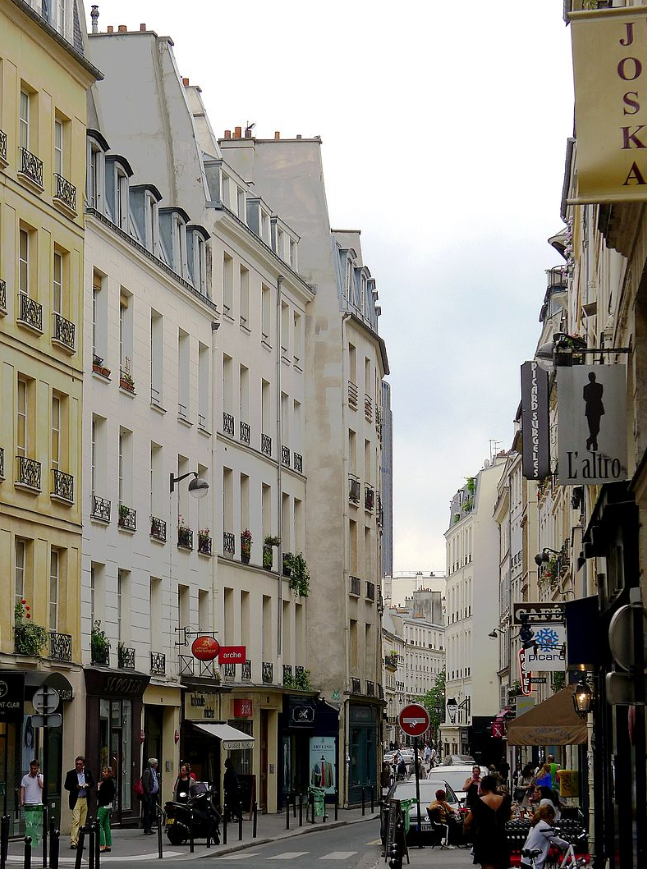
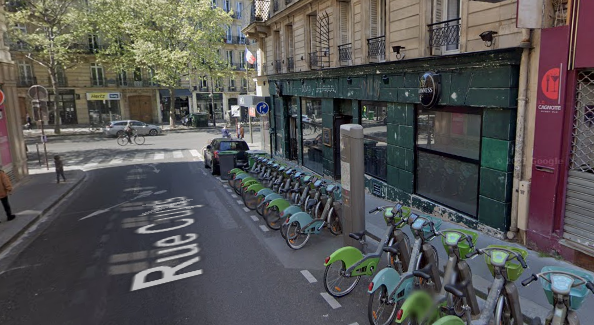
The road was named in 1865 after the 17th century French poet, Jean de la Fontaine, famous for his Fables and one of the quartet of authors with Racine, Boileau and Molière based around the Rue du Vieux Colombier.
Juliette Drouet was living at No. 54 in 1846, the year her daughter Claire died.
Two members of the Resistance network CND Castille, René and Jeannette Drouin lived at No 13. They both died during the war, René in 1942 and Jeannette in 1945.
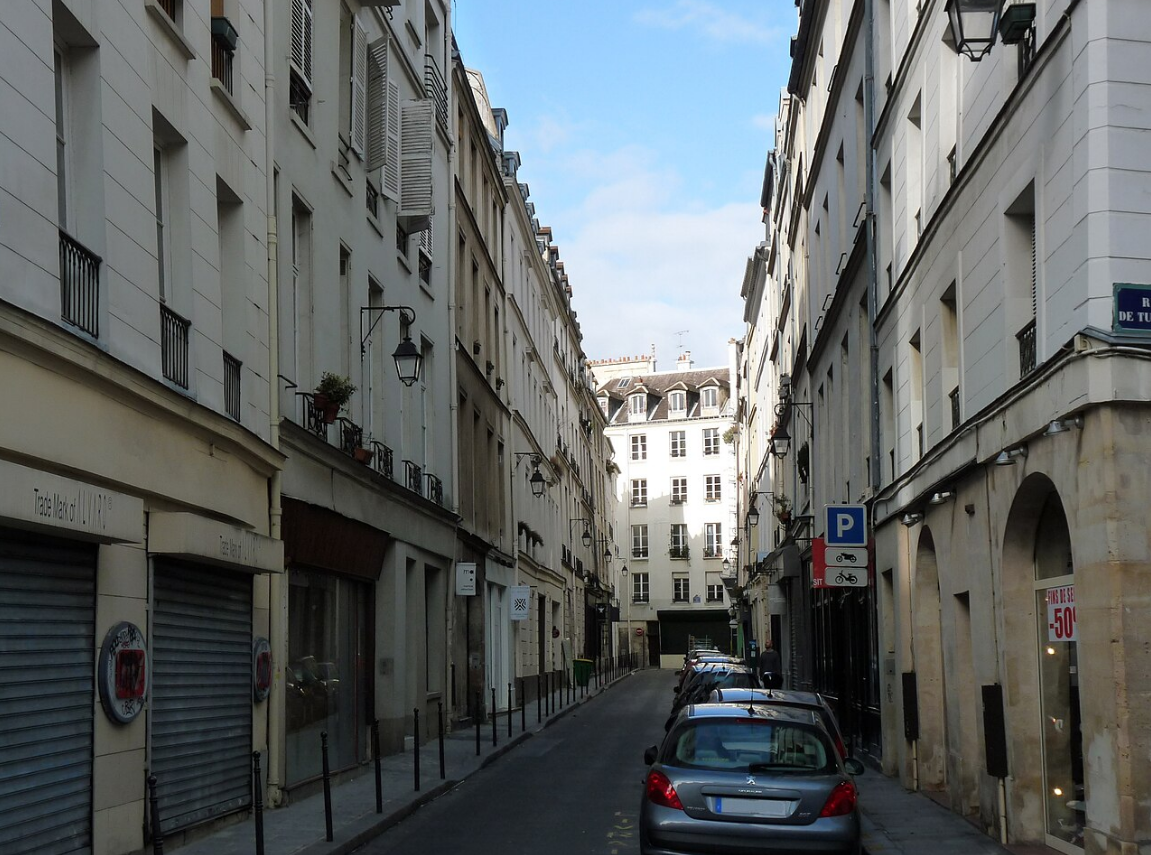
Created in 1741 the street was a by-word for dirty and smelly until the 20th century, despite its situation in the First Arrondissement in the heart of Paris.
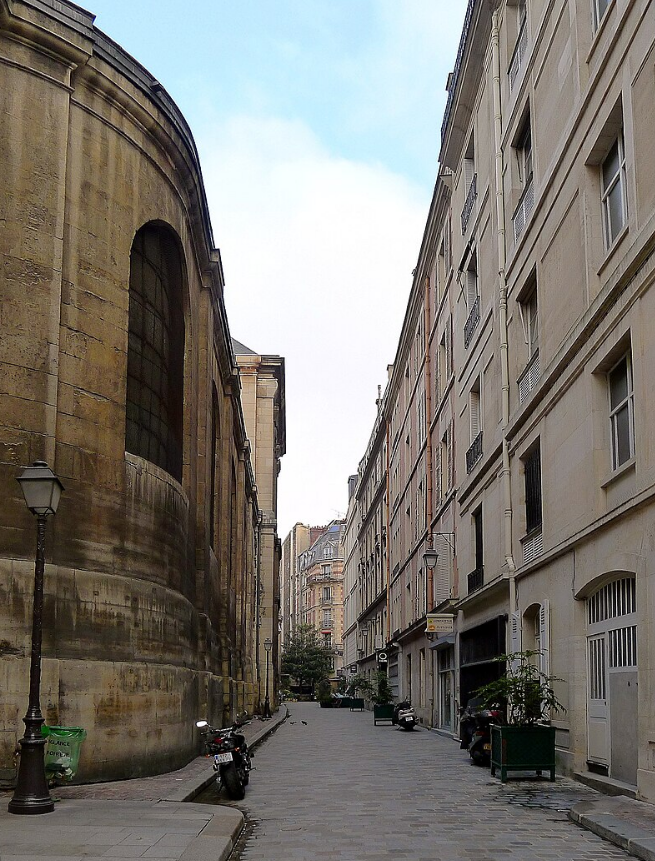
The Passage is just 90m long. A furnished room in the road alongside the Saint-Roch church was where Victor Hugo was caught by the police on July 5 1845 in bed with his second long-term mistress, Léonie Biard. A married woman she was charged with adultery and taken to the St Lazare prison for ‘fallen women’, while Hugo, elevated to a peerage he previous year by King Louis-Philippe, had immunity from prosecution and was allowed to go free.
Opened like other streets in the area in 1620 the narrow road was named after the Saint-Gervais (also called Sainte-Anastase) nursing order that owned the land.
The short street was home to two resistance fighters. The Communist Henri Darracq, shot by the Germans in 1941, lived at No. 3. In 1942 Georges Dudach, who lived at No. 10, became one of 1,014 men shot by the Germans at Fort Mont-Valérien, overlooking the Bois de Boulogne.
Victor Hugo found a flat at No. 14 close to his Place de Vosges home for his long-term mistress, Juliette Drouet, in 1836 . In 1845 Hugo moved her into No 12, where she had a small garden. This was the same address where in his memoirs on 26 June 1848, while he was totally opposed to the workers’ insurrection, he saved the lives of four men who were hiding in the eves of the house.
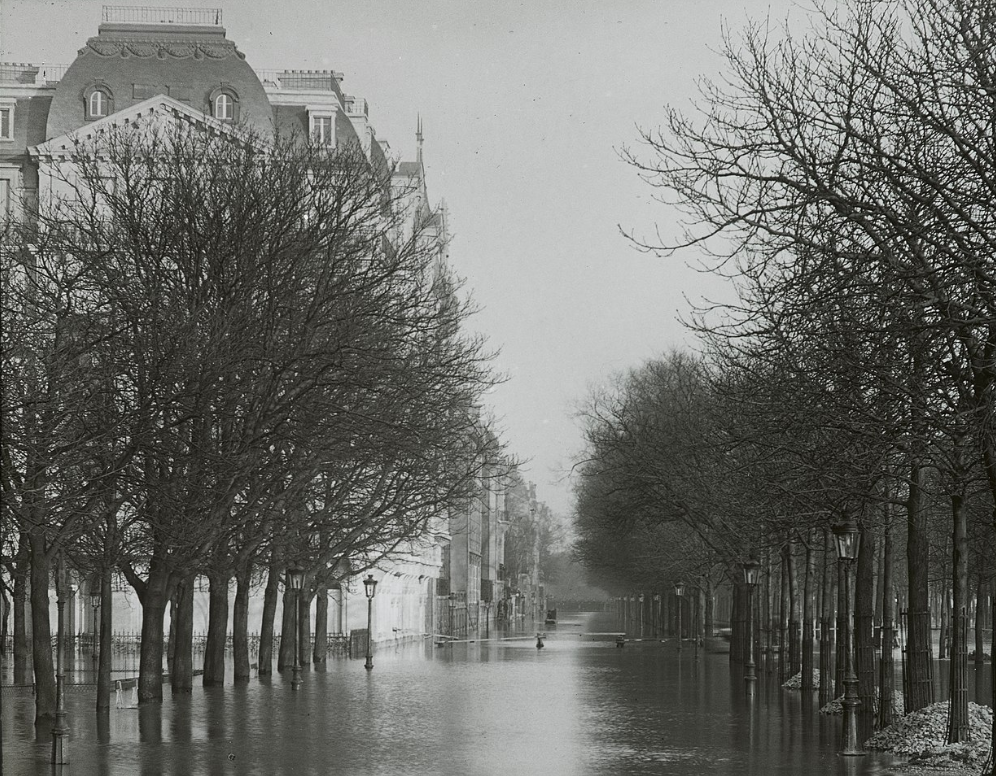
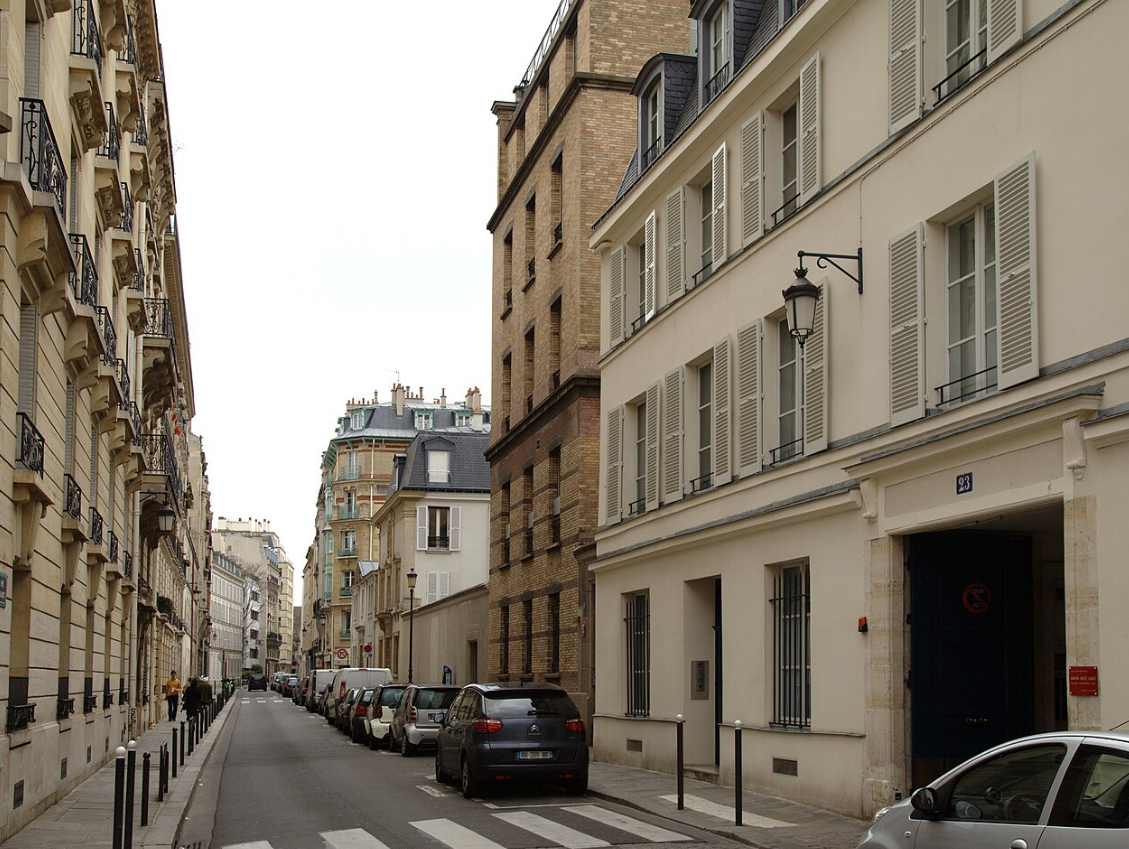
The road was built by a developer in 1823 and named after the renaissance sculptor Jean Goujon. It is full of large stylish buildings constructed over the following century. As the photograph shows, its proximity to the Seine meant in 1910 it suffered badly from that year’s record flood.
On October 29 1945 for the first time Jean-Paul Sartre gave his lecture on ‘Existentialism is a Humanism’ at No. 8, the Hôtel d’Essling owned by a series of aristocrats until is was sold to the Maison des Centraux in 1919. The building was entirely rebuilt in 1989 before housing the Sofitel-Paris-Champs-Élysées hotel and the Press Club of France.
Victor Hugo lived on the second floor of a small individual rented house in the lawn and vegetable nurseries at No. 9 from May 1830 to October 1832. This was where he wrote Notre-Dame de Paris and where his son Charles nearly died of cholera in 1832. The family moved from there to the more central 6 Place des Vosges. The house in Rue Jean-Goujron was replaced by a private mansion in 1859.
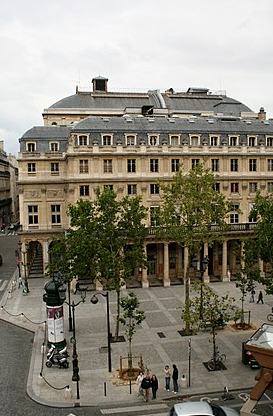
The square’s only address on the north is the state-owned Theatre the Comédie-Française or Théâtre-Français, founded in 1680 with its permanent residence since 1799 in the 862-seater Salle Richelieu. To the east is the Palais-Royal, originally the private residence of Cardinal Richelieu.
Until 1966 the square used to be simply the junction of the rue Saint-Honoré and the rue de Richelieu, but it was renamed Colette after the writer’s only daughter asked André Malraux, then Minister of Culture, to do so.
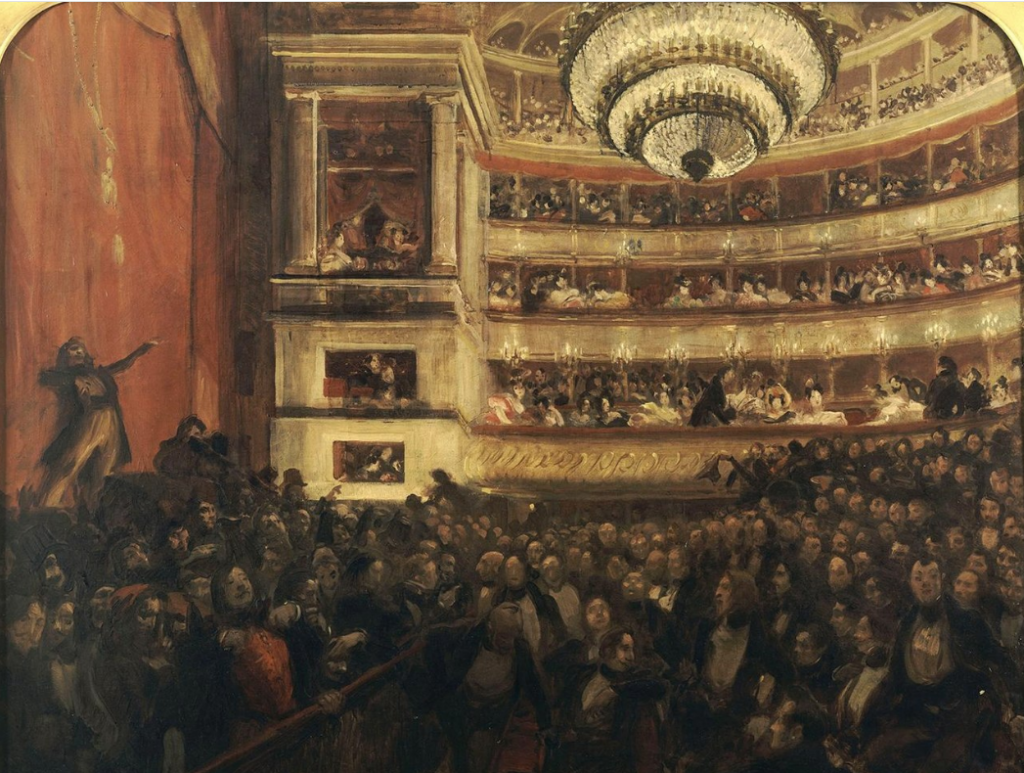
On February 25 1830 shortly before the July Revolution, Victor Hugo’s play, Hernani, was put on by the new director of the traditionally conservativeComédie-Française, but who was a sympathiser of the young French romantics, led by Hugo.
The ‘Battle of Hernani’ between Hugo’s supporters, including Gautier with long hair and a red waistcoat, and the older classicists included organised booing and counter cheering as well as physical fights
Every performance of Hernani over the next four months saw heckling and fighting, and then it was taken off, just before the 1830 July Revolution.
First mapped in the 14th century, the road had five changes of name before it finally took the name Notre-Dame-des-Champs after the church of that same that in 1604 became the Carmelite Monastery of the Saint-Jacques area. During the French Revolution it was renamed La Montagne des Champs, in an attempt to exorcise the religious reference.
For three years, 1827 to 1830, Victor Hugo lived at the address 11 rue Notre-Dame des Champs, today in the area covered by Nos 23-35 but No. 27 was pulled down in 1904 when Bouevlard Raspail was built. While at No. 11 his wife, Adèle, had an affair with Augustin Sainte-Beuve, and Hugo wrote Hernani and Cromwell.
Sainte-Beuve lived at No. 19 in 1830.
Auguste Renoir had a studio at No. 34 from 1871 to 1873, while the art dealer Wilhelm Uhde’s gallery at No. 73, showed paintings by Braque, Dufy, Delaunay, Rousseau and Picasso between 1908 and 1910. The artists James Whistler (1892-1902) and Fernand Léger (1924) were among many artists who had studios at No. 86.
On his second trip to Paris in 1923 with his first wife Hadley, Ernest Hemingway lived at what is today No. 115, and was numbered No 113. They lived with their son John (known as Bumby) in a house within the courtyard where Hemingway wrote Paris est une Fête.
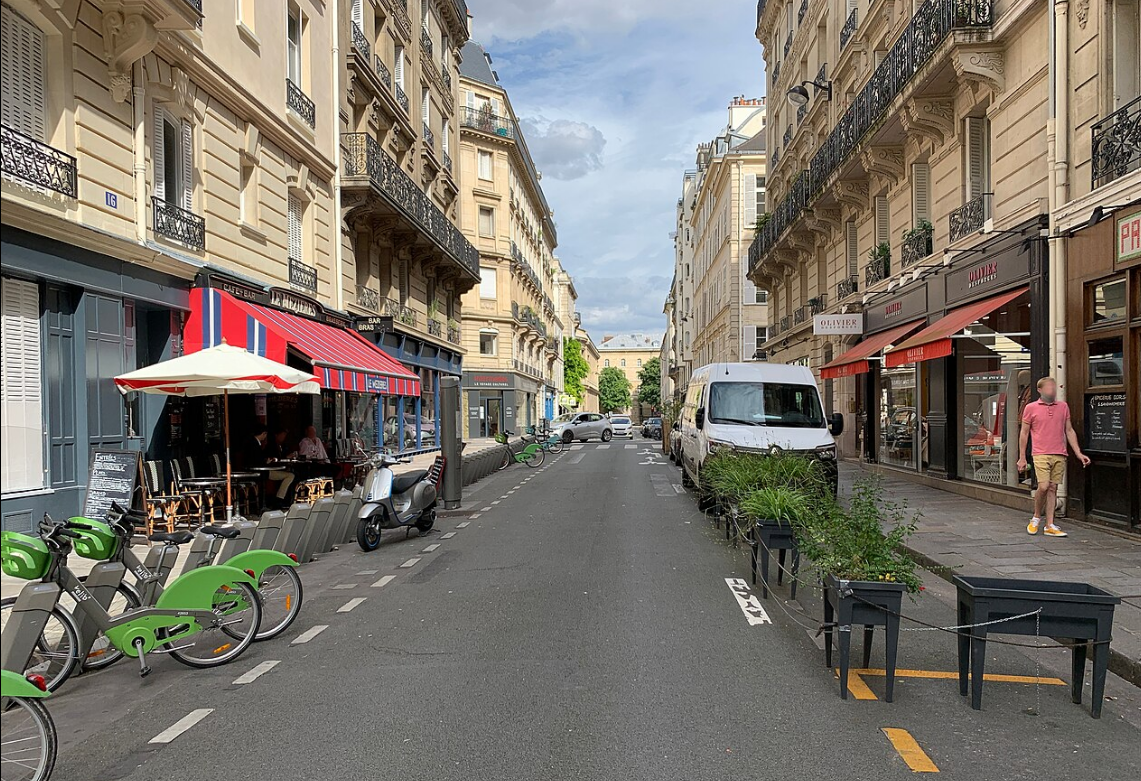
The road was first referred to in the 16th century as a muddy track running alongside the gardens of a private mansion, l’Hôtel-de-Mézières, which originally occupied the land now making up 78, Rue Bonaparte, the Mairie (Town Hall) of the Sixth arrondissement.
Victor Hugo lived briefly at No. 10 in 1820-21 with his mother and his older brother, Eugène, in an apartment rented on their behalf by Abel Hugo, his eldest brother. His mother, Sophie Trébuchet, died there on June 27 1821.
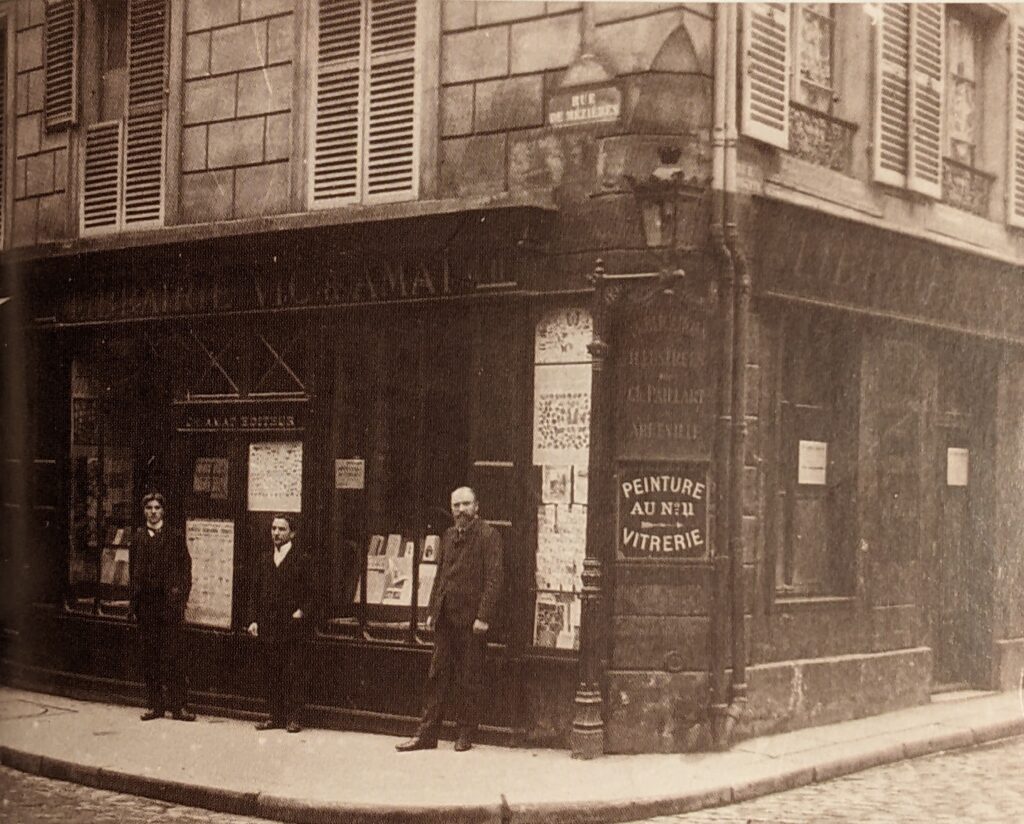
The Catholic bookshop Le Procure has been based at No. 3 since 1919. The photograph below is of the corner with Rue Cassette taken around 1910.
In 1808 the road was renamed at the request of its inhabitants from the morbid-sounding rue du Sépulcre. The choice followed the road’s association with the Dragon’s Courtyard that led into it where an 18th century statue of a dragon had been commissioned by Paul-Ambroise Slodtz for the new house built by the powerful Toulouse financier and slaver, Antoine Crozat.
A photograph of the Dragon’s Courtyard taken in 1908 by Eugène Atget
The actress Simone Signoret, whose Polish-Jewish father’s origins led him to join the Free French in London in July 1940, while she stayed in Paris with her mother, remembered the Gestapo visiting No. 7 in the search for a resistance letter box.
This was also the huge private residence occupied by Homeless Squatters in December 1994. Organised by the Droit au logement association it was supported by the now disgraced Henri Groues (l’Abbé Pierre and many other campaigners against social injustice.
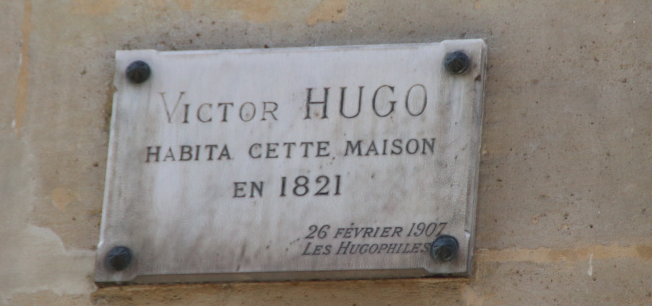
No. 30 has a plaque dedicated to Victor Hugo, who lived in a sunless top (4th at the time) floor two-room flat there briefly in 1821-22 that he shared with a cousin. He had just published the poem Moses on the Nile, in which he refused to amend the words ‘chaste pleasures’ in his first poetry collection, Odes et poésies diverses, that included nearly all his largely monarchist prize-winning poetry.
Hugo lived in No.30 before his marriage to Adele Foucher when he moved to his in-laws’ home in the nearby rye du Cherche-Midi.
Renamed in 1864 under Haussmann and Napoleon III to commemorate the 9th century Bishop of the Saint-Germain-des-Pres Abbey, who was known as the defender of Paris during the Vikings’ siege of Paris from 885 to 887, from 1637 it had been called rue Sainte-Marguerite or rue Sainte-Marguerite-Saint-Germain. No. 1 in the road then was the Porte Sainte Marguerite into the Abbey.
In January 1815 General Leopold Hugo got his sister to board his two youngest sons, Eugène et Victor-Marie, in the Pension Cordier at No. 41 in the then much longer rue Sainte-Marguerite. From there they used to walk to the lycée Louis-le-Grand in the Rue Saint-Jacques.
First created as the Rue Plumet in 1720, the road was renamed in 1851 after General Oudinot, who successfully led the French expeditionary force in 1849 under the orders of the Prince-President Louis-Napoleon to force the republicans out of Rome and restore the power of the pope. The pope then implemented a massive repression on the population.
Under the name Rue Plumet Victor Hugo placed his representative of ‘good’, Jean Valjean, there with Cosette in 1829 in Les Misérables.
The Paris hub of the Comet Line resistance escape network, specialising in saving Jewish children in 1942 and 1943, was based at the home of the nurse Aimable Fouquerel at No 10. Lucienne Laurentie was another resistance activist involved in the network and rescued some 40 airmen before being denounced in 1943. Imprisoned initially at Fresnes she was deported to Ravensbruck in 1944 and from there to Kommando d’Holleischen in Czechoslovakia where she was liberated in 1945.
A long old Roman road across Paris leading from the Bastille west towards the Saint-Antoine abbey that became a hospital in 1796. It now continues under the name Rue de Rivoli up to the Place de la Concorde.
The first office of the ‘German Pilot’ journal (Der deutsche Steuermann), a review produced by the Prussian Embassy in 1844 as a competitor to Marx and Engels’ bi-weekly Vorwärts was at No 100. At the time there were around 60,000 German workers in Paris.
In June 1848 a barricade across the road at No. 100 in front of the St Paul church saw considerable fighting as workers fought to defend the National Workshops established shortly after the February Revolution.
The president of the Luxembourg Commission that established the 1848 National Workshops for the unemployed, Jean-Baptiste Lagarde, a watchmaker, lived at No 99 (previously No. 124). He was sentenced to deportation for having participated in the June insurrection.
The Church of St Paul-St Louis was where Victor Hugo‘s daughter, Léopoldine, married Charles Vacquerie on February 15 1843. In thanks Hugo gave the Church two holy water fonts (although only one appeared to be present when we visited in October 2024). The couple tragically drowned together the following year, and in 1862, when he published Les Misérables, Hugo placed the marriage of Cosette and Marius in the same church iten years earlier in 1833.
The Saint-Louis-des-Jésuites Church at No. 101 had hosted the training school of the Jesuits between 1580 and 1764, but in the Revolution in 1793 it became the storage centre of 1.2 million books confiscated from the monasteries and convents, and one of the major contributors to the National Library.
In 1802 with the re-establishment of the Catholic religion in France following the Concordat with the Vatican, the church was renamed the Saint-Paul-Saint-Louis Parish Church.
In 1818 Louis-August Blanqui attended the Charlemagne’s Royal School at No. 101. It had been renamed in 1815 after being refounded in 1804 as the lycéeCharlemagne, and was again closely associated with the Church.
In May 1871 the Church was used to host the revolutionary Club Paul-Louis and saw the funeral of the commander of the 120th Batallion of the National Guard. The current
In 1870 Louise Michel attended public anarchist meetings in the White Queen room of the Rivoli Rooms at No. 117, the same venue that hosted a meeting of the Socialist Republican Alliance (ASR) on December 10 1880.
The Alliance socialiste républicaine (ASR) was made up of many surviving Communards and former followers of Proudhon who returned to Paris after Hugo and Louis Blanc‘s success in securing the 1879/1880 Amnesty. These including Albert Theisz, one of the witnesses to the 1872 marriage of Charles Longuet with Jenny Caroline Marx, as well as Charles Longuet himself and Georges Clemenceau. The ASR later split between various socialist groups and the Radical-Socialists led by Clemenceau.
The office of the Former Communards Mutual Aid Society (Société de secours mutuel des anciens combattants de la Commune) was set up in May 1882 at No 133.
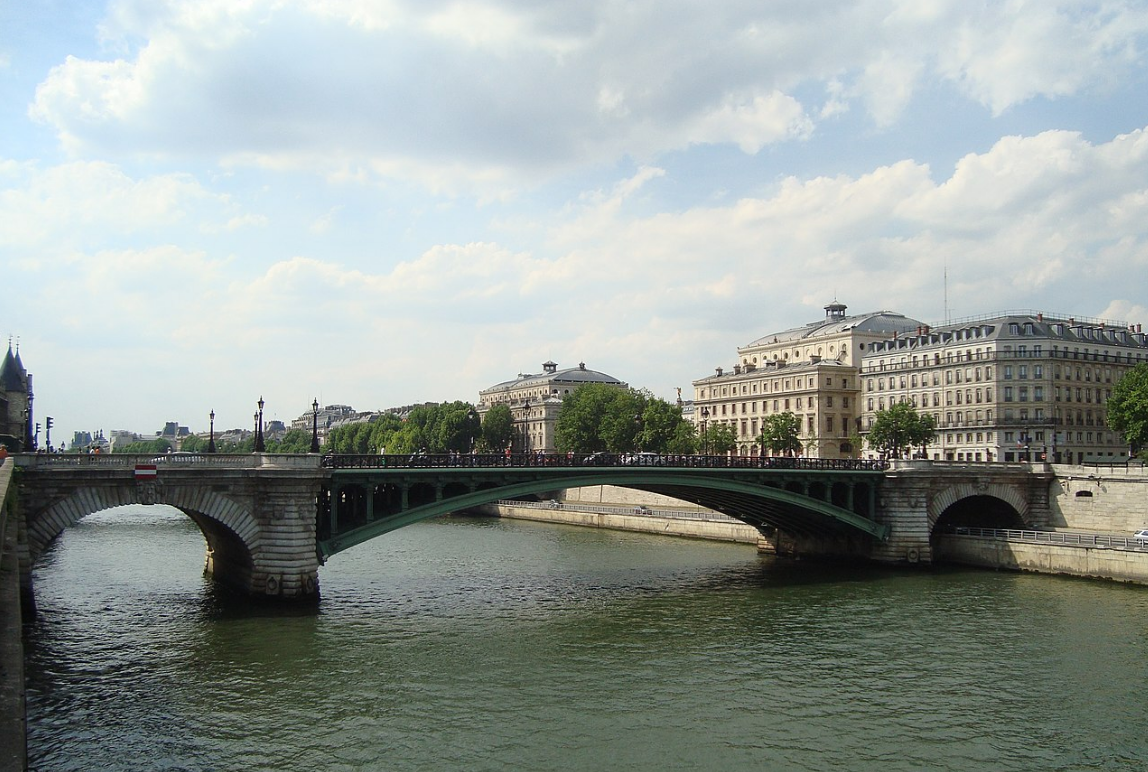
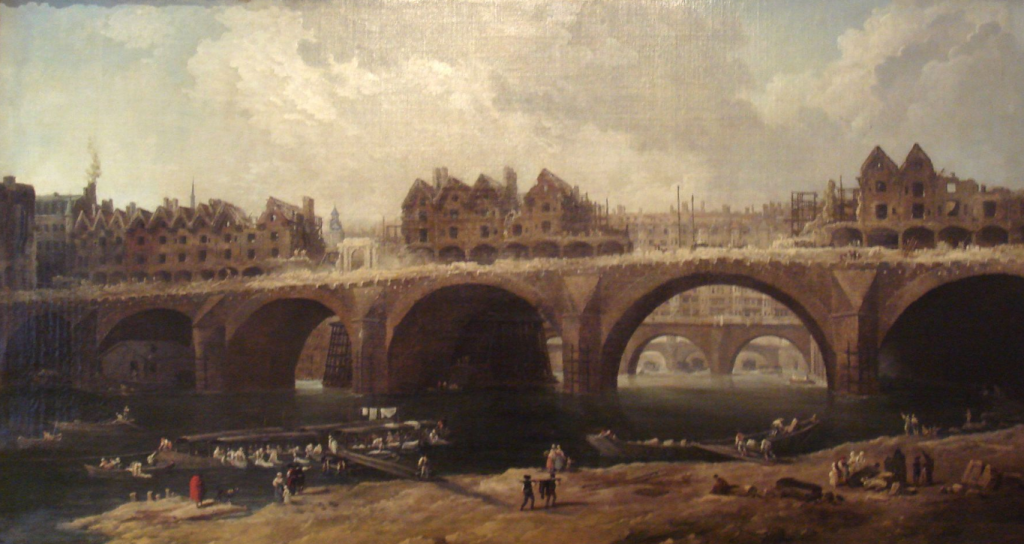
Bridge over the Seine from the Quai de Gesvres to the Quai de la Corse
Today’s Notre-Dame bridge was built in 1853, and reduced from five to three arches in 1912. But the Romans built the first bridge here as part of their North-South axis across the Seine. That bridge lasted until 886, when it was replaced by a bridge built on wooden piers, to which were attached flour mills. This survived until the floods of 1406, and its wooden replacement until the flood of 1499. Its stone pier follow-up was finally completed in 1512, and its 61 six-story houses became the most sought-after in Paris for shops, stores and prestigious living.
By 1786 the houses on the bridge were in such a bad state of repair that Louis XVI ordered their demolition. This did not make the bridge any safer for those on the river. The five arches were obstacles that gave the bridge its nickname: ‘Devil’s bridge‘.
It’s no surprise, then, that the end of the Bridge on the right bank (near the Town Hall) is where Victor Hugo decided to stage the suicide of Javert, the fictitious representative of law and order without any humanity, in Les Misérables.
The road gets its name from the former Convent of the Daughters of Calvary inaugurated in 1633, and whose first stone was laid by the niece of the Cardinal Richelieu. Dissolved in 1790, nationalised and then sold in 1796 it disappeared in 1804.
Number 6 was where in les MisérablesVictor Hugo has the fictional Jean Valjean place the rescued Marius at his grandfather’s house with Cosette after the failed June insurrection of 1832.
On the night of the Daech/Islamic State murderous attacks of November 13 2015, a bar in the street was used as a medical centre close to the Bataclan.
The street was also the hiding place in the week of May 25 1871 of Gustave Lefrançais before he fled to Switzerland. He was a trained teacher who had joined Pauline Roland‘s Association of Socialist Teachers in 1848, lived in exile in London under Napoleon III, and after returning to Paris to fight on the barricades in 1871 was sentenced to death in his absence on 30 August 1872. After his return to Paris he worked with the anarchist geographer, Élisée Reclus.
Another Communard in hiding from the great repression of 1871, Eugene Pottier, wrote and dedicated his poem, L’Internationale, to Lefrancais. In 1888, a year Pottier’s death, the poem was set to musique one Sunday morning by the Belgian, Pierre Degeyter.
Built shortly after the construction of the Philippe Auguste wall around Paris in 1210, it was named after the nearby Saint-Merri church.
Charles Jeanne was one of the leaders of those defending the last barricade across the road at No. 49 to fall in the 1832 insurrection. His memoir of the revolt written in letters to his sister from his prison on Mont Saint Michel was used by Hugo in Les Misérables.
He had been awarded the July Medal by the government of Louis-Philippe for his bravery during the July Revolution of 1830.
Now a short pedestrian-only street, it is one of Paris’ oldest, dating from the 11th century. Much of its original length has been eaten up by other roads, and the origins of its name are uncertain. Some believe it may come from ‘Mauvais Détour’, a wrong turning. Others that it refers to the revenues from the market on the Quai d’Orsay given to the Bishop of Paris in 1205.
The 1933 ‘Brown book on the Reichstag fire’ was published by Willi Münzenberg for the Comité d’aide et de secours aux victimes du fascisme hitlérien (International Committee in Support of the Victimes of Hitlerian fascism) at No 1. A German Communist who had become disenchanted with Stalin, he lived intermittently in Paris from 1933 to 1940 and was murdered or committed suicide in October that year while trying to escape the German invasion.
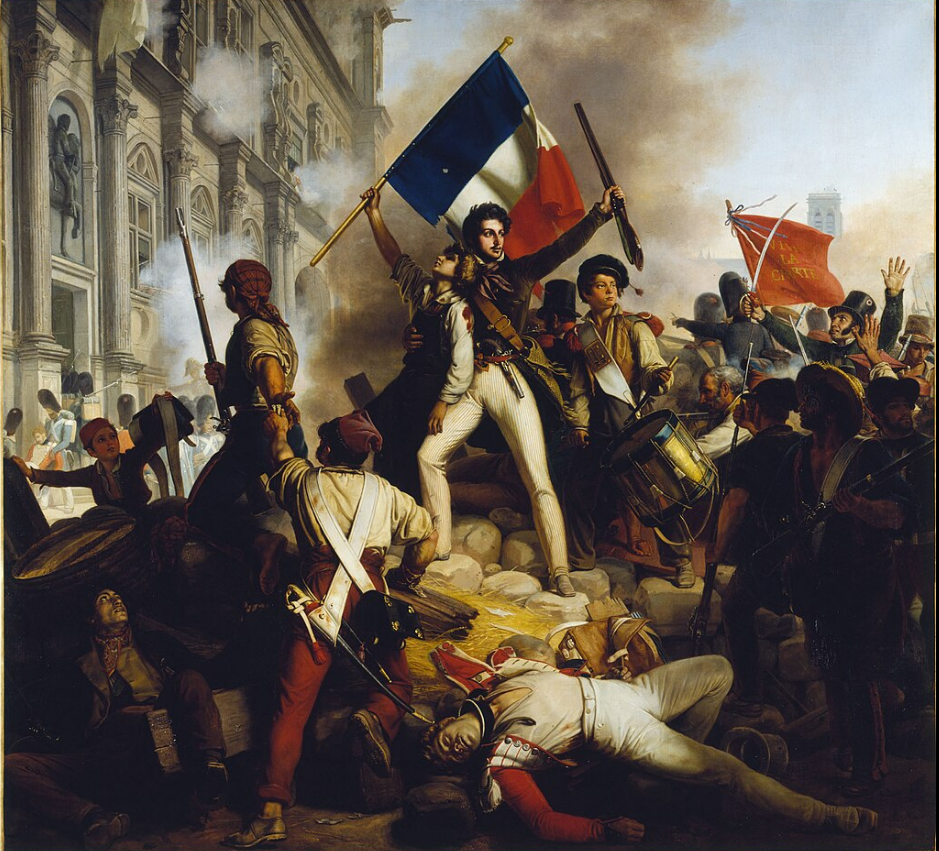
In Les MisérablesHugo placed the barricade where Gavroche on 6 June 1832 was killed outside the Café Corinthe at No. 2. Hugo was perhaps inspired to depict Gavroche by the painting by Jean-Victor Schnetz that, like Delacroix‘s much more famous painting, was commissioned by Louis-Philippe’s government in 1830 but which was never displayed in public until his overthrow in 1848 and the establishment of the Second Republic.
Schnetz painted a young boy passing a satchel of spent bullets up to the insurgents
In November 1802 Victor Hugo‘s mother, Sophie Trébuchet Hugo, left her husband, the baby Victor and his two brothers sons to live in Paris at the Hôtel de Nantes, 78 Rue Neuve-des-Petits-Champs. This was also where Marie-Henri Beyle, the author of The Red and the Black, Stendhal, died in 1842.
Sophie spent thirteen months there, lobbying Joseph Bonaparte (Napoleon’s brother) and others for Joseph-Léopold Hugo‘s favour to get him transferred somewhere more prestigious than Besançon. While there she starts a long-term relationship with Victor de Lahorie (Victor Hugo’s godfather who had fought with the Joseph-Leopold Hugo in 1798 and 1799) but had recently been forced into retirement from the army because of suspicions about his loyalty to Napoleon. The out of favour Lahorie failed to secure Leopold Hugo a better posting, and instead Hugo was sent from Besançon to Corsica and from there to the Isle of Elba.
The street was renamed Danielle Casanova in December 1944. Corsican-born Vincentella Perini was the daughter of teachers. She trained as a dentist in Paris and in 1928 joined the Communist Youth movement eventually becoming a member of its Central Committee. In 1930 she married a law student, Laurent Casanova, and with him became friends of Communist Party leader Maurice Thorez and his wife.
The UJFF was founded partly as a response to the resentment of young communist militants who had little responsibility within the then young French Communist Movement, and partly as a way for the French Communist Party (PCF) to recruit young female members.
Danielle and the other founders of the organisation wanted to focus on issues related to all areas of gender equality: work (referring in particular to the difficulties encountered by Marie Curie in her career), education and leisure. They emphasised the double discrimination of women from the working class due to both gender and social background. The UJFF supported the Republicans during the Spanish Civil War, participating in demonstrations of support and welcoming refugee children from Spain.
After the French Communist Party and its related organisations were banned in August 1939 with the signing of the Molotov–Ribbentrop Pact, Danielle went into hiding. Working underground she organised demonstrations against the occupying forces, including those of 8 November and 11 November 1940 protesting the arrest of Professor Paul Langevin.
From June 22 1941 when Germany invaded Russia, she helped set up women’s committees in the Paris region, she wrote for the underground press, especially Pensée Libre (“Free Thought”) and she founded la Voix des Femmes (“Women’s Voice”).
French Police arrested Danielle on 15 February 1942 after carrying a large bag with coal in it to the hiding place of a Jewish couple. In March they moved her to the La Sante prison, and then in August she was transported to the German-controlled Fort de Romainville. There she continued campaigning and organising clandestine publications and protests. In January 1943 she was transported to Auschwitz where she worked in the camp infirmary as a dentist, continuing to try and help those she had access to. She died of typhus at Auschwitz-Birkenau on 9th May 1943.
Posthumously Danielle Casanova was decorated with the Legion of Honour, and she became a heroine of the women’s movement as well as of the French Resistancce giving her name to streets, schools, and colleges throughout France.
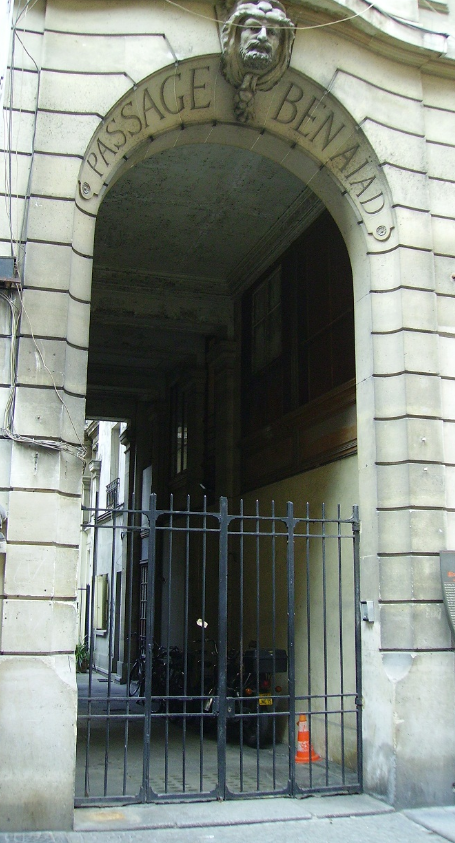
This road testifies to the internationalism of corrupt world elites as early as the mid-19th century. It was only named after an 18th century writer in 1900 but from 1853 it became part of the European estate created by Mahmoud Ben Aïad (1805-1880).
Aïad was a Tunisian who had personally benefited from his management of the finances of its Bey, Ahmed I. This role allowed Aïad to set up his own bank and along with a chateau and Parisian mansions in 1853 he also bought up the land that included the 175m long Passage du Saumon, its shops and the Théâtre Molière. and acquired French nationality.
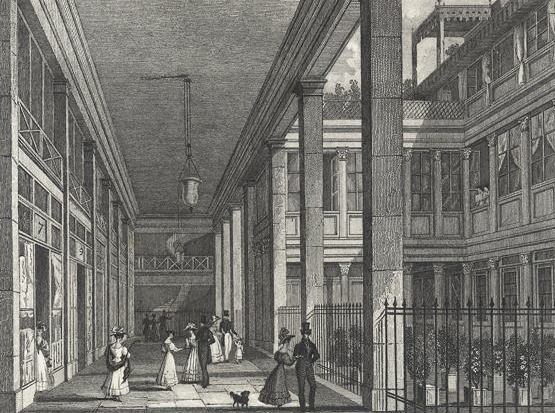
The Passage du Saumon dated from 1763 and was first covered in 1828. It then linked the Rue Montmartre and the Rue Montorgueil.
Four years later the insurrection of June 5-6 1832 on the death of General Lamarque saw a barricade erected here, described by Victor Hugo in Choses Vues and in Les Misérables, where he places the policeman Javert spying on the largely student insurrectionaries.
During the Bloody Week of the 1871 Paris Commune, cellars in the Passage du Saumon were used to hide copies of the Blanquist news sheet, Père Duchêne. It had been banned by the Versailles General Vinoy after its fifth edition but it went on to produce 68 during the Commune up until May 22 1871. It was eight pages long and up to 70,000 copies were published each time.
Eventually the Passage became less profitable and it was largely demolished by Aïad’s son in September 1899. The shortened 90m passage was renamed as the Passage Ben-Aïad with access at Nos. 7-8 from the new road named in 1900 after the writer Louis Petit de Bachaumont (1690-1771).
The Place Vendôme was built to celebrate France’s military might under Louis XIV, the Sun King. Begun in 1699 it was only finished in 1720. It was built on land that had belonged to the illegitimate son of Henry IV, the Duke of Vendôme.
Initially called the Place des Conquêtes (Conquests Square) it soon became the Place Louis-le-grand with a huge equestrian statue of Louis XIV in the middle.
During the French Revolution it was renamed the Place des Piques (Square of Pikes) and the statue was destroyed on August 16 1792 and replaced with a statue representing Liberty.
For most of the 18th century many of the flats in the square’s huge private mansions were occupied by financial speculators and/or tax farmers and relatives of the aristocracy, among whom were a handful of revolutionaries. The leadership of the 1796 Conspiracy of Equals, including Gracchus Babeuf and Philippe Buonarroti met at No. 6, the Hôtel Thibert des Martrais. This was also the address from which two years earlier the Tax Farmers Jacques Paulze and Antoine Laurent de Lavoisier were taken to the guillotine.
Another conspiracy, this time against Napoleon Bonaparte in 1812, two years after the construction of the Vendome Column, was ended when General Malet was arrested by Colonel Doucet and Lieutenant Colonel Laborde at No 7, the Hôtel Le Bas de Montargis. Among those executed a week later, on October 31 1812, was General Lahorie, the god-father of Victor Hugo and Hugo’s mother’s lover since 1802.
In 1871, under the Paris Commune, the square was renamed the Place Internationale.
Number 7 was the same mansion that under the siege of Paris saw the Versailles government’s Paris army General installing Louis d’Aurelle de Paladines as commander of the Paris National Guard against the wishes of the majority of its battalions on March 5 1871. With the failure of the Versailles attempt to remove cannons from Montmartre on March 18 1871, 2,000 men from the Batignolles and Montmartre battalions of the National Guard battalions then evicted de Paladines and took over the building.
This allowed Jules Bergeret to set up his staff headquarters at No. 7. On April 4, after being elected to the Commune’s Council, Bergeret was named Paris National Guard commander.
The square saw much blood spilt at its barricades defending these headquarters of the National Guard during the Paris Commune. On May 23 1871 a barricade at the angle between Nos 1 and 2 with Rue Saint-Honoré was finally captured after Versailles troops got into the square through No. 4 and attacked the barricade’s defenders from behind.
The Hôtel du Rhin at No. 4 was also where Louis-Napoléon Bonaparte had lived in 1848 after his return from exile in England and where he was visited by Victor Hugo who completely believed his assurances that he had no designs to become Emperor.
The second defensive barricade blocking access from the Rue de la Paix in May 1871, stretching across Nos 23-26, was also captured from behind. This was one of the just 18 barricades that had actually been defended with the Commune’s canons.
After the barricades were overwhelmed, the Versailles troops killed most of the survivors. On the following day a group of 30 Communard women were shot in the square.
The Hôtel de Chimay at No. 8 was a centre of the Saint-Jacques resistance network from the start of the 1940 occupation of Paris by the Germans. Radio communications from there to London by began in April 1941 after Maurice Duclos was parachuted into France in February.
During the French Revolution Nos 11-13 became the Ministry of Justice, with Georges Danton nominated as Minister in August 1792. A metre length was installed in the wall there in 1795. The only other remaining original metre length installed in Paris at the changeover to metric distancing is in the Rue de Vaugirard.
No 12, the Hôtel Baudard de Saint-James, was where Frédéric Chopin died supposedly of tuberculosis (although this diagnosis is now contested) on October 17 1849. He was buried in Père Lachaise cemetery. While from 1838 to 1847 Chopin had lived with George Sand, he had separated from her and spent just a month in the Place Vendôme before he died, thanks to a loan from Jane Stirling.
The former Hôtel de Gramont at No. 15 was transformed into a luxury hotel and opened by the Swiss hotelier César Ritz in 1898. During the occupation the most senior Germans lived there and had many ‘traitor lunches’ in its restaurant. On the 16 August 1944 Ernest Hemingway arrived at the Ritz and presented some American rifles to the resistance fighters who had just evicted the Germans. This was also where Coco Chanel lived for many years, including during the period she collaborated with the Germans.
The Hôtel de Boffrand at No. 24, has also become known outside France through its association with Anne Lister, the Gentleman Jack lesbian Calderdale landowner and diarist. She lived there with Maria Barlow in 1824-1825.
Changing statues
In 1806 Napoleon ordered the building of a huge column in the centre of the square to celebrate his military victory at Austerlitz. Ironically this military monument was situated at the end of the Rue de la Paix. Inaugurated on August 15 1810 it was covered in bronze plates featuring battle scenes made, it was said, from melting down foreign captured cannons.
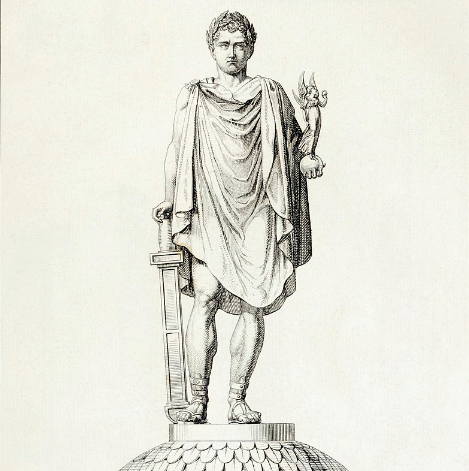
Napoleon was put on top in Roman Emperor robes with a gold laurel wreath on his head. This lasted until April 4 1814 when the invading allies pulled Napoleon’s figure down. Four days later the white Bourbon flag fluttered over the renamed square.
In 1816 the Louis XVIII Restoration government melted Napoleon’s statue down to use its bronze for a new Henry IV statue on the Pont Neuf
For the following 15 years the position at the top of the column was not filled. But in 1833, after a Bonapartist demonstration on May 1 1831, the new King Louis-Philippe (the son of the executed Duke of Orléans, Philippe Égalité, a supporter of the French Revolution and a regicide), replaced Napoleon at the top. This time, however, not dressed as a Roman emperor, but as an army corporal, reflecting the new king’s desire to honour Napoleon, but not too much.
Napoleon did still not appeal to the revolutionaries of 1848, who took the corporal down and threw him into the Seine. Replacing the corporal did not appeal to nephew Louis Napoleon Bonaparte either. His third (and finally successful) military coup d’etat in 1851 led him to proclaim himself Napoleon III, Emperor of the French. In 1864 he placed a copy of the original Napoleon as Emperor statue back on the top of the column.
Karl Marx wrote one of his best political commentaries on contemporary events in 1852: The Eighteenth Brumaire of Louis Bonaparte. In it he compares Louis’ coup of 1851 with Napoleon Bonaparte’s of 1799, and presciently concluded that ‘if the Imperial mantle finally falls on the shoulders of Louis Bonaparte, the bronze statue of Napoleon will fall from the height of the Vendôme Column‘.
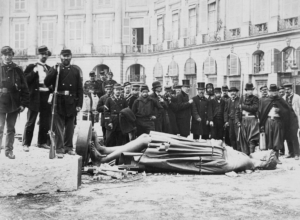
This happened on May 16 1871 during the Paris Commune after the painter, Citizen Courbet, the President of the Federation of Artists that was formed on April 15, persuaded the Commune to authorise the dismantling of the column. He described it as ‘a monument devoid of all artistic value, tending to perpetuate by its expression the ideas of war and conquest of the past imperial dynasty‘.
Courbet’s attack on the column was not universally supported by other artists. Daumier, the head of the Beaux-Arts section of the Federation, believed it should not be taken down. Perhaps this was why the 425 spiralling bas-relief bronze plates carried out by a team of 30 sculptors were removed and stored.
No Caption
No Caption
The column was replaced in 1874 with another copy of the imperial Napoleon at its top.
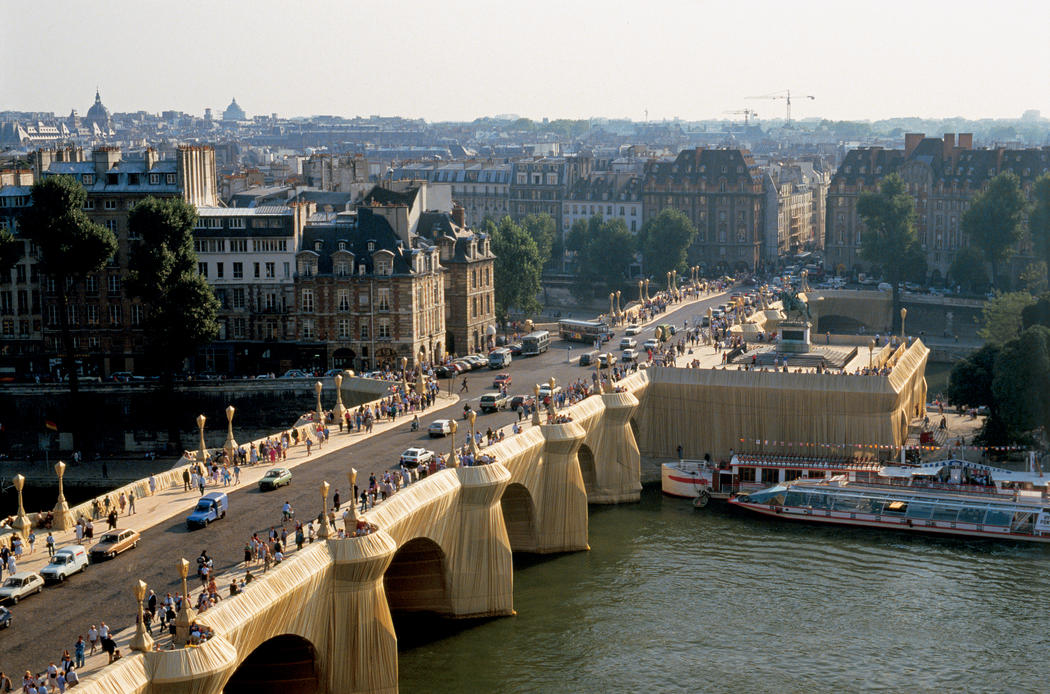
The oldest bridge in Paris, the Pont Neuf was its first bridge without houses and constructed entirely out of stone. It was also unique in having pavements and bastions to protect pedestrians from mud, horses and carriages. Hence it was always called ‘the New Bridge’.
Initial plans assumed it would be paid for by the owners of the houses built on it, as happened on the other mid-16th century bridges shown here in 1651. But it was eventually paid for by the founder of the Bourbon dynasty, Henry IV.
Building had begun in 1578 under Henry III, but was interrupted by the religious wars of 1588-1598 which, after Henry III’s murder, were finally ended by Henry IV’s conversion to Catholicism and his successful seige of Paris.
The bridge was finally completed in 1607. three years before Henry IV was assassinated by a Catholic opponent of the Edict of Nantes, guaranteeing religious liberty in France.
Henry IV’s widow, Marie de Medicis, ordered the erection of a statue to Henry IV to be erected on the bridge at the point where it crosses the Île de la Cité. The statue was finally put in place in 1614. It stood there until evidence appeared in 1792 during the French Revolution that the Bourbon king Louis XVI was corresponding with the Austrians encouraging them to invade France. It was then pulled down, the day after a similar fate happened to statues of Louis XVI.
In 1818 after the restoration of the Bourbons, Louis XVIII ordered a new bronze statue to be erected in the same place. It was claimed to have been made from a surviving original cast, although it is quite unlikely that one survived. The
The bronze for the new statue came from melting down two recent statues: the giant imperial statue of Napoleon on top of the Vendôme column and the statue of the French revolutionary general Louis Desaix on the Place Dauphine. Desaix was an aristocrat who had served in the Bourbon army before the Revolution who then supported the Republic and was killed in action in Italy in 1800. He was a model for the aristocratic but humane Republican general Gauvain in Victor Hugo‘s last novel, 1793.
The sixteen year old Victor Hugo joined a huge crowd cheering on the replacing of the Bourbon statue on the bridge. The next year he wrote a prize-winning poem celebrating the moment. It included the lines: Make no mistake, this august image’s aspect / Will lessen our ills and sweet our happiness.
On May 24 1871 a Versaillais agent was executed in the second niche from the right bank for accusing the Polish General Jaroslaw Dombrowski , the Commander in Chief of the Commune forces, of treachery. Dombrowski had been killed the previous day on the barricades.
Early in 1943 under the German occupation Marcel Rajman, the 19 year-old Jewish Communist member of the FTP (Francs-tireurs et partisans), held his first meeting with the leader of the FTP-MOI, the Armenian Missak Manouchian, in the fourth niche near the statue of Henry IV. Both were eventually caught by Vichy Government’s Brigades Spéciales and shot with 20 other resistance fighters on February 21 1944.
Named after the 16th century lawyer, Jacques Cujas, who exceptionally refused to take sides in the century’s religious wars, the road runs next to the Sorbonne’s law faculty. Close to the Pantheon it was the scene of barricades in June 1848 and of particularly fierce fighting around ones erected during the bloody week that ended the Paris commune of 1871.
During the first decade of the 20th century the French police archives record that many exiled Russian revolutionaries. particularly those from Georgia, used to hang out at the restaurant at No. 11.
In the early 19th century the painter Jacques-Louis David had a studio in the closed and ruined Cluny College (roughly number 16) where over the following two years he painted Napoleon crowning himself in 1805.
On May 1 1898 Charles Péguy, Lucien Herr and Georges Bellais set up a socialist bookshop and publisher at No. 17. It became the headquarters of the Dreyfusard supporters. Within a year Herr had brought several other socialists together to form the Bookshop and Publishers New Society there. Those involved included Léon Blum, Hubert Bourgin, Albert Monot, Mario Roques, Désiré Roustan and François Simiand.
Number 22 is a café, now called the ‘Mad Maker’. Back in 1830 it extended to the corner of Boulevard Saint Michel and was called the Café Musain. This was where Auguste Blanqui organised the Société des Amis du peuple (The People’s Friends), the insurrectionary group that played a role in the July Revolution, les trois glorieueses.
When Victor Hugo wrote Les Misérables, he used this revolutionary sect as a model for an equivalent group behind the 1832 insurrection, the Amis de l’ABC. Their initiative, to begin the insurrection by raising the red flag during the funeral procession of the Republican leader General Lamarque, on June 5 1832, saw several hundred killed in just a few hours.
The present road follows almost exactly the old Roman ‘road to the sea’ to Harfleur (Caracotinum) in Normandy from Paris (Lutèce), and is named after the commune of Clichy to which it leads, some 6 km northwest of Paris.
Victor Hugo lived on the fourth floor of No 21 from 1874 to November 10 1878. He wrote his last great novel, Ninety-three, there before moving to the Avenue d’Eylau to live next door to his son’s widow and her children.
Between 1804 and 1806 Hugo had also lived with his mother (with frequent visits from her lover Lahorie) and two brothers at No. 24. In 1807 Sophie and the three boys undertook a long journey to Naples to see her officer husband, but where they spent one night before returning to Paris and moving into a fourth-floor apartment in the former monastery in the Rue des Feuillantines in February 1808.
The Clichy prosecutor, Bulot, lived on the second floor of No. 39. Bulot had called for the death penalty against three anarchists who had been shot at by police in Clichy after protesting the May 1 1891 mass shooting of 8-hour day demonstrators at Fourmies. After the trial led to two of them being given prison sentences of five and three years, Ravachol, an anarchist and burglar, left a bomb outside Bulot’s door at 8 am on the morning of March 27 1892. The bomb exploded a few minutes later wounding seven people and destroying the flat. Ravachol was arrested on March 30 and executed on July 11 1892.
The deputy for the Ain department from May 1849, a former army doctor who treated the poor, Jean-Baptiste Alphonse Baudin, lived at No. 43 during the Second Republic. He was one of several deputies who accompanied Victor Schœlcher to the barricade in the Saint-Antoine district to try and persuade soldiers from supporting Louis Napoleon’s seizure of power on December 2 1851. That was where he was shot dead, becoming a symbol of republican resistance to despotism. Buried secretly in the Montmartre Cemetery (27th division), Baudin’s remains were transferred to the Pantheon on August 4 1889, part of the celebrations of the centenary of the 1789 French Revolution.
The Clichy prison, known as the Debtors Prison from 1834 to 1867, was situated between Nos. 54 and 68. The private mansion originally at No. 54 was where the Royal Coach was hidden before taking Louis XVI and Marie-Antoinette to Varennes on their failed escape attempt of June 20 1791.
The Communard Sidonie-Marie Herbelin lived at No. 55. She was sentenced to deportation to a fortified prison in New Caledonia on May 13 1872. Witnesses said she had been carrying a red flag while encouraging others to loot the home of an absent Versaillais policeman. She was deported on the same boat as Louise Michel, but never returned to France, dying on March 24 1875.
Probably named from the 15th century after the rocket plant that used to grow extensively hilly and rocky area, it became the place where many wealthy people built homes to be close to the capital.
The Roquette prisons were opened in 1830 and finally closed in 1974
A barricade from No 1 across the road to the Rue du Faubourg St Antoine saw bloody fighting on May 26 1871 when the defending Communards were attacked by the Versaillais soldiers. Their prisoners were systematically executed.
Another barricade crossed to the Rue Neuve de Lappe from No. 34. This was one of the very first barricades set up on the morning of March 18. In total 78 barricades were constructed in just the 11th arrondissement during the Commune.
Paul Verlaine lived with his mother on the 5th floor of No 17 from 1883 to 1896, writing ‘The accursed poets’ there, first published in 1884 and then extended in 1888. In it he called the tribe of poets ‘the race that will always be cursed by the powerful ones of the earth‘.
The Little Roquette Prison at Nos 143-147 was initially for young prisoners and became a women’s prison in 1932 . Outside its walls four of the Commune’s hostages were executed on May 27 1871. Later, after the suppression of the Commune this was where hundreds of young Communards taken to the prison were then executed.
On 25 February 1961 six Algerian and French supporters of the FLN escaped from the Little Roquette during the Algerian War. The escape was organised by Michel Pablo, the Greek Trotskyist who spent most of his life in France.
Hubertine Auclert, the editor of the Womens’ Suffrage Society paper, La Citoyenne, lived at No. 151 from 1892 to 1914.
In 1670 the Sun King Louis XIV was forced to order the building of the hospital the L’hôtel des Invalides to get some of the huge numbers of wounded ageing soldiers from his Thirty Years War off the streets of Paris. What was then a district outside Paris today still treats some of the wounded from France’s continuing militaristic and imperial legacy, and for others is still a retirement home.
At 7 am on the morning of July 14 1789, a huge crowd stormed the building. The governor ordered his troops to fire, but none did. The Invalides’ gates were raised by the retired and wounded soldiers inside and those outside armed themselves and marched on the Bastille.
Early on July 14 1789 Jean-Baptiste Lallemand paints the moments when Parisians take 27 canons and 32,000 rifles from Les Invalides and then march on the Bastille.
Even more significant in French iconography, Les Invalides since 1840 also houses the tomb of Napoléon Bonaparte.
Named in 1846 after the priest Charles-Michel de L’Épée (1712-1789) who founded the Deaf and Dumb Institute (Institution des sourds-muets ).
No. 12 is where the command headquarters of the French resistance against the Luxembourg Palace and gardens was based in August 1944 under the leadership of Colonel Fabien, the alias of Pierre Georges. A very rare plaque naming a Communist is on the right of the entrance.
Military headquarters of Colonel Fabien in August 1944. A rare plaque actually naming a Communist.
On 21 August 1941 Georges, an International Brigade fighter in Spain from 1936 to 1939, then using the alias Frédo, was the first Young Communist to kill a German soldier during the occupation of Paris.
The attack was mounted at the Barbès–Rochechouart metro station after Hitler invaded Russia on June 22 1941 by a PCF member.
The present square includes the chapel of the Saint-Lazare prison. It started as a leper colony run by monks in the 17th century and then as a special prison for the well-to-do. 165 prisoners were executed here over the three days before Robespierre’s arrest on 27 July 1794 at the height of the terror. It became a women’s prison later that year. After being rebuilt in 1834 and closed in 1935 to become a hospital, it was also closed in its turn in 1998.
Square Alban-Satragne showing the Chapel of the Prison Saint-Lazare that survived its demolition
Saint-Lazare had dual roles: medical treatment and jail. After the 1802 law requiring prostitutes to have regular medical check-ups, the Saint-Lazare prison became one of the first prison hospitals in France, with many women undergoing treatment. They would not be released until they were given a ‘clear card’. Those who didn’t have a card at all could simply be locked up in the prison side of the establishment. This law continued in force until 1946, when all women’s detention centres in France were finally closed.
Saint-Lazare was rebuilt by the architect Louis-Pierre Baltard as a special women’s hospital in 1834 after the old Saint-Lazare church collapsed.
Feeding the prisoners at Saint-Lazare. A painting by Hubert Robert, a surviving inmate from 1794,
In 1838 the Paris police chief made the Sisters of Marie-Joseph responsible for guarding the prisoners.
In 1857 Saint-Lazare had about 1,300 prisoners in three
sections: those convicted or waiting trial; those undergoing treatment or
refusing it; and girls between 7 and 16 or 20 who were deemed to be vulnerable.
The Saint Lazare women’s prison in the late 19th century with a male urinal conveniently placed outside
Records show some 11,000 women and girls passed through the Hospital/Prison in the single year, 1885. This was two years after Louise Michel was imprisoned there.
In 1935 the old prison was demolished but the special
hospital continued to treat women prostitutes until 1975, the international
year of women.
The only remaining bits of the prison are the Chapel in the Square and the old hospital’s wings, now associated with the Françoise Sagan media centre.
From January to June 1925 this is where Pierre Monatte and Alfred Rosmer published their dissident Communist journal La Révolution prolétarienne
Named after a 16th century Italian painter in 1880, the old Montmartre street was originally called the rue Saint-André. Its biggest claim to fame, apart from hosting Monatte‘s oppositional publication, La Révolution prolétarienne, at No. 17 in 1925 is the recent discovery (in 1988) of one of the last wells found in Montmartre – at 17b.
Named either after a draper’s street sign showing a tree without leaves or from the hangman’s scaffold a the street’s northern end, on the corner with the Rue Saint-Honoré, in the 13th century it was the north-south road crossing the 10th century city walls.
Friedrich Engels lived at No. 15 (formerly No. 11) in 1844 when he came to visit Marx in Paris. The building is now a primary school, previously for girls.
Engels stayed at No. 15 in 1844 when he visited Marx and ignited their life-long collaboration.
After the First World War, the pioneers of Algerian national independence used to meet at No. 39, the ironmonger’s shop belonging to Hadj-Ali Abdelkader. In 1926 he was both a member of the Central Committee of the French Communist Party and first president of the North-African Star movement created that year.
The German ‘League of the Just‘ formed largely of exiled German skilled workers used to meet in 1836 at No. 46 led at that time by Wilhelm Weitling.
Pierre Lambert ran the Parti communiste internationaliste also at No. 46 in 1950-1951, producing the newspaper, La Vérité, from 1946 until 1958 when it was turned into a journal.
The Brasserie du Commerce and its Auger Restaurant at No. 48 were a regular meeting place for left groups in the mid and late 1930s. The Young Socialists (Jeunesses socialistes), ‘Bolshevik-Leninists around ‘Truth‘, and the Communist-dominated Secours Rouge (Red Cross) that changed its name to Secours populaire (People’s Help) all used to meet there.
It was at the Brasserie du Commerce that Marceau Pivert, Daniel Guérin and the Luxemburgist René Lefeuvre drew up the constitution of the ‘Revolutionary Left’ tendency within the SFIO on September 25 1935.
No 48 was also the place where Pivert’s new left revolutionary socialist party, the PSOP, decided to exclude the small numbers of Trotskyists including Lambert who had started to ‘enter’ it in 1939.
In 1808 the National Archives were placed in the Hôtel de Clisson at No. 58. It was built first in 1371 (its turreted gateway survives) and then acquired by the Duke of Guise who changed the name to the Hôtel de Soubise.
One of the barricades erected during the brief insurrection of May 12 1839 by the Seasons Club led by Blanqui and Barbes was based at No. 76, across the road at what was then the junction of 18 Rue du Grand Chantier with the Rue Pastourelle.
Blanqui lived at No. 13 from 1878 until his death in 1881. At that time his address was in the Boulevard d’Italie, which was renamed in 1905
25 Boulevard Auguste Blanqui. This was where Blanqui died in his room on January 1 1881 after returning from a meeting and suffering a brain haemorrhage.
In 1885 this section of the Rue de l’abbé de L’Epée was given the name of the French mathematician and founder (1798-1857) of the positivist philosophical school
A flat in the imposing No. 3 belonged to the parents of Simone Weil, and this was where she met with Trotksy on 30 December 1933 and hid him for a few days during a clandestine visit to Paris. Trotsky took the decision that night to move to found the Fourth International.
A plaque on the wall states only that Simon Weil lived there from 1929 until 1940 and that she was a philosopher.
The property at No. 3 where Simone Weil’s parents owned a flat now has a plaque commemorating her presence there.