Under its earlier name of the Grande rue d’Auteil, No. 24 was the private house of Mme Helvétius , whose salon from 1772 to 1800 was visited by Diderot, Turgot, Benjamin Franklin, Thomas Jefferson and Thomas Paine as well as by Napoléon Bonaparte.
The Auteuil hamlet was close to the vast forest of Rouvray of which today the only remains are the Bois de Boulogne.
Under the Second Empire the house at 59 rue d’Auteuil was owned by the Emperor’s cousin, Pierre Bonaparte, and was where he shot and killed the unarmed young journalist Victor Noir on January 10 1870. Pierre Bonaparte was quickly found not guilty after a trial heard from several conjured up witnesses, while Noir was buried in Neuilly – and only removed as a Republican symbol to Paris’ Père-Lachaise in 1891.
Dalou sculpted the 21-year-old’s tomb for the Père-Lachaise cemetery to where the remains were taken in 1891
Tens of thousands of outraged republicans, including Louise Michel dressed as a man and carrying a knife, marched in his funeral cortege.
Nothing remains of the superb original building, which was burnt to the ground by the Communards in May 1871. There is now only a huge apartment block at the spot.
However, somewhat ironically, the chemist shop at No. 27, just down the street, where Noir finally died at 2 pm in the afternoon, is now called ‘Body Minute’.
Living further up the street in 1848, at Nos. 63-73, was Louis-Philippe’s vehemently anti-Republican prime minister, François Guizot,.
Called after the ‘small fort’ originally built next to the St Antoine gate into Paris and then turned into a stone fort in 1370, the Bastille soon became a six tower fortress with thick walls and a moat. By 1553 it was an eight-tower fortress with a copper-bottomed moat. In the 17th century it was turned into the prison that was eventually taken by Paris’ newly-formed militia and local people on July 14 1789.
One of the wine merchants, Claude Cholat, who participated in the storming of the Bastille sketched the scene from memory a few days later
Demolition began almost immediately. Voltaire’s coffin was symbolically brought there on its way to the Pantheon on July 11 1791.
In 1792 it was decided to turn it into a huge square, the Place Antoine. The Marseillais volunteer national guardsmen arrived there singing the song that became the national anthem on July 30 1792.
From June 9 to June 14 1794 the guillotine was installed in the ruins of the fort. But after killing 73 people in less than three days the local shopkeepers complained so much (about the smell and those who had come to watch) that it was moved to what is now called the Place de la Nation, and was then the Square of the Overthrown Crown.
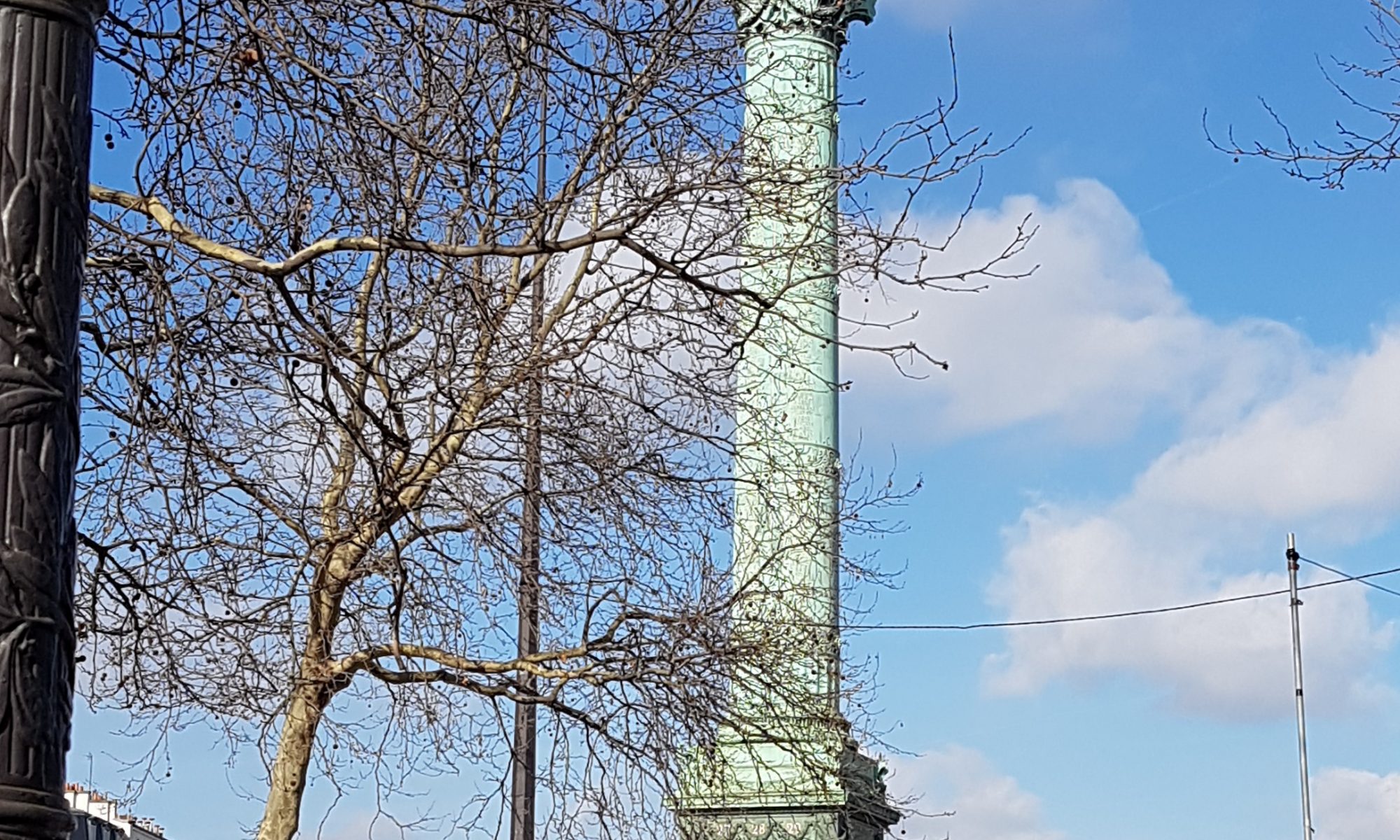
After the 1830 Revolution the new King Louis-Philippe decided to erect a column in the middle of the square to honour the 615 victims of the ‘Trois Glorieuses‘ Revolution – the Three Glory Days. It was inaugurated in 1840.
On April 13 1834 barricades went up in the square as local workers rioted in support of the silk workers’ insurrection in Lyon.
On February 24 1848 Louis-Philippe’s throne was taken from the Tuileries Palace and ceremoniously burnt at the foot of the July column. Three days later the 196 dead in the February Revolution were buried in the crypt beneath the column, and the Second Republic was officially proclaimed there.
On June 24 1848, when the new right-wing government announced the dissolution of the National Workshops, the Bastille square was entirely circled by barricades, and a red flag placed in the hands of Dumont’s 1836 allegorical statue le Génie de la Liberté flew briefly from the top of the July Column to accompany the flame of freedom and the broken chains of despotism.
Dumont’s statue is of a winged male god – chosen probably precisely because it was not the traditionally feminine revolutionary with a phrygian gap – in keeping with the rightward direction of the Orleans monarchy. The names carved on the column are of the dead of 1830.
A red flag flew again on top of the column on February 24 1871, when 14 battalions of the National Guard marched by in a commemoration of the 1848 revolution. The government’s attempt to replace the flag by the Tricolour on February 26 and March 9 1871 both failed.
During the 1871 Paris Commune three local sections of the International Workingmen’s Association used to meet in the Cour Damoye at No. 12.
On May 25 1871 when the Versaillais troops entered Paris the Communards tried to blow up the column by setting fire to five oil delivery barges in the tunnel that runs beneath it. This failed, and the column was also missed by shells fired at it, although nearby buildings were hit.
The Communards fought hard to defend the symbol of revolutionary liberty, but were eventually overrun by the Versaillais. During the bloody week of May 1871 nearly all were killed in the fighting or shot afterwards.
The Place de la Bastille became the symbol of left and republican resistance.
The first Parisian demonstration of Communards after the suppression of the Commune took place at the Bastille square on May 9 1880.
In 1935 two major demonstrations took place there. On International Women’s Day 1935, feminists led by Louise Weiss and Cecile Brunschvicg symbolically burnt chains of male dominance in the square.
On July 14 1935 a demonstration that brought together both Socialists and Communists marched from the Bastille to Vincennes. This was called under the name of ‘People Together’ (Rassemblement populaire) that became the Popular Front that won the 1936 parliamentary elections.
On May 29 1968, the day De Gaulle temporarily left France, the CGT trade union organised a mass demonstration against his government, shown here in a police surveillance photograph passing the Place de la Bastille
Since 1991 the Marche de les Fiertes have usually begun or ended at the Place de la Bastille. In the 21st century they have usually attracted at least half a million people. There were certainly about that number when Marian and I watched for hours as the marchers went by.
The 50th anniversary Paris gay pride march June 24 2017The first Gay Pride march in Paris in 1981 passed through the Place de la Bastille.
Louise Michel lived on the Boulevard just outside Paris proper for a few months in 1856 in a flat opposite the Farmers-General wall. It was then a low rent, strongly working-class district. It is now one of the circle of broad boulevards created when that wall was demolished. To the North-West of Batignolles lies Levallois-Perret where Michel is buried.
The word Batignolles comes either from ‘bastillole’ meaning
little country house, or from ‘batagliona‘, the Latin for a battle. In medieval
France the rural commune of Batignolles-Monceau belonged to the Benedictine
nuns of Montmartre. It was used by the Bourbons for hunting.
The Farmers-General Wall of the Ancien Regime was built to tax Paris not to defend it as were the 13th and 14th century walls
Batignolles lay just to the North, outside the Farmers-General Wall around Paris built between 1784 and 1791 by the corporation of hugely wealthy tax farmers (paid by Louis XVI to collect taxes on goods entering Paris), 28 of whom were guillotined in 1793.
The 24km long wall with 64 toll barriers had boulevards on the outside. The Boulevard des Batignolles was one of these boulevards.
Today the line of the wall is roughly followed by the Metro lines 2 and 6.
Anger at Paris being ‘put in jail’ by the wall was a big factor in making the Bourbon rule highly unpopular. The tolls were abolished on 1 May 1791, although restored by the Directorate in 1798.
In 1860 the Batignolles district was incorporated into Paris by the Paris Prefect, Baron Haussmann, and the remaining sections of the wall destroyed, leaving just a handful of the classical designed custom houses.
Boulevard des Batignolles photographed towards the end of the 19th century
A working-class area with low rents through the second half of the 19th century, Paul Verlaine (1844-1896) lived here as a child. Édouard Manet lived at No. 34 from 1864 to 1866. Émile Zola (1840-1902) supported him when Manet’s paintings were rejected for the 1866 Salon.
One of Paris’ very old boulevards, first called the boulevard Saint-Antoine and renamed boulevard Beaumarchais in 1831, after the important Enlightenment musician and poet. Two of its buildings (Nos. 23 and 28) are classified as historic monuments.
The low-level concert hall and theatre at No.10 was demolished in 1972
No. 10 isn’t. For good reasons. It’s now an ugly modern building. But from 1855 it was the entrance to a major cafe and music hall. The old entrances to the space behind the facade on the street are still there at Nos. 12 and 8.
The Dance hall le Grand Concert de l’Époque, in 1925 it became Concert Pacra until 1962
Initially opened as a dance hall called le Grand Concert de l’Époque, it became a theatre in 1905 and then a cafe-concert hall, Chansonia, in 1908. In 1925 another name change to Concert Pacra lasted until 1962, when for its last decade it became the Théâtre du Marais and then Music-Hall du Marais and finally a cinema.
Among those who appeared at the Concert Pacra were Charles Aznavour, Edith Piaf and the anarchist Georges Brassens.
In May 1968, while all the other shows in Paris stopped with the strike on the metro and the street battles in Paris, a concert of folk music took place there in support of the French Global Campaign against Famine.
On the site of No 62 on April 14 1834 the dozen occupants of a house in the now demolished Rue Transonain were massacred in their beds by King Louis-Philippe’s troops
In 1830 Louis-Philippe was presented the crown of France by the timid reformers who had been pushed into presiding over the downfall of Charles X. But they were not able to suppress the republican pressure to get rid of the monarchical system of privileges and power that was particularly strong in urban areas.
In Lyon on 9 April 1834 a demonstration protesting against new authoritarian laws inhibiting press freedom that was organised by the Society for the Rights of Man and by the Executive Committee of the local workers friendly societies led to mass rioting that appeared to be building up to an insurrection.
Barricades started to appear in Paris on 13 April 1834 and Louis Philippe’s government decided on savage repression. After an infantry captain was wounded by a shot from a window near a barricade in the Rue Transnonain every person found in the house from which the soldiers thought the shot had been fired was killed (12) or wounded (24) (with the victims including old men and women as well as children).
The ‘butchery of Rue Transnonain’ was captured,
famously, by Honoré Daumier in a print that could not be censored and became an
instant success as well as a tribute to Daumier’s art and politics.
Daumier sketched the 14 April 1834 massacre of men, women and children at 12 rue Transnonain by Louis-Philippe’s troops
Renamed in 1864 under Napoleon III in honour of the song-writer Pierre-Jean de Béranger whose songs under the Bourbons had often praised the achievements of Napoleon 1, Béranger himself had lived and then died in a top floor flat at No. 5 when the road was called the Rue de Vendôme.
The name Vendôme used from about 1694 was because Philippe de Vendôme was the head of the Order of Saint John of Jerusalem that ran the nearby huge Templar Knights estate and tower.
Ironically, the 1964 renaming took place in the same year that one of the main figures with Henri Tolain behind the ‘Manifesto of 60 Working Men, Joseph Perrachon, was living at No. 3. The Manifesto was describe by Marx as ‘The first Class charter by a French working class movement on the way to becoming adult‘. Perrachon was one of those who then founded the International Workingmen’s Association.
Fierce fighting took place in the road on May 24 1871, when a barricade from Nos. 25 to 26 was finally taken by some Versaillais troops approaching it from the Boulevard du Temple.
A bustling square on the 1791-1860 northern boundary of Paris at the old tax gate into Paris to the south of the Montmartre hill. Its barricade in May 1871 involved fighter from the Women’s Union. Today it is home to Le Moulin Rouge that opened in 1889 and dozens of tacky strip bars and sex shops.
A century ago the Place Blanche already looked something like it does today
The Place Blanche (White Square) was named after a café called the ‘White Cross’. It got its name from the showers of white flour and gypsum whose mills and quarries often covered those working on and near the Montmartre hill.
A 1785 painting of the customs post at the Place Blanche gate in the recently-built Tax Farmers’ wall around Paris
The tax collectors’ building in the Farmers-General Wall at the Place Blanche was burnt down here on 11 July 1789 in a protest by quarry workers against the taxes on the carts they had to pay to enter neighbouring inner Paris. It was one of the many sparks that ignited in Paris three days later on July 14 1789.
The Farmers-General Wall of the Ancien Regime was built to tax Paris not to defend it as were the 13th and 14th century walls
The tax wall was first abolished by the Constituent Assembly in 1791 and in November 1793 32 of its wealthy tax collectors were arrested and 28 guillotined. After the tax wall’s reintroduction by the Directorate in 1798, it and its gates survived until 1860, when Montmartre was incorporated into Paris.
The Place Blanche tax gate photographed in 1855 before tax collections at the wall finally stopped in 1860
The halfmoon-shaped square was laid out in 1803 as La Place de la Barrière Blanche, and only
became La Place Blanche in 1864.
The barricade with women defending the Commune at the Place Blanche in May 1871
On the morning of 23 May 1871 it was the site of a major battle at the barricade across the southern end of Rue Lepic. The barricade was defended by Elizabeth Dmitrieff, Nathalie Le Mel, Louise Michel and between fifty and 120 fighters from the Women’s Union for the Defence and Care of the Wounded of Paris.
The women fighters had already retreated from the Batignolles barricade, and after the Versaillais took this barricade they were then forced to retreat again to the next barricade at the Place Pigalle.
A kilometre-long road first traced out in the 15th century had previously had 12 other names before its three main fragments (la rue des Petits-Augustins, la rue Saint-Germain-des-Prés and la rue du Pot-de-Fer-Saint-Sulpice) were joined together and given its current name by Napoléon Bonaparte’s nephew, the Prince-President Louis-Napoléon Bonaparte in 1852.
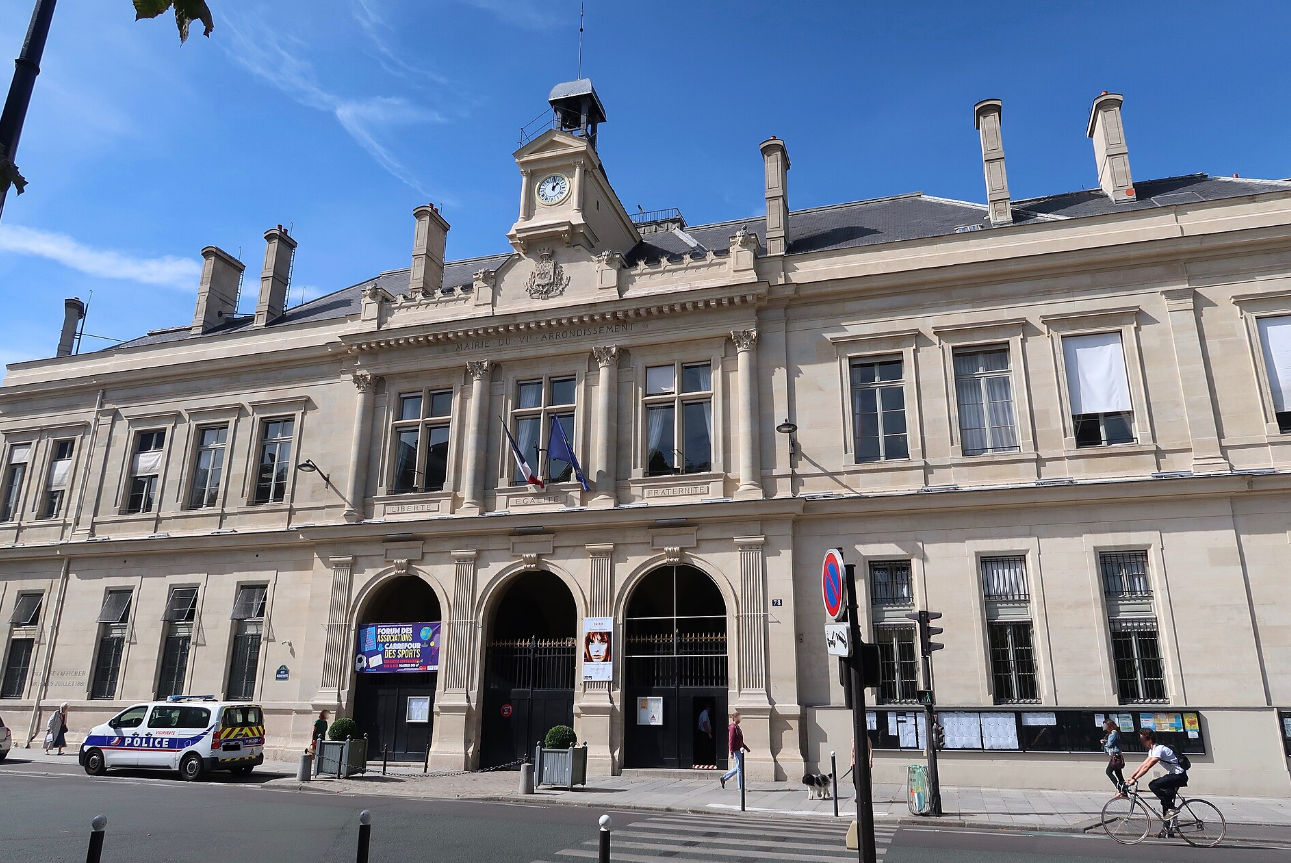
The building I have most contact with in this newly chic area is the sixth arrondissement town hall. When my father’s French employer first found him a flat in the area in 1954 it was still largely cheap student accommodation, dozens of cafes and loads of drunks and intellectuals hanging out. No 78, pictured above, is where 42 years later a motorcycle rider had to rush to for a permit to move my dad’s body out of the sixth before the 24-hour deadline for medical research on his body had passed. The mairie was built in the 1840s.
Paris is still changing, and sometimes by accident. Having a meal with Nicole (my father’s partner for over 25 years) in November 2017, we chatted about the big fire that had started near the Saint Germain church.
The famous La Hune Bookshop after the fire and in the background Sartre’s doorway at 42 Rue Bonaparte
It turned out to be the cremation of the last mortal remains of the famous La Hune bookshop. This had been set up by former resistance fighters in 1949 and had been a centre of Parisian intellectual life for thirty years. It had closed two years earlier after relocating to the corner of the Place Saint-German and Rue Bonaparte in 2012.
Hazan (WTP) remembers it as one of the key left intellectual
meetings places of the 1950s and as a street dominated by ‘realist’ art
galleries in the 1960s. When we walked past it the day after the fire and smelt
the sad pungent aroma of burnt books and wood, it looked as if the fashion shop
with which it shared its premises had mysteriously been largely spared.
Across Rue Bonaparte was where Jean-Paul Sartre used to live in number 42 (third window above the balcony). He moved there to be with his mother after the death of her second husband in 1948. The editorial team of his philosophical journal, Temps modernes, used to meet in the flat. Simone de Beauvoir, with whom he lived there for a while, Raymond Aron and Maurice Merleau-Ponty were among the many Left Bank intellectuals who made up its editorial board.
Rue Bonaparte in January 1962 after an OAS plastic bomb exploded in the doorway outside Sartre’s house
Number 42 was the address where Sartre’s political support for Algerian independence was rewarded on January 7 1962 with the signature plastic bomb used by the OAS – the Organisation armée secrete – whose music I had first heard out with my father on the Champs Elysée celebrating New Years’ Eve just a week earlier. The traffic jam of cars blocking the street appeared nearly all to be honking ‘Algerie Française’ – da da da, daa, daa. A week later we were walking home when we heard the huge bang when the Rue Bonaparte bomb went off – targeted along with another 16 other addresses that night.
There were no injuries, but Sartre promptly moved
out to the much more public Boulevard Raspail.
The 40-year-old French composer of Spanish origins, Francisco Salvador Daniel (1831-24 May 1871) was summarily shot in Rue Bonaparte
Further down the Rue Bonaparte, at the crossroad with Rue Jacob, another story did not end quite so happily. In 1871 the Commune defenders built a barricade between numbers 21 and 28 in Rue Bonaparte and from 29 to 32 in Rue Jacob. There, on May 24 1871 Francisco Salvador-Daniel, the musicologist son of a Jewish refugee from Spain, who had been defending the barricade was captured, and taken back to the barricade and shot by the Versaillais soldiers. He had taught the violin in Algeria and translated and adapted Arabic songs from North Africa for European musical instruments.
Félix Vallotton, the graphic artists and painter sympathetic to anarchism, frequent contributor to La Revue Blanche, where he drew the enigmatic portrait of anarchist and art critic Félix Fénéon, and associated with the Nabis movement, lived in 1886 at No. 21.
The painter, Édouard Manet, was born in the mansion belonging to his family at No. 5. His mother was the goddaughter of the only French general who remained a king (of Sweden) after the defeat of Napoleon and his father was a French judge.
Louis Hélié, one of the rare 60-year-old resistance fighters killed by the Germans in the 1944 liberation struggle in Paris, lived at No. 3, found at the Northern end of the Rue Bonaparte.
A postcard of the Theatre du Gymnase in 1900. In 1848, 28 years after the small theatre was built, a key barricade placed across the boulevard at this location.saw a major contingent of Louis-Philippe’s troops go over to the people.
This is a wide Parisian street built in 1631 on the line of the obsolete 16th century city wall. It was one of what are called the ‘Grands Boulevards’ on the right-bank of the city. Its even numbers are in the 10th arrondissement and its odd numbers in the 2nd.
Named after the local ‘Our Lady Good News’ church (Notre-Dame-de-Bonne-Nouvelle) It is well used to demonstrations. On June 9 1820 Louis XIII’s cavalry charged demonstrators on the Boulevard chanting ‘Long Live the Charter’, killing several of those demanding that the King keep his 1814 promises of acting as a constitutional monarch.
The next time it was King Louis-Philippe’s troops who forcibly cleared the boulevard of republican demonstrators on 15 June 1831.
A major barricade across the boulevard at No. 38 saw the monarchist Odilion Barrot booed by the republican crowd on February 24 1848 when he argued for a regency under Louis-Philippe’s wife to take over from the King. The 2,000 troops sent to demolish the barricade ended up fraternising with the crowd.
On June 23 1848 three of the first barricades in the workers’ insurrection challenging the end of the National Workshops were erected in the short stretch of the boulevard between the Porte St-Denis and the Rue de Mazagran. The flags on the barricades carried the slogan, ‘Bread or Death‘.
After burning down once in 1849, a second time in 1899 and a third time in 1930, a huge post office was built at No 20 on the site of the 1848 Club des Femmes meetings
Many political meetings used to take place during the 1848 Revolution at No. 20, in the concert hall Bonne-Nouvelle. The Women’s Club attended by Désirée Gay and Pauline Roland met there regularly.
On June 13 1849 Ledru-Rollin and Raspail were arrested after organising a demonstration against the government’s decision to besiege the Roman Republic and restore the Pope to the Vatican. Marx, who had observed the demonstration on the Boulevard, was expelled immediately afterwards.
18 months later, 280 opponents of Louis-Napoleon’s coup d’etat of 4 December 1851 were massacred by canon fire at the junction of the Boulevard with the Rue St Denis.
On September 3 1870 it was the police who fired from the police station at No. 23 on demonstrators angry at the announcement of the defeat of Napoleon III at the battle of Sedan.
On Bastille Day, July 14 1941, after Hitler’s invasion of Russia, the Young Communists (Jeunesses communistes) organised a demonstration in the Boulevard that was attacked first by the Paris police and then by the German army.
The Théâtre du Gymnase, also at No. 38, was where Jean Cocteau’s wartime play, The Terrible Parents, was first performed and then banned in 1942.
On 23 August 1927 fighting broke out in the boulevard when the police attacked the demonstration called by the Communist Party against the executions that day in America of the framed Italian migrants Sacco and Vanzetti.
Another street battle between demonstrators and police took place on 16 December 1972, when a protest march against a police murder of a young Algerian man two weeks earlier was broken up, with its leaders, including Michel Foucault, being arrested.
Built in 1838 in the Montrouge commune and absorbed into Paris in 1863 it was named after Michel-Jacques Boulard, Josephine’s official Imperial tapestry-maker, who. He spend the last three years of his life in a hospice and left a huge amount of money to build the new St-Michel Hospice that opened in 1830.
No. 36 was opened on 17 April 1871 as a recruitment office for the National Guard during the Paris Commune.
Proudhon lived at No. 46 with his family for several years in the 1850s. Having been rebuilt or built in the late 19th century as a local boys school, this address is now an elementary school .
Fifty years after Proudhon had lived in Rue Boulard the street had changed little
Proudhon, of course, would not have approved of the state deciding how to educate children. He believed this could lead to brainwashing. He argued instead that each family (father) should be responsible for the education of their children.
The existing Bourbon Palace that has been used as the Chamber of Deputies or National Assembly ever since 1815 was originally built between 1722 and 1728. It was then enlarged considerably between 1771 and 1789 under the neo-classical architect Marie-Joseph Peyre (who also designed the Odeon Theatre) before being nationalised in 1792 after its then princely owner had fled France.
Under the Directory the Council of Five Hundred began to meet in the Palais Bourbon. from January 21 1798. By then it had been modified to include a hemicycle theatre. Napoleon’s powerless Corps Legislatif also met there in a building that was now adorned by a new Corinthian facade facing the Seine and on the opposite bank at the end of the Rue Royale, Napoleon’s Temple to the Glory of the Great Army (now the Church of the Madeleine).
At what is now the back, or south-facing side of the Palais Bourbon is the Square (Place du Palais Bourbon). In 1883 and 1884 Félix Fénéon published poetry by Paul Verlaine and the Illuminations by Arthur Rimbaud from No. 8 in the Libre revue.
Many of those in LeftinParis were deputies in the National Assembly at one point or other in their lives: Jean Zay, Leon Blum, Ledru-Rollin,
Rue Bourdonnais photographed by Charles Marville in 1853
This road owes its present name (finally decided in 1852) to the brothers Adam and Guillaume Bourdon, provost of the merchants of Paris and wealthy Parisians in the 12th century.
This was where on February 21 1848 the Republicans around the Reform paper took the decision to resort to armed resistance to the King’s decision to ban the Paris banquet in their national campaign to extend the franchise. Among those meeting were the Worker Albert, Ledru-Rollin, Etienne Arago and Marc Caussidière.
The office became the headquarters of the February Revolution, and was where on February 24 1848 Ledru-Rollin, Blanc, l’ouvrier Albert, Flocon, Arago and Cavaignac drew up the left’s list for membership of the provisional government.
A century later, No 32 was the home from 1954 to 1958 of the now discredited Catholic priest, Henri Grouès (called l’abbé Pierre), who had been in the resistance and then a deputy, and was the founder of the Emmaüs charity.
Virtually the entire revolutionary left of the 1840s used to visit No. 4. This was where the Slav exiles lived and where Bakunin used to meet Proudhon,Leroux and many others. Bakunin was finally expelled from France in 1847.
After receiving threats to his life, in 1937 Jean Zay moved to the road that was so close to the heavily guarded Chamber of Deputies.
Called after a grandson of Louis XIV, the Duke of Bourgogne (1682-1712), the road was opened in 1707. Running south from today’s National Assembly, the Palais Bourbon, on January 18 1798 it was renamed the Rue du Conseil des Cinq-Cents after the Council of Five Hundred had begun to meet in the Palais Bourbon.
On February 6 1934 there was a police cordon stretching across the road at Nos 7 and 8 to the rue St Dominique protecting the National Assembly from the extreme right demonstrators.
The music teacher and composer Adolphe Reichel (1816-1896) lived at No. 4 in the mid-1840s when Bakunin stayed with him. Bakunin was expelled from France in 1847, but Proudhon and Pierre Leroux visited him there often.
During the Occupation a Resistance group based at No. 28 (pictured) organised escape routes to Spain both for allied soldiers and later for the roughly 200,000 men over 20 avoiding the Obligatory Work Duty (Service du travail obligatoire) introduced by the Laval government on February 16 1943.
Named after the Swiss-origin Abraham Breguet who first conceived of the wrist-watch and established a watch-making business in Paris, the street was opened in 1866.
With Paul Hauet (1866-1945), a retired colonel, Germaine Tillion reactivated the National Association of Soldiers from the Colonies and set up office in the corner building at No. 2 in July 1940. There were around 69,000 prisoners of war originating in the French colonies at the time.
A letter from Commander Bouret, deputy General Secretary of the Assistance Committee for Black Soldiers, to Germaine Tillion asking for her to send on Koranic religious books to be taken by named visitors to two imprisoned soldiers
Officially they were simply sending parcels, letters or copies of the Koran to the prisoners, but in reality they worked organising a network initially to provide papers and clothers for escaping prisoners of war heading for the free zone in the South, and then in collecting information on German army movements.
By the autumn of 1940 Tillion and Hauet had made contact with the resistance group at the Musée de l’Homme. Tillion was finally the only survivor of that network.
Hauet, was finally arrested in January 1944 and deported to the Neuengamme concentration camp near Hamburg, where he died in January 1945.
The road was named ‘Brittany’ after a never completed project of Henry IV to build a great square into which several streets would run, each with the name of a different province. After two streets were merged in 1851 the road is nearly half a kilometre in length. The even-numbered side of the road was demolished in 1920 to widen the road to its present width.
No. 14 was where the first issue of the centre-left newspaper Libération was prepared and published on April 18 1973.
The oldest covered market in Paris at No. 39, the Market of the Red Children (Le marché des Enfants Rouges), was established in 1628 near an orphanage whose children were dressed in red, the colour of charity). During the ‘Bloody week’ at the end of the Paris Commune in May 1871 the market was fortified and defended.
On January 2 1910 Lenin attended a revolutionary ‘goguette‘ – a kind of drinking + sing-song / poetry-and-literature dinner with roughly 20 people – organised by La Muse Rouge in a room on the first floor of No. 49. We don’t know if he was accompanied by Krupskaya or Inessa.
No 49
The venue (shown in the photograph taken in the 1910s) was the Third arrondissement’s communal building. At the time there were hundreds of these goguette events being organised regularly in Paris. The Muse Rouge theatre group was expelled by the PCF in 1925.
By 1921 the building included the office of the Paris Federation of the SFIO (Socialists) and this was where Breton and Aragon came to apply to join the new French Section of the Communist International, less than a week after the majority of socialists had voted at the Tours Congress to affiliate to the Third International.
In 1922 the cooperative workers’ restaurant and café La Famille Nouvelle based at No. 49 was visited by many leftists including Ho Chi Minh. Many left events took place, including monthly dinners of the Revolutionary Esperantists, who were entertained by the Socialist Federation’s choir.
On September 1 1939 Palmiro Togliatti was arrested by the French police and taken to the Police Station at No. 62. They didn’t find out his true identity and he was jailed only for holding false papers and finally released in February 1940.
In the bloody week of May 1871 a barricade across the road at No. 71 defended by the 86th National Guard battalion mounted strong resistance to the Versaillais troops. This was also the address where Sylvain Maréchal, who drafted the Equality Manifesto of April 1796 is supposed to have lived.
Built in an area designated under Charles X as the ‘European district’ in 1826, the road’s name was intended to celebrate the close relations between France and Belgium after the 1820 Treaty of Kortrijk with the Kingdom of the Netherlands that defined Belgium’s borders.
Its only real historical signficance is that having done extremely well as a writer, Émile Zola, occupied the whole of the ground and first floors of No. 21 bis.
Zola’s principal home, living with his wife Emilie for over 20 years until his mysterious death in 1902.
On two of the walls of the house were portraits of Zola and his wife given to them by Édouard Manet, and on others paintings by his childhood friend, Paul Cézanne. There is now a plaque to Zola next to the main entrance.
Simone De Beauvoir lived at No. 11 Rue de la Bûcherie from 1948 to 1955, writing some of her most important works
The short street is one of the oldest on the left bank. It was given the name Bûcherie because of its proximity to the Port aux Bûches. This was where wood was unloaded and it was full of the wood merchants busy building Paris. But later in the Middle Ages the name changed to meaning ‘butchers’ as the street became the place where rotten carcasses of meat were salted and boiled to be fed to people living in Paris’ poorest district.
Opened in 1861 the road was renamed in 1867 after one of the major influences on the teaching of medicine in France, Pierre Jean Georges Cabanis.
The hôpital Sainte-Anne at No. 1 was funded by the Queen Regent, Anne of Austria, in 1651 in exchange for it being called by her name and prayers being given for her soul by the inmates. It was completely rebuilt in 1772, and in 1863 Napoléon III decided to build a psychiatric hospital or asylum on the site of the neighbouring Saints-Anne farm.
Althusser was one of the many patients treated at the hospital. His first time was in 1947 and last in 1980, after he strangled his wife.
Other patients included Maurice Utrillo in 1904 to try and cure his alcoholism.
In the 17th century it was called ‘The rubbish dump path’ (chemin de la Voirie), but when in the 18th century it graduated to being a road it was given the name of the Cadet family who owned some of the land it crossed.
In 1820 the road also housed the Bazar francais, a shop that served as a meeting place for several disgruntled army officers who planned unsuccessfully to overthrow the Bourbons and bring Napoleon’s son to the French imperial throne.
On March 15 1917 the first issue of a new literary review founded by Pierre Reverdy appeared in Paris called ‘North-South‘. Its title indicated a rapprochement between the artistic and literary colonies in the Montmartre and Montparnasse areas, connected directly by the metro.
The review’s first office was at No. 12, and virtually all the later surrealists and Dadaists wrote for and/or attended meetings there: Aragon, Breton, Éluard, Tzara and Duchamp. Georges Braque and Fernand Leger also produced drawings for it.
An illustration by Fernand Leger in 1918 for the Nord-Sud review
The Lodge of France’s oldest, traditional liberal Masonic order, the Grand Orient of France, was based at No. 16. This was where many political events took place. These included the founding of the League for the Rights of Man in 1888 and the first show in 1933 of the October Group’s play supporting the Scottsborough Boys, the young black men wrongly found guilty of rape in 1931.
Rue Cadet no 16 Masonic grand order
French Masonic orders were banned in 1940 under the German Occupation , and the offices of the Grad Orient taken over by the French police’s intelligence unit tracking down secret societies. One hundred agents worked there under the direction of the Gestapo. On August 11 1941 a second law was added to permit the seizure and sale of all Masonic temples and goods belonging to individual Masons. The photo of the entrance to the Lodge above was taken in 1941.
After Jules Vallès gave a lecture on Balzac at the Casino Hall at No. 18 on January 15 1865, Vallès was fired from his job in the Vaugirard Town Hall for having criticised the Second Empire.
Originally this was the principal road through the farm belonging to the Bishop of Paris, annexed to Paris in 1722, and the section called rue Cambacérès was named differently from the rest of the street in 1865.
It was another street renamed under Louis-Napoléon’s search for greater legitimacy in the eyes of both republicans, Bonapartists and freemasons.
Jean-Jacques-Régis de Cambacérès (1753-1824) was an aristocrat who supported the French Revolution and became president of the Convention and the Committee of Public Safety in 1794. In 1796 he was elected president of the Committee of 500, the lower chamber under the Directorate. In 1799 he became minister of Justice and supported Bonaparte’s coup d’état of the 18 Brumaire (1 November 1799).
Three French Consuls from 10 November 1799 to 18 May 1804, Cambacérès replaces the Republican Sieyès on January 1 1800 after which this painting of him (on the left) Bonaparte and Charles-François Lebrun.
Cambacérès’ next promotion saw Napoléon Bonaparte name him Second Consul in 1800. He is a major editor of the March 1804 French Civil Code, known as the Code napoléonien.
President of the Senate on 18 May 1804 he presented its confirmation that Bonaparte is Emperor of the French. The same day he becomes the ‘Archi-chancellor’ of France, number two after the Emperor.
In 1806 he became the Supreme Chief of the ‘Modern French Rites’ of freemasonry and is Grand Master of the Grand Orient of France from 1806 to 1814.
At the Restoration he is stripped of his royal title of Duke of Parma, but instead calls himself Duke of Cambacérès.
Back in the days in 1795 when the whole street was still called rue de la Ville l’Évêque the young Philippe Buonarroti came to meetings at No. 54 (now 26 rue Cambacérès) of the Lycée politique, the future Conspiracy of Equals (Conjuration des Égaux) with Gracchus Babeuf. This was the home of André Amar, a former member of the French Revolution’s Committee of General Safety (Comité de sûreté générale).
A road to find cheap places to live for over a century it attracted many artists and writers like Modigliani who painted at No. 3 after he moved to Paris in 1906. Rosalie Tobia who the restaurant Chez Rosalie there was one of Modigliani’s models.
The road was named ‘First Campaign’ by a local landowner, Alexandre Camille Taponier. In 1793 he was a regular army sergeant who was present at the seizure of the Bastille in 1789. He was promoted to divisional general after distinguishing himself at the first battle of Wissembourg in October 1793, his first campaign.
From 1929 to 1935 Louis Aragon and Elsa Triolet lived together at No. 5 after sharing the same artists and writers’ house at No. 29 from 1924.
Elsa lived in room 12 at what is now the Hotel Istria, while other poets, artists and writers who came and went included Vladimir Mayakovsky, Marcel Duchamp and Man Ray (whose studio was at No 31bis, where he was visited by many other artists including Dora Marr, who came to Paris in 1926 to study photography).
Jules Vallès, the editor of the highly popular newspaper during the Commune, the Cri du Peuple, was hidden for three months by a sculptor friend, François Roubaud, at No. 21 before escaping from France. He returned only after the general amnesty of July 11 1880.
Dividing the 2nd and 9th arrondissement, the Boulevard gets its name from the Capucine Monastery, whose gardens used to lie along the south side of the road.
The Vaudeville Theatre at No. 2 organised a benefit show by the Art Theatre for Gauguin, Flora Tristan‘s grandson, and Verlaine on May 21 1891.
Lenin also showed up there on January 12 1910 to see a play called ‘The Barricade‘ by the catholic reactionary Paul Bourget.
During the Paris Commune‘s final days on May 22 1871 a barricade with 12 canon crossed the road at the Place de L’Opéra.
The first Pan African Congress was held at the Grand-Hôtel de la Paix at No. 12 on February 19 1919. Fifty black representatives who had been excluded from the Versailles Peace Conference met together, closely watched by the police. The American William du Bois and Senegalese Blaise Diagne were its joint chair persons.
The Café de la Paix on the ground floor of the hotel on the northwest corner of the junction between the Boulevard meets the Opera Square opened on June 30 1862. On July 14 1937 it was attacked by striking waiters.
Throughout the German occupation a notice was displayed saying: Jews not allowed (Interdit aux juifs).
The radical democratic German poet Georg Herwegh put up Marx and Jenny von Westphalen at No. 13 when the couple first arrived in Paris on October 12 1843.
The victorious Austrian Emperor Francis 1 stayed at the Colonnade private mansion at Nos. 37 to 43 in 1814 and again in 1815, when it became the Foreign Ministry. It stayed that until 1853.
On September 7 1831 a demonstration outside the Hotel de la Colonnade, the Foreign Ministry at Nos. 37-43, was dispersed violently by the army. The demonstrators shouted: ‘Long Live Poland, Down with the Ministers’.
In the early evening of February 23 1848 another demonstration outside the Ministry sparked the 1848 Revolution. The 14th Line Regiment, protecting the sacked reactionary prime minister Guizot, fired directly into the crowd killing 52 people and wounded many more.
After 52 demonstrators are killed outside the Foreign Ministry on February 23 1848 the call for revenge leads to revolution rather than reform
The bodies of those murdered were then paraded throughout Paris and by the morning most arms shops had been looted and some 1,500 barricades erected.
A big meeting room at No. 39 saw several political meetings at the end of the Second Empire in 1870 and 1871. On September 22 1889 Louise Michel and Maxime Lisbonne, known as the d’Artagnan of the Commune, organised a meeting there in that year’s election campaign. Lisbonne’s manifesto stated:
‘ENTERTAINER I am! ENTERTAINER I remain! Give me your votes to swell the numbers of those who dare to say the same, and you will see that if I hesitate, like a real entertainer, the words on the paper that will come out of the hat will be ‘DEMOCRATIC SOCIAL REVOLUTION’.
A view of the building where Albert Treint was living when he was expelled from the PCF in 1928
Albert Treint, one of the first leaders of the French Communists, was living here in Belleville with his wife and son when he was expelled from the PCF (French Communist Party) for supporting the Left Opposition to Stalin on 31 January 1928.
Albert Treint, one of the first leaders of the French Communists, was living here in Belleville with his wife and son when he was expelled from the PCF (French Communist Party) for supporting the Left Opposition to Stalin on 31 January 1928.
The shortest of the 12 roads leading like star bursts from the Arc de Triomphe, it was partly built in 1840 , added to in 1854 to provide symmetry around the Place de l’Étoile, and extended to its present 300m length in 1867. It was named Carnot instead of the Avenue of Acacias in 1880.
Lazare Carnot was not only a mathematician and doctor. Crucially for the bourgeois politicians who ran the Third Republicand who wished to reaffirm their republicanism he was a regicide and the successful General at the Battle of Wattignies on October 15-16 1793 that finally ended the series of defeats for France’s revolutionary armies.
From 1899 to 1904 Aragon’s mother, Marguerite Toucas, ran a family boarding house at No. 20, providing her, her mother and the young Louis with an income. It is likely that it was Aragon’s father who purchased the small business on behalf of the much younger woman who had fathered his son.
It was only when he was 19 that Aragon was told that the woman he believed was his mother was actually his grandmother and the woman he thought was his sister his mother.
The photograph above was taken in 1900. It captures the wealth of the Avenue at the time Aragon lived there, with a motor car in the very wide street, and delivery routes just in front of the houses.
The street was named after the owner of the land just outside the walls of Paris to the South of the Montparnasse cemetery, Jacques Philippe Martin Cels, who was also a renowned horticulturalist. It was opened in 1850.
Simone de Beauvoir and Sartre rented two rooms at the Hotel Mistral at No. 24, and lived there from 1937 to 1939
One of Paris’ rare plaques remembering left-wingers has been put outside No. 24. This is the Hotel Mistral, where Simone de Beauvoir and Jean-Paul Sartre rented two separate rooms from the autumn of 1937 until September 1939. They had agreed to keep their individual freedom.
The quotes on the plaque are: ‘I would be mistaken if I said we are as one. Between two individuals harmony is never certain, it must continuously be conquered’. Jean-Paul: ‘But there is one thing that doesn’t ever change, nor can it change. It is that whatever happens and whatever I become I will become it with you’.
After being released from his prisoner-of-war status in 1940, Sartre returned to the Hotel Mistral, where de Beauvoir also moved back to. In 1941 the first meeting of the intellectual resistance group, ‘Socialism and Freedom’ (Socialisme et Liberté), was held in Simone de Beauvoir’s room.
The convent that took over the old country mansion on the hill overlooking the Seine in 1651 at the prompting of Henriette-Marie de France, the widow of the executed English king Charles I, was abandoned by them in 1789.
The former Chaillot Palace that became a convent in 1651 shown in this print in 1774
On 31 August 1794 the gunpowder factory at Grenelle on the left bank of the Seine exploded with such force that a wing of the palace collapsed. This was France’s most murderous industrial accident, officially killing 536 people but likely to have killed or wounded up to 1,360. The whole palace was then demolished.
Photographed here in 1900, the Trocadero Palace was incorporated into the supposedly temporary Palais de Chaillot for the 1937 Universal Exhibition. It then reflected more strongly the ‘totalitarian’ style of architecture particularly associated with interwar Germany and Russia.
The square after which the new palace was named in 1823 followed the capture of the Spanish fortified Trocadero island outside Cadiz, when Louis VIII sent French troops to help put down a revolt against the Spanish Bourbon monarchy.
Through the first half of the 19th century at least 5 major projects were proposed for the site but none realised. Then the hill was flattened for the Universal Exhibition of 1867.
This became a National Guard post during the Commune. Around 1,200 Communard soldiers were killed or captured when Versaillais troops took the battery of canons there on 21 May 1871. From there big artillery pieces were then used to shell the Batignolles and Madeleine areas two days later.
The 1937 Universal Exhibition saw the Russian (Hammer and sickle) and German (Swastika) pavillions facing each other across the Palais de Chaillot gardens.
In 1878 the Trocadero Palace was built on the hill for that year’s International Exhibition and this was then extended to become the Palais de Chaillot for the 1937 event.
Hitler at the Trocadero on June 23 1940
After the German occupation of Paris in June 1940 a resistance group was created among the staff of the Humanity Museum (Musée de l’Homme) based since 1937 in the Chaillot Palace, producing an underground paper, Résistance. Its anti-fascist director, Paul Rivet, posted Rudyard Kipyard’s poem, If, on the Museum’s front door.
The museum’s librarian, Yvonne Oddon, was instrumental in launching the resistance network, which helped several prisoners of war to escape and provided information on German troop movements.
During this period the group was joined by others outside the museum, including Germaine Tillion, who took over leadership of the network after February 1941, when nearly all of its members were denounced, arrested and ten sentenced to death. While her husband was executed, Oddon and two other women had their sentences suspended and they were deported to German concentration camps.
Immediately after the Second World War, on 25 September 1945, the Palais de Chaillot was the venue for the first congress of the World Federation of Trade Unions, bringing together trade union delegates from 56 countries.
It was next the venue for two sessions of the newly-created United Nations. The 3rd session of the General Assembly took place here from September to December 1948, and the 6th from November 1951 to February 1952.
The Universal Movement for a World Confederation founded in August 1947 in Switzerland campaigned powerfully in Paris during the famous UN 3rd Session. Garry Davis, a former US pilot who announced he had abandoned American nationality in favour of World Citizenship, was visited at his tent outside the Palais de Chaillot by Sartre, Breton, l’abbé Pierre, Gide and many other left celebrities. André Gorz moved to Paris in June 1949 to work in the international secretariat of the Movement for World Citizenship.
The Universal Declaration of Human Rights agreed by the General Assembly of the United Nations meeting in Paris at the Palais de Chaillot was drafted by Eleanor Roosevelt.
On 10 December 1948 this was where the United National General Assembly adopted the Universal Declaration of the Rights of Man. 50 countries voted in favour. Six abstained: Saudi Arabia, opposing gender equality, South Africa, opposing racial equality, while the Soviet Union alongside Poland, Czechoslovakia and Yugoslavia, opposed its definition of universality. Honduras and Yemen did not participate in the vote.
The Champ de Mars lies between Marshal Foch in front of the École Militaire (since 1939) and the Eiffel Tower erected in 1889.
Before the Military School (École Militaire) was built (1752 to 1760) the boggy area that today lies South of the Eiffel Tower was used for growing vegetables. In 1765 it was decided to use this mainly flat ground to practise manoeuvres, and to name it the ‘God of War Field’ (Champ-de-Mars).
During the French Revolution the area was renamed ‘The meeting field” (Champ de la Réunion). It was surrounded by a ditch and given an ornate entrance and used for national celebrations. The first, on September 20 1790, was to commemorate those killed by the mutineers and those who died in putting down a mutiny that had taken place at Nancy between August 5 and August 31 1790.
The mutineers had imprisoned their officers when they held back some of their wages for alleged expenses they had incurred for laundry and shoes. When they surrendered, 22 were hung, 41 were condemned to 30 years as galley slaves and 72 put in prison. One was the last to be tortured to death in France using a wheel.
The biggest event in the Champ de Mars took place on July 14 1790.
The 1790 etching shows some of the nearly half a million people who heard La Fayette read the Constitution and Louis XVI swear to uphold it, exactly one year after the storming of the Bastille. A huge national alter was built In the middle of the parade ground where the oath was sworn..
Just over a year later, after Louis XVI’s abortive escape bid, it was where people were asked to come to sign the petition calling for the King’s abdication. And so on July 17 1791 it where the Mayor of Paris, Bailly, and La Fayette carried out the orders of the constitutional monarchists who controlled the Constituent Assembly. These were to disperse the crowd. The soldiers opened fire and then the cavalry dispersed everyone else.
On December 30 1793 a celebration of the retaking of Toulon from the English and the Spanish was held there, organised by the regicide painter Jacques-Louis David.
He organised an even bigger event in the Champ de Mars on June 8 1794, the Festival of the Supreme Being. This was Robespierre’s pet dream of replacing Christianity with a more egalitarian and rational religion.
Robespierre’s friend and supporter, the painter David, organised the anti-atheist Festival of the Supreme Being to inaugurate a new state religion. This festival took place just two months before Robespierre was himself guillotined. On the alter stood the tree of liberty, and in the foreground is the plaster statue of LIberty that was usually in the centre of the Place de la Revolution (Concorde).
From September 18 to September 22 1798 the Directorate organised the first exhibition of the products of French industry at the Champ de Mars. This was the precursor of the 19th and 20th century universal exhibitions that took place in 1867, 1878, 1889 (when Buffalo Bill and Annie Oakley spent 6 weeks there), 1900 and 1937.
One of the jobs given to those enrolled in the 1848 National Workshops was to create flatten the terraces and plant trees on the Champ de Mars.
A March 1848 engraving of the work being done at the Champs de Mars show several hundred men working, resting and discussing how the job should be done, with red flags (not tricolours) behind them
On April 16 1848 a march of National Workshop workers on the Town Hall assembled there to demand a second postponement of the national elections after their success on March 17. This time they also sought a change of the provisional government to put Louis Blanc in charge. They were dispersed by the national guard on the orders of Ledru-Rollin.
The area was also used during the ten days from Louis-Napoléon’s December 2 1851 Coup d’État to execute prisoners. On just the one night of December 4 336 were shot without trial.
On May 21 1871 the National Guardsmen defending the canons parked in the Champs de Mars fought hard against superior numbers of Versaillais troops. Finally overrun, many (perhaps up to 1,500) captured defenders of the Commune were then shot.
In May 1905, Lenin travelled back from the London Third Congress of the Russian Social Democratic Labour Party through Paris and with several other delegates visited the Eiffel Tower.
The central bus depot of the wartime Paris transport company was based here
Louise Michel and Mlle. Poulin taught a class for 60 students at No. 24 in what was formerly rue Oudot in 1868. The street’s name had just been changed under Napoleon III in 1867 to Championnet, the name used by one of Napoleon Bonaparte’s favourite generals, Jean Etienne Vachier, but it was still called Oudot by the locals and in Louise Michel’s memoirs.
The site of the school is now entirely occupied by a huge extension of the original Bus Depot at No 34 by the publicly-owned Paris Transport Company. To imagine the kind of building Michel taught at, it’s best to look at Number 36.
A modern RATP office block now sits on the site of the old bus depot, stretching down to include Louise Michel’s school
The Central Bus Depot of the then privately-owned Paris Region Transport company (STCRP) was based at No. 34 rue Championnet. Its huge factory workshop employed between two and three thousand workers – and as soon as this Germans occupied Paris its collaborationist employers jumped at the chance to become a major site for repairs to German armoured vehicles and lorries.
The maintenance factory was the first target for a bomb (that didn’t go off) chosen by the French Communist Party in the summer of 1941, when the PCF started military resistance to the German occupation. Throughout the war resistance members within the workshop sabotaged the vehicles whenever possible.
On 28 November 1941, No 43, this hotel requisitioned by the German army, today the Hotel du Midi, was attacked by the PCF’s Special Organisation and Youth Battalion killing three German soldiers.
The St Denys of La Chapelle is one of Paris’ oldest, and it gave its name to the commune that grew up near it
The boulevard marks the boundary between the 10th and the 18th arrondissement, whose La Chapelle Commune (once known as La Chapelle-Saint-Denis) was only incorporated into Paris in 1860.
Since 1900, as shown in the photograph above, a section of the second Metro line in Paris now runs straight down the middle of the broad boulevard.
During the working class insurrection of June 24 1848 the barricade of the Virtues across the Boulevard at No. 1 briefly stopped General Cavaignac‘s troops from moving from Western to Eastern Paris, the heart of the revolt. It was named after the tax gate of that name there in the Farmers’ General wall that was built in 1786.
In May 1939 the tenth ‘New Family’ working class cooperative restaurant was opened at No. 124.