Rue de Lancry

Arrondissement 10

Numbers: 1-2, 10, 11-15, 63

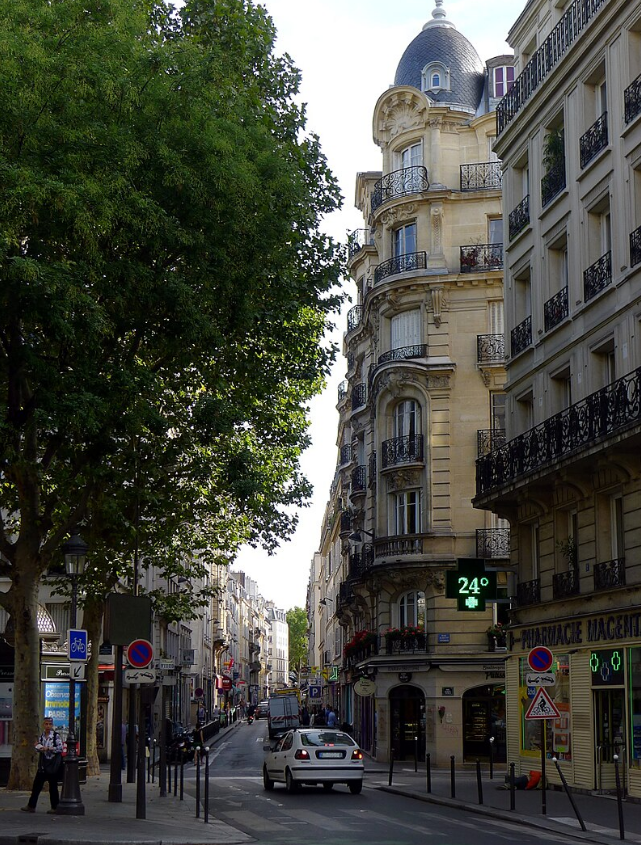
A long road dating from 1777 it took the name of one of its earliest developers. In the 21st century where it crosses the Boulevard Magenta has become one of Paris’ worst traffic accident hot-spots.

Several sculptors and painters used workshop space at No. 63, including Pierre-Jean David d’Angers, who sculpted a bust of Victor Hugo amongst many others, and Auguste Rodin.

This same address was where Victor Hugo described the massacre of several opponents of the December 2 1851 coup d’État by Louis-Napoleon Bonaparte in his History of a Crime.

In 1864 the bronze foundry there experienced a successful strike for the reduction of the working day to 10 hours.

On May 25 1871 during the ‘bloody week’ of the Paris Commune a barricade across the road between numbers 1 and 2 held up the advance of the Versailles troops through particularly strong resistance.

On July 14 1889 the congress of the Federation of the Socialist Workers of France took place in the Lancry Rooms at Nos. 11-15. Led by the Possiblist Paul Brousse. This reformist congress was held in opposition to the Marxist French Workers’ Party held the same day.

The local office of the Kultur Lige, a Jewish Bund affiliate of the Communist International linked to the French Communist Party was at No. 10. In 1923 it published a Yiddish journal called New Press (Naïe Presse) and held meetings in the Lancry rooms next door.

The Lancry Rooms also saw the launch of a campaign to boycott German goods by 15 anti-fascist organisations in 1933 and the 1946 call by Marceau Pivert to merge the SFIO wit the former members of his Workers and Peasants Socialist Party (Parti socialiste ouvrier et paysan).

Paul Lafargue

1842-1911 • Cuba

Socialist • Parti ouvrier • Laura Marx

Lafargue first visited London and met Karl Marx in 1865. He married Laura Marx in 1868 and with Jules Guesde was one of the founders of the French Workers’ Party. Lenin came to see him on his first trip to Paris in 1895. Jaurès, Lenin and Keir Hardie all spoke at his and Laura’s joint funeral in 1911 after they committed suicide together.

Locations
  • 47 rue du Cherche-Midi: Paul Lafargue and Laura Marx, his wife, move in to a flat here on 1 December 1868. In July 1869 Marx made a secret 6-day trip to Paris to see them (using the pseudonyme Alan williams). The couple committed suicide together here in 1911.
  • 51 avenue de Flandre: In 1869-1870 Lafargue worked on Henri Rochefort‘s republican newspaper La Marseillaise with Victor Noir (before his assassination by Napoleon III’s cousin) and Prosper-Oliver Lissagaray.

More info

Socialism

Accused of being drunkards in several areas of France the early SFIO campaigned against alcoholism as well as against capitalism

French socialism began to distinguish itself both from Proudhon’s anarchistic appeal to humanity’s moral responsibilities and from Blanqui’s insurrectionism in the 1890s. Founded by Blum, Jaures and Vaillant in 1905 in the aftermath of the Dreyfus affair, the SFIO united left reformist republicans and Marxist sectarians. The alliance broke up in 1920 when a majority at the Tours Conference voted to affiliate to the new Communist International.

Despite being a minority at that SFIO conference, the SFIO of left reformist socialism became the leading left political current through nearly all the interwar period. After the Communist Party ended Stalin’s ‘class against class’ propaganda against the Socialists and proposed a Popular Front alliance, Blum became prime minister in 1936.

Under the Fourth Republic its internal divisions over Algerian independence, with Mendes France and the challenge of the stronger Communist Party allowed De Gaulle to take power. In 1981 Mitterrand won a decisive majority on a left platform that he abandoned three years later. From then the Socialist Party became largely a party of elected national and local officials, without any real mass membership. In 2017, following five politically disastrous years under Hollande, the Socialist Party suffered a major defeat in both the presidential and National Assembly elections. A new left party, La France Insoumise (France untamed), did relatively well, with the Left Front’s presidential candidate getting 19.6% of the vote in the first round.

The vote for the La France Insoumise leader Mélenchon in the first round of the 2017 presidential elections shows stronger support in the less wealthy parts of Paris

Like the Socialists, though, Melonchon’s La France Insoumise has still virtually no local membership base. In the European elections of 2019, its share of the vote fell to 6%.

Work in progress