Student revolt and Mass strikes

Nanterre, Barricades, Factory occupations, Strikes, Grenelle agreement – in progress


Nanterre, Barricades, Factory occupations, Strikes, Grenelle agreement – in progress
Numbers: 2, 4
The road was renamed in 1893 after the biologist and zoologist, Jean Louis Armand de Quatrefages (1810-1892), who worked at the nearby National Natural History museum.
The location of what was No 2 is now the main entrance to the Great Paris mosque, built after the First World War in tribute to the 70,000 Muslim men who fought and died for France. It was paid for by the French government and inaugurated in 1926 and is the largest mosque in France.

No 4 used to be a centre for the rehabilitation of young tuberculosis sufferers, who included Robert Barcia/Hardy in 1952. Today it is called the Centre Colliard, and specialises in young people’s sexual concerns and health as one of the Health centres organised by the Health Foundation for French Students.
Santé Prison

It’s only a short walk from my flat to the infamous Prison de la Santé, where Victor Serge was jailed in 1912 and three communist trade unionists, Pierre Monatte, Gaston Monmousseau and Boris Souvarine were jailed in 1920 for ‘conspiracy against the state’.
This prison is now the only prison within the city of Paris itself, although when it was built in 1867 there were 11.

In 1939 on the pavement corner with Boulevard Arago, the road was the site of the second-to-last public guillotining in France. It had been Paris’ public scaffold since 1899.
In 1940 Paul Langevin (1972-1946), who had launched the intellectuals’ campaign against fascism in 1934, was jailed there by the Gestapo for two months before being put under house arrest.

Between August 1941 and July 1942 nine communist resistance fighters were guillotined there. In April 1944 another nine were shot. The plaque accuses the French authorities of their murder.

Conrad Miret I Musté, the Catalan head of the CGT’s migrant workers’ organisation (Main d’œuvre Immigrée – MOI) made up largely of Spanish, Italian and Romanian communists that began attacking the Germans in August 1941, was arrested on February 21 1942.
Miret died at the Santé prison after a week of torture. A plaque on the prison wall now commemorates his death. Another 25 of his MOI comrades were executed in April.

In September 1943 the 14-year-old Robert Barcia, known later under the pseudonym of Hardy (1928-2008), was arrested carrying Trotskyist leaflets and spent five months in the prison before being released because he was too young to be charged.
The Santé also briefly housed Jacques Duclos in ‘the pigeon affair’ of 1952. The temporary head of the French Communist Party was arrested in 1952 after a huge demonstration against the American head of NATO visiting Paris ended with two workers dying from police gunshot wounds. In Duclos’ car the police found a revolver, a baton and two dead pigeons as well as a notebook. The Interior Minister then declared Duclos had been using carrier pigeons to send messages to Moscow, and Duclos was jailed. After police enquiries found that Duclos had been hunting and the two pigeons were intended for supper, he was quickly released.
Behind its walls several FLN (Front de libération nationale) militants were guillotined during the Algerian war – their numbers never released publicly. The guillotine’s final use at the prison was in 1972.
Ahmed Ben Bella (1916-2012), leader of the Algerian FLN, and a former Olympic de Marseilles player in the 1939-1940 season, was held prisoner here with five other Algerian leaders at the Santé from November 1956 until January 1959. After several hunger strikes demanding they be treated as political prisoners, and then threats to his life within the prison by supporters of Algérie Française, De Gaulle had him moved to the Isle d’Aix prison.
The Prison de la Santé is now being rebuilt and modernised. But what is extraordinary is that until 2000 its star-shape was used to racially and socially segregate prisoners. One of the five stars was designated for the educated prisoners. The four others were for Western Europeans (Block A), Black Africans (Block B), North Africans (from the Maghreb in Block C) and The rest of the World (Block D).
Places can be shameful too.
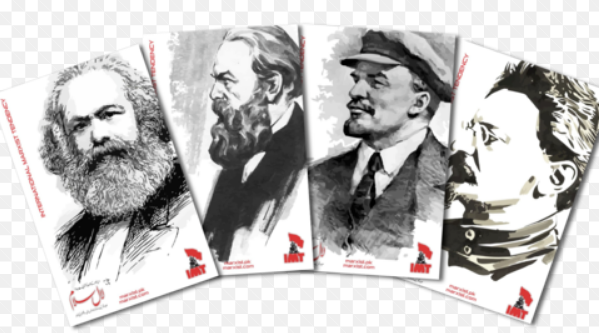

What is shared between those who define themselves or are defined by others as ‘communist’? And how may ‘Communism’ be distinguished both from French anarchism and French socialism, with which it shared much common history and ground?

The 1795 Paris revolutionary ‘Manifesto of Equals’ inspired by François-Noel Babeuf and rescued from oblivion by Philippe Buonarroti (1761-1837) summarised what remained (and remains) common to nearly all those who described themselves as communist across the following two hundred and some years:
‘We need not only that equality of rights written into the Declaration of the Rights of Man and Citizen; we want it in our midst, under the roofs of our houses… We lean towards something more sublime and more just: the common good or the community of property! No more individual property in land: the land belongs to no one. We demand, we want, the common enjoyment of the fruits of the land: the fruits belong to all.
We declare that we can no longer put up with the fact that the great majority work and sweat for the smallest of minorities. Long enough, and for too long, less than a million individuals have disposed of that which belongs to 20 million of their kind, their equals.
Let it at last end, this great scandal that our descendants will never believe existed! Disappear at last, revolting distinctions between rich and poor, great and small, masters and servants, rulers and ruled.’
After agreeing to this general statement of belief, communists had much more to disagree with each other upon.
We have divided the considerable history of Communism in France into five periods:


