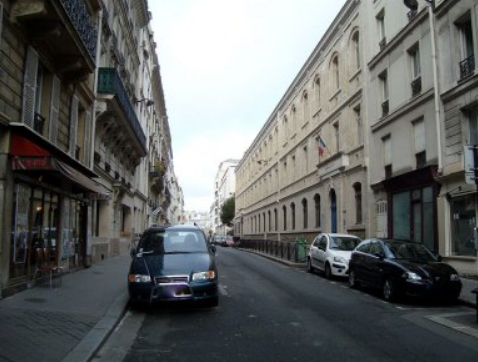
What a miserable sight to find this building at No. 5 on the location of the day school bought by Louise Michel’s mother in 1865.
By selling her last fields outside Paris, Louise Michel‘s mother was able to buy a day school business for her daughter in this street in 1865.
It was then a much longer Montmartre street, going as far as the Rue Championnet. Its name comes from a corruption of the old French word claye, meaning a grill that could be used to close access.
Today the road passes the Square Léon Serpollet, named after the man who built his first steam-powered tricyle at Number 27.
A Communist resistance printworks was operated clandestinely at Number 17 during the Second World War. This was where the first issue of France d’abord (France first), the news sheet of the Communist-founded resistance movement FTP (Franc-tireurs et partisans (Sharp-shooters and patriots) was printed.
Named in 1864 after Philippe de Commynes, the road was built through the site of the Convent of the Daughters of Calvary in 1804, when it was first called the rue Neuve de Ménilmontant,
When Marx arrived in Paris in March 1848 he stayed in the offices of the German Communist League at No. 10. While there he met Engels and Ferdinand Flocon, a member of the new Provisional Government like the Worker Albert. Marx left Paris after the defeat of the June insurrection.
In 1839 Albert was living at No. 15 when he was one of the leaders of the Four Seasons Club organised by Blanqui and Barbes.
The largest square in Paris, covering 18.8 acres (7.6 hectares, was laid out on a boggy piece of land largely belonging to the Crown in 1755. A statue of Louis XV was erected in the square that was named after him on June 20 1763.
The statue of Louis XV in the centre of the Square was destroyed on August 10 1792. This lithograph represents the first skirmishes between the National Guard and the King’s mercentary soldiers in July 1789.
On May 30 1770 the firework display to celebrate the marriage of the future Louis XVI and the Austrian princess Marie Antoinette went wrong. 132 people died and were buried in the nearby Madeleine cemetery.
In 1787 Louis XVI commissioned a bridge over the Seine on its southern side to be called the Pont Louis XV.
By 1791, when the bridge was finished, the French Revolution had forced the King back to Paris from Versailles and the statue torn down. On August 11 1792 the new bridge was renamed the Pont de la Révolution at the same time as the Square was renamed the Place de la Révolution and the statue of Louis XV destroyed.
The west of the Square saw the ‘humane’ execution machine, the guillotine, installed there for the first time on January 21 1793. The beneficiary of this humane public death was King Louis XVI. The square’s public went on to witness another 1,118 executions before the guillotine stopped publicly killing people in Paris’ largest square.
Louis XVI was guillotined on the west of the Place de la Revolution, near the pedestal from which his father’s statue had been pulled down on August 10 1792, the day the French monarchy was abolished.
On May 11 1793 the guillotine was brought back to the square and placed on the east side. It stayed there until June 9 1794, when it was moved again with the introduction of the Great Terror. It was then placed between the square’s centre and the entrance to the gardens of the Tuileries Palace.
On August 11 1793 the Square was given a new plaster statue in its centre, the Statue of Liberty., to replace the statue of Louis XV. By François-Frédéric Lemot, the statue was taken down in June 1800 after Napoleon Bonaparte’s coup d’etat of the 18th Brumaire (9 November 1799) effectively gave him nearly complete power. But Lemot’s chariot and figure of Fame on top of the Carrousel’s Arc de Triumphe, and his 1818 recreation of the statue of Henri IV on the Pont Neuf are still on show in contemporary Paris.
Queen Marie Antoinette lost her head in the square on October 16 1793 as did Georges-Jacques Danton on April 5 1794. Soon afterwards the guillotine was moved to what is now the Place de la Bastille (for four days) and on June 13 1794 to the currentPlace de la Nation, which was at that time called ‘The Square of the Overthrown Throne’ (Place du Trône-Renversé ).
The guillotine only returned for the last time to the Place de la Revolution on July 28 1794. This was expressly to execute Maximilien Robespierre, the principal architect of the ‘Terror’. A day later it was then transferred back to the square in front of the Town Hall, the Place de Grève, the traditional site for Paris executions.
Other name changes for the square followed French revolutionary and counter-revolutionary history. In 1795 the final session of the Convention before the Directorate took over renamed it La Place de la Concorde. This was intended to mark an agreement to end the bloodshed and promote reconciliation.
At the Bourbon restoration under Louis XVIII it was rebadged as the Louis XV Square. Then, two years after the accession of Charles X, in order to show exactly what the new absolutist king felt about the First Republic executing his eldest brother, it became the Louis XVI Square.
In the 1830 July Revolution there were several exchanges of fire in the square between the insurrectionaries and troops still loyal to Charles X. When Charles fled and the constitutional monarchists who had seized power passed the crown on to Louis Philippe, the Duke of Orleans, the square’s name went back to Place de la Concorde.
In 1836 King Louis Philippe installed the 3,400 year-old Egyptian Obelisk in the centre of the Square. It had once marked the entrance to the Luxor Temple in Egypt and had been ‘given’ to Charles X in 1829. Its gold cap was added under Chirac in 1998.
On the north side of the square several buildings witnessed key events in the history of the French left. In 1789 the recently built Royal Hôtel du Garde-Meuble became the Marine ministry at No. 2 in 1789. It remained there with this function, under German occupation becoming their marine headquarters, until the building was closed in 2015 for (continuing at the time of writing in 2020) renovations.
This building was where, on March 4 1848, Victor Schoelcher chaired the opening meeting of a commission to abolish slavery in the French colonies.
On May 23 1871 the Marine Ministry was the site of the most important barricade defending the Commune captured by the Versaillais troops. Its defenders were all massacred.
The square saw further bloodshed on February 6 1934. Some 20 were killed and 2,300 wounded as far-right demonstrations attempted to seize the National Assembly. The left’s reaction to this evidence of the growing strength of French fascism was to hold counter-demonstrations and to build Left Unity between the divided trade unionists and between Communists and Socialists.
Whether or not the fascist demonstrators on February 6 1934 intended to seize state power, their aim was to attack parliamentary democracy. The demonstration became a key turning point in the French anti-fascist struggle leading directly to the 1936 Popular Front
No. 10, the Hotel de Crillon, was built in 1758. Under the Occupation from June 14 1940 it became the Headquarters of the occupying German army, initially under Bogislav von Studnits and then, from 10 August 1944, by Dietrich von Choltitz. To his shame, the singer Maurice Chevalier performed at a charity function there during the way.
German soldiers in the Place de la Concorde in 1941. The Hotel de Crillon, on the far left, was the German Paris HQ and their naval HQ was in the Hotel de Marine on the right of the Rue Royale leading up to the Madeleine Church.
In 1968 the square saw a massive demonstration by the right in support of De Gaulle on May 30. This effectively turned the political tide against the left; but it did not restore De Gaulle’s brand of absolutism that the mass protest movement and wave of factory occupations had broken.
The right used the Place de la Concorde again, on May 7 1995 and on May 6 2007 to celebrate the presidential election victories of first Chirac and then Sarkozy.
Between 1889 and 1895 French supporters of ‘propaganda by the deed’ mounted a series of bomb and knife attacks on ‘class enemies’ – of which the most notorious were the assassination of the President of France, Sadi Carnot, and the bombing of the National Assembly’s Chamber of Deputies.
A lithograph of the moment of the explosion at the Restaurant Foyot at 36 Rue de Condé on April 4 1894
On April 4 1894 a bomb inside a flower vast exploded next to a
Foyot Restaurant window looking onto Rue Condé.
The Foyot restaurant, on the corner of Rue Conde and Rue de Tournon opposite the Luxembourg Palace, was popular with Senators and other wealthy diners.
Laurent Tailhade was a satirical poet and anarchist who had defended Vaillant’s 1893 bombing of the Chamber of Deputies
Only one man was permanently injured: Laurent Tailhade lost an eye. He was an anarchist sympathiser, a poet and a good friend of the art critic, dandy and War Office administrator presumed by the police to have planted the bomb, Félix Fénéon.
Others thought Tailhade
might have been targeted by a jilted lover.
Felix Fénéon (1861-1944) was arrested, imprisoned and tried for conspiracy with 29 other anarchists and some known criminals after detonators and mercury were found in his office at the Ministry of War, where he was then a Chief Clerk. The trial in August 1894 found all except three not guilty.
The senators’ favourite local Restaurant Foyot was bombed by an anarchist on April 4 1894
The Restaurant Foyot, the upper part of which was the Emperor Joseph II hotel, was demolished in 1937. Paris magistrates had decided it was structurally unsound, possibly as a result of the bombing 33 years earlier. There is now a tiny garden and paved area opposite the Luxembourg Palace.
Seeing it every time I’m in Paris, just below the window of my late father’s flat, and buying Le Monde there from the elderly, usually grumpy kiosk owner, it was only in reading Hazan (WTP) that the corner’s actual history was brought to life for me.
George Sand and Ledru-Rollin in an engraving called ‘The Handsome Candidate’ from 1848
Further up Rue de Condé, at Number 8, George Sand lived in Maurice’s (her son’s) flat from March to May 1848 when she was editing political texts and posters for Alexandre Ledru-Rollin (1807-1874) at the Luxembourg Palace.
Rue de l’Égalité
Appropriately, in 1792 the Rue de Condé was renamed Rue de l’Égalité. Not too happy a name, however, for Lucile Desmoulins who lived at Number 22 or for Jean-Baptiste le Rebours who was living at Number 28 . Both were executed in 1794.
Lucile Desmoulins married the French revolutionary and journalist Camille Desmoulins in 1790 at the Saint Sulpice church five minutes walk away. Robespierre, who had been briefly engaged to her sister, attended the wedding. On April 5 1794 Lucile was arrested for plotting to release her husband from the Luxembourg Palace, where he had been on trial with Georges Danton: both men were guillotined the same day.
Lucile’s execution followed a week later. She was 24, Camille was 34, Danton was 35, and his statue stands a minute’s walk north up Rue Condé to what is now the Boulevard St Germain, marking the site of his flat before Haussmann demolished it (and a big chunk of the neighbourhood).
Le Rebours, in contrast, was Lord of Saint Mard, a village and estate to the north of Paris. He had been chair of the Royal Court’s Committee of Requests under Louis XVI. Le Rebours was guillotined four days after Robespierre introduced the ‘Great Terror’ law of June 10 1794. This law removed prisoners’ rights to be defended, and determined there should be no delay between accusation and punishment. From then until Robespierre’s own arrest and execution on July 28 1794 the numbers of executions increased to 50 a day.
Inevitably, the Rue de Condé resumed its aristocratic reference to a junior branch of the Bourbons in 1805, just a few months after Napoleon had crowned himself Emperor on December 2 1804.
Conciergerie photographed during the German Occupation
From the 10th to the 14th century France’s principal Royal palace was on the Cité island in the centre of the Seine. Sometime in the early 12th century the ‘Great Tower’ was built on the North of the island, on what is now the Quai de l’Horloge. Beneath it prisoners were tortured and by the late 14th century it was turned into a prison.
During the Terror under the French Revolution the prison was where many were jailed and tried prior to their executions. Among the more (in)famous were Marie-Antoinette, the 23 Girondins (radical constitutional monarchists) and Robespierre himself.
In August 1815Marshal Ney was jailed there for supporting Napoléon during the One Hundred Days before Waterloo. Tried for treason by French lords on December 6 he was shot the next day near the Luxembourg Garden.
Wounded In the head during the May 12 1839 Insurrection of the Seasons, Barbes was taken to the Conciergerie’s infirmary.
After the failure of his attempted Boulogne coup d’État of August 1840, Louis-Napoléon Bonaparte and his fellow conspirators were first jailed in the Conciergerie.
Many of those arrested but not shot during the June 1848 workers’ insurrection were imprisoned in this jail before being tried.
One of the arms dumps organised by the FTP-MOI resistance during the German occupation was at No. 14. After she was captured in November 1943, the Jewish Romanian communist Olga Bancic responsible for the dump and for up to 100 attacks on the occupying troops, was guillotined in Germany on May 10 1944.
Charles Dickens, not an early socialist but a good social realist author, stayed at No. 48 when he visited Paris in 1868, before the house was turned into a Chinese-style mansion in 1922
The tax office and barrier across the road at No. 77 was burnt down on 22 February 1848 in the uprising against Louis-Phillipe.
The Central Office of the 1848 National Workshops that organised work for up to 100,000 unemployed workers between March and June 1848 were in what is now No. 94 (at the time No. 6 Rue de Chartres).
This street with an amazing history was named after a café sign of a crescent moon with gold stars that hung outside No. 12 way back in 1612.
More recently it became a major centre of left republican and socialist publications. The office of Le Charivari (1832-1893) where Honoré Daumier and other caricaturists worked was at No. 16. This was also the address of Le Siècle, whose office was used for the historic meeting on February 21 1848 that decided to resort to arms if troops were used against the banqueteers.
On September 9 1870 Henri Rochefort printed the first issue of La Marseillaise at No. 16. At about the same time Auguste Blanqui was printing La Patrie en Danger at No. 13.
Under the Commune in 1871 the street became full of daily and weekly newspapers. Henri Rochefort published Le Mot d’Ordre at No. 8. La Mère Duchêne was printed at No 10.
L’ami du Peuple (originally the title of Marat’s publication in the French Revolution) was also printed at No. 13, where people could also buy Le Cri du Peuple and La Fédération, the journal of the National Guard’s Republican Federation. Its press also printed the newspapers La Sociale and La souveraineté du Peuple. Le Père Duchêne was launched at No. 16 and then banned a week later on March 12 1871. The satirical paper Le Grelot was published at No 20.
Later, under the Third Republic in 1884-1886, the L’Intransigeant, involving Rochefort and Nathalie Le Mel, was published at No 12. This initially left paper evolved rapidly towards the extreme right.
‘Newspaper Printing Works’ is still proudly displayed above the modern door to 16 rue du Croissant, former home of L’Humanité.
In 1910 the building at No 16 housed the editorial and business offices of l’Humanité. This was where its founder, Jean Jaurès , was about to go when he was assassinated on July 31 1914 at the Café du Croissant on the corner with rue Montmartre.
The site where Jean Jaurès’ assassin fired two bullets through a café window in the street on the right of my photograph.
The 1896 Congress of the Feminist International took place in the recently completed Hôtel des sociétés savantes (elite Knowledge Societies – ranging from Sociology to Zoology and Astronomy) at No. 8.
This was also the venue for a thousand-strong meeting to hear Trotsky speak on December 6 1907 about ‘The stages of the Russian Revolution and the Current Political Situation‘.
Lenin spoke more than once at the Knowledge Societies meeting hall. On May 12 1908 he spoke there on ‘Our Tasks’ and on November 29 1909, just after he came to live in Paris, he spoke on ‘Counter-Revolutionary Liberal Ideology’. He gave a lecture on Leon Tolstoy who had died two months earlier on 18 January 1911, and in June that year spoke on’ Stolypin and the Revolution’.
The Italian socialist Pietro Nenni spoke there at an advanced Socialist school on January 8 1935.
On 16 January 1955 Pierre Lambert and Marceau Pivert organised a meeting demanding the release of Messali Hadj in the same huge meeting room.
The building was bought by the Sorbonne in 1985 and since 2005 is the Research Centre of Paris IV – Sorbonne university.
About where No. 10 now stands in 1865 was No 1 Rue Larrey, where Nathalie Le Mel lived with her three children and organised the cooperative kitchens of the Marmite association. This was also an address where the International Working Men’s Association continued to organise after it was banned by Napoleon III.
The short street was only built between 1888 and 1895 and was named after the French revolutionary Danton from the start.
A street linked to the revolutionary syndicalist direct action tendency within the CGT, the only trade union confederation in 1908. Pierre Monatte was living at No 22, where he was editing the ‘l’Action directe’ journal and escaped arrest with the rest of the CGT leadership in the aftermath of its call for protest action, The street has a much earlier history too… to a riot at the start of the French 16th century wars of religion.
This was the editorial office of the CGT’s revolutionary syndicalist journal, L’Action directe’. Pierre Monatte worked as its proof reader.
In 1908 Monatte was living here when two gravel-pit strikers were shot by gendarmes at Villeneuve-Saint-Georges. On July 30 1908 the CGT called a solidarity demonstration at Draveil that was attacked by soldiers. Four demonstrators were killed and 200 wounded, with 69 soldiers wounded. The next day the government announced it would arrest the CGT leadership for ‘moral responsibility’, including the printer, Monatte, who escaped to Switzerland.
The CGT called a 24-hour general strike on
August 3 1908, but it only had any real support in the building industry. Its
General Secretary, Victor Griffuelhes, and other CGT leaders were jailed. The
arrest of the direct action leadership, the failure of the general strike and
the defeat of the three-month long gravel workers’ strike was a turning point
in the CGT away from revolutionary syndicalism.
There is a little historical twist to Rue Daubenton’s connection with direct action. In 1561, Hazan (IOP) recalls: ‘following an obscure business about bells spoiling a meeting held by the Calvinists on Rue Patriarche (now Rue Daubenton, opposite Saint-Médard), the latter sacked the Saint-Médard church. This affair, known as the ‘Saint-Médard disturbance’, led to a number of deaths, and is often seen as a prelude to the [French] wars of religion’.
Built in 1607 to link the first stone bridge (the Pont Neuf) across the Seine funded from the king’s purse with the Philippe Auguste wall, it was named after the Dauphin (eldest son) of Henri IV. This peculiar name (meaning dolphin in French) dated from 1349 when King Philippe bought land from the Count of Vienna on condition that all heirs to the French throne be named after the dolphin emblem on the count’s coat of arms.
The royal connection didn’t survive revolutionary France. From 1792 to 1814 it was renamed Rue de Thionville to honour the victorious two-month resistance of the town of that name to the 1792 siege by 36,00 Austrian and French Royalist troops. At the next challenge to the Bourbons a barricade thrown up between Nos. 1 and 2, opposite the Pont Neuf bridge, saw heavy fighting with Charles X’s soldiers defending the Louvre Palace on July 27 1830.
On May 25 1871 a barricade in the same place was taken without great difficulty by the Versaillais troops.
Outside No. 7 there is a plaque on the wall. This is where in 1937Picasso painted Guernica in his roof-top studio for the Spanish Republic’s hall in that year’s Paris International Exhibition. In vain Picasso left a will stating that the work would only be returned to Spain when it was again a Republic.
Picasso painted his most famous painting in his studio at the corner of Rue Dapuhine and the Quai des grands Augustins in just a month before the 1937 International exhibition where it was first shown.
A big arms cache of the FTP resistance group on the mezzanine floor of Staircase D of No. 18 was found by the anti-resistance Special Brigade of the Paris Police in June 1943.
Marat, Danton and Desmoulins used to attend the Cordeliers Club meetings at No 18 from 1792-1795. The club was dominated by the Herbertists
Martin Bernard, a typographer and member of Barbès and Blanqui‘s republican ‘Family Association’ (Société des Familles) conspiracy that subsequently became the Société des saisons and staged the May 12 1839 insurrection set up an ammunition workshop at No. 24. He was arrested there on June 2 1836.
In 1942 Simone de Beauvoir was staying at the Hôtel d’Aubusson, also at No. 33, when she was forced out of teaching. The left/existentialist intellectual bar, Le Tabou, that had been the Bar vert in the Rue Jacob was reopened in the basement by Juliette Greco for rehearsals in 1946 before opening to the public the following year.
After his marriage, Jacques Prévert lived at No. 39 on the fifth floor beneath the roof with his wife Simone Dienne in 1931-1932.
A fortnightly, La Vie ouvriére‘s subscribers numbered 550 in the first issue of December 1909 and rose to 1,350 in January 1911, the year its office moved to the Librarie du Travail on the Quai Jemappes, closer to the CGT’s main offices.
Rue Dauphine was Paris’ widest street in the 17th century, No 42 housed the editorial offices of the influential CGT revolutionary syndicalist fortnightly paper, La Vie Ouvriere.
Rue Dauphine (9 metres wide) was the widest street in early 17th century Paris. It also, arguably, holds one of the keys to Paris’ tradition of uniformity of architectural design.
Hazan (IOP) reports Henry IV writing to Sully in 1607: ‘My friend, following what I have told you that work is beginning on the buildings that are in the new road going from the end of the Pont-Neuf to the Porte de Bussy, I wanted to send you this word to tell you that I would be very happy if you would explain to those who start building in this road that they should make the front of their houses entirely in the same order, for it would be a fine ornament to see from the end of the bridge this road with one and the same façade.’
Named after Jean-Baptiste Delambre, the French astronomist and mathematician who was director of the Paris Observatory, it was first built up on land sold off by Paris hospitals in 1839 and then given its current name in 1844.
In the 1920s, today’s Auberge de Venise at No. 10 used to be called the Dingo Bar. It was a favourite drinking haunt of many of the ‘Lost Generation’ of American writers, including Ernest Hemingway, who met Scott Fitzgerald there in 1925, and John Dos Passos.
On the other side of the street, the Rosebud at No 11bis was a bar Sartre was often at in 1937.
Simone de Beauvoir lived at the Hotel des Bains in the spring of 1937
The reason for Sartre’s presence was that Simone de Beauvoir lived for a few months at the hôtel des Bains at No. 33 in 1937.
Next door, in what was the hôtel des Écoles and is now the Delambre Hotel at No. 35, André Breton lived for a year from October 1920 after giving up his medical studies. There is even a rare leftist plaque on the wall remembering him.
A photograph of Rue Dalembre in 1920 showing the Hotel des Ecoles on the right. Little had changed in the street by 1937 when De Beauvoir moved in to the hotel next door.
Francis Bacon also stayed at this hotel in 1927, coincidentally the same place where Paul Gauguin (the grandson of Flora Tristan) lived in 1891.
The contemporary look of the adjacent Hotel des Bains and the Hotel des Ecoles (now Hotel Delambre) with memories of Simone de Beavuoir, Andre Breton, Paul Gauguin and Francis Bacon.
The Rue de l’Enfer (Hell Road) was only given its current name, Avenue Denfert-Rochereau, after the 1878 death of Colonel Pierre Philippe Denfert-Rochereau. This military hero was known as the ‘Lion of Belfort’ for his holding out against the German army in 1870-1871.
The Monastery at Nos. 65-73 originally hosted the end of the Rungis aqueduct that provided the water supply for the Luxembourg Palace – and then for the rest of the area. It was shelled and burnt down on May 23 1871 during the battle of the Communards against the Versaillais troops.
Ledru-Rollin lived at No 81 Rue de l’Enfer in 1848 while he was organising the first elections in France by universal suffrage
While Ledru-Rollin was in exile, another former political prisoner, Pierre-Joseph Proudhon, moved in with his family to No. 83 during the 1850s.
Simone de Beauvoir moved from home in 1929 to a small flat at No. 91 owned by her grandmother, initially to escape her all-present mother. She stayed there until 1931 when she moved to teach in Marseille.
In June 1940, after having spent four weeks outside Paris, De Beauvoir returned to stay for a few more months in the flat at No. 91 until the winter got too cold for her. She occupied herself during the day reading Hegel at France’s National Library in the Rue de Richelieu.
The 1200-cell Prison de Mazas was built in 1850. Its entrance was at 23-25 boulevard Mazas, which was renamed the boulevard Diderot in 1879.
The location of the Prison Mazas superimposed on a google Map. The Gare de Lyon main station entrance is directly opposite the southern end of the Rue Emile Gilbert.
On April 30 1870 Louis-Napoleon‘s new more liberal government drummed up a red scare and arrested 38 active supporters of the First International just days before a referendum on the latest constitutional moves towards a slightly more parliamentary government system. The ‘reds’ were jailed at the Mazas Prison with its American-style cells. The idea was to keep prisoners isolated at all times from one another.
The cell windows in the Mazas prison shown in an early photograph from the 1850s.
One of the new prison’s earliest political uses was in briefly jailing the republican Assembly representatives and other opponents of Louis-Napoleon’s coup d’Etat of December 2 1851. Among these was the socialist biologist François-Vincent Raspail (1794-1878). His sentence was commuted to exile from which he returned in 1862.
The scientist and republican socialist Francois-Vincent Raspail drawn in the 1850s. Already imprisoned under Louis-Philippe he ran for president in December 1848.
After Louis-Napoleon won the May 8 1870 referendum overwhelmingly by 7.4 million votes to 1.5 million, the republicans believed the Empire was stronger than ever. On July 18 France declared war on Prussia. The Third Republic was declared on September 8.
The 16-year-old Arthur Rimbaud was held at the Mazas prison for a few days from 29 August 1870 on suspicion of being a Prussian spy.
The prison was used to keep many of the hostages taken by the Commune in April 1871 intended (unsuccessfully) to be exchanged for Auguste Blanqui. It was the site of fierce fighting during the Bloody Week of May 1871. After the Austerlitz bridge was taken by the Versaillais on 25 May, the defenders retreated to the prison and fought from there. On 26 May more than 400 Communards were executed there, with their bodies thrown into a well.
Felix Fénéon at the Mazas Prison opposite the Gare du Lyon in 1894 sketched by Maximilien Luce.
In 1894 the 30 anarchists and anarchist sympathisers were imprisoned at the Mazas during their trial for conspiracy to commit bomb attacks and murders in Paris. Felix Fénéon (1861-1944) was sketched here by another anarchist sympathiser, Maximillien Luce , who also produced a lithograph self-portrait of the inside of his prison cell.
Jailed while awaiting the ‘trial of the 30’ in 1894, Maximilien Luce produced this lithograph.
Both Fénéon and Luce and another 24 of those tried in August 1894 were acquitted.
No 7 rue Dupuytren is where Louise Michel opened a girls’ industrial art school weeks before the Paris Commune was crushed.
A short street now full of hair salons, in May 1871 it was where Louise Michel organised a school to teach young women draftsmanship, industrial art. It had previously been the girl’s school annex of the free Royal Decorative Arts School, next to the old Cordeliers Monastery, where girls had been taught only four skills: drawing figures, ornaments, animals and flowers.
The road was named by a decree on 9 April 1851 under the Prince-President Louis Napoleon. He gave the nod to the skilled surgeon who successfully treated his uncle’s haemorrhoids. Guillaume Dupuytren had also subsequently served the last Bourbon kinds, Louis XVIII and Charles X. Louis XVIII have him the hereditary title of Baron. He was the surgeon who attempted, unsuccessfully, to save the life of Charles’ son, the Duc de Berry, the third in line to the French throne, after he was knifed at the Opera in February 1820.
Baron Guillaume Dupuytren (1777-1835) treated haemorrhoids for Napoleon Bonaparte, amassing a fortune in the process
In 1832, when cholera was sweeping France and Paris in particular, Louis-Philippe added to his honours collection. Thanks to his 10,000 annual consultations he was then one of the richest men in France and his daughter Adeline married one of the pretenders to the Imperial throne, Louis Napoléon Bonnin de La Bonninière, Comte de Beaumont.
The free-mason and atheist surgeon also gave his name to the ‘bent finger’ or ‘Vikings’ disease I’ve already had three operations to straighten out. His article about the disease was published in the Lancet in 1834. Its highest incidence is in Iceland, but 10% of Norwegian men and 3% of Norwegian women also have the ‘contracture’.
The rue Dupuytren leads up to one of Paris’ amazing 17th century carved doors in rue Monsieur le Prince.
The short road was the site of an attack by resistance fighters attached to the FTP-MOI on a German patrol in March-April 1943. The three men linked to the attack were Wolf Wajsbrot, Thomas Elek and Marcel Rajman, one of its leaders, who was shot aged 20 in February 1944.
Named after the Medical School which now occupies much of its length, it received its current name for the first time in 1792 after the nationalisation of the huge Cordeliers monastery complex of the Capuchin Franciscan friars. Before then it was the Rue des Cordeliers.
One branch of the Franciscan (followers of St Francis of Assisi) friars, the hood and beard wearing Minor Capuchins, was particularly important in pre-revolutionary France where it had 284 monasteries. In Paris their Couvent des Cordeliers monastery (possibly so-called after the cords the friars tied around their stomachs) was one of the biggest. It covered an area that stretched from today’s Rue Racine and Rue de La Harpe to approximately 15-21 Rue de l’École de Médecine.
Briefly, between 1793 and 1794 the road was renamed Rue Marat, after the revolutionary who lived and was assassinated there in July 1793. At the overthrow of Robespierre it was immediately renamed the Rue de l’École-de-Santé and then from April 20 1796 it regained its earlier (and current) name.
No. 5 was the location of Louis XV’s free boys’ Royal School for Art and Design from its inception in 1767 until 1928. From 1810 it was funded by the State. Fernand Léger studied there in 1901-1902 after he had stopped studying architecture. the school was built on a medieval Jewish cemetery.
The School of Art and Design at No. 5 and the amphitheatre at No. 7 it was allocated after the new medical school was finished on the other side of the road.
The road’s medical connection dates back to 1255 and in 1763 the Barber-Surgeons Guild funded the building of a small amphitheatre where students could watch them carry out operations at No. 7. The building was given its present columns and courtyard and extended in 1794.
The area became known as the Cordeliers district, and even before 1789 already had a radical tradition. Danton, Desmoulins and Marat all lived in the area. Marat in the Hôtel de Cahors roughly where Nos. 18-20 would have stood. This was where he was murdered on July 13 1793.
All of the Cordeliers monasteries were closed in 1790 and so, when the Paris Council abolished the Cordeliers district in the municipal reoganisation, Danton and other area leaders founded a club there in the monastery’s refectory on April 27 1790.
The refectory of the Cordeliers monastery at No 15 is the largest surviving building of the huge religious complex.
The club’s official name was Société des Amis des droits de l’homme et du citoyen (Friends of the Rights of Man and of the Citizen), but it was known as the Club des Cordeliers. Its motto, proposed by Antoine-Francois Momoro, became Liberté, égalité, fraternitéor Death. On June 21 1791 it was the first club to call for the Constituent Assembly to proclaim a republic.
On July 17 1792 this was where, after the failure of Louis XVI’s escape bid, Marat proposed a petition declaring ‘royalty incompatible with freedom’. That night, after the Champs de Mars massacre, the constitutional monarchists ordered the closure of the Cordeliers club and its leaders went into hiding.
A year later, on July 16 1793, after his assassination, the monastery garden was where Marat was first buried.
The School of Medicine’s amphitheatres at No. 7 and No. 12 were used as meeting places by several revolutionaries in 1848. These included those involved in the Club des Homme lettrés , the Club central de l’Agriculture, the Club de l’École de Médecine and the Comité électoral du 11ème arrondissement.
The School of Medicine was not only used for anatomical observation. On January 19 1868 Nathalie Le Mel, Eugène Varlin and others met in the small amphitheatre to hold the General Meeting that created the food cooperative called ‘La Marmite‘ (the cooking pot).
The large amphitheatre at No. 12 witnessed the General Assembly of Lithograph Printers on 29 August 1869 when they decided to affiliate to the International Association of Working Men.
From October 1870 more and more meetings took place at No. 12. On April 12 1871Gustave Courbet was one of 400 artists who met there to elect an Artists’ Committee for the Commune’s Republic (Comité des Artistes pour la République communale). Courbet and 46 others were elected.
The rue des Écoles was the first of the broad streets driven through the Latin Quarter of Paris by Haussmann as a major East-West carriageway. It was given this name in 1852 since it crossed the Paris district with the highest concentration of universities/ colleges (Schools). Hazan reports (IOP) that the second, more successful attempt to create an East-West road on the left bank was the Boulevard Saint Germain. Its final section was only opened in 1877.
From 1816 until 1843 the Institute of Young Blind Persons was located at No. 2, on the site of a 13th century gate in the Philippe-August wall that was finally demolished in 1684. A plaque dating from 2002 records this as the address where Louis Braille (1809-1852) developed what became the braille reading system.
On 7 September 1870, after Napoleon III‘s defeat and capture at Sedan on September 2 in the Franco-Prussian war, Blanquipublished the first edition of a daily, La Patrie en danger (‘The country in danger’). Initially he supported the new Republican government, formed on September 4. The daily’s editorial offices were based then at No. 34, but the paper only published for five days until September 12.
On May 24 1871 during the Paris Commune the Versaillais installed a canon inside the Café Soufflet to be able to fire on the communard barricade at the Collège de France.
The barricade at No. 45 was quickly destroyed and the defenders executed. Priority in the executions was given to soldiers who had supported the Commune, considered deserters from the Versaillais army, and foreign fighters.
As early as 1873, however, students who later included Jules Guesdebegan to discuss Marx’s ideas at the same Café Soufflet on the corner of the Rue des Écoles and Boulevard St-Michel.
The Café Soufflet, photographed here on the left looking west up the rue des Écoles from the Boulevard Saint Michel, was the centre of Parisian debate about scientific socialism and Marxism from the late 1870s
The poet Paul Verlaine lived at No.5 in the apartment belonging to Rachide Eymery in November 1886.
The offices of ‘La Vogue’ were at No. 41, Felix Fénéon became editor of the arts journal in 1885.
In 1902-3 Lenin gave three lectures on the Russian agrarian question to the Sorbonne University’s École pratique des Hautes études at No. 47 and at 16 rue de la Sorbonne, round the corner. Trotsky attended all three of them.
A secret printworks was placed in the basement of the Sorbonne’s Science Faculty at No. 47 in 1941. It printed the paper, Defence of France from September.
Hazan (IOP) adds: ‘Between the river and Rue des Écoles, a number of old bookshops-cum-publishers remain to remind you that until the end of the ancien régime, Rue Saint-Jacques had a virtual monopoly of printing – from the time that the three Gering brothers, who came from Konstanz, established their presses at the sign of the Soleil d’Or in 1473.’
The editorial offices at No. 4 of the libertarian Les Temps Nouveaux (New Times) from 1902 to August 1914 when it was banned. Its first fortnightly edition appeared in 1895. It became a weekly in 1911. Edited by Jean Grave its contributors included Élisée Reclus, Peter Kropotkin and Pierre Monatte. It was illustrated by many libertarian sympathising artists, including Maximilien Luce, Félix Vallotton, Paul Signac and Camille Pissarro.
From 1902-1914 the influential anarchist review, ‘Les Temps nouveaux’ (New Times) was edited at No. 4 rue Édouard Quenu. Among those actively supporting the journal were Monatte, Signac, Pissarro and Luce.
Originally a 12th century road its name has changed many times since then. In 1890 it was made a continuation of the rue Broca. In 1938 it was given its current name in honour of the head of surgery at the Cochin Hospital in the 14th arrondissement who lived from 1852 to 1933. He organised the principles governing the evacuation of the wounded during the First World War.
Gustave Bonickhausen-Eiffel was allowed legally to drop the first half of his surname in 1880, just in time to borrow the idea and to win the 1886 competition to build the world’s tallest tower for the May 5 1889 opening of the Great Universal Exhibition in Paris.
Work building the Eiffel Tower started on January 28 1887 and it was finished on March 31 1889. Only one person died during its construction
Despite being the commemoration of the French Revolution in which, momentarily, the powerful had nearly lost control of events to the politicised workers of Paris, the Eiffel Tower rapidly became Paris’ symbol of modernism and over the next century and more, of Paris itself. It was the logical place for the first wireless telegraphic message to be sent from it to the Panthéon on November 10 1898.
Many left poets and artists have expressed their feelings about the Tour Eiffel in the Champs de Mars.
The Calligramme of the Eiffel Tower was published in 1918 in ‘Poems of Peace and War, 1913-1916’ by Guillaume AppolinaireTwo paintings by Delaunay
In 1975 Louis Aragon published this poem, La Tour Parle, dedicated to Robert Delaunay who started painting his famous Eiffel Tower series in 1908 and stopped only twenty years later. Two of them are shown above.
Vous du Métro
Dans le soir avec mes yeux phosphore orage / C’est moi que les collégiens de leurs mains ivres / Caressent sans savoir pourquoi / Ils lèvent leur front lourd les enfants des péniches
La balle échappe à leurs doigts gourds / Quand le fleuve en passant baigne mes pieds et chante
Voici voici la grande femelle bleue / La dame au corsage de jalousie / Elle est tendre elle est nouvelle / Ses rires sont des incendies
jeunesse de marelle où vas-tu sauter / Vois nos mains traversées d’alcool et de sang bleu / Laisse-nous respirer tes cheveux de métal
Mais accroupi dans mes jupes / Que fait près de moi ce régime de bananes
Paris paysage polaire / Mon corps de lévrier dans le vent chaud / Le sentez-vous comme il est rose / Comme il est blanc comme il est noir
Femmes léchez mes flancs d’où fuit FL FL / Le bulletin météorologique
Messieurs posez vos joues rasées / Contre mes membres adossés aux cieux / Où les oiseaux migrateurs / Nichent
A wealthy street close to the Eiffel Tower and the Seine River whose only claim to be in Left in Paris is because this naming took place two years after Reclus died in Belgium.
Why did France’s greatest geographer die outside France? The answer lies in the Paris Commune.
On 16 November 1871 Reclus was sentenced to deportation to a French colony for life, but after the intervention of English geographers in his favour this was commuted to perpetual banishment.
He went first to Italy, then he settled at Clarens, Switzerland, where he wrote many major books. In 1894 became Chair of Geography at Brussels University.
He had zero connection with wealthy Paris.
Five years after it was given Reclus’ name, the Avenue was truncated to its current 230m length. Exactly 330m of it were lopped off and renamed Émile-Deschanel. after a much more respectable Republican who had died the year before the Communard and anarchist.
Why? The Paris municipal elections of 1904 witnessed a considerable increase in the numbers of socialists, up from 20 to 26, and they became the largest single grouping – although the Boulangist nationalists won 21 seats to the Radical Republicans 18 and the Conservatives and monarchists 11 and the Right-wing Republicans 4. This was just enough to enable some left-inclined street naming.
But the 1908 elections saw the left on the retreat. There were just 10 Socialist Party councillors sit alongside another 11 independent socialists, while the Radical Republicans won 22 seats and the Right-wing Republicans 28 along with 9 conservative monarchists. The right-wing revenge was the truncating of Élisée-Reclus.
Nobuhito Nagaï’s study of the Paris municipal council electon results after the defeat of the Commune shows how the broad republican left (the two left columns) secured majorities from 1887 to 1900 and then again from 1904 to 1912, with the far-right present throughout
The front of the small stone commemorating Zola that since 2000 is in the centre of the Alfred Dreyfus Square
In 1907, within five years of his death the new left-wing majority on the Paris Town Council decided to change the name of the recently built (1905) Rue Frémicourt, to Emile Zola, after the prolific social realist writer.
The 1924 Statue of Zola with a figure representing Work on his right and Fertility below him was melted down along with many other left statues under the German occupation in 1942. Constantin Meunier, the Belgian social realist sculptor had died in 1905. It was only in 1985 that a small commemorative stone was put in its place.
Besides his huge output, Zola’s principal claim to fame is his denunciation of the travesty of justice served upon the Jewish Captain Alfred Dreyfus in 1894. In 2000 the section of the avenue where Zola’s memorial stone stood was renamed the Alfred Drefyus Square.
The back of the small stone commemorating Zola that since 2000 is in the centre of the Alfred Dreyfus Square
For a few years from 1908, No. 146 housed a Mutual Aid (Entr’aide) (lingerie and fashion cooperative founded by the feminist and trade unionist Gabrielle Duchêne, who had become politicised by the Dreyfus Affair and was a rare trade unionist who opposed the First World War. She directed the French section of the Women’s International League for Peace and Freedom from 1919 until her death in 1954.
A very old street that first appears on the records in 1267. It finally got its present name (‘spur’ in English) from a shop sign in 1637.
Its principal claim to fame is at No. 2, theLycée Fénelon. This was the first secondary and higher school for girls in Paris. It was set up in 1892 in 19th century buildings used to prepare young men to enter the competition for the elite École normale supérieure.
It was named after the Archbishop of Cambrai (François de Salignac de La Mothe-Fénelon known succinctly as Fénelon, 1695-1715) who had written extensively on women’s education.
The Lycée became entirely mixed in 1979.
Among its better known students was Simone Weil and while some sources suggest Simone de Beauvoir was a student there, others (more probably in my view) suggest this was one of the Lycées where she taught. Another teacher there, notable for the wrong reasons was Marcel Déat (1894-1955), the fascist whose political career ended up as Minister of Labour and National Solidarity under the Vichy government in 1944.
A print from 1633 of the torture used commonly across Europe the strappado (estrapade in French) by the medieval inquisition and several governments from the 12th to the 18th centuries.
The street finally took its current name in 1881. It roughly translates as ‘the street of torture’. The strappado is where the victim has their hands tied behind their back and they are dropped from a height, sometimes with weights added to the body to increase the pain. In English the word ‘estrapade’ has come to mean where a horse rears and plunges and kicks to try and unseat its rider. This is because it was the site of an ancient deep ditch dug outside Paris’ oldest medieval Wall that was constructed on Philippe Auguste’s order from 1190 to 1215.
Hazan (IOP) describes the Wall’s left-bank route as a ‘semi-eclipse that essentially encompasses the Latin Quarter. Starting at the Seine, where the Institute of France now stands, going up the rue Mazarine to the Porte de Buci, the old wall went along rue (formerly Fossés-) Monsieur-le-Prince up to the top of the Montagne Saint-Geneviève (now the Panthéon) where ‘the names of streets and squares still perpetuate its memory: Fossés-Saint-Jacques, Estrapade, Contrescarpe. It then descended towards the Seine in a straight line, following the rue des Fossés-Saint-Victor (now Cardinal-Lemoine) and rue des Fossés-Saint-Bernard, reaching the river at the tower of La Tournelle.’
On June 24 1848, the workers’ barricade across the rue de l’Estrapade could be taken only after the Panthéon had been captured. To do this canons were placed in the rue Soufflot. Then soldiers who had got through to the square through a backdoor in the law school entered the Panthéon, where they took prisoners before executing them and then attacking and overwhelming the rue de l’Estrapade barricade.
Lenin and Krupskaya stayed here in 1902. The plaque on the wall in the photo isn’t about them.
Number 3, five minutes’ walk to the rue des Écoles where Lenin was lecturing, was where he and Krupskaya were put up by another Russian exile in 1902. The plaque on the wall confirms that Denis Diderot lived at the same address from 1747 to 1754 while he was publishing his enlightenment Encylopedia, whose aim was ‘change the way people think‘.
The word faubourg derives from old French meaning ‘outside the village/town/abbey). Saint-Antoine was the name of the hamlet built outside the 13th century Saint-Antoine-des-Champs abbey walls, on whose site stands the Saint-Antoine Hospital.
The abbey brought in the carpenters, varnishers, tapestry-makers, glass makers (Saint-Gobain started here in 1665 thanks to Colbert) that made the area the most populated in Paris in the 18th century.
The Caplain factory employed many women workers manufacturing gas masks during the First World War
It was also the most revolutionary, with its workers forming the biggest contingent among those who attacked the Bastille prison and armoury in 1789. On July 30 1792, when the Marseillais volunteers marched into Paris along the road singing theChant de marche pour l’armée du Rhin, they had no idea that this song by Claude Joseph Rouget de Lisle would become the French national anthem for the first time in 1795.
At an address in the road that is unknown, Pierre-Jean Beranger lived with his grandfather in the 1780s, before being taken by him to see the storming of the Bastille in 1789. This influence, and that of an uncle, mitigated against that of his father, and put Beranger on the side of ordinary people for most of his life.
One of the few barricades in the insurrection of June 6 1832 that followed the funeral of the republican sympathiser General Lamarque was outside No. 2. This short-lived insurrection was made famous by Victor Hugo in Les Misérables in his description of the barricade in the Rue Saint- Martin.
On June 25 1848 some 29 barricades were erected in the Sainte-Antoine district. The one across the road between No. 1 and No. 2 was where the Archbishop of Paris, Denys Affre, was mortally wounded by Cavaignac‘s soldiers when he tried to persuade both sides to stop fighting. The barricade fell shortly afterwards.
In 1871 the road was once more barricaded by the citizen-soldiers of the National Guard, called the fédérés. One of the most important again was built on March 18 1871 to block the road between No. 1 and No. 2 and prevent access to the Bastille square. Over 100 Communards were killed in the battle before it was taken by the Versaillais army on May 26 1871.
A barricade across Rue du Faubourg Saint-Antoine in May 1871 defended by the National Guard. It is photographed from the Eastern side from where the Versaillais troops were expected to come.
Another barricade in the road in May 1871 ran across the Rue de Charonne from No. 63. This was where Marx’s personal envoy to the Commune, Elisabeth Dmitrieff, helped the Hungarian member of the First International, Léo Fränkel who was wounded on the barricade there on May 25 1871.
On December 3 1851 it was at a barricade crossing from what is now the Rue Trousseau at No. 151 that Victor Schoelcher joined the protest against the seizure of power by Louis-Napoleon and tried to raise a revolt in a working class area. He saw his fellow deputy, Alphonse Baudin, shot dead. The 20 deputies who had come to the barricade had met first at the Café des Peuples at No. 157.
On the second floor of 151 Rue du Faubourg Saint-Antoine this plaque is all that records the location of the young deputy’s death defending democracy in 1851
A later use of No. 157 was made by the publication the Cooperation of Ideas there in 1899. It had then become the venue of the Theatre of the People
This was also where the Club of the Faubourg (Club du Faubourg) used to meet in 1919 and 1920. One of the regular visitors to the Club at No. 157 in 1919 was Nguyên Tat Thanh, alias Nguyên Ai Quôc, Ho Chi Minh.
The cooperative connection was continued further down the road in No. 185. In the ealry 20th century ‘The Family of the 11th Arrondissement’ cooperative shop was also a bulk distribution centre for socialist cooperatives.
The Family of the 11th Arrondissement socialist cooperative on the corner with the Rue Saint-Bernard photographed in the early 20th century
This is the old royal road into Paris that linked the Saint-Denis basilica in the north to the Rue Saint-Denis in the South. Whenever the Bourbons and earlier kings entered Paris this is how they got directly to first their fortified palace on the island of the Cité , and later to their Louvre Palace in the heart of Paris.
In 1849, No. 23 was the location of the People’s Bank experiment set up by Proudhon to allow ordinary people to exchange work and goods. It only lasted four months.
From 1862 until 1871 this address was where Fortuné Henry, a supporter of Fourier who lived with his aunt, before becoming a well-known member of the Commune.
After Fortuné Henry’s death the portrait of him by the anarchist sympathising Swiss-born artist by Félix Vallotton was published in 1897 in La Revue Blanche edited by Félix Féneon
Paul Éluard lived in 1909 to 1909 No. 58 (then taking the name of his grandmother, Grindel).
The house at No. 60 was the birthplace in 1804 of Victor Schoelcher, who from wealthy origins became a lifelong campaigner against slavery as well as a left republican.
Maurice Feld, one of the first young communists to be shot for attacks on the Germans on August 22 1942, was aged just 17. He lived at No 83 and is remembered by a plaque there.
The St Lazare prison was at No. 107. The barricade across the road was taken from behind by the Versaillais troops in May 1871. Seventeen Communards who were captured after refusing to surrender were put up against the prison wall and shot on 25 May 1871.
Louise Saumoneau, the seamstress turned feminist and pacifist journalist was jailed at Lazare for making anti-war propaganda on October 2 1915.
A rare Communist Party demonstration took place under the German occupation at No 122, on the corner with the Boulevard Magenta on 1 July 1944.
On June 23 1848 a barricade was put up across the road at No. 125 where it meets the Rue de Chabrol. This was one of the three major centres of the workers’ uprising in Paris and the last to be crushed on June 25.
The fin de sècle Comic Opera theatre in a street named after the early comic opera/vaudeville writer, Charles-Simon Favart, has a lengthy history. Lenin and Trotksy saw a show together there in 1902.
The Comic Opera, set up by Louis IV in 1714, had the first Favart Theatre built for it in 1783, when it was inaugurated in the presence of Marie-Antoinette. Charles-Simon Favart (1710-1792) was a popular playwright who helped inaugurate the comic opera vaudeville style.
Charles-Simon Favart began life as a pastry cook. Aged 24 he produced his first vaudeville theatre.
The first theatre in Rue Favart was destroyed by fire in 1838, and a new one built on the same site in 1840. The building was burnt down again in 1887 with nearly 100 people in the audience killed.
In 1898 the third Opéra Comique theatre was
opened in Rue Favart in the presence of the French President, Félix Faure. It
was the major work of architect, Louis Bernier (1845-1919).
Four years laterLeninloaned Trotskya pair of respectable shoes so the two couples (Vladimir and Krupskaya, Natalya and Leon) could go along to a show, but Trotsky kept complaining the shoes were too tight.
Two of France’s greatest writers are associated with this road along with a Russian revolutionary.
The road’s name dates back to the convent built in 1622 for an extremely strict Bernardine order, the Feuillantines, brought to Paris and funded by Anne of Austria at the request of Anne Gobelin, daughter of the textile dyer Gobelin family. The order, which wore a white dress and a black veil, was dissolved in the French Revolution.
As a child Victor Hugo lived from 1808-1813 in the old Bernardine (White Nuns) monastery that occupied the area between Nos. 8-12, that had been dissolved in the Revolution.
From the end of 1863 until early 1864 Émile Zola lived with his mother at No. 5.
From January 1914 until September 1916 at No. 17 Trotsky edited with Julius Martov (until he broke with it in 1915) the newspaper called successively ‘The Voice’, ‘Our Word’ and finally ‘The Beginning’. Its opposition to the First World War was followed closely by Monatte and Rosmer.
The paper was supported financially by the Bulgarian socialist Christian Rakovski (1873-1941) who was present at the Zimmerwald Conference of 1915 and was a founder member of the Communist International. Rakovski was a friend of Trotsky and was finally imprisoned and executed in Russia in 1941. Lucky man, he was rehabilitated in 1988!
The street leads up to the garden deliberately renamed Square Louise-Michel just below her antithetical Sacré Coeur (built to celebrate the massacres of the Communards). It is an old winding street leading up Montmartre Hill.
Rosa Luxemburg lived at No. 21 when she first came to Paris in 1893 to start researching her doctorate and to edit the Polish Social Democratic party newspaper, The Workers’ Cause.
Adolf Warski, leader of the Polish Communist Party murdered by Stalin in 1937
Aged 23, she stayed initially in Paris with the 26-year-old Adolf Warski (Warszawski) and his wife. Warski was the theoretician of Polish communism and founder of the Polish Communist Party (KPP) from 1918.
In 1929, with Marshal Piłsudski’s dictatorship tightening, Warski left Poland for Moscow. A critic of Stalinisation, he was arrested and executed the same day, August 21 1937.
A plaque was put on No 21 rue Feutrier on International Women’s Day 2010. Luxemburg could not study in Poland because she was Jewish and she was in Paris to research Polish industrialisation
A memorial plaque to Rosa Luxemburg was erected on the house on International Women’s Day 2010 with the support of the Socialist majority on the Paris City Council.
Ironically, the road these revolutionaries lived in was named after the rich bishop of Beauvais, Jean-François-Hyacinthe Feutrier (1785-1830). He had owned the land on which the road was first built in 1835 and was also a curé at the church of the Madeleine.
Unemployed marchers stole bread from three bakeries here in 1883. In 1943 No. 48 witnessed the first full meeting of the united French resistance under Jean Moulin.
The communal bread oven (four) belonging to the Abbey Saint-Germain was situated at what is now No. 43, and so gave its name to this 13th century road. In 1470 under King Louis XI (‘Louis the Prudent’) all the inhabitants were required to use this oven.
François-Vincent Raspail published his newspaper, L’Ami du Peuple (‘The People’s Friend’) at No 40 between February and May 1848.
On 9 March 1883 the street witnessed the end of the unemployed march led by Louise Michel with a black, anarchist flag. Three bakeries were entered and bread stolen. Michel was later sentenced to 6 years in jail as a result, while Emile Pouget, who supported her and (allegedly) took a pistol away from her before her arrest, was too.
In 1943 Jean Moulin organised the National Resistance Council bringing together the main groups from the Occupied and Vichy halves of France. Its first meeting was in rue du Four in Paris.
On May 27 1943 the National Council of the Resistance met secretly at No. 48 in the flat belonging to René Corbin . Those attending were: Jean Moulin (1899-1943), Roger Ginsburger (Pierre Villon, FN), Roger Coquoin (Ceux de la Libé), Jacques Lecompte-Boinet (Ceux de la Rés), Charles Laurent (Libération-Nord), Jacques-Henri Simon (OCM), Eugène Claudius-Petit (Franc-Tireur) and Claude Bourdet (Combat).
The road gets its name from the alms houses for the respectable poor whose income was too low to pay taxes – the ‘road of the well-to-do who were too poor to pay taxes’. They were built where Nos. 32 to 36 are today, probably in the 17th century. Before then it was called the road of old pulleys (Rue des Viez-Poullies). Part of the road was renamed the Rue des Francs-Citoyens during the French Revolution.
The road still shows off several of Paris’ oldest buildings and now separates the third and fourth arrondissements. At Nos. 14-18 you find the Carnavalet Museum of Paris’ historical collections the museum’s official address is at No. 23 Rue de Sévigné.
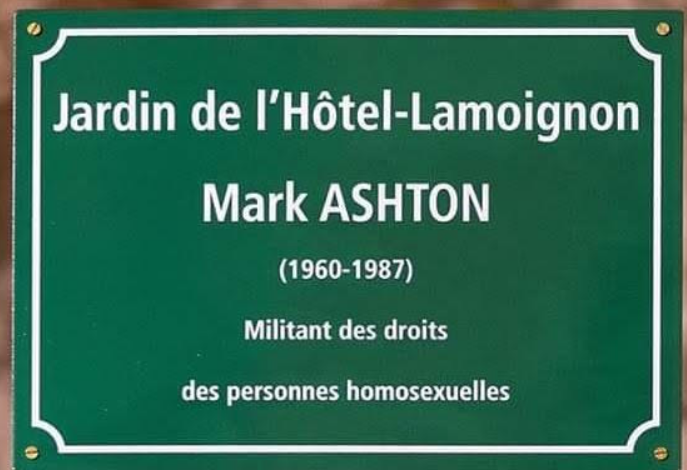
No. 25 is the best-preserved huge aristocrats’ town house, the Hôtel de Lamoignon. It is now a public library of the history of Paris, and its garden, first opened to the public in 1969, was renamed on September 25 2018, my life-long friend Rich Clarke points out, the Jardin de l’Hôtel-Lamoignon – Mark-Ashton.
Most of Ashton’s admirers overlook his strong Communist beliefs and his being active in Red Wedge and then becoming virtually the last General Secretary of the British Young Communist League in 1985.
Mark Ashton was a member of the Islington Branch of the CPGB before the 1984-5 miners’ strike, when he founded Lesbians and Gays Support the Minters the British founded. The garden at No. 25 was renamed in his honour by the Paris Municipal Council on a motion moved by its French Communist Party members.
The street displays vestiges of the Philippe August wall at Nos. 31-33 and No. 57 and several other grand town houses.
On May 12 1839 what was then the Town Hall of the 7th arrondissement at No. 43 was caputred by the Society of Seasons insurrectionaries. Barbès, Blanqui,Martin Bernard and Albert Laponneraye are all linked to its seizure.
When the SFIO and then PCF theoretician Charles Rappoport first arrived in Paris from Russia in 1895 he lived at No. 50.
The magnificent private mansion built on the site of the Hôtel de Guise at No. 60 was known as the Hotel de Soubise. It became the National Archives in 1794 and was saved from being burnt down by shell fire from the Versaillais troops attacking the barricade at No. 61, and by the 125th battalion of the National Guard of the on May 25 1781 by Louis-Guillaume Debock and André Alavoine. They were later pardoned for their support of the Commune because of their actions that day.
While he was studying at the Lycee Charlemagne in the 1880s, Leon Blum lived as a boarder in the Rue des Francs-Bourgeois.
Named in 1863 after the first name of a wife of one of the owners the road was first opened in 1840, initially being called the Rue Neuve-Saint-Paul and then in 1843 the Rue Bénédict.
Picasso lived at No. 49 with his friend Carlos Casagemas from October to December 1900. This was Picasso’s first studio in Paris, but after they returned to Spain for Christmas, Carlos returned on his own to Paris where he committed suicide early the next year. Another painter, an American or Bulgarian origins, Jules Pascin took over the studio there in 1909.
La Vie painted by Picasso in 1903 features his friend Carlos Casagemas who committed suicide in 1901 after falling into a deep depression due, it is believed, to his impotence.
Fifty years earlier Paul Verlaine first met his future wife, the 16-year-old Mathilde Mauté de Fleurville at No. 19.