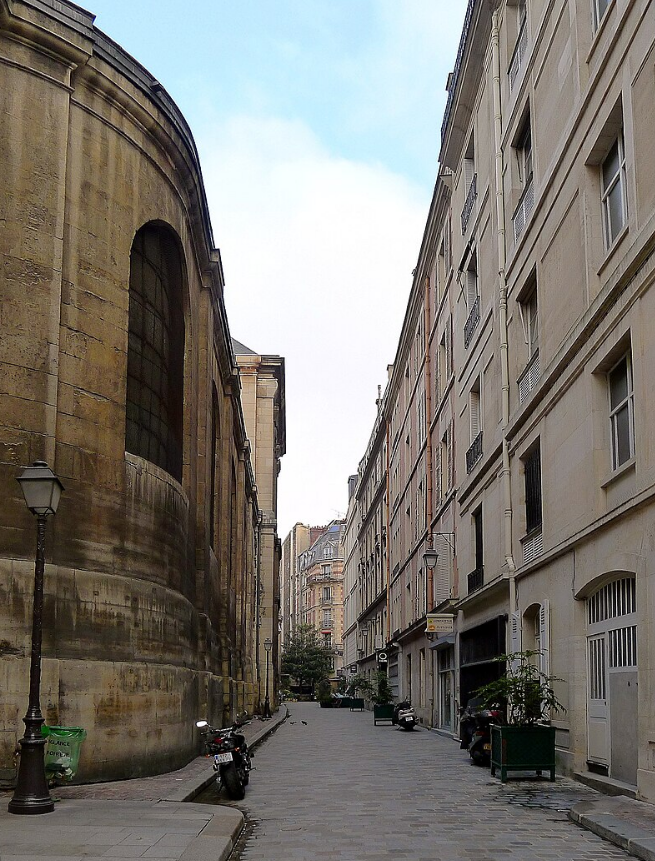
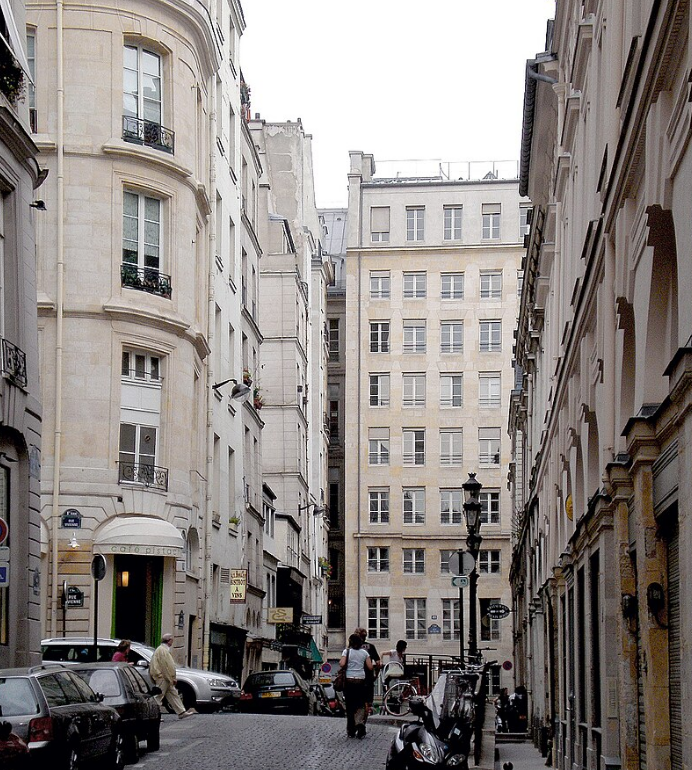
Rue des Pyramides

Arrondissement 1

Numbers: La Place, 3, 10, 22

The small square’s name (Place des Pyramides) at the road’s southern corner with the Rue de Rivoli dates back to 1801, when named the Square was renamed (from Place de Rivoli) after Napoleon’s victory at the Battle of the Pyramids in 1798 since it was he who ordered the demolition of the old Medici stables and riding school and houses of their pages when he was France’s First Consul.

The statue of Jeanne d’Arc in golden bronze was erected there in 1874, near the spot where she was wounded during her failed attempt to take Paris. Unlike all other 150 statues erected in Paris between 1870 and 1914, this was the only statue fully paid for by the government which, after France’s defeat in the Franco-Prussian war of 1870, wished to identify with her spirit of ‘reconquest’.

As part of the celebration of the Popular Front’s election success and two days after the start of the General Strike, Danielle Casanova was one of the organisers of a victory demonstration at the Statue of Joan of Arc by the Communist Party, the Young Communists and its girls’ association (l’Union des jeunes filles de France) on May 14 1936.
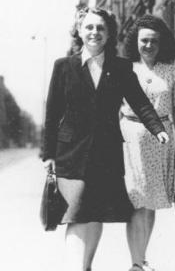
Another organiser of the 1936 demonstration was the 16-year-old Madeleine Vincent. Denounced and arrested for resistance activities at Douai station on January 9 1942, she spent the rest of the war in concentration camps in Essen, Ravensbruck and Mauthausen before being liberated in April 1945. She is shown here in 1946 on the left with Élise Fraysse another communist who had been active in the resistance.

The statue of Joan of Arc was also a point of reference for those resisting the German occupation. The five Parisian activists of the left-Catholic Young Republic League, the only party whose attending deputies unanimously voted against giving all powers to Marshal Petain on June 16 1940, formed the Valmy resistance group on September 20 1940. This was (the anniversary of the Prussian defeat at Valmy by French Revolutionary troops in 1792).

The Valmy group initially produced posters and in January 1941 distributed 50 copies of the first issue of a double-sided duplicated sheet titled ‘Only one enemy: the Invader‘. On May 11 1941 the group led by Raymond Burgard organised a resistance demonstration at the statue. By July 1941 Valmy had merged with the Zone Nord component of the Catholic-democratic Combat resistance movement but this northern group was dismantled in February 1942 by the Germans. In April 1942 Burgard was arrested and deported under Hitler’s December 1941 Night and Fog directive targeting political activists and resistance supporters in its occupied territories. Burgard was later guillotined in Cologne on June 15 1944, in the week following the D-Day landings.

The square had often been used as a meeting place for anti-Semitic demonstrations in the late 19th and early 20th century and its association between fascist-sympathisers and this area in Paris became stronger during the Occupation, fed by its proximity to the German and Gestapo headquarters in the rue de Rivoli.

In the third quarter of the 20th century the racist National Front began holding annual May 1 demonstrations at the square, where it was challenged by anti-fascists and trade unionists.

The collaborationist weekly newspaper, La Gerbe, was based at No 3 from 1940. A racist and Catholic paper, created and subsidised by the German embassy, it included ‘neutral’ writers such as Jean Anouilh and Colette, both of whom lived and worked in Paris throughout the war. In September 1944 its offices were taken over by a new weekly paper, Action, that had since 1943 been an illegal underground publication in the Southern Zone of occupied France. It was edited entirely by resistance activists, largely in the Communist Party or close to it. These included Victor Leduc, amazing humanist photographer, Robert Doisneau, the cartoonists Jean Effel and Siné and the artist and poster designer Paul Colin, whose poster of the Liberation of Paris was on page 1 of the first issue after Liberation.

The headquarters of the main French fascist party, the Parti Populaire Francais, were at No. 10 from 1936 (when it was founded by the ex-Communist Jacques Doriot) to 1945. Its opposition to the Popular Front drew in members of the nationalist right groups banned by the new left government, and anti-Semitic and eugenicist intellectuals as well as many anti-Communists.

On May 13 1961, when No 10 housed the centre-left newspaper France Observateur, it was targeted by the racist Organisation armée secrète (OAS) with a plastic explosive. The OAS mounted a desperate campaign against Algerian independence in 1961-1962.

Further along the road, No. 22 was the location of resistance meetings organised by Henri Ribière, a leader of the largely trade union and socialist Libération-Nord he helped form initially as an underground paper in December 1940.
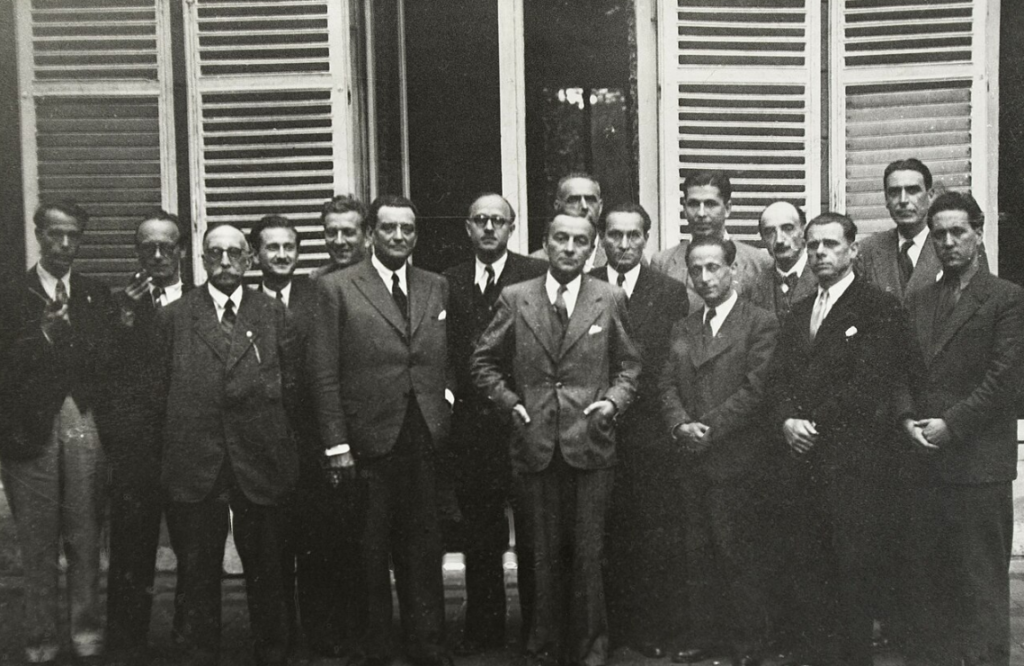
Henri Ribière (7th from the right in this September 1944 photograph of the National Council of the Resistance) was a decorated First World War veteran who had worked in the police during the inter-war years before joining a fellow socialist from Montluçon who was appointed Home Office (ministre de l’Intérieur) in the Popular Front government of 1936. Ribière had then been promoted to Prefect but was sacked by the Vichy Government in 1940 which, unaware of his resistance activity, transferred him to Caen.

In June 1942 Ribière resigned in Caen, citing health reasons, and moved back to Paris to become an underground leader in Paris of Libération-Nord, which began organising armed resistance. No. 22 was a shop called Nouveau-né (New Born) that was initially used as a letter-drop address for the network, and it became a meeting place for the Police et Patrie group Ribière set up. The address stayed secure until Easter 1944 when it as raided and many of the network were arrested by the Milice.

Ribière participated in the taking of the Hôtel de ville on August 20 1944, although he had opposed the Communist Party’s call for an early insurrection.
Rue de Beaujolais

Arrondissement 1

Numbers: 9-11

Opened in 1784 along the northern edge of the Palais-Royal‘s garden, it was named after the Count Beaujolais title of a son of its then owner, the Duke of Chartres (who as Duke of Orleans would become King Louis-Philippe in 1830).

From early in 1941 Suzanne Spaak and her playwright husband Claude Spaak (brother of the socialist Paul-Henri Spaak (Prime Minister of Belgium in 1938-1939 and Belgian’s foreign minister in exile from 1940-1944) used their luxury connecting apartments at No. 9-11 where they lived after having fled the German invasion of Belgium to join an build a resistance network in Paris to try and protect Jewish children.

Their No 9 entrance was shared by the French writer Sidonie-Gabrielle Colette, whose Jewish husband Maurice Goudeket was arrested by the Gestapo in December 1941, but released after seven weeks.

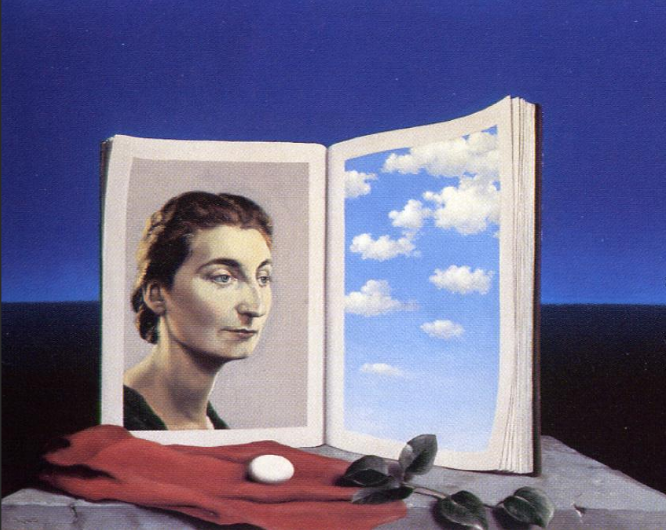
Suzanne Spaak had been painted by Rene Magritte in Brussels in 1936 and using their high social status the Spaaks joined and then led the Mouvement national contre le racisme (MNCR, the “National Movement Against Racism”) whose primary goal was to save as many Jewish children as possible from deportation. Suzanne tried to persuade senior figures in the Catholic Church to condemn discrimination and worked with the Protestant Clairière circle in identifying children at risk. The French Protestant Federation in the Occupied Zone preached spiritual resistance to Nazism, something Suzanne became aware of through a school friend of her daughter’s.

In February 1943 Suzanne was a key organiser in the rescue of 63 Jewish children being held by the largely collaborationist Union générale des israélites de France (General Union of French Israelites set up by the Vichy Government) and about to be deported, hiding several in her own home. In the summer of 1943, while in Brussels she was named in a Gestapo enquiry into a Belgian resistance network, arrested and, returned to the Fresnes prison south of Paris where she was condemned to death in January 1944. Finally she was shot on August 12 1944 among several others whom the Gestapo murdered while leaving the prison just days before its liberation. Buried by them in the prison’s vegetable garden her name was subsequently included in a memorial plaque erected to the resistance at the Fresnes prison.

On April 21 1985 Yad Vashem recognised Suzanne Spaak as ‘Righteous Among the Nations’

Passage St Roch

Arrondissement 1

Created in 1741 the street was a by-word for dirty and smelly until the 20th century, despite its situation in the First Arrondissement in the heart of Paris.

The Passage is just 90m long. A furnished room in the road alongside the Saint-Roch church was where Victor Hugo was caught by the police on July 5 1845 in bed with his second long-term mistress, Léonie Biard. A married woman she was charged with adultery and taken to the St Lazare prison for ‘fallen women’, while Hugo, elevated to a peerage he previous year by King Louis-Philippe, had immunity from prosecution and was allowed to go free.

Place Colette

Arrondissement 1

Comédie-Française, Palais-Royal

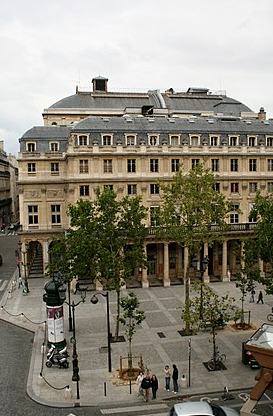
The square’s only address on the north is the state-owned Theatre the Comédie-Française  or Théâtre-Français, founded in 1680 with its permanent residence since 1799 in the 862-seater Salle Richelieu. To the east is the Palais-Royal, originally the private residence of Cardinal Richelieu.

Until 1966 the square used to be simply the junction of the rue Saint-Honoré and the rue de Richelieu, but it was renamed Colette after the writer’s only daughter asked André Malraux, then Minister of Culture, to do so.

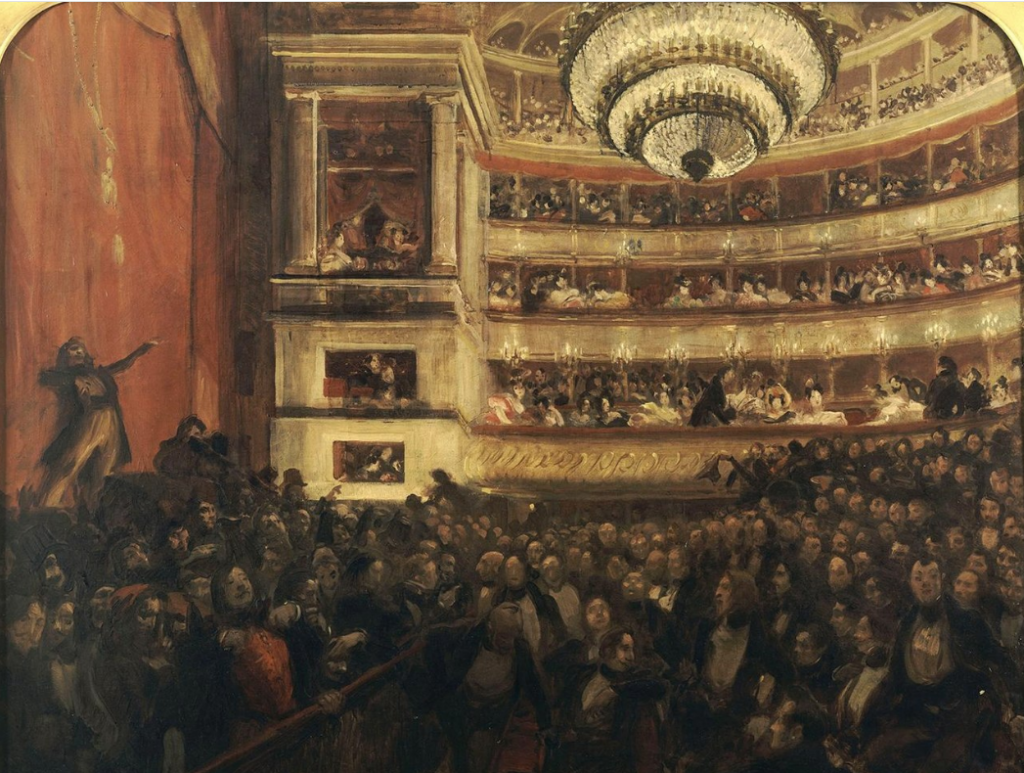
On February 25 1830 shortly before the July Revolution, Victor Hugo’s play, Hernani, was put on by the new director of the traditionally conservative Comédie-Française, but who was a sympathiser of the young French romantics, led by Hugo.

The ‘Battle of Hernani’ between Hugo’s supporters, including Gautier with long hair and a red waistcoat, and the older classicists included organised booing and counter cheering as well as physical fights

Every performance of Hernani over the next four months saw heckling and fighting, and then it was taken off, just before the 1830 July Revolution.

Rue Mondétour  

Arrondissement 1

Numbers: 1, 2

Now a short pedestrian-only street, it is one of Paris’ oldest, dating from the 11th century. Much of its original length has been eaten up by other roads, and the origins of its name are uncertain. Some believe it may come from ‘Mauvais Détour’, a wrong turning. Others that it refers to the revenues from the market on the Quai d’Orsay given to the Bishop of Paris in 1205.

The 1933 ‘Brown book on the Reichstag fire’ was published by Willi Münzenberg for the Comité d’aide et de secours aux victimes du fascisme hitlérien (International Committee in Support of the Victimes of Hitlerian fascism) at No 1. A German Communist who had become disenchanted with Stalin, he lived intermittently in Paris from 1933 to 1940 and was murdered or committed suicide in October that year while trying to escape the German invasion.

In Les Misérables Hugo placed the barricade where Gavroche on 6 June 1832 was killed outside the Café Corinthe at No. 2. Hugo was perhaps inspired to depict Gavroche by the painting by Jean-Victor Schnetz that, like Delacroix‘s much more famous painting, was commissioned by Louis-Philippe’s government in 1830 but which was never displayed in public until his overthrow in 1848 and the establishment of the Second Republic.

Schnetz painted a young boy passing a satchel of spent bullets up to the insurgents


Rue Danielle Casanova

Arrondissements 1, 2

Numbers: 78

In November 1802 Victor Hugo‘s mother, Sophie Trébuchet Hugo, left her husband, the baby Victor and his two brothers sons to live in Paris at the Hôtel de Nantes, 78 Rue Neuve-des-Petits-Champs. This was also where Marie-Henri Beyle, the author of The Red and the Black, Stendhal, died in 1842.

Sophie spent thirteen months there, lobbying Joseph Bonaparte (Napoleon’s brother) and others for Joseph-Léopold Hugo‘s favour to get him transferred somewhere more prestigious than Besançon. While there she starts a long-term relationship with Victor de Lahorie (Victor Hugo’s godfather who had fought with the Joseph-Leopold Hugo in 1798 and 1799) but had recently been forced into retirement from the army because of suspicions about his loyalty to Napoleon. The out of favour Lahorie failed to secure Leopold Hugo a better posting, and instead Hugo was sent from Besançon to Corsica and from there to the Isle of Elba.

The street was renamed Danielle Casanova in December 1944. Corsican-born Vincentella Perini was the daughter of teachers. She trained as a dentist in Paris and in 1928 joined the Communist Youth movement eventually becoming a member of its Central Committee. In 1930 she married a law student, Laurent Casanova, and with him became friends of Communist Party leader Maurice Thorez and his wife.

In 1936 Danielle Casanova became the first president of L’Union des jeunes filles de France (UJFF).

The UJFF was founded partly as a response to the resentment of young communist militants who had little responsibility within the then young French Communist Movement, and partly as a way for the French Communist Party (PCF) to recruit young female members.

Danielle and the other founders of the organisation wanted to focus on issues related to all areas of gender equality: work (referring in particular to the difficulties encountered by Marie Curie in her career), education and leisure. They emphasised the double discrimination of women from the working class due to both gender and social background. The UJFF supported the Republicans during the Spanish Civil War, participating in demonstrations of support and welcoming refugee children from Spain.

After the French Communist Party and its related organisations were banned in August 1939 with the signing of the Molotov–Ribbentrop Pact, Danielle went into hiding. Working underground she organised demonstrations against the occupying forces, including those of 8 November and 11 November 1940 protesting the arrest of Professor Paul Langevin.

From June 22 1941 when Germany invaded Russia, she helped set up women’s committees in the Paris region, she wrote for the underground press, especially Pensée Libre (“Free Thought”) and she founded la Voix des Femmes (“Women’s Voice”).

French Police arrested Danielle on 15 February 1942 after carrying a large bag with coal in it to the hiding place of a Jewish couple. In March they moved her to the La Sante prison, and then in August she was transported to the German-controlled Fort de Romainville. There she continued campaigning and organising clandestine publications and protests. In January 1943 she was transported to Auschwitz where she worked in the camp infirmary as a dentist, continuing to try and help those she had access to. She died of typhus at Auschwitz-Birkenau on 9th May 1943.

Posthumously Danielle Casanova was decorated with the Legion of Honour, and she became a heroine of the women’s movement as well as of the French Resistancce giving her name to streets, schools, and colleges throughout France.

Place Vendôme

Arrondissement 1

Numbers: 1-2, 4, 6, 7, 8, 11-13, 24, 23-26

The Place Vendôme was built to celebrate France’s military might under Louis XIV, the Sun King. Begun in 1699 it was only finished in 1720. It was built on land that had belonged to the illegitimate son of Henry IV, the Duke of Vendôme.

Initially called the Place des Conquêtes (Conquests Square) it soon became the Place Louis-le-grand with a huge equestrian statue of Louis XIV in the middle.

During the French Revolution it was renamed the Place des Piques (Square of Pikes) and the statue was destroyed on August 16 1792 and replaced with a statue representing Liberty.

For most of the 18th century many of the flats in the square’s huge private mansions were occupied by financial speculators and/or tax farmers and relatives of the aristocracy, among whom were a handful of revolutionaries. The leadership of the 1796 Conspiracy of Equals, including Gracchus Babeuf and Philippe Buonarroti met at No. 6, the Hôtel Thibert des Martrais. This was also the address from which two years earlier the Tax Farmers Jacques Paulze and Antoine Laurent de Lavoisier were taken to the guillotine.

Another conspiracy, this time against Napoleon Bonaparte in 1812, two years after the construction of the Vendome Column, was ended when General Malet was arrested by Colonel Doucet and Lieutenant Colonel Laborde at No 7, the Hôtel Le Bas de Montargis. Among those executed a week later, on October 31 1812, was General Lahorie, the god-father of Victor Hugo and Hugo’s mother’s lover since 1802.

In 1871, under the Paris Commune, the square was renamed the Place Internationale.

Number 7 was the same mansion that under the siege of Paris saw the Versailles government’s Paris army General installing Louis d’Aurelle de Paladines as commander of the Paris National Guard against the wishes of the majority of its battalions on March 5 1871. With the failure of the Versailles attempt to remove cannons from Montmartre on March 18 1871, 2,000 men from the Batignolles and Montmartre battalions of the National Guard battalions then evicted de Paladines and took over the building.

This allowed Jules Bergeret to set up his staff headquarters at No. 7. On April 4, after being elected to the Commune’s Council, Bergeret was named Paris National Guard commander.

The square saw much blood spilt at its barricades defending these headquarters of the National Guard during the Paris Commune. On May 23 1871 a barricade at the angle between Nos 1 and 2 with Rue Saint-Honoré was finally captured after Versailles troops got into the square through No. 4 and attacked the barricade’s defenders from behind.

The Hôtel du Rhin at No. 4 was also where Louis-Napoléon Bonaparte had lived in 1848 after his return from exile in England and where he was visited by Victor Hugo who completely believed his assurances that he had no designs to become Emperor.

The second defensive barricade blocking access from the Rue de la Paix in May 1871, stretching across Nos 23-26, was also captured from behind. This was one of the just 18 barricades that had actually been defended with the Commune’s canons.

After the barricades were overwhelmed, the Versailles troops killed most of the survivors. On the following day a group of 30 Communard women were shot in the square.

The Hôtel de Chimay at No. 8 was a centre of the Saint-Jacques resistance network from the start of the 1940 occupation of Paris by the Germans. Radio communications from there to London by began in April 1941 after Maurice Duclos was parachuted into France in February.

During the French Revolution Nos 11-13 became the Ministry of Justice, with Georges Danton nominated as Minister in August 1792. A metre length was installed in the wall there in 1795. The only other remaining original metre length installed in Paris at the changeover to metric distancing is in the Rue de Vaugirard.

No 12, the Hôtel Baudard de Saint-James, was where Frédéric Chopin died supposedly of tuberculosis (although this diagnosis is now contested) on October 17 1849. He was buried in Père Lachaise cemetery. While from 1838 to 1847 Chopin had lived with George Sand, he had separated from her and spent just a month in the Place Vendôme before he died, thanks to a loan from Jane Stirling.

The former Hôtel de Gramont at No. 15 was transformed into a luxury hotel and opened by the Swiss hotelier César Ritz in 1898. During the occupation the most senior Germans lived there and had many ‘traitor lunches’ in its restaurant. On the 16 August 1944 Ernest Hemingway arrived at the Ritz and presented some American rifles to the resistance fighters who had just evicted the Germans. This was also where Coco Chanel lived for many years, including during the period she collaborated with the Germans.

The Hôtel de Boffrand at No. 24, has also become known outside France through its association with Anne Lister, the Gentleman Jack lesbian Calderdale landowner and diarist. She lived there with Maria Barlow in 1824-1825.

Changing statues

In 1806 Napoleon ordered the building of a huge column in the centre of the square to celebrate his military victory at Austerlitz. Ironically this military monument was situated at the end of the Rue de la Paix. Inaugurated on August 15 1810 it was covered in bronze plates featuring battle scenes made, it was said, from melting down foreign captured cannons.

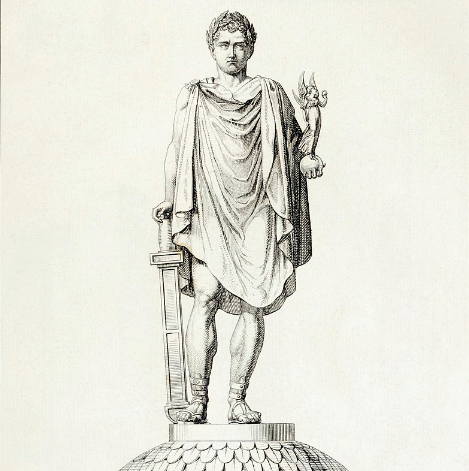
Napoleon was put on top in Roman Emperor robes with a gold laurel wreath on his head. This lasted until April 4 1814 when the invading allies pulled Napoleon’s figure down. Four days later the white Bourbon flag fluttered over the renamed square.

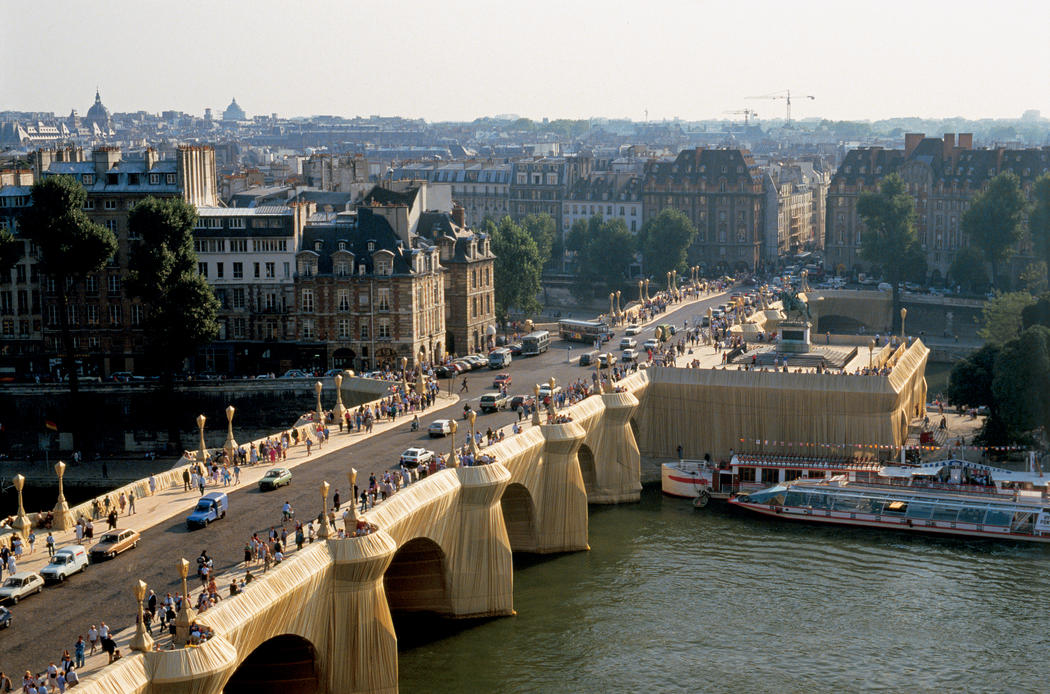
In 1816 the Louis XVIII Restoration government melted Napoleon’s statue down to use its bronze for a new Henry IV statue on the Pont Neuf

For the following 15 years the position at the top of the column was not filled. But in 1833, after a Bonapartist demonstration on May 1 1831, the new King Louis-Philippe (the son of the executed Duke of Orléans, Philippe Égalité, a supporter of the French Revolution and a regicide), replaced Napoleon at the top. This time, however, not dressed as a Roman emperor, but as an army corporal, reflecting the new king’s desire to honour Napoleon, but not too much.

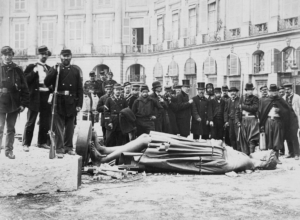
Napoleon did still not appeal to the revolutionaries of 1848, who took the corporal down and threw him into the Seine. Replacing the corporal did not appeal to nephew Louis Napoleon Bonaparte either. His third (and finally successful) military coup d’etat in 1851 led him to proclaim himself Napoleon III, Emperor of the French. In 1864 he placed a copy of the original Napoleon as Emperor statue back on the top of the column.

Karl Marx wrote one of his best political commentaries on contemporary events in 1852: The Eighteenth Brumaire of Louis Bonaparte. In it he compares Louis’ coup of 1851 with Napoleon Bonaparte’s of 1799, and presciently concluded that ‘if the Imperial mantle finally falls on the shoulders of Louis Bonaparte, the bronze statue of Napoleon will fall from the height of the Vendôme Column‘.

This happened on May 16 1871 during the Paris Commune after the painter, Citizen Courbet, the President of the Federation of Artists that was formed on April 15, persuaded the Commune to authorise the dismantling of the column. He described it as ‘a monument devoid of all artistic value, tending to perpetuate by its expression the ideas of war and conquest of the past imperial dynasty‘.

Courbet’s attack on the column was not universally supported by other artists. Daumier, the head of the Beaux-Arts section of the Federation, believed it should not be taken down. Perhaps this was why the 425 spiralling bas-relief bronze plates carried out by a team of 30 sculptors were removed and stored.

The column was replaced in 1874 with another copy of the imperial Napoleon at its top.

Pont Neuf

Arrondissement 1

The oldest bridge in Paris, the Pont Neuf was its first bridge without houses and constructed entirely out of stone. It was also unique in having pavements and bastions to protect pedestrians from mud, horses and carriages. Hence it was always called ‘the New Bridge’.

Initial plans assumed it would be paid for by the owners of the houses built on it, as happened on the other mid-16th century bridges shown here in 1651. But it was eventually paid for by the founder of the Bourbon dynasty, Henry IV.

Building had begun in 1578 under Henry III, but was interrupted by the religious wars of 1588-1598 which, after Henry III’s murder, were finally ended by Henry IV’s conversion to Catholicism and his successful seige of Paris.

The bridge was finally completed in 1607. three years before Henry IV was assassinated by a Catholic opponent of the Edict of Nantes, guaranteeing religious liberty in France.

Henry IV’s widow, Marie de Medicis, ordered the erection of a statue to Henry IV to be erected on the bridge at the point where it crosses the Île de la Cité. The statue was finally put in place in 1614. It stood there until evidence appeared in 1792 during the French Revolution that the Bourbon king Louis XVI was corresponding with the Austrians encouraging them to invade France. It was then pulled down, the day after a similar fate happened to statues of Louis XVI.

In 1818 after the restoration of the Bourbons, Louis XVIII ordered a new bronze statue to be erected in the same place. It was claimed to have been made from a surviving original cast, although it is quite unlikely that one survived. The

The bronze for the new statue came from melting down two recent statues: the giant imperial statue of Napoleon on top of the Vendôme column and the statue of the French revolutionary general Louis Desaix on the Place Dauphine. Desaix was an aristocrat who had served in the Bourbon army before the Revolution who then supported the Republic and was killed in action in Italy in 1800. He was a model for the aristocratic but humane Republican general Gauvain in Victor Hugo‘s last novel, 1793.

The sixteen year old Victor Hugo joined a huge crowd cheering on the replacing of the Bourbon statue on the bridge. The next year he wrote a prize-winning poem celebrating the moment. It included the lines: Make no mistake, this august image’s aspect / Will lessen our ills and sweet our happiness.

On May 24 1871 a Versaillais agent was executed in the second niche from the right bank for accusing the Polish General Jaroslaw Dombrowski , the Commander in Chief of the Commune forces, of treachery. Dombrowski had been killed the previous day on the barricades.

Early in 1943 under the German occupation Marcel Rajman, the 19 year-old Jewish Communist member of the FTP (Francs-tireurs et partisans), held his first meeting with the leader of the FTP-MOI, the Armenian Missak Manouchian, in the fourth niche near the statue of Henry IV. Both were eventually caught by Vichy Government’s Brigades Spéciales and shot with 20 other resistance fighters on February 21 1944.

Rue de l’Arbre Sec

Arrondissement 1

Numbers: 15, 39, 46

Named either after a draper’s street sign showing a tree without leaves or from the hangman’s scaffold a the street’s northern end, on the corner with the  Rue Saint-Honoré, in the 13th century it was the north-south road crossing the 10th century city walls.

Friedrich Engels lived at No. 15 (formerly No. 11) in 1844 when he came to visit Marx in Paris. The building is now a primary school, previously for girls.

Engels stayed at No. 15 in 1844 when he visited Marx and ignited their life-long collaboration.

After the First World War, the pioneers of Algerian national independence used to meet at No. 39, the ironmonger’s shop belonging to Hadj-Ali Abdelkader. In 1926 he was both a member of the Central Committee of the French Communist Party and first president of the North-African Star movement created that year.

The German ‘League of the Just‘ formed largely of exiled German skilled workers used to meet in 1836 at No. 46 led at that time by Wilhelm Weitling.

Pierre Lambert ran the Parti communiste internationaliste also at No. 46 in 1950-1951, producing the newspaper, La Vérité, from 1946 until 1958 when it was turned into a journal.

MAP

Rue des Bourdonnais

Arrondissement 1

Numbers: 11, 32

Rue Bourdonnais photographed by Charles Marville in 1853

This road owes its present name (finally decided in 1852) to the brothers Adam and Guillaume Bourdon, provost of the merchants of Paris and wealthy Parisians in the 12th century.

On July 29 1843 Alexandre Ledru-Rollin and Louis Blanc together with François Arago, Ferdinand Flocon and Godefroi Cavaignac met at Ledru-Rollin’s office at No. 11 and decided to set up a radical newspaper that would campaign for democracy,  La Réforme. The photograph above of Rue Bourdonnais was taken ten years later by Charles Marville.

This was where on February 21 1848 the Republicans around the Reform paper took the decision to resort to armed resistance to the King’s decision to ban the Paris banquet in their national campaign to extend the franchise. Among those meeting were the Worker Albert, Ledru-Rollin, Etienne Arago and Marc Caussidière.

The office became the headquarters of the February Revolution, and was where on February 24 1848 Ledru-Rollin, Blanc, l’ouvrier Albert, Flocon, Arago and Cavaignac drew up the left’s list for membership of the provisional government.

A century later, No 32 was the home from 1954 to 1958 of the now discredited Catholic priest, Henri Grouès (called l’abbé Pierre), who had been in the resistance and then a deputy, and was the founder of the Emmaüs charity.

PLACES

Conciergerie

Arrondissement 1

Number: 1-7 Quai de l’Horloge

Conciergerie photographed during the German Occupation

From the 10th to the 14th century France’s principal Royal palace was on the Cité island in the centre of the Seine. Sometime in the early 12th century the ‘Great Tower’ was built on the North of the island, on what is now the Quai de l’Horloge. Beneath it prisoners were tortured and by the late 14th century it was turned into a prison.

During the Terror under the French Revolution the prison was where many were jailed and tried prior to their executions. Among the more (in)famous were Marie-Antoinette, the 23 Girondins (radical constitutional monarchists) and Robespierre himself.

In August 1815 Marshal Ney was jailed there for supporting Napoléon during the One Hundred Days before Waterloo. Tried for treason by French lords on December 6 he was shot the next day near the Luxembourg Garden.

Wounded In the head during the May 12 1839 Insurrection of the Seasons, Barbes was taken to the Conciergerie’s infirmary.

After the failure of his attempted Boulogne coup d’État of August 1840, Louis-Napoléon Bonaparte and his fellow conspirators were first jailed in the Conciergerie.

Many of those arrested but not shot during the June 1848 workers’ insurrection were imprisoned in this jail before being tried.

The prison was finally decommissoned in 1914.

PLACES

Place Joachim de Bellay

Arrondissement 1

Fontaine des Innocents

Square Joachim du Bellay

The Square covers part of the site of the major cemetery within the Paris walls from the Middle Ages to the end of the 18th century. In 1786 the bones from the Innocents Cemetery were transferred to the Paris catacombs, the Church of the Innocents was demolished, and the site became the Market of the Innocents.

During the 1830 Glorious Revolution it witnessed violent clashes between the insurgents and the army.

Charles Marville photographed the Marché des Innocents and its 16th century fountain in 1858, just two years before the fruit and vegetable market was moved to Les Halles that closed in its turn in 1971.

In 1985 the remaining half of the area that had not been bought and built on in 1860 was named after the 19th century poet, Joachim du Bellay (1522-1560) – a contemporary of its 16th century Fountain.

MAP

Palais du Louvre

Arrondissement 1

Rue de l’Amiral de Coligny

Louvre Palace from Rue de l’Amiral de Coligny

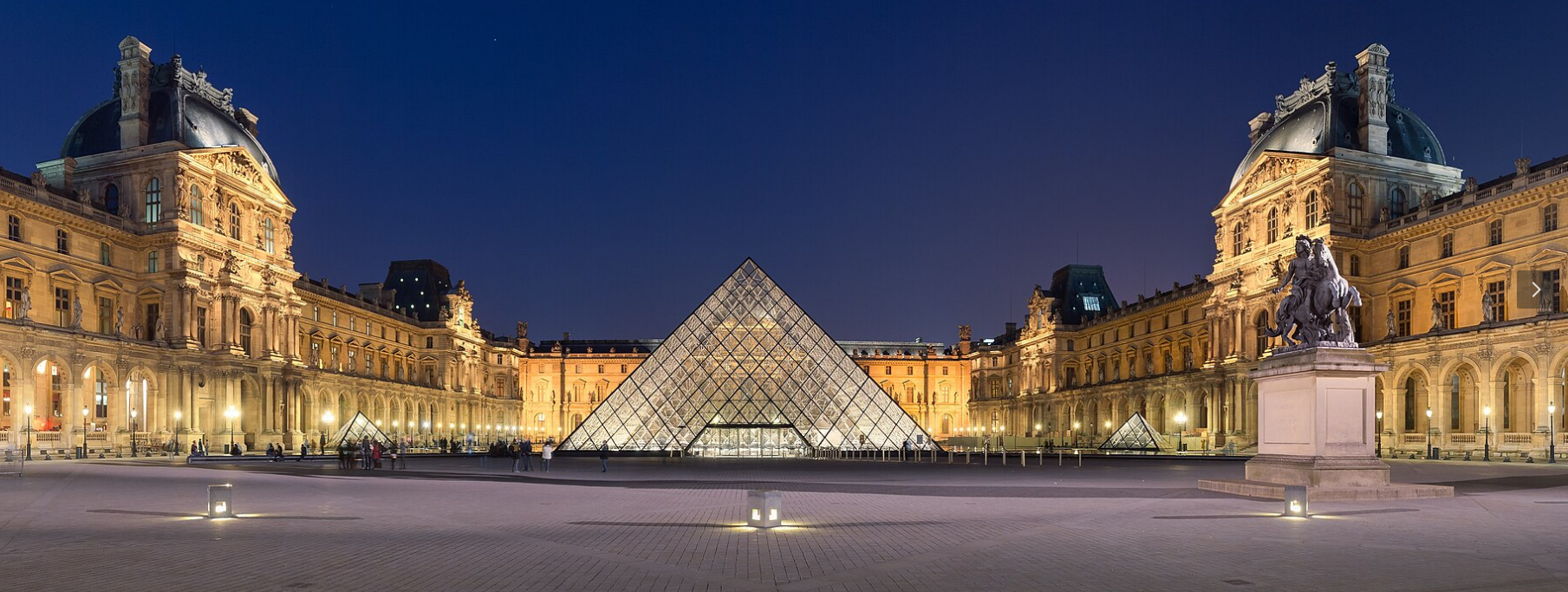
The Louvre Palace was built under Philip II in the late 12th to 13th century. By the 16th century it had ceased to be a fortress and became the primary palace of the French monarchy. Redesigned and extended often it became the home of the royal art collection from 1682 when Louis XIV moved the court to Versailles.

The Louvre played a major symbolic and organisational role in the people’s revolutionary explosions of the 18th and 19th centuries (1789-93, 1830 and 1871). In the 20th century it became associated with Resistance to German Occupation.

During the French Revoution it became a national art museum, largely of royal and confiscated church property.

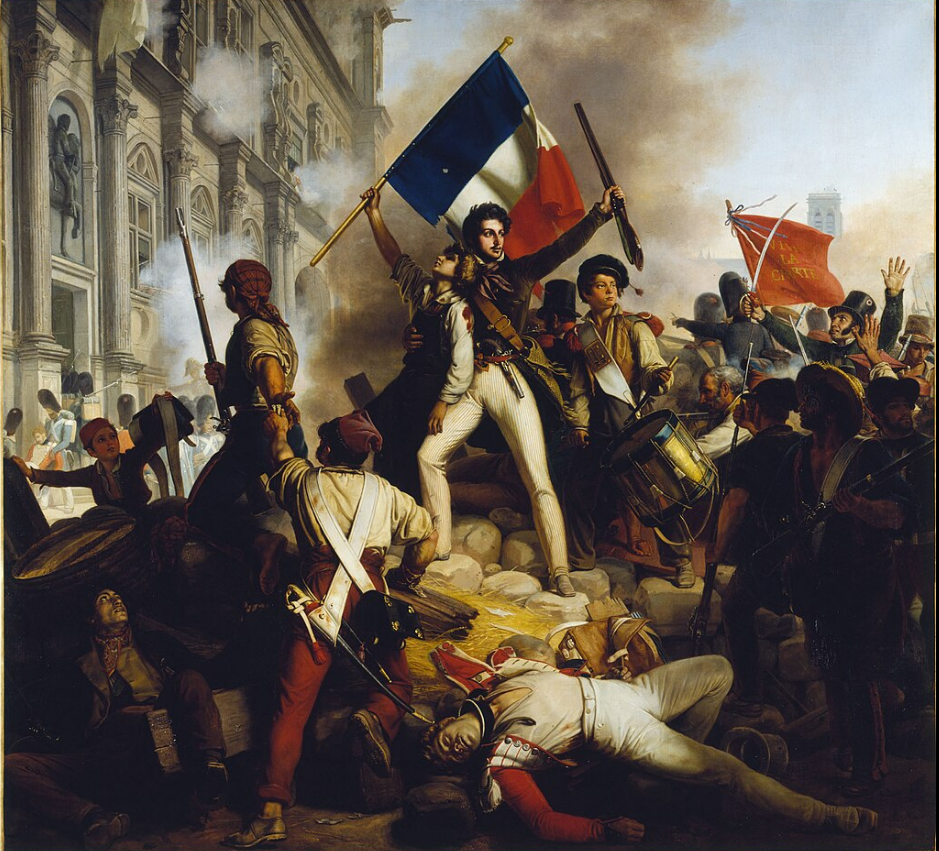
During the July 1830 Revolution it witnessed the defeat of Charles X‘s Swiss guards on July 29, when a crowd, including many Polytechnic students, stormed it using a scaffolding for repairs that covered part of the colonnade.

July 29 1830 Left Bank students workers and shopkeepers cross the Pont Neuf to attack the Louvre. Painted anonymously by an eyewitness.

Louis Vaneau, one of the Ecole Polytechnique students killed in the 1830 fighting, had the Rue Vaneau renamed after him in 1870.

The Louvre Palace in January 2016 photographed from the Pont Neuf with the oldest part on the right in what had been the Rue de Louvre, but is now the Rue de l’Amiral Coligny. It was renamed in 1972 after the Protestant Huguenot prince who was assassinated by the Catholic Fronde on St Bartholomew’s Day 1572


After the 1870 Sedan defeat and the end of the Second Empire, Gustave Courbet chaired a meeting of Parisian artists at the Louvre on September 6 1870. It set up a Commission for the Protection of the Heritage of Paris’ museums.

The leading realist painter of the 19th century, Courbet, photographed by Nadar

On March 1 1871 a hostile crowd gathered at the Louvre to shout insults at the Prussian officers who came to visit their ‘captured’ monuments after Thiers and Favre in Versaiilais had signed an ignominious armistice to end the siege of Paris.

Two weeks later the Louvre was the headquarters of the military governor of Paris at the moment when the Versaillais government attempted to seize control of the canon that were defending Paris. This coup’s failure led to the formation of the Paris Commune on March 18 1871.

The Federation of Artists, including Aimé-Jules Dalou and Jules Héreau as well as Courbet, immediately moved into the Palace. On April 17 a meeting held in the Antiquities Room of the museum (off the Place du Carrousel) elected a 47-strong Committee of the Artists’ Federation.

On 24 May 1871, when the Versaillais troops took over the Louvre Palace, a solitary woman stood in front of them. She was put against the gate of the colonnade and shot.

After the Occupation of Paris by German troops on June 14 1940, several staff at the Louvre Museum formed a collective resistance team aiming to save as many art works as possible from destruction and pillage.

Under the Occupation Parisians were forbidden to enter. Only a handful of staff were allowed in. They included Jacques Jaujard, the existing Protestant-origin head of French national museums.

He used his knowledge of the underground storage beneath the Louvre to store the first leaflets produced by the Committee of Public Safety founded by Boris Vladimirovitch Vildé, an ethnologist and linguist at the Musee de L’Homme. The journal they produced from August 1940 was called Résistance.

Vildé and six other intellectuals and academics in the Groupe du musée de l’Homme were finally denounced by a Vichy supporter and shot at Fort Mont-Valérien in Suresnes, a western Paris suburb, where between 1,000 and 4,500 resisters were executed during the Occupation.

At the Louvre the three rooms taken over by the Germans to store the art and culture seized from Jewish families didn’t provide enough space, so Jaujard and Rose Valland, a graduate student of art history, suggested they use the Jeu de Paume museum in the Tuileries gardens from October 1940. This was where Valland had volunteered since 1932.

Rose Valland, who understood German, but kept that secret from them, then began working full-time alone at the Jeu de Paume, built under Napoleon III in 1861, and a gallery since 1909. While there she secretly kept notes on the over 20,000 works of art the Germans had looted and wherever possible, through talking to lorry drivers taking them onwards to railway stations, finding out where they were going to and in many cases to which individuals.

She was present when on May 3 1941 Hermann Göring made one of his 20 visits to the museum to choose paintings for his own private collection. The others were either sold through Switzerland, burned in a bonfire of ‘degenerate art’ on July 27 1942, or stored to be eventually housed in Hitler’s never-constructed Leader’s Museum in Linz.

Valland passed on information to the Resistance via Jaujard so that the trains east they were on would not be mistakenly blown up. In August 1944 this information was used to prevent the final attempts by the Germans to loot 148 crates of paintings containing in total 967 paintings, including works by Braque, Cézanne, Degas, Dufy, Gauguin, Modigliani, Picasso, Toulouse-Lautrec and Utrillo.

MAP

Rue Montorgueil

Arrondissements 1, 2

Numbers: 50, 52, 57, 72, 73, 78

From the 13th century the road was called ‘mont Orgueilleux‘ (Pride Hill). Until the late 20th century the street was associated with bringing fish, and particularly oysters, into Paris.

Pierre-Jean de Béranger was born in No. 50 in 1780. Years later he was a regular guest at literary events at the restaurant at No. 78 (then number 59) called ‘Au Rocher de Cancale’.

In 1839 the insurrectionaries of Blanqui and Barbes‘ Society of the Season‘s uprising built a barricade across the street between Nos 52 and 43, at an angle with the Rue Tiquetonne.. Blanqui’s headquarters was in the  café at No. 57, on the corner with No. 1 Rue Mandar.

The bustling Café du Centre is on the site of the one that Blanqui and Barbès used as their HQ during the May 1839 insurrection of the 500 members of the Société des Saisons.

On December 4 1851 a barricade across the road at No. 72 was thrown up by opponents of Louis-Napoleon’s coup d’Etat, and many protestors were killed when it was taken by the army.

Twenty years later, nearly at the same place, at No. 73, another barricade witnessed strong resistance to the advance of the Versaillais troops on May 24 1871.

PLACES

Rue des Moulins

Arrondissement 1

Numbers: 14, 25

The road was given the name Mill Street after the mills situated on a small hill that existed there as late as the 17th century. It was opened in 1624 and the hillock levelled out by its new owner.

From January to December 1844 the fortnightly German language paper Vorwärts! (Forward!) was published by Henri Bornstein at what was then 32 rue des Moulins but is now No. 14. Its circulation was about 1,000 copies, and Marx became a major editor of it from the summer. This was where Bakunin stayed when he first arrived in Paris in July 1844.

Vorwärts! was outlawed on January 25 1845 after an article was published applauding an attack on Prussian King Frederick William IV.

Meetings of the editorial collective of the Deutsch–Französische Jahrbücher (German–French Annals), also took place there. However, only one double issue appeared in February 1844. Several of contributors and potential contributors met and argued there frequently in 1844, eventually going their own ways. They included Proudhon, Leroux, Etienne Cabet and Louis Blanc, as well as Marx, Arnold Ruge and Bakunin.

The Desenne printworks that published the radical newspaper Le Vieux Cordelier for Camille Desmoulins during the French Revolution in December 1793 and January 1794 was located at No. 25.

MAP

Palais de Justice, Boulevard du Palais

Arrondissement 1

Number 10

From the left’s perspective the Palais de Justice could perhaps be better named the Palace of Injustice.

Located at Nos. 4-10 boulevard du Palais, the Boulevard was only given that name in 1864, after Haussmann bulldozed broad streets through potentially barricadable medieval streets.

The earlier names of the road in front of the Palace were the rue de la Barillerie  (street of wine cask makers) and the rue Saint-Barthélemy (named after the nearby Church Saint-Barthélemy that in 1791, like the nine others on the ile de la Cité, lost its parish status to Notre-Dame cathedral, was nationalised and then sold and demolished. The site was initially a theatre and from 1865 the current Tribunal de Commerce de Paris).

In 1830 Blanqui was involved in fighting outside the Palais de Justice as the insurgents moved to topple Charles X. He was back there, inside, in 1832 as one of the defenders in the ‘trial of the 15’. This was of the leading members of the mainly student republican ‘Society of Friends of the People’ including Raspail. On January 10 1832 all were acquitted except for Blanqui who was found guilty of an offence against the public peace.

During the May 12 1839 Four Seasons insurrection against Louis-Philippe, Barbès led a column of 600 men to the Palais de Justice where he urged the troops on duty to join him. A refusal led to fighting and the guard-post and Palais were taken, but they failed to capture the Prefecture opposite.

The Palais de Justice was one of the many historic buildings set fire to or bombarded in May 1871 during the ‘Bloody week’ at the end of the Paris Commune, when orders were given to burn the Tuileries Palace and other symbols of government authority in retaliation for the summary executions of Communards taking place all over Paris. In total 238 buildings were burnt down or damaged during the fighting.

A newspaper lithograph shows the return of the Versailles judges to the burnt out Palais de Justice after the defeat of the Paris Commune. Many of the 7,500 Communards who were exiled had their sentences pronounced here.

In 1878 the young lawyer, Jules Guesde, appeared at the Palais de Justice to defend members of the illegal International Workingmen’s Association.
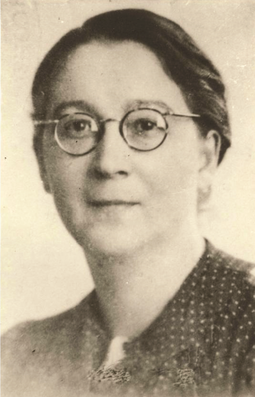
François Ravachol (1859-1892), an anarchist who had placed bombs at the homes of the three judges who had jailed the three Clichy May 1 1891 demonstrators, was sentenced to death here after two trials. He was publicly guillotined on 11 July 1892.

The Palais was also the venue for the ‘Trial of the 30’ anarchists accused of conspiracy and supporting the ‘propaganda by the deed‘ bombings. Among those on trial and acquitted in August 1894 were the revolutionary syndicalist, Émile Pouget, the art critic, Félix Fénéon, the artist, Maximilien Luce, and Kropotkin‘s collaborator, Jean Grave.

One of the anarchists charged but who went to live in Britain under an assumed name (Georges Guyot) was Paul Reclus, the nephew of Élisée Reclus. In his absence Paul was sentenced to 20 years hard labour. Paul moved to Brussels in 1903 to help
Élisée with the publication of his anarcho-geographer testament, L’Homme et la Terre.

In 1913 the Palais was where Victor Serge and the Franco-Belgian anarchist Bonnot gang were tried, with Serge being sentenced to five years for robbery, three were guillotined and three others had their death sentences commuted to life imprisonment.

In 1927 eight PCF leaders including Jacques Duclos and André Marty were tried here following the demonstrations in support of Sacco and Vanzetti., Italian-born migrant anarchists who were executed on trumped up charges in the US on 23 August 1927.

On September 2 1941 only one of the Palais de Justice judges and magistrates, Paul Didier (1889-1961) refused to swear an oath of personal allegiance to Pétain as then required by the Vichy Government. He also refused to work in the Special Sections set up in the Palais de Justice to try Jewish people and those accused of ‘political crimes’. Didier was arrested the following day and then interned before being fired from the judiciary. Reinstated in 1944 Didier then chaired appeal court hearings, including that of PCF leader Jacques Duclos in 1952, held in La Santé prison for a month for what was called the ‘pigeon plot‘, his part in organising a demonstration against the visit of US General Ridgway to Paris.

After the Second World War the Palace was again used to try and jail strikers (in 1950), Communists (1952) and supporters of Algerian independence (the Jeanson network was put on trial – here or at the Cherche-Midi prison – on September 5 1960, with 14 sentenced to 10 years imprisonment each, of which just four were suspended sentences).

Ten years later, in November 1970, the leading Maoist was jailed at the Palais for two years for re-establishing the banned Proletarian Left (Gauche Prolétarienne) group.

The Justice Palace we see today dates back to the earliest years of the Roman occupation after the defeat of the Celtic Gauls under Vercingetorix by Julius Caesar in 52 BC. The already inhabited islands in the River Seine, now merged into the l’île de la Cité, were then just about the only pieces of defensible dry land around that also allowed soldiers and traders to cross the river.

The Romans set up a seat of government on the site of the Palais de Justice from where they ruled France for over 500 years. The mixture of Latin and local Celtic dialects created what became the French language.

Palais de la Cité seen from the rue de la Barillerie in 1650. The drawing shows the Pont Neuf and the Louvre Palace in the background.

From the 10th to the 14th centuries, the quarter of the island covered by the Palace of the Cité was the seat of every French monarch. During that time all the king’s constitutional and judicial courts were based there, including the Paris Parliament until Charles V moved to the right bank of the Seine in 1358 after Etienne Marcel and other important Paris merchants invaded the palace and murdered the Dauphin’s ministers on 22 February.

After Charles V (Charles the Wise) and the court left the Palace, however, all its principal administrative and judicial functions remained. In 1371, during the 100 Years War, the first public clock in Paris was installed at No.2, boulevard du Palais, on the corner tower that carried the Palace’s alarm bell. Over the centuries several major fires destroyed large parts of the royal palace. In 1630 the Sainte Chapelle spire burnt down followed, in 1776, by all the buildings between it and the Conciergerie (the offices and residence of the appointed caretaker in charge during the king’s absences that became a prison from 1391).

The neo-classical colonnade entrance to the Palais de Justice was built between 1783 and 1786, and the Revolutionary Tribunal (Tribunal criminel extraordinaire) with just five judges was located here from 6 April 1793 to 31 May 1795. While it was in existence the Revolutionary Tribunal decided to guillotine 2,585 people and to acquit 1,306 (including Jean-Paul Marat on 24 April 1793).

An engraving showing the Revolutionary Tribunal of 1793-1795 sitting in the Great Hall of the Palais de Justice, renamed ‘Liberty Hall’ (Salle de la Liberté)

Besides Marie-Antoinette and Robespierre and others condemned with whom it is more difficult to feel sympathy were those like Anaxagoras Chaumette, who had campaigned for the abolition of slavery, the journalist Camille Desmoulins who had criticised Robespierre, and Desmoulins’ wife, Lucile, as well as Olympe de Gouges, the author of the 1791 ‘Declaration of the Rights of Women and Women Citizens’ – a feminist answer to the 1789 Déclaration des droits de l’homme et du citoyen. She was arrested at the gates to the Palais de Justice on 20 July 1793.

Declaration of the rights of Women drafted by Olympe de Gouges, playwright and campaigner against slavery, it was published on 5 September 1791 in a pamphlet ‘Rights of Women’ presented to Queen Marie-Antoinette.
Palais de Justice photographed by Steve Jefferys in December 2018 after visiting the Sainte Chapelle – always best on a sunny day

MAP

Palais Royal

Arrondissement 1

Palais-Royal Conseil d’Etat 2016

The Palais Royal (at No. 204 Rue St. Honoré) was the personal residence of Cardinal Richelieu (1585-1642), who ordered its building to the north of the Louvre in 1628. Richelieu gave it to Louis XIII in 1636, after which its name changed from Palais-Cardinal to Palais-Royal.

It was given to the Orléans  junior branch of the Bourbons in 1692, and in 1780 its garden was transformed into an arcade square of galleries comprising some 400 boutique shops. Among the products available were gambling (up to 1836), luxury jewelry and watches, pornographic prints, and (until 1830) prostitution.

Prostitution in the Palais Royal around 1815 as painted by the German artist Georg Opiz (1775-1841)

Under the French Revolution in 1792 the Square was renamed Place de la Maison Égalité

Restored to the Orléans family in 1814, it became a focal point for Republican protests and Blanqui fought here in the 1830 July Revolution.

During the 24 February 1848 revolution against the Palace’s’ owner, King Louis-Philippe the square saw major fighting between the army, defending its position inside the Château d’Eau ( not much more than a facade resembling the Palais Royal on the south side of the Square) and the revolutionaries. The Château d’Eau was finally seized and burnt down, while the Palais Royal was sacked, its paintings were burnt or cut up and its furniture thrown into the street.

Under the second Empire Napoléon’s youngest brother, Jérôme Bonaparte, was allowed by Napoléon III to live there until his death in 1860. On the night of 23 May 1871, the Commune ordered it to be burnt down. Three fires were lit, but all were put out in the early hours of the next morning. Less damage occurred than in 1848.

After 1871 the Palais-Royal became administrative offices for different parts of the French government. Today it hosts the State Council and since De Gaulle’s 1958 introduction of the Constitutional Council, both it and the Culture Ministry (initially under André Malraux).

Palais Royal 1910

MAP

Rue Rambuteau

Arrondissements 1, 3, 4

Numbers: 19, 54, 102, 108

Rambuteau around 1900

The road runs West to East from the Sainte-Eustache church (shown above at 6 am in the morning in 1900 looking up the road from the northern edge of Les Halles) to the Rue des Archives.

Building began in 1838 and in 1839 it was formally named the Rue Rambuteau to honour the Seine department Prefect from 1833 to 1848. Claude-Philibert Barthelot de Rambuteau who initiated its construction with the widening of streets in central Paris to 13m.

The kilometre-long east-west was conceived after the 1832 cholera epidemic had proved the case made by the hygienists to pull down many of the Paris’ narrow medieval streets. Its tearing up a sizeable area of old Paris stimulated one of the first Parisian housing speculation spikes.

One of the original Rambuteau-prescribed street number tiles (white numbers on a blue background) is still above the door at No. 58

One of the streets knocked down and merged into the road was the Rue de la Chanverrerie where, at the junction with Rue Mondétour, at approximately No. 102 Rue Rambuteau, a barricade was built on June 6 1832. This was where Victor Hugo placed the Caberet Corinthe and the death of Enjoiras in Les Misérables.

Several other barricades appeared in the road in the early days of the February Revolution and again during the June days of 1848. Fighting also broke out on December 3 1851 as some tried to resist the seizure of power by Louis-Napoléon Bonaparte. 

The cafe on the corner with the Rue du Temple at No. 19 used to be a favourite restaurant of Russian Nihilist exiles in the late 19th century. Trotsky and Lenin met there early in 1903.

On April 28 1848, after the shift against radical republicanism, Armand Barbès held a meeting of the Club de la Revolution at No. 54, the home of Citizen Furet. Barbès had set up as a more ‘moderate’ alternative to Blanqui‘s more insurrectional Société républicaine centrale, and this meeting discussed the election results and set in motion the attempted insurrection of May 15.

A personal interest of mine is that No. 108 was built on the birthplace of the adventurer cum comic poet Jean-François Regnard. On August 10 1779 his name was given to the second shortest-street in Paris next to the newly-built Odéon Theatre. This street was where my father James Jefferys (1914-1996) lived nearly half his life.

Plus d’informations

PLACES

Rue de Richelieu

Arrondissements 1, 2

Number: 58, 63, 64, 66, 102, 104, 110,

The near kilometre-long road stretching northwards from the centre of Paris was named in 1633 after Cardinal Richelieu’s Palace that runs down its east side. The palace became Palais-Royal and from 1793 to 1806 the road was called the Rue de la Loi (The Road of the Law).

The magnificent reading room of the National Library of France at No. 58 used by both Lenin and Rosa Luxemburg as well as many other socialists and communists..

Lenin got a reader’s ticket to No. 58 on the recommendation of a socialist member of parliament, Louis Roblin. Lenin visited the library regularly throughout his stay in Paris from 1909 to 1912. On one occasion the bicycle he used to journey from the 14th arrondissement was stolen according to police reports.

The bi-monthly La Revue indépendante created by Pierre Leroux, George Sand and Louis Viardot moved to No. 63 early in 1844. But as the journal became less political their involvement ended and they founded La Revue Sociale. In 1847, the bi-monthly became increasingly pro-republican again, just as it moved away from the Rue de Richelieu, but it didn’t survive the tumult of 1848.

The journal of the Internationalist Communist Party, French Section of the Fourth International, Workers’ Truth, that appeared from August 1952 to May 1962, was based at offices at No. 64. Michel Raptis (Pablo), based in Paris until De Gaulle’s 1958 Coup d’Etat was the 4th International’s secretary through this period.

In March 1848 the Fraternal Association of Linen Seamstresses, a women’s revolutionary club set up by Elisa Lemonnier and its president, Désirée Gay, used to meet at No. 66, the Hôtel de Brouilly.

On July 27 1830 the seizure of the presses at the printshop of the ‘Times’ ( Le Temps) at No. 102 was the trigger that set off the 1830 July Revolution against the increasing Bourbon repression under Charles X.

The first meeting of the radical republican Friends of the People club, attended by Pierre-Jean de Béranger and Étienne Cabet among others took place at No. 104 on July 30 1830.

The editorial offices of the socialist daily paper launched on April 18 1904 by Jean Jaurès, Anatole France, Octave Mirbeau and Aristide Briand and others, l’Humanité, were then at No. 110.

MAP

Rue de Rivoli

Arrondissements: 1, 4

29, 31, 39-86, 39-41, 66-68, 98, 172, 182, 228, 248, 254

Rue de Rivoli about 1900

A lengthy 3 kilometre-long street, it was initially opened under Bonaparte in 1802 and 1804 and then extended by Haussmann between 1852 and 1860 to provide a major east-west axis for troop movements – as well as to attract high-priced speculative building developments.

It was first created and named in 1804 after Napoleon Bonaparte’s success over Austria at the January 14 1797 battle of Rivoli in Northern Italy and runs the whole way alongside the Louvre Palace and Tuileries Gardens.

The road’s most significant building is the Paris Town Hall at No. 29, the Hôtel de ville de Paris, which on several occasions over the last 250 years has also doubled as the location of the French government.

Blanqui’s headquarters on October 31 1870, when he unsuccessfully attempted to capture the Town Hall virtually opposite, was the National Guard’s Café, then called the Café du Gaz at No. 31.

His second, equally unsuccessful attempt on January 22 1871 was also headquartered at the same Café du Gaz. Under the Commune this was also the meeting place of the Central Committee of the National Guard.

When working in the Hotel de Ville in September 1871, Paul Verlaine describes using the Café as an ‘annex’ to his office and meeting Arthur Rimbaud there.

An important barricade was built across the street between Nos. 39 and 86 when the Versaillais troops entered Paris. The area saw considerable fighting on May 24 1871. In its aftermath some 200 Communards were shot without trial, and many were buried in quicklime at the Lobau (or called the Napoleon) barracks at Nos. 39-41.

Opposite, in the Square St Jacques, the surrealists led by André Breton and Paul Éluard used to meet after the publication of Breton’s L’Amour fou (Mad love) in 1937.

Where Nos. 66-68 stand today another barricade was erected in June 1848 on the now demolished Rue de la Tixanderie. The fighting there saw the Garde Mobile’s General, Duvivier, mortally wounded, as he defended the Hotel de Ville against workers protesting the government’s closure of the unemployed workshops.

On May 22 1871 there were some 900 barricades in Paris. This one, built in a day at No. 98, was 6 meters high, part of the defence of the Town Hall.

The history of No. 172 is pretty gruesome. During the Occupation the Hotel du Louvre there was the headquarters of the Heydrich’s SS Death Squads.

Perhaps in order to make detection less likely, two meetings of the National Resistance council took place at No. 182 in the spring of 1944 after the assassination of Jean Moulin and after several other resistance leaders had been arrested.

On the railings of the Tuileries gardens opposite No. 228 there is a plaque that marks the location of the National Assembly that met in the Salle du Manege (the riding school) there through the revolutionary days from 1790 to 1794.

Opposite No 228 Rue Rivoli is the plaque showing the approximate location of the old Salle du Manege riding school where delegates voted to execute the King and declare a republic. Some locate the riding school as covering the area between Nos. 230-232.

Ironically, No. 228 was also from 1848 to 1854 the home of Harriet Howard, the English red-haired mistress and financial backer of Louis Napoleon who, when he was Emperor, was given the title of Comtess de Beauregard, and ownership of the accompanying chateau.

During the Occupation of Paris the Hotel Meurice at No. 228 was also the headquarters of the German High Command. It was besieged briefly on August 25 1944 before its commander, Dietrich von Choltitz, surrendered.

On November 26 1941 the Youth Battalion resistance fighters of the French Communist Party exploded a bomb outside the offices of the German military bookshop at No. 248.

Among the first barricades built in both June 1848 and May 1871 were at the corner of No. 254 with the Rue St Florentin. Under the Commune it was one of just 18 that had canon defending them, and it was the only one not taken from behind.

The Versaillais troops used canon and mortars to clear the barricades on the Rue de Rivoli in May 1871

MAP

Rue Saint-Denis

Arrondissement 1, 2

Numbers: 20, 79, 90, 92bis, 93-99, 120, 151, 221, 237/239,

This is one of the earliest known streets in Paris. It was named after an abbey built on the site of a Roman Villa directly to the north of the Roman city of Lutetia. Many believed the villa was the burial site of the Italian evangelist Denis who came to Paris between AD 250 and 270, and was its first Bishop and martyr. So in 630 King Dagobert (of the Franks in what is now northern France) started to build a huge basilica on the spot and called it Saint-Denis. When he died in 639 he was buried there.

From that year on until the French Revolution when the body of the guillotined Louis XVI was disposed off in a quicklime pit, all French kings were buried in the St Denis Basilica. The church was also used to crown the King’s Queen and the road from it into Paris was also always used by the royal family for their processions into Paris, and so was known as the ‘royal route’.

Today the St Denis road begins its journey to the north of Paris at the Place du Châtelet where it is crossed by the Avenue Victoria. It used to go right down to the ‘Grand-Pont’ (Big Bridge) that from the 9th century crossed the wider reach of the Seine and accessed the central island, the Ile du Cite. That bridge was washed away several times and finally replaced by the Pont au Change.

The northern end of the road is at the magnificent Porte St-Denis, a huge triumphal arch created by Louis XIV in 1672 on the site of a major fortified gateway through the (now demolished) Charles V defensive wall that protected the right bank of Paris. The photograph of the arch above was taken in the 1930s.

On June 23 1848 one of the main barricades of the workers’ insurrection against the closure of the national workshops blocked the Boulevard Bonne-Nouvelle from being used to move troops from West to East Paris where the movement was strongest. It was defended by engineers who worked on the Northern Railway Company, and was only taken by the government’s troops after their canon had fired 80 shots at the barricade.

This painting by Nicolas Edward Gabé (1814-1865) captures the moment when a woman picked up the insurrectionists’ flag on the barricade at the Porte St Denis and challenged the soldiers to kill her – which they did.

The Rue St Denis continues beyond the Porte’s Arch northwards towards the Saint-Denis suburb. From this point it becomes the Rue du Faubourg St-Denis which runs as far as the Boulevard de la Chapelle.

Number 20 used to be the entrance to the Halles Centrales café and concert hall, where Blanqui spoke at several meetings in 1870.

The weekly anarchist journal Le Libertaire that had resumed publication on December 21 1944, thanks to the financial support of Georges Brassens, was able to install itself alongside the Libertarian Communist Federation in an office at No. 79 in March 1954. Series 5 of the paper finally stopped publication on July 12 1956.

Subsequently, from 1960 to 1976, No. 79 became the headquarters of the exiled Spanish anarcho-syndicalists who believed that the Confederación Nacional del Trabajo should work with the exiled government.

One of the few barricades built by the leftists who participated in the Society of Seasons uprising on Sunday May 12 1839 led by Blanqui and Barbes was at No. 90. It blocked the road at the junction with the Rue de la Grande Truanderie.

The 1839 barricade was just next door to the one built at No 92 bis in front of the St Leu church on November 19 1827. This was the first barricade in Paris since 1795 and was put up after troops were ordered to remove all signs put up in houses celebrating the liberal victory in Paris in the November 17 legislative elections. The resulting riot was put down with a cavalry charge and some gunfire in which a young Blanqui was wounded by a bullet in the neck.

At the principal barricade built across the road at No. 120 on the same day the 18th regiment fired at the defenders, killing four of its defenders.

No. 151 (or No. 153 or No. 243 where the family lived soon afterwards as is suggested in the Paris birth records) was the birthplace of Léon Blum on April 9 1872. Then, like today, it was in the heart of the Parisian textile and clothing industry. But where once it was predominantly Jewish, today the businesses in the area are largely of North African origins.

A sad plaque on a modernised building that does not indicate that Blum was Jewish, a Socialist or that he was France’s prime minister in 1936

The bloody week that ended the Paris Commune took its toll at No. 199. This was where a barricade was built across the corner with what is now the Rue Réaumur saw serious fighting on May 24 1871. Another barricade at No. 237/239 that crossed to the Passage du Caire covered alleyway was defended by the Commune’s 92nd battalion.

After Honoré Daumier was released from Ste Pélagie prison in 1833 he lived in an artists’ house including Narcisse Virgilio Diaz at No. 221.

As long ago as the Middle Ages the central Paris area around Rue Saint-Denis, Rue Grenata, the Rue aux Ours and the Rue de Saint-Martin was known as the ‘Huleu’ (screeching) quarter because of the prostitutes calling out for clients as men passed by. The women used to hire covered wooden stands, and men climbing on to the stand went ‘en bords’ (onboard). This was the origin of the now internationally recognised word ‘bordel‘ (brothel). Paris counted some 50,000 prostitutes by the mid-19th century.

For me, the southern part of the road near what used to be the huge Les Halles market still conjures up memories of that night in 1962 when I and my close school friend David walked on a cool dark summer night, with money in our pockets, determined to lose our virginities. I was quite amazed to find that more than 50 years later, despite the removal of the Halles market and the gentrification of central Paris, Tripadvisor is actually still selling the area as the place to go to see ‘Paris nightlife’.

Plus d’informations

PLACES

Rue Saint-Honoré

Arrondissement 1, 8

Numbers: 145, 153-155, 157-159, 204, 251, 270, 368

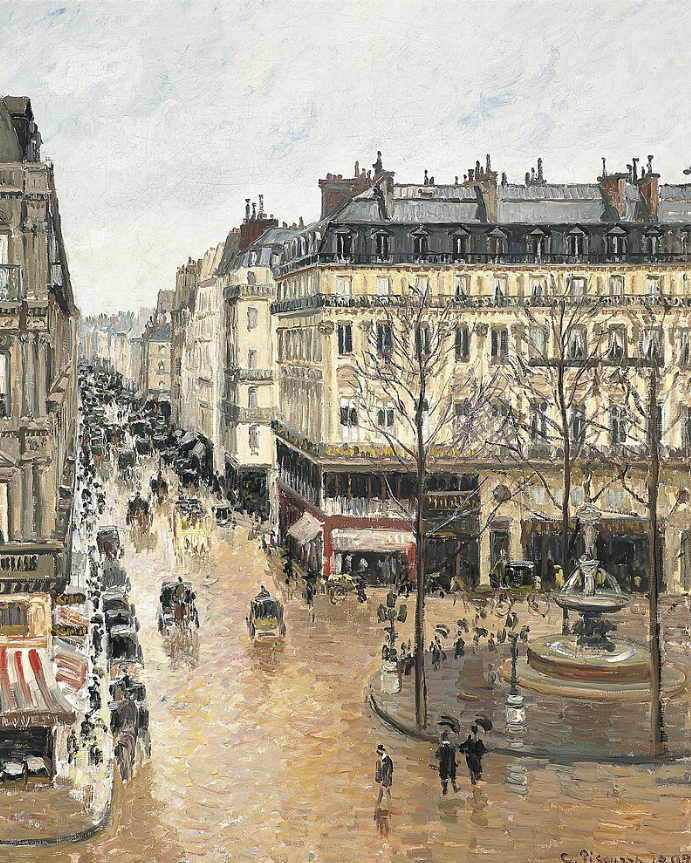
This very old nearly 2 km long road follows most of the west to east Roman road through north central Paris. It was named after a small chapel built outside the walls of Paris in 1204 to remember the patron saint of bakers, Honoré d’Amiens, who died on May 16 600. The church was paid for by a wealthy Parisian baker originating in Picardy. Allegedly Honoré  had been miraculously designated eighth bishop of Amiens. The church was demolished in 1913 and became part of the Grands Magasins du Louvre, from whose hotel Camille Pissarro painted the view of the road shown above.

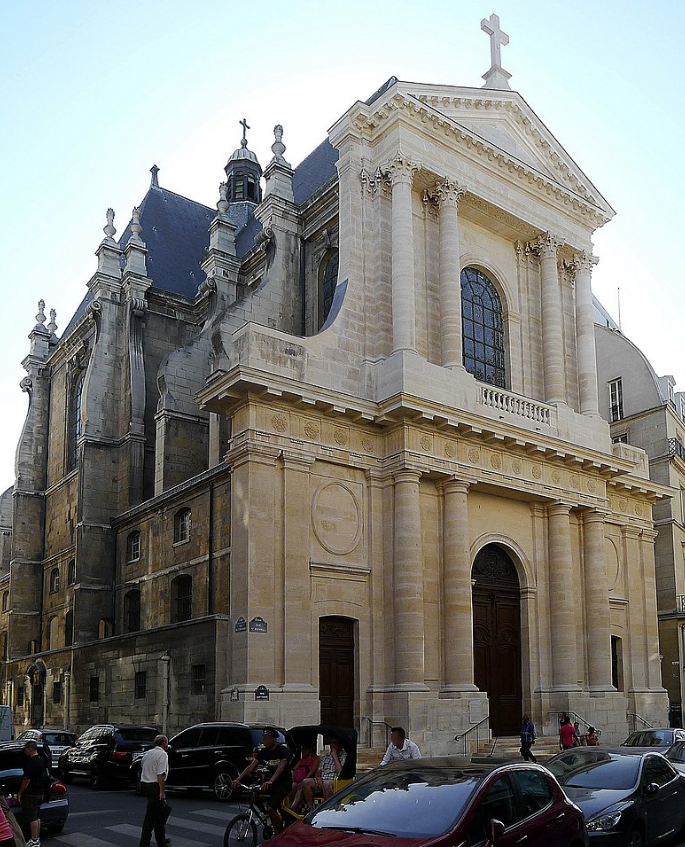
The Oratory of the Louvre at No. 145 had started life as a Catholic church in 1612, had become a monastery , enlarged and rebuilt and in 1624 became the royal church of the Louvre Palace. Another rebuild took place between 1740 and 1750 before th nationalisation of the monastery in 1792 and its deconsecration. In 1800 it became the Bank of France and in 1811 Napoleon decided it should be re-opened as a Protestant place of worship.

During the German occupation of Paris the pastors Paul Vergara, Gustave Vidal and André-Numa Bertrand explicitly preached the need for spiritual resistance to Nazism. On February 17 1943 after Suzanne Spaak had appealed for their assistance in saving Jewish children about to be deported. Marcelle Guillemot, a social worker who edited la Clairière, a protestant socio-health paper, was outside the Temple of the Oratory after Vergara called for volunteers, and took the names of 30 protestant families ready to hide the children, after going to the centres where they were being held and taking them for walks.

A total of 63 children were saved, although Marcelle had to go into hiding in Paris while Vergara escaped to Switzerland.

The Café de la Régence from 1681 to 1854 was based approximately at Nos. 153-155, nearly opposite the Palais Royal (No. 204). Voltaire, Diderot and Rousseau were all enlightened customers there in the mid-18th century. Benjamin Franklin also visited while he was American Ambassador to France from 1776 to 1785.

The rough location of the Cafe de la Regence on the corner of the Palais royal square.

This café was also where Marx and Engels met on August 28 1844 and agreed to work on ‘The Holy Family‘ together. Further along the street, at No. 251, was the Valentino Hall, which Engels entered on one occasion in his brief 1844 visit to Paris to escape the police spies who were following him.

Upstairs the Café de la Régence was the centre of French chess for over a century. It was where Robespierre, the young officer Napoléon Bonaparte and Louis Philippe all played their chess (no not together!). The café also doubled as one of Paris’ four cafe/shop post offices in the early 19th century.

On October 16 1793 the Jacobin and regicide painter, Jacques-Louis David, sketched Marie-Antoinette in a cart being taken to the scaffold from a first floor window in Rue St Honore

The Café was well-positioned. It was close to the Palais Royal before the Revolution and afterwards it was on the route of those being taken from the Conciergerie prison to the Place de la Concorde to be guillotined.

On July 28 1830 at Nos. 157-159 the very first barricade was erected at the cross roads with Rue Rohan and Rue de Richelieu. This marked the start of the July 1830 Glorious Revolution that overthrew Charles X

At 10.30 pm on the evening of December 3 1973 one of the cartoonists for the French satirical paper Le Canard enchaîné returned to its offices at No. 173 to find a government DST ( Direction de la surveillance du territoire) team of spies installing microphones. The French State has always believed it has the right to spy on dissidents.

The editorial offices of Le Canard Enchaine satirical weekly at No. 179

Nearly two hundred years earlier the French state still believed in its right to execute dissidents. One issue was how this done. Should it be a lengthy process by strangulation (hanging) or a lengthy process by chopping at your neck with an axe?

Dr Joseph Ignace Guillotin, a humanist who opposed the death penalty helped develop a quicker, more efficient way of killing people. One of those who drafted the 1789 Declaration of the Rights of Man and of the Citizen, he died on March 26 1814 in his medical office at No. 209. This was on the route of those travelling to be ‘humanely’ executed at what is now the Place de la Concorde.

The medical offices of the man whose name was given to the guillotine died here at No. 209 in 1814.

On November 29 1847 Bakunin spoke to the 1,500 people who attended a commemoration banquet of the 1830 Polish uprising against Russia at the Valentino Hall. Before Haussmann’s re-modelling of Paris its address was No. 359 rue St Honoré. This was where Valentino, the orchestra conductor and violinist, introduced the polka dance to Paris that same year, 1847.

Le Bal Valentino was opened in 1838 and closed in 1890. One of the largest halls in Paris it alternated classical music concerts and dancees, while hosting many political meetings

The size and central location of the Hall attracted many revolutionaries to hold meetings there. In 1848, in February Cabet held a meeting of the Icarians there.

In March, Blanqui organised meetings of the Central Republican Society he chaired at Valentino’s. The Club of Political Prisoners presided by Armand Barbès with Blanqui as its vice-president also met there.

The Socialist Workers’ Club whose honorary president was Louis Blanc also met there until the May 15 1848 demonstration when it was dissolved after the failure of a left insurrectionary attempt to defend the socialist aspects of the February 1848 revolution.

On December 25 1848 No. 251 hosted the first socialist women’s banquet held in Paris.

On January 27 1871 the Valentino Hall was used by the Officers of the 1st Battalion of the National Guard to protest against the Armistice signed by the Thiers government with the Prussians.

251 Rue St Honore is now the exclusive Mandarine Hotel, describing itslf as the ultimate luxury hotel. The earlier dance hall and meeting place was demolished and rebuilt in the 1930s

Olympe de Gouges, opponent of slavery and author of the 1791 Declaration of the Rights of Women and Women Citizens, lived at No. 270. A History of Paris marker post has been put by the front foor to mark this feminist pioneer and martyre.

Olympe de Gouges’ time at 270 Rue st Honore is now marked by a historic Paris plaque in the pavement on the right of the door

The main entrance to the second Jacobin monastery in Paris was at No. 328. Its side entrance in the Rue St Hyacinthe led to the monk’s canteen where the anti-royalist Breton Club began to meet in 1789. After the closure of the monasteries in 1790 the convent was rented to the Friends of the Constitution, who later took the name the Jacobin club .

General Lamarque died at his home at No. 368 of cholera. His funeral procession that left from here on June 5 1832, sparked the 1832 uprising against Louis-Philippe’s increasingly authoritarian rule that features in Hugo‘s Les Misérables.

General Lamarque, who lived at No. 368, was a leading critic of Louis-Philippe. He died of cholera here on June 1 1832 and his funeral on June 5 triggered the 1832 June insurrection in Paris

When Robespierre was himself guillotined on July 28 1794, the cart carrying him to the scaffold stopped outside No. 398 (formerly No. 366) where he had lived for three years since he moved there secretly on July 17 1791 to avoid arrest after the Champs de Mars massacre. The house’s walls had been dripped with the blood of butchered cattle.

Off the courtyard behind the doorway to No. 398 Robespierre rented two rooms from Maurice Duplay, a cabinet-maker and supporter. The house was rebuilt to the same floor plan in the 18th century.

MAP

Boulevard de Sébastopol

Arrondissements 1,2,3,4

Numbers 3, 48, 62-64 (site of 22 Rue du Bourg l’Abbé), 83

In 1854 the boulevard was initially built as part of Haussmann‘s redesign of Paris as the Boulevard du Centre. Half-way between the Rue Saint-Denis and Rue Saint-Martin roads that were closely associated with barricades and insurrections, it involved relatively little demolition of existing buildings and created a 30m wide road along which troops and canons could be easily moved.

Almost immediately it was renamed Sébastopol after a year-long seige finally ended in the successful storming of Sebastopol on September 8 1855 by a joint Franco-British force during the disastrous Crimea War.

The pharmacy shop Cannone at No. 48 on the corner with the Rue aux Ours was the main distribution centre for the underground resistance papers Valmy et Résistance. Initially, from the autumn of 1940 one of the staff, Roger Lardenois, used its huge storage area to hide and then distribute Valmy.

64-66 Boulevard Sebastopol is the location of the Lepage Frères arms depot, before 1854 it was 22 Rue du Bourg-l’Abbé. The warehouse was pillaged by a few hundred men from the secret Seasons Club set up by Blanqui and Barbès for weapons and ammunition on May 12 1839. Many carried three or four pistols and rifles out with them. .

The Lepage Brother’s gun shop in the 1830s just round the corner from their store room in the now disappeared road Bourg-l’Abbé
The site of the Lepage Frère armoury at 22 rue du Bourg de ‘Abbb , now 62-64 Boulevard ~Sebastopol

PLACES

Rue de la Sourdière

Arrondissement 1

Number: 18

The short, narrow road existed already in 1640 when it was named after a Monsieur Sage from La Sourdière, whose house and gardens it ran by.

Daniel Stern (Countess Marie d’Agoult) and Franz Liszt first lived together in this narrow Paris road in 1833.

18 Rue de la Sourdiere

In February 1935 Aragon and ElsaTriolet moved into No. 18. They lived in one of the flats off the still-existing courtyard there until Aragon was called up as a medical reservist in September 1939.

As the political disagreements between Breton and Aragon deepened from 1929 onwards an emergency meeting of the organisers of the International Writers Conference took place there that brought them to a head. Breton had smacked Ilya Ehrenburg across the face for having written that all surrealists were ‘pedarists’, and the Conference committee on June 14 1935 decided to exclude Breton from the official speakers.

PLACES

Jardin des Tuileries

Arrondissement 1

Tuileries Palace in 1615
The Tuileries Garden shown in the foreground of this 1615 map. The Salle de Menage whose location today is on the Rue Rivoli is at the bottom left.

Like the Tuileries Palace (built in 1564) the garden was named after the tile-making factories that were established there in 1372 next to the 15-20 (300-bed) Quinze-Vingt hospice on the Rue Saint-Honoré. Its blind pensioners’ principal job was to pray for the souls of the donating royals.

The Tuileries Palace photographed in 1850 from the courtyard of the Louvre before it was burnt down in 1871 and the ruins removed in 1883. The Arc du Carrousel (1808) is in front of it and the Arc du Triomphe in the distance

Paris’ oldest and largest garden was established by Catherine de Médicis after she had ordered the building of the Tuileries Palace. Redesigned by André Le Nôtre in 1664 it was opened to ‘good people’ by Louis XIV.

Effectively abandoned by Louis XIV for Versailles from 1672, the Palace was used only briefly by Louis XV from 1716 to 1722, so much of the garden has been used as a public space for over 350 years.

On Sunday July 12 1789 Paris learned that Louis XVI had dismissed his finance minister, the constitutional monarchist banker Jacques Necker. Within hours the king’s Swiss Guard were ordered to disperse a demonstration in the Tuileries Garden.

The storming of the Bastille is triggered by the charge of the dragoons on people in the Tuileries Garden, painted here in 1789-1790 by Jean-Baptiste Lallemand

The grand basin in the Garden was the setting for Robespierre to torch a floating monster called Atheism on June 8 1794 to reveal the statue of Wisdom at the start of the Festival of the Supreme Being. During the French Revolution the Garden was called ‘The National Garden’.

Before his coup d’ État overthrowing the Directorate on November 9 1799 (18 Brumaire an 8) Napoléon Bonaparte bivouacked his troops in the garden. This was also where the Austrian and Russian occupying troops set up their encampment in 1814.

Beneath the South side of the garden running parallel to the Seine, what is now the Terrasse du Bord de l’Eau, there were tunnels beneath the Palace. This was where prisoners were murdered both during the suppression of the June 24 1848 uprising and again after Louis Napoléon’s coup d’ État of December 4 1851.

On May 15 1871 during the Paris Commune a battalion of 2,000 armed women paraded through the garden.

On May 23 1871 the Communards carried out the threat they had made to set fire to several historic buildings in Paris if the Versaillais troops continued their advance. 12 men set the Tuileries Palace, Napoléon III’s Paris base and the location for the National Convention in 1793, on fire. Using petroleum and liquid tar it didn’t take long to burn down. The Flore pavilion on the right partly survived and is now a part of the Louvre museum. The remains of the Palace were finally removed in 1882.

Several defenders of the Commune were then killed on the Terrace next to the river on May 24.

During the Second World War the Jeu de Paume museum was used by the Germans as a storage depot for seized artworks. Between November 1940 and November 1942 Göring visited the museum 20 times to pick and choose paintings. On July 29 1943 the Germans burnt around 600 paintings seized from Jewish families on the Tuileries terrace.

More information

MAP

Place Vendôme

Arrondissement 1

Numbers: 1-2, 4, 6, 7, 8, 11-13, 23-26

On May 16 1871 Gustave Courbet endorsed the proposal by Félix Pyat to demolish the column in the centre of the Vendome Square and to melt down the bronze to use in making canon.

The statue of Napoleon had become the symbol of Napoleonic imperialism. It was first put up on August 15 1810 and was then taken down in 1814, replaced in 1831, thrown into the Seine in 1848 and finally restored by Napoleon III.

The column had been decorated in bronze melted down from the canons captured at the battle of Austerlitz. Its crowning figure, Napoleon, had not survived the Bourbon restorations of 1814-1815. Louis XVIII replaced it with the white Bourbon flag and then with the Fleur de Lys. He melted down Napoleon’s statue on top of the column to create the horse-backed Henry IV, founder of the Bourbon dynasty, on the Pont Neuf where it crosses the Island of the Cité.

Citizen Courbet pushing over the Vendome column as seen at the time by the latest version of the revolutionary satirical paper Le Pere Duchesne

During the defence of the Paris Commune in May 1871 a barricade defending the Headquarters of the National Guard at Nos. 11-17 was put up from No. 1 to No. 2 and across the Rue St. Honoré. The Versaillais troops took the barricades from the back by getting through the Hotel du Rhin at No. 4.

Félix Lepeletier, an aristocratic revolutionary, lived at No. 6 and allowed Babeuf, Buonarroti and others involved in leading the Conspiracy of Equals to meet there in March 1796. Félix’s older brother, Louis-Michel Lepeletier de Saint-Fargeau, had cast the deciding vote on the execution of Louis XVI, and that same evening, 20 January 1793, he was stabbed with a sword by one of the king’s former bodyguards.

Louis-Michel Le Peletier died soon after at his family house at No. 8 Place Vendôme. and his body was then draped over the pedestal of Louis XIV’s statue that had been pulled down in 1792. Louis XVI was guillotined the following morning.

The Jacobin painter, Jacques-Louis David, painted LePeletier on his death bed, and one of his students then produced this lithograph print of it. The sword pierces a piece of paper on which is written “I vote the death of the tyrant”, and as a tribute at the bottom right of the picture David placed the inscription “David to Le Peletier. 20 January 1793′

On 18 March 1871, when the Versaillais troops tried and failed to capture the canons stored on the Montmartre and Belleville hills, four battalions of National Guardsmen from Batignolles and Montmartre marched on the National Guard Headquarters at No. 7 and threw out the commanding officer put in place there on March 5, and installed their own commanders.

Jaroslaw Dombrowski, the Polish commanding National Guard General at its headquarters in the Ministry of Justice in Nos. 11-13, was mortally wounded on May 23 1871, when all the defenders were summarily killed.

One of the only 18 Paris barricades in May 1871 that was fortified with canons crossed from Nos. 23 to 26, the Barricade of the Rue de la Paix. It was defended by the 88th, 113th and 182nd National Guard battalions. Very few of the more than one thousand defenders survived the battle.

Chopin, the former lover of George Sand, died in his first floor flat overlooking the court at No. 12 in 1849.

The Ritz Hotel at No. 15, the former Hôtel de Gramont, was colonised by senior Germans and Vichy collaborators under the Occupation and its bar was famously liberated by Ernest Hemingway on August 26 1944, when he gave some American rifles to the arriving FTP. This was also where Princess Diana and Dodi Al-Fayed had their last meal together on August 31 1997.

MAP