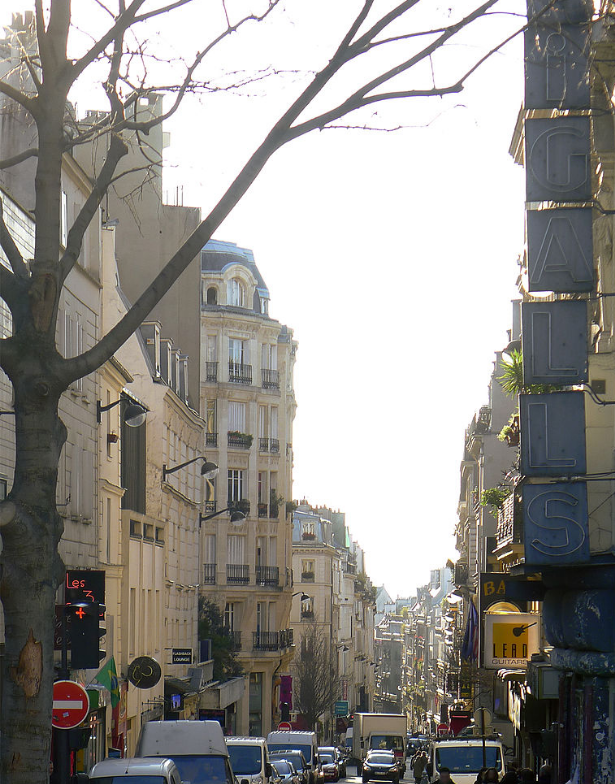
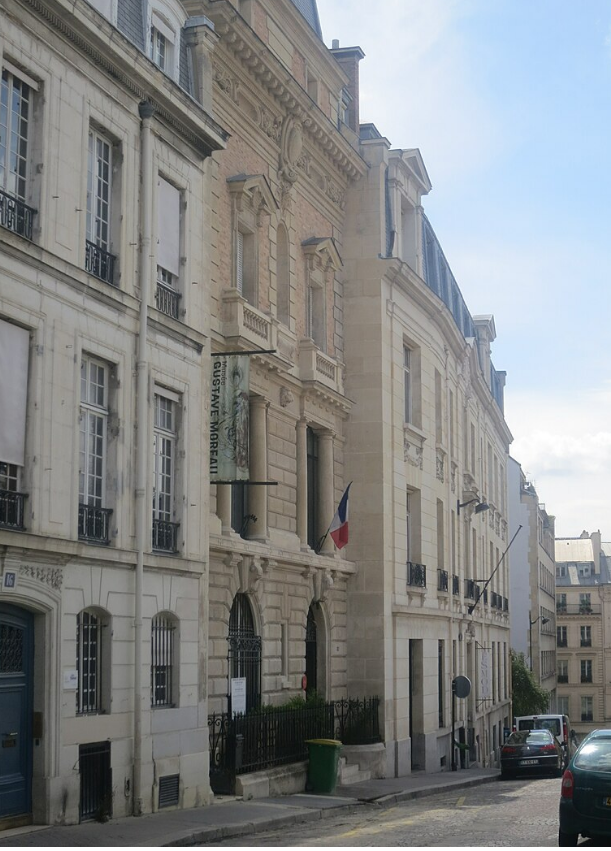
An unusual due North-South road for Paris it was called the Rue Royale in 1772 and during the French Revolution, first Rue de la Republique, then Rue de l’an VIII, and finally Rue Pigalle in 1803, when Napoleon was unchallenged as First Consul.
It was named after the 18th century sculptor Jean-Baptiste Pigalle, who used to live at No. 1 and had a workshop at No. 17 where he sculpted a famous bust of Voltaire. His first name was added in 2020 to balance the adding of a female first name to that of the nearby rue de la Rochefoucauld.
In 1841 to 1842 George Sand lived with her lover Frederik Chopin in one of two small houses she rented at No 16.
Julliete Drouet had a flat at no. 55 from 1871-1874 near her lover, Victor Hugo, who stayed there with her briefly early in 1874 while his son, François-Victor Hugo, was dying aged 45 from tuberculosis.
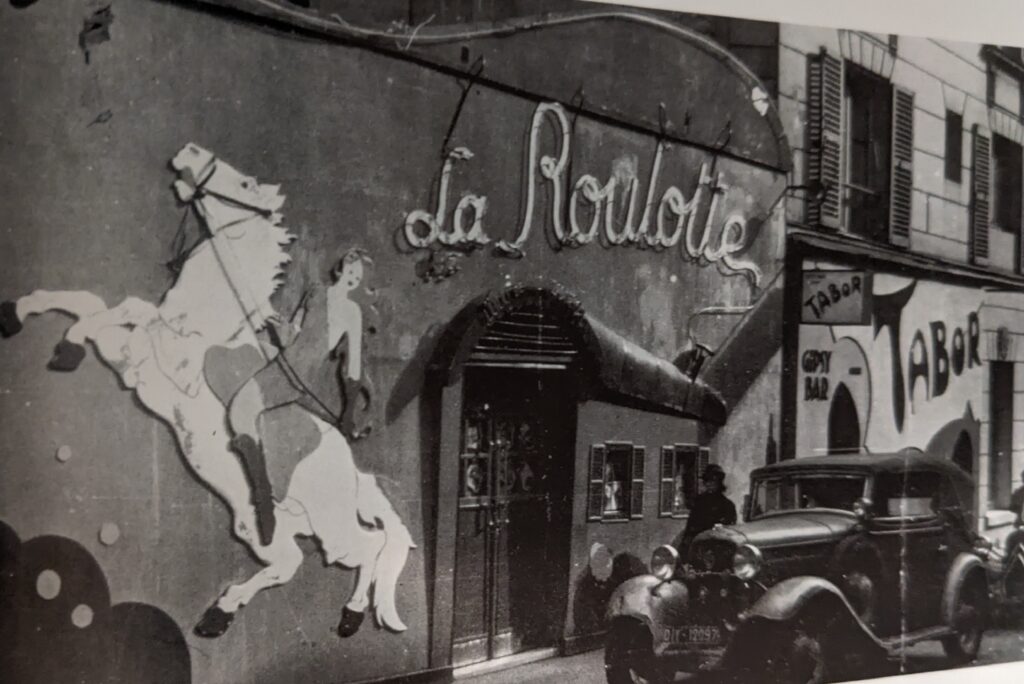
Django Reinhardt often played at La Roulette, one of several well-known jazz clubs in 1930s Paris at No. 62.
Henri de Toulouse-Lautrec famously painted Madame Armande, the owner of the lesbian-associated Hanneton Caberet at No. 75 around 1897-1898.
Named in 2020 after the abbess of the Montmartre Abbey from 1737 to 1760, it was originally a 17th century path over Abbey grounds. In 2020, as part of the feminisation project of the Socialist mayor of Paris, Ann Hidalgo, the first name, Catherine, was added to the road’s official name.
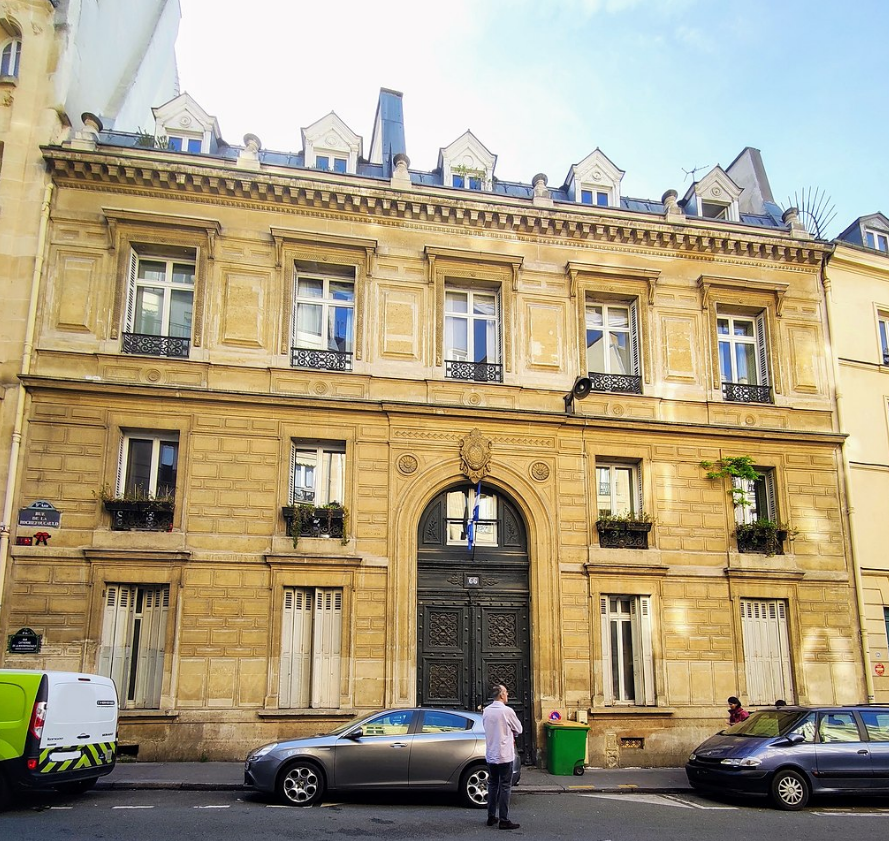
No. 66, the Rousseau mansion, built in 1776 and later divided into apartments was where Victor Hugo lived from 1871 to 1873 after the defeat of the Paris Commune and his return from Brussels where he had lived since the death of his son Charles in March 1871.
Juliette Drouet, Hugo’s long-standing mistress, lived nearly opposite, in Rue Pigalle, where Victor joined her briefly in early 1874.
Like many former church lands taken into state ownership during the French Revolution, the land on which the road now stands was sold to two bankers with permission to develop 13 roads in 1827. Initially the road was called the Abattoirs Road as it led to the Montmartre slaughterhouses. In 1847 it was then renamed the Dunkerque Road since it was so close to the new Gare du Nord, opened a year earlier.
In June 1848 fighting took place alongside the station pier at No. 25 that had just been finished.
On September 5 1870 Victor Hugo arrived by train from Brussels, effectively endorsing the creation of the Third Republic at No. 18.
Victor Hugo returning after 18 years in exile at the Gare du Nord on September 5 1870
During the 1870/71 siege of Paris the Gare du Nord was transformed into a factory to make hot air balloons. The first of these took off on November 24 1870 and finally landed in the north of Norway.
On May 23 1871 ferocious battles took place at the Gare du Nord, where many Communards were shot after being courtmartialed.
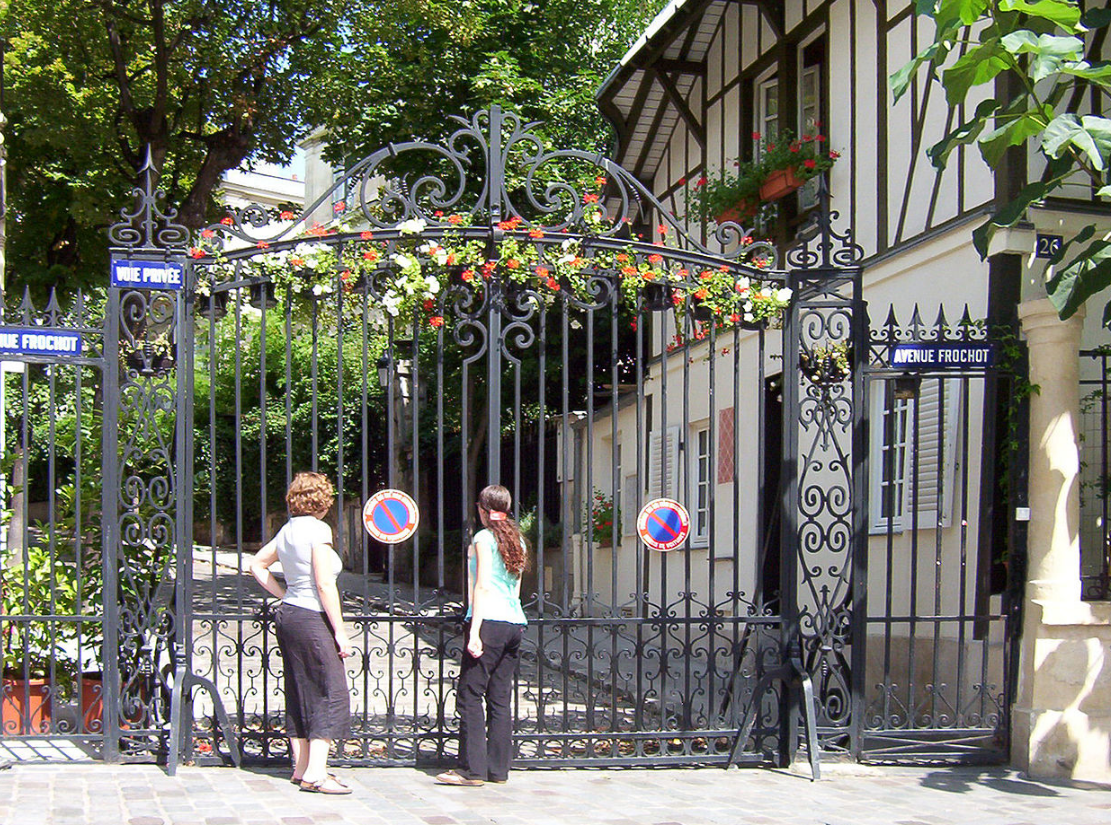
Named after Nicolas Frochot, the prefect who Napoleon ordered to buy land outside the city limits to create four new cemeteries, it is now a private road with an entrance gate in the Rue Pigalle.
A rather select road in the 1840s No. 4 was the centre of a much sought-after society literary circle including Victor Hugo, Gérard de Nerval, Charles Baudelaire and Gustave Flaubert. In 1870, after returning to Paris from exile Hugo was put up briefly at No.5 by Paul Meurice.
Jean Renoir, son of painter Auguste Renoir, was born in 1894 at No 7. Much later, in 1944, Django Reinhardt lived at No 6 after having returned to Paris after two failed escape attempts. This was where his wife, Sophie Ziegler, gave birth to their son Babik Reinhardt.
Renamed in 2019 after one of the abbesses of the Montmartre Abbey for many years since 1760 it had been known simply as the Rue Tour d’Auvergne. It was decided to change it to the current name as a contribution to acknowledging the important role of women in the history of Paris.
Georges Bizet, the composer of Carmen, was born in No. 26 in 1838 while the most popular song-writer of his time, Pierre-Jean de Béranger, lived at no 30.
Victor Hugo lived at No. 37 from 1848 to 1851. He moved in after the part he played in suppressing the June 1848 insurrection against the ending of workshops for the unemployed. This was where in December 1848 Louis-Napoléon Bonaparte met Hugo and promised he had no intention of declaring himself Emperor to gain Hugo’s support for his candidature for President of the Second Republic.
In December 1851 Hugo moved briefly to No. 41, which was where the police searched unsuccessfully for him on December 2 1851 while he escaped through the gardens.
In 1839 Chopin performed his Funeral March for the first time at No. 45 in the Le Carillon cabaret.
A colonel of the Commune and member of the Commission of the National Guard Federation in 1871, Simon Charles Mayer, lived at No. 44.
Owing its name to the transport of plaster into Paris from the Montmartre quarries it already featured on a map dating from 1672, where it was called the White Cross Road (rue de la Croix-Blanche). It got its present name in 1793.
Some 60 ‘left’ members of the National Assembly met at the Baroness Coppens’ first floor home soon after hearing of the December 2 1851 military seizure of power staged by Louis-Napoleon Bonaparte.
Edgar Degas, who was involved in setting up an anonymous artist cooperative, lived at No 77 between Marc h 1873 and 1876. He left when his family bank in Naples went bankrupt.
The second offices of the Independent Review, La Revue indépendante, were at No. 79. In November 1886. Félix Fénéon, organised ‘Symbolist’ meetings there that included Georges Chevrier, Georges Seurat and Édouard Desjardins.
Opened in 1837 it was originally gated at both ends and named after its developer and 18th century tax farmer, the ‘cité Gaillard.
It was renamed in 1937 two years after the death of Paul Escudier, a leader of one of the first French Nationalist movements, the Patriotic League, that was very strong in Paris. From 1885 it became the home of French right wing authoritarianism and the centre of anti-Semetic propaganda in the campaign against Dreyfus.
On December 2 1851 the organisers of resistance to the coup d’État mounted by Louis Napoleon met at No. 4. Victor Hugo was one of their principal leaders, meeting at the home of Pierre Gustave Laissac.
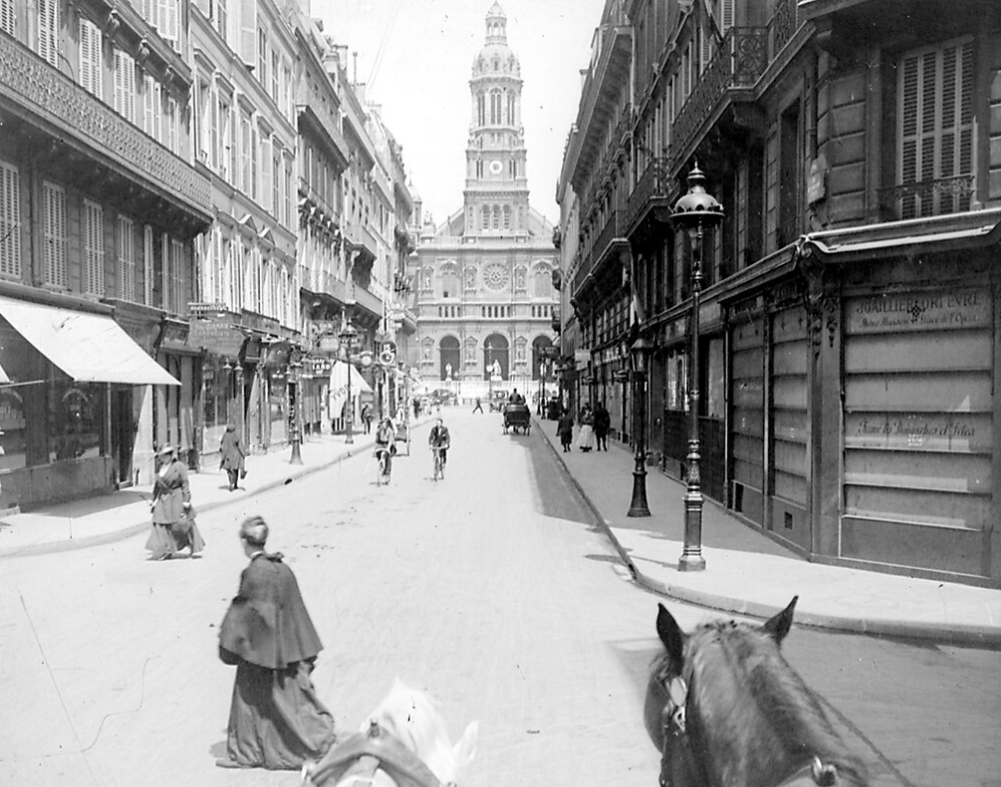
In the early 18th century Louis XV increasingly spent time in Paris, resulting in several of his wealthiest courtiers building their own huge town houses there. One of them, the Duke of Antin, was the son of the superintendent of the King’s estate, and it gave the road its first name in 1712. Under the French revolution it first became the Rue Mirabeau and then from 1793 Rue du Mont Blanc before the Restoration returned it to its aristocratic origins.
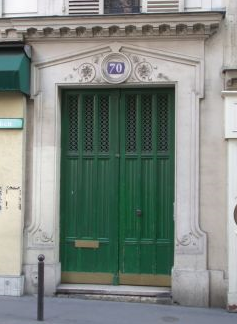
In 1765, across the road at No. 70, the Clichy customs post to collect tax on goods moving in and out of Paris was erected. It survived until the 1789 revolution.
In the 19th century the road became the centre of high society and of musicians. Mozart lived for five months in No. 5 in 1778, while Chopin lived there from 1834 to 1836, before moving to No. 38 from 1836 to 1838. Rossini lived in an apartment on the first floor of No. 2 from 1855.
On August 22 1849 Victor Hugo, elected president of the Second International Peace Conference, gave the inaugural speech in the Salle Ste Cécile at No. 59. In it he spoke for the first time of the need for a European Union in order to preserve future peace.
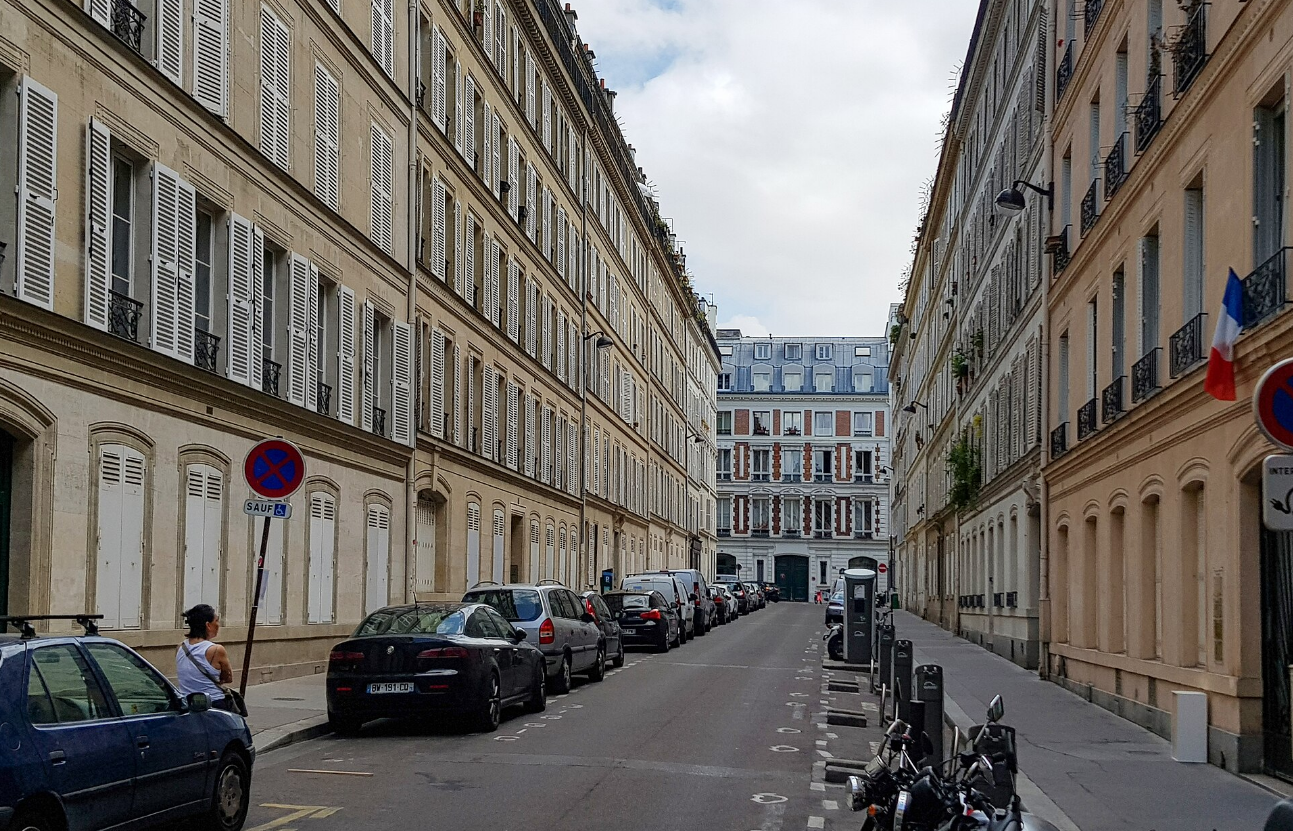
The present road follows almost exactly the old Roman ‘road to the sea’ to Harfleur (Caracotinum) in Normandy from Paris (Lutèce), and is named after the commune of Clichy to which it leads, some 6 km northwest of Paris.
Victor Hugo lived on the fourth floor of No 21 from 1874 to November 10 1878. He wrote his last great novel, Ninety-three, there before moving to the Avenue d’Eylau to live next door to his son’s widow and her children.
Between 1804 and 1806 Hugo had also lived with his mother (with frequent visits from her lover Lahorie) and two brothers at No. 24. In 1807 Sophie and the three boys undertook a long journey to Naples to see her officer husband, but where they spent one night before returning to Paris and moving into a fourth-floor apartment in the former monastery in the Rue des Feuillantines in February 1808.
The Clichy prosecutor, Bulot, lived on the second floor of No. 39. Bulot had called for the death penalty against three anarchists who had been shot at by police in Clichy after protesting the May 1 1891 mass shooting of 8-hour day demonstrators at Fourmies. After the trial led to two of them being given prison sentences of five and three years, Ravachol, an anarchist and burglar, left a bomb outside Bulot’s door at 8 am on the morning of March 27 1892. The bomb exploded a few minutes later wounding seven people and destroying the flat. Ravachol was arrested on March 30 and executed on July 11 1892.
The deputy for the Ain department from May 1849, a former army doctor who treated the poor, Jean-Baptiste Alphonse Baudin, lived at No. 43 during the Second Republic. He was one of several deputies who accompanied Victor Schœlcher to the barricade in the Saint-Antoine district to try and persuade soldiers from supporting Louis Napoleon’s seizure of power on December 2 1851. That was where he was shot dead, becoming a symbol of republican resistance to despotism. Buried secretly in the Montmartre Cemetery (27th division), Baudin’s remains were transferred to the Pantheon on August 4 1889, part of the celebrations of the centenary of the 1789 French Revolution.
The Clichy prison, known as the Debtors Prison from 1834 to 1867, was situated between Nos. 54 and 68. The private mansion originally at No. 54 was where the Royal Coach was hidden before taking Louis XVI and Marie-Antoinette to Varennes on their failed escape attempt of June 20 1791.
The Communard Sidonie-Marie Herbelin lived at No. 55. She was sentenced to deportation to a fortified prison in New Caledonia on May 13 1872. Witnesses said she had been carrying a red flag while encouraging others to loot the home of an absent Versaillais policeman. She was deported on the same boat as Louise Michel, but never returned to France, dying on March 24 1875.
Built in an area designated under Charles X as the ‘European district’ in 1826, the road’s name was intended to celebrate the close relations between France and Belgium after the 1820 Treaty of Kortrijk with the Kingdom of the Netherlands that defined Belgium’s borders.
Its only real historical signficance is that having done extremely well as a writer, Émile Zola, occupied the whole of the ground and first floors of No. 21 bis.
Zola’s principal home, living with his wife Emilie for over 20 years until his mysterious death in 1902.
On two of the walls of the house were portraits of Zola and his wife given to them by Édouard Manet, and on others paintings by his childhood friend, Paul Cézanne. There is now a plaque to Zola next to the main entrance.
In the 17th century it was called ‘The rubbish dump path’ (chemin de la Voirie), but when in the 18th century it graduated to being a road it was given the name of the Cadet family who owned some of the land it crossed.
In 1820 the road also housed the Bazar francais, a shop that served as a meeting place for several disgruntled army officers who planned unsuccessfully to overthrow the Bourbons and bring Napoleon’s son to the French imperial throne.
On March 15 1917 the first issue of a new literary review founded by Pierre Reverdy appeared in Paris called ‘North-South‘. Its title indicated a rapprochement between the artistic and literary colonies in the Montmartre and Montparnasse areas, connected directly by the metro.
The review’s first office was at No. 12, and virtually all the later surrealists and Dadaists wrote for and/or attended meetings there: Aragon, Breton, Éluard, Tzara and Duchamp. Georges Braque and Fernand Leger also produced drawings for it.
An illustration by Fernand Leger in 1918 for the Nord-Sud review
The Lodge of France’s oldest, traditional liberal Masonic order, the Grand Orient of France, was based at No. 16. This was where many political events took place. These included the founding of the League for the Rights of Man in 1888 and the first show in 1933 of the October Group’s play supporting the Scottsborough Boys, the young black men wrongly found guilty of rape in 1931.
Rue Cadet no 16 Masonic grand order
French Masonic orders were banned in 1940 under the German Occupation , and the offices of the Grad Orient taken over by the French police’s intelligence unit tracking down secret societies. One hundred agents worked there under the direction of the Gestapo. On August 11 1941 a second law was added to permit the seizure and sale of all Masonic temples and goods belonging to individual Masons. The photo of the entrance to the Lodge above was taken in 1941.
After Jules Vallès gave a lecture on Balzac at the Casino Hall at No. 18 on January 15 1865, Vallès was fired from his job in the Vaugirard Town Hall for having criticised the Second Empire.
Dividing the 2nd and 9th arrondissement, the Boulevard gets its name from the Capucine Monastery, whose gardens used to lie along the south side of the road.
The Vaudeville Theatre at No. 2 organised a benefit show by the Art Theatre for Gauguin, Flora Tristan‘s grandson, and Verlaine on May 21 1891.
Lenin also showed up there on January 12 1910 to see a play called ‘The Barricade‘ by the catholic reactionary Paul Bourget.
During the Paris Commune‘s final days on May 22 1871 a barricade with 12 canon crossed the road at the Place de L’Opéra.
The first Pan African Congress was held at the Grand-Hôtel de la Paix at No. 12 on February 19 1919. Fifty black representatives who had been excluded from the Versailles Peace Conference met together, closely watched by the police. The American William du Bois and Senegalese Blaise Diagne were its joint chair persons.
The Café de la Paix on the ground floor of the hotel on the northwest corner of the junction between the Boulevard meets the Opera Square opened on June 30 1862. On July 14 1937 it was attacked by striking waiters.
Throughout the German occupation a notice was displayed saying: Jews not allowed (Interdit aux juifs).
The radical democratic German poet Georg Herwegh put up Marx and Jenny von Westphalen at No. 13 when the couple first arrived in Paris on October 12 1843.
The victorious Austrian Emperor Francis 1 stayed at the Colonnade private mansion at Nos. 37 to 43 in 1814 and again in 1815, when it became the Foreign Ministry. It stayed that until 1853.
On September 7 1831 a demonstration outside the Hotel de la Colonnade, the Foreign Ministry at Nos. 37-43, was dispersed violently by the army. The demonstrators shouted: ‘Long Live Poland, Down with the Ministers’.
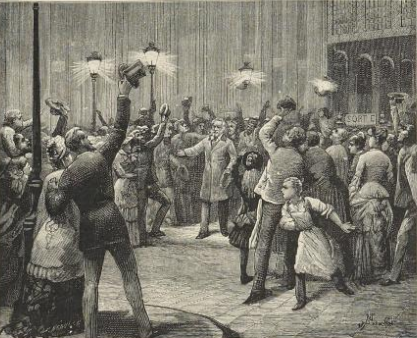
In the early evening of February 23 1848 another demonstration outside the Ministry sparked the 1848 Revolution. The 14th Line Regiment, protecting the sacked reactionary prime minister Guizot, fired directly into the crowd killing 52 people and wounded many more.
After 52 demonstrators are killed outside the Foreign Ministry on February 23 1848 the call for revenge leads to revolution rather than reform
The bodies of those murdered were then paraded throughout Paris and by the morning most arms shops had been looted and some 1,500 barricades erected.
A big meeting room at No. 39 saw several political meetings at the end of the Second Empire in 1870 and 1871. On September 22 1889 Louise Michel and Maxime Lisbonne, known as the d’Artagnan of the Commune, organised a meeting there in that year’s election campaign. Lisbonne’s manifesto stated:
‘ENTERTAINER I am! ENTERTAINER I remain! Give me your votes to swell the numbers of those who dare to say the same, and you will see that if I hesitate, like a real entertainer, the words on the paper that will come out of the hat will be ‘DEMOCRATIC SOCIAL REVOLUTION’.
Boulevard de Clichy painted by Van Gogh March-April 1887.
In 1864 Haussmann prolonged the Clichy Boulevard by extending it with the Boulevard des Martyrs and the Boulevard Pigalle. These were the old broad roads that had followed the 18th century tax farmers’ wall around Paris and which had helped lead to the 1789 French Revolution.
When it was still called the Boulevard Pigalle, Daumier lived at what is now 36 Boulevard de Clichy from roughly 1859 to 1863.
Just to the south of the Montmartre hill the Boulevard was the border between a more expensive inner-Paris and a cheaper area for artists to live in and bars serving tax-free booze. Its even numbers on its northern Montmartre side are in the 18th arrondissement, and the odd numbers in the 9th.
Auguste Renoir lived at No. 11 in 1887, when he painted ‘The swing’, featuring his brother Edmond and Norbert Goeneutte, a painter who illustrated Zola‘s novel, Earth.
From 1886 to 1888, Paul Signac‘s studio was at No. 130. He then moved his studio to No. 20 from 1889 to 1891, where Georges Seurat‘s meetings of the Pointilliste artists used to take place on Mondays.
The painting by Vincent van Gogh of the Boulevard de Clichy at the head of this piece was painted when Vincent had just joined his brother Theo in March 1887, staying close by on the Rue de Laval and then from June in the Rue Lepic. Van Gogh was often at No. 62, the Café du Tambourin, where he gave the owner some of his earliest paintings in exchange for meals, and his first exhibition took place. and Seurat, Toulouse-Lautrec and others also used to eat there.
When he first arrived in Paris in May 1901, Picasso lived in the 6th floor studio at No. 130ter until 1904 during his ‘blue period’. He later lived at No. 11 from 1909 to 1912; for the last five years of his life Edgar Degas (1834-1917) lived on the fifth floor of No. 6, where he died aged 83.
No. 4 used to be the anarchist bookshop belonging to Jules Erelbach, the man known as Ducret who was murdered by Léon Lacombe for allegedly betraying Garnier, one of the Bonnot gang in 1912. Victor Serge was later sentenced to five years imprisonment for his journalistic support for the gang.
In 1928 Jacques Prévert and his wife Simone lived at No. 64, the Hôtel le Radio. While there he wrote some of his first poems, and was visited by André Breton.
The Moulin Rouge was built in 1889 at No. 82-90 on the site of the White Queen ballroom, where Georges Clemenceau and Louise Michel both attended a big political meeting at the close of the Second Empire in 1870.
In the mid-1920s the Café Le Cyrano at No 82 became the headquarters of the surrealists around Breton.
In the 1950s, Fernand Léger set up an art school studio at No 104, where he taught with his second wife Nadia.
In the middle of the boulevard outside No. 122 there is the base of a statue of Charles Fourier (1772-1837). The utopian socialist thinker was sculpted by the anarchist Émile Derré but the statue was destroyed by the Germans in 1942 to be melted down for armaments
Fourier by Franck Scurti and a century earlier by Emile Derre. Fourier’s argument was that there was something fundamentally wrong with an economic system that sold an apple in Paris at 100 times the price it was sold in Rouen. The huge apple was erected there in 2011.
Leading up to the Saint-Lazare station built in 1837 the road was called du Havre in 1845 after the port in Normandy that the station served. The name was extended to include a section of the Rue de la Chaussée-d’Antin with its reference to the Duke of Antin whose town mansion was built there.
The earlier name had been changed during the French Revolution first to Rue Mirabeau le Patriote from 1791 to 1793 and then to Rue du Mont-Blanc from 1793 to 1816. With the Bourbon restoration it had gone back to Chaussée-d’Antin.
The odd numbers in the road are in the 9th arrondissement and the even numbers in the 8th.
Zola met Jeanne Rozerot in 1888 when he was 48 and she was 21. Their children were born in 1889 and 1891. This photograph was taken in 1893, two years after Zola’s wife found out about the relationship.
Emile Zola was often seen walking in this road, since in 1897 he rented an apartment at No. 3 for Jeanne Rozerot, his mistress and mother of his two children.
At No. 8 the Lycée Condorcet, opened in 1803, in the relatively recent monastery of the Capucin monks built in 1780 and nationalised in the Revolution, is one of the four oldest secondary schools in Paris.
Besides three former presidents of the Republic, among the leftists who were educated there were Victor Schoelcher and Paul Verlaine, and much more recently Alain Krivine. Jaurès and Sartre both briefly taught philosophy there while Mallarmé taught English.
Boulevard des Italiens by Gustave Caillebotte (1880)
One of the ‘Great Boulevards’ in a wealthy part of Paris, it was built on the allotments outside the city when in 1670 Louis XIII’s wall around Paris was declared obsolete. Initially called the ‘New Boulevard’ and then the ‘Depot Boulevard’ (after the 1764 regimental arms depot there). It was finally named after the Italian Theatre built there in 1783 that is now occupied by the Comic Opera.
Even numbers are in the Ninth arrondissement, while odd numbers are in the Second.
From December 1919 to 1923 Louis Aragon and André Breton with other surrealists used to meet regularly in the Café Certà at No. 2. This address was in the ‘Passage de l’Opéra‘ – two parallel galleries of cafés and shops first built in 1822 and demolished in 1925.
The Mulhouse bar was based at No. 8. In March 1848 meetings of the German democratic association used to take place here, attended, among others by Karl Marx and Ludwig Feuerbach.
Ironically, on the other side of the Boulevard, at No. 9, in 1942 to 1943 the Vichy government tried unsuccessfully to recruit French workers to work voluntarily in Germany.
Crédit Lyonnais’s headquarters was built between 1876 and 1913 in the grand Haussmann style. This didn’t stop it experiencing a strike and occupation in 1968
Arlette Laguiller, who became the first woman to stand for President of France as a candidate of the Trotskyist Lutte Ouvriere sect in 1974, led a strike and occupation in 1968 at the Credit Lyonnais headquarters at No. 19 in 1968. The building had been the first in Paris to be lit by electricity in 1876.
Louis Blanc lived above the Tortoni café at No. 22 for a period.
No. 30 was the site of a bomb left by the anarchistsAction Directe against the Israeli Leumi bank on 13 April 1985.
The view of the Sacré-Coeur being built above the Notre-Dame-de-Lorette church must have both annoyed and inspired the artistic and literary figures working on La Revue Blanche in the 1890s.
The street offers an extraordinary view, notes Hazan (WTP), of the Sacré-Coeur rising above the Notre-Dame-de-Lorette church. No better reason, perhaps for Fénéon to host the first Georges Seurat retrospective just a few months after the painter’s early death aged 32 at No. 1, the editorial offices of La Revue Blanche.
Toulouse-Lautrec was one of many leading artists who Feneon attracted to La Revue Blanche after becoming editor in 1895, just a year after he had been acquitted of an anarchist conspiracy to undertake a bombing campaign in Paris
Fénéon became La Revue Blanche’s editor in 1896 and committed it strongly to defending Dreyfus from 1897. He published many articles by Léon Blum, then a young lawyer who in his spare time reported on the trials taking place.
Fénéon, Zola, Proust, Sorel, Claude Monet, Emile Durkheim and Daniel Halévy were among the signatures organised from the offices of La Revue Blanche on 15 January 1898 to an early petition to reopen Drefyus’ trial.
No. 8 was the location of the picture gallery opened in 1863 by Alexandre Bernheim, who displayed the paintings of Gustave Courbet and Camille Corot, among others, and who was the organiser of Van Gogh’s first Parisan exhibition in 1901.
In 1872, after Courbet had spent 9 months in jail for his part in the Paris Commune, his work was rejected for display at that year’s Salon. The art dealer Paul Durand-Ruel then showed Courbet’s painting Fruits at the gallery he had opened at No. 16 in 1867.
Rejected by the Paris salon of 1872 Courbet’s Fruits that he painted in 1871-1872 while in jail, was exhibited by the dealer Durand-Ruel at No 16 Rue Laffitte.
In October 1906. after Marguerite Durand‘s La Fronde ceased publication in 1905, Jane Misme founded the weekly feminist 4-page journal, La Française: Journal de progrès féminin, whose offices were at No 49. It became the official outlet of the National Council of French Women (CNFF)
The feminist Jane Misme founded the journal in 1906. In 1909 it became the mouthpiece of the French Women’s Suffrage Union. Charlotte Bonnin‘s report on Equal Pay was published in it in 1929
Origins
The old street Rue d’Artois was renamed in 1897 after one of France’s most influential bankers, Jacques Lafitte (1767-1844). His first job was in the Perregaux Bank, whose international connections led it to become the bank of the French Revolution’s Committee of Public Security, and then financial advisers to Napoleon Bonaparte.
In 1814 Laffitte was asked to head up the Bank of France, which he did until 1820. In the July 1830 Revolution he was one of the most important figures aiming to thwart any move towards a new republic and instead to secure the crown for Louis-Philippe of the Orleans branch of the Bourbon family.
Laffitte became the president of the Chamber of Deputies which declared the throne vacant and that Louis-Philippe was the new king. Laffitte became both President of the governing council and minister of finance in November 1830. He lasted only until March 1831 when he resigned as it became clear that Louis-Philippe was going to try and maintain all the monarch’s power over government rather than move towards a parliamentary government system.
Jacques Laffitte the influential banker who believed a parliamentary system giving power to France’s new wealthy was needed rather than Bourbon and Orleans direct power.
Named because it was an old road that headed towards Montmartre village where, legend had it, St Denis, the first Paris bishop, and his followers were beheaded. It was temporarily renamed the ‘Field of rest’ road (rue du Champ-de-Repos) from 1793 to 1806 at the moment during the French Revolution when the cult of Reason was on the rise.
Béranger‘s friend, the republican Restoration deputy, Jacques-Antoine Manuel, died at No. 19 in August 1827. This was also the address where the Natanson brothers set up la Revue Blanche in 1889.
Victor Schoelcher spoke at a meeting on February 4 1879 at the Paz gym at No. 34 about education reform.
An art gallery at No. 65 was owned by the antique dealer Père Soulier that was a meeting place for Spanish artists. In 1901 Picasso bought a Douanier-Rousseau painting there that he kept throughout his life.
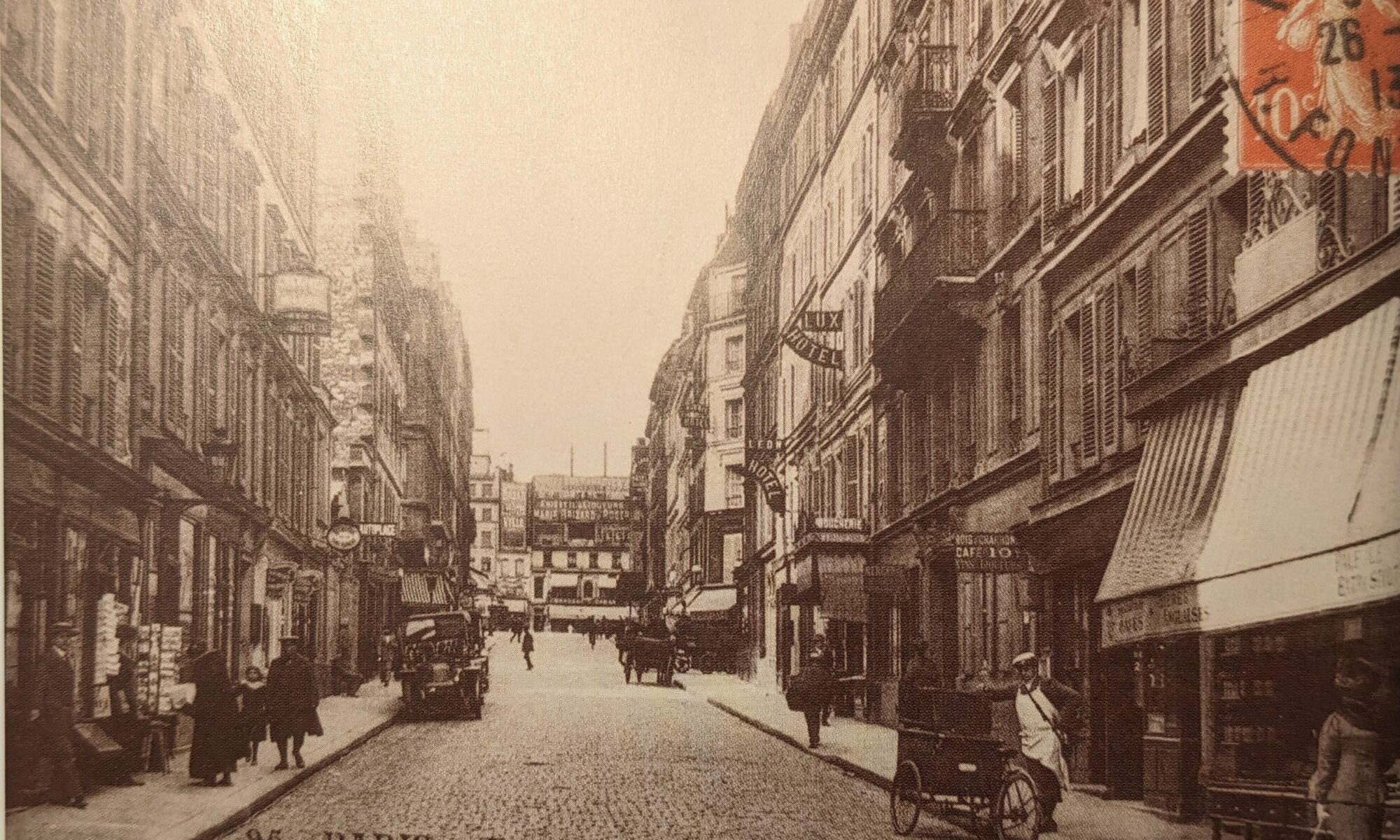
Picasso was also a regular at the Café du Grand Hôtel des Deux Hémisphères at No. 79, along with Appolinaire and many others. The photograph above was taken in the 1900s looking southwards towards where the road crosses the Boulevard de Clichy.
For centuries before 1881 its name was the New Road of the Mathurins (rue Neuve-des-Mathurins) after a farm that had belonged to Mathurin monks who took the name of the 4th century martyr, Mathurin of Larchant. This Saint was very very popular in the Middle Ages, supposedly because of his prowess in healing madness and anxiety, and was the patron saint of clowns.
Daniel Stern, author of the History of the 1848 Revolution, was Marie d’Agoult. Under the July monarchy (1830-1848) she used to host a salon at No. 10 that was frequented, among many others, by Victor Hugo.
George Sand was living at the Florence private house at No. 26 with Baron Casimir Dudevant when she gave birth to her son, Maurice, on June 30 1823. At the time it was owned by the former head chef of Napoleon. It is now a 3-star hotel called George Sand.
The Michel Theatre founded by Michel Mortier was in the basement of No. 38.
This was frequented by Aragon and Picasso who witnessed a fight there on July 6 1923 when Breton (a future surrealist) broke the arm of Tzara, the leading Dadaist .
The street was originally opened on land belonging to the Abbey and then named after the 17th century 43rd abbess of the Montmartre Abbey, Marguerite de Rochechouart de Montpipeau. It only began to be built up in the 18th century was then incorporated into Paris in 1863.
Honoré Daumier lived at No 42 for the last ten years of his life.
Daumier lived at No 42 from 1863 to 1879. It became a theatre and music hall and was the meeting place where Engels and others founded the Second International in 1889.
The same address welcomed the founding meeting of the Second International which Engels and others called., and set the objective of the 8 hour day for all workers This was on the 100th anniversary of the French Revolution, in 1889, and took place in the theatre at the address that, ominously, was called Fantaisies parisiennes.
Ben Bella was hidden by Algerian friends in the street in 1952 on his way to Switzerland.
Cafe Tortini at no 2. Louis Blanc lived above it in the 1840s
Named after the three generations of the Taitbout family who successively became Clerks to the Paris Town Office from 1698 to 1775, the road was opened in 1773.
Louis Blanc lived 1842 to 1848 above the Tortini café at No. 2 that was founded by a Venetian migrant initially called Velloni as a cafe and ice-cream parlour in 1804 (sketched above in 1888). It was there that Blanc and his supporters, Louis Greppo, Théophile Thoré and Hippolyte Detours, met on May 14 1848 and decided not to participate in the following day’s protest demonstration against the new government’s refusal to support the Polish revolutionaries.
Many writers, musicians and artists lived at a creative colony of separate houses at No. 80 that was known first as the Cité des Trois-Frères and then as the Square d’Orléans. Rebuilt in classical style and finished in 1841, from 1842 to 1849 Frédéric Chopin lived in No. 9, while George Sand lived on the first floor of No. 5 from 1842 to 1847. The lovers were both visited by many of the period’s celebrities, including Leroux, Honoré de Balzac, Heinrich Heine, Eugène Delacroix, François Arago and the actress Marie Dorval.
A broad tree-lined road just to the south of the Farmers’ general tax wall, it was opened by a royal decree in 1833, and named after an early 18th century peer of the realm who had a rare reputation for honesty in his post as Prévôt des marchands de Paris (Paris’ Prefect for Commerce, the equivalent of today’s Mayor of Paris).
Its most remarkable building is a huge, historic secondary school, the Collège-lycée Jacques-Decour, where Lucie Aubrac was nominated to teach in 1946.
The Collège-Lycée Jacques-Decour viewed from the North, with the Boulevard des Batignolles in front of it and the Avenue Trudaine on the other side.
The school was originally founded in the 15th century as the Sainte-Barbe college of Paris University. Its current building was moved there by Haussmann and constructed between 1867 and 1876 on the site of the old Montmartre abattoir.
The name was changed in 1944 from Rollin (the name of an 18th century historian) to Jacques Decour, the resistance pseudonym of Daniel Decourdemanche (1910-1942), who had taught German at the Lycée since 1937.
Decourdemanche had joined the Young Communists and then Communist Party. His first book called Philisterburg after teaching in 1932-33 in Germany denounced the risks of nationalism and racism.
Every year his goodbye letter to his parents is read in the school where his parting words were:
I consider myself a little like a leaf that falls from a tree to help become soil. The quality of the soil depends on that of the leaves. I am talking about French young people.
Daniel Decourdemanche’s headstone in Montmatre Cemetery
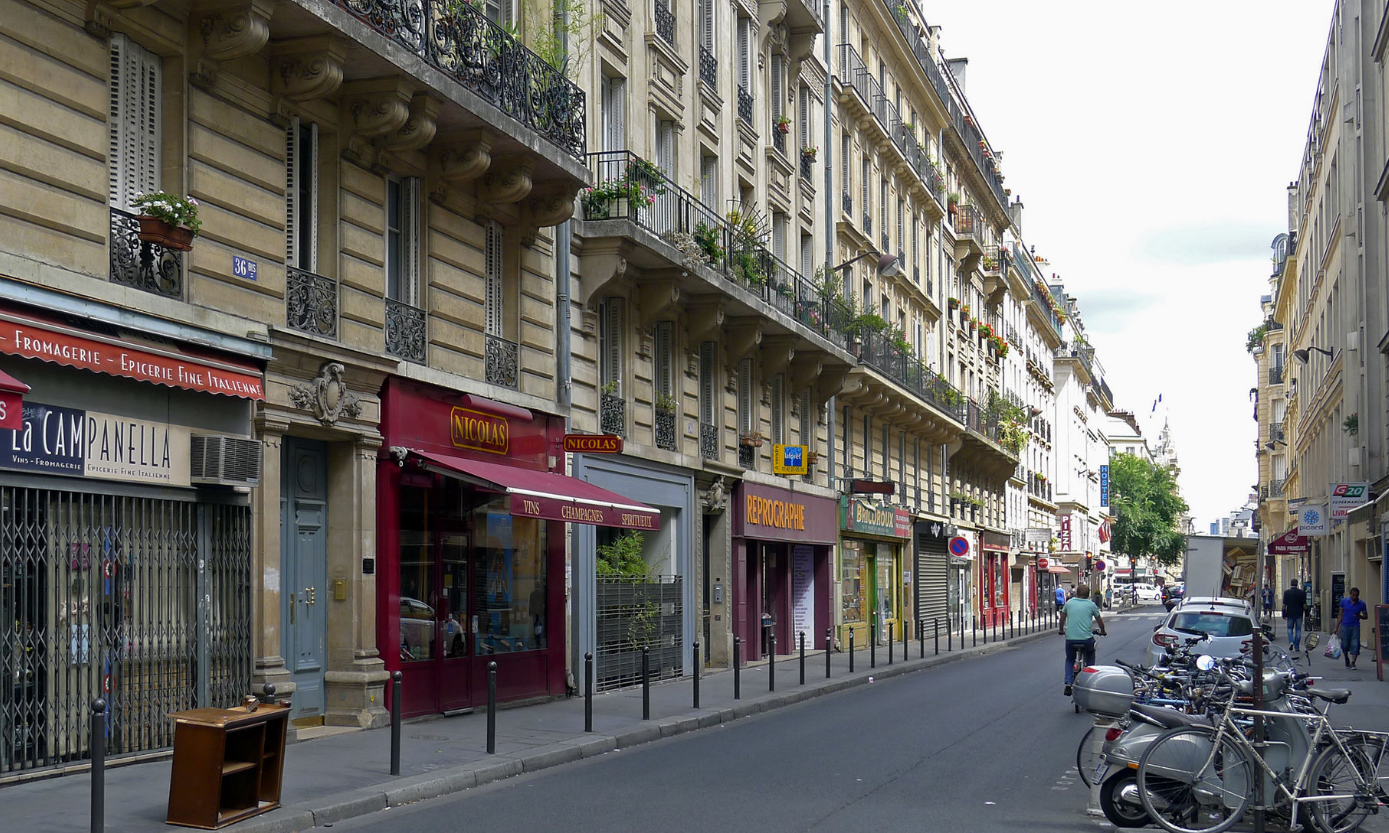
In 1817 under the Restoration the Rue Ferrand (after the landowner on which it was built in 1777) was renamed the Rue Laval after the 71-year-old aristocrat Abbess of Montmartre (Marie-Louise de Laval-Montmorency) executed on July 24 1794. In 1887 it took its present name to honour the composer and music teacher Victor Massé who had died three years earlier.
In the 1920s and 1930s, No. 6 housed the People’s Bookshop (Librairie Populaire) run by the Communist Party. You could buy not just books and pamphlets there, but also busts of great people, badges, red flags and also red liberty caps (Phrygian bonnets).
No. 9 Rue Victor Massé
No. 9 was a key address for French socialists. On April 11 1918 Léon Blum, Jean Longuet and Paul Faure published the first daily issue of the evening paper, Le Populaire, from there.
The offices of Le Populaire and of the French Socialist Party were at No. 9 through the interwar years
Close to Montmartre several artists had workshops and/or lived in the road. Edouard Manet had studied at Thomas Couture’s workshop at No. 23 in 1850. Pierre Bonnard lived at No. 18 in 1890. During his second stay in Paris Vincent van Gogh lived with his brother at No. 25 in March 1886. Berthe Weill had a gallery at that address too, where in 1901 she held a joint exhibition of paintings by André Derain, Maurice de Vlaminck and Henri Matisse. This was also where Diego Rivera opened his first solo exhibition on April 21 1914.
Maurice Ravel also lived in the street between 1880 and 1886 at No. 29, while Edgar Degas lived at No 37 from 1890 to 1912 with his workshop in the attic.