Chronology from Le Maitron of key dates in French labour history
Author: Stéphane Sirot, additional material by Michel Cordillot, René Lemarquis and Claude Pennetier with Steve Jefferys (italicised)
1831
January 15 Blanqui and other student leaders are arrested for organising violent demonstrations near the Sorbonne and judged by its Academic Council.
February 8 The clockmaker Charles Béranger‘s ‘A proletarian’s petition to the Chamber of Deputies’ was published by Le Globe, established by Pierre Leroux.
February 14-15 Anticlerical and anti-Bourbon riots take place in Paris after a Legitimist commemoration of the murder of the Duke de Berry at the Saint-Germain-l’Auxerrois church opposite the Louvre. This was occupied by republican demonstrators who then marched on the Archbishop’s palace near Notre Dame, pillaging and wrecking it. These riots were followed later in provincial France.
March 2 Republican riots break on in Paris after the acquittal of prisoners charged with infringing restrictions on press freedom. Protesting workers march on the Palais Royal, the Louvre and on the Town Hall. The Russians eventually take Warsaw on September 8.
March 9 Republicans riot in Paris on hearing the false news that the Russians had seized Warsaw. The windows of the Russian Embassy were stoned and the crowd sang the Marseillaise.
March – June Demonstrations take place against the introduction of machines in factories in Nantes, Saint-Étienne, Bordeaux and Le Havre.
April 6-10 Trial of 19 republican members of the Friends of the People Society, including Godefroi Cavaignac, arrested during the December 1830 riots. They are all acquitted by the jury on April 15/16, giving rise to several working class demonstrations.
April 9-12 Riots of Lyon silk workers (canuts).
May 5 A Bonapartist demonstration takes place at the Place Vendome on the anniversary of Napoleon’s death.
June Serious rioting in the Saint-Denis district resulting from the tough economic situation. The repression was very severe with many victims.
June 1 The Philanthropic Society of Parisian Working Tailors is established.
June 14-16 Riots in Paris put down by the National Guard and regular soldiers. Particularly heated fighting takes place in the Faubourg Saint-Denis and Boulevard Bonne-Nouvelle.
July 14 Working class riots. Republican attempt is made to plant an Equality Tree in the Place de la Bastille, at the Pantheon, in the Place de Grève and in the Place de la Concorde. The more than 1,500 demonstrators are dispersed by police dressed in disguise as workers. The publication Au Peuple is seized.
September 7 1,500 textile workers organise a demonstration, followed by riots in Paris that don’t end until September 17.
October The Saint-Simonian manifesto is published with a big propaganda campaign in the provinces.
October 30 The first issue of the Factory Echo (L’Écho de la Fabrique) appears in Lyon.
November The Saint-Simonians split. The most faithful will follow Prosper Enfantin to Egypt. Others, like Abel Transon and Jules Lechevalier, publicly turn to Fourierism.
November 14 Philipon draws and then publishes a cartoon of King Louis-Philippe as a pear. He is charged with ‘insulting behaviour towards the king’.
November 20-22 The Lyon silk workers revolt; the negotiations conducted by the prefect fail; an insurrection takes place. Hard repression led by Marshal Soult with 10,000 troops takes place and the revolt finally ends on December 3.
December 15 Daumier‘s cartoon of Louis-Philippe Gargantua is published in La Caricature.
1832
January 10-12. Trial of “The Fifteen” leaders of the SAP (Societe des Amis du Peuple). The accused (Auguste Blanqui, Bonnias, François, Guillaume Gervais, François-Vincent Raspail, Antony Thouret) defend themselves; they are found guilty and sentenced on 27 February, Blanqui was sentenced to a year in prison. The SAP was officially dissolved but it continued its activities.
February. Several newspapers are put on trial. A workers’ commission is set up within the SAP made up of Auguste Caunes senior, Gaussuron-Despréaux, François Sugier). Pierre Leroux and Jean Reynaud take over editorship of the Revue encyclopédique, organ of the neo-Saint-Simonians
February 6 The first cholera epidemic victim dies in Paris.
February 23 Daumier is sentenced to six months in prison and fined 500 francs for his Gargantua cartoon.
February 26 Chopin gives his first concert in Paris in the Pleyel‘s salon in the Rue Cadet.
March 29. Official announcement of a cholera epidemic in Paris.
April 1 Revolt by prisoners at Sainte-Pélagie, supported by several sections of the SAP. One death. A protest by Parisian chiffoniers (rag collectors) begins against the official collection of refuse introduced by the authorities to try to halt the spread of cholera.
April 20 Leroux’s newspaper Le Globe ceases publication.
End April. Commissions for the Rights of Man are set up within the Friends of the People Society (SAP).
May 16 The banker, mine owner and President of the Council of Ministers (Prime Minister) since March 13 1831, Casimir Perier, dies of cholera. He had visited ill patients in Paris’ principal hospital next to Notre-Dame, the Hotel Dieu. A conservative right-winger who had tried to keep Charles X in power he had accepted the position of prime minister only after Louis-Philippe had agreed to allow him to have more freedom of manoeuvre in government than the king.
June 1 Jean-Maximilien Lamarque dies of cholera at his house in the Rue St Honore. Promoted to General by Bonaparte in 1801, he again served with him during the Hundred Days of 1815. Exiled until 1818, he supported the liberal opposition to Louis XVIII and then Charles X. Elected a deputy in 1828, he reluctantly accepted the July Monarchy. His reputation was as someone who had fought both for the Republic and the Empire.
June 2 A large gathering of members of the Friends of the People (SAP) takes place at the funeral of the 20-year-old republican who posthumously become known as one of France’s leading mathematicians, Évariste Galois. He had been mortally wounded in a duel, and was buried in Montparnasse Cemetery.
June 5-6. Popular insurrection in Paris on the occasion of the funeral of General Lamarque. The last group of insurgents fight heroically around the cloisters of Saint-Merri in the Rue de St Martin. Casualities are very heavy: at least 150 are killed on the side of the insurgents, more than 400 are wounded and more than 1,500 arrested; 134 deaths and 326 wounded on the side of the police. A state of siege is declared in Paris that lasts until June 29.
Summer. Birth of the Society for the Rights of Man (SDH).
August 15 The first issue of La Femme libre (the Free Woman) appears. It was an answer by working class women to the Saint-Simonian ‘silence’ on the women’s question imposed by Prosper Enfantin. ‘Written and published by women’ from No. 17 Rue du Caire, it only gives the first names of one founder and one editor, .Jeanne-Désirée (Véret-Gay) and Marie-Reine (Guindorf). One other name appears in the single article in the first issue, that of Jeanne-Victoire (Deroin), a washerwoman who had become a teacher. Thirty-one issues of the paper appear until it ceases publication in 1834.
August 27 Daumier is imprisoned in Sainte-Pélagie.
August 27-28 Trial of the Saint-Simonians in the Court of Assizes in Paris for organising an illegal association and of publishing material offensive to public morality. Prosper Enfantin, Michel Chevalier and Charles Duveyrier are sentenced to one year in prison. Enfantin and Chevalier are imprisoned in Sainte-Pelagie on December 15.
October 23-31 Trial of the 22 charged with fighting on the barricade at cloisters of Saint-Merri. Charles Jeanne, who had been awarded the July 1830 decoration for his part in that insurrection, told the court he took full responsibility for his actions. He was sentenced to be deported, but instead, after being moved successively between various prisons he died in 1837.
November-December Several groups of Saint-Simonian missionaries (40 altogether) move from Paris to Lyon to build a ‘workers peaceful army’ there.
December 1 Charles Philipon sets up Le Charivari, an illustrated daily satirical paper that later served as a model for Punch.
December 15. Opening of the trial of “The Association of Rights” against the SAP (Friends of the People). The SAP is definitively dissolved, but the acquittal of the accused enables it to survive for a little longer.
1833
January 25 La Tribune publishes a list of five great ‘patriotic’ (Republican) associations in Paris, including the Society of the Friends of the People (SAP) and the Society for the Rights of Man (SDH). With the exception of the Société Aide-toi, le Ciel t’aidera (Help yourself, God will help you) distant from the workers’ movement, the other associations for free public education and for press freedom played a significant part in encouraging republican ideas in working class areas of Paris.
February 1 Already imprisoned in Sainte-Pélagie for having published four lessons of a course on the history of France from 1789 to 1830 that ‘attacked the authority of the King, spread hatred of the government and of a class of people, calling for civil war and the pillage of private property and for an insurrection’ Albert Laponneraye publishes his Lettre aux prolétaires. It wil be followed by Deuxième lettre aux prolétaires dated 26 March. (The first of these letters will see the author be condemned on 27 June following). As a result he was only finally released in June 1837.
May 17-27 Insurrection of the Anzin coalminers after the launch of their ‘Four Sous’ strike which is put down by the army.
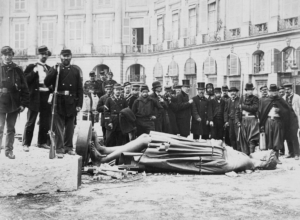
July 28 Napoleon’s statue is put back on top of the Vendome column.
September 1 Étienne Cabet publishes the weekly newspaper, Le Populaire that appears until October 1835.
September-October Reorganization of the Société des droits de l’homme (SDH) with the far left ‘Montagnards’ becoming predominant after several months of internal conflicts. These were between the ‘Girondists’ (following Francois-Vincent Raspail) and the “Montagnards” (following Napoleon Lebon).
Within the Society, a Propaganda Committee in charge of education and organisation of workers, is founded. It gathers Neo-Babouvists like Lebon, Buonarroti and Marc Voyer d’Argenson, as well as workers like the tailor Alphonse Grignon and shoemaker Zael Efrahem.
Several of its members will be imprisoned in November as ‘instigators of combinations of workmen’. Important movements of the carpenters in Paris, tailors (who create a “national workshop” to provide work for the strikers), shoemakers and bakers. Creation of a Lyons section of the SDH. The SDH publishes its “Manifesto” in the La Tribune. Publication of Reflections of a Tailor by Alphonse Grignon, and On the Association of Workers of all Trades by Efrahem.
October 1 Creation of the Philanthropic Society of Tailors in Nantes. It will play an important part in the creation of a network of correspondents from Brittany to Bordeaux, as in Marseille. Its leadership were arrested and organisation destroyed on 20 February 1837.
December 11-22. “Trial of the 27” leaders of the Société des droits de l’homme (SDH) including Raspail are accused of having planned a riot in July to mark the third anniversary of the “Three Glorious Days.” They are all acquitted.
1834
1834 saw the founding of an Association of Goldsmiths that survives until 1873.
January 25 A republican François-Charles Dulong caustically heckled another deputy who was defending the government’s military severity in a debate in the Chamber of Deputies. Four days later he was mortally wounded in a duel in the Bois de Boulogne. His funeral at Père-Lachaise was attended by large numbers of republicans.
February 2 The first and only issue of Auguste Blanqui’s newspaper, Libérateur, appears.
February 14-24 A solidarity strike of workers who were members of mutual aid associations takes place in Lyon following wage cuts for coat makers. The general strike lasts approximately 10 days. Seventeen master silk weavers and three apprentices are arrested.
February 16 A law is passed suppressing town criers unless they had prior permission from the local authorities.
February 20-24 After a new press law and the suppression of unofficial town criers is passed, scuffles take place at night with the police in Paris, especially in the workers’ districts of Montmartre, Montorgueil, Saint-Martin, Bonne-Nouvelle and the Faubourg Saint-Denis. In the Place de la Bourse, one man is killed when the police and cavalry break up a demonstration.
February 22 Towards the end of the general strike in Lyon, a law is passed prohibiting associations organised in branches of less than 20 persons.
February 25 Nearly all the members of two republican clubs (Gracques and Cincinnatus) are arrested at the Café des Deux Portes on the Boulevard Saint-Denis. the next day saw the arrests of 73 members of the Society for the Rights of Man.
February 28 Étienne Cabet is sentenced to two years jail for breaking the press laws. For the next five years he lives in Britain.
April 6 A funeral procession in Lyon of a protestant master workman is followed by nearly 10,000 people.
April 9-14 After wages are lowered in response to falling demand, an essentially working class insurrection breaks out in Lyon and Saint-Étienne, taking forms in Arbois, Épinal, Lunéville, Chalon, Grenoble, Vienne, Clermont-Ferrand, Marseille and Toulon.
April 10 A new law is passed limiting the right to form associations, in particular threatening workers’ mutual aid societies. It requires them to get official approval and only permits their existence if they are split into associations with fewer 20 members.
April 11 A massacre takes place in the rue Projetée in Lyon. More than 300 are killed and 600 wounded in Lyon with over 500 arrests during the insurrection.
April 12 150 republicans, including the leadership of the SDH, are arrested in Paris. La Tribune newspaper does not appear again until August 11.
April 14 Troops carry out the massacre of the Rue Transnonain. Riots are quickly repressed with very heavy causalities. Scores were killed in Paris and of the 2,500 arrested across France, half are in Paris.
June-September Disorder and revolts in Sainte-Pélagie prison.
July-August. Creation of the Société des Familles by Hadot-Desages, probably while he was imprisoned with other member of the SDH at Sainte-Pélagie, where he had recorded his profession as ‘proletarian’ . In order to avoid mass arrests of republicans in future, each ‘family’ had only five members, and only its head would know the heads of another family. It soon had between 900 and 1,600 members in Paris, including workers, students and some National Guard volunteers.
July 28 The Vatican adds the songs of Pierre-Jean de Béranger and Victor Hugo‘s Notre-Dame de Paris to the Catholic Index of forbidden books. The Index was begun in 1559 and was finally abandoned as an obligation on Catholics in 1966. Among others who were put on the list and who feature in LeftinParis are De Beauvoir, Sartre, Sand, Proudhon and Zola.
October 8 Raspail publishes the first issue of Réformateur.
1835
February 6 Members of the House of Lords (Chambre des Pairs) sign arrest warrants for more than 420 republicans over the 1834 insurrections. Defence committees are set up in Paris (Godefroi Cavaignac, Guinard, Auguste Blanqui, Vignerte…) and in Lyon (Baune, Lagrange, Caussidière…). There are disagreements between those taking a traditional defence (Jules Favre, Ledru-Rollin) and those who want to use the trial to build a movement.
April 17 The list of the lawyers chosen by the defendants appears in the press.
5 May The ‘monster trial’ begins before the court of the Chamber of Peers. 121 are charged, of whom 59 are from Lyon, 5 from Saint-Etienne and the rest from Paris. after the withdrawal of charges, according to the Tableau drawn up by Caussidière. The defendants meet at Auguste Blanqui’s apartment.
May 8 A letter with several signatures defending the accused is published by the republican Ulysse Trélat who, with others who had defended the accused, was then tried by the court of the Chamber of Peers on May 29.
June 4 The sentence of the Chamber of Peers on Trélat is three years imprisonment, while Michel de Bourges. who had redrafted the letter first drafted by George Sand, is given one year.
July 13 The Society of Families organises the escape from Sainte-Pélagie prison of 25 to 27 prisoners accused of leading the 1834 insurrection.
July 28 Joseph Fieschi is arrested after an attempt to kill Louis-Phillippe on the anniversary of the 1830 Glorious Revolution. He missed the King but killed 18 others. His accomplices, Theodore Pepin and Pierre Morey, were dedicated republicans. All three were guillotined on February 19 1836.
August 13 The Chamber of Peers court convicts 72 (of whom 22 in their absence) with the sentences announced over the next five months.
September 9 Three laws are passed to ensure the security of the state. Called the September laws they strongly restrict the freedom of the press and the theatre to make any comment that could encourage attacks on the king or the government, making it an offence to declare oneself a republican. They increase the powers of the prosecutors in cases of rebellion or of holding illegal weapons and reduce the two-thirds jury majority needed to find accused people guilty to a simple majority of 7 to 5.
December 7 and 28 The Chamber of Peers court convicts 25 of the accused from Lunéville, Saint-Étienne, Grenoble, Marseille, Arbois and Besançon.
1836
January 23 The ‘monster trial’ finally ends with 40 Parisian republicans found guilty by the Chamber of Peers.
February 19 Fieschi, Pépin and Morey are guillotined.
March 8 The government uncovers an ‘Explosives Conspiracy’. Eustache Beaufour is arrested with five other republicans in the Saint-Marceaux district while making gun powder. Two days later Armand Barbès and Auguste Blanqui are arrested followed by another 200 republicans.
June 2 A secret gunpowder store in the Rue Dauphine is raided and several members of the Society des Familles who were making cartridges were arrested.
July 11 Louis Alibaud, a militant republican, is executed for an attempt to kill the King on June 25.
August 2-11 The ‘Explosives Conspiracy Trial’ of 43 Family Society members takes place, ending with Armand Barbès, Auguste Blanqui and Beaufort being sentenced to two years in jail.
October 17-23 Most of those convicted in the ‘Explosives Conspiracy Trial’ have their appeals rejected.
December 27 A 22-year-old republican Meunier shoots at Louis-Philippe but misses. His plea for mercy is accepted by the King in April 1837 and he is exiled to the United States.
1837
January 6-18 The jury in the trial of those who had supported the failed October 30 1837 uprising in Strasbourg organised by Louis-Napoleon Bonaparte acquits all the accused.
April-July Republicans organise a campaign, with 7 posters from the ‘Printworks of the Republic’. The first was called ‘To the People’ (Au Peuple). They announce the Reorganization of the Société des Familles into teams called ‘Pelotons’
May 8 An amnesty is granted to political prisoners to mark the marriage of the King’s son, the Duke of Orléans. Those convicted in their absence or who had escaped prisoners are excluded.
June The clandestine republican Family Association (Société des Familles) is replaced by the Seasons Association.
August 7 The 17-year-old Eugène Fombertaux is arrested for putting up the seditious poster, To the People, calling of a workers’ uprising and announcing the imminent appearance of the Moniteur républicain.
November First issue of the Moniteur républicain appears. It is dated ‘3 frimaire an XLVI’ according to the Revolutionary Republican calendar The 8th and last number was published in July 1838.
December A plot against the government is uncovered involving Seasons Association members Aloys Huber, Jacob Steuble and one of the leading women republicans, Laure Grouvelle. Convicted on May 25 1838, Huber is sentenced to deportation. The others to five years in prison. Steuble commits suicide at Mont-Saint-Michel prison on December 30 1838; Grouvelle eventually goes from prison to being held in a lunatic asylum that in 1844 also held Auguste Blanqui, but where she dies.
1838
August 24 The Paris municipal police is set up. It comprises 1,444 men and 432 horses with its object the maintenance of order in Paris and the repression of riots and uncovering of anti-government plots.
August-September. Publication of four numbers of L’Homme libre, followed by the arrest of Antoine Fomberteaux and of the printers Eugène Fombertaux, Jean-Baptiste Guillemin and Lecomte Minor, who was sentenced to five years at Mont-Saint-Michel in June 1839.
1839
May 12-13 An attempted insurrection led by Armand Barbès, the printworker Martin Bernard and Auguste Blanqui through the Société des Saisons fails. Barbès, who was wounded in the fighting is arrested; the other two manage to elude the police until June 21 and October 14 respectively. There were 77 killed and at least 51 wounded on the side of the insurgents, 28 and 62 on the other side. More than 750 republicans are brought to trial.
June 11-July 12 The trial takes place of the first 19 of the May insurgents. Faithful to the Carbonari and secret society traditions, Armand Barbès and Martin Bernard refuse to defend themselves. Bernard is condemned to deportation and Barbès to death. Without his knowledge, Barbès’ sister gets the commutation of his sentence from the king to forced labour for life and then on December 31 to deportation .
October 14 Blanqui and five others are arrested. Charges against the five are not pursued.
November Saint-Simonian workers (including the singer song-writer Jules Vinçard, L.-J. Vannostal, and others) set up La Ruche populaire (‘The working class beehive’) with the Fourierists (like Henri Fugère) and the ‘Democrats’ (like the worker-poet J. Gilland) although these soon withdraw from the newspaper. Its publication will be stopped in 1842, before being followed by L’Union from 1843 to 1846.
November 28 A bomb explodes near the Palais-Royal. The police already held republican suspects including Pierre Béraud who had been arrested following the discovery on October 29 of 80kg of gunpowder at another recently released republican prisoner’s house, that of Mathieu d’Épinal. The accused are sentenced to two years imprisonment for possession of gunpowder on May 16 1840.
December The Nouvelles saisons society is set up by Henri Dourille and Lucien Delahodde, a police informer.
December 4 The second trial of the May insurgents opens in the court of the Chamber of Peers.
1840
January First edition (without the name of the author) of Voyage en Icarie by Étienne Cabet. It gives birth to the Icarian utopian Communist movement that attracts increasing support leading to the decision to leave France to found a Communist colony in Texas is taken at the end of 1847.
Formation of the ‘Egalitarian Workers’, a neo-Babouvist communist tendency.
January 1 The definitive change from the old systems of measurement to the metric system (first introduced on August 1 1793, then reestablished by Napoleon on February 12 1812, and finally passed into law on July 4 1837.
January 13-31 Trial by the Chamber of Peers of 34 of the May 1839 insurrectionaries. Auguste Blanqui refuses to defend himself. He is condemned to death on 31 January. On February 1, after the intervention of his wife and without his knowledge (like Barbès and because of the precedent set by Barbès), his sentence is commuted to forced labour for life and then to deportation. He will join Barbès and the others in Mont-Saint-Michel prison.
April 27 Those tried in their absence or were prisoners who had escaped like Godefroi Cavaignac and Édouard Colombat had not been amnestied in May 1837 are now amnestied.
June
Pierre-Joseph Proudhon pronounces his celebrated maxim: ‘Property is theft.’
An important strike movement by tailors led by André Troncin, the republican and president in 1833 of the Philanthropic Society of Working Tailors, begins against the workers’ passbook (livret ouvrier). The strike became more extensive over the following months extending to other trades. Troncin is jailed on October 14 for possessing strike funds and sentenced to five years in prison. He dies just days after his release on December 24 1845. Some 2,000 workers attend his funeral.
July 1 A communist banquet is organised in Belleville by a member of the Society of Seasons, Jean-Jacques Pillot. Police spies reported that 1,200 attended, mainly members of secret societies.
September
The utopian Christian socialist newspaper L’Atelier, written entirely by workers influenced by Philippe Buchez, is launched. It appear regularly until July 1850.
Louis Blanc publishes his book The Organisation of Work (L’Organisation du travail) that has nine editions up to 1850. It sparks furious debates that continue right up to the end of the Second Republic.
Early September Almost 30,000 workers are on strike against the workers’ passport, the hated livret ouvrier. Over 400 arrests take place.
September 4 A riot takes place around the Place de La Bastille with a gun shop being pillaged by unemployed workers.
September 7 Woodworkers in the Faubourg Saint-Antoine district erupt in response to the severe economic situation and meet with government repression.
October 15 Edmond Darmès, a 43-year-old communist republican, tries to kill Louis-Phillipe in his carriage on the Tuileries Terrasse. quai. Overloaded, his pistol exploded. A member of the Egalitarian Workers since 1839 he had participated in Pillot’s communist Belleville banquet. His trial highlights the existence of secret societies of revolutionary repubicans. Darmes is sentenced to death by the Chamber of Peers and executed on May 31 1841.
December 15 Napoleon’s ashes are taken to Les Invalides in the presence of Louis-Philippe and his family.
1841
March 14 Étienne Cabet relaunches Le Populaire. He had first founded this newspaper in 1833, but was exiled for five years in 1839. The paper survives until 1850, but its name is revived in 1916 by socialist opponents of the First World War, including Jean Longuet.
March 22 Following the 1840 publication of Louis René Villermé‘s report on the physical and moral state of workers in the cotton, wool and silk factories, a law is passed limiting child labour in factories. Children under the age of eight are forbidden to work in factories employing 20 or more workers, the working day is restricted to eight hours for 8 to 12 year-olds and to 12 hours for 12 to 16 year-olds. Night work (9pm-5am) is forbidden for children under 13 years, and for all ages, two nightwork hours will count as three. A child labour inspectorate is established comprising well-heeled and financially needy upper class friends of the employers.
May
Richard Lahautière launches the neo-Babouvist newspaper, La Fraternité.
July 11 The first edition of L’Humanitaire, a materialist-communist journal is launched by the hat-maker brothers turned book sellers, Jean and Gabriel Charavay. This was the first libertarian communist publication in France. The paper was supported by the former young farm workers, Jean Joseph May, and the jewelry worker Antoine Pierre Page. Page was among the 20 arrested on September 12 and jailed for six months for illegal association.
A letter to L’Humanitaire by the Robert Owen-influenced Jules Gay found by the police when they arrested Charavay attacked the historical obsessions of ‘the altar the throne, private property and the family’ and criticised anti-equality and non-fraternal Republicans for substituting the throne for a new fetish, the fatherland (la patrie). This letter was used to promote a witchhunt against all Republicans as anti-patriotic extremists.
August 1 The daily Fourierist newspaper, La Démocratie pacifique, that appears from 1843 to 1851, begins life as a newssheet appearing three times a week. It does so thanks to a wealthy British backer, Arthur Young.
September 11 300 mainly young demonstrators gather in the Place du Châtelet chanting republican anti-royalist and anti-government slogans. The demonstrations continue over the following week.
September 13 Francois Quénisset uses a pistol to shoot at the Duc d’Aumale, the fifth son of the King Louis-Philippe, who at the age of eight had inherited France’s biggest fortune. The Duke was riding at the head of his troops in the Rue du Faubourg Saint-Antoine returning from a stint in the Algerian war. Two horses were wounded. His trial in front of the House of Lords was turned into a trial of the Société des Travailleurs égalitaires (The Association of Workingmen for Equality) that he had joined in August. Condemned to death his sentence was commuted to life-long exile.
October
A petition initiated by Armand Barbès‘ sister and drafted by Fulgence Girard with the agreement of Auguste Blanqui and other prisoners protests the cell confinement regime for poltiical prisoners at Mont-St-Michel. The press campaign is picked up in the Journal du Peuple, Le National, and later La Réforme. The issue culminates in a debate in the Chamber of Deputies.
November 1 The 300-page monthly Revue indépendante (1841-1848) based in the rue des Saints-Pères is set up by Pierre Leroux, George Sand and the art critic and theatre director Louis Viardot. In December 1842 it becomes a fortnightly publication and early in 1844 its editorial address moves to the Rue de Richelieu.
1842
November
Théodore Dezamy finishes his Code de la Communauté that is published in full the following month. Influenced by Robert Owen and Buonarroti, a critic of Fourier, he broke with the utopianism of Cabet. He was credited by Marx as having developed the most advanced theoretical work of French materialist communism at the time. Others argue that his summary arguments about property, work and the family helped convince many Parisian workers of the merits of a communist solution to their problems.
December
There is a spike in unemployment leading to some 150 000 Parisian workers having no work.
1843
May
Six months after the success of her ‘Walks in London‘ that was dedicated ‘To the working classes’, Flora Tristan publishes L’Union ouvrière, making the case for a united working class response to capitalism. Influenced by the ideas of Fourier and Owen, she made contact with a large number of workers and with people like the song-writer Jules Vinçard and the carpenter Agricol Perdiguier. Flora Tristan was actively preparing for a Tour of France destined to popularise her project to set up local circles of the L’Union ouvrière. Exhausted, she died at Bordeaux in November 1844.
July 5 Alexis de Tocqueville reported on French prisons supporting the use of solitary confinement.
July 10 The Parisian Typographers’ Society, founded in 1839, signed the first wage agreement with the print employers association. This was effectively the very first French collective agreement.
July 29 Alexandre Ledru-Rollin funds the La Réforme newspaper. for which virtually every French leftist contributed during the mid and late 1840s. It was banned after the 1850 coup d’etat.
1844
February-December
The press campaign in support of political prisoners is buoyed by debates in the Chamber of Deputies in April and May around the prison laws. It continues until December,
February 25 The first issue of Annales franco-allemandes for which Karl Marx had moved to Paris to co-edit with Arnold Ruge is published.
March 31 A miners’ strike begins in Rive-de-Gier on the Loire as a response to an employers’ coalition aiming to reduce wages and increase working time.
April 5 300-400of the Loire striking miners try to free 17 arrested miners being transferred to another prison. The troops open fire and kill one 18-year-old miner. The strike ends after two months in a failure for the miners except in one small mine.
August 14 French occupying forces defeat the Algerians at the Battle of Isly.
October 8-14 Louis-Philippe visits Queen Victoria in England.
October 18 To counter the unpopularity of his foreign policy, Louis-Philippe grants most political prisoners limited pardons. Armand Barbès, Martin Bernard, Auguste Blanqui and some 32 others are excluded. These ‘pardons’ are, however, only ‘remise de peine‘, sentence reductions rather than a full amnesty. Those released would be denied the possibility of recovering their full rights as citizens. The government additionally hints that an amnesty would be proclaimed on November 25 when the Louis-Philippe’s fifth son gets married, although this does not actually happen.
December 9 Auguste Blanqui in the Tours hospital prison is finally given a pardon but he rejects it and it is never ratified by the Court. Blanqui stays a prisoner.
December 29 Conseils des prud’hommes ( a cross between Conciliation Boards and Employment Tribunals) are set up in Paris to over the engineering sector.
1845
January
La Réforme newspaper launches ‘The Workers’ Petition’ in the workshops of Paris.
January 9 The first issue of a communist newspaper, La Fraternité, appears in Paris. Its first editor is Brige, an activist who had been involved in the Owenite-Communist group around Jules Gay and Desiree Viret-Gary and with Flora Tristan. André Savary becomes the paper’s editor in 1846.
February 3 Marx is ordered to leave Paris because of his revolutionary activities. He moves to Brussels.
March 11 A Paris-wide employment tribunal/conciliation board (Conseil de prud’hommes) is set up in the Palais de Justice.
June 9 A strike of Parisian carpenters for a wage rise begins. For the first time, the military are placed at the disposal of the employers.
June 18-19 In Algeria General Pélissier murders a thousand men women and children by smoking them to death while they were hiding in caves in the mountainous area of Dahra on Algeria’s Mediterranean coast.
July 5 Victor Hugo, who had just been elevated to the Peerage on April 13 1845, was discovered in bed with Léonie d’Aunet, the wife of a painter who has her followed after she asks him to agree a ‘separation of they body’ – divorce still being illegal. She is jailed for adultery in Saint-Lazare prison, while Huge is released because as a peer he cannot be arrested.
October 5 Pierre Leroux publishes the first issue of the ‘Revue sociale, ou Solution pacifique du problème du prolétariat’ (A labour review, or a peaceful solution to the proletariat issue).
1846
March 30 Without being ordered, troops fire on a demonstration of strikers in front of the Outre-Furan town hall near Saint-Étienne. The strike was to get a wage increase for the miners carrying out the hardest and most dangerous work in the local pits. The official prosecutor had arrested five of the miners. Four men and two women are killed and many are wounded by the 400-500 rounds fired. The strike then spread rapidly but the movement ended nearly three weeks later.
May 22 Textile workers at Elbeuf in Normandy demonstrate calling for the destruction of machines that are causing unemployment. Since 1667 the works there had been supported by Colbert who set up the Royal Elbeuf Sheet Making Factory.
June 20-21 Troops kill three people during bread riots in Nancy.
July
Théodore Dezamy dissolves the Communistes égalitaires. They are still arrested and tried for their views the following year.
July 29 A metal worker whose trade is making fantasy objects in steel, Joseph Henry, fires his pistol at Louis-Philippe, who was standing on the balcony of the Tuileries Palace with his family, but misses. Henry was sentenced to hard labour for life in his August 25-27 trial before the House of Lords where Hugo had spoken in favour of leniency.
August
A new economic crisis moves towards creating starvation.
September 30 Troops restore order after demonstrators in the Saint-Antoine district protest against increases in the price of bread. The protest continue until October 3. Some rioters are jailed.
October 15 Proudhon‘s ‘Poverty of Philosophy’ subtitled ‘The System of Economic Contradictions’ is published.
November 21-23 Bread riots in Tours are accompanied by the arrest of several members of workers’ unions such as Jean-François Béasse, Étienne Bonnin, Pierre Boucher, Louis Desmoulins and Eugene Vieillefond.
November 25 A potato riot takes place at Boulogne.
1847
January 13-14 Peasant riots in Buzançais (Indre) as starvation bites. A crowd seizes corn and one of them is killed by a landowner. Two of the landowners are then killed by the crowd. The government demands exemplary punishment. 26 villagers are arrested and tried between February 25 and March 4. three are condemned to death and executed on April 16. Four others are sentenced to a life of forced labour and 12 are given prison terms of five to ten years. Those jailed are freed during the 1848 Revolution.
April 26-29 Blanqui is tried at Blois for alleged involvement in the Buzançais corn riots and acquitted. But he refuses to be set free and remains in Blois, staying at a friend (Édouard Gouté) until February 25 1848 when he returns to Paris.
June 8 The democratic opposition, arguing for the extension of the suffrage, issue an initial manifesto prior to the Banquet Campaign. Having huge meals across France would enable them to get round the ban on holding political meetings by having speakers give highly political toasts.
June 27 The ‘Bakers’ Party’ riot takes place in Mulhouse after increases in bread prices. Several bakeries are pillages and several soldiers and police are hit by the crowd throwing stones. The troops open fire killing four people and wounding 11. The agitation goes on until August 9, when a trial of those arrested takes place.
July 9 2,200 people attend the first reformist banquet in the democratisation campaign held in the garden of Montmartre’s Château Rouge. Between July and December some 70 banquets are held throughout France.
July 18 Lamartine speaks at a literary banquet in Mâcon as part of the campaign.
August 31 – September 7 A week of working class riots break out in therue Saint-Honoré in Paris.
October 10 A meeting of 150 people in the office of Le Populaire votes in favour of the Icarian Constitution, and elect Cabet as their president with an Icarian Immigration Office
November 7 At a republican banquet in Lille, Alexandre Ledru-Rollin demands universal suffrage.
November 21 At a reformist banquet in Dijon, Ledru-Rollin proposes a toast to the sovereignty of the people and speaks about the symbols of ‘Liberté, égalité, fraternité’.
PLACES
Fetching directions......