A lengthy 3 kilometre-long street, it was initially opened under Bonaparte in 1802 and 1804 and then extended by Haussmann between 1852 and 1860 to provide a major east-west axis for troop movements – as well as to attract high-priced speculative building developments.
It was first created and named in 1804 after Napoleon Bonaparte’s success over Austria at the January 14 1797 battle of Rivoli in Northern Italy and runs the whole way alongside the Louvre Palace and Tuileries Gardens.
The road’s most significant building is the Paris Town Hall at No. 29, the Hôtel de ville de Paris, which on several occasions over the last 250 years has also doubled as the location of the French government.
Blanqui’s headquarters on October 31 1870, when he unsuccessfully attempted to capture the Town Hall virtually opposite, was the National Guard’s Café, then called the Café du Gaz at No. 31.
His second, equally unsuccessful attempt on January 22 1871 was also headquartered at the same Café du Gaz. Under the Commune this was also the meeting place of the Central Committee of the National Guard.
When working in the Hotel de Ville in September 1871, Paul Verlaine describes using the Café as an ‘annex’ to his office and meeting Arthur Rimbaud there.
An important barricade was built across the street between Nos. 39 and 86 when the Versaillais troops entered Paris. The area saw considerable fighting on May 24 1871. In its aftermath some 200 Communards were shot without trial, and many were buried in quicklime at the Lobau (or called the Napoleon) barracks at Nos. 39-41.
Opposite, in the Square St Jacques, the surrealists led by André Breton and Paul Éluard used to meet after the publication of Breton’s L’Amour fou (Mad love) in 1937.
Where Nos. 66-68 stand today another barricade was erected in June 1848 on the now demolished Rue de la Tixanderie. The fighting there saw the Garde Mobile’s General, Duvivier, mortally wounded, as he defended the Hotel de Ville against workers protesting the government’s closure of the unemployed workshops.
On May 22 1871 there were some 900 barricades in Paris. This one, built in a day at No. 98, was 6 meters high, part of the defence of the Town Hall.
The history of No. 172 is pretty gruesome. During the Occupation the Hotel du Louvre there was the headquarters of the Heydrich’s SS Death Squads.
Perhaps in order to make detection less likely, two meetings of the National Resistance council took place at No. 182 in the spring of 1944 after the assassination of Jean Moulin and after several other resistance leaders had been arrested.
On the railings of the Tuileries gardens opposite No. 228 there is a plaque that marks the location of the National Assembly that met in the Salle du Manege (the riding school) there through the revolutionary days from 1790 to 1794.
Opposite No 228 Rue Rivoli is the plaque showing the approximate location of the old Salle du Manege riding school where delegates voted to execute the King and declare a republic. Some locate the riding school as covering the area between Nos. 230-232.
Ironically, No. 228 was also from 1848 to 1854 the home of Harriet Howard, the English red-haired mistress and financial backer of Louis Napoleon who, when he was Emperor, was given the title of Comtess de Beauregard, and ownership of the accompanying chateau.
During the Occupation of Paris the Hotel Meurice at No. 228 was also the headquarters of the German High Command. It was besieged briefly on August 25 1944 before its commander, Dietrich von Choltitz, surrendered.
On November 26 1941 the Youth Battalion resistance fighters of the French Communist Party exploded a bomb outside the offices of the German military bookshop at No. 248.
Among the first barricades built in both June 1848 and May 1871 were at the corner of No. 254 with the Rue St Florentin. Under the Commune it was one of just 18 that had canon defending them, and it was the only one not taken from behind.
The Versaillais troops used canon and mortars to clear the barricades on the Rue de Rivoli in May 1871
The street was named after Saint Benoît, the founder of the Benedictine religious order that created the Saint-Germain-des-Prés abbey (and whose first church dates from 558).
During the Orléans monarchy the oppositional clandestine newspapers Moniteur Républicain (the Republican Instructor) and L’Homme libre (The Free Man) were printed by the Blanquist concierge of No. 26, Antoine Fomberteaux, who was arrested there for possession of gunpowder in October 1838.
In 1839, Etienne Cabet also lived in the street after his return from exile in England.
During the Commune the mainly Proudhon-influenced Paris members of the International Working Men’s Association used to print leaflets at the Claye printshop at No. 7.
The same address was used by Lucien Rameau in 1941-1942. He clandestinely printed anti-Vichy leaflets in the secret Communist Party bookshop and print works based there.
The buildings at No. 16-18 used to be a girls’ school and are now a mixed nursery and primary school. In 1871 it was the meeting place of the ‘Union des Femmes pour la défense de Paris et les soins aux blessés ‘ (The Women’s Paris Defence and Wounded Relief Union), attended by Elisabeth Dmitrieff and Nathalie Le Mel.
In 1935 Jacques Prévert lived with Jacqueline Laurent on the 7th floor in the Hotel Montana at No. 28.
A third floor apartment at 5, Rue Saint Benoît became Marguerite Duras‘ permanent home and the 20th century equivalent of a ‘salon’ for intellectuals and artists from 1942 to 1996.
In 1943 Duras’ flat was where Francois Mitterrand turned towards the resistance, joining the network the Antelme and Duras were involved in.
This was also the address where her husband, Robert Antelme, was arrested and deported by the Germans on 1 July 1944.
In February 1948 Boris Vian began converting the French to Be Bop at the Club St Germain at No. 13. Americans who played there included Miles Davis, Charlie Parker and Duke Ellington.
The 2.5 kilometre road was named Rue Saint-Dominique in 1631 after the Dominican order set itself up on what had been a long path leading to the Saint-Germain-des-Prés Abbey complex.
The Hotel de Brienne at No. 14 (see entrance above) had been bought by Louis XVIII in 1817 to house the Ministry of War. In April 1871 Gustave Cluseret installed the Central Committee of the National Guard in the War Ministry. Its last meeting there took place on May 23.
The Ministry of Public Works at No. 62 was the location of efforts by the Paris Commune first, on May 10 1871, to discuss workers’ conditions and second, on May 15, to create an enquiry made up of 11 trade associations and the Women’s Union into abandoned workshops.
At an unknown location in the road a barricade was erected rapidly on May 22 1871 when the news arrived that the Versaillais troops had entered Paris. This was one of the 900 estimated by Robert Tombs (1971) to have been erected by the Commune’s defenders.
After the April 4 1894 bombing in the Rue de Conde, the police searched Félix Fénéon‘s office at the Ministry of War in , finding enough evidence of his complicity to put him on trial with the others in the August show trial of 30 anarchists.
The Ministry of War also was where Alfred Dreyfus was arrested on October 15 1894. The campaign for his innocence was largely responsible for creating the unity of the left in the early 20th century.
Charles Marville’s (1813-1879) photographic studio was at No. 27. We have used several of his pictures to illustrate Leftinparis since he was the photographer contracted by Hausmann to take pictures of the streets that would disappear in the remodelling of Paris.
In 1929 No. 28, a huge early 18th century mansion belonging to La Rochefoucauld d’Estissac was bought by the Chemical Industry Foundation and turned into the Maison de la Chimie (Chemistry House).
This was the venue for the trial by German court martial of 27 Resistance fighters from the PCF’s Youth Battalions (16) and Special Organisation (9) from April 7 to 14 1942. The 28th fighter arrested, the Catalan communist Conrad Miret i Musté, was tortured to death at the Santé prison on February 27. All except four were shot at the Mont-Valérien fort on April 17. One of them, a 22-year-old Polish-origin Jewish woman, Simone Schloss, was guillotined on July 17 1942 in Cologne. Her name is among the list of those shot on the plaque on the wall at No 28 opposite the Maison de la Chimie.
At the end of the German occupation De Gaulle set up his Provisional Government on 25 August 1944 in the War Ministry. This was where he dissolved the Paris Resistance movement on August 28 1944, calling the 20 major Resistance leaders ‘secondhand officers’.
The meeting helped organise the legal defence of the five women who were tried at Bobigny on November 8 for having supported a 16-year-old who had had an abortion after being raped. De Beauvoir, president of Choisir, gave evidence attacking the 1920 law that outlawed abortion and made any mention of it in the press illegal. The action and publicity surrounding this trial was a key turning point in the campaign to legalise abortion in France.
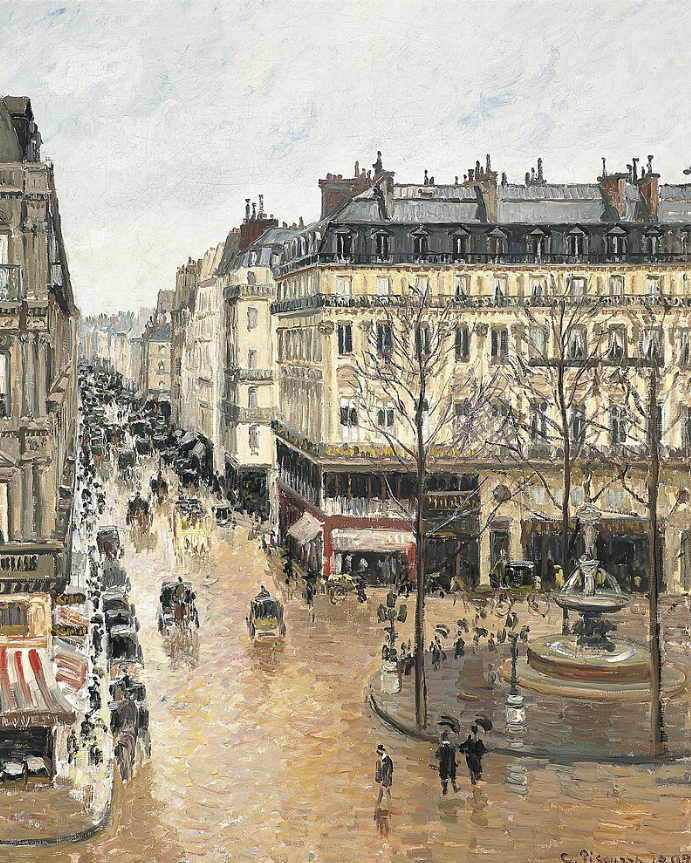
This very old nearly 2 km long road follows most of the west to east Roman road through north central Paris. It was named after a small chapel built outside the walls of Paris in 1204 to remember the patron saint of bakers, Honoré d’Amiens, who died on May 16 600. The church was paid for by a wealthy Parisian baker originating in Picardy. Allegedly Honoré had been miraculously designated eighth bishop of Amiens. The church was demolished in 1913 and became part of the Grands Magasins du Louvre, from whose hotel Camille Pissarro painted the view of the road shown above.
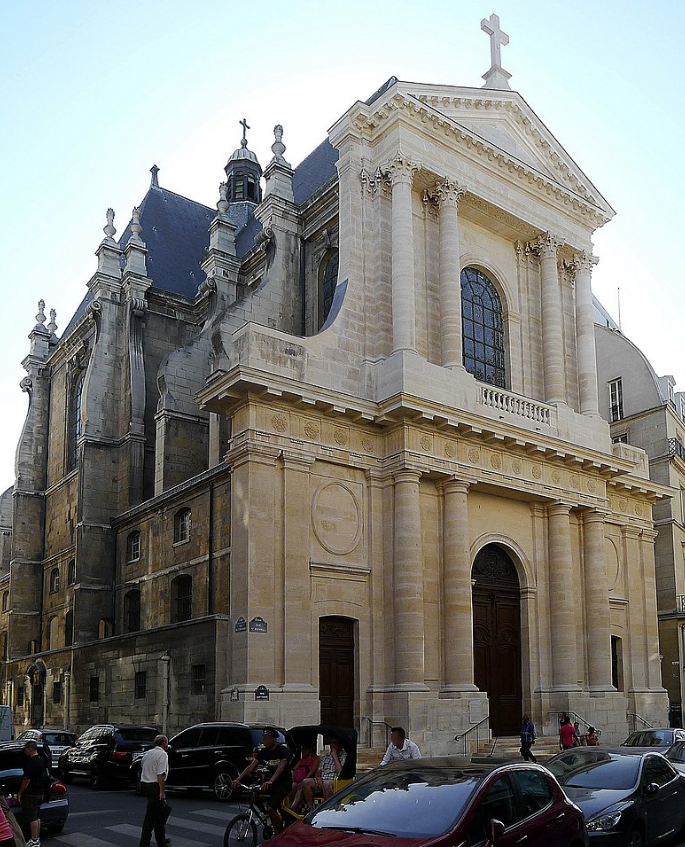
The Oratory of the Louvre at No. 145 had started life as a Catholic church in 1612, had become a monastery , enlarged and rebuilt and in 1624 became the royal church of the Louvre Palace. Another rebuild took place between 1740 and 1750 before th nationalisation of the monastery in 1792 and its deconsecration. In 1800 it became the Bank of France and in 1811 Napoleon decided it should be re-opened as a Protestant place of worship.
During the German occupation of Paris the pastors Paul Vergara, Gustave Vidal and André-Numa Bertrand explicitly preached the need for spiritual resistance to Nazism. On February 17 1943 after Suzanne Spaak had appealed for their assistance in saving Jewish children about to be deported. Marcelle Guillemot, a social worker who edited la Clairière, a protestant socio-health paper, was outside the Temple of the Oratory after Vergara called for volunteers, and took the names of 30 protestant families ready to hide the children, after going to the centres where they were being held and taking them for walks.
A total of 63 children were saved, although Marcelle had to go into hiding in Paris while Vergara escaped to Switzerland.
The Café de la Régence from 1681 to 1854 was based approximately at Nos. 153-155, nearly opposite the Palais Royal (No. 204). Voltaire, Diderot and Rousseau were all enlightened customers there in the mid-18th century. Benjamin Franklin also visited while he was American Ambassador to France from 1776 to 1785.
The rough location of the Cafe de la Regence on the corner of the Palais royal square.
This café was also where Marx and Engels met on August 28 1844 and agreed to work on ‘The Holy Family‘ together. Further along the street, at No. 251, was the Valentino Hall, which Engels entered on one occasion in his brief 1844 visit to Paris to escape the police spies who were following him.
Upstairs the Café de la Régence was the centre of French chess for over a century. It was where Robespierre, the young officer Napoléon Bonaparte and Louis Philippe all played their chess (no not together!). The café also doubled as one of Paris’ four cafe/shop post offices in the early 19th century.
On October 16 1793 the Jacobin and regicide painter, Jacques-Louis David, sketched Marie-Antoinette in a cart being taken to the scaffold from a first floor window in Rue St Honore
The Café was well-positioned. It was close to the Palais Royal before the Revolution and afterwards it was on the route of those being taken from the Conciergerie prison to the Place de la Concorde to be guillotined.
On July 28 1830 at Nos. 157-159 the very first barricade was erected at the cross roads with Rue Rohan and Rue de Richelieu. This marked the start of the July 1830 Glorious Revolution that overthrew Charles X
At 10.30 pm on the evening of December 3 1973 one of the cartoonists for the French satirical paper Le Canard enchaînéreturned to its offices at No. 173 to find a government DST ( Direction de la surveillance du territoire) team of spies installing microphones. The French State has always believed it has the right to spy on dissidents.
The editorial offices of Le Canard Enchaine satirical weekly at No. 179
Nearly two hundred years earlier the French state still believed in its right to execute dissidents. One issue was how this done. Should it be a lengthy process by strangulation (hanging) or a lengthy process by chopping at your neck with an axe?
Dr Joseph Ignace Guillotin, a humanist who opposed the death penalty helped develop a quicker, more efficient way of killing people. One of those who drafted the 1789 Declaration of the Rights of Man and of the Citizen, he died on March 26 1814 in his medical office at No. 209. This was on the route of those travelling to be ‘humanely’ executed at what is now the Place de la Concorde.
The medical offices of the man whose name was given to the guillotine died here at No. 209 in 1814.
On November 29 1847 Bakunin spoke to the 1,500 people who attended a commemoration banquet of the 1830 Polish uprising against Russia at the Valentino Hall. Before Haussmann’s re-modelling of Paris its address was No. 359 rue St Honoré. This was where Valentino, the orchestra conductor and violinist, introduced the polka dance to Paris that same year, 1847.
Le Bal Valentino was opened in 1838 and closed in 1890. One of the largest halls in Paris it alternated classical music concerts and dancees, while hosting many political meetings
The size and central location of the Hall attracted many revolutionaries to hold meetings there. In 1848, in February Cabet held a meeting of the Icarians there.
In March, Blanqui organised meetings of the Central Republican Society he chaired at Valentino’s. The Club of Political Prisoners presided by Armand Barbès with Blanqui as its vice-president also met there.
The Socialist Workers’ Club whose honorary president was Louis Blanc also met there until the May 15 1848 demonstration when it was dissolved after the failure of a left insurrectionary attempt to defend the socialist aspects of the February 1848 revolution.
On January 27 1871 the Valentino Hall was used by the Officers of the 1st Battalion of the National Guard to protest against the Armistice signed by the Thiers government with the Prussians.
251 Rue St Honore is now the exclusive Mandarine Hotel, describing itslf as the ultimate luxury hotel. The earlier dance hall and meeting place was demolished and rebuilt in the 1930s
Olympe de Gouges, opponent of slavery and author of the 1791 Declaration of the Rights of Women and Women Citizens, lived at No. 270. A History of Paris marker post has been put by the front foor to mark this feminist pioneer and martyre.
Olympe de Gouges’ time at 270 Rue st Honore is now marked by a historic Paris plaque in the pavement on the right of the door
The main entrance to the second Jacobin monastery in Paris was at No. 328. Its side entrance in the Rue St Hyacinthe led to the monk’s canteen where the anti-royalist Breton Club began to meet in 1789. After the closure of the monasteries in 1790 the convent was rented to the Friends of the Constitution, who later took the name the Jacobin club .
General Lamarque died at his home at No. 368 of cholera. His funeral procession that left from here on June 5 1832, sparked the 1832 uprising against Louis-Philippe’s increasingly authoritarian rule that features in Hugo‘s Les Misérables.
General Lamarque, who lived at No. 368, was a leading critic of Louis-Philippe. He died of cholera here on June 1 1832 and his funeral on June 5 triggered the 1832 June insurrection in Paris
When Robespierre was himself guillotined on July 28 1794, the cart carrying him to the scaffold stopped outside No. 398 (formerly No. 366) where he had lived for three years since he moved there secretly on July 17 1791 to avoid arrest after the Champs de Mars massacre. The house’s walls had been dripped with the blood of butchered cattle.
Off the courtyard behind the doorway to No. 398 Robespierre rented two rooms from Maurice Duplay, a cabinet-maker and supporter. The house was rebuilt to the same floor plan in the 18th century.
Delacroix shows all social classes supporting the July Revolution of 1830
Eugène Delacroix (1798-1863) showed his bare-breasted Liberty-Marianne in a Phrygian cap walking across a barricade thought to have been at 8 Rue de Saint-Martin in his iconic painting Liberty guiding the People. He wrote to his brother soon after the July 1830 Glorious Revolution:
‘I’ve embarked on a modern subject—a barricade. And if I haven’t fought for my country at least I’ll paint for her.’
Delacroix’s painting was shown in the Salon
of 1831 and bought by the French government. Its intention was to hang it in
the throne room of the Luxembourg Palace. But after the June 1832 insurrection
it was returned to Delacroix as being ‘too revolutionary’. It was only
exhibited again briefly after the February 1848 Revolution, and then next in
the Salon of 1855.
John, the designer of Left in Paris, borrowed from Delacroix the bearded rifle-wielding bourgeois revolutionary and the pistol-waving working-class teenager seen on our menu pages.
Hazan (WTP) tells us that the two-day 1832 Republican insurrection that followed the dispersal of the huge crowd behind a red flag at the Republican General Lamarque’s funeral on June 5 saw the first use of artillery against Parisian insurgents. The demonstrations followed opposition deputies accusing the government of breaking its promises and refusing to support oppressed people like those in Poland.
George Sand painted by Delacroix in 1838, about the time she was working on the novel referring to Rue Saint-Martin
There were three barricades protecting the Rue de Saint Martin headquarters of the Republicans at what was then number 30. Writing a novel about the events ten years later George Sand makes this address the home of her working-class hero.
The reality was that the defenders of the 1832 barricades killed around 75 soldiers and National Guardsmen sent by Louis-Philippe. Over 90 insurgents were killed, 200 wounded and 1,500 prisoners were taken. Eighty-two people were subsequently deported.
Victor Hugo’s Les Misérables fiction places Gavroche’s death at 107 Rue de Saint Martin at the barricade with the Rue Aubry le Boucher. In his Comédie humaine Balzac (1799-1850) has the republican Michel Chrestien killed at the Rue Saint-Merri barricade across the street.
Louis-Auguste Blanqui’s first
insurrectionary attempt was made in 1839 with the Society of the Seasons, and its
first barricade built was across the entrance to the Rue de Saint Martin, from
numbers 1 to 2 on 12 May 1839. The conspirators used to meet in a wine seller’s
shop at 10 Rue de Saint Martin.
Blanqui and Armand Barbès were also present at what was probably the most important barricade erected in 1839, at number 78 Rue de Saint-Martin, the St Merry barricade. Barbès was wounded outside number 248 and arrested at the end of the insurrection.
Another barricade appeared at the beginning
of Rue de Saint-Martin during the workers’ uprising against the closing down of
the schemes for unemployed workers on 23 June 1848.
In July 2018 I spent a couple of days at a sociological conference at the Conservatoire des Arts et Métiers at 270-272 Rue St Martin. A 19th century costumed film was being shot there using the 19th century buildings as a backdrop, with a portable guillotine added for good measure. Strange to think that Karl Marx supposedly gave a speech there on March 5 1848 to the Central branch of the Rights of Man and of the Citizen Club immediately after his explusion from Brussels.
The Conservatoire (before 1794 the priory of Saint-Martin-des-Champs) was also the location of the National Convention organised by Ledru-Rollin a year later, on 13 June 1849, to try and stop the war on the Republic of Rome.
Further up the street, the old Molière Theatre at No 159 provided a venue for many meetings and organisations. Ledru-Rollin and Barbès were among those who held meetings of the Revolutionary Committee for the elections to the Constituent Assembly in March 1848. On November 14 1869 the Parisian Federation of Workers Societies was formed there.
During the bloody week of May 1871 the Conservatoire was fortified, and the last fighter is supposed to have been a woman defending it with a machine gun. Another barricade that saw fierce fighting was built at 145 Rue de Saint-Martin.
One of the 600 barricades built in August 1944 in answer to the FFI call to make German troop movements in Paris as difficult as possible
The street’s cobblestones again came in handy in August 1944. One photograph looking down Rue St Martin shows the barricade built outside number 135 (now next to a Monoprix shop). It was one of some 600 built in Paris after the resistance FFI (French Forces of the Interior) called for them to be built on August 19 to stop German troop movements.
Today, the left side of the street exists no longer: it was demolished to make room for the Beaubourg (Pompidou Centre) as was the 1832 battleground of the Rue Saint-Merri. From barricades to shopping opportunities.
But at least there is still some art nearby – although as Hazan (WTP) reminds us, the architects’ original democratic, accessible concept for Beaubourg “for people to meet here, in a certain everyday way, without having to pass through a gate and being checked like in a factory” has now been ‘renovated’ out of existence. Today access is only for ‘the right class of people’.
In 1842 Gustave Courbet‘s first workshop was at 89 Rue de la Harpe which, after the Southern part of the Rue de la Harpe was knocked down, was approximately at the location of 31 Boulevard St Michel. This was where Courbet got to know Proudhon.
One of Baron George Haussmann’s objectives in tearing up much of old Paris after the 1848 Revolution was to try and eradicate the possibilities of street barricades and open resistance, or at least to ensure that the army and police would find suppressing it easier. The Latin Quarter and its student and poor working class inhabitants were a key target.
Hazan (IOP) quotes Haussmann as acknowledging his aim was to restructure Paris ‘strategically’:
“I read, in a book which enjoyed great success last year, that the streets of Paris had been enlarged to permit ideas to circulate, and, above all, regiments to pass. This malicious statement (which comes in the wake of others) is the equivalent of saying that Paris has been strategically embellished. Well, so be it . . . I do not hesitate to proclaim that strategic embellishments are the most admirable of embellishments.”
In 1851 Paris comprised 30,770 houses; by 1860, when he expanded Paris to include all the land within the 33km-long Thiers Wall, built between 1840 and 1844, he had already demolished 14% of them. Between 1852 and 1868 a grand total of 18,000 houses had been demolished.
Among the old narrow streets pulled down to make way for the Boulevard St Michel was part of the Rue Cujas. The Café Musain at No 22, then on the corner with the Boulevard, doubled as the headquarters of the Société des Amis du peuple (Society of the People’s Friends). This was the secret society run by Auguste Blanqui that played a part in the 1830 Revolution.
Victor Hugo in Les Misérables modelled his secret society, the ‘Friends of ABC‘ on the Blanqui club, suggesting it was their initiative to use the appearance of a red flag at the funeral of General Lamarque on June 5 1832 as the signal for that uprising.
Haussmann’s first idea for the Fountain at
the Place St Michel, on the new North-South axis he had constructed through
Paris, was for a giant Napoleon Bonaparte. Finally, the architect Gabriel
Davioud designed the ‘Victory of Good over Evil’, with Saint Michael defeating
the devil (or Louis-Napoleon Bonaparte defeating the 1848 Revolution) that was
put in place in 1860, hiring nine different sculptors to sculpt its different
elements.
Strategically, though, Boulevard Saint-Michel may be considered to have been more successful than the dreadful fountain. In May 1871 it took little time for the fragile barricades in the broad street to be broken.
On August 21 1944, the Boulevard
Saint-Michel was again a key strategic route for the German occupiers to move their
troops from the garrison at the Luxembourg Gardens to the right bank in the
North.
The resistance built a barricade across it to
the Café Cluny on the corner with the Boulevard Saint-Germain, on whose
pavements in 1995 I first met Sylvie, a French doctoral student who became very
close to me over the following two decades.
In August 1944 the strategic crossroad
there quickly became known as the ‘crossroad of death’. In one account I read there
was a suggestion that some Germans tied French men and women to the front of
their tanks as human shields to go up Boulevard Saint-Michel.
Insurgent Paris rarely sleeps long. On May 13 1968 ten years to the day after the Algerian generals’ coup d’état toppled the Fourth Republic, a one million strong trade union and student demonstration protesting police violence against students on the night of the barricades (May 10) marched down the Boulevard Saint-Michel and past the Place Saint-Michel over to the right bank. The following day factory occupations started to spread throughout France.
Back in London at the LSE in May 1968, we Socialist Society activists organised a sit-in in solidarity with French students and workers on the one day that week when we didn’t have exams. From the sublime …
It’s only a short walk from my flat to the infamous Prison de la Santé, where Victor Serge was jailed in 1912 and three communist trade unionists, Pierre Monatte, Gaston Monmousseau and Boris Souvarine were jailed in 1920 for ‘conspiracy against the state’.
This prison is now the only prison within the city of Paris itself, although when it was built in 1867 there were 11.
Guillotine being checked by the executioners at the Prison de la Santé
In 1939 on the pavement corner with Boulevard Arago, the road was the site of the second-to-last public guillotining in France. It had been Paris’ public scaffold since 1899.
In 1940 Paul Langevin (1972-1946), who had launched the intellectuals’ campaign against fascism in 1934, was jailed there by the Gestapo for two months before being put under house arrest.
Remembering the 18 guillotined and shot resistance fighters
Between August 1941 and July 1942 nine communist resistance fighters were guillotined there. In April 1944 another nine were shot. The plaque accuses the French authorities of their murder.
Conrad Miret was arrested by French police at the Champ de Mars in February 1942 and charged with 40 actions against the occupiers
Conrad Miret I Musté, the Catalan head of the CGT’s migrant workers’ organisation (Main d’œuvre Immigrée – MOI) made up largely of Spanish, Italian and Romanian communists that began attacking the Germans in August 1941, was arrested on February 21 1942.
Miret died at the Santé prison after a week of torture. A plaque on the prison wall now commemorates his death. Another 25 of his MOI comrades were executed in April.
Plaque remembering the Spanish Civil War veteran Conrad Miret
In September 1943 the 14-year-old Robert Barcia, known later under the pseudonym of Hardy (1928-2008), was arrested carrying Trotskyist leaflets and spent five months in the prison before being released because he was too young to be charged.
The Santé also briefly
housed Jacques Duclos in ‘the pigeon affair’ of 1952. The temporary head of the
French Communist Party was arrested in 1952 after a huge demonstration against
the American head of NATO visiting Paris ended with two workers dying from
police gunshot wounds. In Duclos’ car the police found a revolver, a baton and
two dead pigeons as well as a notebook. The Interior Minister then declared
Duclos had been using carrier pigeons to send messages to Moscow, and Duclos was
jailed. After police enquiries found that Duclos had been hunting and the two
pigeons were intended for supper, he was quickly released.
Behind its walls several FLN (Front de libération nationale) militants were guillotined during the Algerian war – their numbers never released publicly. The guillotine’s final use at the prison was in 1972.
Ahmed Ben Bella (1916-2012), leader of the Algerian FLN, and a former Olympic de Marseilles player in the 1939-1940 season, was held prisoner here with five other Algerian leaders at the Santé from November 1956 until January 1959. After several hunger strikes demanding they be treated as political prisoners, and then threats to his life within the prison by supporters of Algérie Française, De Gaulle had him moved to the Isle d’Aix prison.
The Prison de la Santé is now being rebuilt and modernised. But what is extraordinary is that until 2000 its star-shape was used to racially and socially segregate prisoners. One of the five stars was designated for the educated prisoners. The four others were for Western Europeans (Block A), Black Africans (Block B), North Africans (from the Maghreb in Block C) and The rest of the World (Block D).
Numbers 3, 48, 62-64 (site of 22 Rue du Bourg l’Abbé), 83
In 1854 the boulevard was initially built as part of Haussmann‘s redesign of Paris as the Boulevard du Centre. Half-way between the Rue Saint-Denis and Rue Saint-Martin roads that were closely associated with barricades and insurrections, it involved relatively little demolition of existing buildings and created a 30m wide road along which troops and canons could be easily moved.
Almost immediately it was renamed Sébastopol after a year-long seige finally ended in the successful storming of Sebastopol on September 8 1855 by a joint Franco-British force during the disastrous Crimea War.
The pharmacy shop Cannone at No. 48 on the corner with the Rue aux Ours was the main distribution centre for the underground resistance papers Valmy et Résistance. Initially, from the autumn of 1940 one of the staff, Roger Lardenois, used its huge storage area to hide and then distribute Valmy.
64-66 Boulevard Sebastopol is the location of the Lepage Frères arms depot, before 1854 it was 22 Rue du Bourg-l’Abbé. The warehouse was pillaged by a few hundred men from the secret Seasons Club set up by Blanqui and Barbès for weapons and ammunition on May 12 1839. Many carried three or four pistols and rifles out with them. .
The Lepage Brother’s gun shop in the 1830s just round the corner from their store room in the now disappeared road Bourg-l’Abbé The site of the Lepage Frère armoury at 22 rue du Bourg de ‘Abbb , now 62-64 Boulevard ~Sebastopol
As early as the 14th century the 1.5km-long road from central Paris towards the village of Sèvres six miles away (nearly 10km) got its name. The name was later made famous by the Manufacture nationale de Sèvres (the porcelain factory) moved there in 1756 at the demand of Madame de Pompadour, mistress of Louis XV, and then bought by the king three years later.
One of the largest underground newspapers circulating in the Northern Zone, Défense de la France, during the German Occupation was printed at No. 11. It was printing 450,000 in January 1944. The niece of Charles de Gaulle, Geneviève de Gaulle-Anthonioz, was one of its supporters. One of those involved in the printing, Jacques Grou-Radenez, was arrested and died in deportation on November 12 1943.
Marc Bloch the Left historian who founded the Economic and Social History Annales lived in a flat at No. 17, above the then Lutetia swimming pool, from 1936 to 1940. Initially used exclusively by the adjoining hotel it was requisitioned by the Gestapo in 1940. In 1945 it became a centre for returning concentration camp inmates and then a public swimming pool. until it was closed in the 1970s. The Lutetia swimming pool is now a Hermes shop.
A rare plaque for the Leftist was put on the first floor wall of the building because of his wartime role leading the resistance in Lyon, after he was sacked from his job as Professor at the Sorbonne University for being a Jew.
On the right, above the Hermes shop at No. 17, a plaque remembers Marc Bloch
The huge establishment at No. 22-24, Le Bon Marche, the French equivalent of Harrods, has been catering to wealthy French Parisians and tourists since 1852, just 11 months after the December 1851 coup d’état when Charles-Louis Napoléon Bonaparte seized power.
Jacques Prévert worked as a salesman there in March 1916, before being fired for having ‘turned a salewoman from the right path’.
A broad tree-lined road just to the south of the Farmers’ general tax wall, it was opened by a royal decree in 1833, and named after an early 18th century peer of the realm who had a rare reputation for honesty in his post as Prévôt des marchands de Paris (Paris’ Prefect for Commerce, the equivalent of today’s Mayor of Paris).
Its most remarkable building is a huge, historic secondary school, the Collège-lycée Jacques-Decour, where Lucie Aubrac was nominated to teach in 1946.
The Collège-Lycée Jacques-Decour viewed from the North, with the Boulevard des Batignolles in front of it and the Avenue Trudaine on the other side.
The school was originally founded in the 15th century as the Sainte-Barbe college of Paris University. Its current building was moved there by Haussmann and constructed between 1867 and 1876 on the site of the old Montmartre abattoir.
The name was changed in 1944 from Rollin (the name of an 18th century historian) to Jacques Decour, the resistance pseudonym of Daniel Decourdemanche (1910-1942), who had taught German at the Lycée since 1937.
Decourdemanche had joined the Young Communists and then Communist Party. His first book called Philisterburg after teaching in 1932-33 in Germany denounced the risks of nationalism and racism.
Every year his goodbye letter to his parents is read in the school where his parting words were:
I consider myself a little like a leaf that falls from a tree to help become soil. The quality of the soil depends on that of the leaves. I am talking about French young people.
Daniel Decourdemanche’s headstone in Montmatre Cemetery
A 12 metre-wide street originally built in 1826 under a royal decree, it was initially named rue Mademoiselle because of its proximity to the building that became the Matignon Palace/Hôtel , now the official residence of France’s prime ministers. The owner of the huge Hôtel at 55 rue de Varenne at that time was Mademoiselle Louise-Eugenie, the younger sister of Louis-Philippe. The name was changed to rue Vanneau (with two nn’s) in the initial democratic phase of King Louis-Philippe in October 1830.
The street was again renamed in 1873, as the right-wing Republican government sought to use name changes to reinforce its shaky legitimacy. So from rue Vanneau it became rue Vaneau (with one n) in honour of a student killed attacking the Babylone barracks during the Glorious Revolution on July 29 1830.
Although Karl Marx lived at both No. 38 and No. 23 in 1843-1844 and his first daughter, Jenny (who later married Charles Longuet), was born at No. 38 there is no commemorative plaque on either address. The offices of the review that had brought Marx to Paris, Annales franco-allemandes, were at No. 22.
The socialist senator and first female Senate vice-president Gilberte Brossolette (Bruel) was born at No. 24 in 1905. She married Pierre Brossolette in 1926 and worked as a journalist for the socialist paper, Le Populaire. From the autumn of 1940 the couple secretly held meetings in their home to create the first resistance group in Paris. In May 1942 after French police searches led to their teenage son being taken to Gestapo HQ, they crossed the demarcation line with their two children. Gilberte then sailed with the boy and girl to Gibraltar and from there took a cargo vessel to London, where she worked as the liaison between De Gaulle and the BBC.
Another left literary figure to have lived in the road was Félix Fénéon. He was still living with his parents at No. 26 when he got his first job at the Ministry of War in 1881 and soon afterwards began writing art criticism, book summaries, short stories and even a first draft of a psychological novel for a monthly journal that ran from October 1883 to March 1884.
The photograph above is from 1905, some 60 years after the Marx family lived a little further down the street.
You will see a plaque on 1b, rue Vaneau, where André Gide lived on the sixth floor from 1928 and died in 1951, and where he hid Albert Camus in another flat in the building in 1944.
The Luxembourg Palace (Nos. 15-17) is the most well-known building in the old Roman road that is the longest street in Paris. The road now stretches 4.360 Km westwards from the Boulevard Saint Michel to the junction of the Boulevards Lefebvre and Victor on the inner ring-road called the ‘Petite Ceinture‘ on which route a small train used to run round Paris.
Rue Vaugirard is so well known that it also features as a possible building or hotel site in the French version of Monopoly.
The western end of the road was where, at Nos. 393 and 399 barricades were built across the street in March 1871 to prevent the Versaillais troops from entering.
The road’s name comes from the ancient village of Vaugirard, called after the mid-13th century owner of the land there, ‘Val du Girard’.
Among the tens of thousands who have lived in this old road are some who we feature in Left in Paris, often living alongside forgotten bits of left history.
The Trianon-hôtel, for example, at No. 1- 3 witnessed one of the first attacks by the resistance against a hotel requisitioned by the German army. The bombing took place on 14 November 1942 organised by thelargely foreigner and Jewish Francs-tireurs et partisans – main-d’œuvre immigrée(Fighters and partisans – Migrant Workers) group.
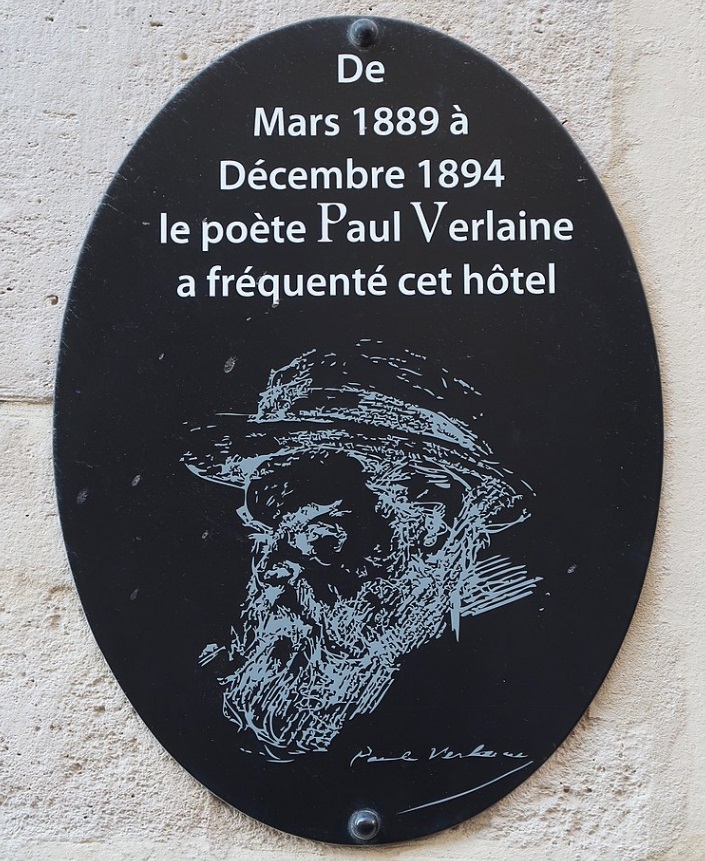
At No. 4, then called the Hôtel Lisbonne, Paul Verlaine lived off and on between periods in hospital from 1889 to 1894.
Today the hotel boasts of its earlier desperately poor and severely ill guest, and calls itself the Hôtel Fontaines du Luxembourg.
From 1906 Jacques Prévert lived at No. 7 and went to the school next door, No. 9.
I’ve very fond memories of the Vaugirard school where my son Michael spent a happy four months when he was ten. The area has completely changed since then. The school was constantly complaining about the bourgeois dog owners who allowed their absurdly small animals to deposit all over the surrounding streets as they walked them to the Luxembourg Garden. The disappearance of less well off and younger residents has led the authorities to close the whole school down in 2019.
The only good news is that the building hasn’t been sold off to developers. In 2023 the school is being occupied by the Cité Audacieuse and the ground floor and playground of the school is being run four days a week as a cafe by a feminist collective.
Émile Zola lived in rooms at No 10 in 1866 with Alexandre Meley whom he married in 1870.
After the5 metre high and 24km long tax wall was built under Louis XVI there were two customs posts across Rue Vaugirard. One was at No. 102 and another (la barrière du Maine) from Nos. 111-132. While unused during the Revolution, they were reinstated after the 1815 Restoration and only finally largely demolished in 1860 with the expansion of Paris to the Thiers walls, built in the early 1840s roughly 5km from the city centre.
Victor Hugo and his wife Adèle lived together at what was 90 rue de Vaugirard before the Rue de Rennes was built (after sharing with the in-laws in the Rue du Cherche-Midi). they lived from 1824 to 1827 in the bit of the road now numbered 86-88. This period of his life followed the anonymous publication of the 21-year-old’s first novel, Han d’Islande set in 17th century Norway.
In 1826 Hugo wrote and published his second romance novel, Bug Jarval, featuring exceptionally for the time a black slave insurrectionist in St Domingo as its hero who falls passionately in love with a white women.
Lenin sat for Naoum Aronson in his studio at 93 rue Vaugirard on December 10 1904. The bust was subsequently displayed in the Soviet pavilion at the 1937 World Fair in Paris.
On December 10 1904 Lenin sat for the Russian sculptor, Naoum Aronson (1872-1943) at his studio in No. 93.
When she first arrived in Paris around 1860, the feminist bookbinder and Communard Nathalie le Mel mother of three worked at Pasquier et Vigneau’s bookbinding works at No. 150 (in the 15th arrondissement).
A long way along the road was also where Michel Foucault lived, at no. 289 from 1970 until his death in 1984.
French measurementsof distance
MËtre Ètalon par Chalgrin
For the real historical nerds among us, in the wall at No. 85 is an early 18th century ‘half-league stone’. The Fleur de Lys on it was removed during the French Revolution. The marker (borne) indicates the first half-league (lieue) – that is 500 toises.
A toise was the distance between a man’s outstretched arms, approximately 6 feet) or 2 Km from the entrance to Notre-Dame cathedral. 1 lieue = 1,000 toises, or approximately 4 Km. A toise is the equivalent of the fathom in English, but in France it was used both on land and at sea.
At the French Revolution France still used hundreds of different weights and measures, originally derived from Roman units where the leuga (lieue/league) was the distance that a man can run in an hour. King Charlemagne (742-814) had added the pied du Roi (the King’s foot) and the toise. The pouce (inch) was the width of a human thumb, and was 1/12th of the pied du roi. The ligne (line) was 1/12th of a pouce, and the point (Truchet point in English) was 1/12th of a ligne.
After Charlemagne the fragmentation of France and of Europe accelerated. So distances varied from town to town, with the variation in 1 league (lieue) being from 3.268 km to 5.849.
On August 4 1789 a successful resolution from the Jacobin Club at the Constituent Assembly abolished all the privileges of the Crown, including its right to determine measures of distance and weight.
In 1790 Talleyrand proposed the drawing up of a Universal Measure, and the National Assembly proposed doing this jointly with the United Kingdom, who refused.
In 1791 a law established a Commission to establish the universal measure. They decided it should be based on a quarter of the length of a meridian and gave two geographers the task of measuring it exactly. They took seven years to measure the distance between Barcelona and Dunkerque.
This exercise was considered too long-winded for both military and political reasons. So on August 1 1793 the National Convention passed a decree determining the ‘provisional’ length of what in 1795 was named the metre. This was based on a millionth of the 1739-1740 distance measured by Lacaille from the North Pole to the Equator. It was exactly 3 pieds, 11 lignes and 44 hundredths of the principal toise then used in Paris.
Finally, on 7 April 1795, the new system of weights and measures adopted by the French National Convention were named: metres and grams. A metal metre-long yardstick embedded in marble was then placed in the wall at no. 36 rue de Vaugirard. And in a shop window at No. 215 there is an 1840 cast iron kilometre stone marking 3.5 km from the centre of Paris.
The old and new systems were used concurrently in France over the next half century. Metric leagues were used from 1812 to 1840 with one metric lieue = 4000 metres or 4 Km. The use of the old system was finally ended across the whole of France by the law of 1837.
But when in 1988 Joe, Joan and I bought a half-finished farm/barn in the Haute Savoie, and I had to finish off the plumbing, I can still remember the plumbing shop in Thonon-les-Bains where the width of copper pipes and joints were still in pouces (inches). In the UK metrication became government policy under Wilson in 1965 and in 1973, with accession to the European Economic Community, the UK was given 5 years to adopt metric units and by 1980 virtually no schools continued to teach in feet and inches.
This, the second longest of the twelve roads leading out from what is since 1970 the Place Charles-de-Gaulle (previously the place de l’Étoile), was renamed three times before Victor Hugo moved and died there. In 1840 it was simply called Departmental Road 64, and then after land speculators took over in 1850 it was the avenue de Saint-Cloud and subsequently, at the time Victor Hugo moved in, the Avenue d’Eylau. This name dated from the Third Empire and was its attempt to associate itself with Napoleon I’s military successes, even including the inconclusive Battle of Eylau of 1807.
As a continuation of the same attempt to weaken the anti-Republican monarchists and Bonapartists by celebrating France’s biggest-ever Republican celebrity, the road’s present name was adopted on Victor Hugo‘s 79th birthday in 1881.
Number 14 was where Guy de Maupassant, the author of Boule de Suif (The Dumpling), lived from 1889-1890.
The office organising the recruitment of French citizens into the Waffen SS was based at No. 60. Pierre Laval signed the decree, which led to some 2,740 French joining up by 1944. Laval was one of just three French men executed by the French High Court in 1945.
In August 1940 Laval ordered the arrest of Georges Mandel, who had lived at No. 69. A Radical Party deputy in the National Assembly he had opposed the Vichy regime and was deported to Buchenwald. Returned to Paris as a hostage in 1944 he was seized by the French Milice and shot in the Fontainbleau Forest on July 7 1944. The Milice’s leader, Joseph Darnand, was tried and executed in 1945. Thousands of other Milice members were never caught or tried.
The former fascist founder of the resistance Hector escape network and the Civil and Military Organisation, Jacques Arthuys, lived and was arrested at No. 72. He was killed in December 1941 at the Hinzert concentration camp.
Hugo on the lintel above 124 avenue Victor Hugo, sculpted by Marcel Fonquergne from a photograph
The building at No. 124 was built in 1907 on the site of the previous home of Hugo and Juliette Drouet, who moved there together in 1878. This was where Juliette died on May 11 1883.
On February 28 1882, on the initiative of a journalist and political exile from 1871 to 1877, Edmond Bazire, a huge 600,000 strong celebration of Hugo’s 80th birthday took place outside his home. Victor Hugo died there on 22 May 1885.
In 1791 the owner of the huge house at No. 27, the Marquis de Villette, a gay friend of the enlightenment philosopher and writer who had died there in 1778 , renamed the street Quai Voltaire. Villette had supported the 1789 Revolution and renounced his nobility. Elected to the Convention in 1792, Charles Villette argued for the banishment of Louis XVI, but died of what was then described as ‘melancholia’ (langeur) aged 57 in July 1793.
Alongside the plaque on No. 27 remembering Voltaire is another recalling the meetings that took place there of the leaders of the national and local police groups of Résistance Libération-Nord. This was initially the name of a clandestine newspaper, established after SFIO and non-Communist CGT trade unionists signed the Declaration of Twelve opposing the Vichy regime and the dissolution of the trade unions on November 15 1940. It became a resistance organisation in November 1941 and in 1943 was one of the eight resistance movements represented on the National Resistance Council.
29, Quai Voltaire is where Daniel Stern (Marie d’Agoult) lived in the Hôtel de Mailly-Nesle after her 1839 breakup with Franz Liszt. She ran a republican literary salon there, and in 1844 Karl Marx used to attend.
No 7 Quai Voltaire is another well-plaqued house (three). It was the home of Hubert de Lagarde, founder and head of the Resistance Eleuthère network of the Forces Françaises Combattantes . A plaque tells how he was arrested by the Gestapo on June 15 1944. This was only a few days after he had protested against the appointment of a Communist to head up the now merged FFI (French Forces of the Interior). He was tortured and then deported to Buchenwald before dying of dysentery on January 25 1945.
Looking up the Avenue to the Arc de Triomphe around 1900
One of 12 broad radial roads that leaves the Arc de Triomphe from what used to be called the ‘Square of the Star’ (Place de l’Étoile) and was renamed Place Charles-de-Gaulle in 1970. The road was first opened on January 16 1789 when the section of the Farmers’ tax wall was completed between the Etoile (Neuilly) and Roule (Ternes) customs posts. It became de Wagram on March 2 1864 during the Second Empire to honour Napoleon I’s significant victory over the Austrians at the Battle of Wagram on July 6 1809.
The Salle Wagram at No. 37/39 witnessed some key meetings in the history of the Left in France. On the site of a guingette (open air café) run by a Napoleonic war veteran since 1812 on a country lane outside the city walls (and so providing cheap wine), under the restoration he developed it into dance hall, the Bal Dourlans.
In 1865 a new covered hall designed by Fleuret was inaugurated surrounded by two rings of seats. In 1899 the hall was given in a legacy to one of the five academies grouped within the Institut de France, which continued to run it as a dance hall, concert hal, exhibition halll and venue for political meetings.
Immediately after the 5th Congress of the Second Socialist International was held at the Salle Wagram from September 23 to 27 1900, leading to the establishment of a permanent international committee, an even more important development took place.
The entrance that led to the Salle Wagram around 1900
On March 28 1910 Vera Figner presided at a fund-raising concert at the Salle Wagram to support Russian revolutionaries escape from prison. Among those who attended were Lenin and Maxime Gorky, although Lenin avoided meeting Gorky since he didn’t wish to have a political argument with him.
Shortly before Lenin left Paris he attended an event at the Salle Wagram on April 15 1912 to honour the centenary of the birth of Alexander Herzen, the founder of Russian socialism.
On the third anniversary of the Russian Revolution, November 7 1920, Pierre Monatte, the anarchist Caroline Rémy and Boris Souvarine were among those who attended a celebration meeting at the Salle Wagram.
Caroline Remy, the anarchist journalist who joined the Communist Party in 1921 shown here painted by Pierre-Auguste Renoir
André Malraux attended at least two meetings organised by the Communist Party in the Salle Wagram. One in 1933 was support of ErnstThälmann, the jailed leader of the German Communist Party, and on December 23 1935 he spoke at the second anniversary of Dmitrov’s acquittal of setting fire to the Reichstag.
On July 30 1936 Malraux was given huge applause at the Salle Wagram when, returning from Spain, he spoke at the first major solidarity meeting with Republican Spain.
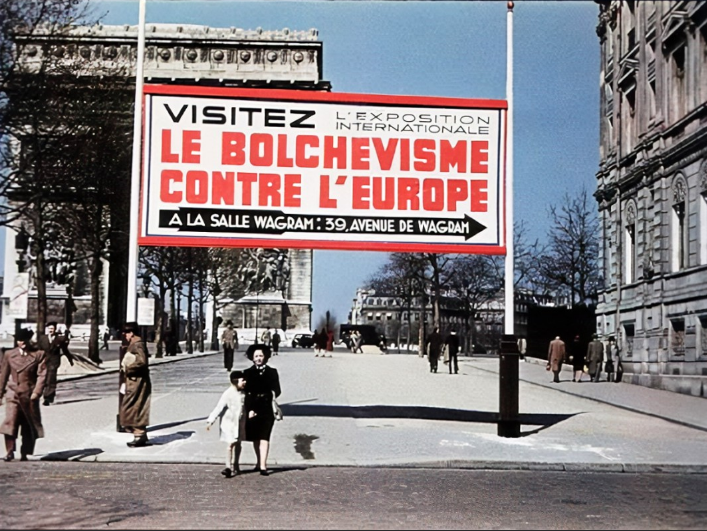
Under the Occupation the fascist French Popular Party mounted a ‘Bolshevism against Europe’ exhibition at the Salle Wagram that opened on March 1 1942
On March 8 three resistance fighters failed to set off a bomb in the exhibition. The Romanian-born Jew André Kirschen (aged 15 and a half), Karl Schoenhaar and Georges Tondelier were arrested. They were tortured and the two older men were executed after the German court martial of 27 resistance fighters from April 7-14 1942. Also found guilty of shotting at a German soldier in September 1941, Kirschen was sentenced to ten years imprisonment because of his youth, then deported to Germany and, fortunately, survived.
After the Second World War the Salle Wagram was hired by the extreme right on October 28 1948 to hold a meeting for ‘Peoples oppressed by the Bolsheviks’. A counter demonstration by 12,000 communists was attacked by the police, involving 1 death and 300 wounded.
After the war it was also the major Paris jazz venue, with musicians such as Louis Armstrong, Duke Ellington, Lionel Hampton, Bud Powell and Django Reinhardt all playing there. Sidney Bechet performed his last concert there in 1958.
On September 1 1950 a communist meeting in support of the Vietnam liberation movement was held at the Salle Wagram. Its principal speaker was Léo Figuères, a resistance fighter who had visited Vietnam and whose arrest had been ordered by the military.
The Algerian liberation movement whose president was Messali Hadj, the Mouvement pour le Triomphe des Libertés Démocratiques, held huge meetings at No. 37 on June 13 1950 and, in protest against police violence on May Day, on May 5 1951.
The Algerian war for independence that began in 1954 saw a joint protest meeting of the SFIO and Marceau Pivert‘s recently founded (June 1955) Mouvement pour la justice et les libertés outre-mer (Movement for Justice and Freedom in the Colonies) taking place at the Salle Wagram on October 7 1955. The meeting called on the government to stop sending military reinforcements to Algeria.