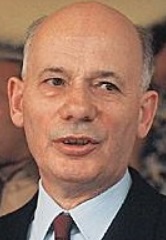
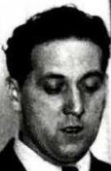
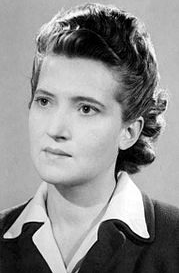
A Communist Party member from 1924 he was given political training in Moscow, and from 1934 he was one of the handful of PCF leaders. Elected deputy in 1936 he was jailed by Vichy and then in 1943 represented the PCF in London. From 1964 to 1969 he was General Secretary of the PCF. He reoriented the PCF towards a democratic road to socialism and criticised Russia for the invasion of Czechoslovakia and then fell ill in 1969 after a visit to the USSR.
Trade unionism • Resistance • World Federation of Trade Unions
One of 12 leading trade unionists who publicly opposed the dissolution of the trade unions in November 1940 and then joined the resistance, where he helped reunite the divided CGT. He represented the CGT on the National Resistance Council. In 1946 he became General Secretary of the World Federation of Trade Unions, and kept the post until 1968 – an extraordinary feat for a non-Communist.
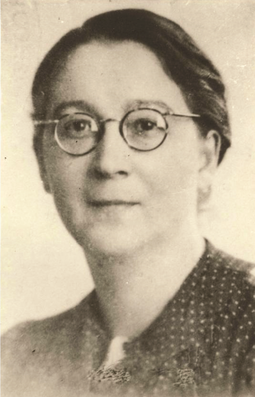
One of the less Stalinist CGT leaders of the post-war period, Georges Séguy, died aged 89 in 2016.
Among his experience as a life-long PCF member was attending the 1956 Russian Communist Party conference where Khruschev outlined Stalin’s crimes.
In 1968, as General Secretary of France’s then biggest trade union, the Communist-dominated CGT, he participated in the famous Grenelle negotiations in May 1968 whose agreements created an amazing advance in working class lives in France. But in failing to lead on to a revolution, his participation and not calling for a General Strike, made Séguy the object of much (unfair in my view) criticism from French Maoists and Trotskyists alike (and, to be fair, from many ordinary workers who believed still more could have been won).
Séguy’s father had been a founder member of the French Communist Party, and Georges was arrested as a member of the CP-led French Free Fighters and Partisan (FTPF) resistance at 17 years old in 1944 and deported to Mauthhausen in Austria. When he returned to France he identified the person who had denounced him, who was then tried and shot.
In 1978 he attempted to win over the CGT to form a united front with the formerly Catholic, then radical, CFDT union, but failed in the face of French CP opposition. He resigned aged 55 (the retirement age of the railwaymen he had been since 1946).
Germaine Tillion was arrested as a member of a resistance network in 1942 and deported to Ravensbruck in 1943, from where she was transferred to Sweden in April 1945.
Named in 1846 after the priest Charles-Michel de L’Épée (1712-1789) who founded the Deaf and Dumb Institute (Institution des sourds-muets ).
No. 12 is where the command headquarters of the French resistance against the Luxembourg Palace and gardens was based in August 1944 under the leadership of Colonel Fabien, the alias of Pierre Georges. A very rare plaque naming a Communist is on the right of the entrance.
Military headquarters of Colonel Fabien in August 1944. A rare plaque actually naming a Communist.
On 21 August 1941 Georges, an International Brigade fighter in Spain from 1936 to 1939, then using the alias Frédo, was the first Young Communist to kill a German soldier during the occupation of Paris.
The attack was mounted at the Barbès–Rochechouart metro station after Hitler invaded Russia on June 22 1941 by a PCF member.
A kilometre-long road first traced out in the 15th century had previously had 12 other names before its three main fragments (la rue des Petits-Augustins, la rue Saint-Germain-des-Prés and la rue du Pot-de-Fer-Saint-Sulpice) were joined together and given its current name by Napoléon Bonaparte’s nephew, the Prince-President Louis-Napoléon Bonaparte in 1852.
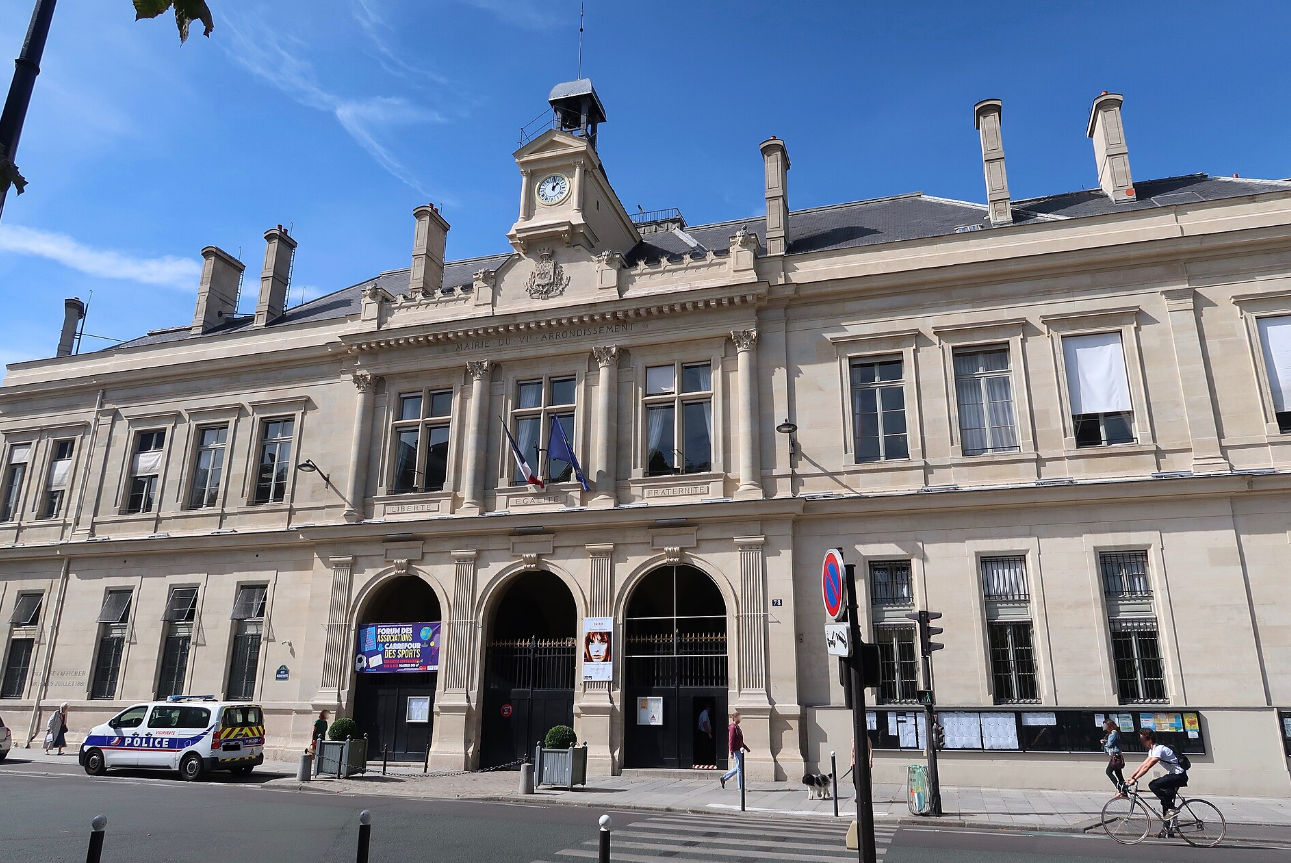
The building I have most contact with in this newly chic area is the sixth arrondissement town hall. When my father’s French employer first found him a flat in the area in 1954 it was still largely cheap student accommodation, dozens of cafes and loads of drunks and intellectuals hanging out. No 78, pictured above, is where 42 years later a motorcycle rider had to rush to for a permit to move my dad’s body out of the sixth before the 24-hour deadline for medical research on his body had passed. The mairie was built in the 1840s.
Paris is still changing, and sometimes by accident. Having a meal with Nicole (my father’s partner for over 25 years) in November 2017, we chatted about the big fire that had started near the Saint Germain church.
The famous La Hune Bookshop after the fire and in the background Sartre’s doorway at 42 Rue Bonaparte
It turned out to be the cremation of the last mortal remains of the famous La Hune bookshop. This had been set up by former resistance fighters in 1949 and had been a centre of Parisian intellectual life for thirty years. It had closed two years earlier after relocating to the corner of the Place Saint-German and Rue Bonaparte in 2012.
Hazan (WTP) remembers it as one of the key left intellectual
meetings places of the 1950s and as a street dominated by ‘realist’ art
galleries in the 1960s. When we walked past it the day after the fire and smelt
the sad pungent aroma of burnt books and wood, it looked as if the fashion shop
with which it shared its premises had mysteriously been largely spared.
Across Rue Bonaparte was where Jean-Paul Sartre used to live in number 42 (third window above the balcony). He moved there to be with his mother after the death of her second husband in 1948. The editorial team of his philosophical journal, Temps modernes, used to meet in the flat. Simone de Beauvoir, with whom he lived there for a while, Raymond Aron and Maurice Merleau-Ponty were among the many Left Bank intellectuals who made up its editorial board.
Rue Bonaparte in January 1962 after an OAS plastic bomb exploded in the doorway outside Sartre’s house
Number 42 was the address where Sartre’s political support for Algerian independence was rewarded on January 7 1962 with the signature plastic bomb used by the OAS – the Organisation armée secrete – whose music I had first heard out with my father on the Champs Elysée celebrating New Years’ Eve just a week earlier. The traffic jam of cars blocking the street appeared nearly all to be honking ‘Algerie Française’ – da da da, daa, daa. A week later we were walking home when we heard the huge bang when the Rue Bonaparte bomb went off – targeted along with another 16 other addresses that night.
There were no injuries, but Sartre promptly moved
out to the much more public Boulevard Raspail.
The 40-year-old French composer of Spanish origins, Francisco Salvador Daniel (1831-24 May 1871) was summarily shot in Rue Bonaparte
Further down the Rue Bonaparte, at the crossroad with Rue Jacob, another story did not end quite so happily. In 1871 the Commune defenders built a barricade between numbers 21 and 28 in Rue Bonaparte and from 29 to 32 in Rue Jacob. There, on May 24 1871 Francisco Salvador-Daniel, the musicologist son of a Jewish refugee from Spain, who had been defending the barricade was captured, and taken back to the barricade and shot by the Versaillais soldiers. He had taught the violin in Algeria and translated and adapted Arabic songs from North Africa for European musical instruments.
Félix Vallotton, the graphic artists and painter sympathetic to anarchism, frequent contributor to La Revue Blanche, where he drew the enigmatic portrait of anarchist and art critic Félix Fénéon, and associated with the Nabis movement, lived in 1886 at No. 21.
The painter, Édouard Manet, was born in the mansion belonging to his family at No. 5. His mother was the goddaughter of the only French general who remained a king (of Sweden) after the defeat of Napoleon and his father was a French judge.
Louis Hélié, one of the rare 60-year-old resistance fighters killed by the Germans in the 1944 liberation struggle in Paris, lived at No. 3, found at the Northern end of the Rue Bonaparte.
Named after the Swiss-origin Abraham Breguet who first conceived of the wrist-watch and established a watch-making business in Paris, the street was opened in 1866.
With Paul Hauet (1866-1945), a retired colonel, Germaine Tillion reactivated the National Association of Soldiers from the Colonies and set up office in the corner building at No. 2 in July 1940. There were around 69,000 prisoners of war originating in the French colonies at the time.
A letter from Commander Bouret, deputy General Secretary of the Assistance Committee for Black Soldiers, to Germaine Tillion asking for her to send on Koranic religious books to be taken by named visitors to two imprisoned soldiers
Officially they were simply sending parcels, letters or copies of the Koran to the prisoners, but in reality they worked organising a network initially to provide papers and clothers for escaping prisoners of war heading for the free zone in the South, and then in collecting information on German army movements.
By the autumn of 1940 Tillion and Hauet had made contact with the resistance group at the Musée de l’Homme. Tillion was finally the only survivor of that network.
Hauet, was finally arrested in January 1944 and deported to the Neuengamme concentration camp near Hamburg, where he died in January 1945.
The street was named after the owner of the land just outside the walls of Paris to the South of the Montparnasse cemetery, Jacques Philippe Martin Cels, who was also a renowned horticulturalist. It was opened in 1850.
Simone de Beauvoir and Sartre rented two rooms at the Hotel Mistral at No. 24, and lived there from 1937 to 1939
One of Paris’ rare plaques remembering left-wingers has been put outside No. 24. This is the Hotel Mistral, where Simone de Beauvoir and Jean-Paul Sartre rented two separate rooms from the autumn of 1937 until September 1939. They had agreed to keep their individual freedom.
The quotes on the plaque are: ‘I would be mistaken if I said we are as one. Between two individuals harmony is never certain, it must continuously be conquered’. Jean-Paul: ‘But there is one thing that doesn’t ever change, nor can it change. It is that whatever happens and whatever I become I will become it with you’.
After being released from his prisoner-of-war status in 1940, Sartre returned to the Hotel Mistral, where de Beauvoir also moved back to. In 1941 the first meeting of the intellectual resistance group, ‘Socialism and Freedom’ (Socialisme et Liberté), was held in Simone de Beauvoir’s room.
The convent that took over the old country mansion on the hill overlooking the Seine in 1651 at the prompting of Henriette-Marie de France, the widow of the executed English king Charles I, was abandoned by them in 1789.
The former Chaillot Palace that became a convent in 1651 shown in this print in 1774
On 31 August 1794 the gunpowder factory at Grenelle on the left bank of the Seine exploded with such force that a wing of the palace collapsed. This was France’s most murderous industrial accident, officially killing 536 people but likely to have killed or wounded up to 1,360. The whole palace was then demolished.
Photographed here in 1900, the Trocadero Palace was incorporated into the supposedly temporary Palais de Chaillot for the 1937 Universal Exhibition. It then reflected more strongly the ‘totalitarian’ style of architecture particularly associated with interwar Germany and Russia.
The square after which the new palace was named in 1823 followed the capture of the Spanish fortified Trocadero island outside Cadiz, when Louis VIII sent French troops to help put down a revolt against the Spanish Bourbon monarchy.
Through the first half of the 19th century at least 5 major projects were proposed for the site but none realised. Then the hill was flattened for the Universal Exhibition of 1867.
This became a National Guard post during the Commune. Around 1,200 Communard soldiers were killed or captured when Versaillais troops took the battery of canons there on 21 May 1871. From there big artillery pieces were then used to shell the Batignolles and Madeleine areas two days later.
The 1937 Universal Exhibition saw the Russian (Hammer and sickle) and German (Swastika) pavillions facing each other across the Palais de Chaillot gardens.
In 1878 the Trocadero Palace was built on the hill for that year’s International Exhibition and this was then extended to become the Palais de Chaillot for the 1937 event.
Hitler at the Trocadero on June 23 1940
After the German occupation of Paris in June 1940 a resistance group was created among the staff of the Humanity Museum (Musée de l’Homme) based since 1937 in the Chaillot Palace, producing an underground paper, Résistance. Its anti-fascist director, Paul Rivet, posted Rudyard Kipyard’s poem, If, on the Museum’s front door.
The museum’s librarian, Yvonne Oddon, was instrumental in launching the resistance network, which helped several prisoners of war to escape and provided information on German troop movements.
During this period the group was joined by others outside the museum, including Germaine Tillion, who took over leadership of the network after February 1941, when nearly all of its members were denounced, arrested and ten sentenced to death. While her husband was executed, Oddon and two other women had their sentences suspended and they were deported to German concentration camps.
Immediately after the Second World War, on 25 September 1945, the Palais de Chaillot was the venue for the first congress of the World Federation of Trade Unions, bringing together trade union delegates from 56 countries.
It was next the venue for two sessions of the newly-created United Nations. The 3rd session of the General Assembly took place here from September to December 1948, and the 6th from November 1951 to February 1952.
The Universal Movement for a World Confederation founded in August 1947 in Switzerland campaigned powerfully in Paris during the famous UN 3rd Session. Garry Davis, a former US pilot who announced he had abandoned American nationality in favour of World Citizenship, was visited at his tent outside the Palais de Chaillot by Sartre, Breton, l’abbé Pierre, Gide and many other left celebrities. André Gorz moved to Paris in June 1949 to work in the international secretariat of the Movement for World Citizenship.
The Universal Declaration of Human Rights agreed by the General Assembly of the United Nations meeting in Paris at the Palais de Chaillot was drafted by Eleanor Roosevelt.
On 10 December 1948 this was where the United National General Assembly adopted the Universal Declaration of the Rights of Man. 50 countries voted in favour. Six abstained: Saudi Arabia, opposing gender equality, South Africa, opposing racial equality, while the Soviet Union alongside Poland, Czechoslovakia and Yugoslavia, opposed its definition of universality. Honduras and Yemen did not participate in the vote.
The central bus depot of the wartime Paris transport company was based here
Louise Michel and Mlle. Poulin taught a class for 60 students at No. 24 in what was formerly rue Oudot in 1868. The street’s name had just been changed under Napoleon III in 1867 to Championnet, the name used by one of Napoleon Bonaparte’s favourite generals, Jean Etienne Vachier, but it was still called Oudot by the locals and in Louise Michel’s memoirs.
The site of the school is now entirely occupied by a huge extension of the original Bus Depot at No 34 by the publicly-owned Paris Transport Company. To imagine the kind of building Michel taught at, it’s best to look at Number 36.
A modern RATP office block now sits on the site of the old bus depot, stretching down to include Louise Michel’s school
The Central Bus Depot of the then privately-owned Paris Region Transport company (STCRP) was based at No. 34 rue Championnet. Its huge factory workshop employed between two and three thousand workers – and as soon as this Germans occupied Paris its collaborationist employers jumped at the chance to become a major site for repairs to German armoured vehicles and lorries.
The maintenance factory was the first target for a bomb (that didn’t go off) chosen by the French Communist Party in the summer of 1941, when the PCF started military resistance to the German occupation. Throughout the war resistance members within the workshop sabotaged the vehicles whenever possible.
On 28 November 1941, No 43, this hotel requisitioned by the German army, today the Hotel du Midi, was attacked by the PCF’s Special Organisation and Youth Battalion killing three German soldiers.
The road was named because it used to lead up to a small Château that was finally demolished in 1898. The so-called Château du Maine was the name given to a three story private town house built around 1730 also known as ‘Fantasie’ and finally demolished in 1898. The house itself was situated at what is now roughly No. 142 Rue du Château.The eastern part of the road, with numbers between 2 and 80, also appear to have been demolished roughly a century later.
Around 1867 when the International Association of Working Men was banned by Napoleon III, its supporters, including Nathalie Le Mel launched several cooperative restaurants. La Marmite (cooking pot) at No. 47 was one of these, part;y acting as a cover for continued political organisation.
South of Montparnasse station it was a working class street with cheap rents and poor quality housing (see picture above from the 1900s), most of which was pulled down if it didn’t fall down towards the end of the 29th century.
The Bar du Chateau at No. 53 was a regular meeting place for the surrealist group. This (largely male) group included André Breton, Louis Aragon, Benjamin Péret, Raymond Queneau and Max Morise were among those attending. One meeting on March 11 1929 saw three members including Roger Vailland breaking away after rejecting the supportive line for Stalin taken by a majority.
From 1924 to 1928 the poet Jacques Prévert lived in a creative colony at No. 54 with Yves Tanguy in a flat belonging to Marcel Duhamel. Duhamel sold it in 1928 to Louis Aragon, who moved in and was joined by Elsa Triolet in January 1929.
Two resistance fighters lived at No. 114 with their daughter in 1943. Olga Bancic was a 32-year-old Romanian Jewish Communist. She was captured on November 6 1943 and sentenced to death with the others in the Manouchian group.
French law did not allow the execution of women so Olga Blancic was deported to Stuttgart and her head hacked off with an axe
Louise Michel taught at a boarding school run by Mme Vollier at No. 14 in 1856-7. It is the building on the right-hand corner looking up the street.
The Château d’Eau road runs towards the Gare du Nord for nearly 700m from the Boulevard de Magenta that leads directly from the Place de la République. The road used to cover a sewer that was finally completely covered up in 1841. The old road was renamed in 1851 by the government the Rue du Château d’Eau. This was one of the first demonstrations of how the then President Louis Napoléon was using his uncle’s achievements to bolster his own political designs to become Emperor.
The Chateau d’Eau fountain that stood from 1811 to 1867 in the Place du Chateau d’Eau that was enlarged in 1854 and finally became the Place de La République on the 100th anniversary of the 1789 French Revolution
In 1811 Napoléon Bonaparte had inaugurated a huge fountain, surrounded by lions, in the square of what became known as the Place du Château d’Eau that became the Place de la République in 1879. The original fountain erected to celebrate the opening of a much-needed aqueduct bringing fresh water to Paris from the North, was moved to La Villette in 1867.
Louise Michel taught briefly at a boarding school based in 14 rue du Château d’Eau in 1856-7.
The doorway to 14 rue du Chateau d’Eau, where Louise Michel first taught in Paris in 1857The first Labour Exchange (Bourse du Travail) in France was established in Paris in 1887. This Paris-council purpose-built support for trade unionism still offers Paris trade union branches offices and meeting rooms. It is dated 1888 and 1889 and was completed in 1896.
One of the most interesting buildings at the start of the Rue du Château d’Eau is the monumental Bourse du Travail at No. 3. Built between 1888 and 1896 for the City of Paris after the left Republican majority on the City council was the first to vote in 1887 to create a trade union alternative venue to private employment hiring agencies. Reproduced nearly everywhere that the centre left won municipal councils, the federation of Bourses du Travail was one of the key components of early French trade unionism. Even today, where they still exist, unions using the Bourses du Travail are provided with free office space. meeting rooms and phone lines by their local councils.
In 1944 the Bourse du Travail was one of the first municipal buildings taken by the resistance. The Paris Liberation Committee used to meet there after the liberation of Paris in August 1944.
Created in October 1943 the underground leadership of the Liberation Committee are listed on this plaque. After Liberation it took the role of the Municipal Council until 1945.A meeting of Paris Liberation Committee at the Bourse du Travail in 1944
Next to the Bourse du Travail there’s a nice cafe, with some old trade union banners and memorabilia. Well worth a stop…
The trade union café next to the Bourse du Travail
What a miserable sight to find this building at No. 5 on the location of the day school bought by Louise Michel’s mother in 1865.
By selling her last fields outside Paris, Louise Michel‘s mother was able to buy a day school business for her daughter in this street in 1865.
It was then a much longer Montmartre street, going as far as the Rue Championnet. Its name comes from a corruption of the old French word claye, meaning a grill that could be used to close access.
Today the road passes the Square Léon Serpollet, named after the man who built his first steam-powered tricyle at Number 27.
A Communist resistance printworks was operated clandestinely at Number 17 during the Second World War. This was where the first issue of France d’abord (France first), the news sheet of the Communist-founded resistance movement FTP (Franc-tireurs et partisans (Sharp-shooters and patriots) was printed.
One of the arms dumps organised by the FTP-MOI resistance during the German occupation was at No. 14. After she was captured in November 1943, the Jewish Romanian communist Olga Bancic responsible for the dump and for up to 100 attacks on the occupying troops, was guillotined in Germany on May 10 1944.
Charles Dickens, not an early socialist but a good social realist author, stayed at No. 48 when he visited Paris in 1868, before the house was turned into a Chinese-style mansion in 1922
The tax office and barrier across the road at No. 77 was burnt down on 22 February 1848 in the uprising against Louis-Phillipe.
The Central Office of the 1848 National Workshops that organised work for up to 100,000 unemployed workers between March and June 1848 were in what is now No. 94 (at the time No. 6 Rue de Chartres).
Built in 1607 to link the first stone bridge (the Pont Neuf) across the Seine funded from the king’s purse with the Philippe Auguste wall, it was named after the Dauphin (eldest son) of Henri IV. This peculiar name (meaning dolphin in French) dated from 1349 when King Philippe bought land from the Count of Vienna on condition that all heirs to the French throne be named after the dolphin emblem on the count’s coat of arms.
The royal connection didn’t survive revolutionary France. From 1792 to 1814 it was renamed Rue de Thionville to honour the victorious two-month resistance of the town of that name to the 1792 siege by 36,00 Austrian and French Royalist troops. At the next challenge to the Bourbons a barricade thrown up between Nos. 1 and 2, opposite the Pont Neuf bridge, saw heavy fighting with Charles X’s soldiers defending the Louvre Palace on July 27 1830.
On May 25 1871 a barricade in the same place was taken without great difficulty by the Versaillais troops.
Outside No. 7 there is a plaque on the wall. This is where in 1937Picasso painted Guernica in his roof-top studio for the Spanish Republic’s hall in that year’s Paris International Exhibition. In vain Picasso left a will stating that the work would only be returned to Spain when it was again a Republic.
Picasso painted his most famous painting in his studio at the corner of Rue Dapuhine and the Quai des grands Augustins in just a month before the 1937 International exhibition where it was first shown.
A big arms cache of the FTP resistance group on the mezzanine floor of Staircase D of No. 18 was found by the anti-resistance Special Brigade of the Paris Police in June 1943.
Marat, Danton and Desmoulins used to attend the Cordeliers Club meetings at No 18 from 1792-1795. The club was dominated by the Herbertists
Martin Bernard, a typographer and member of Barbès and Blanqui‘s republican ‘Family Association’ (Société des Familles) conspiracy that subsequently became the Société des saisons and staged the May 12 1839 insurrection set up an ammunition workshop at No. 24. He was arrested there on June 2 1836.
In 1942 Simone de Beauvoir was staying at the Hôtel d’Aubusson, also at No. 33, when she was forced out of teaching. The left/existentialist intellectual bar, Le Tabou, that had been the Bar vert in the Rue Jacob was reopened in the basement by Juliette Greco for rehearsals in 1946 before opening to the public the following year.
After his marriage, Jacques Prévert lived at No. 39 on the fifth floor beneath the roof with his wife Simone Dienne in 1931-1932.
A fortnightly, La Vie ouvriére‘s subscribers numbered 550 in the first issue of December 1909 and rose to 1,350 in January 1911, the year its office moved to the Librarie du Travail on the Quai Jemappes, closer to the CGT’s main offices.
Rue Dauphine was Paris’ widest street in the 17th century, No 42 housed the editorial offices of the influential CGT revolutionary syndicalist fortnightly paper, La Vie Ouvriere.
Rue Dauphine (9 metres wide) was the widest street in early 17th century Paris. It also, arguably, holds one of the keys to Paris’ tradition of uniformity of architectural design.
Hazan (IOP) reports Henry IV writing to Sully in 1607: ‘My friend, following what I have told you that work is beginning on the buildings that are in the new road going from the end of the Pont-Neuf to the Porte de Bussy, I wanted to send you this word to tell you that I would be very happy if you would explain to those who start building in this road that they should make the front of their houses entirely in the same order, for it would be a fine ornament to see from the end of the bridge this road with one and the same façade.’
No 7 rue Dupuytren is where Louise Michel opened a girls’ industrial art school weeks before the Paris Commune was crushed.
A short street now full of hair salons, in May 1871 it was where Louise Michel organised a school to teach young women draftsmanship, industrial art. It had previously been the girl’s school annex of the free Royal Decorative Arts School, next to the old Cordeliers Monastery, where girls had been taught only four skills: drawing figures, ornaments, animals and flowers.
The road was named by a decree on 9 April 1851 under the Prince-President Louis Napoleon. He gave the nod to the skilled surgeon who successfully treated his uncle’s haemorrhoids. Guillaume Dupuytren had also subsequently served the last Bourbon kinds, Louis XVIII and Charles X. Louis XVIII have him the hereditary title of Baron. He was the surgeon who attempted, unsuccessfully, to save the life of Charles’ son, the Duc de Berry, the third in line to the French throne, after he was knifed at the Opera in February 1820.
Baron Guillaume Dupuytren (1777-1835) treated haemorrhoids for Napoleon Bonaparte, amassing a fortune in the process
In 1832, when cholera was sweeping France and Paris in particular, Louis-Philippe added to his honours collection. Thanks to his 10,000 annual consultations he was then one of the richest men in France and his daughter Adeline married one of the pretenders to the Imperial throne, Louis Napoléon Bonnin de La Bonninière, Comte de Beaumont.
The free-mason and atheist surgeon also gave his name to the ‘bent finger’ or ‘Vikings’ disease I’ve already had three operations to straighten out. His article about the disease was published in the Lancet in 1834. Its highest incidence is in Iceland, but 10% of Norwegian men and 3% of Norwegian women also have the ‘contracture’.
The rue Dupuytren leads up to one of Paris’ amazing 17th century carved doors in rue Monsieur le Prince.
The short road was the site of an attack by resistance fighters attached to the FTP-MOI on a German patrol in March-April 1943. The three men linked to the attack were Wolf Wajsbrot, Thomas Elek and Marcel Rajman, one of its leaders, who was shot aged 20 in February 1944.
This is the old royal road into Paris that linked the Saint-Denis basilica in the north to the Rue Saint-Denis in the South. Whenever the Bourbons and earlier kings entered Paris this is how they got directly to first their fortified palace on the island of the Cité , and later to their Louvre Palace in the heart of Paris.
In 1849, No. 23 was the location of the People’s Bank experiment set up by Proudhon to allow ordinary people to exchange work and goods. It only lasted four months.
From 1862 until 1871 this address was where Fortuné Henry, a supporter of Fourier who lived with his aunt, before becoming a well-known member of the Commune.
After Fortuné Henry’s death the portrait of him by the anarchist sympathising Swiss-born artist by Félix Vallotton was published in 1897 in La Revue Blanche edited by Félix Féneon
Paul Éluard lived in 1909 to 1909 No. 58 (then taking the name of his grandmother, Grindel).
The house at No. 60 was the birthplace in 1804 of Victor Schoelcher, who from wealthy origins became a lifelong campaigner against slavery as well as a left republican.
Maurice Feld, one of the first young communists to be shot for attacks on the Germans on August 22 1942, was aged just 17. He lived at No 83 and is remembered by a plaque there.
The St Lazare prison was at No. 107. The barricade across the road was taken from behind by the Versaillais troops in May 1871. Seventeen Communards who were captured after refusing to surrender were put up against the prison wall and shot on 25 May 1871.
Louise Saumoneau, the seamstress turned feminist and pacifist journalist was jailed at Lazare for making anti-war propaganda on October 2 1915.
A rare Communist Party demonstration took place under the German occupation at No 122, on the corner with the Boulevard Magenta on 1 July 1944.
On June 23 1848 a barricade was put up across the road at No. 125 where it meets the Rue de Chabrol. This was one of the three major centres of the workers’ uprising in Paris and the last to be crushed on June 25.
Unemployed marchers stole bread from three bakeries here in 1883. In 1943 No. 48 witnessed the first full meeting of the united French resistance under Jean Moulin.
The communal bread oven (four) belonging to the Abbey Saint-Germain was situated at what is now No. 43, and so gave its name to this 13th century road. In 1470 under King Louis XI (‘Louis the Prudent’) all the inhabitants were required to use this oven.
François-Vincent Raspail published his newspaper, L’Ami du Peuple (‘The People’s Friend’) at No 40 between February and May 1848.
On 9 March 1883 the street witnessed the end of the unemployed march led by Louise Michel with a black, anarchist flag. Three bakeries were entered and bread stolen. Michel was later sentenced to 6 years in jail as a result, while Emile Pouget, who supported her and (allegedly) took a pistol away from her before her arrest, was too.
In 1943 Jean Moulin organised the National Resistance Council bringing together the main groups from the Occupied and Vichy halves of France. Its first meeting was in rue du Four in Paris.
On May 27 1943 the National Council of the Resistance met secretly at No. 48 in the flat belonging to René Corbin . Those attending were: Jean Moulin (1899-1943), Roger Ginsburger (Pierre Villon, FN), Roger Coquoin (Ceux de la Libé), Jacques Lecompte-Boinet (Ceux de la Rés), Charles Laurent (Libération-Nord), Jacques-Henri Simon (OCM), Eugène Claudius-Petit (Franc-Tireur) and Claude Bourdet (Combat).
The avenue d’Ivry runs south to external limit of the 20 arrondissements in today’s Paris. Hazan (WTP) suggests this boundary presents a false image: by confining Paris to the twenty arrondissements, it contributes to the image of a city that is mummified and museum-ified, in which working class life is reduced to a narrow sector.
The Panhard & Levassor factory gate at 19 Avenue d’Ivry in 1900
Hazan (WTP) also explains the origins of the Asian ethnicity of the area: during the First World War, Panhard & Levassor, like Citroen and Renault, employed workers brought from Indochina, or recruited in China, to replace Frenchmen sent to the front. This is said to be the origin of the Chinese quarter in the 13th arrondissement, which grew in the 1970s with the arrival of the “boat people”.
Towards the circular Boulevard Périphérique the Avenue has since the 1990s become a centre of modern business buildings.
Initially called the Rue des Deux Moulins (the Two Mill road) the road at the bottom left of this image was extended to the Boulevard Massena by Haussmann in 1863 and then renamed the Rue Nationale in 1870. This south-facing photograph shows its junction with the Avenue d’Ivry on the right of the red building, built on the site of the Panhard & Levassor factory.
The Ivry-sur-Seine commune to which the
avenue leads is just 3.3 miles (5.3 km) from the centre of Paris. Ivry used to
stretch down to the Seine and included the land on which the new Mitterrand
national French library was build. A third of Ivry was annexed by Paris in 1860.
Hazan (IOP) draws a political line of
Resistance Paris based on those who were shot or deported between 1940 and 1944.
In Paris it runs from the Porte de Clignancourt to the Porte de Vincennes,
broadly the poorest, more working class areas, and then into what became known
as the ‘Red Belt’ around Paris, ‘to Montreuil [in the East] and Ivry [to the
South East].’
Ivry was the cradle of Municipal Communism. Georges Marrane was its Communist mayor from 1935 to 1965. In the 2017 general election Ivry still voted for the left France Insoumise parliamentary candidate and had a Communist mayor. The Red Belt’s population today is, Hazan (IOP) writes ‘now for the greater part ‘of immigrant origin’, i.e., made up of Blacks and Arabs, the very people (or their relatives) who had been driven out of the city by renovation and rising rents.’
Initially opened up in 1816, the name of most of the road was the Rue des Boulets (probably either from canonballs or from the rounded shape much coal was distributed in during the 19th century), but on December 18 1944 the section north of Boulevard Voltaire was renamed Léon Frot.
Frot lived in No. 55 and was an elected 11th arrondissement Communist municipal councillor who had been sentenced to five years imprisonment on May 14 1940 by the Paris military court for distributing communist propaganda.
Moved from the Sante prison to the Bourges (Cher) prison and then to Clairvaux (Aube) he was executed there on January 13 1942. Between January and May 21 political prisoners were shot at Clairvaux. This followed the German policy of first selecting Jews and Communists in determining who should be shot in reprisals for Resistance attacks on Germans.
Elected a Communist municipal councillor in 1935, jailed for his Communist Party activities before the German occupation of June 1940 Frot was killed aged 42.
The worker known as Albert in the 1848 provisional government worked at the button manufacturer Bapterosses situated at No. 64 (formerly 16 rue de la Muette) in the 1840s.
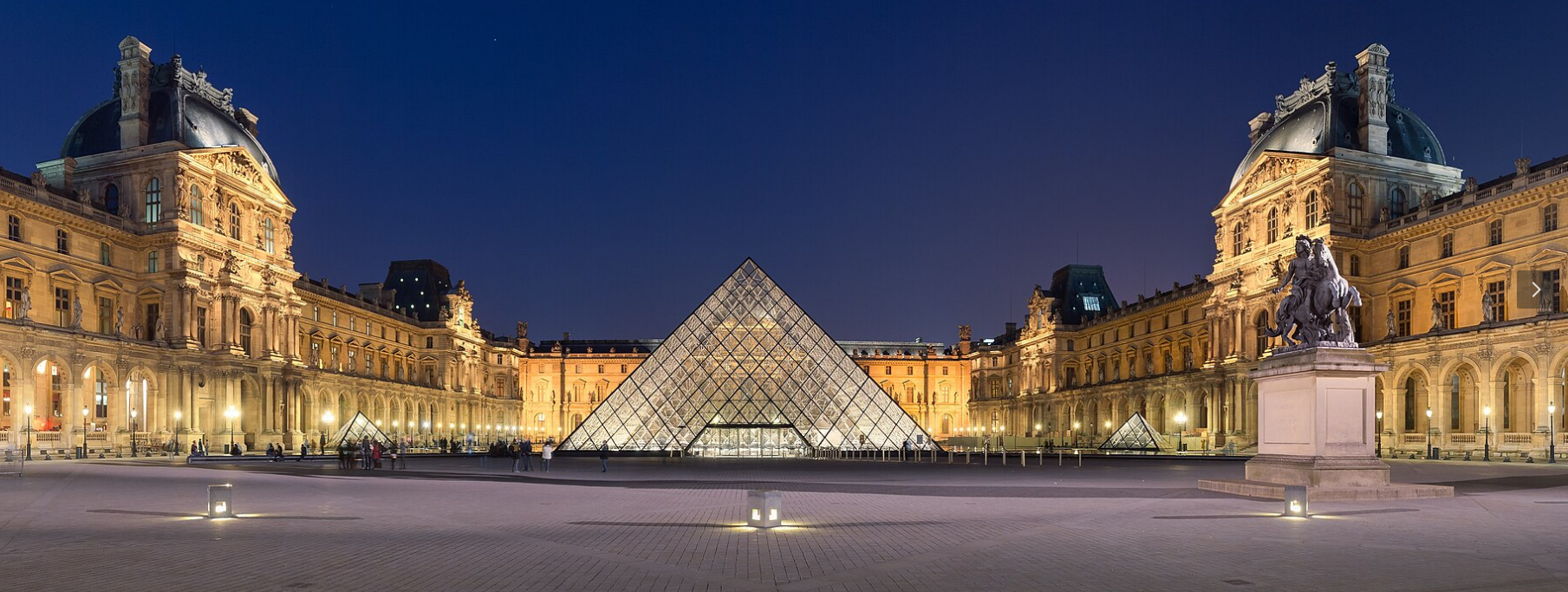
The Louvre Palace was built under Philip II in the late 12th to 13th century. By the 16th century it had ceased to be a fortress and became the primary palace of the French monarchy. Redesigned and extended often it became the home of the royal art collection from 1682 when Louis XIV moved the court to Versailles.
The Louvre played a major symbolic and organisational role in the people’s revolutionary explosions of the 18th and 19th centuries (1789-93, 1830 and 1871). In the 20th century it became associated with Resistance to German Occupation.
During the French Revoution it became a national art museum, largely of royal and confiscated church property.
During the July 1830 Revolution it witnessed the defeat of Charles X‘s Swiss guards on July 29, when a crowd, including many Polytechnic students, stormed it using a scaffolding for repairs that covered part of the colonnade.
July 29 1830 Left Bank students workers and shopkeepers cross the Pont Neuf to attack the Louvre. Painted anonymously by an eyewitness.
Louis Vaneau, one of the Ecole Polytechnique students killed in the 1830 fighting, had the Rue Vaneau renamed after him in 1870.
The Louvre Palace in January 2016 photographed from the Pont Neuf with the oldest part on the right in what had been the Rue de Louvre, but is now the Rue de l’Amiral Coligny. It was renamed in 1972 after the Protestant Huguenot prince who was assassinated by the Catholic Fronde on St Bartholomew’s Day 1572
After the 1870 Sedan defeat and the end of the Second Empire, Gustave Courbet chaired a meeting of Parisian artists at the Louvre on September 6 1870. It set up a Commission for the Protection of the Heritage of Paris’ museums.
The leading realist painter of the 19th century, Courbet, photographed by Nadar
On March 1 1871 a hostile crowd gathered at the Louvre to shout insults at the Prussian officers who came to visit their ‘captured’ monuments after Thiers and Favre in Versaiilais had signed an ignominious armistice to end the siege of Paris.
Two weeks later the Louvre was the headquarters of the military governor of Paris at the moment when the Versaillais government attempted to seize control of the canon that were defending Paris. This coup’s failure led to the formation of the Paris Commune on March 18 1871.
The Federation of Artists, including Aimé-Jules Dalou and Jules Héreau as well as Courbet, immediately moved into the Palace. On April 17 a meeting held in the Antiquities Room of the museum (off the Place du Carrousel) elected a 47-strong Committee of the Artists’ Federation.
On 24 May 1871, when the Versaillais troops took over the Louvre Palace, a solitary woman stood in front of them. She was put against the gate of the colonnade and shot.
After the Occupation of Paris by German troops on June 14 1940, several staff at the Louvre Museum formed a collective resistance team aiming to save as many art works as possible from destruction and pillage.
Under the Occupation Parisians were forbidden to enter. Only a handful of staff were allowed in. They included Jacques Jaujard, the existing Protestant-origin head of French national museums.
He used his knowledge of the underground storage beneath the Louvre to store the first leaflets produced by the Committee of Public Safety founded byBoris Vladimirovitch Vildé, an ethnologist and linguist at the Musee de L’Homme. The journal they produced from August 1940 was called Résistance.
Vildé and six other intellectuals and academics in the Groupe du musée de l’Homme were finally denounced by a Vichy supporter and shot at Fort Mont-Valérien in Suresnes, a western Paris suburb, where between 1,000 and 4,500 resisters were executed during the Occupation.
At the Louvre the three rooms taken over by the Germans to store the art and culture seized from Jewish families didn’t provide enough space, so Jaujard and Rose Valland, a graduate student of art history, suggested they use the Jeu de Paume museum in the Tuileries gardens from October 1940. This was where Valland had volunteered since 1932.
Rose Valland, who understood German, but kept that secret from them, then began working full-time alone at the Jeu de Paume, built under Napoleon III in 1861, and a gallery since 1909. While there she secretly kept notes on the over 20,000 works of art the Germans had looted and wherever possible, through talking to lorry drivers taking them onwards to railway stations, finding out where they were going to and in many cases to which individuals.
She was present when on May 3 1941 Hermann Göring made one of his 20 visits to the museum to choose paintings for his own private collection. The others were either sold through Switzerland, burned in a bonfire of ‘degenerate art’ on July 27 1942, or stored to be eventually housed in Hitler’s never-constructed Leader’s Museum in Linz.
Valland passed on information to the Resistance via Jaujard so that the trains east they were on would not be mistakenly blown up. In August 1944 this information was used to prevent the final attempts by the Germans to loot 148 crates of paintings containing in total 967 paintings, including works by Braque, Cézanne, Degas, Dufy, Gauguin, Modigliani, Picasso, Toulouse-Lautrec and Utrillo.
A wonderful park in central Paris it also has a darker side. It was a place of summary trial and execution in 1871 and witnessed the final battle of the Liberation of Paris in 1944.
This garden is where I’ve spent many hours watching speed-chess and slow-boules (pétanque – from the old Occitane word meaning feet planted on the ground). I have even once waded in January into the half-frozen circular basin to rescue my ten-year-old’s sinking electronically-controlled boat (I hadn’t followed all the assembly instructions entirely correctly).
Hazan (WTP) writes ‘Few places in Paris have inspired so many writers and poets, not to mention cineastes’.
The Medicis Fountain dates back to 1630, but it was remodeled in 1864. Venus was removed and replaced by Ottin’s statues of the giant Polyphemus discovering the lovers Acis and Galatea. Perhaps that’s why couples enjoy the basin’s cool and calm.
The Medicis Fountain on the west side of the Palace that is now the French upper chamber, the Senate, can be a beautiful spot when it’s not overflowing with tourists.
The Luxembourg Gardens also have a darker side. On December 7 1815 it was where Marshal Ney was shot for having supported Napoleon during the hundred days before the defeat at Waterloo.
That was nothing compared to the hundreds murdered there by government troops in the final ‘bloody week’ of the Paris Commune.
A drawing of the executions in the Luxembourg Garden during the Bloody Week of May 21 to May 28 1871
On 29 November 2016, the French National Assembly (Parliament) passed a resolution to pardon all ‘the victims of the repression of the 1871 Paris Commune‘ – the 10-25,000 people who were shot, imprisoned, exiled, deported or otherwise punished by the French Government for their part in the Paris Commune between May 1871 and 1877.
There is no reference to Dr Tony Moilin or any other individuals murdered here by the Versaillais army in 1871
Sadly, commemorations appear to be about the only positive thing that Hollande’s socialist government did from 2012 to 2017.
There is now one very small plaque referring to the thousands killed in the Paris Commune. Not at all obvious, it is on the wall facing the Palace to the South-East of the basin, often obscured from view in the Spring and Summer by couples profiting from the Luxembourg’s reclining chairs in the warmth of the sun.
I wrote what follows after walking for perhaps the thousandth
time through the Luxembourg Gardens. It is strange what you don’t see when you
don’t look.
‘This time I quite quickly found the tiny memorial plaque
beneath the Queens’ Terrace for those shot in the terrible week 21 May to 28
May 1871 that I’d first seen online two days ago. There were three burial pits
dug in the gardens, where perhaps a third of the estimated 2,000 summarily
executed prisoners across Paris were buried.
One of those given a military trial on the spot was a doctor, Tony Moilin, who had been jailed by Napoleon III for writing a futurist socialist book titled Paris in the Year 2000. Released with other political prisoners with the abdication of the Emperor in 1870, Moilin briefly became mayor of the 6th arrondissement. Taken prisoner on the 27th May he admitted helping the wounded on the barricades.
A few hours before he was shot on the 28th, he was allowed to
marry his pregnant partner. His body was never recovered. The inscription on
the plaque doesn’t even get the dates of the murders right.
A postcard of the Cornice of Kisses in the Luxembourg Gardens around 1910
Michel had given the funeral oration to Blanqui in 1881 and Derré was an anarchist sympathiser and pacifist. In 1906, when he first exhibited it the sculpture, Derré (1867-1938) called it Dream for a House of the People. The column was then placed in the Luxembourg Gardens.
Louise Michel is shown kissing goodbye (and death) to Auguste Blanqui. The three other kisses sculpted represent maternal instincts, love and consolation
After being lost for several years it is now in the square in front of the Roubaix town hall in France’s old northern mining area that used to be a stronghold of socialism.
Émile Derré’s column shown in its new home in Roubaix in 2017. It was found, broken in three pieces, in the yard of the 400-year old St Gobelins tapestry and carpet works.
I too have a soft spot for Pierre Mendès-France (1907-1982). The university named after him in Grenoble was where I first did any teaching in France. He did end France’s Vietnam War in 1954, and then began decolonialisation in Tunisia.
In 1984 Mitterrand preferred to dump Derré’s column for Louise Michel and install his friend and mentor Pierre Mendès-France in the garden
Mendès-France was also a consistent opponent of De Gaulle’s 5th Republic constitution, that concentrates power very dangerously (as Macron began demonstrating in 2018) in the hands of the President. He had also served in Leon Blum’s Popular Front government of 1936.
From 1896 to 1898 the future Jewish first minister of France, Blum (1872-1950), lived at No. 36 rue Guynemer (then rue de Luxembourg) on the western edge of the Garden.
But the Mendès-France statue is far from being about dreams of social change. Surely Mitterrand could have moved one of the hundreds of memorials to France’s ruling class power in the Jardin du Luxembourg rather than take away the beautiful and romantic Louise Michel column.
Mitterrand’s easier option was to replace one politically ‘left’
public object by another. Sad.
The Luxembourg Palace was also the site of the last armed German resistance in Paris at Liberation in August 1944. All round the Latin Quarter there are memorial plaques to the courageous French men and women who died in the uprising between August 19 and August 29. Altogether some 1,500 Parisian resistance fighters were killed, including some 600 civilians.
Looking towards the Luxembourg boating pond past the occupying German tanks on August 25 1944 shows the gardeners kept putting out the palm trees during the Germany occupation of the Luxembourg Palace.
On August 25 1944 Pierre Georges (Colonel Fabien), who had fought in the International Brigade in Spain, commanded 300 resistance fighters around the Luxembourg Palace. Fighting was intense and the SS, who were concentrated there, only finally surrendered when given an hour’s notice of an aerial bombardment.
The garden still displays some sculptures that remind us of some key personalities and movements in French left history.
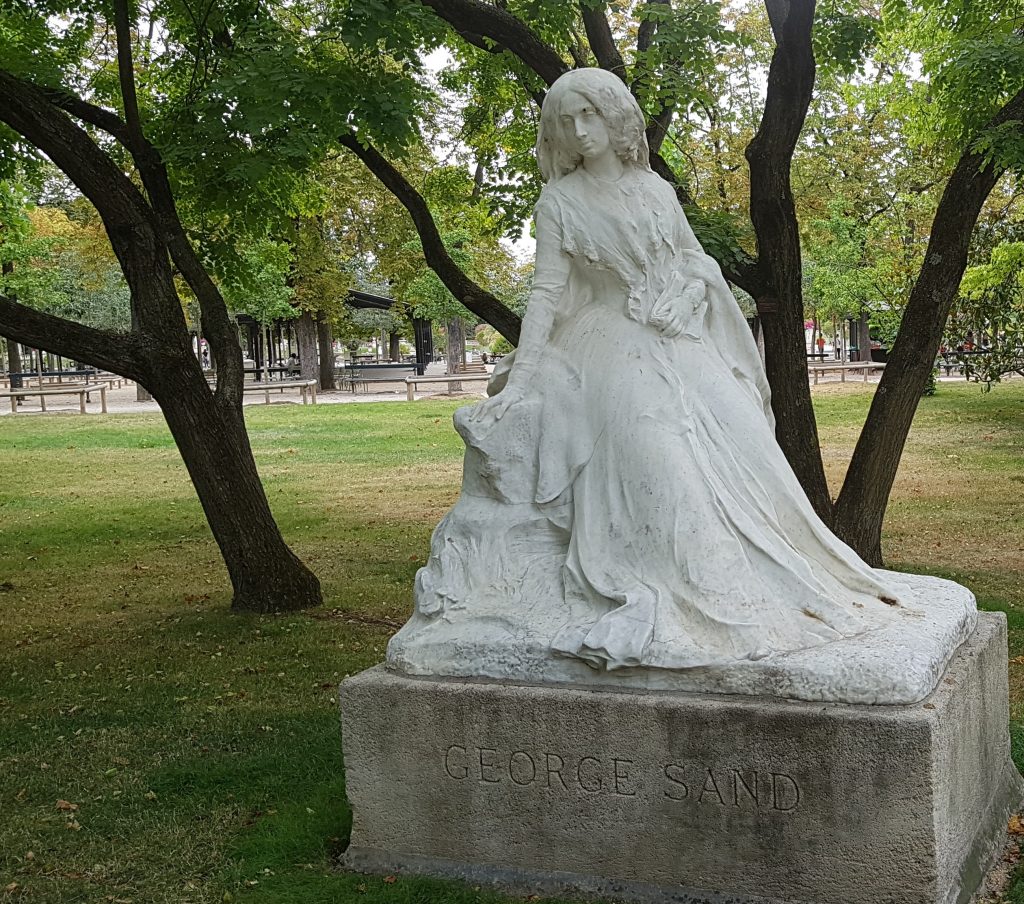
George Sand, sculpted by Francois Sicard was inaugurated in 1904 on the centenary of her birth. Not at all the image of the male-clothed self-declared communist.
Jules Dalou‘s three commissions all come from the same period from the 1890s through the 1900s when liberal republican governments fought off the right and sought to strengthen republican imagery and values. different and all interesting.
In 1890 Dalou’s Monument to Eugene Delacroix – the painter whose most famous work, Liberty leading the people was kept hidden by King Louis-Philippe from 1832 until 1848, and that we have borrowed characters from in designing LeftinParis – was inaugurated in the garden.
Dalou produced a bust of Delacroix but also comments on his belated recognition. Delacroix had died 27 years earlier, so Dalou shows him being given a palm and crown by Glory, lifted up by Time and applauded by Apollo, the god of genius.
In our brief biography of Dalou we show his two other sculptures present in the garden:The Triumph of Silenius, finished in 1885 but only erected in 1898 and the Monument to Scheurer-Kestner, installed in 1908.
A statue referencing surrealism and poetry, dedicated to Paul Eluard, a founder of surrealism who then joined the Communist Party, was erected in 1954, just two years after Eluard’s death. It was sculpted by Ossip Zadkine.
During the Revolutionary Terror (April 6 1793 to July 28 1794), the Palace became an overflow prison, holding among others Danton and Desmoulins who were both executed on April 5 1794.
In December 1830 a demonstration against the clemency shown to Charles X’s former ministers, was violently put down outside the Palace.
The Palace was the location of the Workers’ Commission set up after the February 1848 revolution. Workers had demanded a Minister of Labour, calling the post a ‘Minister of Progress’, but this had been turned down and Louis Blanc accepted the position of President of the Commission instead.
Others nominated to the Commission included Albert and the followers of Fourier, Victor Considerant and François Vidal.
Pierre Marie de Saint-Georges, the Minister responsible for the National Workshops set up in 1848 was also based at the Palace. On June 22 Louis Pujol was nominated spokesperson of the 56 delegates chosen by a workers’ meeting at the Panthéon to negotiate with Pierre Marie.
The meeting took place at the Luxembourg Palace, and Pierre Marie’s attack on the delegation, asking if they were ‘slaves’ to Pujol, fueled an anger that observers credited with sparking the huge June 1848 workers’ uprising.
In May 1871 the military tribunal set up in the Palace summarily sentenced hundreds of Communard fighters and supporters to be shot in the Luxembourg Garden at the back of the palace, just below the statues of French queens.
On July 3 1880 Victor Hugo finally got the amnesty for the Communards through the Senate, based at the Palace more or less continuously since 1805.
After the Germans occupied Paris in 1940 they made the Palace the headquarters of the Luftwaffe, where it was visited by Hermann Goering. His Luftwaffe Field Marshal was also given a luxurious apartment there. It also served as an administrative centre covering prisoners of war.
The Palace was one of the last bastions of German opposition at Liberation in August 1944. Its soldiers only finally surrendered on August 25 to the resistance fighters led by Colonel Fabien, when they were faced with 5 tanks detached by General Leclerc and the threat of air strikes.
The street was built in 1898 over an old quarry. It was named after an earlier owner of the land.
Inessa Armand lived at No. 2 from 1910 until she left France with her lover, Lenin, and Krupskaya for Switzerland in 1912 .
Inessa Armand lived at No. 2 Rue Marie Rose from 1910 to 1912
Number 4, the 48 square meter two-room second-floor flat was occupied by Lenin, Krupskaya and her mother from July 6 1909 to June 12 2012.
The flat was bought by the Communist Party in 1955 and opened as the Paris Lenin museum in 1955. On March 25 1960 it was visited by Krushchev along with Maurice Thorez. It was given the Russian Communist Party’s seal of approval a second time in 1985, when it was visited by Gorbachev and Georges Marchais.
In 2007, however, the PCF sold it when things were going downhill for its fortunes . The plaque outside the building was then taken down.
Lenin used to do repairs and maintenance on his bicycle in the street outside No. 4. When I passed by and took these photographs, all the windows on the second-floor had their shutters closed.
Father Corentin Cloarec (1894-1944), the Franciscan vicar of the nearby Saint-François monastery at No. 7 who was chaplain to the Denfert-Rochereau resistance group, was assassinated there by the Gestapo on June 28 1944. The brick monastery was built in 1935 and its remarkable chapel glass is now listed as a historic monument.
The Chilean embassy is in a prime location at No. 2. It had previously been the private mansion of the Tour-d’Auvergne family.
Built in 1907 for Prince Henri de La Tour-d’Auvergne it was rented to the US Embassy until 1929 and then sold to Chile to become its Embassy
The Chilean Embassy was where Louis Aragon was allowed to take refuge for a few days on August 28 1939 by fellow poet and Communist, but also a diplomat there at the time, Pablo Neruda. Aragon had been attacked in the street by the extreme right-wing after the French Communist Party had been banned on August 25, two days after the 1939 Hitler-Stalin ‘Non-aggression Pact’.
Between 1971 and 1973 Neruda was made Chili’s Ambassador to France by Salvador Allende. Back in Chili Neruda witnessed the September 11 1973 Pinochet coup d’etat (protests outside the Paris embassy pictured here). But 12 days later Neruda died of ‘heart failure’. 21st century scientific analysis has suggested he could have been murdered in hospital through being injected with botulism.
Jean Jaurès, the leader of the Socialist Party before World War I, lived at No 19 for a period of time according to Paris Revolutionnaire, but we still need to check out the source for this and the time he spent there.
The French Jewish 20-year-old Louise Alcan lived at No. 48 and became a supporter of resistance in 1940. She later moved to Vichy France but was denounced and arrested in December 1943 in Marseille after the Germans moved to occupy the whole of France.
Louise was first taken to the Drancy transit camp and then deported in Convoy 64 to Auschwitz-Birkenau in February 1944. She later escaped from the Ravensbruck Death March of April 1945.
Further down the road at No. 52 there are several connections to the resistance. This was where the leading Catholic resistance organiser from De Gaulle’s secret service in London, Gilbert Renault known as Colonel Rémy, lived from December 1941 to June 1942. With a month of the 1940 defeat he returned from London and with Louis de La Bardonnie set up the Confrérie Notre-Dame (later called the CND-Castille). Two of Renault’s sisters, Maisie and Madeleine, also joined the CND and were arrested at No. 52 on June 13 1942. But they were able to ensure Gilbert’s escape.
Maisie Renault (1907-2003) was first taken to the Santé prison and then to Fresnes until March 1943. She was next moved to the Romainville Fort and on August 15, after D-Day, she and her married sister Madeleine were deported with 550 others to Ravensbruck. They were among the 17 from that convoy who survived to be liberated on April 22 1945.
Outside No. 52 Roland Abon, a resistance fighter aged 19 was killed fighting for the liberation of Paris on August 25 1944.
The huge garden-square-roundabout was originally called the Place du Trône. This name was given it from August 26 1660 when the young Sun King, Louis XIV, sat on a huge throne placed there at the entrance to Paris to receive oaths of allegiance from the Paris guilds after he arrived from the Franco-Spanish border having just married his 22-year-old double-cousin Marie-Thérèse of Austria and Spain.
In 1787 two huge columns were erected alongside the two single story customs houses and 60 metre-high gates that completed the tax border wall built by the Paris Tax Farmers. Statues of Kings Philippe II and Louis IX were put on top of the columns in 1845.
After the Jacobin insurrection of August 10 1792 the square was renamed ‘The Square of the Overturned Throne’ (place du Trône-Renversé). Two years later on June 13 1794, three days after the passage of the Law of 22 Prairial, the guillotine was erected on the shadier south side of the square. From then until 9 thermidor an 2 (27 July 1794) and the overthrow of Robespierre, an average of 30 people a day were executed there.
At the restorations of 1814 and 1815 the square’s name became again the Place du Trône.
On July 14 1880, at the same moment that the Third Republic determined that inscription Liberté, Égalité, Fraternitéwas made obligatory on all French public buildings, the square was given its current name.
Nine years later, on the one hundreth anniversary of the storming of the Bastille, the sculpture The Triumph of the Republic put in the centre of the Place.
This was a large piece by the Communard Jules Dalou, who had returned from exile in 1879 and who had originally designed it for a competition to place a republican statue in the Place de la République. Dalou also sculpted the tombs of Victor Noir and Auguste Blanqui in the Père Lachaise cemetery.
In 1908 sea monsters in a basin sculpted by Georges Gardet and representing reactionary forces being kept at bay by the Republic were added. The crocodile-like monsters were melted down for the German occupiers in 1942 and the basin concreted over.
A general strike supported by both the CGT and the CGTU in defence of the republic against the growing fascist threat was called on Monday February 12 1934. A Socialist column headed by Leon Blum and other Socialist deputies walked from Vincennes to la Place la Nation, with Dalou’s Republican statue its message. There the Socialist column was joined by an even larger Communist march creating a demonstration of 150,000 in Paris alone, while tens of thousands demonstrated elsewhere in France.
On February 12 the divided trade unions and left parties created the biggest demonstration yet seen in France and marked the beginning of united left action against fascism that led to the Popular Front.
The Place de la Nation became a symbol of anti-fascism and left unity. So two huge contingents came together there on July 14 1936 to celebrate the Popular Front victory. This time the call came from 48 different organisations and delegations in traditional provincial as well as working clothes were present alongside each other. Tartakowsky (1997) estimated there were a million people on the streets of Paris for the occasion, marching from the Place de la Republique and Place de la Bastille to the Nation.
Communist and Socialist columns met at the Place de la Nation again to celebrate the first-ever French May Day public holiday on May 1 1937.
In 1938, with the end of the Popular Front government, the strike called on November 30 by the CGT against the dismantling of the 1936 labour laws saw demonstrators attacked by the police.
A young FTP-M.O.I. resistance group (Meier List, Marcel Rajman and Jaroch Klesczelski) threw a grenade at a group of German soldiers in the Place on December 12 1942. Nearly a year later Rajman was arrested with Olga Bancic. He was shot after a trial on February 21 1944, while she was deported to Stuffgart where her head was cut off with an axe.
On May 1 1951 the police attacked a May Day demonstration of Algerians who were carrying the MTLD independence movement’s flag. One hundred police were injured and 1,600 Algerians arrested.
On July 14 1953 the traditional march took place from the Place de la Republique to the Place de la Nation. Then the Algerian demonstrators behind the MTLD banners continued to where their lorry was parked to stack their placards.
At that point the Paris police opened fire on them: six Algerians and one French CGT worker were killed and 126 wounded. No inquiry was held into the police action.
A plaque in memory of those killed is now fixed on the side of one of the customs housesA film poster about the July 14 1953 police murders of Algerian independence supporters in the Place de la Nation. The film is by Daniel Kupferstein
The Panthéon dome (actually three in one like a Russian doll) is one of Paris’ landmarks. Jacques-Germain Soufflot’s Church of Saint-Genevieve on the hill to the South of the River Seine was built on a grand scale between 1755 and 1790 – and being completed only shortly after the French Revolution began.
Almost immediately the National Constituent Assembly decided to use the model of the Roman Pantheon and to install statues of great Frenchmen in it.
The slogan, ‘A grateful nation honours its great men‘, was put over the entrance and on April 4 1791 Mirabeau became its first brief resident (his ashes were taken away on November 25 1793), followed by Voltaire (July 11 1791), Rousseau (October 11 1794) and then several executed revolutionaries, including Jean-Paul Marat (September 21 1794 – and then thrown into the gutters by the Muscadins on February 26 1795).
Rousseau’s statue in the square put up in 1889 was destroyed under the German Occupation in 1942.
Under Napoleon Bonaparte who gave it back to the Catholic Church, its crypt was stuffed with 41 mainly military figures. After the July Revolution it reverted to being a secular Pantheon on August 26 1830, but no more ‘great men’ were inserted there under Louis-Philippe who kept the crypt closed.
The square in front of the Panthéon became the meeting place for hundreds of demonstrations and pitched battles in the 19th and 20th centuries. One riot under a black flag started there on 21 December 1830 in protest against the light sentences given to the reactionary government ministers of Charles X.
On 22 February 1848 a student demonstration against the banning of university courses by Quinet and Michelet left from there for the Madeleine. Soon after the Panthéon was renamed ‘The Temple of Humanity’, with the intention of turning it into a monument to human progress. The Law School at No. 12 hosted the revolutionary Soufflot Club in March 1848.
On June 22 1848 the square was the meeting place of thousands of workers protesting the closure of the National Workshops who then organised the building of barricades and the call for an armed insurrection. It was one of the three main centres of resistance, with the barricade at the Rue d’Ulm being one of the most important.
The National Guard used canon to burst through the doors of the Panthéon on 25 June 1848 to dislodge the workers inside.
Following Louis Napoleon’s 1852 coup-d’état the building was returned to the Church again, now the ‘National Basilica’, and the surviving bits of the nun Genevieve’s 1,350-year-old corpse stuck together in a new tomb.
From September 4 1870 the Town Hall of the 5th Arrondissement at No. 21 became the recruiting office for the National Guard defending Paris. with 12 separate offices interviewing recruits. Between 200 and 300 summary executions of Communards took place there on 24 May 1871.
The Panthéon itself was shelled during the Franco-Prussian war and became the scene of a major battle between the Communards and the Versaillais army. On 31 March 1871 a red flag was attached to the sawn off wooden cross that had been erected on top of the building on the orders of Napoleon III. Jean Allemane spoke on the steps supporting the raising of the red flag.
The Law School at No. 12 was where the ‘Democ-Socs‘, the 5th arrondissement’s Democratic-Socialist Club was based in 1870-1871. Many were massacred here on May 24 1871 as the Army burst through to attack those defending the Panthéon via a side door.
Before the ‘Bloody Week’ of the Commune a communist and atheist newspaper l’Éducation républicaine was published at No. 9, being used by a revolutionary club called ‘The Democratic Association of Masters of Study‘.
The Panthéon finally returned to its role as resting place for the ‘great men’ of France on June 1 1885, after the government inserted Victor Hugo‘s body into the crypt.
On June 4 1908 Alfred Dreyfus was wounded in an attack on him when he attended the ceremony installing Émile Zola‘s body into the Panthéon.
The Ste Geneviève Library where Lenin researched ‘Materialism and Empiro Criticism’ in 1908, was based at No. 10.
In 1920, as part of the celebration of the German defeat, Sicard was commissioned to produce an altar dedicated to the National Convention that declared the First Republic in 1792.
The space for the intended religious altar in the centre of the Panthéon was finally filled by Sicard’s secular monument to the glory of the National Convention in 1920.
On July 16 1942 the Police Station based in the Town Hall at No. 21 was used at a primary collection point for Jews being arrested for deportation by the Paris police in the entirely French-run exercise called ‘The Vel’ d’Hiv Roundup‘ (Rafle du Vélodrome d’Hiver).
In some form of recompense, on May 27 2015, Jean Zay‘s remains were transferred to the Pantheon, along with the resistance fighter Pierre Brossolette, and soli from the graves of two women heros of the Resistance who survived the occupation, Geneviève de Gaulle-Anthonioz, and Germaine Tillion.
This very long street now linking the very wealthy Avenue du President-Kennedy with the Boulevard de Beauséjour was originally part of the Commune of Passy. Named after the nearby Ranelagh Garden it was opened when the lawyer for the estate agent who demolished the Boulainvilliers Château sold off the land in 1825. It was then successively extended between 1854 and 1877.
Building speculation was rife throughout 19th century Paris. The highest prices for land were reached as the Westward expansion of the city exploded in the 1820s. The Roëhn firm and its lawyer did very well.
From the age of two in 1844, Stéphane Mallarmé lived at No. 44 before being sent to a Christian boarding school between the ages of 10 and 13.
On May 22 1871 captured Communards were lined up against a wall in rue Ranelagh and summarily shot.
In the school year following the Popular Front election victory and strike wave of 1936, Simone de Beauvoir spent a year teaching at the Lycée Molière at No. 71.
The lycée Molière in the early 20th century. Designed by the architect Vaudremer and opened in 1888 it had taken two years to build. The Figaro and other right winters denounced the use of Molière’s name, arguing that he would only have wanted women to be taught morality and housekeeping.
This secondary school for 14-18 year-old was opened in 1888, the third for young women in Paris. its openinig followed the Camille Sée law, passed in 1880 and given the name of the Jewish deputy for Saint-Denis who succeeded Louis Blanc.
Based in the wealthy west of Paris, attending the Lycée Molière provided an education for many of the French female intellectual and political elite in the first half of the 20th century. It became a mixed school in 1973.
Under the Occupation in 1941, No. 97 was where Jean Mazeline, working with the Alsace-born lycee teacher and subsequent academic, Robert Schilling, as part of the Guédon resistance group printed a newspaper, Unter Uns, aiming to deliver counter propaganda to German soldiers.
The street still possesses an illustration of its earlier wealth, an elaborate mosaic street name and number.The last section of the Petite Ceinture railway was finally closed in 1985, and the rails taken up in 1993. Since then it has become a 1.2 km green walk way.
At the very end of the street is a green space that was opened on the land that was once used by the Petite Ceinture railway line whose 32 kilometers used to circle Paris.
The road got its name from an 18th century Irish peer, Lord Ranelagh, who built a domed dance hall rotunda in his Chelsea garden in 1742 that was copied near the Château de la Muette in 1774 and then called ‘le petit Ranelagh’. The Jardin Ranelagh, was created on the lawn of the royal Château by Haussmann in 1860.
One of the 22 metre-wide roads hammered through the old medieval street network of central Paris under Baron Haussmann from 1854 to 1858. It absorbed some of the ancient streets it went through and destroyed others. Its final section, westwards from the rue St Denis, was only opened in 1897.
Léon Blum was moved round the corner from his birthplace in rue St Denis to No. 57 when he was a young boy.
A member of the Paris National Guard and of the International Workingmen’s Association, Jacques Durand, lived at No 90 (at the time No. 8 rue Thévenot). A cobbler who had stood as an IWMA candidate in the February 8 1871 elections he was elected by the 2nd Arrondissement to the Paris Commune on April 21. On May 25 1871 after fighting ended in the area he was arrested at home, interrogated at the Town Hall of the arrondissement, and then taken to the back of the Notre-Dame des Victoires church and shot.
From 1924 to 1940, the editorial office and printworks of what was then a right-wing paper, ‘L’Intransigeant‘ that was edited by André Malraux in 1934, were at Nos. 98-100.
Outside the printing works and offices at No.100 in 1927 when an American film star came to Paris
After the June 1940 Occupation of France the building housed a German press centre from 1940-1944, and was targeted several times by the Resistance.
After Liberation in 1944 No. 100 became the offices and printshop of the papers Franc-Tireur and the Défense de la France that eventually became France-Soir.
The L’Algérie libre paper of Messali Hadj’s Mouvement pour le triomphe des libertés démocratiques was also printed at No. 100 from its launch at the end of 1948 until its suppression in November 1954. On June 17 1950 sellers of the paper were arrested, and on September 18 1950 when the edition of the paper was seized for the first time, a protest demonstration led to the arrests of 1,100 Algerians who came to protest outside the printworks.
The newspaper Jean Jaurès co-edited at No. 111 in 1898, La Petite république, was France’s widest circulation socialist paper in the 1890s. This was where he published ‘The Proofs’ of the innocence of Dreyfus.
Opened only in the mid-19th century, the road’s name derives from its leading to the railway station, the Gare de Rennes (now renamed Paris-Montparnasse), whose trains traveled to Brittany.
Haussmann‘s original design was to extend it to the Seine, but because this would have involved knocking down the prestigious French Institute and creating a giant X at the eastern end of the île de la Cité it never happened. The road’s numbering thus only starts at 41 and 48 just south of the boulevard Saint-Germain. Its buildings mainly represent the classical Haussmann-Second Empire style, while No. 140b is attributed to Gaudi and Ausher in the Art nouveau style, and dated 1904.
During the Paris Commune the offices of one of the most successful daily newspapers, le Cri du Peuple , whose contributors included Gustave Courbet, were based at No. 61. It printed up to 100,000 copies and published 82 issues between 22 February and May 23 1871. Initially banned on March 11 it was reissued on March 21 and then continued daily until the ‘bloody week’ at the end of May.
18 issues appeared between 22 February 1871 and 12 March, when it was banned by the Army’s Commander in Chief in Paris, General Vinoy. Another 65 issues appeared from March 21.
Jules Vallès, its editor in 1871, returned from exile in 1880. The journal was given a new lease of life between 1883 and 1889 by Vallès and Séverine (Caroline Rémy), with Jules Guesde. One of its first articles describing students as ‘idot children of a rotten bourgeosie’ led to students demonstrating outside the offices.
In 1919 Simone de Beauvoir‘s family moved into No 71, a small sixth floor flat without a lift and without running water. She lived here until 1929.
There is no plaque in the street for her. But at No 128 there is one for Colonel Robert Fouré (1875-1945). He was retired after the June 22 1940 armistice and at the end of 1940 made contact with the new clandestine Socialist/SFIO resistance. This initially produced a Libération-Nordunderground newspaper, and then in November 1941 it moved into organised resistance.
Between the end of 1943 and May 17 1944, Fouré was its military head. Arrested by the Gestapo he was deported to Buchenwald and died at its offshoot, the Mittelbau Dora concentration camp a few days after the arrival of US troops in April 1945.
A plaque commemorating one of the leaders of the clandestine SFIO resistance movement who lived at 128 rue de Rennes
Another plaque at the Art Nouveau No. 140bis rue de Rennes was laid by President François Mitterrand to remember the seven killed and 55 wounded by a bomb planted in a dustbin outside the Tati shop there. This was the last, and the most dangerous, of the ‘Black September’ 14 bombings. These were claimed by a Lebanese Hezbollah-linked group aiming to secure the release of three of their jailed members and to stop France supporting Sadam Hussein in the Iraq invasion of Iran.