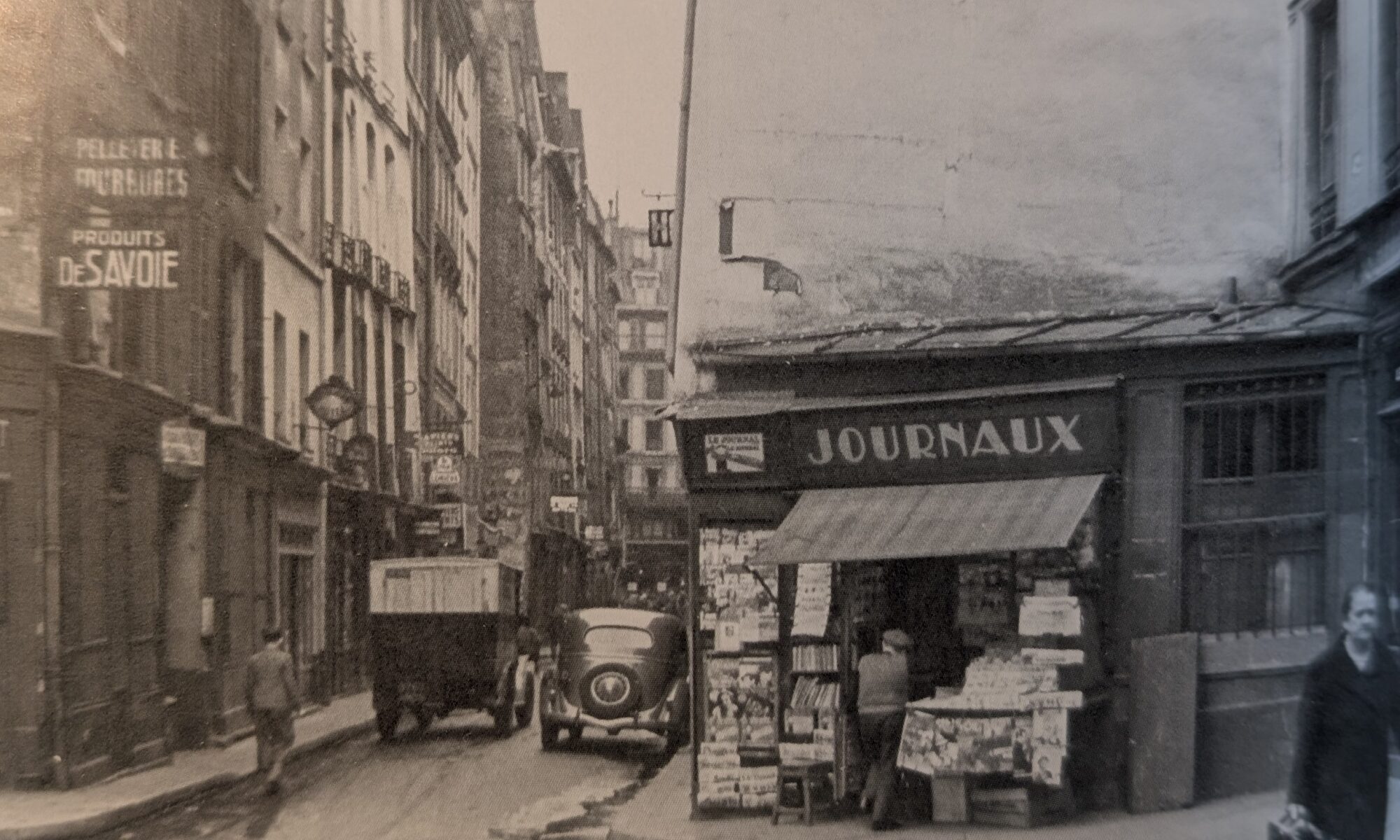
The entrance to Rue Graneta was blocked by a barricade between Nos. 1 to 2 that witnessed fighting on May 12 1839 during the short-lived insurrection of the Four Seasons. This was inspired by Blanqui and Barbès, both of whom were later condemned to death and then reprieved for their part in the planning and fighting.
In 1911 the protestant Pasteur Wilfred Monod established the Centre social La Clairière (the Clearing community centre) at No. 60. His aim to provide a place where poor families could send their children to a ‘free space in a dark forest’. One of his successors as Pastor at the Louvre Oratory was Paul Vergara who also led La Clairière‘s social work from the Centre.
Asked for help in 1943 by the Belgian resistance networker Suzanne Spaak, Vergara’s Sunday February 12 sermon asked his congregation to volunteer to help rescue 63 Jewish children from an impending deportation from where the Paris police and Milice had gathered them in Rue Guy-Patin and Rue Lamarck.
Outside the Oratory church Marcelle Guillemot, a social worker employed by the La Clairière associaton, collected the names of 25 women volunteers and over the next couple of days 15 more women, largely Jewish or from the migrant resistance network FTP-MOI, joined up too. On Thursday 16 February, the women arrived individually at one or other of the deportation centres and ostensibly took the children for a walk.
All the children aged between 3 and 8 were walked to the community centre at No. 60. There they spent the night, fed with Red Cross food parcels. Curious neighbours had been told the children were victims of bombing being temporarily found new homes.
The next day Vergara organised false identity papers for them and then in small groups the evacuation began. Over the next few days members of the recently dissolved Protestant French girl guides movement took those being hidden or lodged some distance (Normandy, the South of France or the Paris suburbs) while several of the local women volunteers took others back to their homes.
Meanwhile La Clairière‘s hall was cleaned and cleared of all trace of the children. But three months later the Gestapo called. Marcelle Guillemot wouldn’t let them in, and before they broke in she was able to destroy an incriminating documents and escape through the back window into an unguarded ally. She spent the rest of the war living clandestinely in Paris, while Vergara escaped to Switzerland.
In November 1802 Victor Hugo‘s mother, Sophie Trébuchet Hugo, left her husband, the baby Victor and his two brothers sons to live in Paris at the Hôtel de Nantes, 78 Rue Neuve-des-Petits-Champs. This was also where Marie-Henri Beyle, the author of The Red and the Black, Stendhal, died in 1842.
Sophie spent thirteen months there, lobbying Joseph Bonaparte (Napoleon’s brother) and others for Joseph-Léopold Hugo‘s favour to get him transferred somewhere more prestigious than Besançon. While there she starts a long-term relationship with Victor de Lahorie (Victor Hugo’s godfather who had fought with the Joseph-Leopold Hugo in 1798 and 1799) but had recently been forced into retirement from the army because of suspicions about his loyalty to Napoleon. The out of favour Lahorie failed to secure Leopold Hugo a better posting, and instead Hugo was sent from Besançon to Corsica and from there to the Isle of Elba.
The street was renamed Danielle Casanova in December 1944. Corsican-born Vincentella Perini was the daughter of teachers. She trained as a dentist in Paris and in 1928 joined the Communist Youth movement eventually becoming a member of its Central Committee. In 1930 she married a law student, Laurent Casanova, and with him became friends of Communist Party leader Maurice Thorez and his wife.
The UJFF was founded partly as a response to the resentment of young communist militants who had little responsibility within the then young French Communist Movement, and partly as a way for the French Communist Party (PCF) to recruit young female members.
Danielle and the other founders of the organisation wanted to focus on issues related to all areas of gender equality: work (referring in particular to the difficulties encountered by Marie Curie in her career), education and leisure. They emphasised the double discrimination of women from the working class due to both gender and social background. The UJFF supported the Republicans during the Spanish Civil War, participating in demonstrations of support and welcoming refugee children from Spain.
After the French Communist Party and its related organisations were banned in August 1939 with the signing of the Molotov–Ribbentrop Pact, Danielle went into hiding. Working underground she organised demonstrations against the occupying forces, including those of 8 November and 11 November 1940 protesting the arrest of Professor Paul Langevin.
From June 22 1941 when Germany invaded Russia, she helped set up women’s committees in the Paris region, she wrote for the underground press, especially Pensée Libre (“Free Thought”) and she founded la Voix des Femmes (“Women’s Voice”).
French Police arrested Danielle on 15 February 1942 after carrying a large bag with coal in it to the hiding place of a Jewish couple. In March they moved her to the La Sante prison, and then in August she was transported to the German-controlled Fort de Romainville. There she continued campaigning and organising clandestine publications and protests. In January 1943 she was transported to Auschwitz where she worked in the camp infirmary as a dentist, continuing to try and help those she had access to. She died of typhus at Auschwitz-Birkenau on 9th May 1943.
Posthumously Danielle Casanova was decorated with the Legion of Honour, and she became a heroine of the women’s movement as well as of the French Resistancce giving her name to streets, schools, and colleges throughout France.
This road testifies to the internationalism of corrupt world elites as early as the mid-19th century. It was only named after an 18th century writer in 1900 but from 1853 it became part of the European estate created by Mahmoud Ben Aïad (1805-1880).
Aïad was a Tunisian who had personally benefited from his management of the finances of its Bey, Ahmed I. This role allowed Aïad to set up his own bank and along with a chateau and Parisian mansions in 1853 he also bought up the land that included the 175m long Passage du Saumon, its shops and the Théâtre Molière. and acquired French nationality.
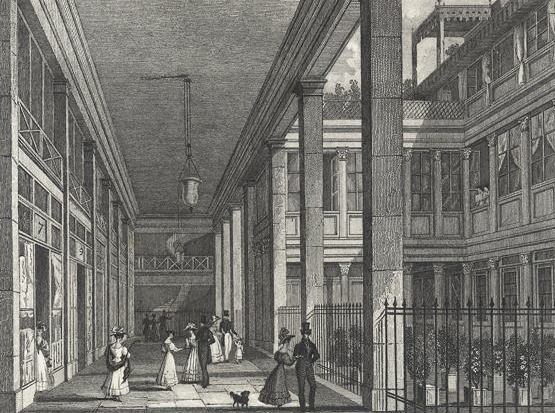
The Passage du Saumon dated from 1763 and was first covered in 1828. It then linked the Rue Montmartre and the Rue Montorgueil.
Four years later the insurrection of June 5-6 1832 on the death of General Lamarque saw a barricade erected here, described by Victor Hugo in Choses Vues and in Les Misérables, where he places the policeman Javert spying on the largely student insurrectionaries.
During the Bloody Week of the 1871 Paris Commune, cellars in the Passage du Saumon were used to hide copies of the Blanquist news sheet, Père Duchêne. It had been banned by the Versailles General Vinoy after its fifth edition but it went on to produce 68 during the Commune up until May 22 1871. It was eight pages long and up to 70,000 copies were published each time.
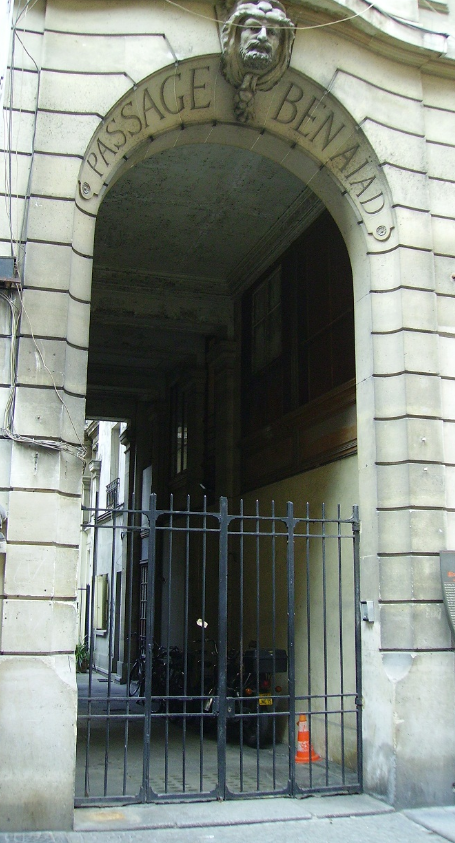
Eventually the Passage became less profitable and it was largely demolished by Aïad’s son in September 1899. The shortened 90m passage was renamed as the Passage Ben-Aïad with access at Nos. 7-8 from the new road named in 1900 after the writer Louis Petit de Bachaumont (1690-1771).
A postcard of the Theatre du Gymnase in 1900. In 1848, 28 years after the small theatre was built, a key barricade placed across the boulevard at this location.saw a major contingent of Louis-Philippe’s troops go over to the people.
This is a wide Parisian street built in 1631 on the line of the obsolete 16th century city wall. It was one of what are called the ‘Grands Boulevards’ on the right-bank of the city. Its even numbers are in the 10th arrondissement and its odd numbers in the 2nd.
Named after the local ‘Our Lady Good News’ church (Notre-Dame-de-Bonne-Nouvelle) It is well used to demonstrations. On June 9 1820 Louis XIII’s cavalry charged demonstrators on the Boulevard chanting ‘Long Live the Charter’, killing several of those demanding that the King keep his 1814 promises of acting as a constitutional monarch.
The next time it was King Louis-Philippe’s troops who forcibly cleared the boulevard of republican demonstrators on 15 June 1831.
A major barricade across the boulevard at No. 38 saw the monarchist Odilion Barrot booed by the republican crowd on February 24 1848 when he argued for a regency under Louis-Philippe’s wife to take over from the King. The 2,000 troops sent to demolish the barricade ended up fraternising with the crowd.
On June 23 1848 three of the first barricades in the workers’ insurrection challenging the end of the National Workshops were erected in the short stretch of the boulevard between the Porte St-Denis and the Rue de Mazagran. The flags on the barricades carried the slogan, ‘Bread or Death‘.
After burning down once in 1849, a second time in 1899 and a third time in 1930, a huge post office was built at No 20 on the site of the 1848 Club des Femmes meetings
Many political meetings used to take place during the 1848 Revolution at No. 20, in the concert hall Bonne-Nouvelle. The Women’s Club attended by Désirée Gay and Pauline Roland met there regularly.
On June 13 1849 Ledru-Rollin and Raspail were arrested after organising a demonstration against the government’s decision to besiege the Roman Republic and restore the Pope to the Vatican. Marx, who had observed the demonstration on the Boulevard, was expelled immediately afterwards.
18 months later, 280 opponents of Louis-Napoleon’s coup d’etat of 4 December 1851 were massacred by canon fire at the junction of the Boulevard with the Rue St Denis.
On September 3 1870 it was the police who fired from the police station at No. 23 on demonstrators angry at the announcement of the defeat of Napoleon III at the battle of Sedan.
On Bastille Day, July 14 1941, after Hitler’s invasion of Russia, the Young Communists (Jeunesses communistes) organised a demonstration in the Boulevard that was attacked first by the Paris police and then by the German army.
The Théâtre du Gymnase, also at No. 38, was where Jean Cocteau’s wartime play, The Terrible Parents, was first performed and then banned in 1942.
On 23 August 1927 fighting broke out in the boulevard when the police attacked the demonstration called by the Communist Party against the executions that day in America of the framed Italian migrants Sacco and Vanzetti.
Another street battle between demonstrators and police took place on 16 December 1972, when a protest march against a police murder of a young Algerian man two weeks earlier was broken up, with its leaders, including Michel Foucault, being arrested.
Dividing the 2nd and 9th arrondissement, the Boulevard gets its name from the Capucine Monastery, whose gardens used to lie along the south side of the road.
The Vaudeville Theatre at No. 2 organised a benefit show by the Art Theatre for Gauguin, Flora Tristan‘s grandson, and Verlaine on May 21 1891.
Lenin also showed up there on January 12 1910 to see a play called ‘The Barricade‘ by the catholic reactionary Paul Bourget.
During the Paris Commune‘s final days on May 22 1871 a barricade with 12 canon crossed the road at the Place de L’Opéra.
The first Pan African Congress was held at the Grand-Hôtel de la Paix at No. 12 on February 19 1919. Fifty black representatives who had been excluded from the Versailles Peace Conference met together, closely watched by the police. The American William du Bois and Senegalese Blaise Diagne were its joint chair persons.
The Café de la Paix on the ground floor of the hotel on the northwest corner of the junction between the Boulevard meets the Opera Square opened on June 30 1862. On July 14 1937 it was attacked by striking waiters.
Throughout the German occupation a notice was displayed saying: Jews not allowed (Interdit aux juifs).
The radical democratic German poet Georg Herwegh put up Marx and Jenny von Westphalen at No. 13 when the couple first arrived in Paris on October 12 1843.
The victorious Austrian Emperor Francis 1 stayed at the Colonnade private mansion at Nos. 37 to 43 in 1814 and again in 1815, when it became the Foreign Ministry. It stayed that until 1853.
On September 7 1831 a demonstration outside the Hotel de la Colonnade, the Foreign Ministry at Nos. 37-43, was dispersed violently by the army. The demonstrators shouted: ‘Long Live Poland, Down with the Ministers’.
In the early evening of February 23 1848 another demonstration outside the Ministry sparked the 1848 Revolution. The 14th Line Regiment, protecting the sacked reactionary prime minister Guizot, fired directly into the crowd killing 52 people and wounded many more.
After 52 demonstrators are killed outside the Foreign Ministry on February 23 1848 the call for revenge leads to revolution rather than reform
The bodies of those murdered were then paraded throughout Paris and by the morning most arms shops had been looted and some 1,500 barricades erected.
A big meeting room at No. 39 saw several political meetings at the end of the Second Empire in 1870 and 1871. On September 22 1889 Louise Michel and Maxime Lisbonne, known as the d’Artagnan of the Commune, organised a meeting there in that year’s election campaign. Lisbonne’s manifesto stated:
‘ENTERTAINER I am! ENTERTAINER I remain! Give me your votes to swell the numbers of those who dare to say the same, and you will see that if I hesitate, like a real entertainer, the words on the paper that will come out of the hat will be ‘DEMOCRATIC SOCIAL REVOLUTION’.
This street with an amazing history was named after a café sign of a crescent moon with gold stars that hung outside No. 12 way back in 1612.
More recently it became a major centre of left republican and socialist publications. The office of Le Charivari (1832-1893) where Honoré Daumier and other caricaturists worked was at No. 16. This was also the address of Le Siècle, whose office was used for the historic meeting on February 21 1848 that decided to resort to arms if troops were used against the banqueteers.
On September 9 1870 Henri Rochefort printed the first issue of La Marseillaise at No. 16. At about the same time Auguste Blanqui was printing La Patrie en Danger at No. 13.
Under the Commune in 1871 the street became full of daily and weekly newspapers. Henri Rochefort published Le Mot d’Ordre at No. 8. La Mère Duchêne was printed at No 10.
L’ami du Peuple (originally the title of Marat’s publication in the French Revolution) was also printed at No. 13, where people could also buy Le Cri du Peuple and La Fédération, the journal of the National Guard’s Republican Federation. Its press also printed the newspapers La Sociale and La souveraineté du Peuple. Le Père Duchêne was launched at No. 16 and then banned a week later on March 12 1871. The satirical paper Le Grelot was published at No 20.
Later, under the Third Republic in 1884-1886, the L’Intransigeant, involving Rochefort and Nathalie Le Mel, was published at No 12. This initially left paper evolved rapidly towards the extreme right.
‘Newspaper Printing Works’ is still proudly displayed above the modern door to 16 rue du Croissant, former home of L’Humanité.
In 1910 the building at No 16 housed the editorial and business offices of l’Humanité. This was where its founder, Jean Jaurès , was about to go when he was assassinated on July 31 1914 at the Café du Croissant on the corner with rue Montmartre.
The site where Jean Jaurès’ assassin fired two bullets through a café window in the street on the right of my photograph.
The fin de sècle Comic Opera theatre in a street named after the early comic opera/vaudeville writer, Charles-Simon Favart, has a lengthy history. Lenin and Trotksy saw a show together there in 1902.
The Comic Opera, set up by Louis IV in 1714, had the first Favart Theatre built for it in 1783, when it was inaugurated in the presence of Marie-Antoinette. Charles-Simon Favart (1710-1792) was a popular playwright who helped inaugurate the comic opera vaudeville style.
Charles-Simon Favart began life as a pastry cook. Aged 24 he produced his first vaudeville theatre.
The first theatre in Rue Favart was destroyed by fire in 1838, and a new one built on the same site in 1840. The building was burnt down again in 1887 with nearly 100 people in the audience killed.
In 1898 the third Opéra Comique theatre was
opened in Rue Favart in the presence of the French President, Félix Faure. It
was the major work of architect, Louis Bernier (1845-1919).
Four years laterLeninloaned Trotskya pair of respectable shoes so the two couples (Vladimir and Krupskaya, Natalya and Leon) could go along to a show, but Trotsky kept complaining the shoes were too tight.
The street was opened in 1780 and named after a nearby building called the Hanover Villa that was build by the 3rd Duke of Richelieu with the profits he made from the 1757 invasion of Hanover during the Seven Years’ War.
6 rue de Hanovre
Blanqui was involved in the fighting in this street in July 1830. No. 6 is its only notable building, an office block now listed as a historic monument, thanks to its art nouveau style. It was built in 1907.
Boulevard des Italiens by Gustave Caillebotte (1880)
One of the ‘Great Boulevards’ in a wealthy part of Paris, it was built on the allotments outside the city when in 1670 Louis XIII’s wall around Paris was declared obsolete. Initially called the ‘New Boulevard’ and then the ‘Depot Boulevard’ (after the 1764 regimental arms depot there). It was finally named after the Italian Theatre built there in 1783 that is now occupied by the Comic Opera.
Even numbers are in the Ninth arrondissement, while odd numbers are in the Second.
From December 1919 to 1923 Louis Aragon and André Breton with other surrealists used to meet regularly in the Café Certà at No. 2. This address was in the ‘Passage de l’Opéra‘ – two parallel galleries of cafés and shops first built in 1822 and demolished in 1925.
The Mulhouse bar was based at No. 8. In March 1848 meetings of the German democratic association used to take place here, attended, among others by Karl Marx and Ludwig Feuerbach.
Ironically, on the other side of the Boulevard, at No. 9, in 1942 to 1943 the Vichy government tried unsuccessfully to recruit French workers to work voluntarily in Germany.
Crédit Lyonnais’s headquarters was built between 1876 and 1913 in the grand Haussmann style. This didn’t stop it experiencing a strike and occupation in 1968
Arlette Laguiller, who became the first woman to stand for President of France as a candidate of the Trotskyist Lutte Ouvriere sect in 1974, led a strike and occupation in 1968 at the Credit Lyonnais headquarters at No. 19 in 1968. The building had been the first in Paris to be lit by electricity in 1876.
Louis Blanc lived above the Tortoni café at No. 22 for a period.
No. 30 was the site of a bomb left by the anarchistsAction Directe against the Israeli Leumi bank on 13 April 1985.
The bustling Café du Centre is on the site of the one hat Blanqui and Barbès used as their HQ during the May 1839 insurrection of the 500 members of the Société des Saisons.
On May 12 1839 the café on the corner with the Rue Montorgueil at No 1 was used as Blanqui’s headquarters during the Insurrection against King Louis-Philippe that was staged by the Four Seasons secret society.
Today’s cafe uses a red star motif everywhere – even on the ceiling. None of the staff I spoke to knew why. But the food and wine were good.
It was one of the few streets that saw a barricade built on December 4 1851 in a weakly-supported attempt to stop Louis-Napoléon Bonaparte’s coup d’État. Several people were killed, including Denis Dussoubs, for whom a commemorative tomb was put up in the Montmartre cemetery
The street was opened in 1790 and named after its architect, Charles-François Mandar. Unlike many contemporary architects, he actually lived in the street he designed. Deliberately, in pursuit of egalitarian ideals, all his neighbours’ houses were built with identical facades.
Mandar (1757-1844) lived at No. 9. During the revolution he got several commissions as a result of his brother knowing Danton and Robespierre, and the rue Mandar was built as a speculative housing development.
From the 13th century the road was called ‘mont Orgueilleux‘ (Pride Hill). Until the late 20th century the street was associated with bringing fish, and particularly oysters, into Paris.
Pierre-Jean de Béranger was born in No. 50 in 1780. Years later he was a regular guest at literary events at the restaurant at No. 78 (then number 59) called ‘Au Rocher de Cancale’.
In 1839 the insurrectionaries of Blanqui and Barbes‘ Society of the Season‘s uprising built a barricade across the street between Nos 52 and 43, at an angle with the Rue Tiquetonne.. Blanqui’s headquarters was in the café at No. 57, on the corner with No. 1 Rue Mandar.
The bustling Café du Centre is on the site of the one that Blanqui and Barbès used as their HQ during the May 1839 insurrection of the 500 members of the Société des Saisons.
On December 4 1851 a barricade across the road at No. 72 was thrown up by opponents of Louis-Napoleon’s coup d’Etat, and many protestors were killed when it was taken by the army.
Twenty years later, nearly at the same place, at No. 73, another barricade witnessed strong resistance to the advance of the Versaillais troops on May 24 1871.
The cafe at the corner of Rue Montmartre and Rue du Croissant where Jean Jaurès’ assassin fired two bullets through the café window in the street on the right of my photograph.
On January 11 1898 Zola submitted his defence of Alfred DreyfusJ’accuse to Georges Clemenceau, editor of the L’Aurore newspaper at No. 144. It was printed the following day.
Jean Jaurès was assassinated in the adjoining cafe at No. 146 on 31 July 1914.
Rarely for Paris, two plaques mark both these important spots in the story that helped define the modern French left.
The street has many other associations with the history of left struggles in Paris too. At No. 1, the barricade across La Pointe St Eustache saw considerable fighting on May 24 1871.
No 24 was the location of an arms depot created in 1942 by Paris city employees during the German occupation.
Nearly a century earlier, in March 1848, the Hôtel d’Angleterre at No. 64 was the location of the German Social Democratic Society organised by the poet Georg Herwegh, and the arms depot set up by the Republican National Guard to arm the ‘Democratic Legion’ of German volunteers formed to go to the support of the German Republican Hecker insurrection in Baden in April 1848.
During the 1830 Revolution François-Vincent Raspail was the president of the Revolutionary Club based at No. 113 that Buonarroti supported. It soon became the Society of the Rights of Man that was responsible for the first huge demonstration (and riot and barricade made famous by Victor Hugo) of June 5-6 1832.
A northern stretch of Rue Montmartre was a centre of newpaper printshops.
No. 123 was associated with left newspapers. In 1893, Le Chambard socialiste was based there. The CGT and then CGTU trade union paper Worker’s Life (La Vie Ouvrière) was printed at the Dangon printworks there from 1919. In 1927 the same printshop produced Ho Chi Minh‘s Vietnamese paper, l’Âme annamite (The Vietnamese soul).
On 18 April 1904 the first issue of the daily newspaper l’Humanité founded by Jean Jaurès was printed at No. 138-142. The same address in 1916 saw a left socialist anti-war newspaper, Le Populaire de Paris, appear. It was founded by Marceau Pivert, Jean Longuet, Paul Faure and Henri Barbusse.
On July 18 1927 the then Communist leaders Marcel Cachin and Jacques Doriot (who became a fascist leader between 1934 and 1936) were arrested at the L’Humanité offices now based at its printing works. The same address, No. 138-142, was the interwar editorial offices of the Young Communist publication, L’Avant-Garde.
On 27 February 1848, Proudhon published the first edition of his newspaper, The People’s Representative, at No. 154.
On November 15 1793, four months after Jean-Paul Marat‘s assassination, the delegates from the Montmartre commune called for the Rue Montmartre to be renamed Rue Mont-Marat.
Originally some believe the name Montmartre derived from ‘Mont Mars’ because of an alleged Roman temple to Mars built on the hill. Others consider it was because criminals or Christian martyrs were executed on the top of hills.
One of the 22 metre-wide roads hammered through the old medieval street network of central Paris under Baron Haussmann from 1854 to 1858. It absorbed some of the ancient streets it went through and destroyed others. Its final section, westwards from the rue St Denis, was only opened in 1897.
Léon Blum was moved round the corner from his birthplace in rue St Denis to No. 57 when he was a young boy.
A member of the Paris National Guard and of the International Workingmen’s Association, Jacques Durand, lived at No 90 (at the time No. 8 rue Thévenot). A cobbler who had stood as an IWMA candidate in the February 8 1871 elections he was elected by the 2nd Arrondissement to the Paris Commune on April 21. On May 25 1871 after fighting ended in the area he was arrested at home, interrogated at the Town Hall of the arrondissement, and then taken to the back of the Notre-Dame des Victoires church and shot.
From 1924 to 1940, the editorial office and printworks of what was then a right-wing paper, ‘L’Intransigeant‘ that was edited by André Malraux in 1934, were at Nos. 98-100.
Outside the printing works and offices at No.100 in 1927 when an American film star came to Paris
After the June 1940 Occupation of France the building housed a German press centre from 1940-1944, and was targeted several times by the Resistance.
After Liberation in 1944 No. 100 became the offices and printshop of the papers Franc-Tireur and the Défense de la France that eventually became France-Soir.
The L’Algérie libre paper of Messali Hadj’s Mouvement pour le triomphe des libertés démocratiques was also printed at No. 100 from its launch at the end of 1948 until its suppression in November 1954. On June 17 1950 sellers of the paper were arrested, and on September 18 1950 when the edition of the paper was seized for the first time, a protest demonstration led to the arrests of 1,100 Algerians who came to protest outside the printworks.
The newspaper Jean Jaurès co-edited at No. 111 in 1898, La Petite république, was France’s widest circulation socialist paper in the 1890s. This was where he published ‘The Proofs’ of the innocence of Dreyfus.
The near kilometre-long road stretching northwards from the centre of Paris was named in 1633 after Cardinal Richelieu’s Palace that runs down its east side. The palace became Palais-Royal and from 1793 to 1806 the road was called the Rue de la Loi (The Road of the Law).
The magnificent reading room of the National Library of France at No. 58 used by both Lenin and Rosa Luxemburg as well as many other socialists and communists..
Lenin got a reader’s ticket to No. 58 on the recommendation of a socialist member of parliament, Louis Roblin. Lenin visited the library regularly throughout his stay in Paris from 1909 to 1912. On one occasion the bicycle he used to journey from the 14th arrondissement was stolen according to police reports.
The bi-monthly La Revue indépendante created by Pierre Leroux, George Sand and Louis Viardot moved to No. 63 early in 1844. But as the journal became less political their involvement ended and they founded La Revue Sociale. In 1847, the bi-monthly became increasingly pro-republican again, just as it moved away from the Rue de Richelieu, but it didn’t survive the tumult of 1848.
The journal of the Internationalist Communist Party, French Section of the Fourth International, Workers’ Truth, that appeared from August 1952 to May 1962, was based at offices at No. 64. Michel Raptis (Pablo), based in Paris until De Gaulle’s 1958 Coup d’Etat was the 4th International’s secretary through this period.
In March 1848 the Fraternal Association of Linen Seamstresses, a women’s revolutionary club set up by Elisa Lemonnier and its president, Désirée Gay, used to meet at No. 66, the Hôtel de Brouilly.
On July 27 1830 the seizure of the presses at the printshop of the ‘Times’ ( Le Temps) at No. 102 was the trigger that set off the 1830 July Revolution against the increasing Bourbon repression under Charles X.
This is one of the earliest known streets in Paris. It was named after an abbey built on the site of a Roman Villa directly to the north of the Roman city of Lutetia. Many believed the villa was the burial site of the Italian evangelist Denis who came to Paris between AD 250 and 270, and was its first Bishop and martyr. So in 630 King Dagobert (of the Franks in what is now northern France) started to build a huge basilica on the spot and called it Saint-Denis. When he died in 639 he was buried there.
From that year on until the French Revolution when the body of the guillotined Louis XVI was disposed off in a quicklime pit, all French kings were buried in the St Denis Basilica. The church was also used to crown the King’s Queen and the road from it into Paris was also always used by the royal family for their processions into Paris, and so was known as the ‘royal route’.
Today the St Denis road begins its journey to the north of Paris at the Place du Châtelet where it is crossed by the Avenue Victoria. It used to go right down to the ‘Grand-Pont’ (Big Bridge) that from the 9th century crossed the wider reach of the Seine and accessed the central island, the Ile du Cite. That bridge was washed away several times and finally replaced by the Pont au Change.
The northern end of the road is at the magnificent Porte St-Denis, a huge triumphal arch created by Louis XIV in 1672 on the site of a major fortified gateway through the (now demolished) Charles V defensive wall that protected the right bank of Paris. The photograph of the arch above was taken in the 1930s.
On June 23 1848 one of the main barricades of the workers’ insurrection against the closure of the national workshops blocked the Boulevard Bonne-Nouvelle from being used to move troops from West to East Paris where the movement was strongest. It was defended by engineers who worked on the Northern Railway Company, and was only taken by the government’s troops after their canon had fired 80 shots at the barricade.
This painting by Nicolas Edward Gabé (1814-1865) captures the moment when a woman picked up the insurrectionists’ flag on the barricade at the Porte St Denis and challenged the soldiers to kill her – which they did.
The Rue St Denis continues beyond the Porte’s Arch northwards towards the Saint-Denis suburb. From this point it becomes the Rue du Faubourg St-Denis which runs as far as the Boulevard de la Chapelle.
Number 20 used to be the entrance to the Halles Centrales café and concert hall, where Blanqui spoke at several meetings in 1870.
The weekly anarchist journal Le Libertaire that had resumed publication on December 21 1944, thanks to the financial support of Georges Brassens, was able to install itself alongside the Libertarian Communist Federation in an office at No. 79 in March 1954. Series 5 of the paper finally stopped publication on July 12 1956.
Subsequently, from 1960 to 1976, No. 79 became the headquarters of the exiled Spanish anarcho-syndicalists who believed that the Confederación Nacional del Trabajo should work with the exiled government.
One of the few barricades built by the leftists who participated in the Society of Seasons uprising on Sunday May 12 1839 led by Blanqui and Barbes was at No. 90. It blocked the road at the junction with the Rue de la Grande Truanderie.
The 1839 barricade was just next door to the one built at No 92 bis in front of the St Leu church on November 19 1827. This was the first barricade in Paris since 1795 and was put up after troops were ordered to remove all signs put up in houses celebrating the liberal victory in Paris in the November 17 legislative elections. The resulting riot was put down with a cavalry charge and some gunfire in which a young Blanqui was wounded by a bullet in the neck.
At the principal barricade built across the road at No. 120 on the same day the 18th regiment fired at the defenders, killing four of its defenders.
No. 151 (or No. 153 or No. 243 where the family lived soon afterwards as is suggested in the Paris birth records) was the birthplace of Léon Blum on April 9 1872. Then, like today, it was in the heart of the Parisian textile and clothing industry. But where once it was predominantly Jewish, today the businesses in the area are largely of North African origins.
A sad plaque on a modernised building that does not indicate that Blum was Jewish, a Socialist or that he was France’s prime minister in 1936
The bloody week that ended the Paris Commune took its toll at No. 199. This was where a barricade was built across the corner with what is now the Rue Réaumur saw serious fighting on May 24 1871. Another barricade at No. 237/239 that crossed to the Passage du Caire covered alleyway was defended by the Commune’s 92nd battalion.
As long ago as the Middle Ages the central Paris area around Rue Saint-Denis, Rue Grenata, the Rue aux Ours and the Rue de Saint-Martin was known as the ‘Huleu’ (screeching) quarter because of the prostitutes calling out for clients as men passed by. The women used to hire covered wooden stands, and men climbing on to the stand went ‘en bords’ (onboard). This was the origin of the now internationally recognised word ‘bordel‘ (brothel). Paris counted some 50,000 prostitutes by the mid-19th century.
For me, the southern part of the road near what used to be the huge Les Halles market still conjures up memories of that night in 1962 when I and my close school friend David walked on a cool dark summer night, with money in our pockets, determined to lose our virginities. I was quite amazed to find that more than 50 years later, despite the removal of the Halles market and the gentrification of central Paris, Tripadvisor is actually still selling the area as the place to go to see ‘Paris nightlife’.
Once called ‘Lost Time’ (Rue du Temps Perdu), in 1640 it was renamed after the Saint Joseph funeral chapel that used to occupy the corner with the Rue Montmartre.
On April 2 1840 Emile Zola was born on the fourth floor of No. 10 to a Venetian father and a French mother who came from Dourdan, 44km south of Paris. He is one of the rare leftists to be honoured with a plaque commemorating the first three years of their lives.
An old road that was first built around 1650 it was named after a shop sign. Amokrane Ould Aoudia, a lawyer for the FLN, was assassinated at his home at No. 1 on May 21 1959 by the French Secret Service. The operation was called ‘Omo’ and the secret service decided to pretend it was carried out by a fictitious ‘Red Hand‘ organisation.
Around the locations of No. 36 and No. 39 (at what was the old No. 10 Rue Neuve St Marc) was the print shop of Le National. This new paper housed the meeting on July 26 1830 of the 44 journalists, including Pierre Leroux who drafted a protest letter against the Four Ordinances issued by Charles X. It was the seizure of the four papers who printed the letter the next day that sparked the July revolution of July 27 to July 30.
Numbers 3, 48, 62-64 (site of 22 Rue du Bourg l’Abbé), 83
In 1854 the boulevard was initially built as part of Haussmann‘s redesign of Paris as the Boulevard du Centre. Half-way between the Rue Saint-Denis and Rue Saint-Martin roads that were closely associated with barricades and insurrections, it involved relatively little demolition of existing buildings and created a 30m wide road along which troops and canons could be easily moved.
Almost immediately it was renamed Sébastopol after a year-long seige finally ended in the successful storming of Sebastopol on September 8 1855 by a joint Franco-British force during the disastrous Crimea War.
The pharmacy shop Cannone at No. 48 on the corner with the Rue aux Ours was the main distribution centre for the underground resistance papers Valmy et Résistance. Initially, from the autumn of 1940 one of the staff, Roger Lardenois, used its huge storage area to hide and then distribute Valmy.
64-66 Boulevard Sebastopol is the location of the Lepage Frères arms depot, before 1854 it was 22 Rue du Bourg-l’Abbé. The warehouse was pillaged by a few hundred men from the secret Seasons Club set up by Blanqui and Barbès for weapons and ammunition on May 12 1839. Many carried three or four pistols and rifles out with them. .
The Lepage Brother’s gun shop in the 1830s just round the corner from their store room in the now disappeared road Bourg-l’Abbé The site of the Lepage Frère armoury at 22 rue du Bourg de ‘Abbb , now 62-64 Boulevard ~Sebastopol