Rue Greneta

Arrondissement 2, 3

Numbers 1-2, 60

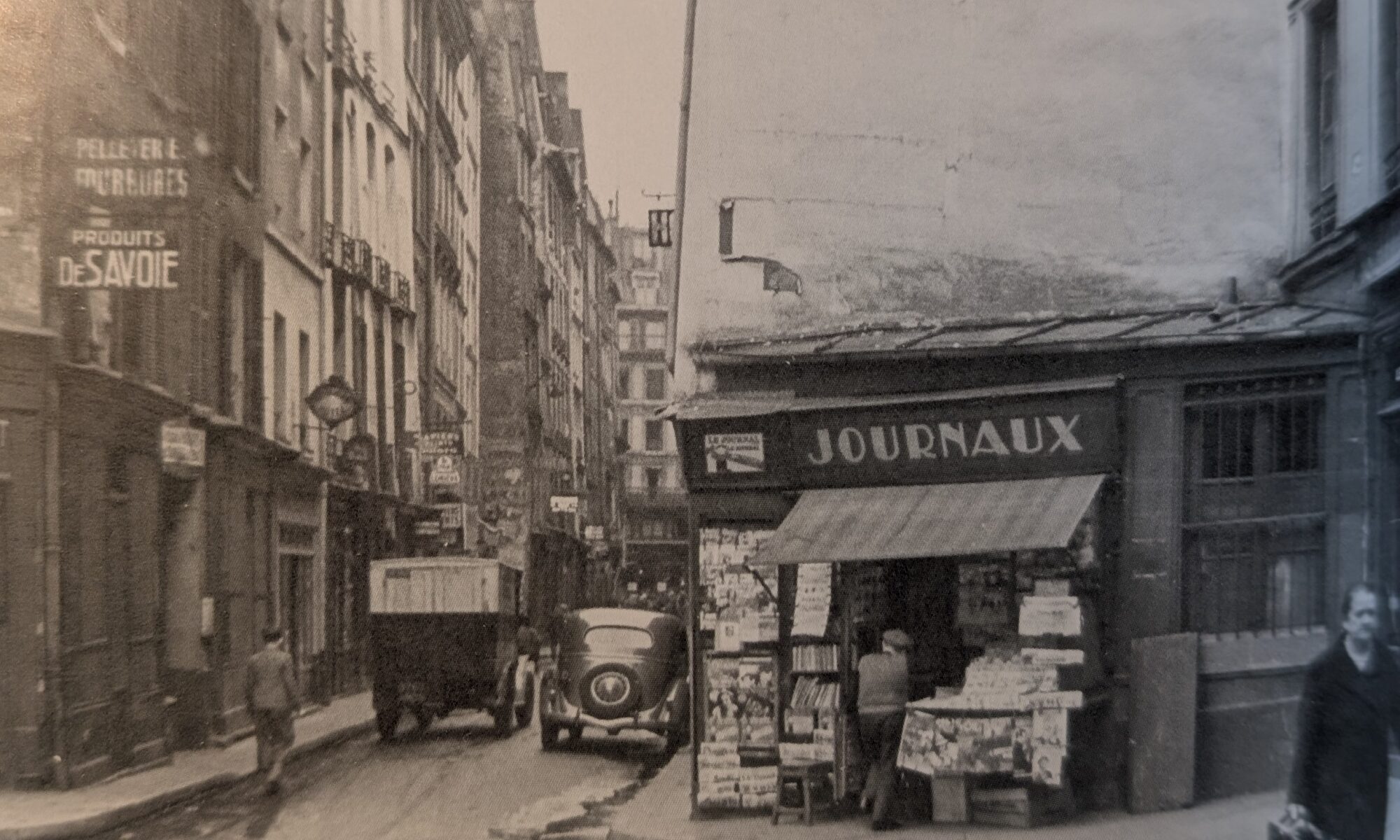
The entrance to Rue Graneta was blocked by a barricade between Nos. 1 to 2 that witnessed fighting on May 12 1839 during the short-lived insurrection of the Four Seasons. This was inspired by Blanqui and Barbès, both of whom were later condemned to death and then reprieved for their part in the planning and fighting.

In 1911 the protestant Pasteur Wilfred Monod established the Centre social La Clairière (the Clearing community centre) at No. 60. His aim to provide a place where poor families could send their children to a ‘free space in a dark forest’. One of his successors as Pastor at the Louvre Oratory was Paul Vergara who also led La Clairière‘s social work from the Centre.

Asked for help in 1943 by the Belgian resistance networker Suzanne Spaak, Vergara’s Sunday February 12 sermon asked his congregation to volunteer to help rescue 63 Jewish children from an impending deportation from where the Paris police and Milice had gathered them in Rue Guy-Patin and Rue Lamarck.

Outside the Oratory church Marcelle Guillemot, a social worker employed by the La Clairière associaton, collected the names of 25 women volunteers and over the next couple of days 15 more women, largely Jewish or from the migrant resistance network FTP-MOI, joined up too. On Thursday 16 February, the women arrived individually at one or other of the deportation centres and ostensibly took the children for a walk.

All the children aged between 3 and 8 were walked to the community centre at No. 60. There they spent the night, fed with Red Cross food parcels. Curious neighbours had been told the children were victims of bombing being temporarily found new homes.

The next day Vergara organised false identity papers for them and then in small groups the evacuation began. Over the next few days members of the recently dissolved Protestant French girl guides movement took those being hidden or lodged some distance (Normandy, the South of France or the Paris suburbs) while several of the local women volunteers took others back to their homes.

Meanwhile La Clairière‘s hall was cleaned and cleared of all trace of the children. But three months later the Gestapo called. Marcelle Guillemot wouldn’t let them in, and before they broke in she was able to destroy an incriminating documents and escape through the back window into an unguarded ally. She spent the rest of the war living clandestinely in Paris, while Vergara escaped to Switzerland.

Rue St Antoine

Arrondissement 4

Numbers: 99-101, 104, 117, 133

A long old Roman road across Paris leading from the Bastille west towards the Saint-Antoine abbey that became a hospital in 1796. It now continues under the name Rue de Rivoli up to the Place de la Concorde.

The first office of the ‘German Pilot’ journal (Der deutsche Steuermann), a review produced by the Prussian Embassy in 1844 as a competitor to Marx and Engels’ bi-weekly Vorwärts was at No 100. At the time there were around 60,000 German workers in Paris.

In June 1848 a barricade across the road at No. 100 in front of the St Paul church saw considerable fighting as workers fought to defend the National Workshops established shortly after the February Revolution.

The president of the Luxembourg Commission that established the 1848 National Workshops for the unemployed, Jean-Baptiste Lagarde, a watchmaker, lived at No 99 (previously No. 124). He was sentenced to deportation for having participated in the June insurrection.

The Church of St Paul-St Louis was where Victor Hugo‘s daughter, Léopoldine, married Charles Vacquerie on February 15 1843. In thanks Hugo gave the Church two holy water fonts (although only one appeared to be present when we visited in October 2024). The couple tragically drowned together the following year, and in 1862, when he published Les Misérables, Hugo placed the marriage of Cosette and Marius in the same church iten years earlier in 1833.

The Saint-Louis-des-Jésuites Church at No. 101 had hosted the training school of the Jesuits between 1580 and 1764, but in the Revolution in 1793 it became the storage centre of 1.2 million books confiscated from the monasteries and convents, and one of the major contributors to the National Library.

In 1802 with the re-establishment of the Catholic religion in France following the Concordat with the Vatican, the church was renamed the Saint-Paul-Saint-Louis Parish Church.

In 1818 Louis-August Blanqui attended the Charlemagne’s Royal School at No. 101. It had been renamed in 1815 after being refounded in 1804 as the lycée Charlemagne, and was again closely associated with the Church.

In May 1871 the Church was used to host the revolutionary Club Paul-Louis and saw the funeral of the commander of the 120th Batallion of the National Guard. The current

In 1870 Louise Michel attended public anarchist meetings in the White Queen room of the Rivoli Rooms at No. 117, the same venue that hosted a meeting of the Socialist Republican Alliance (ASR) on December 10 1880.

The Alliance socialiste républicaine (ASR) was made up of many surviving Communards and former followers of Proudhon who returned to Paris after Hugo and Louis Blanc‘s success in securing the 1879/1880 Amnesty. These including Albert Theisz, one of the witnesses to the 1872 marriage of Charles Longuet with Jenny Caroline Marx, as well as Charles Longuet himself and Georges Clemenceau. The ASR later split between various socialist groups and the Radical-Socialists led by Clemenceau.

The office of the Former Communards Mutual Aid Society (Société de secours mutuel des anciens combattants de la Commune) was set up in May 1882 at No 133.

Rue Bachaumont

Arrondissement 2

Numbers: 7-8

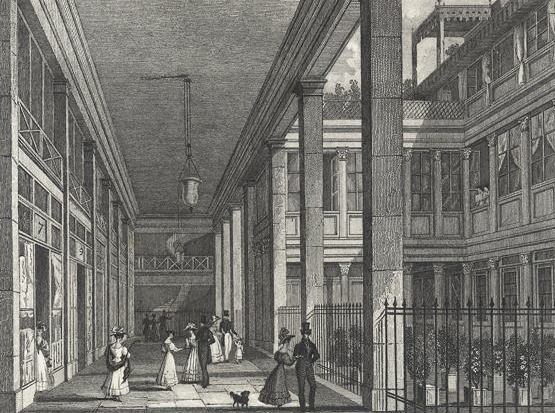
This road testifies to the internationalism of corrupt world elites as early as the mid-19th century. It was only named after an 18th century writer in 1900 but from 1853 it became part of the European estate created by Mahmoud Ben Aïad (1805-1880).

Aïad was a Tunisian who had personally benefited from his management of the finances of its Bey, Ahmed I. This role allowed Aïad to set up his own bank and along with a chateau and Parisian mansions in 1853 he also bought up the land that included the 175m long Passage du Saumon, its shops and the Théâtre Molière. and acquired French nationality.

The Passage du Saumon dated from 1763 and was first covered in 1828. It then linked the Rue Montmartre and the Rue Montorgueil.

Four years later the insurrection of June 5-6 1832 on the death of General Lamarque saw a barricade erected here, described by Victor Hugo in Choses Vues and in Les Misérables, where he places the policeman Javert spying on the largely student insurrectionaries.

During the Bloody Week of the 1871 Paris Commune, cellars in the Passage du Saumon were used to hide copies of the Blanquist news sheet, Père Duchêne. It had been banned by the Versailles General Vinoy after its fifth edition but it went on to produce 68 during the Commune up until May 22 1871. It was eight pages long and up to 70,000 copies were published each time.

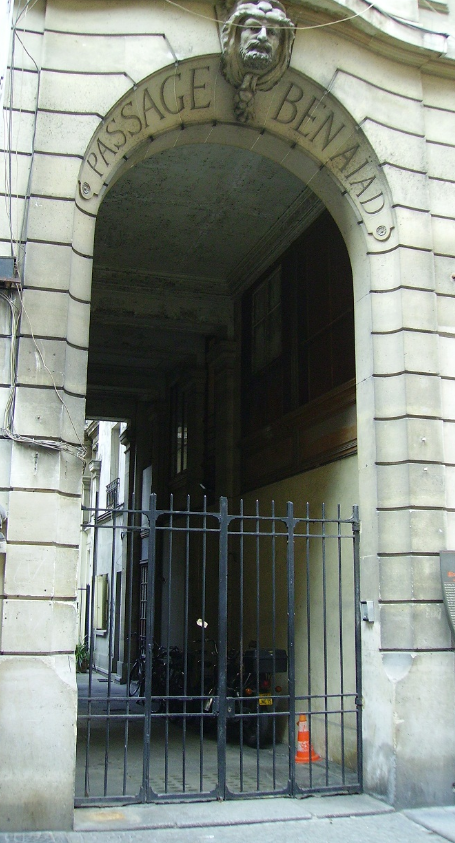
Eventually the Passage became less profitable and it was largely demolished by Aïad’s son in September 1899. The shortened 90m passage was renamed as the Passage Ben-Aïad with access at Nos. 7-8 from the new road named in 1900 after the writer Louis Petit de Bachaumont (1690-1771).

Rue Cujas

Arrondissement 5

Numbers: 11, 16, 17, 22

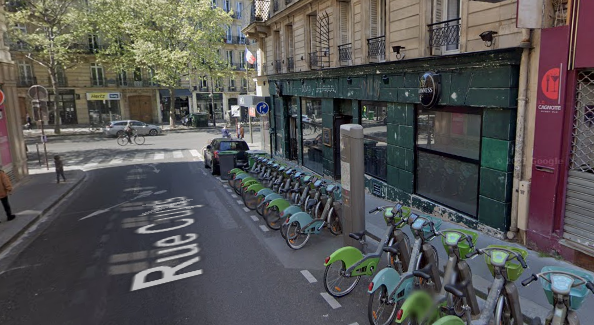
Named after the 16th century lawyer, Jacques Cujas, who exceptionally refused to take sides in the century’s religious wars, the road runs next to the Sorbonne’s law faculty. Close to the Pantheon it was the scene of barricades in June 1848 and of particularly fierce fighting around ones erected during the bloody week that ended the Paris commune of 1871.

During the first decade of the 20th century the French police archives record that many exiled Russian revolutionaries. particularly those from Georgia, used to hang out at the restaurant at No. 11.

In the early 19th century the painter Jacques-Louis David had a studio in the closed and ruined Cluny College (roughly number 16) where over the following two years he painted Napoleon crowning himself in 1805.

On May 1 1898 Charles Péguy, Lucien Herr and Georges Bellais set up a socialist bookshop and publisher at No. 17. It became the headquarters of the Dreyfusard supporters. Within a year Herr had brought several other socialists together to form the Bookshop and Publishers New Society there. Those involved included Léon Blum, Hubert Bourgin, Albert Monot, Mario Roques, Désiré Roustan and François Simiand.

Number 22 is a café, now called the ‘Mad Maker’. Back in 1830 it extended to the corner of Boulevard Saint Michel and was called the Café Musain. This was where Auguste Blanqui organised the Société des Amis du peuple (The People’s Friends), the insurrectionary group that played a role in the July Revolution, les trois glorieueses.

When Victor Hugo wrote Les Misérables, he used this revolutionary sect as a model for an equivalent group behind the 1832 insurrection, the Amis de l’ABC. Their initiative, to begin the insurrection by raising the red flag during the funeral procession of the Republican leader General Lamarque, on June 5 1832, saw several hundred killed in just a few hours.

Key days in 1871

Chronology from Le Maitron of Key Dates in French Labour History

Authors: Stéphane Sirot, complétée par Michel Cordillot, René Lemarquis, Claude Pennetier and Céline Lenormand; italicised additions by Steve Jefferys

January

A Meunier chocolate factory building with a metal frame is erected by the architect Jules Saulnier at Noisel-sur-Marne.

January 5 Southern districts of Paris begin to be shelled by the Prussians. The siege began on September 18 1870.

January 6-7 Overnight a red poster signed by the Central Committee of Paris’ 20 arrondissements appears on walls all over Paris. It calls for the creation of an all-Paris Commune.

January 18 The proclamation of the German Empire occurs in the Mirror Gallery of the Versailles Château takes place before William I and Bismarck.

January 22 Parisian revolutionaries try to seize power for a Commune in Paris as part of the ‘action day’ protesting against the government of National Defence’s decision to offer to surrender Paris to Bismarck. A decision is taken to order the troops to fire on the crowd outside the Town Hall, allegedly (and probably fake news) given by Gustave Chaudey, a friend of Courbet.

January 23 Jules Favre, a leading republican who was Foreign Minister of the Government of National Defence in Bordeaux, begins peace talks with Bismarck. It is agreed by the government two days later, and signed by Favre and Bismarck in Versailles on January 27.

January 28 The official journal announces a 21-day armistice with Bismarck to allow national elections to take place to create an Assembly to meet in Bordeaux that would ratify the peace. Paris is instructed to surrender and to allow the Germans into the defensive forts around Paris. The Germans would be allowed to march through Paris in early March. Paris would have to pay for the siege.

February

February 6 Opposed to the decision to cease fighting, and aware of the pro-peace monarchist majority being elected, Leon Gambetta resigns from the government.

February 8 Elections for the National Assembly provide a right-wing monarchist majority (214 Orleanists, 182 Bourbonists, 20 Bonapartists) who want peace and are opposed to the majority republican deputies from Paris and other major cities.

February 15 The Paris battalions of the National Guard decide to combine under a single command and decide to reject the surrender.

February 17 Adolphe Thiers is elected head of the Executive by the National Assembly meeting in Bordeaux.

February 22 Jules Vallès launches the daily newspaper ‘Le Cri du peuple’, critical of Thiers and the monarchist National Assembly. It sells at 5 centimes and its print run is between 50,000 and 100,000, making it the most read newspaper during the Commune. 65 issues are produced between February 22 and March 12, when it is banned, and from March 21 to May 23, when it ceases publication with the start of the Bloody Week that ends the Commune.

February 24 Several battalions of the Paris National Guard march from the Place de la Bastille in commemoration of the 1848 February Revolution. They demand the continuation of the war and oppose the disarming of Paris. The demonstrations continue over the next few days.

March

March 1

The National Assembly in Bordeaux confirms the abolition of Napoleon III’s Empire and agrees to ratify the peace treaty by 546 votes to 107.

March 1 – 3 Prussian troops symbolically occupy parts of western Paris and hold a victory parade on the Champs-Élysées.

March 3 The Paris battalions of the National Guard meet in the Tivoli-Vauxhall dance hall (in what since 1970 is the Rue Léon-Jouhaux) and draw up new rules.

March 9 Universal male suffrage is granted to two ‘French’ communes (Saint-Louis and Gorée and extended later to Dakar and Rufisque) in Senegal. Their deputies will sit in the National Assembly.

March 10 The Bordeaux National Assembly decides to move to Versailles.

March 11 Vinoy, the government’s military commander of Paris, bans six republican newspapers.

March 15

The National Guard elects a Central Committee whose members install themselves in the Hotel de Ville.

Thiers and his government return to Paris.

March 17 Auguste Blanqui, who had left Paris because he was unwell, is arrested staying with a friend in the Dordogne.

March 18

The Paris Commune begins in response to an attempt by the Thiers government’s army to take control of the 227 canons stockpiled at Montmartre and Belleville.

The 88th regiment is surrounded by National Guardsmen and the crowd. Louise Michel among them. The soldiers start to fraternise. The officers are disarmed and their general and another former general who had played a part in the vicious suppression of the June 1848 workers’ insurrection are arrested and taken to the Chateau Rouge. The generals are shot later, despite the intervention of several leading Communards.

Thiers and the members of his government flee to Versailles.

March 19 The Central Committee of the National Guard announce communal elections for Paris.

March 22 The Paris National Guard dispersed a ‘Friends of Order’ demonstration in the Place Vendome, killing around ten of the demonstrators.

March 23 Communes are proclaimed in Lyon and Marseille.

March 24 An attempt to declare a Commune in Nîmes fails. Other Communes are declared in Narbonne and in Toulouse.

March 25 The Lyon mayor is able to end the Commune there by welcoming the soldiers returning from the siege of Belfort, who then put an end to the Commune at the town hall.

March 26

The results of the election for the Paris Commune are declared. 229 167 men had voted out of the 484 569 entitled to vote. Of the 80 members elected, 25 are workers. Among them are Eugène Varlin, Zéphirin Camélinat, Benoît Malon and  Léo Frankel, leading members of the International Working Men’s Association. Others elected included Charles Delescluze, one of around 20 admirers of the Jacobins, and Théophile Ferré, one of a dozen followers of the absent Blanqui . So too were some Proudhonista like Pierre Denis and a handful of independents like Gustave Courbet and Jules Vallès. Twenty of those elected were free masons.

In Creusot a Commune is declared by Jean-Baptiste Dumay.

28 mars.

The Communes in Creusot and Toulouse are overthrown.

The elected Paris Commune declares itself the government of Paris at the Hotel de Ville. It is given this authority by the National Guard’s Central Committee.

March 29 The Commune adopts the manifesto drafted by Pierre Denis, based on Proudhon’s philosophy of communal federalism.

March 31 The Commune of Narbonne fails

April

The Versailles Government commands the support of some 130,000 troops under the orders of MacMahon, the general who had been defeated at Sedan. Perhaps as many as half of these had been prisoners of the Prussians who agreed to their release so they could assist in the battle against the Paris Commune. The Commune was defended by approximately 20-30,000 members of the National Guard, most of whom had never been involved in military action.

April 2 Some 9,000 regular Versaillais army soldiers attack around 600 men defending a barricade of carts and wooden barrels at Courbeovie, to west of Neuilly. The Commune’s Federal soldiers retreat under artillery fire. Casualties are 5 killed and 21 wounded among the Versaillais and 17 killed and 25 captured among the ‘Fédérés’. Five Communards killed were prisoners who were immediately shot on the orders of General Vinoy.

April 3

The Commune decrees the separation of the Church from the State and ends the statement payment of priests.

Under the Blanquist Émile Eudes three loosely connected column of 10,000 Communard soldiers and 8 canon march on Versaillais, largely hoping the regular army will fraternise with them. Surprised by the artillery fire directed against them the Versaillais win both the Battle of Meudon and the Battle of Rueil. Having surrendered at Chatillon, Emile Victor Duval, is shot at Petit-Clamart on the orders of Vinoy as he was being taken to Versailles the following day. Unarmed, one of the Communard leaders at Rueil, Gustave Flourens, is executed on the spot by a gendarme captain.

Aril 4

The Marseille Commune fails.

An insurrection in Limoges initially stops troops being taken by train to Versaillais, but is then defeated.

April 5 The siege of Paris by the Versailles army begins. The Versaillais start shelling Paris. The Commune declares that Theirs and his government will be held responsible.

April 6 Following the summary executions of Duval and Flourens, the Commune passed the hostage decree. This stipulates that for every one Communard executed, three hostages will be executed. This is only put into effect during the Bloody Week from May 21. On May 14 the Commune proposed exchanging all 74 hostages against one man, Blanqui. This proposal was rejected by Thiers and finally on May 24 six hostages were executed, the Archbishop of Paris Georges Darboy, four other priests and the judge Louis-Bernard Bonjean.

April 8

The Commune passed a law stating that municipal councillors in communes of populations less than 20,000 could elect their mayors.

Shells hit the Arc de Triomphe.

April 11 Nathalie Lemel and Elisabeth Dmitrieff set up the ‘Women’s Union for the Defence of Parris and Care of the Wounded’.

April 16 The Commune decrees that any workshop abandoned by their owner should be requisitioned by their workers in order to become workers’ cooperatives that would pay an indemnity to their former owners.

April 19 The Commune issued its Declaration to the French People. It stood for: the consolidation of the republic, an association of autonomous communes throughout France, each of which would vote its budget, taxes and other key issues; the election or selection by competition with the right to recall of all justices, magistrates and communal functionaries; the guarantee of individual freedom of conscience and of the freedom to work; the organisation of an elected national guard whose job was to keep order.

April 24 Abandoned houses by those who had fled Paris were to be requisitioned to house those made homeless by the shelling.

April 27 The Commune outlaws fines and withholding of wages by employers; it bans night work for bakers, it establishes a commission to examine how to organise secular primary and professional education in Paris.

April 30, May 7 Municipal elections take place.

May

May 1 The Jacobins and Blanquists win a majority of 45 to 23 on the Commune to establish a Committee of Public Safety of five elected delegates in response to the multiple dangers faced by the Communards. The Proudhonists are opposed to this step. The role of the Committee is not defined, and a new Committee is elected on May 9.

May 10 The Versailles government signs the Treaty of Frankfort. Under it Germany annexes the Alsace and a significant part (the actual Moselle departmnet) of Lorraine. Some 160,000 inhabitants who refuse to become German leave their homes and move to other parts of France.

May 15 Twenty-one Commune delegates protest the authoritarian turn of the Committee of Public Safety.

May 16 The statue of Napoleon on the Vendome Column is pulled down. The decision was confirmed/accepted by Gustave Courbet.

May 18 The National Assembly in Versailles ratifies the Frankfort Treaty.

May 19 The Commune issues a decree requiring the secularisation of education.

May 21 to May 28 The Bloody Week

May 21 The Versailles troops enter Paris through the Saint-Cloud gate, and then start attacking the over 500 barricades that block most of the main streets.

May 23 The Commune decides to set fire to several public buildings, including the Tuileries, the Hotel de Ville, the Cour des Comptes and the Conseil d’Etat on the ground floor of the Orsay Palace, and the Finance Ministry. Many other buildings are destroyed by shellfire from the Versaillais.

May 24 The six hostages, Darboy, Archbishop of Paris, four Jesuit priests and a judge, are executed at La Roquette prison.

May 24-May 25 484 Communard prisoners are executed by the Versailles soldiers in the Parc Monceau and in Montmartre.

May 26 In retaliation the Communards execute 52 Versaillais prisoners in the Rue Haxo.

May 27 The fighting ends in the Père-Lachaise cemetery.

May 28 The last barricade of the Commune at the Rue Ramponeau is overrun by the Versailles army.  Eugène Varlin, who lived in the Rue Dauphine, was totured and shot.

May 29 The Communards supporting garrison of the Vincennes Castle finally surrender.

By the end of this ‘bloody week’ the Versailles troops have retaken Paris. There are thousands of dead, tens of thousands of arrests. Many activists, followed by the police, flee Paris and try to escape in province or abroad. Estimates of those killed range from 6,000-7,500 (Robert Tombs) to 20,000-35,000 (Henri Rochefort).

June

22 military courts are set up in Versailles to try the 38,000 arrested insurrectionaries. 270 are condemned to death (23 death sentences are carried out); 410 are condemned to forced labour, 3,989 are sentenced to prison terms, 322 are exiled and 7,500 are deported to Algeria or New Caledonia. 56 children are jailed in houses of correction.

July

In partial elections in 47 departments the republicans secure support in 39, carrying 99 seats out of 114. These republican gains are repeated in municipal elections in Paris on July 23 and July 30.

August

August 7 The Versailles riding school sees the opening of the third military tribunal judging 17 leading Communards including Théophile Ferré and Gustave Courbet. Others tried included the elected Commune members Adolphe Assi, François Jourde, Paschal Grousset, Dominique Régère, Alfred-Édouard Billioray, Raoul Urbain, Victor Clément, Alexis Trinquet, Henry Champy, Paul Rastoul, Augustin Verdure, Baptiste Descamps and Ulysse Parent, as well as members of the National Guard’s Central Committee, Charles Lullier and Paul Ferrat.

September

September 2 The trial ended with sentences: two death sentences (Ferré was executed, Lullier spared); Urbain and Trinquet were given forced labour for life; seven were sentenced to deportation to overseas prisons, two to simple deportation, four to prison (six months for Courbet) and two (Descamps and Parent) were acquitted.

September 4 The 4th military tribunal trial opens of five women who were ambulance or canteen workers during the Commune. Élisabeth Rétiffe, Joséphine Marchais, Eugénie Suétens were sentenced to death, with the penalties commuted, Eulalie Papavoine was sentenced to deportation to a prison and Lucie Maris-Bocquin who with Rose Rétiffe had been seen building barricades in the Rue de Lille wearing a red scarf and carrying a rifle, was sentenced to ten years in jail and eventually released in 1878.

September 17-23 The International Workingmen’s Association (IWMA) meets in London. Karl Marx wins a vote to create a working class political party in all countries affiliated to the IWMA. The opposition comes from supporters of the more libertarian views of Proudhon and Bakunin.

October

The huge disinvestments that followed the payments of the war debt (25% of France’s GDP had to be borrowed) to Germany create a monetary crisis.

Émile Zola publishes the first of his 20 volume Rougon-Macquart series of books attacking the values and morality of France under the Empire. It’s called La fortune des Rougon.

October 8, October 15 Regional elections confirm the success of the Republicans.

November

November 7 Gambetta founds what became the most influential French newspaper, La Republique Francaise.

November 28 The only army officer to support the Commune, Louis Rossel, is executed at the Satory military camp at Versailles, along with Sergeant Pierre Bourgeois and Théophile Ferré.

November 30 Gaston Crémieux, a leader of the Marseille Commune, is executed after six months in prison.

December 23 The Circles of Catholic Workers come into existence.

Key dates 1831-1847

Chronology from Le Maitron of key dates in French labour history

Author: Stéphane Sirot, additional material by Michel Cordillot, René Lemarquis and Claude Pennetier with Steve Jefferys (italicised)

1831

January 15 Blanqui and other student leaders are arrested for organising violent demonstrations near the Sorbonne and judged by its Academic Council.

February 8 The clockmaker Charles Béranger‘s ‘A proletarian’s petition to the Chamber of Deputies’ was published by Le Globe, established by Pierre Leroux.

February 14-15 Anticlerical and anti-Bourbon riots take place in Paris after a Legitimist commemoration of the murder of the Duke de Berry at the Saint-Germain-l’Auxerrois church opposite the Louvre. This was occupied by republican demonstrators who then marched on the Archbishop’s palace near Notre Dame, pillaging and wrecking it. These riots were followed later in provincial France.

March 2 Republican riots break on in Paris after the acquittal of prisoners charged with infringing restrictions on press freedom. Protesting workers march on the Palais Royal, the Louvre and on the Town Hall. The Russians eventually take Warsaw on September 8.

March 9 Republicans riot in Paris on hearing the false news that the Russians had seized Warsaw. The windows of the Russian Embassy were stoned and the crowd sang the Marseillaise.

March – June Demonstrations take place against the introduction of machines in factories in Nantes, Saint-Étienne, Bordeaux and Le Havre.

April 6-10 Trial of 19 republican members of the Friends of the People Society, including Godefroi Cavaignac, arrested during the December 1830 riots. They are all acquitted by the jury on April 15/16, giving rise to several working class demonstrations.

April 9-12 Riots of Lyon silk workers (canuts).

May 5 A Bonapartist demonstration takes place at the Place Vendome on the anniversary of Napoleon’s death.

June Serious rioting in the Saint-Denis district resulting from the tough economic situation. The repression was very severe with many victims.

June 1 The Philanthropic Society of Parisian Working Tailors is established.

June 14-16 Riots in Paris put down by the National Guard and regular soldiers. Particularly heated fighting takes place in the Faubourg Saint-Denis and Boulevard Bonne-Nouvelle.

July 14 Working class riots. Republican attempt is made to plant an Equality Tree in the Place de la Bastille, at the Pantheon, in the Place de Grève and in the Place de la Concorde. The more than 1,500 demonstrators are dispersed by police dressed in disguise as workers. The publication Au Peuple is seized.

September 7 1,500 textile workers organise a demonstration, followed by riots in Paris that don’t end until September 17.

October The Saint-Simonian manifesto is published with a big propaganda campaign in the provinces.

October 30 The first issue of the Factory Echo (L’Écho de la Fabrique) appears in Lyon.

November The Saint-Simonians split. The most faithful will follow Prosper Enfantin to Egypt. Others, like Abel Transon and Jules Lechevalier, publicly turn to Fourierism.

November 14 Philipon draws and then publishes a cartoon of King Louis-Philippe as a pear. He is charged with ‘insulting behaviour towards the king’.

November 20-22 The Lyon silk workers revolt; the negotiations conducted by the prefect fail; an insurrection takes place. Hard repression led by Marshal Soult with 10,000 troops takes place and the revolt finally ends on December 3.

December 15 Daumier‘s cartoon of Louis-Philippe Gargantua is published in La Caricature.

1832

January 10-12. Trial of “The Fifteen” leaders of the SAP (Societe des Amis du Peuple). The accused (Auguste Blanqui, Bonnias, François, Guillaume Gervais, François-Vincent Raspail, Antony Thouret) defend themselves; they are found guilty and sentenced on 27 February, Blanqui was sentenced to a year in prison. The SAP was officially dissolved but it continued its activities.

February. Several newspapers are put on trial. A workers’ commission is set up within the SAP made up of Auguste Caunes senior, Gaussuron-Despréaux, François Sugier). Pierre Leroux and Jean Reynaud take over editorship of the Revue encyclopédique, organ of the neo-Saint-Simonians

February 6 The first cholera epidemic victim dies in Paris.

February 23 Daumier is sentenced to six months in prison and fined 500 francs for his Gargantua cartoon.

February 26 Chopin gives his first concert in Paris in the Pleyel‘s salon in the Rue Cadet.

March 29. Official announcement of a cholera epidemic in Paris.

April 1 Revolt by prisoners at Sainte-Pélagie, supported by several sections of the SAP. One death. A protest by Parisian chiffoniers (rag collectors) begins against the official collection of refuse introduced by the authorities to try to halt the spread of cholera.

April 20 Leroux’s newspaper Le Globe ceases publication.

End April. Commissions for the Rights of Man are set up within the Friends of the People Society (SAP).

May 16 The banker, mine owner and President of the Council of Ministers (Prime Minister) since March 13 1831, Casimir Perier, dies of cholera. He had visited ill patients in Paris’ principal hospital next to Notre-Dame, the Hotel Dieu. A conservative right-winger who had tried to keep Charles X in power he had accepted the position of prime minister only after Louis-Philippe had agreed to allow him to have more freedom of manoeuvre in government than the king.

June 1 Jean-Maximilien Lamarque dies of cholera at his house in the Rue St Honore. Promoted to General by Bonaparte in 1801, he again served with him during the Hundred Days of 1815. Exiled until 1818, he supported the liberal opposition to Louis XVIII and then Charles X. Elected a deputy in 1828, he reluctantly accepted the July Monarchy. His reputation was as someone who had fought both for the Republic and the Empire.

June 2 A large gathering of members of the Friends of the People (SAP) takes place at the funeral of the 20-year-old republican who posthumously become known as one of France’s leading mathematicians, Évariste Galois. He had been mortally wounded in a duel, and was buried in Montparnasse Cemetery.

June 5-6. Popular insurrection in Paris on the occasion of the funeral of General Lamarque. The last group of insurgents fight heroically around the cloisters of Saint-Merri in the Rue de St Martin. Casualities are very heavy: at least 150 are killed on the side of the insurgents, more than 400 are wounded and more than 1,500 arrested; 134 deaths and 326 wounded on the side of the police. A state of siege is declared in Paris that lasts until June 29.

Summer. Birth of the Society for the Rights of Man (SDH).

August 15 The first issue of La Femme libre (the Free Woman) appears. It was an answer by working class women to the Saint-Simonian ‘silence’ on the women’s question imposed by Prosper Enfantin. ‘Written and published by women’ from No. 17 Rue du Caire, it only gives the first names of one founder and one editor, .Jeanne-Désirée (Véret-Gay) and Marie-Reine (Guindorf). One other name appears in the single article in the first issue, that of Jeanne-Victoire (Deroin), a washerwoman who had become a teacher. Thirty-one issues of the paper appear until it ceases publication in 1834.

August 27 Daumier is imprisoned in Sainte-Pélagie.

August 27-28 Trial of the Saint-Simonians in the Court of Assizes in Paris for organising an illegal association and of publishing material offensive to public morality. Prosper Enfantin, Michel Chevalier and Charles Duveyrier are sentenced to one year in prison. Enfantin and Chevalier are imprisoned in Sainte-Pelagie on December 15.

October 23-31 Trial of the 22 charged with fighting on the barricade at cloisters of Saint-Merri. Charles Jeanne, who had been awarded the July 1830 decoration for his part in that insurrection, told the court he took full responsibility for his actions. He was sentenced to be deported, but instead, after being moved successively between various prisons he died in 1837.

November-December  Several groups of Saint-Simonian missionaries (40 altogether) move from Paris to Lyon to build a ‘workers peaceful army’ there.

December 1 Charles Philipon sets up Le Charivari, an illustrated daily satirical paper that later served as a model for Punch.

December 15. Opening of the trial of “The Association of Rights” against the SAP (Friends of the People). The SAP is definitively dissolved, but the acquittal of the accused enables it to survive for a little longer.

1833

January 25  La Tribune publishes a list of five great ‘patriotic’ (Republican) associations in Paris, including the Society of the Friends of the People (SAP) and the Society for the Rights of Man (SDH). With the exception of the Société Aide-toi, le Ciel t’aidera (Help yourself, God will help you) distant from the workers’ movement, the other associations for free public education and for press freedom played a significant part in encouraging republican ideas in working class areas of Paris.

February 1  Already imprisoned in Sainte-Pélagie for having published four lessons of a course on the history of France from 1789 to 1830 that ‘attacked the authority of the King, spread hatred of the government and of a class of people, calling for civil war and the pillage of private property and for an insurrection’ Albert Laponneraye publishes his Lettre aux prolétaires. It wil be followed by Deuxième lettre aux prolétaires dated 26 March. (The first of these letters will see the author be condemned on 27 June following). As a result he was only finally released in June 1837.

May 17-27  Insurrection of the Anzin coalminers after the launch of their ‘Four Sous’ strike which is put down by the army.

July 28 Napoleon’s statue is put back on top of the Vendome column.

September 1 Étienne Cabet publishes the weekly newspaper, Le Populaire that appears until October 1835.

September-October  Reorganization of the Société des droits de l’homme (SDH) with the far left ‘Montagnards’ becoming predominant after several months of internal conflicts. These were between the ‘Girondists’ (following Francois-Vincent Raspail) and the “Montagnards” (following Napoleon Lebon).

Within the Society, a Propaganda Committee in charge of education and organisation of workers, is founded. It gathers Neo-Babouvists like Lebon, Buonarroti and Marc Voyer d’Argenson, as well as workers like the tailor Alphonse Grignon and shoemaker Zael Efrahem.

Several of its members will be imprisoned in November as ‘instigators of combinations of workmen’. Important movements of the carpenters in Paris, tailors (who create a “national workshop” to provide work for the strikers), shoemakers and bakers. Creation of a Lyons section of the SDH. The SDH publishes its “Manifesto” in the La Tribune. Publication of Reflections of a Tailor by Alphonse Grignon, and On the Association of Workers of all Trades by Efrahem.

October 1  Creation of the Philanthropic Society of Tailors in Nantes. It will play an important part in the creation of a network of correspondents from Brittany to Bordeaux, as in Marseille. Its leadership were arrested and organisation destroyed on 20 February 1837.

December 11-22. “Trial of the 27” leaders of the Société des droits de l’homme (SDH) including Raspail are accused of having planned a riot in July to mark the third anniversary of the “Three Glorious Days.” They are all acquitted.

1834

1834 saw the founding of an Association of Goldsmiths that survives until 1873.

January 25 A republican François-Charles Dulong caustically heckled another deputy who was defending the government’s military severity in a debate in the Chamber of Deputies. Four days later he was mortally wounded in a duel in the Bois de Boulogne. His funeral at Père-Lachaise was attended by large numbers of republicans.

February 2  The first and only issue of Auguste Blanqui’s newspaper, Libérateur, appears.

February 14-24 A solidarity strike of workers who were members of mutual aid associations takes place in Lyon following wage cuts for coat makers. The general strike lasts approximately 10 days. Seventeen master silk weavers and three apprentices are arrested.

February 16 A law is passed suppressing town criers unless they had prior permission from the local authorities.

February 20-24 After a new press law and the suppression of unofficial town criers is passed, scuffles take place at night with the police in Paris, especially in the workers’ districts of Montmartre, Montorgueil, Saint-Martin, Bonne-Nouvelle and the Faubourg Saint-Denis. In the Place de la Bourse, one man is killed when the police and cavalry break up a demonstration.

February 22  Towards the end of the general strike in Lyon, a law is passed prohibiting associations organised in branches of less than 20 persons.

February 25 Nearly all the members of two republican clubs (Gracques and Cincinnatus) are arrested at the Café des Deux Portes on the Boulevard Saint-Denis. the next day saw the arrests of 73 members of the Society for the Rights of Man.

February 28 Étienne Cabet is sentenced to two years jail for breaking the press laws. For the next five years he lives in Britain.

April 6 A funeral procession in Lyon of a protestant master workman is followed by nearly 10,000 people.

April 9-14 After wages are lowered in response to falling demand, an essentially working class  insurrection breaks out in Lyon and Saint-Étienne, taking forms in Arbois, Épinal, Lunéville, Chalon, Grenoble, Vienne, Clermont-Ferrand, Marseille and Toulon.

April 10  A new law is passed limiting the right to form associations, in particular threatening workers’ mutual aid societies. It requires them to get official approval and only permits their existence if they are split into associations with fewer 20 members.

April 11 A massacre takes place in the rue Projetée in Lyon. More than 300 are killed and 600 wounded in Lyon with over 500 arrests during the insurrection.

April 12 150 republicans, including the leadership of the SDH, are arrested in Paris. La Tribune newspaper does not appear again until August 11.

April 14 Troops carry out the massacre of the Rue Transnonain. Riots are quickly repressed with very heavy causalities. Scores were killed in Paris and of the 2,500 arrested across France, half are in Paris.

June-September  Disorder and revolts in Sainte-Pélagie prison.

July-August.  Creation of the Société des Familles by Hadot-Desages, probably while he was imprisoned with other member of the SDH at Sainte-Pélagie, where he had recorded his profession as ‘proletarian’ . In order to avoid mass arrests of republicans in future, each ‘family’ had only five members, and only its head would know the heads of another family. It soon had between 900 and 1,600 members in Paris, including workers, students and some National Guard volunteers.

July 28 The Vatican adds the songs of Pierre-Jean de Béranger and Victor Hugo‘s Notre-Dame de Paris to the Catholic Index of forbidden books. The Index was begun in 1559 and was finally abandoned as an obligation on Catholics in 1966. Among others who were put on the list and who feature in LeftinParis are De Beauvoir, Sartre, Sand, Proudhon and Zola.

October 8 Raspail publishes the first issue of Réformateur.

1835

February 6 Members of the House of Lords (Chambre des Pairs) sign arrest warrants for more than 420 republicans over the 1834 insurrections. Defence committees are set up in Paris (Godefroi Cavaignac, Guinard, Auguste Blanqui, Vignerte…) and in Lyon (Baune, Lagrange, Caussidière…). There are disagreements between those taking a traditional defence (Jules Favre, Ledru-Rollin) and those who want to use the trial to build a movement.

April 17 The list of the lawyers chosen by the defendants appears in the press.

5 May  The ‘monster trial’ begins before the court of the Chamber of Peers. 121 are charged, of whom 59 are from Lyon, 5 from Saint-Etienne and the rest from Paris. after the withdrawal of charges, according to the Tableau drawn up by Caussidière. The defendants meet at Auguste Blanqui’s apartment.

May 8  A letter with several signatures defending the accused is published by the republican Ulysse Trélat who, with others who had defended the accused, was then tried by the court of the Chamber of Peers on May 29.

June 4  The sentence of the Chamber of Peers on Trélat is three years imprisonment, while Michel de Bourges. who had redrafted the letter first drafted by George Sand, is given one year.

July 13  The Society of Families organises the escape from Sainte-Pélagie prison of 25 to 27 prisoners accused of leading the 1834 insurrection.

July 28 Joseph Fieschi is arrested after an attempt to kill Louis-Phillippe on the anniversary of the 1830 Glorious Revolution. He missed the King but killed 18 others. His accomplices, Theodore Pepin and Pierre Morey, were dedicated republicans. All three were guillotined on February 19 1836.

August 13 The Chamber of Peers court convicts 72 (of whom 22 in their absence) with the sentences announced over the next five months.

September 9  Three laws are passed to ensure the security of the state. Called the September laws they strongly restrict the freedom of the press and the theatre to make any comment that could encourage attacks on the king or the government, making it an offence to declare oneself a republican. They increase the powers of the prosecutors in cases of rebellion or of holding illegal weapons and reduce the two-thirds jury majority needed to find accused people guilty to a simple majority of 7 to 5.

December 7 and 28 The Chamber of Peers court convicts 25 of the accused from Lunéville, Saint-Étienne, Grenoble, Marseille, Arbois and Besançon.

1836

January 23 The ‘monster trial’ finally ends with 40 Parisian republicans found guilty by the Chamber of Peers.

February 19  Fieschi, Pépin and Morey are guillotined.

March 8  The government uncovers an ‘Explosives Conspiracy’. Eustache Beaufour is arrested with five other republicans in the Saint-Marceaux district while making gun powder. Two days later Armand Barbès and Auguste Blanqui are arrested followed by another 200 republicans.

June 2 A secret gunpowder store in the Rue Dauphine is raided and several members of the Society des Familles who were making cartridges were arrested.

July 11 Louis Alibaud, a militant republican, is executed for an attempt to kill the King on June 25.

August 2-11  The ‘Explosives Conspiracy Trial’ of 43 Family Society members takes place, ending with Armand Barbès, Auguste Blanqui and Beaufort being sentenced to two years in jail.

October 17-23 Most of those convicted in the ‘Explosives Conspiracy Trial’ have their appeals rejected.

December 27 A 22-year-old republican Meunier shoots at Louis-Philippe but misses. His plea for mercy is accepted by the King in April 1837 and he is exiled to the United States.

1837

January 6-18 The jury in the trial of those who had supported the failed October 30 1837 uprising in Strasbourg organised by Louis-Napoleon Bonaparte acquits all the accused.

April-July  Republicans organise a campaign, with 7 posters from the ‘Printworks of the Republic’. The first was called ‘To the People’ (Au Peuple). They announce the Reorganization of the Société des Familles into teams called ‘Pelotons’

May 8 An amnesty is granted to political prisoners to mark the marriage of the King’s son, the Duke of Orléans. Those convicted in their absence or who had escaped prisoners are excluded.

June The clandestine republican Family Association (Société des Familles) is replaced by the Seasons Association.

August 7 The 17-year-old Eugène Fombertaux is arrested for putting up the seditious poster, To the People, calling of a workers’ uprising and announcing the imminent appearance of the Moniteur républicain.

November  First issue of the Moniteur républicain appears. It is dated ‘3 frimaire an XLVI’ according to the Revolutionary Republican calendar The 8th and last number was published in July 1838.

December  A plot against the government is uncovered involving Seasons Association members Aloys Huber, Jacob Steuble and one of the leading women republicans, Laure Grouvelle. Convicted on May 25 1838, Huber is sentenced to deportation. The others to five years in prison. Steuble commits suicide at Mont-Saint-Michel prison on December 30 1838; Grouvelle eventually goes from prison to being held in a lunatic asylum that in 1844 also held Auguste Blanqui, but where she dies.

1838

August 24 The Paris municipal police is set up. It comprises 1,444 men and 432 horses with its object the maintenance of order in Paris and the repression of riots and uncovering of anti-government plots.

August-September. Publication of four numbers of L’Homme libre, followed by the arrest of Antoine Fomberteaux and of the printers Eugène Fombertaux, Jean-Baptiste Guillemin and Lecomte Minor, who was sentenced to five years at Mont-Saint-Michel in June 1839.

1839

May 12-13  An attempted insurrection led by Armand Barbès, the printworker Martin Bernard and Auguste Blanqui through the Société des Saisons fails. Barbès, who was wounded in the fighting is arrested; the other two manage to elude the police until June 21 and October 14 respectively. There were 77 killed and at least 51 wounded on the side of the insurgents, 28 and 62 on the other side. More than 750 republicans are brought to trial.

June 11-July 12  The trial takes place of the first 19 of the May insurgents. Faithful to the Carbonari and secret society traditions, Armand Barbès and Martin Bernard refuse to defend themselves. Bernard is condemned to deportation and Barbès to death. Without his knowledge, Barbès’ sister gets the commutation of his sentence from the king to forced labour for life and then on December 31 to deportation .

October 14  Blanqui and five others are arrested. Charges against the five are not pursued.

November  Saint-Simonian workers (including the singer song-writer Jules Vinçard, L.-J. Vannostal, and others) set up La Ruche populaire (‘The working class beehive’) with the Fourierists (like Henri Fugère) and the ‘Democrats’ (like the worker-poet J. Gilland) although these soon withdraw from the newspaper. Its publication will be stopped in 1842, before being followed by L’Union from 1843 to 1846.

November 28 A bomb explodes near the Palais-Royal. The police already held republican suspects including Pierre Béraud who had been arrested following the discovery on October 29 of 80kg of gunpowder at another recently released republican prisoner’s house, that of Mathieu d’Épinal. The accused are sentenced to two years imprisonment for possession of gunpowder on May 16 1840.

December The Nouvelles saisons society is set up by Henri Dourille and Lucien Delahodde, a police informer.

December 4 The second trial of the May insurgents opens in the court of the Chamber of Peers.

1840

January First edition (without the name of the author) of Voyage en Icarie by Étienne Cabet. It gives birth to the Icarian utopian Communist movement that attracts increasing support leading to the decision to leave France to found a Communist colony in Texas is taken at the end of 1847.

Formation of the ‘Egalitarian Workers’, a neo-Babouvist communist tendency.

January  1 The definitive change from the old systems of measurement to the metric system (first introduced on August 1 1793, then reestablished by Napoleon on February 12 1812, and finally passed into law on July 4 1837.

January 13-31 Trial by the Chamber of Peers of 34 of the May 1839 insurrectionaries. Auguste Blanqui refuses to defend himself. He is condemned to death on 31 January. On February 1, after the intervention of his wife and without his knowledge (like Barbès and because of the precedent set by Barbès), his sentence is commuted to forced labour for life and then to deportation. He will join Barbès and the others in Mont-Saint-Michel prison.

April 27  Those tried in their absence or were prisoners who had escaped like Godefroi Cavaignac and Édouard Colombat had not been amnestied in May 1837 are now amnestied.

June 

Pierre-Joseph Proudhon pronounces his celebrated maxim: ‘Property is theft.’

An important strike movement by tailors led by André Troncin, the republican and president in 1833 of the Philanthropic Society of Working Tailors, begins against the workers’ passbook (livret ouvrier). The strike became more extensive over the following months extending to other trades. Troncin is jailed on October 14 for possessing strike funds and sentenced to five years in prison. He dies just days after his release on December 24 1845. Some 2,000 workers attend his funeral.

July 1  A communist banquet is organised in Belleville by a member of the Society of Seasons, Jean-Jacques Pillot. Police spies reported that 1,200 attended, mainly members of secret societies.

September 

The utopian Christian socialist newspaper L’Atelier, written entirely by workers influenced by Philippe Buchez, is launched. It appear regularly until July 1850.

Louis Blanc publishes his book The Organisation of Work (L’Organisation du travail) that has nine editions up to 1850. It sparks furious debates that continue right up to the end of the Second Republic.

Early September  Almost 30,000 workers are on strike against the workers’ passport, the hated livret ouvrier. Over 400 arrests take place.

September 4 A riot takes place around the Place de La Bastille with a gun shop being pillaged by unemployed workers.

September 7 Woodworkers in the Faubourg Saint-Antoine district erupt in response to the severe economic situation and meet with government repression.

October 15  Edmond Darmès, a 43-year-old communist republican, tries to kill Louis-Phillipe in his carriage on the Tuileries Terrasse. quai. Overloaded, his pistol exploded. A member of the Egalitarian Workers since 1839 he had participated in Pillot’s communist Belleville banquet. His trial highlights the existence of secret societies of revolutionary repubicans. Darmes is sentenced to death by the Chamber of Peers and executed on May 31 1841.

December 15 Napoleon’s ashes are taken to Les Invalides in the presence of Louis-Philippe and his family.

1841

March 14  Étienne Cabet relaunches Le Populaire. He had first founded this newspaper in 1833, but was exiled for five years in 1839. The paper survives until 1850, but its name is revived in 1916 by socialist opponents of the First World War, including Jean Longuet.

March 22  Following the 1840 publication of Louis René Villermé‘s report on the physical and moral state of workers in the cotton, wool and silk factories, a law is passed limiting child labour in factories. Children under the age of eight are forbidden to work in factories employing 20 or more workers, the working day is restricted to eight hours for 8 to 12 year-olds and to 12 hours for 12 to 16 year-olds. Night work (9pm-5am) is forbidden for children under 13 years, and for all ages, two nightwork hours will count as three. A child labour inspectorate is established comprising well-heeled and financially needy upper class friends of the employers.

May

Richard Lahautière launches the neo-Babouvist newspaper, La Fraternité.

July 11 The first edition of L’Humanitaire, a materialist-communist journal is launched by the hat-maker brothers turned book sellers, Jean and Gabriel Charavay. This was the first libertarian communist publication in France. The paper was supported by the former young farm workers, Jean Joseph May, and the jewelry worker Antoine Pierre Page. Page was among the 20 arrested on September 12 and jailed for six months for illegal association.

A letter to L’Humanitaire by the Robert Owen-influenced Jules Gay found by the police when they arrested Charavay attacked the historical obsessions of ‘the altar the throne, private property and the family’ and criticised anti-equality and non-fraternal Republicans for substituting the throne for a new fetish, the fatherland (la patrie). This letter was used to promote a witchhunt against all Republicans as anti-patriotic extremists.

August 1  The daily Fourierist newspaper, La Démocratie pacifique, that appears from 1843 to 1851, begins life as a newssheet appearing three times a week. It does so thanks to a wealthy British backer, Arthur Young.

September 11 300 mainly young demonstrators gather in the Place du Châtelet chanting republican anti-royalist and anti-government slogans. The demonstrations continue over the following week.

September 13  Francois Quénisset uses a pistol to shoot at the Duc d’Aumale, the fifth son of the King Louis-Philippe, who at the age of eight had inherited France’s biggest fortune. The Duke was riding at the head of his troops in the Rue du Faubourg Saint-Antoine returning from a stint in the Algerian war. Two horses were wounded. His trial in front of the House of Lords was turned into a trial of the Société des Travailleurs égalitaires (The Association of Workingmen for Equality) that he had joined in August. Condemned to death his sentence was commuted to life-long exile.

October

A petition initiated by Armand Barbès‘ sister and drafted by Fulgence Girard with the agreement of Auguste Blanqui and other prisoners protests the cell confinement regime for poltiical prisoners at Mont-St-Michel. The press campaign is picked up in the Journal du Peuple, Le National, and later La Réforme. The issue culminates in a debate in the Chamber of Deputies.

November 1  The 300-page monthly Revue indépendante  (1841-1848) based in the rue des Saints-Pères is set up by Pierre Leroux, George Sand and the art critic and theatre director Louis Viardot. In December 1842 it becomes a fortnightly publication and early in 1844 its editorial address moves to the Rue de Richelieu.

1842

November

Théodore Dezamy finishes his Code de la Communauté that is published in full the following month. Influenced by Robert Owen and Buonarroti, a critic of Fourier, he broke with the utopianism of Cabet. He was credited by Marx as having developed the most advanced theoretical work of French materialist communism at the time. Others argue that his summary arguments about property, work and the family helped convince many Parisian workers of the merits of a communist solution to their problems.

December

There is a spike in unemployment leading to some 150 000 Parisian workers having no work.

1843

May 

Six months after the success of her ‘Walks in London‘ that was dedicated ‘To the working classes’, Flora Tristan publishes L’Union ouvrière, making the case for a united working class response to capitalism. Influenced by the ideas of Fourier and Owen, she made contact with a large number of workers and with people like the song-writer Jules Vinçard and the carpenter Agricol Perdiguier. Flora Tristan was actively preparing for a Tour of France destined to popularise her project to set up local circles of the L’Union ouvrière. Exhausted, she died at Bordeaux in November 1844.

July 5  Alexis de Tocqueville reported on French prisons supporting the use of solitary confinement.

July 10  The Parisian Typographers’ Society, founded in 1839, signed the first wage agreement with the print employers association. This was effectively the very first French collective agreement.

July 29  Alexandre Ledru-Rollin funds the La Réforme newspaper. for which virtually every French leftist contributed during the mid and late 1840s. It was banned after the 1850 coup d’etat.

1844

February-December

The press campaign in support of political prisoners is buoyed by debates in the Chamber of Deputies in April and May around the prison laws. It continues until December,

February 25 The first issue of Annales franco-allemandes for which Karl Marx had moved to Paris to co-edit with Arnold Ruge is published.

March 31  A miners’ strike begins in Rive-de-Gier on the Loire as a response to an employers’ coalition aiming to reduce wages and increase working time.

April 5 300-400of the Loire striking miners try to free 17 arrested miners being transferred to another prison. The troops open fire and kill one 18-year-old miner. The strike ends after two months in a failure for the miners except in one small mine.

August 14 French occupying forces defeat the Algerians at the Battle of Isly.

October 8-14 Louis-Philippe visits Queen Victoria in England.

October 18 To counter the unpopularity of his foreign policy, Louis-Philippe grants most political prisoners limited pardons. Armand Barbès, Martin Bernard, Auguste Blanqui and some 32 others are excluded. These ‘pardons’ are, however, only ‘remise de peine‘, sentence reductions rather than a full amnesty. Those released would be denied the possibility of recovering their full rights as citizens. The government additionally hints that an amnesty would be proclaimed on November 25 when the Louis-Philippe’s fifth son gets married, although this does not actually happen.

December 9  Auguste Blanqui in the Tours hospital prison is finally given a pardon but he rejects it and it is never ratified by the Court. Blanqui stays a prisoner.

December 29  Conseils des prud’hommes ( a cross between Conciliation Boards and Employment Tribunals) are set up in Paris to over the engineering sector.

1845

January

La Réforme newspaper launches ‘The Workers’ Petition’ in the workshops of Paris.

January 9 The first issue of a communist newspaper, La Fraternité, appears in Paris. Its first editor is Brige, an activist who had been involved in the Owenite-Communist group around Jules Gay and Desiree Viret-Gary and with Flora Tristan. André Savary becomes the paper’s editor in 1846.

February 3 Marx is ordered to leave Paris because of his revolutionary activities. He moves to Brussels.

March 11 A Paris-wide employment tribunal/conciliation board (Conseil de prud’hommes) is set up in the Palais de Justice.

June 9 A strike of Parisian carpenters for a wage rise begins. For the first time, the military are placed at the disposal of the employers.

June 18-19 In Algeria General Pélissier murders a thousand men women and children by smoking them to death while they were hiding in caves in the mountainous area of Dahra on Algeria’s Mediterranean coast.

July 5 Victor Hugo, who had just been elevated to the Peerage on April 13 1845, was discovered in bed with Léonie d’Aunet, the wife of a painter who has her followed after she asks him to agree a ‘separation of they body’ – divorce still being illegal. She is jailed for adultery in Saint-Lazare prison, while Huge is released because as a peer he cannot be arrested.

October 5 Pierre Leroux publishes the first issue of the ‘Revue sociale, ou Solution pacifique du problème du prolétariat’ (A labour review, or a peaceful solution to the proletariat issue).

1846

March 30   Without being ordered, troops fire on a demonstration of strikers in front of the Outre-Furan town hall near Saint-Étienne. The strike was to get a wage increase for the miners carrying out the hardest and most dangerous work in the local pits. The official prosecutor had arrested five of the miners. Four men and two women are killed and many are wounded by the 400-500 rounds fired. The strike then spread rapidly but the movement ended nearly three weeks later.

May 22  Textile workers at Elbeuf in Normandy demonstrate calling for the destruction of machines that are causing unemployment. Since 1667 the works there had been supported by Colbert who set up the Royal Elbeuf Sheet Making Factory.

June 20-21 Troops kill three people during bread riots in Nancy.

July 

Théodore Dezamy dissolves the Communistes égalitaires. They are still arrested and tried for their views the following year.

July 29 A metal worker whose trade is making fantasy objects in steel, Joseph Henry, fires his pistol at Louis-Philippe, who was standing on the balcony of the Tuileries Palace with his family, but misses. Henry was sentenced to hard labour for life in his August 25-27 trial before the House of Lords where Hugo had spoken in favour of leniency.

August

A new economic crisis moves towards creating starvation.

September 30 Troops restore order after demonstrators in the Saint-Antoine district protest against increases in the price of bread. The protest continue until October 3. Some rioters are jailed.

October 15 Proudhon‘s ‘Poverty of Philosophy’ subtitled ‘The System of Economic Contradictions’ is published.

November 21-23  Bread riots in Tours are accompanied by the arrest of several members of workers’ unions such as Jean-François Béasse, Étienne Bonnin, Pierre Boucher, Louis Desmoulins and Eugene Vieillefond.

November 25 A potato riot takes place at Boulogne.

1847

January 13-14 Peasant riots in Buzançais (Indre) as starvation bites. A crowd seizes corn and one of them is killed by a landowner. Two of the landowners are then killed by the crowd. The government demands exemplary punishment. 26 villagers are arrested and tried between February 25 and March 4. three are condemned to death and executed on April 16. Four others are sentenced to a life of forced labour and 12 are given prison terms of five to ten years. Those jailed are freed during the 1848 Revolution.

April 26-29  Blanqui is tried at Blois for alleged involvement in the Buzançais corn riots and acquitted. But he refuses to be set free and remains in Blois, staying at a friend (Édouard Gouté) until February 25 1848 when he returns to Paris.

June 8  The democratic opposition, arguing for the extension of the suffrage, issue an initial manifesto prior to the Banquet Campaign. Having huge meals across France would enable them to get round the ban on holding political meetings by having speakers give highly political toasts.

June 27  The ‘Bakers’ Party’ riot takes place in Mulhouse after increases in bread prices. Several bakeries are pillages and several soldiers and police are hit by the crowd throwing stones. The troops open fire killing four people and wounding 11. The agitation goes on until August 9, when a trial of those arrested takes place.

July 9  2,200 people attend the first reformist banquet in the democratisation campaign held in the garden of Montmartre’s Château Rouge. Between July and December some 70 banquets are held throughout France.

July 18 Lamartine speaks at a literary banquet in Mâcon as part of the campaign.

August 31 – September 7 A week of working class riots break out in therue Saint-Honoré in Paris.

October 10 A meeting of 150 people in the office of Le Populaire votes in favour of the Icarian Constitution, and elect Cabet as their president with an Icarian Immigration Office

November 7 At a republican banquet in Lille, Alexandre Ledru-Rollin demands universal suffrage.

November 21 At a reformist banquet in Dijon, Ledru-Rollin proposes a toast to the sovereignty of the people and speaks about the symbols of ‘Liberté, égalité, fraternité’. 

PLACES

Key days in 1830

Chronology from Le Maitron of key dates in French labour history

Author: Stéphane Sirot, additional material by Michel Cordillot, René Lemarquis and Claude Pennetier with Steve Jefferys (italicised)

January 19 The first extreme cold period of the year that began on December 6 1829 ends.

February 7 The government decides to seize Algiers.

February 8 The second extreme cold period of the year that began on January 24 ends.

February 15 The Globe set up by Paul-François Dubois and Pierre Leroux becomes a daily.

February James Fazy and Antony Thouret‘s newspaper La Revolution first appears.

May 16 Charles X dissolves the Chamber of Deputies after 221 deputies voted against his ministers.

May 25 The French expeditionary force of 38,000 soldiers embarks at Toulon to attack Algiers.

June 23-July 19 The new elections give outright majority to the liberal opposition to Charles X with 274 deputies out of 428.

July 5 Algiers is taken and Algeria becomes a French colony. This colonisation without consulting the British leads their ambassador to not give support to Charles X during the July Revolution; the expedition also weakens the number of loyal troops based in and around Paris. The news reaches Paris on July 9.

July 25 Under Article 14 of the 1814 Constitutional Charter that allowed the King to rule by decree, Charles X signed four decrees at St Cloud to restrict press freedom to cut the number of voters (by excluding patents from the possessions that counted towards taxable wealth), to dissolve the new Chamber of Deputies and to set up a new reactionary government.

July 26 The new ordinances were published, sparking a protest letter signed by 44 journalists from 12 newspapers who met in the National office in the Rue St Marc. They included Leroux of the Saint-Simonian Le Globe and Thiers of the constitutional monarchist Le National. Four newspapers (Le National, Le Temps, Le Globe and Le Journal du commerce) decide to go ahead and publish the protest letter, Thousands of copies are then distributed in the streets.

July 27-28-29 The ‘Glorious Three days’. Barricades across Paris. Louis-Philippe replaced Charles X in August.

July 27 The Commerce Law Court declares the ordinances restricting the electorate of the merchant and commercial classes was contrary to the 1814 Charter and was not obligatory. In the printing districts a large number of print workers found themselves unemployed, and angry, unleashed a Paris-wide insurrection threatening the government and ministers. A big crowd gathered in the gardens of the Palais-Royal and are cleared by mounted troops. In the early afternoon, after troops killed one man and wounded three others, the first barricade was built in the Rue Saint-Honoré, turning over a builders’ rubble cart that had been waiting for the troops to pass.

That night barricades were built across Paris, using paving stones and tree trunks where they could be cut. Meanwhile Charles X’s new military commander, Marmont, the hated Duke of Raguse, dispersed his 15,000 troops to key places such as the Place du Carrousel, the Place Louis XVI (Concorde), the Bastille square, the Place Vendome and the Pont Neuf.

July 28 As Paris students, workers and shopkeepers armed themselves fighting took place near the Town Hall that Marmont attempted to retake, and in the Rue Saint-Denis and Rue Saint Martin in an effort to clear Rue St Honoré. By early afternoon the troops were cornered and fraternisation was beginning. But Charles X rejected proposals to negotiate.

The Town Hall was occupied and the fearful government ministers escaped back to the Tuileries Palace. At nightfall Marmont organised a difficult retreat to a defensive rectangle stretching from the Place de la Concorde to the Louvre, with the Rue St Honoré and the Seine its north and south limits. Altogether some 800 insurgents had been killed and 4,500 wounded in the fighting, while 200 soldiers were killed and 800 wounded.

Large numbers of Parisians spent the night building still more barricades which in some places were every 20 metres apart, making it very difficult for the troops to move their artillery. Eyewitnesses suggested after the event that there were 4,000 barricades built in total during the July revolution.

July 29 The Louvre, the Tuileries Palace, the Rue de Babylone barracks are all taken by the insurgents. Printworkers destroy the mechanical presses of the Royal Printworks. The kings’ troops retreat to the Bois de Boulogne. Lafayette is named commander of the National Guard (that had been dissolved in 1827). At the Town Hall he declares that ‘the Royal family has ceased to reign’.

July 30 The republican club called Friends of the People is set up by Étienne Arago, Auguste Blanqui and others as a response to the call made by the constitutional monarchists Laffitte, Thiers and nearly all the 50 deputies still in Paris for the Duke of Orleans to become the ‘lieutenant-general’ of France.

July 31 The last attempt to prevent Lafayette from transferring power to Louis-Philippe fails. Lafayette gives his support for the new Orleans monarchy from the balcony of the Town Hall.

August 7 The Chamber of Deputies voted 219 to 33 to offer the vacant throne to Louis-Philippe d’Orléans on condition that he undertakes to respect an amended 1814 Charter which he does at the Palais-Royal that evening.

August 9 The official proclamation of the establishment of the July Monarchy and Louis-Philippe 1 takes places two days at the Palais Bourbon in front of the two chambers of deputies and of lords.

August 14 The new Charter becomes law. The suffrage is extended to another 250,000 French men, of whom 58,000 pay the higher taxes required to become eligible to stand as a deputy.

July-November Strikes take place for higher wages and the reduction of the working day in Rouen, Darnetal, Paris, Roubaix and Limoges. Some printing and weaving machines are borken.

October 17-20 Considerable unrest in Paris breaks out as the trial of Charles X’s ministers is announced. Posters appear on the walls again in the workers’ districts inciting citizens to arm themselves to reconquer the rights they have again been denied. Demonstrators occupy the Palais-Royal and then march on the Vincennes Chateau where the four ministers were imprisoned.

November 4 Charles Philipon launches the weekly satirical newspaper La Caricature that becomes increasingly critical of the July Monarchy for failing to live up to its promises, and published many of Daumier’s drawings.

December 15-21 The trial of the ministers takes place before the Chamber of Lords at the Luxembourg Palace. They are sentenced to life imprisonment.

December 21-22 A new wave of poster proclamations aimed at ‘the People’ and calling on the workers’ districts to take action and demanding an elected assembly representing these districts renewable every year. Some very violent worker and student demonstrations take place followed by a large number of arrests.

Wikipedia

PLACES

Key Dates 1816 – 1829

Chronology from Le Maitron of key dates in French labour history

Authors: Stéphane Sirot, additional material by Michel Cordillot, René Lemarquis et Claude Pennetier and Steve Jefferys (italicised)

1816

May 8 Divorce abolished (only to be re-established in 1884) by the ultraroyalist chamber of deputies elected in august 1815 by a majority of 225 to 11.

1817

January 8 An order forbidding introduction of black slaves into French colonies was issued

January/February Rural unrest as bread shortages and local famines hit the Brie and Champagne areas of France.

February 5 A new electoral law restricts the electorate to those who pay 300 francs in taxes, to about 90,000 men, and to become a deputy requires paying 1000 francs in taxes, limiting eligibility to about 15,000. Elections take place at meetings of electors who have constituted themselves as an Electoral College.

February 12 A law permits those suspected of plotting against the royal family or state security can be arrested and held without being taken to court.

April 1 The coalition powers agree to a reduction in the numbers of occupying soldiers from 150,000 to 120,000, reducing the cost of supporting them to the treasury.

June 8 An insurrection breaks out in Lyon and the surrounding area, leading to the first executions of workers on June 13.

September 20 Elections for the Chamber of Deputies see some liberal deputies elected and the formation of an Independent Party in the Chamber.

October Trials take place in Lyon of the Lyon workers arrested in June.

1818

March 20 A fire takes place at the Odeon Theatre.

October 20-26 Partial elections in which the Independents gain 20 seats.

November 30 The occupying troops leave France after it paid war indemnities,

1819

February 26 Weaving machines are destroyed in Vienne and later in the year at Mortagne and Limoux.

September 11-20 The liberals have some success in the elections

1820

February 13 Assassination of the Duke de Berry, King Louis XVIII’s nephew and son of the future Charles X provoking a government shift towards repression and the start of the second wave of White Terror. Censorship is reestablished and individual liberty suspended.

June 3 A 17-year-old student Nicolas Lallemand is killed by a palace guard in the Place du Carrousel during a demonstration against giving two votes to the tax payers who pay the most tax.

June 9 Lallemand’s funeral procession to Pere Lachaise cemetery was swollen to 6,000 people by large numbers of workers from the Saint-Antoine area.

August 19 The French Bazar conspirators of the Rue Cadet try to initiate a Bonapartist conspiracy, at the same time as in Lyon and Colmar.

1821

May 1 The French Carbonari movement is founded by Philippe Buchez, Saint-Arnand Bazard and Jacques-Thomas Flotard. Support for secret societies is in part a response to the gradual elimination of liberals in the National Assembly as the 1820 law of the double vote takes effect.

May 5 Napoleon dies on Saint Helena. The news reaches Paris on July 5.

December 24-28 A Carbonari insurrection is Saumur fails to take off.

France: Population is 30,461,875, of which Paris is 713,000 and the next two largest towns are Marseille with 116,000 and Lyon with 115,000.

1822

January 1 La Fayette arrives in Belfort but the Carbonari plan for an insurrection is discovered.

February 24 Carbonari insurrection led by General Berton fails at Thouars. His march on Saumur is stopped and he is executed on October 5.

Spring Charles Fourier published the first abridged 700-page version of his Grand Treatise, proposing the establishment of ideal communities and moved from Besancon to Paris with most of the 1,000 copies to sell them to as many people as possible. Initially only having a handful of followers, the Fourierist movement developed rapidly in the 1830s under the leadership of Victor Considerant.

March 19 Four sergeants based at La Rochelle are arrested for planning a Carbonari insurrection.

July 1-3 A Carbonari insurrection at Colmar aiming to release the Belfort prisoners and to bring Napoleon II to power, fails. It was led by Colonel Caron, who was executed in Strasbourg on October 1.

September 21 The Four Sergeants of La Rochelle are executed in the Place de Grève in front of the Paris Town Hall. The executions are witnessed by the young Auguste Blanqui.

1823

March 3-4 Jacques-Antoine Manuel, a minority liberal deputy and friend of Beranger, is thrown out of the Chamber of Deputies for opposing Louis XVIII’s proposed invasion of Spain to ‘restore a grandchild of Henry IV to the throne of Spain’ and with him, royal despotism. Some rioting in Paris followed.

1824

February 25 – March 6 The ultra royalist right secure 415 deputies out of 430 after rigged elections that follow the victory of the French army over the Spanish democratic movement.

August 6-8 A strike and demonstrations involving over 1,500 spinners at Houlmes, near Rouen, and neighbouring villages demands parity with wages and conditions in all the factories in the region.

September 16 Louis XVIII dies. Charles X becomes king.

1825

May 19 Death of Saint-Simon, author of the Catechism of Industrials and New Christianity. Few knew of them during his life, but his ideas were popularised by his disciples Olinde Rodrigues, Prosper Enfantin and Saint-Amand Bazard., who brought together between 1826 and 1830 a philosophical school comprising a brilliant and active group. Saint-Simon is buried at Pere Lachaise.

October 1 The first issue is published of the Saint-Simonian Producer journal, whose final issue is published on December 12.

November 30 Between 60,000 and 100,000 people attend the funeral of the former Napoloeonic General and liberal deputy Maximilien Sébastien Foy, who is buried at Pere Lachaise.

December 24 A strike takes place in the coal mines and mirror factories of Commentry in central France. This small town became the first in France to elect a socialist mayor in 1882, and hosted the September 1902 unity congress that created the short-lived Socialist Party of France with the merger of the ‘Marxist’ French Workers Party (POF) of Jules Guesde, with the Blanquiste Revolutionary Socialist Party of Eduard Vaillant and its semi-autonomous Revolutionary Communist Alliance led by Arthur Groussier.

1826

November 1 The Law Gazette appears for the first time.

1827

February 7 Nine miners are killed in a coal mine in Aniche.

March 30 The funeral of La Rochefoucault-Liancourt sparks a riot after the police charge the students carrying the casket in the Rue Saint-Honore, and it falls to the ground and breaks open.

April 29 A republican demonstration takes place against the new press censorship laws. The Parisian National Guard is disbanded.

August 24 Some 100,000 people attend the funeral of the liberal deputy Manuel who had earlier opposed the French army intervention to restore absolutism in Spain.

September The royalist Pierre Charnier founds the earliest Lyon mutual aid society among the silk weavers of Lyon. It watches prices and allows the master workers to support each other.

October 4 The French start fighting the Dey of Algiers following the alleged insult to the French consul on April 30.

November 17-20 After the electoral success of the opposition (180 government absolutism-supporting deputies are re-elected with an opposition of 170 liberals and 80 right/conservative deputies) violent demonstrations, met with severe repression, take place across France but especially in Paris. Many workers are killed and wounded. For the first time since the 17th century Fronde barricades appeared on the streets. Blanqui was shot in the neck on the corner of the Rue aux Ours and the Rue Quincampoix on November 19.

November 30 The Lyon Mutual Aid Society founded by Jacques Lacombe is authorised by the mayor.

1828

Bazard publishes the Doctrine of Saint-Simon. Buonarroti publishes in Brussels his historic Conspiracy of Equals. This action, and the success of this book, stimulate the emergence after 1830 of a communist neo-Babeufian movement that will inspire the secret societies of the first decade of the July Monarch, that will develop further during its second decade.

Journalists associated with ‘Young France’ and the La Tribune des départements which is launched the following year, becoming the official voice of the Rights of Man society, form a Republican Society.

1829

January 1 Gas lights are lit for the first time in the Rue de La Paix (10) and in the Place Vendôme.(4). By the end of the year 12 gas lights lit up the night at both the Place de l’Odeon and the Rue de Catiglione, as well as the galaries of the Palais Royal.

May 25-30 The ‘War of the Maidens’ (Guerre des Demoiselles) breaks out in the Ariège department in the Pyrennees in protest against the 1827 Forestry Code that prohibited peasants from collecting wood, cutting it and keeping their animals in pastures in the forests. The rebellion continued off and on for three years, and then sporadically until 1872.

June 8 The republican daily newspaper, La Tribune des départements, is published

December The newspaper Le Globe moves under the control of the Saint-Simonians under the influence of Pierre Leroux.

PLACES

Armand Barbès

1809-1870 • France

Republican Insurrectionist

Organiser with Blanqui of the republican Rights of Man society, he was wounded in the 1839 insurrection and sentenced to life imprisonment. Called ‘the scourge of the establishment‘ by Marx , in 1892 perceptions had changed. The 18th arrondissement’s Boulevard Barbès and in 1903 the new Barbès metro station were named after him as a republican icon.

Barbès was one of the many left political prisoners who were jailed in the Sainte Pélagie prison from 1831.

On June 2 1836 several members of the Society of Seasons led by Barbès and Blanqui were arrested in their secret workshop at 22-24 Rue Dauphine where they were making gunpowder.

On May 9 1839 Barbès arranged for a trunk to be left that evening with the 55-year-old Catherine Rouchon, a widow who made trimmings for furniture, at 23 Rue Quincampoix. On May 12 when she wasn’t there some of the Society knocked down her door and collected its contents, ammunition. After the insurrection she identified Barbès to the police in the infirmary at the Conciergerie.

When the Society of Seasons insurrection finally took place on May 12 1839 Barbès and Blanqui took part in the pillaging of the Lepage armoury at 22 Rue du Bourg l’Abbé. Today, after the Haussmann rebuilding of Paris under the Second Empire, this is where the buildings stand at 64-66 Boulevard de Sébastopol.

Blanqui’s headquarters during the insurrection was in a café at 1 Rue Mandar. Barbès led another column to seize the Palais de Justice on the Cité island on the Seine, where they also attacked the police station, killing its commander.

The most important of the barricades erected on that Sunday in May 1839 was across the Rue de St. Martin. The insurrection was able to seize one local town hall at 43 Rue des Franc-Bourgeois.

The insurrectionaries, in the low thousands, including an estimated 200-300 students, occupied the Hotel de Ville. During the attack Barbès was wounded in the head. He was arrested outside 79 Rue des Gravilliers (now 248 Rue St Martin) at about 7 pm on May 12.

In 1848 Blanqui and Barbès were both released from prison, but they were no longer close allies. They did, however, found the Political Prisoners’ club at a meeting in the Salle Valentino at 251 Rue St Honoré  with Barbès as President and Blanqui Vice-President.

On March 21 Barbès founded the Club de la Révolution at a meeting in the Salle Molière at 159 Rue St Martin. At the same time he was meeting Proudhon, Pierre Leroux and Étienne Arago. With Leroux at 12ter Rue Coquilliere Barbes founded the newspaper, The True Republic, whose first issue stated: ‘Without labour reform, there is no true Republic‘. It produced 104 issues before being banned in August by Cavaignac.

On May 15 1848 the Republican left (Barbès, the worker Albert, Louis Blanc, François-Vincent Raspail and others) organised a demonstration in Paris to the Palais Bourbon, the Chamber of Deputies in support of the Polish revolution. While not being planned as an insurrection, Barbès took centre stage in the Constituent Assembly and announced the formation of a new government. Soon after they are all arrested.

The 15 arrested after the May 1848 protests against government inaction over the Polish revolt against the Russian colonisers included insurrectionary revolutionaries like Barbes and Blanqui alongside socialist republicans like Blanc and Raspail.

More info

Le Maitron

BARBES PLACES

Philippe (Filippo) Buonarroti

1761-1837 • Italy

Communist insurrectionary • Babeuf • Blanqui

Born in Tuscany, a direct descendant of Michaelangelo’s brother, he was enthused by the French Revolution and moved, first to Corsica, then to Paris. Nominated by Robespierre as a Commisioner responsible for newly conquered territories to the East of France, after Robespierre’s overthrow in 1794 he was imprisoned in the Plessis prison in Rue Saint-Jacques for allegedly having decided illegal to confiscate the land of a Genoan wealthy man.

Prison was where Buonarroti first met Gracchus Babeuf (1760-1797). Arguably, Babeuf was the first revolutionary socialist.

As Buonarroti’s biographer, Jean Marc Schiappa wrote, the Paris prisons at this time were “real schools of political confrontation and education”. After many political prisoners were amnestied in October 1795, Babeuf’s supporters became active in the political ferment of the Club du Panthéon in Rue Clovis.

Buonarroti sketched at about the time of the Conspiracy of Equals in the French Revolution

In 1795 Buonarroti attended meetings of the future Conspiracy of Equals at 54
rue de la Ville l’Évêque
. There, they organised what the “Conspiracy of the Equals” of 1796 (“Conspiracy” was the name given to the organisation by the government that repressed it.

Babeuf and Buonarroti aimed to agitate as openly as possible. Buonarroti was an organiser, but also wrote one of the key documents of the organisation, the remarkable Draft Economic Decree, which proposed full citizenship for both sexes a hundred and fifty years before it was achieved in France.

After a ninety-six day trial in Vendôme (the authorities were afraid that holding the trial in Paris would lead to disorder) Babeuf was guillotined, but before he died Buonarroti promised his comrade that he would tell the story of the “conspiracy”.

Buonarroti was imprisoned for six years, and then exiled, first to Geneva and then to Brussels, Grenoble (then in Savoy) and back to Geneva. He lived in considerable poverty, working as a music teacher, accompanied by his faithful partner Teresa Poggi. But he continued to try to organise, though the organisations he formed, sometimes concealed within Freemasonry, were of necessity highly secretive in form.

In 1828 he published his History of Babeuf’s Conspiracy for Equality, which circulated widely in Paris, and established a continuity between Babeuf’s ideas and a new generation of activists.

Utopian socialist and influential propagandist for Babeuf in Paris, he was a strong influence on Auguste Blanqui. He returned to Paris in August 1830, and spent his last years developing contacts with the new generation of revolutionaries.

One of his associates described him then as “a man of seventy… with a Prometheus-like energy, bidding defiance to the powers of the earth, arousing all far and near to break the chains of despotism”.

More info / Plus d’informations

1815-1830

Bourbon Restoration and revolt. Key dates

The 1814 Restoration of the Bourbon dynasty in the figure of Louis XVIII and his reinstatement after Waterloo saw the near disappearance of the French left. Accounts of the egalitarian ideals of the Revolution were kept alive by handfuls of teachers, defrocked priests and former revolutionaries. It was only in the late 1820s that historical studies of the French Revolution started to be published.

In April 1814 Louis XVIII, brother of the executed Louis XVI, rejected a constitution drafted by the provisional government set up after Napoleon’s first abdication. The Charter of 1814 he then imposed was only implemented after foreign troops again occupied Paris after the June 1815 battle of Waterloo. The Charter reaffirmed the idea that the French King was the central authority by divine (birth) right.  Nevertheless, it also endorsed some of the elements introduced since 1795.

The 1815 Constitutional Charter was a decree issued by Louis XVIII. It declared that all French men are equal before the law and that their individual freedom is guaranteed, including the right to religious choice – while declaring France’s state religion to be Roman Catholic.  It offered to overlook the opinions and votes given before the Restoration (excepting those of the Regicides who had voted to executive Louis XVI and Marie Antoinette).

The Charter left in place most of the administrative and legal changes introduced by Napoléon.

The new constitution closely and consciously mimicked the British monarchical structure. Louis XVIII shared legislative power with a Chamber of Peers made up of aristocrats nominated by the King, and a Chamber of Deputies.

The Chamber of Deputies was made up only of men aged over 40 who paid over 1,000 francs a year in direct tax, and who were elected by men aged over 30 who paid over 300 francs a year in tax. Just 15,000 very rich Frenchmen were eligible to become deputies and only about 94,000 wealthy Frenchmen were enfranchised (out of a French population of approximately 35 million).

Opposition to the authoritarian regime came from both republicans and Bonapartists. In 1821 the poet songwriter Pierre-Jean Béranger was jailed in Sainte-Pélagie prison for three months for publishing political song lyrics.

In 1822 four soldiers who were allegedly members of the French Carbonari were executed for plotting to overthrow the king.

In 1824 Louis XVIII died and his younger (67-year-old) and still more reactionary brother, Charles X, became king. Still a firm believer in the divine right of kings he claimed the right to rule by decree whenever he felt it necessary.

In 1827 Parisian protests became more frequent. Demonstrations took place against the growing influence of the Jesuits, for greater press freedom and when the opposition to Charles X won a majority among the Paris deputies. Blanqui was wounded three times that year.

Pierre-Jean de Béranger, the most popular song-writer/poet of the period, was jailed for 9 months in La Force prison after publishing his fourth volume of songs in 1828.

In 1829 Béranger was jailed again for nine months, this time in La Force prison, for publishing songs advocating freedom of speech.  

To try and win nationalistic support Charles X ordered his army to seize Algeria on July 5 1830. At the same time, refusing to respond to growing pressure for political influence from the few wealthy voters, his government issued four new decrees on July 26 1830.

Charles X banned freedom of the press, dissolved parliament, halved the numbers of deputies and gave the richest 25% of electors in each constituency a veto over which deputies would actually sit in parliament. The July Revolution broke out the next day.

1830

Glorious Revolution Key days

On 27 July 1830, the day after Charles X’s four decrees were printed, four newspapers appeared illegally. Print workers resisted the seizure of their presses by the police. In that afternoon’s protest riots, encouraged by republicans like the student, Auguste Blanqui, broke out near the Palais-Royal. In the early evening troops shot and killed some of the demonstrators.

The next morning, 28 July, barricades appeared across the centre and East of the city. An estimated 10,000 protestors raided local armouries. The Hôtel de Ville (Town Hall) was seized. The French revolutionary anthem, La Marseillaise, that had been the official national song from 1795 to 1804, was sung everywhere. The plain white Bourbon French flag was pulled down and the Tricolour flag raised. Charles X still rejected any compromise and called on his troops to stand firm.

The Three Day peaceful Revolution of February 1830 (only 1,000 deaths)

On the morning of 29 July 1830 many new barricades appeared. But the 5th and 53rd foot soldier regiments at the Place Vendôme) went over to the people. The royal Tuileries Palace (finally destroyed in 1848) came under attack. Charles X’s remaining troops left Paris to defend the king at the Chateau of Saint-Cloud.

Over the next two days Charles X slowly realised he could not continue and tried instead to get his young grandson endorsed by the parliamentary deputies to reign under a regent. The republican deputies were few in number, and the majority of deputies, constitutional monarchists, played upon the fear of a new republic.

Not trusting Charles X, some deputies then entered negotiations with the 57-year-old Louis-Philippe, Duke of Orléans, Charles’ cousin.  On July 31 Charles X fled from Saint-Cloud and – seeing the throne vacant – Louis-Philippe d’Orléans agreed to accept the Tricolour flag and to rule as a constitutional monarch as ‘king of the French’ rather than as ‘king of France’.

Delacroix, in Paris but not a participant, painted all social classes supporting the July Revolution of 1830. The perspective suggests a barricade at the southern end of the Rue de Saint Martin

Roughly 800 Parisians and 200 soldiers were killed during the three July days of riots, barricades and fighting. Delacroix painted his famous Liberty leading the People soon afterwards.

One reason for the small number of troops (8,000) at Charles X’s disposal in July 1830 was his decision to send soldiers to take over Algeria through seizing Algiers on July 5 1830. The invasion succeeded, but still failed to win him rapidly enough the popular support that he craved in France. What it did was to initiate a military pacification campaign that lasted the following 45 years before the struggle for national independence was renewed in the 1950s.

Wikipedia

PLACES

1830-1848

The rise of Republicanism, Socialism and Feminism. Key dates

The 1830 July Revolution transformed a generation and the next two hundred years of French history.

Many of the largely young men and women who had risen up against Charles X and absolutism lived the rest of their lives with the certainty that revolutionary change was possible. They knew that direct action by the few and supported by the many could change the course of history.

If the Bourbon family dynasty whose first king had been crowned in 1272 could be overthrown by popular revolt, then why couldn’t women achieve equality with men?

Why couldn’t wealth and privilege be abolished? Why couldn’t both political and economic democracy replace elite rulers everywhere?

The next eighteen years saw Paris become the centre of European left thinking. The great left movements of the later 19th and most of the 20th centuries, women’s liberation, mass unionism, communist utopianism, insurrectionism, internationalism, anarchism and socialism, were all conceived and theorised in Paris during these electrically charged two decades.

Bakunin, Blanc, Blanqui, Buronarroti, Buchez, Cabet, Engels, Leroux, Marx, Proudhon, Roland, Sand, Tristan and Veret-Gay along with thousands of lesser known social optimists from Paris, France and the whole of Europe met and discussed together how the world could be made better now it was clear that the old order could and should be overthrown.

From revolution to repression

On August 7 1830 Louis-Philippe agreed to a new Constitutional Charter. This promised freedom of the press and declared that censorship would never be re-established. Within weeks there was an explosion of papers with political cartoons.

On November 4 1830 Charles Philipon launched a weekly newspaper, La Caricature, whose four pages of text were accompanied by two of lithographs.

A month later the government reacted. On December 4 1830 it restored the stamp duty tax on newspapers and re-introduced censorship. Philipon’s response in the Foam of July cartoon above showed Louis-Philippe blowing bubbles of many of the unfulfilled promises in the Charter: popular elections, mayoral elections, an end to ‘jobs for the boys’.

Philipon was acquitted for this cartoon but was arrested again. On November 14 1831 he first drew Louis-Philippe as an image transformed into a pear. He was jailed for a year in January 1832 at Sainte-Pelagie prison, where he was joined by Daumier for his cartoon, Gargantua.

Daumier’s 1831 cartoon showing Louis-Philippe demanding ever more in taxes while excreting increasingly authoritarian laws earned the artist six months in prison

The Orléans monarchy deceived those who had hoped the relatively bloodless July Revolution would lead to a constitutional monarchy and deeply angered the Republicans who had been sceptical from the outset. At the same time, industrialisation was beginning to transform small bits of France, particularly its major towns and Paris. The scene was being set for the re-emergence of French radical republicanism and its more edgy components, socialist and feminist thought and organisation.

The slow growth of an increasingly impoverished urban working class, the much more rapid growth of a wealthy upper class of merchants, financiers and of the lawyers on whom they depended, coupled with the spread of literacy and connectivity through railway travel all occurred against living memories of revolutionary democracy, secularism and of Napoleonic modernity.

The young who had been the first to support the insurrection and even to die in 1830 were the first to experience disillusion. The change of King had neither removed aristocratic privilege nor did it guarantee a free critical press.

Many workers were resisting the commodification of their lives that followed the development of huge workplaces in which they had no rights to collectively resist or to make collective demands.

Many young middle and working class women not only experienced the same disenfranchisement that their male peers did, but considered that the enlightenment and French Revolutionary calls for full male franchise, freedom and democracy should also apply to their gender.

PLACES

Rue des Archives

Arrondissement 3

Numbers: 48, 58, 76

The Brasserie du Commerce and its Auger Restaurant at No. 48 were a regular meeting place for left groups in the mid and late 1930s. The Young Socialists (Jeunesses socialistes), ‘Bolshevik-Leninists around ‘Truth‘, and the Communist-dominated Secours Rouge (Red Cross) that changed its name to Secours populaire (People’s Help) all used to meet there.

It was at the Brasserie du Commerce that Marceau Pivert, Daniel Guérin and the Luxemburgist René Lefeuvre drew up the constitution of the ‘Revolutionary Left’ tendency within the SFIO on September 25 1935.

No 48 was also the place where Pivert’s new left revolutionary socialist party, the PSOP, decided to exclude the small numbers of Trotskyists including Lambert who had started to ‘enter’ it in 1939.

In 1808 the National Archives were placed in the Hôtel de Clisson at No. 58. It was built first in 1371 (its turreted gateway survives) and then acquired by the Duke of Guise who changed the name to the Hôtel de Soubise.

One of the barricades erected during the brief insurrection of May 12 1839 by the Seasons Club led by Blanqui and Barbes was based at No. 76, across the road at what was then the junction of 18 Rue du Grand Chantier with the Rue Pastourelle.

Plus d’informations

PLACES

Boulevard Auguste-Blanqui

Arrondissement 13

Number 25

Blanqui lived at No. 13 from 1878 until his death in 1881. At that time his address was in the Boulevard d’Italie, which was renamed in 1905

25 Boulevard Auguste Blanqui. This was where Blanqui died in his room on January 1 1881 after returning from a meeting and suffering a brain haemorrhage.

PLACES

Rue Charlemagne

Arrondissement 4

Number 13-14

A short very old street that used to run along the Philippe Auguste wall around Paris, it was once named ‘the street of the Priests of Saint-Paul’. It was renamed under Louis-Philippe in 1844 after King Charlemagne, the French king who became Roman Emperor in 800 AD. Bits of the old wall remain at numbers 9 and 15.

Among the men who attended the Lycée Charlemagne at Nos. 13 and 14 were Blanqui, Blum, Ledru-Rollin , Leroux, Jospin and in 1816 Honoré de Balzac.

PLACES

Rue du Croissant

Arrondissement 2

Numbers 8, 10, 12, 13, 16 20

This street with an amazing history was named after a café sign of a crescent moon with gold stars that hung outside No. 12 way back in 1612.

More recently it became a major centre of left republican and socialist publications. The office of Le Charivari (1832-1893) where Honoré Daumier and other caricaturists worked was at No. 16. This was also the address of Le Siècle, whose office was used for the historic meeting on February 21 1848 that decided to resort to arms if troops were used against the banqueteers.

On September 9 1870 Henri Rochefort printed the first issue of La Marseillaise at No. 16. At about the same time Auguste Blanqui was printing La Patrie en Danger at No. 13.

Under the Commune in 1871 the street became full of daily and weekly newspapers. Henri Rochefort published Le Mot d’Ordre at No. 8. La Mère Duchêne was printed at
No 10.

L’ami du Peuple (originally the title of Marat’s publication in the French Revolution) was also printed at No. 13, where people could also buy Le Cri du Peuple and La Fédération, the journal of the National Guard’s Republican Federation. Its press also printed the newspapers La Sociale and La souveraineté du Peuple. Le Père Duchêne was launched at No. 16 and then banned a week later on March 12 1871. The satirical paper Le Grelot was published at No 20.

Later, under the Third Republic in 1884-1886, the L’Intransigeant, involving Rochefort and Nathalie Le Mel, was published at No 12. This initially left paper evolved rapidly towards the extreme right.

‘Newspaper Printing Works’ is still proudly displayed above the modern door to 16 rue du Croissant, former home of L’Humanité.

In 1910 the building at No 16 housed the editorial and business offices of l’Humanité.  This was where its founder, Jean Jaurès , was about to go when he was assassinated on July 31 1914 at the Café du Croissant on the corner with rue Montmartre.

The site where Jean Jaurès’ assassin fired two bullets through a café window in the street on the right of my photograph.

PLACES

Rue des Écoles

Arrondissement 5

Numbers 2, 5, 34, 41, 45, 47

The rue des Écoles was the first of the broad streets driven through the Latin Quarter of Paris by Haussmann as a major East-West carriageway. It was given this name in 1852 since it crossed the Paris district with the highest concentration of universities/ colleges (Schools). Hazan reports (IOP) that the second, more successful attempt to create an East-West road on the left bank was the Boulevard Saint Germain. Its final section was only opened in 1877.

From 1816 until 1843 the Institute of Young Blind Persons was located at No. 2, on the site of a 13th century gate in the Philippe-August wall that was finally demolished in 1684. A plaque dating from 2002 records this as the address where Louis Braille (1809-1852) developed what became the braille reading system.

On 7 September 1870, after Napoleon III‘s defeat and capture at Sedan on September 2 in the Franco-Prussian war, Blanqui published the first edition of a daily, La Patrie en danger (‘The country in danger’). Initially he supported the new Republican government, formed on September 4. The daily’s editorial offices were based then at No. 34, but the paper only published for five days until September 12.

On May 24 1871 during the Paris Commune the Versaillais installed a canon inside the Café Soufflet to be able to fire on the communard barricade at the Collège de France.

The barricade at No. 45 was quickly destroyed and the defenders executed. Priority in the executions was given to soldiers who had supported the Commune, considered deserters from the Versaillais army, and foreign fighters.

As early as 1873, however, students who later included Jules Guesde began to discuss Marx’s ideas at the same Café Soufflet on the corner of the Rue des Écoles and Boulevard St-Michel.

The Café Soufflet, photographed here on the left looking west up the rue des Écoles from the Boulevard Saint Michel, was the centre of Parisian debate about scientific socialism and Marxism from the late 1870s

The poet Paul Verlaine lived at No.5 in the apartment belonging to Rachide Eymery in November 1886.

The offices of ‘La Vogue’ were at No. 41, Felix Fénéon became editor of the arts journal in 1885.

In 1902-3 Lenin gave three lectures on the Russian agrarian question to the Sorbonne University’s École pratique des Hautes études at No. 47 and at 16 rue de la Sorbonne, round the corner. Trotsky attended all three of them.

A secret printworks was placed in the basement of the Sorbonne’s Science Faculty at No. 47 in 1941. It printed the paper, Defence of France from September.

Hazan (IOP) adds: ‘Between the river and Rue des Écoles, a number of old bookshops-cum-publishers remain to remind you that until the end of the ancien régime, Rue Saint-Jacques had a virtual monopoly of printing – from the time that the three Gering brothers, who came from Konstanz, established their presses at the sign of the Soleil d’Or in 1473.’

Plus d’informations

PLACES

Rue des Francs-Bourgeois

Arrondissements 3, 4

Numbers: 14-16, 25, 43, 50, 60, 61

The road gets its name from the alms houses for the respectable poor whose income was too low to pay taxes – the ‘road of the well-to-do who were too poor to pay taxes’. They were built where Nos. 32 to 36 are today, probably in the 17th century. Before then it was called the road of old pulleys (Rue des Viez-Poullies). Part of the road was renamed the Rue des Francs-Citoyens during the French Revolution.

The road still shows off several of Paris’ oldest buildings and now separates the third and fourth arrondissements. At Nos. 14-18 you find the Carnavalet Museum of Paris’ historical collections the museum’s official address is at No. 23 Rue de Sévigné.

No. 25 is the best-preserved huge aristocrats’ town house, the Hôtel de Lamoignon. It is now a public library of the history of Paris, and its garden, first opened to the public in 1969, was renamed on September 25 2018, my life-long friend Rich Clarke points out, the Jardin de l’Hôtel-Lamoignon – Mark-Ashton.

Most of Ashton’s admirers overlook his strong Communist beliefs and his being active in Red Wedge and then becoming virtually the last General Secretary of the British Young Communist League in 1985.

Mark Ashton was a member of the Islington Branch of the CPGB before the 1984-5 miners’ strike, when he founded Lesbians and Gays Support the Minters the British founded. The garden at No. 25 was renamed in his honour by the Paris Municipal Council on a motion moved by its French Communist Party members.

The street displays vestiges of the Philippe August wall at Nos. 31-33 and No. 57 and several other grand town houses.

On May 12 1839 what was then the Town Hall of the 7th arrondissement at No. 43 was caputred by the Society of Seasons insurrectionaries. Barbès, Blanqui, Martin Bernard and Albert Laponneraye are all linked to its seizure.

When the SFIO and then PCF theoretician Charles Rappoport first arrived in Paris from Russia in 1895 he lived at No. 50.

The magnificent private mansion built on the site of the Hôtel de Guise at No. 60 was known as the Hotel de Soubise. It became the National Archives in 1794 and was saved from being burnt down by shell fire from the Versaillais troops attacking the barricade at No. 61, and by the 125th battalion of the National Guard of the on May 25 1781 by Louis-Guillaume Debock and André Alavoine. They were later pardoned for their support of the Commune because of their actions that day.

While he was studying at the Lycee Charlemagne in the 1880s, Leon Blum lived as a boarder in the Rue des Francs-Bourgeois.

PLACES

Rue de Hanovre

Arrondissement 2

Number 6

The street was opened in 1780 and named after a nearby building called the Hanover Villa that was build by the 3rd Duke of Richelieu with the profits he made from the 1757 invasion of Hanover during the Seven Years’ War.

6 rue de Hanovre

Blanqui was involved in the fighting in this street in July 1830. No. 6 is its only notable building, an office block now listed as a historic monument, thanks to its art nouveau style. It was built in 1907.

PLACES

Rue de la Harpe

Arrondissement 5

Numbers 6, 11, (63, 85, 89)

During his final years Paul Verlaine lived in the Hotel de la Harpe at No 6, shown here as the mauve building on the right.

Before the construction of the boulevards Saint-Germain and Saint-Michel, the 13th century narrow road went all the way to the southern gates of Paris (today’s Place Edmond-Rostand). It was named after a café sign of a harp.

Towards the end of his life the poet elected ‘Prince of Poets’ by the French literary world, Paul Verlaine (1844-1896), lived in poverty at the Hôtel de la Harpe at No. 6.

In the remaining old part of the street at No. 11, Philippe Buonarroti often visited his editor in 1830 as they prepared the publication of Babeuf’s political legacy.

No 11 was a very old bookshop and printworks, where Philippe Buonarroti printed his influential works on Babeuf in 1830. Blanqui lived at No. 85 rue de la Harpe while fighting in the 1830 Revolution. Much earlier, in 1746, another printworks, Le Breton, at No. 16, printed the first volume of Diderot’s Encyclopedia.

Gustave Courbet‘s first Paris studio was at No. 89 in 1842, and was where he became friendly with Proudhon.

The 1848 Jacobin club used to meet at 63 rue de la Harpe during the 1848 revolution.

PLACES

Jardin du Luxembourg

Arrondissement 6

Gardens with a darker side

A wonderful park in central Paris it also has a darker side. It was a place of summary trial and execution in 1871 and witnessed the final battle of the Liberation of Paris in 1944.

This garden is where I’ve spent many hours watching speed-chess and slow-boules (pétanque – from the old Occitane word meaning feet planted on the ground). I have even once waded in January into the half-frozen circular basin to rescue my ten-year-old’s sinking electronically-controlled boat (I hadn’t followed all the assembly instructions entirely correctly).

Hazan (WTP) writes ‘Few places in Paris have inspired so many writers and poets, not to mention cineastes’.

The Medicis Fountain dates back to 1630, but it was remodeled in 1864. Venus was removed and replaced by Ottin’s statues of the giant Polyphemus discovering the lovers Acis and Galatea. Perhaps that’s why couples enjoy the basin’s cool and calm.

The Medicis Fountain on the west side of the Palace that is now the French upper chamber, the Senate, can be a beautiful spot when it’s not overflowing with tourists.

The Luxembourg Gardens also have a darker side. On December 7 1815 it was where Marshal Ney was shot for having supported Napoleon during the hundred days before the defeat at Waterloo.

That was nothing compared to the hundreds murdered there by government troops in the final ‘bloody week’ of the Paris Commune.

A drawing of the executions in the Luxembourg Garden during the Bloody Week of May 21 to May 28 1871

On 29 November 2016, the French National Assembly (Parliament) passed a resolution to pardon all ‘the victims of the repression of the 1871 Paris Commune‘ – the 10-25,000 people who were shot, imprisoned, exiled, deported or otherwise punished by the French Government for their part in the Paris Commune between May 1871 and 1877.

There is no reference to Dr Tony Moilin or any other individuals murdered here by the Versaillais army in 1871

Sadly, commemorations appear to be about the only positive thing that Hollande’s socialist government did from 2012 to 2017.

There is now one very small plaque referring to the thousands killed in the Paris Commune.  Not at all obvious, it is on the wall facing the Palace to the South-East of the basin, often obscured from view in the Spring and Summer by couples profiting from the Luxembourg’s reclining chairs in the warmth of the sun.

I wrote what follows after walking for perhaps the thousandth time through the Luxembourg Gardens. It is strange what you don’t see when you don’t look. 

‘This time I quite quickly found the tiny memorial plaque beneath the Queens’ Terrace for those shot in the terrible week 21 May to 28 May 1871 that I’d first seen online two days ago. There were three burial pits dug in the gardens, where perhaps a third of the estimated 2,000 summarily executed prisoners across Paris were buried.

One of those given a military trial on the spot was a doctor, Tony Moilin, who had been jailed by Napoleon III for writing a futurist socialist book titled Paris in the Year 2000. Released with other political prisoners with the abdication of the Emperor in 1870, Moilin briefly became mayor of the 6th arrondissement. Taken prisoner on the 27th May he admitted helping the wounded on the barricades.

A few hours before he was shot on the 28th, he was allowed to marry his pregnant partner. His body was never recovered. The inscription on the plaque doesn’t even get the dates of the murders right.

Moving on through the Gardens I found the Pierre Mendès-France statue that Mitterrand had preferred to Émile Derré’s Column of Kisses cornice featuring the anarchists Louise Michel, Auguste Blanqui and Élisée Reclus. 

A postcard of the Cornice of Kisses in the Luxembourg Gardens around 1910

Michel had given the funeral oration to Blanqui in 1881 and Derré was an anarchist sympathiser and pacifist. In 1906, when he first exhibited it the sculpture, Derré (1867-1938) called it Dream for a House of the People. The column was then placed in the Luxembourg Gardens.

Louise Michel is shown kissing goodbye (and death) to Auguste Blanqui. The three other kisses sculpted represent maternal instincts, love and consolation

After being lost for several years it is now in the square in front of the Roubaix town hall in France’s old northern mining area that used to be a stronghold of socialism.

Émile Derré’s column shown in its new home in Roubaix in 2017. It was found, broken in three pieces, in the yard of the 400-year old St Gobelins tapestry and carpet works.

I too have a soft spot for Pierre Mendès-France (1907-1982). The university named after him in Grenoble was where I first did any teaching in France. He did end France’s Vietnam War in 1954, and then began decolonialisation in Tunisia.

In 1984 Mitterrand preferred to dump Derré’s column for Louise Michel and install his friend and mentor Pierre Mendès-France in the garden

Mendès-France was also a consistent opponent of De Gaulle’s 5th Republic constitution, that concentrates power very dangerously (as Macron began demonstrating in 2018) in the hands of the President. He had also served in Leon Blum’s Popular Front government of 1936.

From 1896 to 1898 the future Jewish first minister of France, Blum (1872-1950), lived at No. 36 rue Guynemer (then rue de Luxembourg) on the western edge of the Garden.

But the Mendès-France statue is far from being about dreams of social change. Surely Mitterrand could have moved one of the hundreds of memorials to France’s ruling class power in the Jardin du Luxembourg rather than take away the beautiful and romantic Louise Michel column.

Mitterrand’s easier option was to replace one politically ‘left’ public object by another. Sad.

The Luxembourg Palace was also the site of the last armed German resistance in Paris at Liberation in August 1944. All round the Latin Quarter there are memorial plaques to the courageous French men and women who died in the uprising between August 19 and August 29. Altogether some 1,500 Parisian resistance fighters were killed, including some 600 civilians.

Looking towards the Luxembourg boating pond past the occupying German tanks on August 25 1944 shows the gardeners kept putting out the palm trees during the Germany occupation of the Luxembourg Palace.

On August 25 1944 Pierre Georges (Colonel Fabien), who had fought in the International Brigade in Spain, commanded 300 resistance fighters around the Luxembourg Palace. Fighting was intense and the SS, who were concentrated there, only finally surrendered when given an hour’s notice of an aerial bombardment.

The garden still displays some sculptures that remind us of some key personalities and movements in French left history.

George Sand, sculpted by Francois Sicard was inaugurated in 1904 on the centenary of her birth. Not at all the image of the male-clothed self-declared communist.

Jules Dalou‘s three commissions all come from the same period from the 1890s through the 1900s when liberal republican governments fought off the right and sought to strengthen republican imagery and values. different and all interesting.

In 1890 Dalou’s Monument to Eugene Delacroix – the painter whose most famous work, Liberty leading the people was kept hidden by King Louis-Philippe from 1832 until 1848, and that we have borrowed characters from in designing LeftinParis – was inaugurated in the garden.

Dalou produced a bust of Delacroix but also comments on his belated recognition. Delacroix had died 27 years earlier, so Dalou shows him being given a palm and crown by Glory, lifted up by Time and applauded by Apollo, the god of genius.

In our brief biography of Dalou we show his two other sculptures present in the garden:The Triumph of Silenius, finished in 1885 but only erected in 1898 and the Monument to Scheurer-Kestner, installed in 1908.

A statue referencing surrealism and poetry, dedicated to Paul Eluard, a founder of surrealism who then joined the Communist Party, was erected in 1954, just two years after Eluard’s death. It was sculpted by Ossip Zadkine.

Plus d’informations

PLACES

Rue Mandar

Arrondissement 2

Number 1, 9

The bustling Café du Centre is on the site of the one hat Blanqui and Barbès used as their HQ during the May 1839 insurrection of the 500 members of the Société des Saisons.

On May 12 1839 the café on the corner with the Rue Montorgueil at No 1 was used as Blanqui’s headquarters during the Insurrection against King Louis-Philippe that was staged by the Four Seasons secret society.

Today’s cafe uses a red star motif everywhere – even on the ceiling. None of the staff I spoke to knew why. But the food and wine were good.

It was one of the few streets that saw a barricade built on December 4 1851 in a weakly-supported attempt to stop Louis-Napoléon  Bonaparte’s coup d’État. Several people were killed, including Denis Dussoubs, for whom a commemorative tomb was put up in the Montmartre cemetery

The street was opened in 1790 and named after its architect, Charles-François Mandar. Unlike many contemporary architects, he actually lived in the street he designed. Deliberately, in pursuit of egalitarian ideals, all his neighbours’ houses were built with identical facades.

Mandar (1757-1844) lived at No. 9. During the revolution he got several commissions as a result of his brother knowing Danton and Robespierre, and the rue Mandar was built as a speculative housing development.

PLACES

Rue Montorgueil

Arrondissements 1, 2

Numbers: 50, 52, 57, 72, 73, 78

From the 13th century the road was called ‘mont Orgueilleux‘ (Pride Hill). Until the late 20th century the street was associated with bringing fish, and particularly oysters, into Paris.

Pierre-Jean de Béranger was born in No. 50 in 1780. Years later he was a regular guest at literary events at the restaurant at No. 78 (then number 59) called ‘Au Rocher de Cancale’.

In 1839 the insurrectionaries of Blanqui and Barbes‘ Society of the Season‘s uprising built a barricade across the street between Nos 52 and 43, at an angle with the Rue Tiquetonne.. Blanqui’s headquarters was in the  café at No. 57, on the corner with No. 1 Rue Mandar.

The bustling Café du Centre is on the site of the one that Blanqui and Barbès used as their HQ during the May 1839 insurrection of the 500 members of the Société des Saisons.

On December 4 1851 a barricade across the road at No. 72 was thrown up by opponents of Louis-Napoleon’s coup d’Etat, and many protestors were killed when it was taken by the army.

Twenty years later, nearly at the same place, at No. 73, another barricade witnessed strong resistance to the advance of the Versaillais troops on May 24 1871.

PLACES

Rue de Montreuil

Arrondissement 14

Numbers 31, 96

An old road to Montreuil where the Montgolfier brothers first flew above Paris in a hot air balloon and where a workers protest helped trigger the 1789 revolution. No 96 was where Blanqui’s mother nursed his gunshot wound in 1827, and where he lived with his wife from 1830 and in 1834 his son was born.

It was on the road to Montreuil towards the north- east of Paris that Blanqui’s highly supportive mother, Sophie de Brionville, bound his wounds in 1827 at number 96 and took him and his wife in from 1830. His only son was born there.

The first tethered manned flight by Etienne Montgolfier was tested on October 15 1783 in the backyard of the Réveillon works at no 31 rue de Montreuil.


In 1783, in the back yard at number 31 the Montgolfier brothers first stayed on their hot-air balloon as it took place off at the Royal wallpaper factory that six years later helped trigger the 1789 revolution.

In 1789 the wallpaper factory’s owner and designer of the balloon’s wallpaper decorative covering, Jean-Baptiste Réveillon, was a candidate in the upcoming elections for the General Estates forced on Louis XVI. Réveillon argued that his workers’ wages could be reduced if bread prices were lowered and the workers stopped spending their wages on drink .

On 28 April 1789 workers sacked and pillaged the factory and his house, while Réveillon took refuge in the Bastille fort. The army then killed somewhere between 25 and 100 people in quelling the riot. It was the first of several workers’ riots that led up to the July 14 storming of the Bastille.

PLACES

Rue aux Ours

Arrondissement 3

Number 19

The street rue aux Ours was named after the geese (oues in old French) that used to be roasted there. Over time this evolved to ours. Pictured here at the corner with the rue Quincampoux, it is first recorded in 1297 and was named after an individual who lived there.

The street was named after the geese (oues in old French) that used to be roasted there. Over time this evolved to Ours.

Auguste Blanqui was shot in the neck at the corner of the rue aux Ours with rue Quincampoix in a street celebration of the Paris Republican electoral victory of November 1827.

PLACES

Palais de Justice, Boulevard du Palais

Arrondissement 1

Number 10

From the left’s perspective the Palais de Justice could perhaps be better named the Palace of Injustice.

Located at Nos. 4-10 boulevard du Palais, the Boulevard was only given that name in 1864, after Haussmann bulldozed broad streets through potentially barricadable medieval streets.

The earlier names of the road in front of the Palace were the rue de la Barillerie  (street of wine cask makers) and the rue Saint-Barthélemy (named after the nearby Church Saint-Barthélemy that in 1791, like the nine others on the ile de la Cité, lost its parish status to Notre-Dame cathedral, was nationalised and then sold and demolished. The site was initially a theatre and from 1865 the current Tribunal de Commerce de Paris).

In 1830 Blanqui was involved in fighting outside the Palais de Justice as the insurgents moved to topple Charles X. He was back there, inside, in 1832 as one of the defenders in the ‘trial of the 15’. This was of the leading members of the mainly student republican ‘Society of Friends of the People’ including Raspail. On January 10 1832 all were acquitted except for Blanqui who was found guilty of an offence against the public peace.

During the May 12 1839 Four Seasons insurrection against Louis-Philippe, Barbès led a column of 600 men to the Palais de Justice where he urged the troops on duty to join him. A refusal led to fighting and the guard-post and Palais were taken, but they failed to capture the Prefecture opposite.

The Palais de Justice was one of the many historic buildings set fire to or bombarded in May 1871 during the ‘Bloody week’ at the end of the Paris Commune, when orders were given to burn the Tuileries Palace and other symbols of government authority in retaliation for the summary executions of Communards taking place all over Paris. In total 238 buildings were burnt down or damaged during the fighting.

A newspaper lithograph shows the return of the Versailles judges to the burnt out Palais de Justice after the defeat of the Paris Commune. Many of the 7,500 Communards who were exiled had their sentences pronounced here.

In 1878 the young lawyer, Jules Guesde, appeared at the Palais de Justice to defend members of the illegal International Workingmen’s Association.

François Ravachol (1859-1892), an anarchist who had placed bombs at the homes of the three judges who had jailed the three Clichy May 1 1891 demonstrators, was sentenced to death here after two trials. He was publicly guillotined on 11 July 1892.

The Palais was also the venue for the ‘Trial of the 30’ anarchists accused of conspiracy and supporting the ‘propaganda by the deed‘ bombings. Among those on trial and acquitted in August 1894 were the revolutionary syndicalist, Émile Pouget, the art critic, Félix Fénéon, the artist, Maximilien Luce, and Kropotkin‘s collaborator, Jean Grave.

One of the anarchists charged but who went to live in Britain under an assumed name (Georges Guyot) was Paul Reclus, the nephew of Élisée Reclus. In his absence Paul was sentenced to 20 years hard labour. Paul moved to Brussels in 1903 to help
Élisée with the publication of his anarcho-geographer testament, L’Homme et la Terre.

In 1913 the Palais was where Victor Serge and the Franco-Belgian anarchist Bonnot gang were tried, with Serge being sentenced to five years for robbery, three were guillotined and three others had their death sentences commuted to life imprisonment.

In 1927 eight PCF leaders including Jacques Duclos and André Marty were tried here following the demonstrations in support of Sacco and Vanzetti., Italian-born migrant anarchists who were executed on trumped up charges in the US on 23 August 1927.

On September 2 1941 only one of the Palais de Justice judges and magistrates, Paul Didier (1889-1961) refused to swear an oath of personal allegiance to Pétain as then required by the Vichy Government. He also refused to work in the Special Sections set up in the Palais de Justice to try Jewish people and those accused of ‘political crimes’. Didier was arrested the following day and then interned before being fired from the judiciary. Reinstated in 1944 Didier then chaired appeal court hearings, including that of PCF leader Jacques Duclos in 1952, held in La Santé prison for a month for what was called the ‘pigeon plot‘, his part in organising a demonstration against the visit of US General Ridgway to Paris.

After the Second World War the Palace was again used to try and jail strikers (in 1950), Communists (1952) and supporters of Algerian independence (the Jeanson network was put on trial – here or at the Cherche-Midi prison – on September 5 1960, with 14 sentenced to 10 years imprisonment each, of which just four were suspended sentences).

Ten years later, in November 1970, the leading Maoist was jailed at the Palais for two years for re-establishing the banned Proletarian Left (Gauche Prolétarienne) group.

The Justice Palace we see today dates back to the earliest years of the Roman occupation after the defeat of the Celtic Gauls under Vercingetorix by Julius Caesar in 52 BC. The already inhabited islands in the River Seine, now merged into the l’île de la Cité, were then just about the only pieces of defensible dry land around that also allowed soldiers and traders to cross the river.

The Romans set up a seat of government on the site of the Palais de Justice from where they ruled France for over 500 years. The mixture of Latin and local Celtic dialects created what became the French language.

Palais de la Cité seen from the rue de la Barillerie in 1650. The drawing shows the Pont Neuf and the Louvre Palace in the background.

From the 10th to the 14th centuries, the quarter of the island covered by the Palace of the Cité was the seat of every French monarch. During that time all the king’s constitutional and judicial courts were based there, including the Paris Parliament until Charles V moved to the right bank of the Seine in 1358 after Etienne Marcel and other important Paris merchants invaded the palace and murdered the Dauphin’s ministers on 22 February.

After Charles V (Charles the Wise) and the court left the Palace, however, all its principal administrative and judicial functions remained. In 1371, during the 100 Years War, the first public clock in Paris was installed at No.2, boulevard du Palais, on the corner tower that carried the Palace’s alarm bell. Over the centuries several major fires destroyed large parts of the royal palace. In 1630 the Sainte Chapelle spire burnt down followed, in 1776, by all the buildings between it and the Conciergerie (the offices and residence of the appointed caretaker in charge during the king’s absences that became a prison from 1391).

The neo-classical colonnade entrance to the Palais de Justice was built between 1783 and 1786, and the Revolutionary Tribunal (Tribunal criminel extraordinaire) with just five judges was located here from 6 April 1793 to 31 May 1795. While it was in existence the Revolutionary Tribunal decided to guillotine 2,585 people and to acquit 1,306 (including Jean-Paul Marat on 24 April 1793).

An engraving showing the Revolutionary Tribunal of 1793-1795 sitting in the Great Hall of the Palais de Justice, renamed ‘Liberty Hall’ (Salle de la Liberté)

Besides Marie-Antoinette and Robespierre and others condemned with whom it is more difficult to feel sympathy were those like Anaxagoras Chaumette, who had campaigned for the abolition of slavery, the journalist Camille Desmoulins who had criticised Robespierre, and Desmoulins’ wife, Lucile, as well as Olympe de Gouges, the author of the 1791 ‘Declaration of the Rights of Women and Women Citizens’ – a feminist answer to the 1789 Déclaration des droits de l’homme et du citoyen. She was arrested at the gates to the Palais de Justice on 20 July 1793.

Declaration of the rights of Women drafted by Olympe de Gouges, playwright and campaigner against slavery, it was published on 5 September 1791 in a pamphlet ‘Rights of Women’ presented to Queen Marie-Antoinette.
Palais de Justice photographed by Steve Jefferys in December 2018 after visiting the Sainte Chapelle – always best on a sunny day

MAP

Palais Royal

Arrondissement 1

Palais-Royal Conseil d’Etat 2016

The Palais Royal (at No. 204 Rue St. Honoré) was the personal residence of Cardinal Richelieu (1585-1642), who ordered its building to the north of the Louvre in 1628. Richelieu gave it to Louis XIII in 1636, after which its name changed from Palais-Cardinal to Palais-Royal.

It was given to the Orléans  junior branch of the Bourbons in 1692, and in 1780 its garden was transformed into an arcade square of galleries comprising some 400 boutique shops. Among the products available were gambling (up to 1836), luxury jewelry and watches, pornographic prints, and (until 1830) prostitution.

Prostitution in the Palais Royal around 1815 as painted by the German artist Georg Opiz (1775-1841)

Under the French Revolution in 1792 the Square was renamed Place de la Maison Égalité

Restored to the Orléans family in 1814, it became a focal point for Republican protests and Blanqui fought here in the 1830 July Revolution.

During the 24 February 1848 revolution against the Palace’s’ owner, King Louis-Philippe the square saw major fighting between the army, defending its position inside the Château d’Eau ( not much more than a facade resembling the Palais Royal on the south side of the Square) and the revolutionaries. The Château d’Eau was finally seized and burnt down, while the Palais Royal was sacked, its paintings were burnt or cut up and its furniture thrown into the street.

Under the second Empire Napoléon’s youngest brother, Jérôme Bonaparte, was allowed by Napoléon III to live there until his death in 1860. On the night of 23 May 1871, the Commune ordered it to be burnt down. Three fires were lit, but all were put out in the early hours of the next morning. Less damage occurred than in 1848.

After 1871 the Palais-Royal became administrative offices for different parts of the French government. Today it hosts the State Council and since De Gaulle’s 1958 introduction of the Constitutional Council, both it and the Culture Ministry (initially under André Malraux).

Palais Royal 1910

MAP

Père Lachaise Cemetery

Arrondissement 20

East Cemetery

Opened in 1804 this world famous cemetery gets its name from Louis XIV’s Jesuit priest confessor from 1675 to 1709, François d’Aix de La Chaize. This was the period when the Sun King, having decided that anyone who was not a Catholic was the ‘enemy within’, revoked the 1598 Edict of Nantes that had tolerated protestants. While discriminatory measures took off from 1661, persecutions intensified from 1679 leading up to the 1685 revocation in the Edict of Fontainebleau. One per cent of the population, some 200,000 Huguenots were then forced out of France.

The Jesuits bought the land on the Mont-aux-Vignes hill to the North-East of Paris in the 16th century. After the young King Louis XIV had spent a few hours there the hill was renamed the Mont-Louis, and this was where Louis’ confessor, Father La Chaise, lived and died.

In 1780, finally, all cemeteries within the city walls were closed. As Consul Napoleon decreed that cemeteries should be open to all faiths and to the poor as well as the rich. In 1803 the land on the hill was acquired by the Prefect of the Seine department and the design of the cemetery entrusted to Alexandre-Theodore Brongiart.

The Père La Chaise opened for its first burial on June 4 1804. That year there were only 13 tombs. In 1815 still only 2,000. In 1830 there were 33,000 and after several expansions some 70,000 in 2014.

PLACES