No-one knows reliably the origin of the name of this really old road. It was already called the rue Quiquempoist in 1292.
Looking up rue Quincampoix from the corner with rue aux Ours, where Blanqui was shot in the neck in 1827
From a left point of view it is notable simply because you can imagine Blanqui and other young men using the narrow street to their advantage when fighting the cavalry and soldiers in November 1827. That was where, on the corner with the rue aux Ours that Blanqui was shot in the neck at the demonstration against Charles X that took place celebrating the high vote for Republican candidates in the Paris elections.
This was also the street where in preparation for the 1839 Four Seasons insurrection, Barbès had left a trunk of cartridges with a friend, Mme Roux. She wasn’t at home on the afternoon of Sunday May 12 when the insurrection was launched, so Barbès broke down the door to get hold of it. He then led a few hundred of the insurrectionists down the street and to the banks of the Seine shouting ‘Down with Louis-Philippe – Long live the Republic‘.
Looking to the West along the rue Quincampoix from the rue des Lombards. This is the direction from which Barbès and his column of armed insurrectionists marched down on May 12 1839. This photograph was taken by Brassai in 1932
A lengthy 3 kilometre-long street, it was initially opened under Bonaparte in 1802 and 1804 and then extended by Haussmann between 1852 and 1860 to provide a major east-west axis for troop movements – as well as to attract high-priced speculative building developments.
It was first created and named in 1804 after Napoleon Bonaparte’s success over Austria at the January 14 1797 battle of Rivoli in Northern Italy and runs the whole way alongside the Louvre Palace and Tuileries Gardens.
The road’s most significant building is the Paris Town Hall at No. 29, the Hôtel de ville de Paris, which on several occasions over the last 250 years has also doubled as the location of the French government.
Blanqui’s headquarters on October 31 1870, when he unsuccessfully attempted to capture the Town Hall virtually opposite, was the National Guard’s Café, then called the Café du Gaz at No. 31.
His second, equally unsuccessful attempt on January 22 1871 was also headquartered at the same Café du Gaz. Under the Commune this was also the meeting place of the Central Committee of the National Guard.
When working in the Hotel de Ville in September 1871, Paul Verlaine describes using the Café as an ‘annex’ to his office and meeting Arthur Rimbaud there.
An important barricade was built across the street between Nos. 39 and 86 when the Versaillais troops entered Paris. The area saw considerable fighting on May 24 1871. In its aftermath some 200 Communards were shot without trial, and many were buried in quicklime at the Lobau (or called the Napoleon) barracks at Nos. 39-41.
Opposite, in the Square St Jacques, the surrealists led by André Breton and Paul Éluard used to meet after the publication of Breton’s L’Amour fou (Mad love) in 1937.
Where Nos. 66-68 stand today another barricade was erected in June 1848 on the now demolished Rue de la Tixanderie. The fighting there saw the Garde Mobile’s General, Duvivier, mortally wounded, as he defended the Hotel de Ville against workers protesting the government’s closure of the unemployed workshops.
On May 22 1871 there were some 900 barricades in Paris. This one, built in a day at No. 98, was 6 meters high, part of the defence of the Town Hall.
The history of No. 172 is pretty gruesome. During the Occupation the Hotel du Louvre there was the headquarters of the Heydrich’s SS Death Squads.
Perhaps in order to make detection less likely, two meetings of the National Resistance council took place at No. 182 in the spring of 1944 after the assassination of Jean Moulin and after several other resistance leaders had been arrested.
On the railings of the Tuileries gardens opposite No. 228 there is a plaque that marks the location of the National Assembly that met in the Salle du Manege (the riding school) there through the revolutionary days from 1790 to 1794.
Opposite No 228 Rue Rivoli is the plaque showing the approximate location of the old Salle du Manege riding school where delegates voted to execute the King and declare a republic. Some locate the riding school as covering the area between Nos. 230-232.
Ironically, No. 228 was also from 1848 to 1854 the home of Harriet Howard, the English red-haired mistress and financial backer of Louis Napoleon who, when he was Emperor, was given the title of Comtess de Beauregard, and ownership of the accompanying chateau.
During the Occupation of Paris the Hotel Meurice at No. 228 was also the headquarters of the German High Command. It was besieged briefly on August 25 1944 before its commander, Dietrich von Choltitz, surrendered.
On November 26 1941 the Youth Battalion resistance fighters of the French Communist Party exploded a bomb outside the offices of the German military bookshop at No. 248.
Among the first barricades built in both June 1848 and May 1871 were at the corner of No. 254 with the Rue St Florentin. Under the Commune it was one of just 18 that had canon defending them, and it was the only one not taken from behind.
The Versaillais troops used canon and mortars to clear the barricades on the Rue de Rivoli in May 1871
The only physical remains of the Prison de la Force in the rue de Roi de Sicile. Many aristocrats were placed before their executions in September 1792. Later it was a holding prison for opposition figures on short sentences such as Pierre-Jean Béranger and Blanqui .
In 1780 the huge 16th century town house at numbers 2-4 that had once belonged to the Duc de La Force was bought by Louis XVI and rebuilt as a modern prison in two sections, one for men and the other for women. Under the French Revolution it became a holding prison, and from 1815 to 1828 a prison used mainly for prostitutes.
In 1828-29 Pierre Jean de Béranger, the Georges Brassensof his day, a highly popular song-writer critical of Charles X was jailed there. In 1831 this was where Blanqui entered his first prison.
Falling down and dirty and disease-ridden the prison was demolished in 1845, with just one wall still surviving in the rue Mahler, where it now joins the Historical Library of the city of Paris.
This is one of the earliest known streets in Paris. It was named after an abbey built on the site of a Roman Villa directly to the north of the Roman city of Lutetia. Many believed the villa was the burial site of the Italian evangelist Denis who came to Paris between AD 250 and 270, and was its first Bishop and martyr. So in 630 King Dagobert (of the Franks in what is now northern France) started to build a huge basilica on the spot and called it Saint-Denis. When he died in 639 he was buried there.
From that year on until the French Revolution when the body of the guillotined Louis XVI was disposed off in a quicklime pit, all French kings were buried in the St Denis Basilica. The church was also used to crown the King’s Queen and the road from it into Paris was also always used by the royal family for their processions into Paris, and so was known as the ‘royal route’.
Today the St Denis road begins its journey to the north of Paris at the Place du Châtelet where it is crossed by the Avenue Victoria. It used to go right down to the ‘Grand-Pont’ (Big Bridge) that from the 9th century crossed the wider reach of the Seine and accessed the central island, the Ile du Cite. That bridge was washed away several times and finally replaced by the Pont au Change.
The northern end of the road is at the magnificent Porte St-Denis, a huge triumphal arch created by Louis XIV in 1672 on the site of a major fortified gateway through the (now demolished) Charles V defensive wall that protected the right bank of Paris. The photograph of the arch above was taken in the 1930s.
On June 23 1848 one of the main barricades of the workers’ insurrection against the closure of the national workshops blocked the Boulevard Bonne-Nouvelle from being used to move troops from West to East Paris where the movement was strongest. It was defended by engineers who worked on the Northern Railway Company, and was only taken by the government’s troops after their canon had fired 80 shots at the barricade.
This painting by Nicolas Edward Gabé (1814-1865) captures the moment when a woman picked up the insurrectionists’ flag on the barricade at the Porte St Denis and challenged the soldiers to kill her – which they did.
The Rue St Denis continues beyond the Porte’s Arch northwards towards the Saint-Denis suburb. From this point it becomes the Rue du Faubourg St-Denis which runs as far as the Boulevard de la Chapelle.
Number 20 used to be the entrance to the Halles Centrales café and concert hall, where Blanqui spoke at several meetings in 1870.
The weekly anarchist journal Le Libertaire that had resumed publication on December 21 1944, thanks to the financial support of Georges Brassens, was able to install itself alongside the Libertarian Communist Federation in an office at No. 79 in March 1954. Series 5 of the paper finally stopped publication on July 12 1956.
Subsequently, from 1960 to 1976, No. 79 became the headquarters of the exiled Spanish anarcho-syndicalists who believed that the Confederación Nacional del Trabajo should work with the exiled government.
One of the few barricades built by the leftists who participated in the Society of Seasons uprising on Sunday May 12 1839 led by Blanqui and Barbes was at No. 90. It blocked the road at the junction with the Rue de la Grande Truanderie.
The 1839 barricade was just next door to the one built at No 92 bis in front of the St Leu church on November 19 1827. This was the first barricade in Paris since 1795 and was put up after troops were ordered to remove all signs put up in houses celebrating the liberal victory in Paris in the November 17 legislative elections. The resulting riot was put down with a cavalry charge and some gunfire in which a young Blanqui was wounded by a bullet in the neck.
At the principal barricade built across the road at No. 120 on the same day the 18th regiment fired at the defenders, killing four of its defenders.
No. 151 (or No. 153 or No. 243 where the family lived soon afterwards as is suggested in the Paris birth records) was the birthplace of Léon Blum on April 9 1872. Then, like today, it was in the heart of the Parisian textile and clothing industry. But where once it was predominantly Jewish, today the businesses in the area are largely of North African origins.
A sad plaque on a modernised building that does not indicate that Blum was Jewish, a Socialist or that he was France’s prime minister in 1936
The bloody week that ended the Paris Commune took its toll at No. 199. This was where a barricade was built across the corner with what is now the Rue Réaumur saw serious fighting on May 24 1871. Another barricade at No. 237/239 that crossed to the Passage du Caire covered alleyway was defended by the Commune’s 92nd battalion.
As long ago as the Middle Ages the central Paris area around Rue Saint-Denis, Rue Grenata, the Rue aux Ours and the Rue de Saint-Martin was known as the ‘Huleu’ (screeching) quarter because of the prostitutes calling out for clients as men passed by. The women used to hire covered wooden stands, and men climbing on to the stand went ‘en bords’ (onboard). This was the origin of the now internationally recognised word ‘bordel‘ (brothel). Paris counted some 50,000 prostitutes by the mid-19th century.
For me, the southern part of the road near what used to be the huge Les Halles market still conjures up memories of that night in 1962 when I and my close school friend David walked on a cool dark summer night, with money in our pockets, determined to lose our virginities. I was quite amazed to find that more than 50 years later, despite the removal of the Halles market and the gentrification of central Paris, Tripadvisor is actually still selling the area as the place to go to see ‘Paris nightlife’.
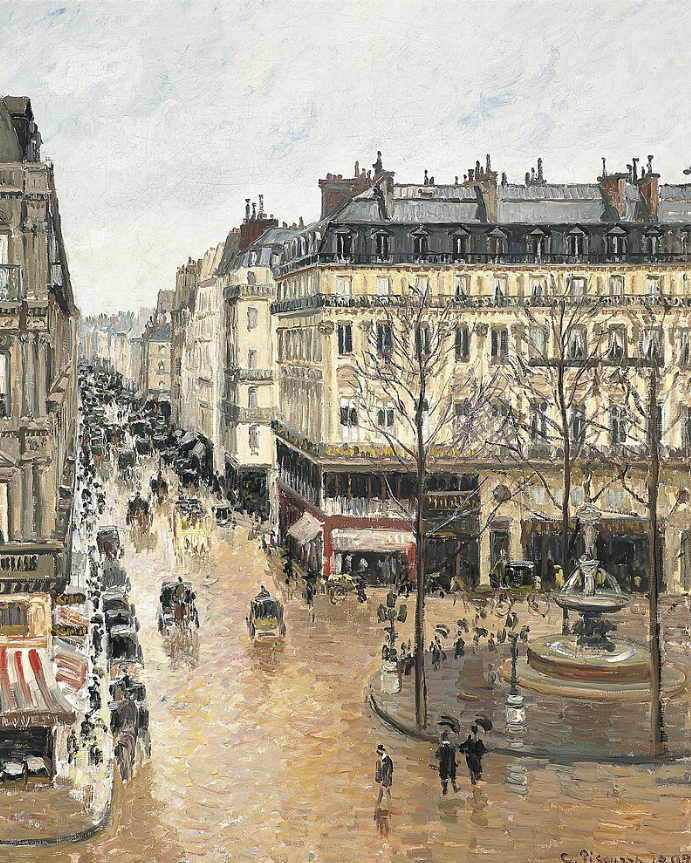
This very old nearly 2 km long road follows most of the west to east Roman road through north central Paris. It was named after a small chapel built outside the walls of Paris in 1204 to remember the patron saint of bakers, Honoré d’Amiens, who died on May 16 600. The church was paid for by a wealthy Parisian baker originating in Picardy. Allegedly Honoré had been miraculously designated eighth bishop of Amiens. The church was demolished in 1913 and became part of the Grands Magasins du Louvre, from whose hotel Camille Pissarro painted the view of the road shown above.
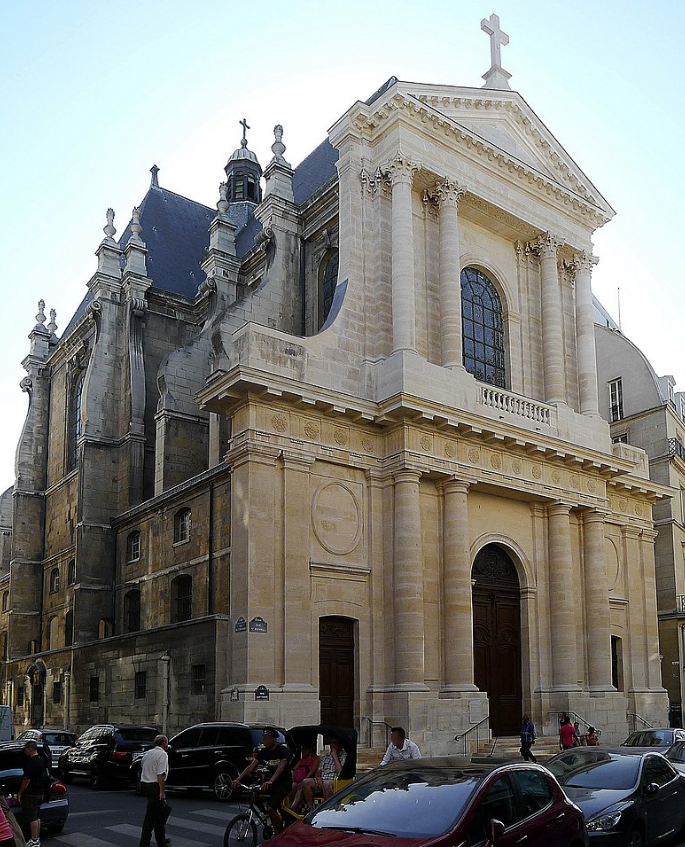
The Oratory of the Louvre at No. 145 had started life as a Catholic church in 1612, had become a monastery , enlarged and rebuilt and in 1624 became the royal church of the Louvre Palace. Another rebuild took place between 1740 and 1750 before th nationalisation of the monastery in 1792 and its deconsecration. In 1800 it became the Bank of France and in 1811 Napoleon decided it should be re-opened as a Protestant place of worship.
During the German occupation of Paris the pastors Paul Vergara, Gustave Vidal and André-Numa Bertrand explicitly preached the need for spiritual resistance to Nazism. On February 17 1943 after Suzanne Spaak had appealed for their assistance in saving Jewish children about to be deported. Marcelle Guillemot, a social worker who edited la Clairière, a protestant socio-health paper, was outside the Temple of the Oratory after Vergara called for volunteers, and took the names of 30 protestant families ready to hide the children, after going to the centres where they were being held and taking them for walks.
A total of 63 children were saved, although Marcelle had to go into hiding in Paris while Vergara escaped to Switzerland.
The Café de la Régence from 1681 to 1854 was based approximately at Nos. 153-155, nearly opposite the Palais Royal (No. 204). Voltaire, Diderot and Rousseau were all enlightened customers there in the mid-18th century. Benjamin Franklin also visited while he was American Ambassador to France from 1776 to 1785.
The rough location of the Cafe de la Regence on the corner of the Palais royal square.
This café was also where Marx and Engels met on August 28 1844 and agreed to work on ‘The Holy Family‘ together. Further along the street, at No. 251, was the Valentino Hall, which Engels entered on one occasion in his brief 1844 visit to Paris to escape the police spies who were following him.
Upstairs the Café de la Régence was the centre of French chess for over a century. It was where Robespierre, the young officer Napoléon Bonaparte and Louis Philippe all played their chess (no not together!). The café also doubled as one of Paris’ four cafe/shop post offices in the early 19th century.
On October 16 1793 the Jacobin and regicide painter, Jacques-Louis David, sketched Marie-Antoinette in a cart being taken to the scaffold from a first floor window in Rue St Honore
The Café was well-positioned. It was close to the Palais Royal before the Revolution and afterwards it was on the route of those being taken from the Conciergerie prison to the Place de la Concorde to be guillotined.
On July 28 1830 at Nos. 157-159 the very first barricade was erected at the cross roads with Rue Rohan and Rue de Richelieu. This marked the start of the July 1830 Glorious Revolution that overthrew Charles X
At 10.30 pm on the evening of December 3 1973 one of the cartoonists for the French satirical paper Le Canard enchaînéreturned to its offices at No. 173 to find a government DST ( Direction de la surveillance du territoire) team of spies installing microphones. The French State has always believed it has the right to spy on dissidents.
The editorial offices of Le Canard Enchaine satirical weekly at No. 179
Nearly two hundred years earlier the French state still believed in its right to execute dissidents. One issue was how this done. Should it be a lengthy process by strangulation (hanging) or a lengthy process by chopping at your neck with an axe?
Dr Joseph Ignace Guillotin, a humanist who opposed the death penalty helped develop a quicker, more efficient way of killing people. One of those who drafted the 1789 Declaration of the Rights of Man and of the Citizen, he died on March 26 1814 in his medical office at No. 209. This was on the route of those travelling to be ‘humanely’ executed at what is now the Place de la Concorde.
The medical offices of the man whose name was given to the guillotine died here at No. 209 in 1814.
On November 29 1847 Bakunin spoke to the 1,500 people who attended a commemoration banquet of the 1830 Polish uprising against Russia at the Valentino Hall. Before Haussmann’s re-modelling of Paris its address was No. 359 rue St Honoré. This was where Valentino, the orchestra conductor and violinist, introduced the polka dance to Paris that same year, 1847.
Le Bal Valentino was opened in 1838 and closed in 1890. One of the largest halls in Paris it alternated classical music concerts and dancees, while hosting many political meetings
The size and central location of the Hall attracted many revolutionaries to hold meetings there. In 1848, in February Cabet held a meeting of the Icarians there.
In March, Blanqui organised meetings of the Central Republican Society he chaired at Valentino’s. The Club of Political Prisoners presided by Armand Barbès with Blanqui as its vice-president also met there.
The Socialist Workers’ Club whose honorary president was Louis Blanc also met there until the May 15 1848 demonstration when it was dissolved after the failure of a left insurrectionary attempt to defend the socialist aspects of the February 1848 revolution.
On January 27 1871 the Valentino Hall was used by the Officers of the 1st Battalion of the National Guard to protest against the Armistice signed by the Thiers government with the Prussians.
251 Rue St Honore is now the exclusive Mandarine Hotel, describing itslf as the ultimate luxury hotel. The earlier dance hall and meeting place was demolished and rebuilt in the 1930s
Olympe de Gouges, opponent of slavery and author of the 1791 Declaration of the Rights of Women and Women Citizens, lived at No. 270. A History of Paris marker post has been put by the front foor to mark this feminist pioneer and martyre.
Olympe de Gouges’ time at 270 Rue st Honore is now marked by a historic Paris plaque in the pavement on the right of the door
The main entrance to the second Jacobin monastery in Paris was at No. 328. Its side entrance in the Rue St Hyacinthe led to the monk’s canteen where the anti-royalist Breton Club began to meet in 1789. After the closure of the monasteries in 1790 the convent was rented to the Friends of the Constitution, who later took the name the Jacobin club .
General Lamarque died at his home at No. 368 of cholera. His funeral procession that left from here on June 5 1832, sparked the 1832 uprising against Louis-Philippe’s increasingly authoritarian rule that features in Hugo‘s Les Misérables.
General Lamarque, who lived at No. 368, was a leading critic of Louis-Philippe. He died of cholera here on June 1 1832 and his funeral on June 5 triggered the 1832 June insurrection in Paris
When Robespierre was himself guillotined on July 28 1794, the cart carrying him to the scaffold stopped outside No. 398 (formerly No. 366) where he had lived for three years since he moved there secretly on July 17 1791 to avoid arrest after the Champs de Mars massacre. The house’s walls had been dripped with the blood of butchered cattle.
Off the courtyard behind the doorway to No. 398 Robespierre rented two rooms from Maurice Duplay, a cabinet-maker and supporter. The house was rebuilt to the same floor plan in the 18th century.
Delacroix shows all social classes supporting the July Revolution of 1830
Eugène Delacroix (1798-1863) showed his bare-breasted Liberty-Marianne in a Phrygian cap walking across a barricade thought to have been at 8 Rue de Saint-Martin in his iconic painting Liberty guiding the People. He wrote to his brother soon after the July 1830 Glorious Revolution:
‘I’ve embarked on a modern subject—a barricade. And if I haven’t fought for my country at least I’ll paint for her.’
Delacroix’s painting was shown in the Salon
of 1831 and bought by the French government. Its intention was to hang it in
the throne room of the Luxembourg Palace. But after the June 1832 insurrection
it was returned to Delacroix as being ‘too revolutionary’. It was only
exhibited again briefly after the February 1848 Revolution, and then next in
the Salon of 1855.
John, the designer of Left in Paris, borrowed from Delacroix the bearded rifle-wielding bourgeois revolutionary and the pistol-waving working-class teenager seen on our menu pages.
Hazan (WTP) tells us that the two-day 1832 Republican insurrection that followed the dispersal of the huge crowd behind a red flag at the Republican General Lamarque’s funeral on June 5 saw the first use of artillery against Parisian insurgents. The demonstrations followed opposition deputies accusing the government of breaking its promises and refusing to support oppressed people like those in Poland.
George Sand painted by Delacroix in 1838, about the time she was working on the novel referring to Rue Saint-Martin
There were three barricades protecting the Rue de Saint Martin headquarters of the Republicans at what was then number 30. Writing a novel about the events ten years later George Sand makes this address the home of her working-class hero.
The reality was that the defenders of the 1832 barricades killed around 75 soldiers and National Guardsmen sent by Louis-Philippe. Over 90 insurgents were killed, 200 wounded and 1,500 prisoners were taken. Eighty-two people were subsequently deported.
Victor Hugo’s Les Misérables fiction places Gavroche’s death at 107 Rue de Saint Martin at the barricade with the Rue Aubry le Boucher. In his Comédie humaine Balzac (1799-1850) has the republican Michel Chrestien killed at the Rue Saint-Merri barricade across the street.
Louis-Auguste Blanqui’s first
insurrectionary attempt was made in 1839 with the Society of the Seasons, and its
first barricade built was across the entrance to the Rue de Saint Martin, from
numbers 1 to 2 on 12 May 1839. The conspirators used to meet in a wine seller’s
shop at 10 Rue de Saint Martin.
Blanqui and Armand Barbès were also present at what was probably the most important barricade erected in 1839, at number 78 Rue de Saint-Martin, the St Merry barricade. Barbès was wounded outside number 248 and arrested at the end of the insurrection.
Another barricade appeared at the beginning
of Rue de Saint-Martin during the workers’ uprising against the closing down of
the schemes for unemployed workers on 23 June 1848.
In July 2018 I spent a couple of days at a sociological conference at the Conservatoire des Arts et Métiers at 270-272 Rue St Martin. A 19th century costumed film was being shot there using the 19th century buildings as a backdrop, with a portable guillotine added for good measure. Strange to think that Karl Marx supposedly gave a speech there on March 5 1848 to the Central branch of the Rights of Man and of the Citizen Club immediately after his explusion from Brussels.
The Conservatoire (before 1794 the priory of Saint-Martin-des-Champs) was also the location of the National Convention organised by Ledru-Rollin a year later, on 13 June 1849, to try and stop the war on the Republic of Rome.
Further up the street, the old Molière Theatre at No 159 provided a venue for many meetings and organisations. Ledru-Rollin and Barbès were among those who held meetings of the Revolutionary Committee for the elections to the Constituent Assembly in March 1848. On November 14 1869 the Parisian Federation of Workers Societies was formed there.
During the bloody week of May 1871 the Conservatoire was fortified, and the last fighter is supposed to have been a woman defending it with a machine gun. Another barricade that saw fierce fighting was built at 145 Rue de Saint-Martin.
One of the 600 barricades built in August 1944 in answer to the FFI call to make German troop movements in Paris as difficult as possible
The street’s cobblestones again came in handy in August 1944. One photograph looking down Rue St Martin shows the barricade built outside number 135 (now next to a Monoprix shop). It was one of some 600 built in Paris after the resistance FFI (French Forces of the Interior) called for them to be built on August 19 to stop German troop movements.
Today, the left side of the street exists no longer: it was demolished to make room for the Beaubourg (Pompidou Centre) as was the 1832 battleground of the Rue Saint-Merri. From barricades to shopping opportunities.
But at least there is still some art nearby – although as Hazan (WTP) reminds us, the architects’ original democratic, accessible concept for Beaubourg “for people to meet here, in a certain everyday way, without having to pass through a gate and being checked like in a factory” has now been ‘renovated’ out of existence. Today access is only for ‘the right class of people’.
In 1842 Gustave Courbet‘s first workshop was at 89 Rue de la Harpe which, after the Southern part of the Rue de la Harpe was knocked down, was approximately at the location of 31 Boulevard St Michel. This was where Courbet got to know Proudhon.
One of Baron George Haussmann’s objectives in tearing up much of old Paris after the 1848 Revolution was to try and eradicate the possibilities of street barricades and open resistance, or at least to ensure that the army and police would find suppressing it easier. The Latin Quarter and its student and poor working class inhabitants were a key target.
Hazan (IOP) quotes Haussmann as acknowledging his aim was to restructure Paris ‘strategically’:
“I read, in a book which enjoyed great success last year, that the streets of Paris had been enlarged to permit ideas to circulate, and, above all, regiments to pass. This malicious statement (which comes in the wake of others) is the equivalent of saying that Paris has been strategically embellished. Well, so be it . . . I do not hesitate to proclaim that strategic embellishments are the most admirable of embellishments.”
In 1851 Paris comprised 30,770 houses; by 1860, when he expanded Paris to include all the land within the 33km-long Thiers Wall, built between 1840 and 1844, he had already demolished 14% of them. Between 1852 and 1868 a grand total of 18,000 houses had been demolished.
Among the old narrow streets pulled down to make way for the Boulevard St Michel was part of the Rue Cujas. The Café Musain at No 22, then on the corner with the Boulevard, doubled as the headquarters of the Société des Amis du peuple (Society of the People’s Friends). This was the secret society run by Auguste Blanqui that played a part in the 1830 Revolution.
Victor Hugo in Les Misérables modelled his secret society, the ‘Friends of ABC‘ on the Blanqui club, suggesting it was their initiative to use the appearance of a red flag at the funeral of General Lamarque on June 5 1832 as the signal for that uprising.
Haussmann’s first idea for the Fountain at
the Place St Michel, on the new North-South axis he had constructed through
Paris, was for a giant Napoleon Bonaparte. Finally, the architect Gabriel
Davioud designed the ‘Victory of Good over Evil’, with Saint Michael defeating
the devil (or Louis-Napoleon Bonaparte defeating the 1848 Revolution) that was
put in place in 1860, hiring nine different sculptors to sculpt its different
elements.
Strategically, though, Boulevard Saint-Michel may be considered to have been more successful than the dreadful fountain. In May 1871 it took little time for the fragile barricades in the broad street to be broken.
On August 21 1944, the Boulevard
Saint-Michel was again a key strategic route for the German occupiers to move their
troops from the garrison at the Luxembourg Gardens to the right bank in the
North.
The resistance built a barricade across it to
the Café Cluny on the corner with the Boulevard Saint-Germain, on whose
pavements in 1995 I first met Sylvie, a French doctoral student who became very
close to me over the following two decades.
In August 1944 the strategic crossroad
there quickly became known as the ‘crossroad of death’. In one account I read there
was a suggestion that some Germans tied French men and women to the front of
their tanks as human shields to go up Boulevard Saint-Michel.
Insurgent Paris rarely sleeps long. On May 13 1968 ten years to the day after the Algerian generals’ coup d’état toppled the Fourth Republic, a one million strong trade union and student demonstration protesting police violence against students on the night of the barricades (May 10) marched down the Boulevard Saint-Michel and past the Place Saint-Michel over to the right bank. The following day factory occupations started to spread throughout France.
Back in London at the LSE in May 1968, we Socialist Society activists organised a sit-in in solidarity with French students and workers on the one day that week when we didn’t have exams. From the sublime …
Numbers 3, 48, 62-64 (site of 22 Rue du Bourg l’Abbé), 83
In 1854 the boulevard was initially built as part of Haussmann‘s redesign of Paris as the Boulevard du Centre. Half-way between the Rue Saint-Denis and Rue Saint-Martin roads that were closely associated with barricades and insurrections, it involved relatively little demolition of existing buildings and created a 30m wide road along which troops and canons could be easily moved.
Almost immediately it was renamed Sébastopol after a year-long seige finally ended in the successful storming of Sebastopol on September 8 1855 by a joint Franco-British force during the disastrous Crimea War.
The pharmacy shop Cannone at No. 48 on the corner with the Rue aux Ours was the main distribution centre for the underground resistance papers Valmy et Résistance. Initially, from the autumn of 1940 one of the staff, Roger Lardenois, used its huge storage area to hide and then distribute Valmy.
64-66 Boulevard Sebastopol is the location of the Lepage Frères arms depot, before 1854 it was 22 Rue du Bourg-l’Abbé. The warehouse was pillaged by a few hundred men from the secret Seasons Club set up by Blanqui and Barbès for weapons and ammunition on May 12 1839. Many carried three or four pistols and rifles out with them. .
The Lepage Brother’s gun shop in the 1830s just round the corner from their store room in the now disappeared road Bourg-l’Abbé The site of the Lepage Frère armoury at 22 rue du Bourg de ‘Abbb , now 62-64 Boulevard ~Sebastopol
From the junction of Rue-du Temple and Rue de Turbigo looking at the Place de la Republique
One of Paris’ oldest streets it now runs for 1.3 km from the Rue Rivoli up the the Place de la Republique, with the Square du Temple garden created in 1857 leading off it at No. 158.
The name Rue du Temple comes from the Templars district, a large area of land given to the Knights Templar military religious order around 1170. In 1240 the 50 metre high keep was built within a walled enclosure. It initially housed the king’s treasure, and then became a prison. Its most famous occupants from August 13 1792 were Louis XVI and his family.
On December 18 1795 Marie-Thérèse Charlotte de France, their daughter, was the only Bourbon to leave the Tower alive and without a trip to the guillotine. Louis XVI was guillotined on January 21 1793. Marie-Antoinette on October 16 1793. Elisabeth, the king’s sister, on May 10 1794. Louis, the king’s son, died from tuberculosis in the keep on June 8 1795.
On June 29 2017 the Square’s name was changed to Square du Temple – Elie-Wiesel in honour of the human rights campaigner and Holocaust survivor.
In 2007 the incumbent Socialist mayor from a Jewish Polish family erected a Stele in the Square to commemorate the 85 Jewish children of the Third Arrondissement who, under the age of six, had been arrested by the French police and deported to Auschwitz, never to return.
The Templar Tower was knocked down by Napoléon Bonaparte in 1808 partly to prevent Royalist pilgrimages to the site and partly, some argue, to spare his future wife, the sight of her aunt’s last address. The garden and Square was one of 24 laid down under Haussmann’s plan for giving Parisians a little more air.
On February 27 1871 the Square at No 158 was the meeting point of the National Guardsmen on their way to the Champs-Élysées to try and stop the Prussians from entering Paris. Every Saturday during the Commune the band of the National Guard played there to raise funds for the widows and children of men who had died in the war.
Former soldiers who had joined the Commune and foreigners were the first to be executed in the Square on May 25 1871.
Women Communards such as Elisabeth Dmitrieff and Nathalie Le Mel used to meet in a women’s club at the Grand café de la Nation at No. 79, the 17th century Hotel de Montmor. On International Women’s Day March 8 2007 under the recently elected Socialist Paris mayor, a small triangular square at the meeting point of the Rue du Temple and the Rue de Turbigo was named the Place Elisabeth Dmitrieff. It is just outside the entrance to the Temple metro station.
In October 1870 Blanqui was in hiding at No. 191. The flat belonged to Eugène Cléray, a clockmaker and follower of Blanqui who was deputy mayor of the Third arrondissement during the Siege of Paris. Blanqui stayed in the flat on October 31 before going to the Hotel de Ville to see how the insurrection against the new republican government’s indifferent handling of the war with Prussia was going.
Despite 15,000 demonstrating outside the Hotel de Ville for the resignation of the government and then occupying it, by the early hours of the next day it had failed. Blanqui then returned to No. 191.
Where the rue Rambuteau crosses the Rue du Temple at No. 63 there was a restaurant where the Russian Nihilists met in the late 19th century. Trotsky and Lenin also met there early in 1903.
During the occupation of Paris the Central Telephone Archives at No. 106, built in 1927-1928, was taken over by the Germans, and was one of their remaining strong-holds in August 1944.
Jean-Victor Schnetz‘s painting of the July 28 1830 battle outside the symbolic Paris Town Hall shows both the Tricolor and a Red flag – with the words’ ‘Long Live the Charter’ on it. The July Revolution was about restoring a semblance of democratic bourgeois rights, with the threat of workers’ rights behind it.
Lamartine rejecting the red flag on 25 February 1848 in favour of the Tricolor representing the Bourbons (white), the Empire (blue) and the Republic (red).
At the next successful insurrection on February 25 1848, Henri Philippoteaux painted the republican Lamartine outside the Town Hall rejecting the Red flag and endorsing the Tricolor.
Citizens, for me, the red flag, I am not adopting it, and I’ll tell you why I’m against with all the strength of my patriotism. It’s that the tricolor has toured the world with the Republic and the Empire with your freedoms and your glory, and the red flag was that around the Champ-de-Mars, dragged into the people’s blood.
Alphonse Lamartine
On March 22 1848 a delegation of women activists from the ‘Women’s voice’ group went to the Town Hall to demand women have full citizens’ rights including the right to vote.
On May 15 1848 demonstrators against French intervention in Poland, including Blanqui, the worker Albert, Blanc, Cabet, Leroux and Raspail occupied the Town Hall and declared a new provisional government before being arrested.
Lamartine went on to order the brutal suppression of the June 1848 workers’ insurrection sparked by the government’s closing of the world’s first unemployment system with national workshops offering work paid by the state.
On September 4 1870, after Napoleon III’s capture at the battle of Sedan, Léon Gambetta stood on the Town Hall balcony and announced the end of the Second Empire and proclaimed the creation of a new Republic.
On 31 October Blanqui and others demonstrated in front of the Town Hall demanding more action against the Prussian army from the new government led by Jules Favre. A supporter on the inside unlocked the doors and the demonstrators occupied it.
On January 22 1871 Louise Michel was one of many who protested outside the Town Hall at the government’s inertia in face of the Prussian siege of Paris. the demonstrators were fired on and Louise Michel later wrote that this was the first occasion that she had fired back with her rifle.
On March 18 1871 the Thiers government first placed a regiment loyal to to it into the Town Hall overnight, and then attempted to seize all the canons in Paris. These events sparked the creation of the Paris Commune by the Central Committee of the National Guard on March 29 1871.
Retreating before the murdering Versaillais troops the Communards carried out their warning that they would burn down several of Paris’ historic buildings, including the Hotel de Ville
Communism as an international struggle for freedom. This 1951 socialist realist painting by Boris Taslitkzy shows French dockers fighting to stop arms going to French Indochina
What is shared between those who define themselves or are defined by others as ‘communist’? And how may ‘Communism’ be distinguished both from French anarchism and French socialism, with which it shared much common history and ground?
Babeuf was guillotined on 27 May 1797 as leader of the Conspiracy of Equals against the Directorate
Manifesto
of Equals
The 1795 Paris revolutionary ‘Manifesto of Equals’ inspired by François-Noel Babeuf and rescued from oblivion by Philippe Buonarroti (1761-1837) summarised what remained (and remains) common to nearly all those who described themselves as communist across the following two hundred and some years:
‘We need not only that equality of rights written into the Declaration of the Rights of Man and Citizen; we want it in our midst, under the roofs of our houses… We lean towards something more sublime and more just: the common good or the community of property! No more individual property in land: the land belongs to no one. We demand, we want, the common enjoyment of the fruits of the land: the fruits belong to all.
We declare that we can no longer put up with the fact that the great majority work and sweat for the smallest of minorities. Long enough, and for too long, less than a million individuals have disposed of that which belongs to 20 million of their kind, their equals.
Let it at last end, this great scandal that our descendants will never believe existed! Disappear at last, revolting distinctions between rich and poor, great and small, masters and servants, rulers and ruled.’
After agreeing to this general statement of belief, communists had much more to disagree with each other upon.
We have divided the considerable history of Communism in France into five periods:
Accused of being drunkards in several areas of France the early SFIO campaigned against alcoholism as well as against capitalism
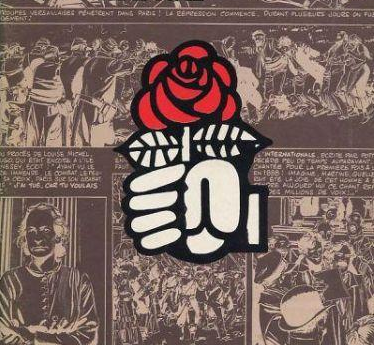
French socialism began to distinguish itself both from Proudhon’s anarchistic appeal to humanity’s moral responsibilities and from Blanqui’s insurrectionism in the 1890s. Founded by Blum, Jaures and Vaillant in 1905 in the aftermath of the Dreyfus affair, the SFIO united left reformist republicans and Marxist sectarians. The alliance broke up in 1920 when a majority at the Tours Conference voted to affiliate to the new Communist International.
Despite being a minority at that SFIO conference, the SFIO of left reformist socialism became the leading left political current through nearly all the interwar period. After the Communist Party ended Stalin’s ‘class against class’ propaganda against the Socialists and proposed a Popular Front alliance, Blum became prime minister in 1936.
Under the Fourth Republic its internal divisions over Algerian independence, with Mendes France and the challenge of the stronger Communist Party allowed De Gaulle to take power. In 1981 Mitterrand won a decisive majority on a left platform that he abandoned three years later. From then the Socialist Party became largely a party of elected national and local officials, without any real mass membership. In 2017, following five politically disastrous years under Hollande, the Socialist Party suffered a major defeat in both the presidential and National Assembly elections. A new left party, La France Insoumise (France untamed), did relatively well, with the Left Front’s presidential candidate getting 19.6% of the vote in the first round.
The vote for the La France Insoumise leader Mélenchon in the first round of the 2017 presidential elections shows stronger support in the less wealthy parts of Paris
Like the Socialists, though, Melonchon’s La France Insoumise has still virtually no local membership base. In the European elections of 2019, its share of the vote fell to 6%.