Hitler met Vichy France’s 80-year-old head of state on October 24 1940 German motorbikes travelling up the Champs Elysée in a victory parade in 1940The politics of Liberation in August 1944. This map in Matthew Cobb’s Eleven Days in August’ (2013) shows how nearly all of Paris’ 600 barricades were built in left-leaning and working class areas of the city
Occupation, Collaboration, Resistance, Liberation, De Gaulle, Communist Party – in progress
Victims
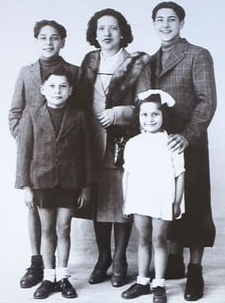
Malika Opalek and her children Aaron (14), Joseph (13), Benjamin (8) and Nina (5) lived at 67, rue des Amandiers in the 20th arrondissement. They were sent to Germany on Convoy 26 on August 31 1942, following Gedalin, husband and father, deported on Convoy 5 by the French police. They never returned.
Malika Opalek and her children Aaron (14), Joseph (13), Benjamin (8) and Nina (5) were sent to Germany on Convoy 26 on August 31 1940, following Gedalin, husband and father deported on Convoy 5
Communism as an international struggle for freedom. This 1951 socialist realist painting by Boris Taslitkzy shows French dockers fighting to stop arms going to French Indochina
What is shared between those who define themselves or are defined by others as ‘communist’? And how may ‘Communism’ be distinguished both from French anarchism and French socialism, with which it shared much common history and ground?
Babeuf was guillotined on 27 May 1797 as leader of the Conspiracy of Equals against the Directorate
Manifesto
of Equals
The 1795 Paris revolutionary ‘Manifesto of Equals’ inspired by François-Noel Babeuf and rescued from oblivion by Philippe Buonarroti (1761-1837) summarised what remained (and remains) common to nearly all those who described themselves as communist across the following two hundred and some years:
‘We need not only that equality of rights written into the Declaration of the Rights of Man and Citizen; we want it in our midst, under the roofs of our houses… We lean towards something more sublime and more just: the common good or the community of property! No more individual property in land: the land belongs to no one. We demand, we want, the common enjoyment of the fruits of the land: the fruits belong to all.
We declare that we can no longer put up with the fact that the great majority work and sweat for the smallest of minorities. Long enough, and for too long, less than a million individuals have disposed of that which belongs to 20 million of their kind, their equals.
Let it at last end, this great scandal that our descendants will never believe existed! Disappear at last, revolting distinctions between rich and poor, great and small, masters and servants, rulers and ruled.’
After agreeing to this general statement of belief, communists had much more to disagree with each other upon.
We have divided the considerable history of Communism in France into five periods: