The Chilean embassy is in a prime location at No. 2. It had previously been the private mansion of the Tour-d’Auvergne family.
Built in 1907 for Prince Henri de La Tour-d’Auvergne it was rented to the US Embassy until 1929 and then sold to Chile to become its Embassy
The Chilean Embassy was where Louis Aragon was allowed to take refuge for a few days on August 28 1939 by fellow poet and Communist, but also a diplomat there at the time, Pablo Neruda. Aragon had been attacked in the street by the extreme right-wing after the French Communist Party had been banned on August 25, two days after the 1939 Hitler-Stalin ‘Non-aggression Pact’.
Between 1971 and 1973 Neruda was made Chili’s Ambassador to France by Salvador Allende. Back in Chili Neruda witnessed the September 11 1973 Pinochet coup d’etat (protests outside the Paris embassy pictured here). But 12 days later Neruda died of ‘heart failure’. 21st century scientific analysis has suggested he could have been murdered in hospital through being injected with botulism.
Jean Jaurès, the leader of the Socialist Party before World War I, lived at No 19 for a period of time according to Paris Revolutionnaire, but we still need to check out the source for this and the time he spent there.
The French Jewish 20-year-old Louise Alcan lived at No. 48 and became a supporter of resistance in 1940. She later moved to Vichy France but was denounced and arrested in December 1943 in Marseille after the Germans moved to occupy the whole of France.
Louise was first taken to the Drancy transit camp and then deported in Convoy 64 to Auschwitz-Birkenau in February 1944. She later escaped from the Ravensbruck Death March of April 1945.
Further down the road at No. 52 there are several connections to the resistance. This was where the leading Catholic resistance organiser from De Gaulle’s secret service in London, Gilbert Renault known as Colonel Rémy, lived from December 1941 to June 1942. With a month of the 1940 defeat he returned from London and with Louis de La Bardonnie set up the Confrérie Notre-Dame (later called the CND-Castille). Two of Renault’s sisters, Maisie and Madeleine, also joined the CND and were arrested at No. 52 on June 13 1942. But they were able to ensure Gilbert’s escape.
Maisie Renault (1907-2003) was first taken to the Santé prison and then to Fresnes until March 1943. She was next moved to the Romainville Fort and on August 15, after D-Day, she and her married sister Madeleine were deported with 550 others to Ravensbruck. They were among the 17 from that convoy who survived to be liberated on April 22 1945.
Outside No. 52 Roland Abon, a resistance fighter aged 19 was killed fighting for the liberation of Paris on August 25 1944.
One of Paris’ oldest streets traced onto an earlier Roman road it dates back to the 3rd century AD when the old Roman town on the left bank was being abandoned in favour of the safer, fortified smaller location on the île de la Cité.
The road falls away on the south side of the Sainte-Genevieve hill. Its name could come from a corruption of the place name, Mont Cétard, to Mont Fétard and eventually becoming Mouffetard. Alternatively, the old French word ‘moufette‘ used to mean an awful smell, and it could be that this is its origin.
No. 23 was an important address for the interwar left in Paris. In 1933 Daniel Guérin organised meetings there for antifascist German refugees.
The Rue Mouffetard was still a busy shopping street in the 1930s when this photograph was taken. Today No. 23 is a bar, and, still busy, the old road now has dozens of restaurants.
In 1935 it housed the offices of Marceau Pivert‘s Revolutionary Left newspaper, and in 1936 the anarchist journal ‘Spartacus’ Notebooks’ where Victor Serge published ‘16 shot: Where is the Russian Revolution going?‘.
In June 1848 a barricade went up across the road at No. 89. On June 23 1848 a company of the Mobile Guard was disarmed here.
Perhaps unsurprisingly, given it was a very cheap area in which to live, and the numbers of political refugees coming to Paris, for nearly two decades from 1885, No. 140 was strongly associated with anarchist publications.
Rue Mouffetard with No 140 on the left, photographed around 1900. The market is in front of the Saint-Médard church.
On 1 February 1885 Jean Grave launched a French-based edition of Kropotkin‘s anarchist journal Le Révolté at this address. After its presses were seized it changed its name to La Révolte. Among those who wrote for it were the exiled Élisée Reclus and Émile Pouget. Among its readers was Pierre Monatte.
From 4 May 1895 it changed its name to become Les Temps Nouveaux (New Times), which continued to publish up to August 1914, when almost all its writers supported the First World War’s ‘Holy Unity’ against Germany.
On 24 February 1889 Pouget launched the weekly anarchist newspaper Le Père Peinard from the same address. This was frequently raided by the police and the last number of its first series appeared on 21 February 1894, when Pouget escaped to London.
In 1871 Élie Reclus, who had been director of the National Library in Paris under the Paris Commune was hidden in the rue Mouffetard by a family friend for several weeks before escaping to London.
The road was given the name Mill Street after the mills situated on a small hill that existed there as late as the 17th century. It was opened in 1624 and the hillock levelled out by its new owner.
From January to December 1844 the fortnightly German language paper Vorwärts! (Forward!) was published by Henri Bornstein at what was then 32 rue des Moulins but is now No. 14. Its circulation was about 1,000 copies, and Marx became a major editor of it from the summer. This was where Bakunin stayed when he first arrived in Paris in July 1844.
Vorwärts! was outlawed on January 25 1845 after an article was published applauding an attack on Prussian King Frederick William IV.
Meetings of the editorial collective of the Deutsch–Französische Jahrbücher (German–French Annals), also took place there. However, only one double issue appeared in February 1844. Several of contributors and potential contributors met and argued there frequently in 1844, eventually going their own ways. They included Proudhon, Leroux, Etienne Cabet and Louis Blanc, as well as Marx, Arnold Ruge and Bakunin.
In the 1860s Narcisse Diaz was often at Étretat, partly for health reasons and partly to paint with his friend Courbet.
Originally called the ‘Sentier des Arches’ (the arches pathway) and the ‘Rue de Seine’, it next became a section of the rue Wilhelm before finally in 1894 being renamed in honour of the painter Narcisse Diaz (1807-1876), a friend of Gustave Courbet, next to whom in the 1860s he painted several scenes on the Normandy coast.
Lev Sedov with his father
At No. 7 the street hosts the Clinique Mirabeau founded in 1929 where Trotsky and Natalia Sedov’s activist son, Lev Sedov, showing signs of appendicitis was advised to go in 1938 by his secretary, a secret agent of the Russian NKVD. The clinic’s director an informer for the NKVD was in charge of anaesthetising Sedov. Four days later, on February 18 1938, Sedov (born 1906 in Saint Petersbourg) was dead.
The opened records of the Stalin’s secret police show them congratulating themselves on his death, but some suggest it was not planned, and was due merely the incompetence of the surgeon.
The huge garden-square-roundabout was originally called the Place du Trône. This name was given it from August 26 1660 when the young Sun King, Louis XIV, sat on a huge throne placed there at the entrance to Paris to receive oaths of allegiance from the Paris guilds after he arrived from the Franco-Spanish border having just married his 22-year-old double-cousin Marie-Thérèse of Austria and Spain.
In 1787 two huge columns were erected alongside the two single story customs houses and 60 metre-high gates that completed the tax border wall built by the Paris Tax Farmers. Statues of Kings Philippe II and Louis IX were put on top of the columns in 1845.
After the Jacobin insurrection of August 10 1792 the square was renamed ‘The Square of the Overturned Throne’ (place du Trône-Renversé). Two years later on June 13 1794, three days after the passage of the Law of 22 Prairial, the guillotine was erected on the shadier south side of the square. From then until 9 thermidor an 2 (27 July 1794) and the overthrow of Robespierre, an average of 30 people a day were executed there.
At the restorations of 1814 and 1815 the square’s name became again the Place du Trône.
On July 14 1880, at the same moment that the Third Republic determined that inscription Liberté, Égalité, Fraternitéwas made obligatory on all French public buildings, the square was given its current name.
Nine years later, on the one hundreth anniversary of the storming of the Bastille, the sculpture The Triumph of the Republic put in the centre of the Place.
This was a large piece by the Communard Jules Dalou, who had returned from exile in 1879 and who had originally designed it for a competition to place a republican statue in the Place de la République. Dalou also sculpted the tombs of Victor Noir and Auguste Blanqui in the Père Lachaise cemetery.
In 1908 sea monsters in a basin sculpted by Georges Gardet and representing reactionary forces being kept at bay by the Republic were added. The crocodile-like monsters were melted down for the German occupiers in 1942 and the basin concreted over.
A general strike supported by both the CGT and the CGTU in defence of the republic against the growing fascist threat was called on Monday February 12 1934. A Socialist column headed by Leon Blum and other Socialist deputies walked from Vincennes to la Place la Nation, with Dalou’s Republican statue its message. There the Socialist column was joined by an even larger Communist march creating a demonstration of 150,000 in Paris alone, while tens of thousands demonstrated elsewhere in France.
On February 12 the divided trade unions and left parties created the biggest demonstration yet seen in France and marked the beginning of united left action against fascism that led to the Popular Front.
The Place de la Nation became a symbol of anti-fascism and left unity. So two huge contingents came together there on July 14 1936 to celebrate the Popular Front victory. This time the call came from 48 different organisations and delegations in traditional provincial as well as working clothes were present alongside each other. Tartakowsky (1997) estimated there were a million people on the streets of Paris for the occasion, marching from the Place de la Republique and Place de la Bastille to the Nation.
Communist and Socialist columns met at the Place de la Nation again to celebrate the first-ever French May Day public holiday on May 1 1937.
In 1938, with the end of the Popular Front government, the strike called on November 30 by the CGT against the dismantling of the 1936 labour laws saw demonstrators attacked by the police.
A young FTP-M.O.I. resistance group (Meier List, Marcel Rajman and Jaroch Klesczelski) threw a grenade at a group of German soldiers in the Place on December 12 1942. Nearly a year later Rajman was arrested with Olga Bancic. He was shot after a trial on February 21 1944, while she was deported to Stuffgart where her head was cut off with an axe.
On May 1 1951 the police attacked a May Day demonstration of Algerians who were carrying the MTLD independence movement’s flag. One hundred police were injured and 1,600 Algerians arrested.
On July 14 1953 the traditional march took place from the Place de la Republique to the Place de la Nation. Then the Algerian demonstrators behind the MTLD banners continued to where their lorry was parked to stack their placards.
At that point the Paris police opened fire on them: six Algerians and one French CGT worker were killed and 126 wounded. No inquiry was held into the police action.
A plaque in memory of those killed is now fixed on the side of one of the customs housesA film poster about the July 14 1953 police murders of Algerian independence supporters in the Place de la Nation. The film is by Daniel Kupferstein
Initially called the Rue des Deux Moulins (the Two Mill road) the road at the bottom left of this image was extended to the Boulevard Massena by Haussmann in 1863 and then renamed the Rue Nationale in 1870. This south-facing photograph shows its junction with the Avenue d’Ivry on the right of the red building, built on the site of the Panhard & Levassor factory.
Hazan (WTP)
describes finding the site of the former Panhard & Levassor factory on the Boulevard
Massena at the corner between the Avenue d’Ivry and the Rue Nationale. The 1891
three-level structure has been preserved.
This is
not the case with the rest of the area. But even so, unlike most of inner
Paris, it has not been gentrified. From the 1970s many migrant boat-people from
Vietnam settled in the area between Rue de Tolbiac (to the West), the Rue
Nationale (to the North East) and the Avenue d’Italie (to the South).
In 2017, the Marguerite-Durand historical library of gender and feminism, named after the founder of La Fronde in 1897, survived an attempt to close it. Its wealth of archives can be found at 79 Rue Nationale. After nearly two years of works the library re-opens on December 3 2019.
Rue de l Odeon photographed in 1905 from the steps of the Theatre. The bust of the playwright Emile Augier in the centre of the square was melted down in 1942 to be turned into German guns
The gently climbing slope from the crossroads with the Boulevard St Germain up to what is now called the Odéon-Théâtre de l’Europe, was opened up in 1779 as the rue du Théâtre Français. The theatre at the southern top of the slope was built between 1779 and 1782 in the garden of the huge Hôtel de Condéprivate house, owned by a junior branch of the Bourbons.
Thanks to the opening of the theatre, in 1782 the road was the very first in Paris to be given pavements with gutters running next to them. It was given its current name in 1797 under the Directorate.
A watercolour and ink painting by a contemporary JD Periel of the fire at the Odeon Theatre on March 20 1818
The surrealist poets André Breton and Louis Aragon first met each other in 1917 at No. 7, the bookshop called ‘The Friends of Books’ (Maison des Amis des Livres). This bookshop was also frequented by Jacques Prévert. On March 19 1918 Breton and Aragon launched their magazine, Littérature, from there. Among the other literary left figures who wrote for it were André Gide and Paul Valéry.
The bookshop’s owner, Adrienne Monnier, held a launch party at No. 7 for James Joyce‘s novel Ulysses on December 7 1922.
No. 10 was where Thomas Paine lived from 1797 to 1802, when, describing Bonaparte ‘as the biggest charlatan the world as ever seen’, he took the opportunity of a brief peace with England to leave Paris for America.
Tom Paine lived for five years at No. 10 Rue de l’Odeon. While initially hoping Bonaparte would spread freedom throughout Europe he quickly became disillusioned, and left France at the earliest opportunity in 1802.
Next door was another famous bookshop. No 12 was the first site of the English-language bookshop Shakespeare & Company. Owned by an American, Sylvia Beach, it became a major draw for radical writers living in Paris in the interwar years such as Hemingway, James Joyce and Simone de Beauvoir.
Shakespeare and Co at No 12 with Sylvia Beach and Ernest Hemingway on the right around 1922
Further up the street, on March 31 1794, this was where at No. 22 rue du Théâtre Français that Camille Desmoulins was arrested. He had lived there since 1782. He was executed with Danton on April 5. His wife, Lucile, was executed a week later. They had married in 1790 with Robespierre a witness who in 1792 became their son’s godfather.
The road was named after the housing scheme called the cité d’Odessa built in 1854 at the same time as the shelling by French and British frigates at the town of that name during the Crimean War. The road was then opened in 1881.
Today the street is best known for its Breton-origin crepe cafés that derive from the Breton migration into the area in the late 19th century, due to its proximity to the Gare Montparnasse. I usually choose a crepe with Grand Marnier when I walk through, but there are so many it’s difficult to make knowledgeable recommendations as to which creperie to eat in without defeating my diet.
The hôtel Odessa at No. 28 on the corner the southern part of the street was where Trotsky lived from 1914 to 1916 and again, clandestinely, in 1933. You can bet that he ate several crepes during his stay there – one of the cheapest foods around at the time.
The entrance to the Hotel Odessa photgraphed by Steve Jefferys in October 2016, 100 years after Trotsky was expelled from France.
The Polish Library at No 6 Quai d’Orleans was used by Rosa Luxemburg.
This is the Polish Library on the Île du Cité where between 1893 and 1897 Rosa Luxemburg spent time researching her doctoral thesis on the ‘Industrial Development of Poland’.
Visiting it in 2018 with Marian I couldn’t find any references to Luxemburg’s presence, and none to the relevance of Poland and international solidarity for France in 1848. It has a small Chopin exhibition includes some images of his French lover, George Sand. It also contains an historical exhibition with an account of key 19th century Polish nationalist figures.
Renamed in 1894 after the 18th century animal painter and former director of the Gobelins Tapestry factory, Jean-Baptiste Oudry, the road had been a centre for tanneries for nearly two hundred years.
Trotsky and his family lived and he was arrested at No. 27 in 1916, before being expelled to Spain. His movements were spied upon from a bar round the corner in the Boulevard St. Marcel.
The street rue aux Ours was named after the geese (oues in old French) that used to be roasted there. Over time this evolved to ours. Pictured here at the corner with the rue Quincampoux, it is first recorded in 1297 and was named after an individual who lived there.
The street was named after the geese (oues in old French) that used to be roasted there. Over time this evolved to Ours.
Auguste Blanqui was shot in the neck at the corner of the rue aux Ours with rue Quincampoix in a street celebration of the Paris Republican electoral victory of November 1827.
From the left’s perspective the Palais de Justice could perhaps be better named the Palace of Injustice.
Located at Nos. 4-10 boulevard du Palais, the Boulevard was only given that name in 1864, after Haussmann bulldozed broad streets through potentially barricadable medieval streets.
The earlier names of the road in front of the Palace were the rue de la Barillerie (street of wine cask makers) and the rue Saint-Barthélemy (named after the nearby Church Saint-Barthélemy that in 1791, like the nine others on the ile de la Cité, lost its parish status to Notre-Dame cathedral, was nationalised and then sold and demolished. The site was initially a theatre and from 1865 the current Tribunal de Commerce de Paris).
In 1830Blanqui was involved in fighting outside the Palais de Justice as the insurgents moved to topple Charles X. He was back there, inside, in 1832 as one of the defenders in the ‘trial of the 15’. This was of the leading members of the mainly student republican ‘Society of Friends of the People’ including Raspail. On January 10 1832 all were acquitted except for Blanqui who was found guilty of an offence against the public peace.
During the May 12 1839 Four Seasons insurrection against Louis-Philippe, Barbès led a column of 600 men to the Palais de Justice where he urged the troops on duty to join him. A refusal led to fighting and the guard-post and Palais were taken, but they failed to capture the Prefecture opposite.
The Palais de Justice was one of the many historic buildings set fire to or bombarded in May 1871 during the ‘Bloody week’ at the end of the Paris Commune, when orders were given to burn the Tuileries Palace and other symbols of government authority in retaliation for the summary executions of Communards taking place all over Paris. In total 238 buildings were burnt down or damaged during the fighting.
A newspaper lithograph shows the return of the Versailles judges to the burnt out Palais de Justice after the defeat of the Paris Commune. Many of the 7,500 Communards who were exiled had their sentences pronounced here.
In 1878 the young lawyer, Jules Guesde, appeared at the Palais de Justice to defend members of the illegal International Workingmen’s Association.
François Ravachol (1859-1892), an anarchist who had placed bombs at the homes of the three judges who had jailed the three Clichy May 1 1891 demonstrators, was sentenced to death here after two trials. He was publicly guillotined on 11 July 1892.
The Palais was also the venue for the ‘Trial of the 30’ anarchists accused of conspiracy and supporting the ‘propaganda by the deed‘ bombings. Among those on trial and acquitted in August 1894 were the revolutionary syndicalist, Émile Pouget, the art critic, Félix Fénéon, the artist, Maximilien Luce, and Kropotkin‘s collaborator, Jean Grave.
One of the anarchists charged but who went to live in Britain under an assumed name (Georges Guyot) was Paul Reclus, the nephew of Élisée Reclus. In his absence Paul was sentenced to 20 years hard labour. Paul moved to Brussels in 1903 to help Élisée with the publication of his anarcho-geographer testament, L’Homme et la Terre.
In 1913 the Palais was where Victor Serge and the Franco-Belgian anarchist Bonnot gang were tried, with Serge being sentenced to five years for robbery, three were guillotined and three others had their death sentences commuted to life imprisonment.
In 1927 eight PCF leaders including Jacques Duclos and André Marty were tried here following the demonstrations in support of Sacco and Vanzetti., Italian-born migrant anarchists who were executed on trumped up charges in the US on 23 August 1927.
On September 2 1941 only one of the Palais de Justice judges and magistrates, Paul Didier (1889-1961) refused to swear an oath of personal allegiance to Pétain as then required by the Vichy Government. He also refused to work in the Special Sections set up in the Palais de Justice to try Jewish people and those accused of ‘political crimes’. Didier was arrested the following day and then interned before being fired from the judiciary. Reinstated in 1944 Didier then chaired appeal court hearings, including that of PCF leader Jacques Duclos in 1952, held in La Santé prison for a month for what was called the ‘pigeon plot‘, his part in organising a demonstration against the visit of US General Ridgway to Paris.
After the Second World War the Palace was again used to try and jail strikers (in 1950), Communists (1952) and supporters of Algerian independence (the Jeanson network was put on trial – here or at the Cherche-Midi prison – on September 5 1960, with 14 sentenced to 10 years imprisonment each, of which just four were suspended sentences).
Ten years later, in November 1970, the leading Maoist was jailed at the Palais for two years for re-establishing the banned Proletarian Left (Gauche Prolétarienne) group.
The Justice Palace we see today dates back to the earliest years of the Roman occupation after the defeat of the Celtic Gauls under Vercingetorix by Julius Caesar in 52 BC. The already inhabited islands in the River Seine, now merged into the l’île de la Cité, were then just about the only pieces of defensible dry land around that also allowed soldiers and traders to cross the river.
The Romans set up a seat of government on the site of the Palais de Justice from where they ruled France for over 500 years. The mixture of Latin and local Celtic dialects created what became the French language.
Palais de la Cité seen from the rue de la Barillerie in 1650. The drawing shows the Pont Neuf and the Louvre Palace in the background.
From the 10th to the 14th centuries, the quarter of the island covered by the Palace of the Cité was the seat of every French monarch. During that time all the king’s constitutional and judicial courts were based there, including the Paris Parliament until Charles V moved to the right bank of the Seine in 1358 after Etienne Marcel and other important Paris merchants invaded the palace and murdered the Dauphin’s ministers on 22 February.
After Charles V (Charles the Wise) and the court left the Palace, however, all its principal administrative and judicial functions remained. In 1371, during the 100 Years War, the first public clock in Paris was installed at No.2, boulevard du Palais, on the corner tower that carried the Palace’s alarm bell. Over the centuries several major fires destroyed large parts of the royal palace. In 1630 the Sainte Chapelle spire burnt down followed, in 1776, by all the buildings between it and the Conciergerie (the offices and residence of the appointed caretaker in charge during the king’s absences that became a prison from 1391).
The neo-classical colonnade entrance to the Palais de Justice was built between 1783 and 1786, and the Revolutionary Tribunal (Tribunal criminel extraordinaire) with just five judges was located here from 6 April 1793 to 31 May 1795. While it was in existence the Revolutionary Tribunal decided to guillotine 2,585 people and to acquit 1,306 (including Jean-Paul Marat on 24 April 1793).
An engraving showing the Revolutionary Tribunal of 1793-1795 sitting in the Great Hall of the Palais de Justice, renamed ‘Liberty Hall’ (Salle de la Liberté)
Besides Marie-Antoinette and Robespierre and others condemned with whom it is more difficult to feel sympathy were those like Anaxagoras Chaumette, who had campaigned for the abolition of slavery, the journalist Camille Desmoulins who had criticised Robespierre, and Desmoulins’ wife, Lucile, as well as Olympe de Gouges, the author of the 1791 ‘Declaration of the Rights of Women and Women Citizens’ – a feminist answer to the 1789 Déclaration des droits de l’homme et du citoyen. She was arrested at the gates to the Palais de Justice on 20 July 1793.
Declaration of the rights of Women drafted by Olympe de Gouges, playwright and campaigner against slavery, it was published on 5 September 1791 in a pamphlet ‘Rights of Women’ presented to Queen Marie-Antoinette. Palais de Justice photographed by Steve Jefferys in December 2018 after visiting the Sainte Chapelle – always best on a sunny day
The Palais Royal (at No. 204 Rue St. Honoré) was the personal residence of Cardinal Richelieu (1585-1642), who ordered its building to the north of the Louvre in 1628. Richelieu gave it to Louis XIII in 1636, after which its name changed from Palais-Cardinal to Palais-Royal.
It was given to the Orléans junior branch of the Bourbons in 1692, and in 1780 its garden was transformed into an arcade square of galleries comprising some 400 boutique shops. Among the products available were gambling (up to 1836), luxury jewelry and watches, pornographic prints, and (until 1830) prostitution.
Prostitution in the Palais Royal around 1815 as painted by the German artist Georg Opiz (1775-1841)
Under the French Revolution in 1792 the Square was renamed Place de la Maison Égalité
During the 24 February 1848 revolution against the Palace’s’ owner, King Louis-Philippe the square saw major fighting between the army, defending its position inside the Château d’Eau ( not much more than a facade resembling the Palais Royal on the south side of the Square) and the revolutionaries. The Château d’Eau was finally seized and burnt down, while the Palais Royal was sacked, its paintings were burnt or cut up and its furniture thrown into the street.
Under the second Empire Napoléon’s youngest brother, Jérôme Bonaparte, was allowed by Napoléon III to live there until his death in 1860. On the night of 23 May 1871, the Commune ordered it to be burnt down. Three fires were lit, but all were put out in the early hours of the next morning. Less damage occurred than in 1848.
After 1871 the Palais-Royal became administrative offices for different parts of the French government. Today it hosts the State Council and since De Gaulle’s 1958 introduction of the Constitutional Council, both it and the Culture Ministry (initially under André Malraux).
The Panthéon dome (actually three in one like a Russian doll) is one of Paris’ landmarks. Jacques-Germain Soufflot’s Church of Saint-Genevieve on the hill to the South of the River Seine was built on a grand scale between 1755 and 1790 – and being completed only shortly after the French Revolution began.
Almost immediately the National Constituent Assembly decided to use the model of the Roman Pantheon and to install statues of great Frenchmen in it.
The slogan, ‘A grateful nation honours its great men‘, was put over the entrance and on April 4 1791 Mirabeau became its first brief resident (his ashes were taken away on November 25 1793), followed by Voltaire (July 11 1791), Rousseau (October 11 1794) and then several executed revolutionaries, including Jean-Paul Marat (September 21 1794 – and then thrown into the gutters by the Muscadins on February 26 1795).
Rousseau’s statue in the square put up in 1889 was destroyed under the German Occupation in 1942.
Under Napoleon Bonaparte who gave it back to the Catholic Church, its crypt was stuffed with 41 mainly military figures. After the July Revolution it reverted to being a secular Pantheon on August 26 1830, but no more ‘great men’ were inserted there under Louis-Philippe who kept the crypt closed.
The square in front of the Panthéon became the meeting place for hundreds of demonstrations and pitched battles in the 19th and 20th centuries. One riot under a black flag started there on 21 December 1830 in protest against the light sentences given to the reactionary government ministers of Charles X.
On 22 February 1848 a student demonstration against the banning of university courses by Quinet and Michelet left from there for the Madeleine. Soon after the Panthéon was renamed ‘The Temple of Humanity’, with the intention of turning it into a monument to human progress. The Law School at No. 12 hosted the revolutionary Soufflot Club in March 1848.
On June 22 1848 the square was the meeting place of thousands of workers protesting the closure of the National Workshops who then organised the building of barricades and the call for an armed insurrection. It was one of the three main centres of resistance, with the barricade at the Rue d’Ulm being one of the most important.
The National Guard used canon to burst through the doors of the Panthéon on 25 June 1848 to dislodge the workers inside.
Following Louis Napoleon’s 1852 coup-d’état the building was returned to the Church again, now the ‘National Basilica’, and the surviving bits of the nun Genevieve’s 1,350-year-old corpse stuck together in a new tomb.
From September 4 1870 the Town Hall of the 5th Arrondissement at No. 21 became the recruiting office for the National Guard defending Paris. with 12 separate offices interviewing recruits. Between 200 and 300 summary executions of Communards took place there on 24 May 1871.
The Panthéon itself was shelled during the Franco-Prussian war and became the scene of a major battle between the Communards and the Versaillais army. On 31 March 1871 a red flag was attached to the sawn off wooden cross that had been erected on top of the building on the orders of Napoleon III. Jean Allemane spoke on the steps supporting the raising of the red flag.
The Law School at No. 12 was where the ‘Democ-Socs‘, the 5th arrondissement’s Democratic-Socialist Club was based in 1870-1871. Many were massacred here on May 24 1871 as the Army burst through to attack those defending the Panthéon via a side door.
Before the ‘Bloody Week’ of the Commune a communist and atheist newspaper l’Éducation républicaine was published at No. 9, being used by a revolutionary club called ‘The Democratic Association of Masters of Study‘.
The Panthéon finally returned to its role as resting place for the ‘great men’ of France on June 1 1885, after the government inserted Victor Hugo‘s body into the crypt.
On June 4 1908 Alfred Dreyfus was wounded in an attack on him when he attended the ceremony installing Émile Zola‘s body into the Panthéon.
The Ste Geneviève Library where Lenin researched ‘Materialism and Empiro Criticism’ in 1908, was based at No. 10.
In 1920, as part of the celebration of the German defeat, Sicard was commissioned to produce an altar dedicated to the National Convention that declared the First Republic in 1792.
The space for the intended religious altar in the centre of the Panthéon was finally filled by Sicard’s secular monument to the glory of the National Convention in 1920.
On July 16 1942 the Police Station based in the Town Hall at No. 21 was used at a primary collection point for Jews being arrested for deportation by the Paris police in the entirely French-run exercise called ‘The Vel’ d’Hiv Roundup‘ (Rafle du Vélodrome d’Hiver).
In some form of recompense, on May 27 2015, Jean Zay‘s remains were transferred to the Pantheon, along with the resistance fighter Pierre Brossolette, and soli from the graves of two women heros of the Resistance who survived the occupation, Geneviève de Gaulle-Anthonioz, and Germaine Tillion.
View of Rue Pascal from the Boulevard du Pont Royal c1910
The road was built in 1825 along the course of one of the arms of the Bièvre River on the site of the former Cordeliers convent that was nationalised in the French Revolution and sold to tanning works 1796. The road was named after the 17th century philosopher and mathematician Blaise Pascal who had lived nearby and who invented the first calculating machine.
The river bed on which it was built was crossed by the Boulevard de Port-Royal in 1866 (a view from the bridge is shown above in and the stream finally covered over in 1905.
Louis-Philippe’s prime minister, François Guizot, banned a democratic reform banquet scheduled for January 13 1848 to take place at what is now No. 54, in the Lourcine-Pascal Hospital, a cholera refuge from 1838 (since 1905 the Broca Hospital) on the site of the former Cordelières Abbey. That meeting was postponed to February 22 to take place in the Champs-Élysées. It is the banning of that meeting that sparked the 1848 February Revolution.
On June 23 1848 violent fighting took place at a barricade between Nos. 1 and 2 and only finished with the defeat of the workers protesting the closure of the National Workshops the following day.
In March 1871Jean Allemane and other Communards established the 5th arrondissement’s Watch Committee (Comité de vigilance), meeting at No. 17.
Already an important shopping street in the Passy village in the 19th century, by 1860 its wealthy residents not only had the usual shops selling basic foods, but also clothing and furniture shops, a chemist, an optician and a bookshop.
Proudhon lived at No. 12 from 1861 until his death here on 19 January 1865. There is a rare now very faded plaque above the entrance to a smartphone shop.
The rather faded plaque to Pierre-Joseph Proudhon is now above a smart-phone shop in the still busy Rue de Passy
Opened in 1804 this world famous cemetery gets its name from Louis XIV’s Jesuit priest confessor from 1675 to 1709, François d’Aix de La Chaize. This was the period when the Sun King, having decided that anyone who was not a Catholic was the ‘enemy within’, revoked the 1598 Edict of Nantes that had tolerated protestants. While discriminatory measures took off from 1661, persecutions intensified from 1679 leading up to the 1685 revocation in the Edict of Fontainebleau. One per cent of the population, some 200,000 Huguenots were then forced out of France.
The Jesuits bought the land on the Mont-aux-Vignes hill to the North-East of Paris in the 16th century. After the young King Louis XIV had spent a few hours there the hill was renamed the Mont-Louis, and this was where Louis’ confessor, Father La Chaise, lived and died.
In 1780, finally, all cemeteries within the city walls were closed. As Consul Napoleon decreed that cemeteries should be open to all faiths and to the poor as well as the rich. In 1803 the land on the hill was acquired by the Prefect of the Seine department and the design of the cemetery entrusted to Alexandre-Theodore Brongiart.
The Père La Chaise opened for its first burial on June 4 1804. That year there were only 13 tombs. In 1815 still only 2,000. In 1830 there were 33,000 and after several expansions some 70,000 in 2014.
The street was named, it is believed, after the large numbers of students from Poitou who lived in the 13th century street. It became known as the Rue Poitevine in 1448.
In 1824 Pierre Leroux worked in the printshop belonging to Charles-Louis Panckoucke and founded the newspaper The Globe, that became the organ of the Saint-Simoniam utopian socialists from 1830. The printshop at No. 4 was in the Hotel de Thou, where Jacques Auguste de Thou, a president of the Paris parliament, had first established a major library there in 1587.
Rue des Poitevins photographed by Charles Marville in the early 1850s, a few years after Courbet roomed in the street in the early 1840s..
No. 6 was a lodging house and restaurant set up in 1840 and called the pension Laveur. It was based in a wing of Thou’s Paris mansion. Gustave Courbet, Elisee Reclus and many other 19th century political figures stayed and/or ate there as students or while first living in Paris – either at this address or at 20 Rue Serpente, where the pension Laveur moved to later.
A short, narrow road, in 1282 it was first opened by the Knights Templar as the Rue Richard-des-Poulies. Soon afterwards a wealthy man Jean Portefin built a private mansion there and its name was changed to Portefin, and in the 17th century to Portefoin.
No. 17 is the house where Honoré de Balzac lived in 1819, just up the road from Madame de Berny, his mistress at No. 3. Shown on the left of the Google Streetview image above, No. 17 became the agreed meeting place of the French Socialist Unity Committee after the Second Unity Congress held in the Salle Wagram in September 1900.
In January 1902 Allemane finally left the committee because Jaurès‘ daughter had gone to communion, and Alexandre Millerand had attended the September 1901 reception for the Russian Tsar Nicholas II.
The road was renamed in 1893 after the biologist and zoologist, Jean Louis Armand de Quatrefages (1810-1892), who worked at the nearby National Natural History museum.
The location of what was No 2 is now the main entrance to the Great Paris mosque, built after the First World War in tribute to the 70,000 Muslim men who fought and died for France. It was paid for by the French government and inaugurated in 1926 and is the largest mosque in France.
No 4 used to be a centre for the rehabilitation of young tuberculosis sufferers, who included Robert Barcia/Hardy in 1952. Today it is called the Centre Colliard, and specialises in young people’s sexual concerns and health as one of the Health centres organised by the Health Foundation for French Students.
No-one knows reliably the origin of the name of this really old road. It was already called the rue Quiquempoist in 1292.
Looking up rue Quincampoix from the corner with rue aux Ours, where Blanqui was shot in the neck in 1827
From a left point of view it is notable simply because you can imagine Blanqui and other young men using the narrow street to their advantage when fighting the cavalry and soldiers in November 1827. That was where, on the corner with the rue aux Ours that Blanqui was shot in the neck at the demonstration against Charles X that took place celebrating the high vote for Republican candidates in the Paris elections.
This was also the street where in preparation for the 1839 Four Seasons insurrection, Barbès had left a trunk of cartridges with a friend, Mme Roux. She wasn’t at home on the afternoon of Sunday May 12 when the insurrection was launched, so Barbès broke down the door to get hold of it. He then led a few hundred of the insurrectionists down the street and to the banks of the Seine shouting ‘Down with Louis-Philippe – Long live the Republic‘.
Looking to the West along the rue Quincampoix from the rue des Lombards. This is the direction from which Barbès and his column of armed insurrectionists marched down on May 12 1839. This photograph was taken by Brassai in 1932
Montmartre cemetery from where Louise Michel, a member of the 61st Foot Montmartre battalion of the National Guard, witnessed some of her comrades being executed on May 23 1871. The Babeuvist Philippe Buonarotti is also buried here as was, temporarily, Emile Zola before his body was transferred to the Pantheon.
The Montmartre
Cemetery was opened in 1825. Like the two larger Parisian cemeteries, Père
Lachaise (1804) in the east and Montparnasse (1824) in the South, it was
located just outside the Paris Farmers-General Wall after laws were passed
banning the burying of corpses within the city.
The cemetery was laid out in an abandoned gypsum quarry that had been used as a mass grave for the bodies of the Swiss Guards killed when the Tuileries Palace was stormed in 1792. Its official name is Cimitière du Nord.
A little obelisk remembering the communist insurrectionist Buonarroti has had two bronze medallions stolen: one depicting Buonarroti, the other Charles-Antoine Teste
Philippe Buonarroti (1761-1837), the Italian revolutionary who resurrected Babeuf’s communist and insurrectionist politics in France from 1830 onwards, is buried here.
Tomb of Henri Murger behind which Louise Michel sheltered during shelling by the Versaillais troops on May 23 1871.
This is also where on May 23 1871 Louise Michel sheltered behind the tombstone of Henri Murger as the Versaillais troops shelled the Communards. From there she made her way to top of the Montmartre Hill, to the National Guard post at the corner of the old Rue des Rosiers and Rue de la Bonne, now 36 rue du Chevalier de la Barre, to exchange herself for her mother as a prisoner.
Émile Zola (1840-1902) was one of the many other radicals who was buried in Montmartre Cemetery. His, however, was, only a temporary burial. Six years later his remains were moved to the Panthéon. During the ceremony, Alfred Dreyfus (who had been pardoned two years earlier) was shot twice and wounded in the arm by a nationalist who was later acquitted on the grounds that it was ‘a natural nationalist act’.
Zola was asphyxiated (possibly murdered) a few hundred metres from his first resting place in the Montmartre Cemetery before being moved to the Pantheon. His tomb is still here.
His wonderful art nouveau tomb designed by Frantz Jourdain and sculpted by one of Zola’s oldest friends, Philippe Solari, can still be seen near the entrance to the cemetery.
The road runs West to East from the Sainte-Eustache church (shown above at 6 am in the morning in 1900 looking up the road from the northern edge ofLes Halles) to the Rue des Archives.
Building began in 1838 and in 1839 it was formally named the Rue Rambuteau to honour the Seine department Prefect from 1833 to 1848. Claude-Philibert Barthelot de Rambuteau who initiated its construction with the widening of streets in central Paris to 13m.
The kilometre-long east-west was conceived after the 1832 cholera epidemic had proved the case made by the hygienists to pull down many of the Paris’ narrow medieval streets. Its tearing up a sizeable area of old Paris stimulated one of the first Parisian housing speculation spikes.
One of the original Rambuteau-prescribed street number tiles (white numbers on a blue background) is still above the door at No. 58
One of the streets knocked down and merged into the road was the Rue de la Chanverrerie where, at the junction with Rue Mondétour, at approximately No. 102 Rue Rambuteau, a barricade was built on June 6 1832. This was where Victor Hugo placed the Caberet Corinthe and the death of Enjoiras in Les Misérables.
Several other barricades appeared in the road in the early days of the February Revolution and again during the June days of 1848. Fighting also broke out on December 3 1851 as some tried to resist the seizure of power by Louis-Napoléon Bonaparte.
The cafe on the corner with the Rue du Temple at No. 19 used to be a favourite restaurant of Russian Nihilist exiles in the late 19th century. Trotsky and Lenin met there early in 1903.
On April 28 1848, after the shift against radical republicanism, Armand Barbès held a meeting of the Club de la Revolution at No. 54, the home of Citizen Furet. Barbès had set up as a more ‘moderate’ alternative to Blanqui‘s more insurrectional Société républicaine centrale, and this meeting discussed the election results and set in motion the attempted insurrection of May 15.
A personal interest of mine is that No. 108 was built on the birthplace of the adventurer cum comic poet Jean-François Regnard. On August 10 1779 his name was given to the second shortest-street in Paris next to the newly-built Odéon Theatre. This street was where my father James Jefferys (1914-1996) lived nearly half his life.
The school where Albert Treint taught in 1919-1921 before being fired for his active role in the formation of the French Communist Party
It’s a big haul walking up from the boulevard de Belleville to the Boys’ Elementary School (now mixed) where Albert Treint taught from 1919 to September 1921. He was then dismissed for his political activities as a leader of the new French Communist Party.
His victimisation was revoked in 1936 when Jean Zay became Minister of Education in the Popular Front government. Three years later, however, Treint was dismissed again when the Daladier government passed a law interning all those considered a threat to the security of the state.
The last barricade of the Commune was taken by the Versaillais army at 1 pm on May 28 1871
Hazan (IOP) quotes the Communard historian Prosper-Olivier Lissagaray as writing that the last of the 1871 Commune barricades to hold out on May 28 1871 was across the Rue Ramponeau at numbers 40-42, rising above the Rue de Belleville (then Rue de Paris), and within a kilometre of the Père-Lachaise cemetery where the last Communards were gunned down.
The entrance to rue Ramponeau from the Belleville Boulevard photographed in 1900
This very long street now linking the very wealthy Avenue du President-Kennedy with the Boulevard de Beauséjour was originally part of the Commune of Passy. Named after the nearby Ranelagh Garden it was opened when the lawyer for the estate agent who demolished the Boulainvilliers Château sold off the land in 1825. It was then successively extended between 1854 and 1877.
Building speculation was rife throughout 19th century Paris. The highest prices for land were reached as the Westward expansion of the city exploded in the 1820s. The Roëhn firm and its lawyer did very well.
From the age of two in 1844, Stéphane Mallarmé lived at No. 44 before being sent to a Christian boarding school between the ages of 10 and 13.
On May 22 1871 captured Communards were lined up against a wall in rue Ranelagh and summarily shot.
In the school year following the Popular Front election victory and strike wave of 1936, Simone de Beauvoir spent a year teaching at the Lycée Molière at No. 71.
The lycée Molière in the early 20th century. Designed by the architect Vaudremer and opened in 1888 it had taken two years to build. The Figaro and other right winters denounced the use of Molière’s name, arguing that he would only have wanted women to be taught morality and housekeeping.
This secondary school for 14-18 year-old was opened in 1888, the third for young women in Paris. its openinig followed the Camille Sée law, passed in 1880 and given the name of the Jewish deputy for Saint-Denis who succeeded Louis Blanc.
Based in the wealthy west of Paris, attending the Lycée Molière provided an education for many of the French female intellectual and political elite in the first half of the 20th century. It became a mixed school in 1973.
Under the Occupation in 1941, No. 97 was where Jean Mazeline, working with the Alsace-born lycee teacher and subsequent academic, Robert Schilling, as part of the Guédon resistance group printed a newspaper, Unter Uns, aiming to deliver counter propaganda to German soldiers.
The street still possesses an illustration of its earlier wealth, an elaborate mosaic street name and number.The last section of the Petite Ceinture railway was finally closed in 1985, and the rails taken up in 1993. Since then it has become a 1.2 km green walk way.
At the very end of the street is a green space that was opened on the land that was once used by the Petite Ceinture railway line whose 32 kilometers used to circle Paris.
The road got its name from an 18th century Irish peer, Lord Ranelagh, who built a domed dance hall rotunda in his Chelsea garden in 1742 that was copied near the Château de la Muette in 1774 and then called ‘le petit Ranelagh’. The Jardin Ranelagh, was created on the lawn of the royal Château by Haussmann in 1860.
Named in 1877 after Marc Rataud, the Second Empire mayor of the 5th arrondissement from 1860 to 1870, the road climbs gently up the hill called themontagne Sainte-Geneviève.
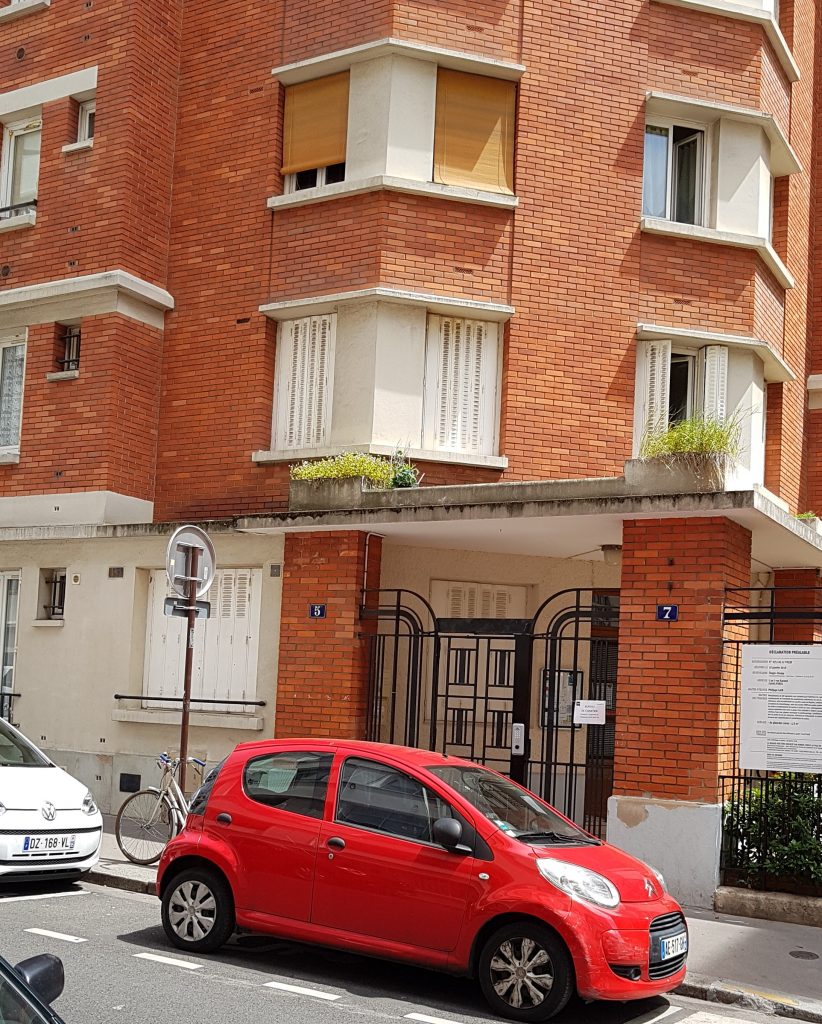
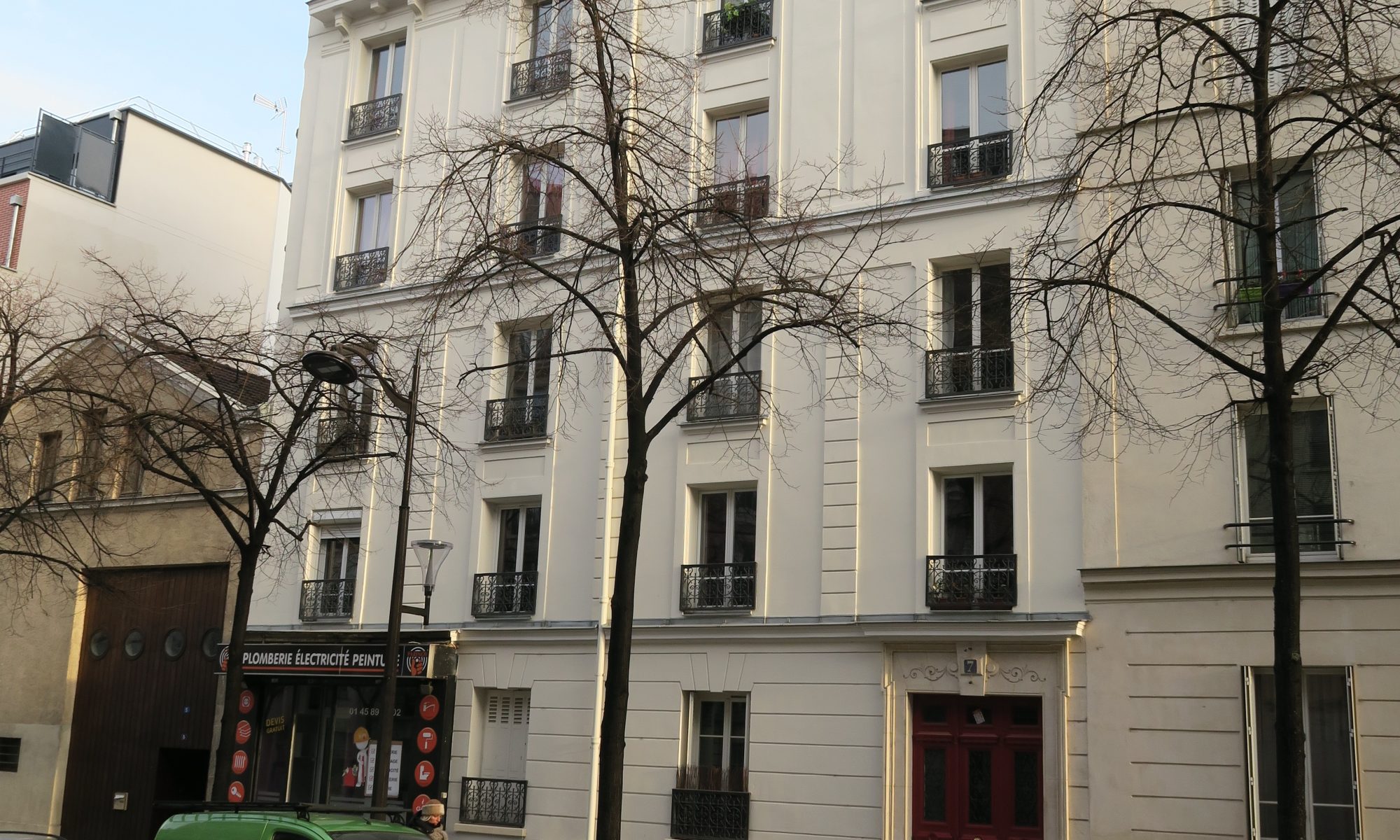
In the 1930s 5 rue Rataud was both where Lucie Bernard (Aubrac ) lived as a stuident and housed the office of the Quakers’ International Refugee Aid society
Lucie Bernard (Aubrac from 1950) rented a flat in no. 5 from 1935 to 1938. This was the same address in the Latin Quarter that was expanding to the North as was used from 1933 to 1937 by the French section of the Society of Friends for their International Refugee Aid society, which supported refugees from Germany and then Spain.
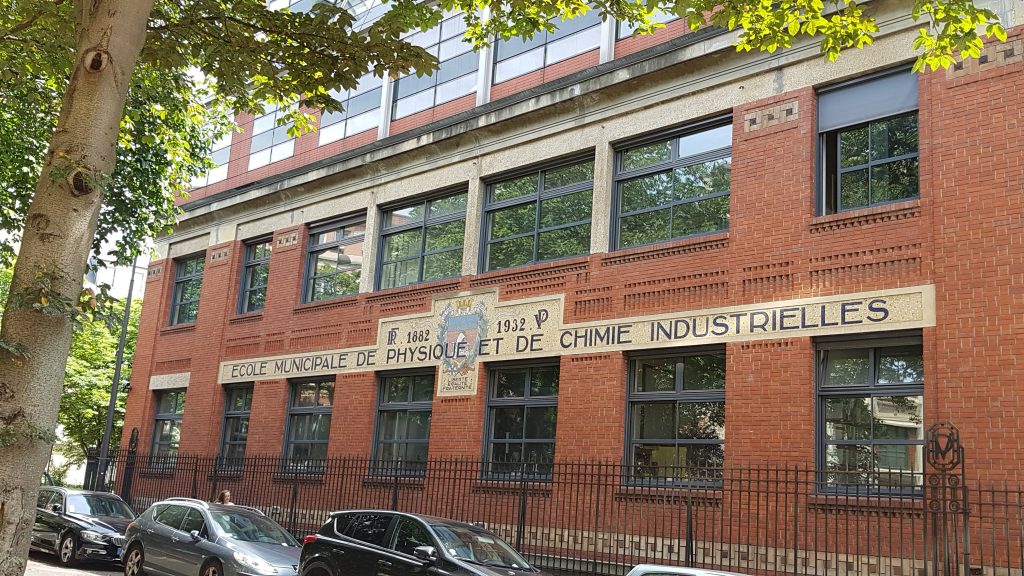
Rue Rataud began to see the construction of several educational buildings from 1882, including this Municipal School for Physics and Chemistry
Originally a cul de sac called the rue des Vignes after the vineyards planted down one side of the street, from 1882 it saw the construction of the Paris centre for science that became one of the 205 engineering universities in France allowed to award an engineering degree, the École supérieure de physique et de chimie industrielles de la ville de Paris.
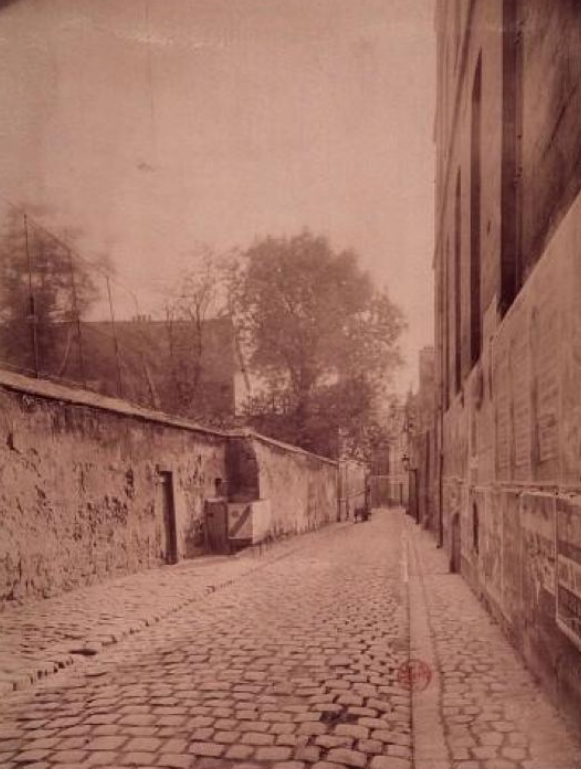
Rue Rataud in 1899. On the left are the grounds of a convent and further down, on the right, gardens belonging to the Ecole Normale that would soon be built over.
From the 1900s the area was rebuilt to further accommodate buildings attached to the elite universities such as the École normale supérieure, in the nearby rue d’Ulm, known as the ENS, originally created in 1794.
One of the 22 metre-wide roads hammered through the old medieval street network of central Paris under Baron Haussmann from 1854 to 1858. It absorbed some of the ancient streets it went through and destroyed others. Its final section, westwards from the rue St Denis, was only opened in 1897.
Léon Blum was moved round the corner from his birthplace in rue St Denis to No. 57 when he was a young boy.
A member of the Paris National Guard and of the International Workingmen’s Association, Jacques Durand, lived at No 90 (at the time No. 8 rue Thévenot). A cobbler who had stood as an IWMA candidate in the February 8 1871 elections he was elected by the 2nd Arrondissement to the Paris Commune on April 21. On May 25 1871 after fighting ended in the area he was arrested at home, interrogated at the Town Hall of the arrondissement, and then taken to the back of the Notre-Dame des Victoires church and shot.
From 1924 to 1940, the editorial office and printworks of what was then a right-wing paper, ‘L’Intransigeant‘ that was edited by André Malraux in 1934, were at Nos. 98-100.
Outside the printing works and offices at No.100 in 1927 when an American film star came to Paris
After the June 1940 Occupation of France the building housed a German press centre from 1940-1944, and was targeted several times by the Resistance.
After Liberation in 1944 No. 100 became the offices and printshop of the papers Franc-Tireur and the Défense de la France that eventually became France-Soir.
The L’Algérie libre paper of Messali Hadj’s Mouvement pour le triomphe des libertés démocratiques was also printed at No. 100 from its launch at the end of 1948 until its suppression in November 1954. On June 17 1950 sellers of the paper were arrested, and on September 18 1950 when the edition of the paper was seized for the first time, a protest demonstration led to the arrests of 1,100 Algerians who came to protest outside the printworks.
The newspaper Jean Jaurès co-edited at No. 111 in 1898, La Petite république, was France’s widest circulation socialist paper in the 1890s. This was where he published ‘The Proofs’ of the innocence of Dreyfus.
On the St Louis island this very narrow street was built between 1614 and 1646 and named after François Le Regrattier, the wealthy treasurer of the Swiss Guards, the mercenary soldiers who served the kings of France from 1471 to 1830. He and two developers were awarded the contract to build on the Island. Its current length was decreed in 1868 when it incorporated the ‘Headless Woman Road’ (La rue de la Femme sans Tête).
1 Rue Le Regrattier
No. 1 at the southern side of the Island, in a prime location with a view of Notre-Dame, contained the apartment belonging to the heiress of the Cunard Lines, Nancy Cunard. She had many lovers and from 1925 to 1928, Louis Aragon was largely living there with her.
Jules Guesde has one of the rare plaques for leftists in Paris, probably because he moved from being a ‘doctrinaire’ Marxist to joining the war government in 1914.
The founder of the French Workers’ Party. Jules Guesde (then Jules Bazile), was born in No. 22 on November 11 1845.
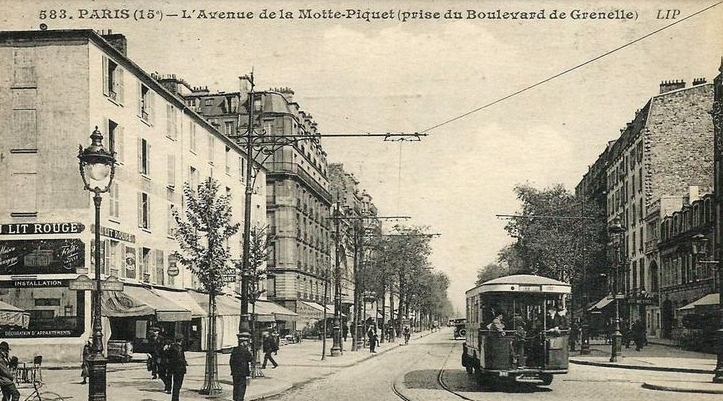
Running southwards up to the Montsouris Park the avenue was opened in 1865 under the Second Empire. Because it was close to the Thiers wall around Paris, it was named after Marshal Charles Reille who had died five years earlier. He had been promoted to General by Napoleon Bonaparte, whom he supported during the 100 days of 1815, leading the Second Army corps at Waterloo.
The leafy Avenue Reille in 1900, fifteen years after Rosa Luxemburg moved in.
For 18 months from 18 March 1895 Rosa Luxemburg shared a third-floor flat at No. 7 with Cezaryna Wanda Wojnarowska, a Polish revolutionary who had already lived in Paris for several years and who lived in France for the rest of her life, joining the SFIO in the 1900s.
Rosa Luxemburg shared a flat at No. 7 in 1895-96 while working on her doctorat and producing the ‘Workers’ Cause’ Polish social democratic newspaper.
In September 1910 Inessa Armand stayed for a couple of months at No 25 with her former husband, who then moved back to Moscow with their three children.
No. 53, the Villa Reille, was the first building in Paris, a house cum artist’s studio, designed by Le Corbusier working with his cousin, Pierre Jeanneret, in 1923.
A street named after a trade unionist is rare in Paris. During the Occupation René Boulanger was one of the organisers of the underground CGT. Aged 43 he was tortured to death by the Gestapo on March 7 1944. The road was renamed in his honour on December 18 1944, recalling the presence in the Rue Bondy of the Paris regional office of his union, the CGT’s white collar finance section.
Aged 20 Pierre-Jean de Béranger lived in a garret at No. 50 in 1800.
The painter Georges Seurat was born at No. 60 on December 2 1859. This was also the address of the monthly journal La Voie Communiste. This was an opposition paper within the Communist Party started in 1958 by Gérard Spitzer and Denis Berger that supported the Algerian FLN. Its publication stopped in 1965.