Karl Marx

1818-1883 Germany

Communism, First International, Parti ouvrier

Karl Marx’s Jewish father, Heinrich, studied law in the French law school in Mainz. He converted to Protestantism when Russia annexed the Rhineland to keep his legal job. Karl, himself, studied at the French secondary school in Trier on the Moselle river that flows through France to Germany.

It was not, therefore, by accident that the 25-year-old newly-married young neo-Hegelian atheist student chose to emigrate to Paris when political opposition became impossible in Colonge. Karl and Jenny von Westphalen lived in Paris from October 1843 to January 1845.

Jenny von Westphalen iat about the time of her 1836 engagement to her childhood friend in Trier, Karl Marx, whom she married in 1843. Over the next 14 years they had seven children, of whom only three daughters survived into adulthood.

They stayed in two different addresses in the Rue Vaneau. Arnold Ruge had invited Marx to Paris to work on the German-French Annals based at No. 22.

Editorial meetings of the Annals took place at Henry Bornstein‘s editorial offices of the fortnightly Vorwärts! Pariser Deutsche Zeitschrift Forward! Paris German Journal] that appeared in 1844. The meetings with French leftists included Marx as well as Etienne Cabet, Proudhon, Pierre Leroux and Louis Blanc. The German idea of collaboration didn’t go down to well with the French socialists, however, and only one double issue of the Annals was ever published in February 1844.

Ruge put the couple up at No. 23, where one flat was already the home of the German leader of the League of the Just, German Maurer. With approximately 60,000 German workers in Paris at this time the League became a migrant organisation, supported by many communistic skilled workers, and meeting regularly in a now unknown venue in the Cours de Vincennes that links the Place de la Nation to the Porte de Vincennes.

There were fields and a pond to the Eastern side of Rue Vaneau, part of the estate belonging to the then ruling Orléans branch of the Bourbon family, whose huge house is now known as the Matignon palace. This became the official residence of French prime ministers in 1935.

Marx published two articles at this time, the Critique of Hegel’s Philosophy of Right, and On the Jewish Question‘, where he began to develop the argument that the working class was the key agent of social change. Flora Tristan had also placed the working class at the centre of political action a year earlier, and in The Holy Family Engels had written a brief defence of her from the Young Hegelians. Between April and August 1844 Marx wrote the 1844 Paris Manuscripts now known as the Economic and Philosophic Manuscripts of 1844.

After their first child, Jenny, was born on 1 May 1844, Marx and Jenny rented a 3-room flat on the other side of the street at No. 38 Rue Vaneau. This was where guests such as Engels, Proudhon and the Russian, Bakunin came to discuss politics.

While he lived in Paris Marx met with many leftists and republicans. He visited Daniel Stern‘s salon on the Quai Voltaire. He met with Proudhon several times in a bar in the Rue Coquillière from October 1843 onwards, and also visited him in his student room home at 36 Rue Mazarine. Proudhon was also invited to Marx’s flat at 38 Rue Vaneau.

On one walk I strolled the 35 minutes from there, across the Pont Royal to the site of the Café de la Régence on the Rue St Honoré opposite the Palais Royal and where, today, No 155 Rue St Honore is at an angle with the Rue St Thomas du Louvre. This was where Marx met the 24-year-old German socialist Friedrich Engels on August 28 1844, and where Marx first talked to Engels about the concept of historical materialism.

Friedrich Engels in his mid-20s, about the time he began working with with Marx on The Holy Family

Marx, then 26, had read and liked Engels’ articles on the Condition of the Working Class in England, and they had corresponded. So it wasn’t an accidental meeting. Upstairs was the centre of the French chess circle – and allegedly characters as diverse as Robespierre, Napoleon and Louis Philippe had all played chess there (not together!). The cafe also doubled as one of Paris’ four cafe/shop post offices at the time.

After agreeing to collaborate with Marx on what was published in 1845 as The Holy Family, Engels continued on his way home to Germany on September 6 1844. By then the core of what became known as ‘Marxism’ had already taken shape in Marx’s thoughts.

Marx was expelled from Paris to Brussels on February 3 1845 after an article he wrote in Vorwärts resulted in pressure being put on Guizot, Louis-PHilippe’s prime minster, by the Prussian king. There, Marx completed the Theses on Feuerbach, arguing that the world only changes through actual, physical, material activity.

Marx was briefly in Paris again in 1848 during the revolution before leaving for Cologne in April. On 5 March 1848, after arriving from Brussels he spoke at a meeting of the Central branch of the Society for the Rights of Man and the Citizen in the Rue St Martin, Marx spent several nights at the Hotel Manchester at 1, Rue de Gramont.

After a few nights there he moved in to the headquarters of the German Communist League at 10 rue Commines (the old Rue Neuve de Ménilmontant) in the Marais. While he was in Paris on March 8 he helped found the German Workers’ Club, and attended meetings of the German Democratic Club that met in the Mulhouse Bar at 8, Boulevard des Italiens. Others present at that time were Ludwig Feuerbach and Arnold Ruge.

Marx left Paris for Cologne at the beginning of April 1848, where he would edit ‘The New Rhine gazette’.

Back in Paris again the following year after his expulsion from Germany, Marx and his family lived from June to August in a couple of rooms in the Rue de Lille under the name of Meyen.

Marx was an observer of the start of the Boulevard Bonne-Nouvelle demonstration against French intervention against the Roman Republic on June 13 1849. The Left Republican contingent set off from their meeting place at 6, rue Thérèse (then called the Rue du Hasard).

Marx’s next visit to Paris was under the false identity of Alan Williams to spend a week in July 1869 with his daughter Laura, and son-in-law, Paul Lafargue at their home at 47 Rue du Cherche-Midi.

Paul and Laura Lafargue about the time they moved in to the Rue Hautefeuille in 1869.

Marx’s final visit to Paris was in June 1881 . He stayed with his Parisian first-born daughter, Jenny, at her and Charles Longuet’s house in Argenteuil for three months after returning (still ill) from a break in Algeria that Engels had hoped would improve his health.

Jennychen’s own health was poor, although she disguised this from her father. In September 1881 she gave birth to a fifth child [Jenny Longuet (1881-1952)] before dying four months later at Argenteuil from bladder cancer. She was 38 year old.

Marx’s wife Jenny died in December 1881, shortly after he returned to England. The news of Jennychen’s death devastated him early in 1882. He died in London just over a year later at 64 on 14 March 1883 and was buried in Highgate Cemetery in an area reserved for agnostics and atheists.

More Info / Plus d’informations

Places

Pierre Monatte

1881 – 1960 • France

Communism • Trade unionism • Trotsky

A highly influential figure in French revolutionary syndicalism from 1905 to 1925, Monatte was an opponent of the First World War from the start. In the 1920s he joined the Communist Party briefly but was expelled after opposing its shift towards Stalinism. He remained a principled socialist throughout his life.

Anti-war activists were few in number in August 1914.

August 2 1914 outside the Gare de l’Est saw a popular mass mobilisation for the war against Germany

Why was the 32-year-old proof-reader, red-haired Pierre Monatte, against the war from the start?

Monatte had become a leftist while reading Les Misérables by Victor Hugo at school at the age of 13. In 1902 after working as a teaching assistant for two years, he moved to Paris. He was just 20. The Dreyfus Affair was sharpening left-right political divisions across France. Working for various left papers as a proof-reader he then joined the proof-readers’ trade union, where his latent libertarianism shifted towards revolutionary syndicalism.

In 1905 he walked alongside socialists and anarchists in the funeral procession of Louise Michel from the Gare de Lyon, where the Communard’s body arrived on a train from Marseille.  Another demonstrator suggested he take up a temporary post editing the 5,000-circulation paper, L’Action syndicale. The four-page weekly focusing on miners’ problems was based in Lens, in France’s northern coalfields.

On March 10 1906 Europe’s biggest ever-mining disaster took place at the Courrières company pits at Lens. 1,099 miners were killed. Then, 17 days after the company had stopped trying to rescue surviving miners and started trying to save its mines, first 13 miners emerged alive and then another three days later, another man emerged unaided.

Europe’s worst mining disaster killed 1,099 miners in Lens, northern France on 10 March 1906. There were only 600 survivors.

Cries of ‘Assassins’ greeted the company directors at the funerals. The shock and the scandal unleashed a wave of strikes by 60,000 miners. Within days Monatte and 40 others were arrested and charged with plotting against the Republic.

Released after a month in jail Monatte attended the Amiens Congress of the CGT (Confédération Générale du Travail) in October 1906. He was one of the 840 (to 8) delegates who voted for the independence of the trade union from the political parties and the sects. He was now less an anarchist and much more a revolutionary syndicalist, believing, through the amazing miners’ actions following Courrières, that social transformation could occur very rapidly.

In 1907 he developed his analysis of revolutionary syndicalism at the Amsterdam conference of the Anarchist International.

In 1908 Monatte, then living in Rue Daubenton narrowly escaped arrest with the other main leaders of the CGT for organizing a huge demonstration for the 8-hour day, where four demonstrators were killed by the army. He went into exile disguised as a clergyman and changed train stations in Lyon thanks to the secretary of the taxi trade union. He lived under a pseudonym in Switzerland until the failure of the case against the other CGT leaders allowed him to travel back to Paris.

In 1909 he married. The same year he founded the fortnightly CGT paper, la Vie ouvrière (Worker’s Life), editing it from his flat in Rue Dauphine. The numbers of its subscriptions rose from 500 in 1909 to 2000 in 1914 before it was banned. It expanded from 64 to 80 pages. It was read widely among the most active and leading trade unionists.

In November 1914 Trotsky and Julius Martov met Pierre Monatte, Alfred Rosmer and a handful of French socialists who opposed the First World War from the very start at the anarchist Librarie du Travail bookshop on the Quai de Jemmapes.

In December 1914 Monatte became the first trade unionist to resign publicly from the Federal Committee of the CGT, in protest against the French union’s refusal to support a meeting of the Socialist international being organized by Swedish socialists. His close friend and collaborator, Alphonse Merrheim, signed the anti-war Zimmerwald Manifesto in 1915.

‘Irrespective of the truth as to the direct responsibility for the outbreak of the war, one thing is certain. The war which has produced this chaos is the outcome of imperialism, of the attempt on the part of the capitalist classes of each nation, to foster their greed for profit by the exploitation of human labor and of the natural treasures of the entire globe.’


1915 Zimmerwald declaration

Lenin, Zinoviev, Radek, Warski and Trotksy were among the 42 delegates from 11 countries who unanimously passed a resolution of sympathy for the victims of the war and of persecution by the belligerent governments. This mentioned the fate of the Poles, Belgians, Armenians and Jewish peoples, the exiled Duma members, Karl Liebknecht, Klara Zetkin, Rosa Luxemburg and Pierre Monatte. In January 1915 Monatte had been conscripted in the 252nd Regiment, and would shortly spend two years at the front.

Demobilised in March 1919, Monatte quickly re-launched La Vie Ouvrière, this time as a weekly. He also organised and then led the left minority at the CGT Congress in September 1919, criticising the Federal Executive for its ‘holy union’ wartime policy and its weak support for the Russian Revolution. In 1920 he was elected Secretary of the Revolutionary syndicalist committees, launched by the left minority, which decided to affiliate to the Communist (Third) International.

Monatte became a leading figure of the workers’ left after the war, challenging both the anarchists and the shift towards Stalinism. He resigned from the CGT’s La Vie Ouvrière and in March 1922 became the labour correspondent for l’Humanité, that had become the new Communist Party’s daily paper. Two years later, having constantly been attacked as a left supporter of Trotksy by Albert Treint, Monatte first resigned from the paper and was then expelled from the PCF in November 1924.

Robert Louzon (1882-1976), who had helped produce the first Arabic language Communist daily paper in Tunisia in 1921, resigned from the PCF when his friends Monatte and Rosmer were expelled. In 1936, aged over fifty, Louzon fought at the front with Republican forces in Spain. And in 1960 with Rosmer, he signed the Manifesto of 121.

In January 1925 Monatte responded to his expulsion with the first issue of a monthly called Révolution prolétarienne including a second letter by him and Alfred Rosmer to Communist Party members.

In January 1925 Monatte responded with a second (equally unsuccessful) appeal signed by him and Alfred Rosmer to Communist Party members to challenge the growing Stalinisation of the PCF. This revolutionary syndicalist journal ran until 1939 and is still in existence today after Monatte relaunched it in 1947 (although he ceased to play an active part in 1951 when he objected to its occasional pro-American positions).

From 1925 to 1952 Monatte worked as a proof reader, but through his RP articles, contacts and correspondence he continued to be a voice on the left attacking both the reformist CGT and the descent into Stalinism. He was one of the few French anti-colonialism campaigners.

During the German occupation Monatte believed it was necessary to struggle against the occupiers, but to guard against nationalism and the idea of a ‘holy alliance’.

The Maitron, France’s national labour dictionary, ends its biography of Pierre Monatte like this:

‘Few who got close to him were not influenced by his personality. He remained resolutely optimistic about the future of the working class, believing that while the revolutionary flame could dim, it would not go out’.

More info

Gaston Monmousseau

1883 – 1960 • France

Revolutionary syndicalist • Trade unionism • Communism

A leader of the small group of revolutionary syndicalists who opposed the First World War, in 1922 he became General Secretary of the minority CGTU trade union that affiliated to the Communist International. Elected a Communist deputy in 1936 he tried to get a law passed to provide national unemployment pay.

Monmousseau was jailed five times between 1921 and 1931 in the Prison de la Santé

The Prison de la Santé was opened in 1867. Photographed here by Charles Marville (1813-1879)

More info

Michel Pablo (Raptis)

1911 – 1996 • Egypt

Communism • Trotskyism • Fourth International

Pablo grew up in Greece, where he became a Trotskyist as a student in Athens, but was first jailed and then expelled in 1937 by the Metaxas dictatorship.  He came to Paris in 1938 and attended the founding conference of the Fourth International in Alfred Rosmer‘s house in Périgny in the Paris suburbs. During the German Occupation he was involved with attempts to organise among German soldiers with the publication Arbeiter und Soldat (Worker and Soldier) – this was extremely dangerous work and several of those involved were killed by the Germans.

One of those killed was Martin Monath (1912-1944) , a German Jew who had left Germany in 1938 for Belgium, where he worked with Ernest Mandel. In 1943 he was sent to Paris and once or twice a week he travelled to Brest to make contact with a small group of German soldiers. He was arrested, shot and left for dead in the Bois de Vincennes, but survived to be taken to hospital where the Gestapo captured him again and hanged him.

Another one of those undertaking this dangerous work, was Jean-René Chauvin (1918-2011). Arrested in Paris on February 15 1943, the French police passed him on to the Gestapo. Deported he survived Mauthausen, Auschwitz and Buchenwald. Throughout his life he kept his concentration camp number tattooed on his forearm. [Later he was a member of the Voix communiste, which gave active support to the Algerian FLN and then of the PSU and Ligue Communiste revolutionnaire].

Pablo played a key role in uniting three factions of French Trotskyists into the Parti communiste internationaliste (PCI).

In 1946 he was elected General Secretary of the Fourth International, based in Paris, where the PCI journal, ‘Workers’ Truth’ (La Vérité des travailleurs) was based at 64 Rue de Richelieu.  By the early 1950s he began to develop a distinctive political perspective. Believing that a Third World War was imminent, he argued that in this war the class struggle would acquire the new form of a conflict between blocs of states.  He therefore argued that Trotskyists must enter the mass working‑class parties in order to intervene in the new situation.

But entering the French Communist Party, with its tight organisation and a phobia of Trotskyists, was not easy – only seven Trotskyists succeeded. One of those who did, from 1953, was Denis Berger (1932-2013). He was later the founder in 1958 of the review called ‘The Communist Path’ (La Voie communiste) and also the organiser of the escape on February 25 1961 from La Roquette prison of five women members of the Jeanson Network from ten year prison sentences for supporting the FLN.

But Pablo’s strategy led to an acrimonious split in the PCI, with two organisations emerging, one led by Pierre Frank [1905-1984] and one by Pierre Lambert [1920-2008]. 

There was also an international split in the Fourth International, with James P Cannon in the USA and Gerry Healy in Britain denouncing Pablo for abandoning the building of revolutionary organisation. The word “Pabloism” became a term of abuse for some political currents.

But Pablo was also very much aware of the significance of revolutionary movements in the so-called “Third World”. He was one of the first to make contact with the Algerian National Liberation Front (FLN) and began to organise solidarity action (the so-called “suitcase carriers” who assisted the FLN with publications and transferring funds.

One of the ‘bag carriers’ was Jakob Moneta (1914-2012), who was a Trotskyist employed as the trade union representative at the West German embassy at 28 Rue Marbeau. He used his ‘diplomatic bag’ to transport documents for the FLN.

Pablo was personally involved with two more ambitious ventures – setting up an arms factory in Morocco where Trotskyist engineering workers from France and elsewhere worked, and a project for forging currency; for the latter he was arrested and jailed in the Netherlands in 1960.

After Algerian independence in 1962 Pablo became an adviser to Ben Bella until his being overthrown in 1965.

Subsequently he only visited Paris briefly. He was marginalised from the Fourth International which he left in order to build his own tendency; he travelled widely before returning to his native Greece, where he advised Andreas Papandreou.

More info

Pablo Picasso

1881-1973 • Spain

Art • Communism • Spanish Civil War

Picasso visited Paris often between 1900 and 1904 when he settled there. From 1935 he associated with many of the left surrealists and in 1937 painted Guernica. He joined the French Communist Party in October 1944, gave money to it, and remained a member until his death.

Picasso aged 56. The self-portrait was painted a year after Guernica.

More info

Jacques Prévert

1900 – 1977 • France

Poet • Literature • Surrealism • Communism

Surrealist, briefly Communist, film director and major 20th century poet, he opposed of the forces of law and order in 1968 and supported Angela Davis in 1970.

A member of the Surrealist Group from 1926 to 1929, he became increasinglly interest in film-making with the introduction of sound. For four years from 1932 to 1936 he was the principal organiser of the theatre group called October.

He lived in Rue Vaugirard as a child and went to the primary school next door. in 1907.

More info

Waldeck Rochet

1905 – 1983 • France

Communist • Resistance


A Communist Party member from 1924 he was given political training in Moscow, and from 1934 he was one of the handful of PCF leaders. Elected deputy in 1936 he was jailed by Vichy and then in 1943 represented the PCF in London. From 1964 to 1969 he was General Secretary of the PCF. He reoriented the PCF towards a democratic road to socialism and criticised Russia for the invasion of Czechoslovakia and then fell ill in 1969 after a visit to the USSR.

More info

Alfred Rosmer/Griot

1877-1964 • USA

Trade unionism • Communism • Trotskyism

Aged 7 Alfred Griot returned with his family from Patterson, New York, where his father was a barber. Alfred spoke good English, a facility that helped shape his revolutionary life as an internationalist. Griot’s father was a Dreyfusard and Alfred Griot attended revolutionary socialist and anarchist meetings as a teenager.

He became a trade unionist in 1899, joining the municipal workers’ union. In 1910 he was asked by his then anarchist friend Amédée Dunois to act as an interpreter for Pierre Monatte, founder of La Vie ouvrière at its office at 42 Rue Dauphine in a meeting with an American IWW member, William Z Foster.

Griot was a keen theatre-goer and in 1911-12 took his pseudonym Rosmer from an Ibsen character, and used this when he replaced Dunois as editor of the daily CGT trade union newspaper, La Bataille syndicaliste, printed at the Union Printworks at 40 Boulevard Arago.

Classified as ‘auxiliary service’ rather than conscripted during the First World War he was one ot the handful of trade unionists most present in Paris. He spent many of his Sundays at Trotsky‘s changing addresses. Trotsky and Martov, regularly attended the continuing La Vie ouvrière meetings that took place even after they stopped publishing it, at 96 Quai de Jemmapes, whose ‘Labour’ bookshop had been closed by the CGT that supported the war effort and the ‘holy union’..

In 1916 Rosmer, reporting back on the Zimmerwald Conference, met the anti-war activist, Marguerite Thévenet, who became his lifelong partner, marrying in 1932.

Having begun work as a clerk in the Paris-Orléans railway company, Thévenet’s experience there, and subsequently working for a Protestant holiday camp organisation (colonies de vacances) led her to become an expert at smuggling subversive literature and revolutionary activists across frontiers.

Thévenet first met revolutionary syndicalists when her childhood friend, Léontine Valette, met and married Pierre Monatte in 1909. When Monatte resigned from the leadership of the CGT she wrote strongly congratulating him. Member of the Rue Foudary pacificist group she met Rosmer at a meeting reporting on Zimmerwald in March 1916.

In May 1919 the French Committee for the Third International decided to send Rosmer to Moscow, where he played a big part in the Second Congress of the Comintern. In February 1921 he spoke at the funeral of Peter Kropotkin.

Still in France, Thévenet may have helped organise the illegal presence of Clara Zetkin at the Party’s founding congress in 1920.

Partners in seeking to change the world for nearly half a century Marguerite and Alfred Rosmer

Rosmer was back in France in 1921-22 where he joined the PCF but did not support the idea of trade unions affiliating to a single Communist international. Back in Moscow in May 1923 he became increasingly disquiet at the direction of the political infighting there, and after circulating Lenin’s Testament in France he, Monatte and others were expelled from the Communist Party.

In 1924 with Pierre Monatte he founded La Révolution prolétarienne, but he became less active in the anti-Stalinist opposition and had doubts about the possibility of creating a ‘Fourth International’.

Rosmer did support the idea of producing a journal to keep the militants together and informed, and he became the editor of the weekly Trotskyist paper The Truth first published by on 15 August 1929 at 23 rue des Vinaigriers. The editorial office of the weekly Trotskyist paper The Truth published by the Communist League on 15 August 1929. In April 1930 it led to the creation of the Communist League with which the Rosmers were involved along with Pierre Frank, Pierre Naville and Marthe Bigot.

Within nine months, however, Rosmer resigned from the editorial committee of The Truth. He had supported the idea of carrying out trade union work without party interference, a view Trotsky considered ‘rightist’ and detested the bullying of the League’s leader, Raymond Molinier. Trotsky then broke all contact with the Rosmers, even when he was in Paris for nearly two years in 1932-33.

The Rosmers survived on Marguerite’s work organising children’s holiday camps, and Alfred’s job as a proof-reader. Alfred was active in exposing the fraudulent nature of the Moscow trials, and working with the Dewey commission in 1937 in the US.

After the murder of his eldest son, Léon Sedov, in Paris in February 1938 Trotsky asked the Rosmers to find his grandson Sieva and bring him to Mexico to join him and Natalia. It took them a year of legal and police action (opposed by Sedov’s partner) before they succeeded – in a trip paid for by the royalties of the sale of the French edition of Trotsky’s book Stalin.

Friends of Trotsky’s assassinated son, Lev, Marguerite and Alfred took Trotsky’s daughter’s (Volkova) son Esteban (Seva) to Mexico to live with Trotsky in 1939. Seva is on the left in this photograph with Marguerite Rosmer and Natalia standing above Trotsky and Alfred Rosmer.

After the declaration of war the Rosmers decided to leave Coyoacan for New York, where Marguerite gave French lessons and Alfred resumed work as a proof-reader (initially on the bible thanks to work passed his way by Max Eastman).

They returned to France in the summer of 1946 and in 1947 resumed writing and supporting La Révolution prolétarienne, struggling for socialism against Stalinism without falling into the American camp.

In 1946 Natalia Trotsky gave the Alfred Rosmer authority to publish Trotsky’s works and he carried out this extremely difficult task for the rest of his life.

Maurice Nadeau (1911-2013), who had helped to organise an International Federation of Independent Revolutionary Artists in the 1930s with the support of André Breton and Diego Rivera gave Rosmer a great deal of support in publishing Trotsky. In 1960 he played a key role in organising the Manifesto of the 121 unequivocally supporting those who refused to fight against Algerian independence.

The Manifesto was signed, naturally, by Rosmer, but also by De Beauvoir, Sartre, Breton and Guerin featured in Left in Paris. His office at Les Lettres nouvelles at 3 Rue Malebranche was searched as a result and Nadeau questioned by the police.

It became easier after the Khruschev revelations of 1956, and the royalties he sent to Natalia became larger. Natalia and Marguerite died a week apart in 1962, and Alfred two years later after a fall in which be broke his femur.

More info / Plus d’informations

Jean-Paul Sartre

1905-1980 • France

Existentialism • Literature • Communism • Philosopher

A major philosopher of existentialism, he described it as a form of humanism. In 1941 he helped found ‘Socialism and Liberty’ with Simone de Beauvoir to bring together various intellectuals in a resistance organisation. His support for Algerian independence saw the OAS choose to place a plastic bomb outside his door in the Rue Bonaparte.

More info

Georges Séguy

1927 – 2016 • France

Trade unionism • Communism • Resistance

One of the less Stalinist CGT leaders of the post-war period, Georges Séguy, died aged 89 in 2016.

Among his experience as a life-long PCF member was attending the 1956 Russian Communist Party conference where Khruschev outlined Stalin’s crimes.

In 1968, as General Secretary of France’s then biggest trade union, the Communist-dominated CGT, he participated in the famous Grenelle negotiations in May 1968 whose agreements created an amazing advance in working class lives in France. But in failing to lead on to a revolution, his participation and not calling for a General Strike, made Séguy the object of much (unfair in my view) criticism from French Maoists and Trotskyists alike (and, to be fair, from many ordinary workers who believed still more could have been won).

Séguy’s father had been a founder member of the French Communist Party, and Georges was arrested as a member of the CP-led French Free Fighters and Partisan (FTPF) resistance at 17 years old in 1944 and deported to Mauthhausen in Austria. When he returned to France he identified the person who had denounced him, who was then tried and shot.

In 1978 he attempted to win over the CGT to form a united front with the formerly Catholic, then radical, CFDT union, but failed in the face of French CP opposition. He resigned aged 55 (the retirement age of the railwaymen he had been since 1946).

Plus d’informations

Maurice Thorez

1900-1964 • France

Communist • PCF General Secretary 1930-1964

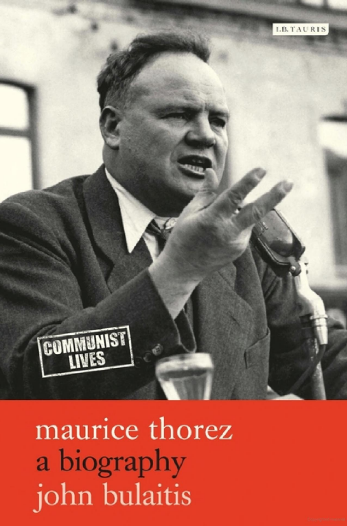
Maurice Thorez was the working class General Secretary of the French Communist Party from 1930 to 1964. Throughout this period he closely followed the twists and turns of the Russian Communist Party.

More info

This insightful and critical biography is the place to go to understand both the twists and turns of French Communist policy and how otherwise decent individuals can get trapped by a personality cult

Le Maitron

Albert Treint

1889-1971 • France

Communism • Trotskyism

Albert Treint was one of the first speakers at the Tours 1920 Congress of French Socialists (SFIO) to propose French affiliation to the Communist Third International and proposed the formation of the SFIC (Section Française de l’Internationale Communiste). At 31, he was then head of the Paris Federation of the SFIO. 

The son of a Parisian bus conductor, at 17 Treint won a three-year scholarship to train as a primary school. He then did two years’ military service before teaching for three years near Nanterre from 1910 to 1913. He joined the SFIO in 1914, the year he was called up. In the 21st Infantry regiment he was promoted captain.

Wounded in the Somme in both 1915 and 1917, in 1919 he was teaching again at Belleville’s rue Ramponeau boys’ primary school. From outside the school there is an amazing view all over Paris. Treint did not enjoy it for long.

The view over Paris from the school where Albert Treint taught in 1919-1921 before being fired for his active role in the formation of the French Communist Party

Shortly after his December 30 1920 election to the steering committee of the brand new SFIC he was first arrested in May for a speech calling on French soldiers to disobey orders to fight in Russia, and then fired from his teaching post in September 1921.

A key participant in the internal Communist faction fights between those like Monatte, arguing for greater unity with other revolutionary syndicalists, and those defending the Third International’s anti-unity and disciplinary positions, Treint’s hard-line faction won.

In November-December 1922 at the first enlarged executive meeting of the Third International he defended the United Front in these terms:

‘We get closer to and then further away from (reformist leaders) alternating in the same way as the hand gets closer to and further away from the chicken it is plucking.

Albert Treint 1922

In 1923-24, on behalf of his left faction he shared the General Secretaryship of the PCF with a centrist, first Frossard (who left the PCF on January 1 1924) and then Sellier.  He then spent four months in jail with Gaston Monmousseau (1883-1960) and others for having attended a conference with German communists calling for opposition to the French occupation of the Ruhr in January 1923.

Albert Treint successfully defended himself in May 1923 after being charged with calling on soldiers to mutiny. He is pictured here with a lawyer advising him.

In Moscow representing the PCF from 1924 to 1927, he transited politically from supporting Stalin to supporting Trotsky and Zinoviev and the Left Opposition. In 1928 he returned to live in Belleville. He was expelled from the Central Committee of the PCF and then from the PCF itself. For the next ten years Treint tried to build left opposition groups in France, before adopting the view of a tiny minority fringe of the communist left that saw the Soviet Union as a form of ‘state capitalism’ rather than as the Trotskyist sects did, as a ‘degenerated workers’ state’.

Treint rejoined the SFIO after the threat of a fascist coup d’etat in February 1934. As a virulent anti-Stalinist he opposed the Popular Front between the SFIO and PCF. Yet with the return of the 1936 Popular Front government headed by Léon Blum, he was reinstated in his teaching post by Jean Zay, the new Jewish minister of Education and Culture.
With the outbreak of the Second World War, the PCF was dissolved by the Daladier government on September 26 1939 for supporting the August 1939 Hitler-Stalin pact. 317 town councils controlled by the PCF were shut down. 2,800 councillors were declared illegal. 620 trade union branches were immediately closed by the now right-wing majority controlling what had been a reunited CGT since 1934.
On 18 November 1939 the government adopted a decree allowing internment of anyone considered dangerous to national defence or public safety. Treint aged 50, was fired again along with tens of thousands of other communists and those suspected of communist leanings.
Treint sought safety about 100 miles south of Paris, and probably (although this is uncertain) joined the resistance. After the war he played no part in political life, dying at the age of 82 in 1971.
Expelled from the giant French Communist Party; far too left-wing for the French Socialists (SFIO and PS); too troublesome for the Trotksyist sects; suspected of allowing three anarchists to be killed while they were trying to break up an early PCF meeting; married with one son born in 1914… it’s perhaps not surprising I can’t much about where this Parisian lived in Paris, except that in 1928, when he was expelled from the PCF he was living at 3, rue Carducci.
But it is a pity that so many socialists who spent their lives trying their best to change the world and achieve international workers’ unity are largely unremembered. So for them, this beautiful red poppy photographed by Ivor Penn in 1968 (and then photographed by me in another Paris museum).

Ivor Penn photographed this wilting red poppy in 1968. It is still beautiful today.

Plus d’informations

Leon Trotsky (Bronstein)

1879 – 1940 • Russia

Communism • Trotskyism • Fourth International

Trotsky (the alias Lev Davidovitch Bronstein adopted to replace his earlier one of Pero in 1902) first stayed in Paris for a few months in the Autumn of 1902 after his solo escape from Siberia on his way to London. This was where he first met the Ukrainian Natalya Sedova, three years his junior.

Trotsky photographed about the time he escaped from Siberiai and first arrived in Paris in 1902

He had been exiled to Siberia with Alexandra Sokolovskaïa (1872-1938), whom he married in a Moscow jail in 1899 when he was 20 and she 27. Already a Marxist she was one of the leaders of the Southern Russian Workers’ Trade Union that Trotsky had worked with. In Siberia the couple had two daughters, Zinaida Volkova (1901-1933) and Nina Nevelson (1902-1928).

Trotsky and Natalia Sedova his companion from 1902 until his assassination in Mexico

In 1902, the Russians living in Paris associated with Iskra, the occasional paper of the Russian Social Democratic Labour Party, used to meet in the flat rented by Natalya Sedova at 4 Rue Lalande, near the Montparnasse Cemetery in the 14th arrondissement.

In Autumn 1902 the 21-year-old Natalya was asked to find a flat for an incoming revolutionary from Vienna, whom she had not met and whose name she was not told.

That revolutionary was Lev Bronstein. And they spent many hours walking Paris together before living together in 1903.

Lenin was also lecturing in Paris in 1902-3 accompanied by Nadezhda Krupskaya. In December 1902 the two couples went to see a show at the Comic Opera in Rue Favart. Lenin lent Trotsky a pair of shoes for the occasion since his were not presentable. Trotsky later complained they were too small:

I suffered awfully, and Lenin kept making fun of me the whole time.

Shortly afterwards, Leon and Natalya moved to London to support and then break with Lenin, and then reunite and then…

In 1905, before leaving for Russia and the Revolution taking place there, Trotksy was again briefly in Paris and is supposed to have visited the Café Le Dôme  at 108 Boulevard du Montparnasse.

The couple’s first son, Lev, was born while Trotsky was in jail in Moscow after the 1905 Russian Revolution. Escaping from exile to Siberia in 1907 Trotsky spent seven years in Austria and Germany, with perhaps a visit to Paris to meet Lenin in 1910.

This meeting took place at a Montmartre artists’ café where it is suggested they also may encountered the poet Guillaume Apollinaire. 

The police informer who ran the Café de la Rotonde on the other side of the Boulevard also reported Lenin and Trotksy meeting with other Russian exiles there in 1910.

That same year, another report suggests Lenin was playing chess with Trotsky and with Apollinaire at the Closerie des Lilas restaurant cum corner street café at the Port Royal/eastern end of the boulevard du Montparnasse.

Trotksy and Lenin and Apollinaire were reported as playing chess together here at No. 171 boulevard du Montparnasse in 1910

Trotsky was back in Paris from 1914 until his deportation in 1916. He was then
editing an internationalist socialist paper, ‘Our Word’ (Nashe Slovo) whose editorial offices were at 17 rue des Feuillantines. He also met many French anti-war activists such as Pierre Monatte at the revolutionary syndicalist bookshop located at 96 Quai de Jemmapes.

Inside the Hotel d’Odessa Stephen Marks photographed this plaque commemorating Trotsky’s stay there in 1933. Other sources suggest he was also stayed there in 1914.

While in Paris this time he lived for several months at the Hotel d’Odessa at 28 Rue d’Odessa which now has the only semi-public plaque to Trotsky in Paris (next to the reception) and met Diego Rivera at the nearby Café de la Rotonde.

He then moved to 23 Rue de l’Amiral Mouchez and invited Natalya and his family to join him before moving to 27 Rue Oudry. The French police used to spy on Trotsky from the cafe Le Petit Bar at 57 Boulevard St Marcel.

Trotksy with his 13-year-old daughter Nina photographed in Paris in 1915

On March 31 1916 Trotsky was arrested at Rue Oudry and taken by the police to the Spanish border, from where he was deported to the US. He got back to Russia in May 1917… and despite being white-washed out of the official Soviet history under Stalin, became, arguably, the second most important leader of the Russian Revolution after Lenin until his death in 1924.

The next time Trotsky was in Paris was 1933. This was the year that began with Hitler being nominated Chancellor of Germany. It also saw Trotsky’s eldest daughter, Zina, both of whose two husbands would soon be executed in Stalin’s Great Purges, committing suicide in Berlin aged 32. His youngest daughter, Nina, had already died from tuberculosis in Russia in 1928.

On December 30 1933, while in hiding at Simone Weil‘s parents’ third-floor flat in the Rue Auguste Comte Trotsky made the absurdly unrealistic decision to launch a ‘Fourth International’ – because, logically he considered, something had to be done to mobilise against the fascists. It was not because there were real people out there wanting or waiting for his leadership.

After leaving Simone Weil’s flat Trotksy stayed at the Carlton Hotel at 207 Boulevard Raspail.

Both of Trotsky and Natalia’s two sons were killed on Stalin’s orders. Their youngest son, Sergei, was killed in 1937 in Russia. His first wife, Alexandra Sokolovskaïa, was executed in 1938 during Stalin’s Great Purges.

Natalia and Leon’s eldest son, Lev Sedov, was advised (by one of Stalin’s agents acting as his secretary) to go to a private Clinique Mirabeau at 7, rue Narcisse-Diaz for appendicitis. Shortly after the operation, carried out by an incompetent doctor and an anaesthetist who also worked for Stalin, he died of complications in 1938.

After breaking the heart-rending news to Natalya, Trotsky wrote: ‘Everything that was young in us died with our son’. Lev had been looking after Zinaida’s son, Vsevolod (Sieva), who, accompanied by Alfred and Marguerite Rosmer, then joined his grandfather in Mexico in 1939, aged 13. Sieva was present at one failed assassination attempt on his grandfather. Trotsky was finally assassinated there in 1940.

Natalya, who broke with the Fourth International in 1951 because its leadership insisted on still seeing Stalin’s Russia as a ‘workers’ state’, lived on until 1962 in France. She died in Corbeil-Essonnes, part of what was then the municipal Communist ‘red belt’ just South-East of Paris. The last Communist mayor there was defeated by the reactionary industrialist Dassault in 1995. 

In October 2016, walking south between the two halves of the Montparnasse Cemetery towards 46 rue Gassendi, where in 1902 the 20-year-old Natalya had found the 27-year-old Trotsky a Paris room to rent, and they became lovers, I counted six homeless tent shelters attached to the trees and cemetery wall. It was rather sad to see after so many people had fought and died and loved over the previous hundred years for a world that wouldn’t treat people out like that.

Homeless shelters and tents dotted the Rue Emile Richard on October 6 2016 when I walked south towards the 1902 meeting place of Leon and Natalya

More info

Avenue General Leclerc

Arrondissement 14

Numbers 5, 11, 19, 43, 70, 101, 110

Since 1948 the Avenue is now named after Philippe Leclerc de Hauteclocque, the first French general to arrive in Paris in August 1944 – in American-loaned tanks and armoured vehicles and wearing American helmets with the Croix de Lorraine painted on their sides. He died in a plane crash in 1947 just as he was about to argue the case for French withdrawal from Indochina – before the wars of national liberation in the region had really started.

From 1863 to 1948 the tree-lined avenue was called the Avenue d’Orléans, running from the Denfert-Rochereau Square to the southern ‘ entrance to Paris (Porte d’Orléans), at the huge roundabout now called the Place du 25 Aout 1944, commemorating the Liberation of Paris.

It is one of Paris’ oldest roads, down which pilgrims used to follow what the Pope officially called one of the three most important pilgrimages for Christians in 1492 to the cathedral of Saint Jacques de Compostelle in Spain. This pilgramage had begun as early as the 9th century AD.

In the days when it was still the Avenue d’Orléans Lenin was often seen in the Café du Lion at No. 5 , where he organised meetings of the Bolshevik faction of the Russian social democrats.

Lenin might well turn in his Moscow mausoleum. His old meeting place is now a McDonald’s with a tiny Lion tobacco shop adjoining it that still bears the name of the original Lion cafe.

The French police estimated there were around 25,000 Russians in Paris around 1910, of whom 1,000 were revolutionary socialists and 500 anarchists. They were being watched both by the French police and by the Czar’s secret police, the Okhrana. On one occasion an agent spying on them was chased by Lenin and other Bolsheviks along the pavement in front of No. 101.

In 1911 a meeting of the Bolshevik faction organised by Lenin in the first floor room at the Café Les Manilleurs at No. 11 saw a near physical fight between them and Anatoli Lunacharsky and other followers of his brother-in-law, Bogdanov in the Vpered faction.

In December 1908 Lenin opened a bank account at the Crédit Lyonnais bank branch at No. 19.

Lenin and Inessa Armand used to frequent the old Cafe d’Orleans at No. 43 in 1910-1912. This is the new one, even closer to Rue Marie-Rose where the lovers lived. And still good for a drink after a long walk.

During his time in the area, Lenin used occasionally to be seen at the music hall called the Fantaisies de Montrouge at No 70. It was converted from being a theatre to the Grand-Cinéma that re-opened there in September 1911. That building was knocked down and rebuilt in reinforced concrete in 1922 and then became the 1,300-seater cinema the Mistral. Gaumont finally closed it in July 2016 and sold it to a housing developer.

The headquarters of the Russian Social Democrats on the first floor and the printworks of the ‘Social Democrat’ paper in a office in the back of the yard, were at No 110. Among those regularly present between 1909 and 1912 were Lenin, Zinoviev, and Kamenev.

PLACES

Rue Léon-Frot

Arrondissement 11

Number: 55, 64

Initially opened up in 1816, the name of most of the road was the Rue des Boulets (probably either from canonballs or from the rounded shape much coal was distributed in during the 19th century), but on December 18 1944 the section north of Boulevard Voltaire was renamed Léon Frot.

Frot lived in No. 55 and was an elected 11th arrondissement Communist municipal councillor who had been sentenced to five years imprisonment on May 14 1940 by the Paris military court for distributing communist propaganda.

Moved from the Sante prison to the Bourges (Cher) prison and then to Clairvaux (Aube) he was executed there on January 13 1942. Between January and May 21 political prisoners were shot at Clairvaux. This followed the German policy of first selecting Jews and Communists in determining who should be shot in reprisals for Resistance attacks on Germans.

Elected a Communist municipal councillor in 1935, jailed for his Communist Party activities before the German occupation of June 1940 Frot was killed aged 42.

The worker known as Albert in the 1848 provisional government worked at the button manufacturer Bapterosses situated at No. 64 (formerly 16 rue de la Muette) in the 1840s.

Plus d’informations

PLACES

Rue Marie Rose

Arrondissement 14

Numbers 2, 4, 7

The street was built in 1898 over an old quarry. It was named after an earlier owner of the land.

Inessa Armand lived at No. 2 from 1910 until she left France with her lover, Lenin, and Krupskaya for Switzerland in 1912 .

Inessa Armand lived at No. 2 Rue Marie Rose from 1910 to 1912

Number 4, the 48 square meter two-room second-floor flat was occupied by Lenin, Krupskaya and her mother from July 6 1909 to June 12 2012.

The flat was bought by the Communist Party in 1955 and opened as the Paris Lenin museum in 1955. On March 25 1960 it was visited by Krushchev along with Maurice Thorez. It was given the Russian Communist Party’s seal of approval a second time in 1985, when it was visited by Gorbachev and Georges Marchais.

In 2007, however, the PCF sold it when things were going downhill for its fortunes . The plaque outside the building was then taken down.

Lenin used to do repairs and maintenance on his bicycle in the street outside No. 4. When I passed by and took these photographs, all the windows on the second-floor had their shutters closed.

Father Corentin Cloarec (1894-1944), the Franciscan vicar of the nearby Saint-François monastery at No. 7 who was chaplain to the Denfert-Rochereau resistance group, was assassinated there by the Gestapo on June 28 1944. The brick monastery was built in 1935 and its remarkable chapel glass is now listed as a historic monument.

Franciscan monastery

PLACES