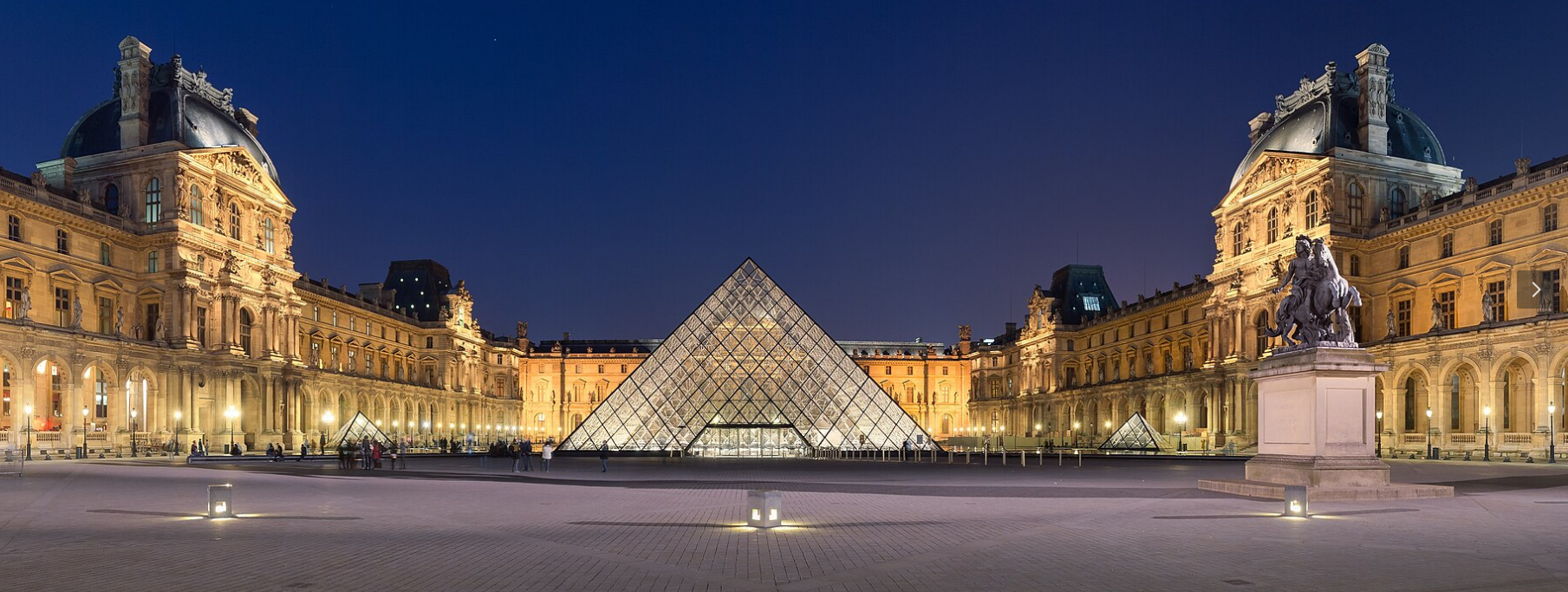
Palais du Louvre

Arrondissement 1

Rue de l’Amiral de Coligny

Louvre Palace from Rue de l’Amiral de Coligny

The Louvre Palace was built under Philip II in the late 12th to 13th century. By the 16th century it had ceased to be a fortress and became the primary palace of the French monarchy. Redesigned and extended often it became the home of the royal art collection from 1682 when Louis XIV moved the court to Versailles.

The Louvre played a major symbolic and organisational role in the people’s revolutionary explosions of the 18th and 19th centuries (1789-93, 1830 and 1871). In the 20th century it became associated with Resistance to German Occupation.

During the French Revoution it became a national art museum, largely of royal and confiscated church property.

During the July 1830 Revolution it witnessed the defeat of Charles X‘s Swiss guards on July 29, when a crowd, including many Polytechnic students, stormed it using a scaffolding for repairs that covered part of the colonnade.

July 29 1830 Left Bank students workers and shopkeepers cross the Pont Neuf to attack the Louvre. Painted anonymously by an eyewitness.

Louis Vaneau, one of the Ecole Polytechnique students killed in the 1830 fighting, had the Rue Vaneau renamed after him in 1870.

The Louvre Palace in January 2016 photographed from the Pont Neuf with the oldest part on the right in what had been the Rue de Louvre, but is now the Rue de l’Amiral Coligny. It was renamed in 1972 after the Protestant Huguenot prince who was assassinated by the Catholic Fronde on St Bartholomew’s Day 1572


After the 1870 Sedan defeat and the end of the Second Empire, Gustave Courbet chaired a meeting of Parisian artists at the Louvre on September 6 1870. It set up a Commission for the Protection of the Heritage of Paris’ museums.

The leading realist painter of the 19th century, Courbet, photographed by Nadar

On March 1 1871 a hostile crowd gathered at the Louvre to shout insults at the Prussian officers who came to visit their ‘captured’ monuments after Thiers and Favre in Versaiilais had signed an ignominious armistice to end the siege of Paris.

Two weeks later the Louvre was the headquarters of the military governor of Paris at the moment when the Versaillais government attempted to seize control of the canon that were defending Paris. This coup’s failure led to the formation of the Paris Commune on March 18 1871.

The Federation of Artists, including Aimé-Jules Dalou and Jules Héreau as well as Courbet, immediately moved into the Palace. On April 17 a meeting held in the Antiquities Room of the museum (off the Place du Carrousel) elected a 47-strong Committee of the Artists’ Federation.

On 24 May 1871, when the Versaillais troops took over the Louvre Palace, a solitary woman stood in front of them. She was put against the gate of the colonnade and shot.

After the Occupation of Paris by German troops on June 14 1940, several staff at the Louvre Museum formed a collective resistance team aiming to save as many art works as possible from destruction and pillage.

Under the Occupation Parisians were forbidden to enter. Only a handful of staff were allowed in. They included Jacques Jaujard, the existing Protestant-origin head of French national museums.

He used his knowledge of the underground storage beneath the Louvre to store the first leaflets produced by the Committee of Public Safety founded by Boris Vladimirovitch Vildé, an ethnologist and linguist at the Musee de L’Homme. The journal they produced from August 1940 was called Résistance.

Vildé and six other intellectuals and academics in the Groupe du musée de l’Homme were finally denounced by a Vichy supporter and shot at Fort Mont-Valérien in Suresnes, a western Paris suburb, where between 1,000 and 4,500 resisters were executed during the Occupation.

At the Louvre the three rooms taken over by the Germans to store the art and culture seized from Jewish families didn’t provide enough space, so Jaujard and Rose Valland, a graduate student of art history, suggested they use the Jeu de Paume museum in the Tuileries gardens from October 1940. This was where Valland had volunteered since 1932.
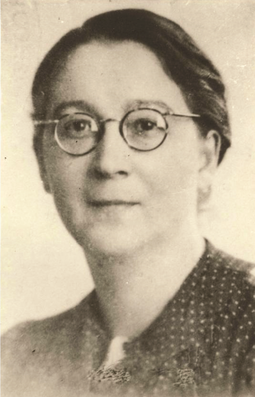
Rose Valland, who understood German, but kept that secret from them, then began working full-time alone at the Jeu de Paume, built under Napoleon III in 1861, and a gallery since 1909. While there she secretly kept notes on the over 20,000 works of art the Germans had looted and wherever possible, through talking to lorry drivers taking them onwards to railway stations, finding out where they were going to and in many cases to which individuals.

She was present when on May 3 1941 Hermann Göring made one of his 20 visits to the museum to choose paintings for his own private collection. The others were either sold through Switzerland, burned in a bonfire of ‘degenerate art’ on July 27 1942, or stored to be eventually housed in Hitler’s never-constructed Leader’s Museum in Linz.

Valland passed on information to the Resistance via Jaujard so that the trains east they were on would not be mistakenly blown up. In August 1944 this information was used to prevent the final attempts by the Germans to loot 148 crates of paintings containing in total 967 paintings, including works by Braque, Cézanne, Degas, Dufy, Gauguin, Modigliani, Picasso, Toulouse-Lautrec and Utrillo.

MAP

Jardin du Luxembourg

Arrondissement 6

Gardens with a darker side

A wonderful park in central Paris it also has a darker side. It was a place of summary trial and execution in 1871 and witnessed the final battle of the Liberation of Paris in 1944.

This garden is where I’ve spent many hours watching speed-chess and slow-boules (pétanque – from the old Occitane word meaning feet planted on the ground). I have even once waded in January into the half-frozen circular basin to rescue my ten-year-old’s sinking electronically-controlled boat (I hadn’t followed all the assembly instructions entirely correctly).

Hazan (WTP) writes ‘Few places in Paris have inspired so many writers and poets, not to mention cineastes’.

The Medicis Fountain dates back to 1630, but it was remodeled in 1864. Venus was removed and replaced by Ottin’s statues of the giant Polyphemus discovering the lovers Acis and Galatea. Perhaps that’s why couples enjoy the basin’s cool and calm.

The Medicis Fountain on the west side of the Palace that is now the French upper chamber, the Senate, can be a beautiful spot when it’s not overflowing with tourists.

The Luxembourg Gardens also have a darker side. On December 7 1815 it was where Marshal Ney was shot for having supported Napoleon during the hundred days before the defeat at Waterloo.

That was nothing compared to the hundreds murdered there by government troops in the final ‘bloody week’ of the Paris Commune.

A drawing of the executions in the Luxembourg Garden during the Bloody Week of May 21 to May 28 1871

On 29 November 2016, the French National Assembly (Parliament) passed a resolution to pardon all ‘the victims of the repression of the 1871 Paris Commune‘ – the 10-25,000 people who were shot, imprisoned, exiled, deported or otherwise punished by the French Government for their part in the Paris Commune between May 1871 and 1877.

There is no reference to Dr Tony Moilin or any other individuals murdered here by the Versaillais army in 1871

Sadly, commemorations appear to be about the only positive thing that Hollande’s socialist government did from 2012 to 2017.

There is now one very small plaque referring to the thousands killed in the Paris Commune.  Not at all obvious, it is on the wall facing the Palace to the South-East of the basin, often obscured from view in the Spring and Summer by couples profiting from the Luxembourg’s reclining chairs in the warmth of the sun.

I wrote what follows after walking for perhaps the thousandth time through the Luxembourg Gardens. It is strange what you don’t see when you don’t look. 

‘This time I quite quickly found the tiny memorial plaque beneath the Queens’ Terrace for those shot in the terrible week 21 May to 28 May 1871 that I’d first seen online two days ago. There were three burial pits dug in the gardens, where perhaps a third of the estimated 2,000 summarily executed prisoners across Paris were buried.

One of those given a military trial on the spot was a doctor, Tony Moilin, who had been jailed by Napoleon III for writing a futurist socialist book titled Paris in the Year 2000. Released with other political prisoners with the abdication of the Emperor in 1870, Moilin briefly became mayor of the 6th arrondissement. Taken prisoner on the 27th May he admitted helping the wounded on the barricades.

A few hours before he was shot on the 28th, he was allowed to marry his pregnant partner. His body was never recovered. The inscription on the plaque doesn’t even get the dates of the murders right.

Moving on through the Gardens I found the Pierre Mendès-France statue that Mitterrand had preferred to Émile Derré’s Column of Kisses cornice featuring the anarchists Louise Michel, Auguste Blanqui and Élisée Reclus. 

A postcard of the Cornice of Kisses in the Luxembourg Gardens around 1910

Michel had given the funeral oration to Blanqui in 1881 and Derré was an anarchist sympathiser and pacifist. In 1906, when he first exhibited it the sculpture, Derré (1867-1938) called it Dream for a House of the People. The column was then placed in the Luxembourg Gardens.

Louise Michel is shown kissing goodbye (and death) to Auguste Blanqui. The three other kisses sculpted represent maternal instincts, love and consolation

After being lost for several years it is now in the square in front of the Roubaix town hall in France’s old northern mining area that used to be a stronghold of socialism.

Émile Derré’s column shown in its new home in Roubaix in 2017. It was found, broken in three pieces, in the yard of the 400-year old St Gobelins tapestry and carpet works.

I too have a soft spot for Pierre Mendès-France (1907-1982). The university named after him in Grenoble was where I first did any teaching in France. He did end France’s Vietnam War in 1954, and then began decolonialisation in Tunisia.

In 1984 Mitterrand preferred to dump Derré’s column for Louise Michel and install his friend and mentor Pierre Mendès-France in the garden

Mendès-France was also a consistent opponent of De Gaulle’s 5th Republic constitution, that concentrates power very dangerously (as Macron began demonstrating in 2018) in the hands of the President. He had also served in Leon Blum’s Popular Front government of 1936.

From 1896 to 1898 the future Jewish first minister of France, Blum (1872-1950), lived at No. 36 rue Guynemer (then rue de Luxembourg) on the western edge of the Garden.

But the Mendès-France statue is far from being about dreams of social change. Surely Mitterrand could have moved one of the hundreds of memorials to France’s ruling class power in the Jardin du Luxembourg rather than take away the beautiful and romantic Louise Michel column.

Mitterrand’s easier option was to replace one politically ‘left’ public object by another. Sad.

The Luxembourg Palace was also the site of the last armed German resistance in Paris at Liberation in August 1944. All round the Latin Quarter there are memorial plaques to the courageous French men and women who died in the uprising between August 19 and August 29. Altogether some 1,500 Parisian resistance fighters were killed, including some 600 civilians.

Looking towards the Luxembourg boating pond past the occupying German tanks on August 25 1944 shows the gardeners kept putting out the palm trees during the Germany occupation of the Luxembourg Palace.

On August 25 1944 Pierre Georges (Colonel Fabien), who had fought in the International Brigade in Spain, commanded 300 resistance fighters around the Luxembourg Palace. Fighting was intense and the SS, who were concentrated there, only finally surrendered when given an hour’s notice of an aerial bombardment.

The garden still displays some sculptures that remind us of some key personalities and movements in French left history.

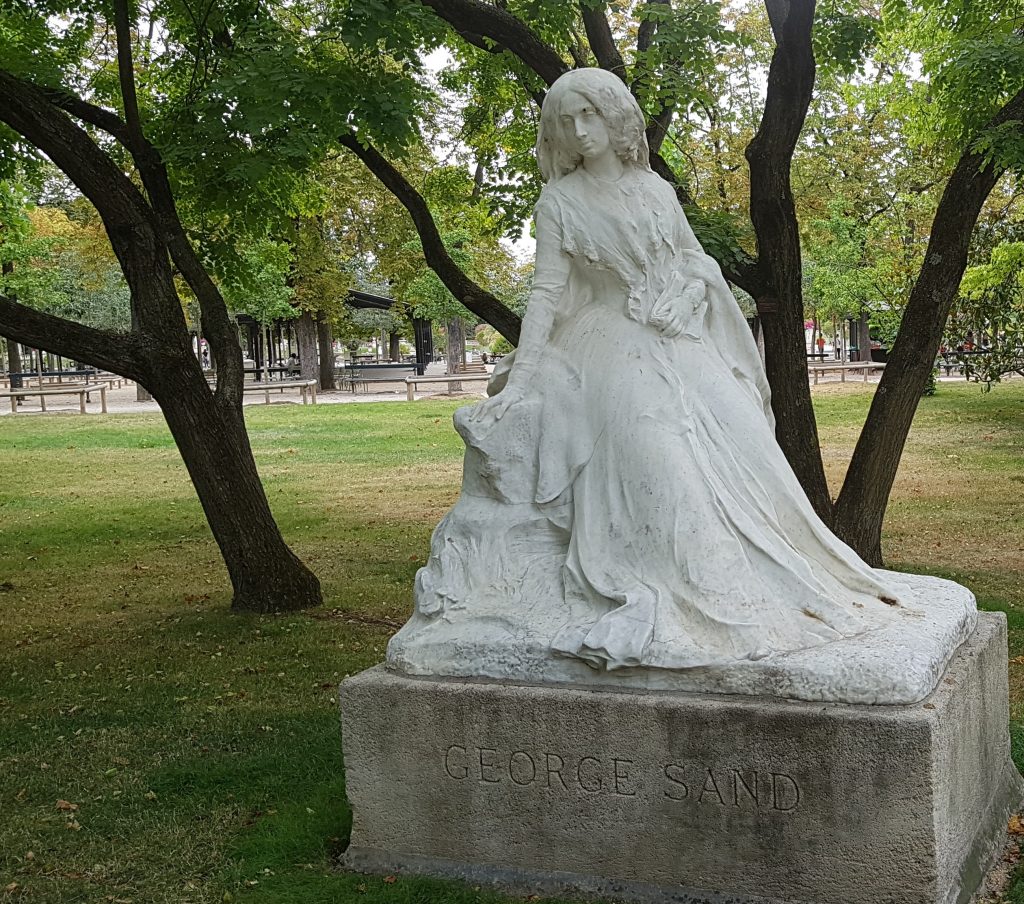
George Sand, sculpted by Francois Sicard was inaugurated in 1904 on the centenary of her birth. Not at all the image of the male-clothed self-declared communist.

Jules Dalou‘s three commissions all come from the same period from the 1890s through the 1900s when liberal republican governments fought off the right and sought to strengthen republican imagery and values. different and all interesting.

In 1890 Dalou’s Monument to Eugene Delacroix – the painter whose most famous work, Liberty leading the people was kept hidden by King Louis-Philippe from 1832 until 1848, and that we have borrowed characters from in designing LeftinParis – was inaugurated in the garden.

Dalou produced a bust of Delacroix but also comments on his belated recognition. Delacroix had died 27 years earlier, so Dalou shows him being given a palm and crown by Glory, lifted up by Time and applauded by Apollo, the god of genius.

In our brief biography of Dalou we show his two other sculptures present in the garden:The Triumph of Silenius, finished in 1885 but only erected in 1898 and the Monument to Scheurer-Kestner, installed in 1908.

A statue referencing surrealism and poetry, dedicated to Paul Eluard, a founder of surrealism who then joined the Communist Party, was erected in 1954, just two years after Eluard’s death. It was sculpted by Ossip Zadkine.

Plus d’informations

PLACES

Palais du Luxembourg

Arrondissement 6

Numbers: 15-17 Rue Vaugirard

During the Revolutionary Terror (April 6 1793 to July 28 1794), the Palace became an overflow prison, holding among others Danton and Desmoulins who were both executed on April 5 1794.

In December 1830 a demonstration against the clemency shown to Charles X’s former ministers, was violently put down outside the Palace.

The Palace was the location of the Workers’ Commission set up after the February 1848 revolution. Workers had demanded a Minister of Labour, calling the post a ‘Minister of Progress’, but this had been turned down and Louis Blanc accepted the position of President of the Commission instead.

Others nominated to the Commission included Albert and the followers of Fourier, Victor Considerant and François Vidal.

Pierre Marie de Saint-Georges, the Minister responsible for the National Workshops set up in 1848 was also based at the Palace. On June 22 Louis Pujol was nominated spokesperson of the 56 delegates chosen by a workers’ meeting at the Panthéon to negotiate with Pierre Marie.

The meeting took place at the Luxembourg Palace, and Pierre Marie’s attack on the delegation, asking if they were ‘slaves’ to Pujol, fueled an anger that observers credited with sparking the huge June 1848 workers’ uprising.

In May 1871 the military tribunal set up in the Palace summarily sentenced hundreds of Communard fighters and supporters to be shot in the Luxembourg Garden at the back of the palace, just below the statues of French queens.

On July 3 1880 Victor Hugo finally got the amnesty for the Communards through the Senate, based at the Palace more or less continuously since 1805.

After the Germans occupied Paris in 1940 they made the Palace the headquarters of the Luftwaffe, where it was visited by Hermann Goering. His Luftwaffe Field Marshal was also given a luxurious apartment there. It also served as an administrative centre covering prisoners of war.

The Palace was one of the last bastions of German opposition at Liberation in August 1944. Its soldiers only finally surrendered on August 25 to the resistance fighters led by Colonel Fabien, when they were faced with 5 tanks detached by General Leclerc and the threat of air strikes.

PLACES

Avenue du Maine

Arrondissements 14, 15

Numbers: 21, 22, 33, 44, 52, 54, 77, 141,198

Avenue du Maine around 1905

In the 1760s the avenue that now runs from the Boulevard du Montparnasse to the Rue de Vaugirard was called the way to Orléans. It only became known as the Maine road in 1791, and finally the Avenue du Maine from 1821. The only connection with one of Louis XIV’s sons, the Duke of Maine, is that in the early 18th century Auguste de Bourbon used to travel down that way from his chateau at Sceaux to his principal town house on the Rue de Varenne.

Close to the heaving left-leaning cultural centre of Montparnasse in the early 20th century, the Avenue was where many artists and writers chose to live and work. Mondrian lived and worked at No. 33 at the end of 1911; Douanier Rousseau was at No. 44 from 1893 to 1905; Diego Rivera lived at No 52 after returning from Mexico where he had feted the centenary of the Mexican Revolution.

The Russian artist Marie Vassilieff opened her first art school in 1908 at No. 54 and after she moved down the Avenue to No. 21 in 1911, Emmeline Pankhurst stayed at No. 54 briefly in 1913.

Marie Vassilieff painted by Modigliani around 1918

During the First World War Vassilieff opened a ‘canteen’ there, providing very cheap meals for often starving artists and their models. Apollinaire, Matisse and dozens of others benefited. Operating as a private club Vassilieff was also able to avoid the curfew, with music and dancing in the evenings.

Marie Vassilieff’s studio at No 21. In January 1917 she and Picasso evicted a drunk Modigliani from an event celebrating Braque‘s release from military service. A Montmartre Museum at No. 21 opened in 1998 but closed in 2015.

Among others known to have attended Vassilieff’s cheap lunches and night club were Trotksy and Rosmer. Lenin according to one rumour also visited. Her studio walls were covered with paintings by Chagall and Modigliani and with drawings by Picasso and Fernand Léger. On May 5 and 9 1913 Léger lectured there on the balance between lines, forms and colours and representation in contemporary art.

Owned by the City of Paris, No. 21 is now the Villa Vassilieff – a contempory art and research centre ‘ded­i­cated to un-explored resources and aims to rewrite and diver­sify the his­tory of art’.

In 1880, after his return from exile after having been joint administrator of the Louvre during the Commune (he had been sentenced in 1874 to forced labour for life), Jules Dalou lived with his wife and disabled daughter at No. 22, near his studio in the nearby Impasse du Maine (now the Rue Antoine-Bourdelle. Dalou’s studio was knocked down for an extension of the Bourdelle Museum in 1961).

It was while Dalou lived at No. 22 that he sculpted many of his most famous pieces, including in 1889 his Triumph of the Republic for the Place de la Nation and in 1890 his Monument to Eugene Delacroix for the Luxembourg Garden.

The Brasserie des Trois Mousquetaires at No. 77 was one of many bars Simone de Beauvoir visited between 1937 and 1939.

On 22 November 1941 three young Communists, Albert Gueusquin (alias Bob), Raymond Tardif and Jean Garreau threw a fire bomb into the Hôtel Océan at No. 100 that had been requisitioned for the exclusive use of German soldiers.

After Léon Jouhaux agreed to set up a new anti-Communist trade union confederation, the Confédération Générale du Travail-Force ouvrière (FO), the funding it received from the CIA allowed it to move into headquarters at No. 198. The Palais d’Orléans the FO took over had been built at the end of the 19th century as a huge house for weddings and banquets. The building has now been transformed into flats.

FO remained at No. 198 until 1996. André Bergeron led the union from there from 1963 to 1989 when he was succeeded by Marc Blondel, under whom FO moved to its newly-built headquarters at No. 141 in 1996.

PLACES

Rue Mandar

Arrondissement 2

Number 1, 9

The bustling Café du Centre is on the site of the one hat Blanqui and Barbès used as their HQ during the May 1839 insurrection of the 500 members of the Société des Saisons.

On May 12 1839 the café on the corner with the Rue Montorgueil at No 1 was used as Blanqui’s headquarters during the Insurrection against King Louis-Philippe that was staged by the Four Seasons secret society.

Today’s cafe uses a red star motif everywhere – even on the ceiling. None of the staff I spoke to knew why. But the food and wine were good.

It was one of the few streets that saw a barricade built on December 4 1851 in a weakly-supported attempt to stop Louis-Napoléon  Bonaparte’s coup d’État. Several people were killed, including Denis Dussoubs, for whom a commemorative tomb was put up in the Montmartre cemetery

The street was opened in 1790 and named after its architect, Charles-François Mandar. Unlike many contemporary architects, he actually lived in the street he designed. Deliberately, in pursuit of egalitarian ideals, all his neighbours’ houses were built with identical facades.

Mandar (1757-1844) lived at No. 9. During the revolution he got several commissions as a result of his brother knowing Danton and Robespierre, and the rue Mandar was built as a speculative housing development.

PLACES

Rue Marbeuf

Arrondissement 8

Numbers 33, 39

A Karaite-Jewish Russian exile who had arrived in France in the 1930s, Michel Szkolnikoff, made one of the biggest fortunes during the German occupation of Paris. He bought about 50 addresses in the Champs-Élysées area, including 16 in the Rue Marbeuf.

Sequestered in 1944 upon the liberation of Paris, the Aubrac family was given an apartment in No. 39 on their return and lived there until the spring of 1946.

Szkolnikoff was killed in Spain in 1945 by the French security services as they tried to bring him back to France for trial. All the properties in Rue Marbeuf were sold off individually in 1947-48. Not all his massive fortune was ever fully restored to the French state.

Since 1798 the new road built running alongside the Grand Égout (the major drain collecting sewage from Paris right-bank) had been called ‘the street of squashes’ (rue des Gourdes) since these had been grown for hundreds of years in the bog that covered the area from there to the Place de la Concord. But in 1829 it was renamed the Rue Marbeuf, after the Marquise de Marbeuf who had owned the nearby Marbeuf Garden, and who was executed on February 5 1794 for having ‘been found guilty of wishing the Prussians would come to Paris’.

In 1982 a car bomb planted by Carlos (Ilich Ramírez Sánchez) was exploded outside No. 33, the offices of a pro-Irak and anti-Syrian regime Lebanese newspaper, killing one person and wounding 66.

PLACES

Rue Marie Rose

Arrondissement 14

Numbers 2, 4, 7

The street was built in 1898 over an old quarry. It was named after an earlier owner of the land.

Inessa Armand lived at No. 2 from 1910 until she left France with her lover, Lenin, and Krupskaya for Switzerland in 1912 .

Inessa Armand lived at No. 2 Rue Marie Rose from 1910 to 1912

Number 4, the 48 square meter two-room second-floor flat was occupied by Lenin, Krupskaya and her mother from July 6 1909 to June 12 2012.

The flat was bought by the Communist Party in 1955 and opened as the Paris Lenin museum in 1955. On March 25 1960 it was visited by Krushchev along with Maurice Thorez. It was given the Russian Communist Party’s seal of approval a second time in 1985, when it was visited by Gorbachev and Georges Marchais.

In 2007, however, the PCF sold it when things were going downhill for its fortunes . The plaque outside the building was then taken down.

Lenin used to do repairs and maintenance on his bicycle in the street outside No. 4. When I passed by and took these photographs, all the windows on the second-floor had their shutters closed.

Father Corentin Cloarec (1894-1944), the Franciscan vicar of the nearby Saint-François monastery at No. 7 who was chaplain to the Denfert-Rochereau resistance group, was assassinated there by the Gestapo on June 28 1944. The brick monastery was built in 1935 and its remarkable chapel glass is now listed as a historic monument.

Franciscan monastery

PLACES

Rue des Martyrs

Arrondissements 9, 18

Numbers: 19, 34, 65, 79

Photo taken around 1905 looking south

Named because it was an old road that headed towards Montmartre village where, legend had it, St Denis, the first Paris bishop, and his followers were beheaded. It was temporarily renamed the ‘Field of rest’ road (rue du Champ-de-Repos) from 1793 to 1806 at the moment during the French Revolution when the cult of Reason was on the rise.

Béranger‘s friend, the republican Restoration deputy, Jacques-Antoine Manuel, died at No. 19 in August 1827. This was also the address where the Natanson brothers set up la Revue Blanche in 1889.

Victor Schoelcher spoke at a meeting on February 4 1879 at the Paz gym at No. 34 about education reform.

An art gallery at No. 65 was owned by the antique dealer Père Soulier that was a meeting place for Spanish artists. In 1901 Picasso bought a Douanier-Rousseau painting there that he kept throughout his life.

Picasso was also a regular at the Café du Grand Hôtel des Deux Hémisphères at No. 79, along with Appolinaire and many others. The photograph above was taken in the 1900s looking southwards towards where the road crosses the Boulevard de Clichy.

PLACES

Rue des Mathurins

Arrondissements 8, 9

Number: 10, 26, 38

For centuries before 1881 its name was the New Road of the Mathurins (rue Neuve-des-Mathurins) after a farm that had belonged to Mathurin monks who took the name of the 4th century martyr, Mathurin of Larchant. This Saint was very very popular in the Middle Ages, supposedly because of his prowess in healing madness and anxiety, and was the patron saint of clowns.

Daniel Stern, author of the History of the 1848 Revolution, was Marie d’Agoult. Under the July monarchy (1830-1848) she used to host a salon at No. 10 that was frequented, among many others, by Victor Hugo.

George Sand was living at the Florence private house at No. 26 with Baron Casimir Dudevant when she gave birth to her son, Maurice, on June 30 1823. At the time it was owned by the former head chef of Napoleon. It is now a 3-star hotel called George Sand.

The Michel Theatre founded by Michel Mortier was in the basement of No. 38.

This was frequented by Aragon and Picasso who witnessed a fight there on July 6 1923 when Breton (a future surrealist) broke the arm of Tzara, the leading Dadaist .

Plus d’informations

Parisrevolutionnaire

PLACES

Rue Mazarine

Arrondissement 6

Numbers 5, 34, 36, 70

The road was named in 1687 after the nearby Four Nations College founded by the chief minister to Louis XIII and Louis XIV, Cardinal Mazarin. This is now the Institute of France, whose dome is seen at the end of the street.

It runs along the length of the Philippe August 13th century city wall, the base of one of whose towers can still be seen in the courtyard of the Institute of France at No. 5.

The Mazarin College, now the Institute of France at the end of the road shown here in the early 20th century, was where the revolutionaries of July 28 1830 distributed gunpowder before the assault on the Hotel de Ville.

The first of several cooperative Marmite restaurant was opened by Nathalie Le Mel at No. 34 in 1868. Associated with the Paris section of the International Workingmen’s Association, it offered food and political discussions

Proudhon had a long association with Rue Mazarine. He roomed in No 36 in 1844 and 1845, when he had several discussions with Marx there.

By 1847-1848 Proudhon was living in a cheap top floor room in the house built at No. 70, the same address as the novelist of Parisan poverty, Henri Murger..

Plus d’informations

PLACES

Rue Méchain

Arrondissment 14

Number 13

The site at No 13 rue Méchain of the famous left-wing Union print works from 1910 to 1990.

What was once the Ruelle des Capucins was renamed in 1806 soon after the death of the astrologist Pierre Méchain, due to its proximity to the Observatory that was founded in 1667.

Georgi Plekhanov, a founding figure of Russian marxism, used the Russian language Union print shop to print his Fundamental Marxist Questions in 1910

The Union printers, a Russian immigrant printing works, was set up here in 1910. Hazan (WTP) writes that it was supposedly used by Plekhanov and Lenin. It then moved in book printing, along with publications of the modernist movement.

In 1913 Monatte had the CGT paper, La Vie Ouvrière printed here.

Founder of surrealism Guillaume Apollinaire published his Calligrammes poems of peace and war in 1918 at the Union printshop

Shortly after his death in the Spanish flu pandemic of 1918, Guillaume Apollinaire’s Calligrammes was also printed here. From 1930 to 1933 the Union also printed the Surrealist group’s periodical, Le Surrealisme au service de la revolution.

The printshop finally closed in 1990.

PLACES

Rue de Médicis

Arrondissement 6

Number 7

Rue de Médicis viewed through the arches at the rear of the Odéon Theatre.

The road was created in 1860 under the impetus of the changes being brought about by the Prefect of Paris, Haussmann. Here it involved moving the fountain ordered by Marie de Médicis by 30 metres and restricting the size of the Luxembourg Garden on the east.

The Médicis fountain in Autumn. The basin in front of it used to be 50 metres long before it was moved to make room for the Rue de Medicis and a lot of property speculation behind.

The Italian Renaissance style fountain was built on the instructions of Marie de Médicis, the widow of King Henri IV and regent of King Louis XIII in 1630. The problem of a lack of water on the Left Bank of Paris to feed it was solved by the building of the acqueduct of Arcueil, which then enabled the expansion of Paris to the South to take off.

The decaying grotto was restored on the instructions of Napoleon Bonaparte in 1811 and then rebuilt in 1864. At the back of the Médicis fountain is the Fontaine de Léda, a fountain scuplted in 1809 and depicting the story of Leda and the swan.

Just opposite, in the mid-1880s, Félix Fénéon was editor in chief of La Revue indépendante art and literary journal at 7 rue de Medicis, where among many others he published Verlaine.

The impressive door to No 7 rue de Medicis in a building built in 1867-8 was where Felix Feneon worked in 1884 as a founding editor of Le Revue Independant

PLACES

Rue du Mont Cenis

Arrondissement: 18

Number 26

Louise Michel became director of the school at No 26 rue du Mont Cenis, just below the top of the Montmartre Hill, in 1871. The present building dates from the end of the 19th century

One of the very old main roads through the Montmartre village. In 1868 it was given the name of a mountain in the northern Alps after its ending in the abrupt climb by the school at No 26.

Rue du Mont Cenis painted by Maurice Utrillo in 1914 showing the top of the school Michel taught at on the right.

PLACES

Rue Montorgueil

Arrondissements 1, 2

Numbers: 50, 52, 57, 72, 73, 78

From the 13th century the road was called ‘mont Orgueilleux‘ (Pride Hill). Until the late 20th century the street was associated with bringing fish, and particularly oysters, into Paris.

Pierre-Jean de Béranger was born in No. 50 in 1780. Years later he was a regular guest at literary events at the restaurant at No. 78 (then number 59) called ‘Au Rocher de Cancale’.

In 1839 the insurrectionaries of Blanqui and Barbes‘ Society of the Season‘s uprising built a barricade across the street between Nos 52 and 43, at an angle with the Rue Tiquetonne.. Blanqui’s headquarters was in the  café at No. 57, on the corner with No. 1 Rue Mandar.

The bustling Café du Centre is on the site of the one that Blanqui and Barbès used as their HQ during the May 1839 insurrection of the 500 members of the Société des Saisons.

On December 4 1851 a barricade across the road at No. 72 was thrown up by opponents of Louis-Napoleon’s coup d’Etat, and many protestors were killed when it was taken by the army.

Twenty years later, nearly at the same place, at No. 73, another barricade witnessed strong resistance to the advance of the Versaillais troops on May 24 1871.

PLACES

Rue Monsieur le Prince

Arrondissement 6

Numbers: 14, 16, 20, 41, 56, 63, 65

Rue Monsieur le Prince viewed from the Boulevard St Michel

Until the 1960s the narrow road climbing up from the Boulevard St Germain towards the Boulevard St Michel was much as it had always been in the 19th and 20th centuries: a very low-cost area for students, artists and revolutionaries to live amid cafes and bookshops.

The road originally skirted the Charles V city wall and was called after the court title of the Prince of Condé, whose palace grounds bordered the road. From 1793 to 1805 during the French Revolution the road was renamed ‘Rue de la Liberté’.

The triangle of land, mansion and estate occupied by the House of Condé between the Rue Monsieur le Prince, the Rue de Condé and the Rue de Vaugirard in the Turgot plan of Paris in 1740

To get an idea of the wealth and stature of the Condé branch of the Bourbon family, you can take a look at the door to No. 4 – built on the site of the stables of the Condé town house.

The wonderful door and window above it at 4 Rue Monsieur le Prince are all that remain of the private Hôtel de Bacq, built in 1750 for Pierre Darlons, the secretary of the Prince of Conde

The black American writer Richard Wright lived at No. 14 from 1948 to 1959, the year before he died in Paris aged 52. A plaque has been put up to his memory, not mentioning the reports he gave to the American embassy on Nkrumah and French communists he met, arguably doing so to ensure the renewal of his passport. The building has another interesting door built under the Second Empire.

The wooden sculpted entrance to the four-floored building at No. 14 is in the Napoleon III style. On the right the libertine, on the left the student.

Next door, at No. 16, there used to be a very long-lasting anarchist bookshop. It survived from 1908 to 1932 and before the First World War was a regular meeting place for anarchist trade unionists.

A couple of doors further up the road, the Communist Party owned the Racine/Social publications bookshop at No. 20 in 1938.

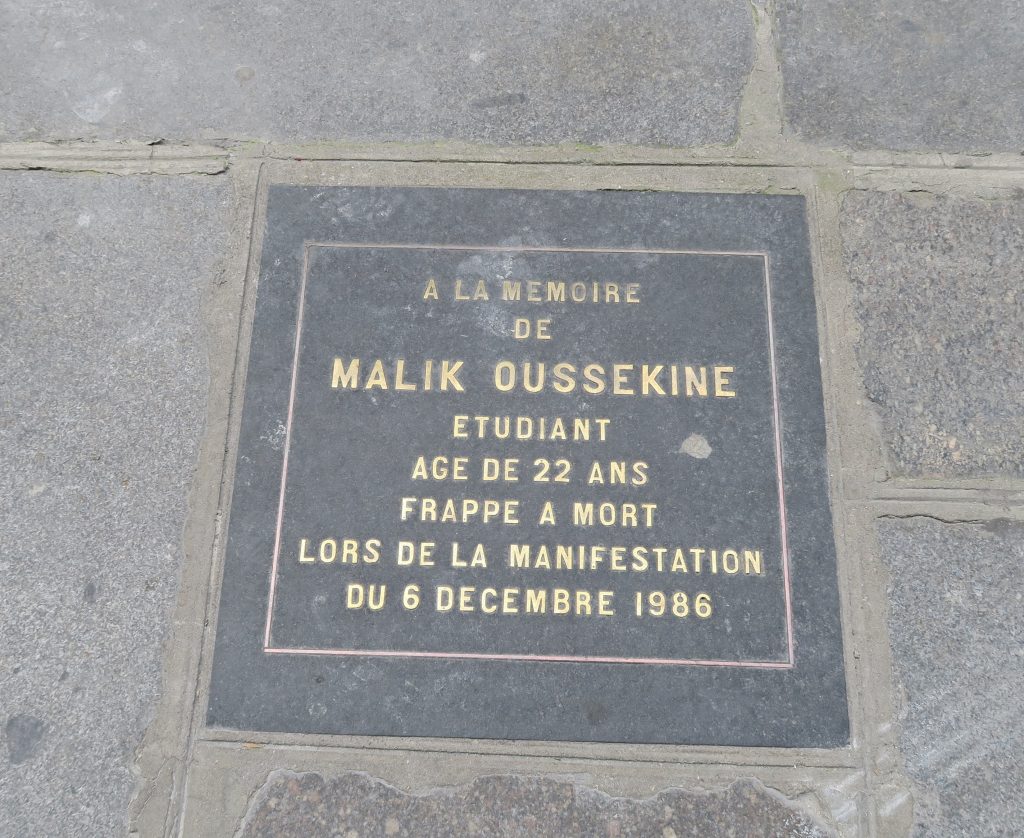
No. 20 was also where, after midnight on December 5 1986 a young student, Malik Oussekine, coming out of a jazz club, was chased down the road to the entrance where he was beaten to death by riot police who attacked him because he was an Algerian and young. The previous day hundreds of thousands of young people had taken part in the day’s demonstrations against the Devaquet election reform. The police tried to cover the murder by calling an ambulance that took the dead body to hospital. Three years later two of the three police were found guilty of wounding Oussekine so badly that he died, and given suspended sentences of five and two years in prison.

On December 6 2006, 20 years later, a memorial plaque was put in the pavement outside No. 20 at a ceremony led by the Paris Mayor, Betrand Delanoë. The sister of the victim found it strange that it wasn’t on the wall. Others criticised the reference to a demonstration that had occurred on December 4, and that it didn’t say that two policemen had been found guilty of his murder.

Paul Verlaine, moving frequently in the last years of his life, lived in No. 21 in 1894, while much earlier, Arthur Rimbaud had a room at No. 41 in May 1872.

Over the years Verlaine and many other writers and artists like James Joyce, Hemingway and Max Ernst used to eat at the Polidor restaurant on the ground floor of No. 41. Until recently its old style benches on which basic French food is served was commanded over by a stereotypical in-your-face French waitress. Now, however, it has even expanded and set up a wine shop.

In 1920, Nguyên Ai Quôc, the future Ho Chi Minh, lived at No. 56. He would have been not at all pleased by the coincidence that led the Indochinese section of the Trotskyist Communist League to meet at No. 65 in 1930.

The first cheap room where the teenage Émile Zola lived on arriving in Paris in 1858 was at No. 63.

Plus d’informations

PLACES

Rue Montalembert

Arrondissement 7

Number 7

The swish Hotel Pont Royal occupies much of this short street opened in 1913 off the Rue de Bac leading to the Pont Royal. It was given this name in 1924, after a theoretician of liberal Catholicism, Charles de Montalembert (1810-1870).

In October 1944 this hotel was where Lucie Aubrac was lodged with her children while a delegate to the National Consultative Assembly, before moving to the Rue Marbeuf in January when her husband Raymond was abruptly fired from his job as Commissioner of Marseilles because of his pronounced left leanings.

From the 1930s the basement bar at the Hotel Pont-Royal was used by Gaston Gallimard (1881-1975), head of the Gallimard publishing house as a discrete meeting place with intellectuals and writers such as Hemingway, Malraux, Gide, de Beauvoir, Camus, Sagan, Sartre and many more in the 1930s and 1950s.

in 1928 Gallimard purchased the effectively adjacent 5, Rue Sébastien-Bottin (at the time 43 Rue de Beaune) as his new headquarters. As managing editor of La Nouvelle Revue française (NRF) from, 1911 to 1940, Gallimard gave Gide the literary editorship and was the first publisher of Malraux and Sartre.

In June 1940 Gallimard moved to the South of France trying to please the Germans by leaving a writer, Drieu la Rochelle, who espoused ‘Socialist Fascism’ as Editor of the NRF. Accused by the Germans of employing Jews and communists La Rochelle fired them.

The Gallimard press was accused of collaborationism during the Occupation and La Rochelle committed suicide in March 1945.

In 2011, on the 100th anniversary of the founding of the Gallimard publishing house, the section of the street Rue Sébastien-Bottin that included No 5 was renamed Rue Gaston-Gallimard.

Two minutes from the Hotel Pont Royal is the publishing house Gallimard, now in a street named after its founder

PLACES

Rue Montmartre

Arrondissements 1, 2

Numbers: 1, 24, 64, 113, 123, 138-142, 144, 146, 154

The cafe at the corner of Rue Montmartre and Rue du Croissant where Jean Jaurès’ assassin fired two bullets through the café window in the street on the right of my photograph.

On January 11 1898 Zola submitted his defence of Alfred Dreyfus J’accuse to Georges Clemenceau, editor of the L’Aurore newspaper at No. 144. It was printed the following day.

Jean Jaurès was assassinated in the adjoining cafe at No. 146 on 31 July 1914.

Rarely for Paris, two plaques mark both these important spots in the story that helped define the modern French left.

The street has many other associations with the history of left struggles in Paris too. At No. 1, the barricade across La Pointe St Eustache saw considerable fighting on May 24 1871.

No 24 was the location of an arms depot created in 1942 by Paris city employees during the German occupation.

Nearly a century earlier, in March 1848, the Hôtel d’Angleterre at No. 64 was the location of the German Social Democratic Society organised by the poet Georg Herwegh, and the arms depot set up by the Republican National Guard to arm the ‘Democratic Legion’ of German volunteers formed to go to the support of the German Republican Hecker insurrection in Baden in April 1848.

During the 1830 Revolution François-Vincent Raspail was the president of the Revolutionary Club based at No. 113 that Buonarroti supported. It soon became the Society of the Rights of Man that was responsible for the first huge demonstration (and riot and barricade made famous by Victor Hugo) of June 5-6 1832.

A northern stretch of Rue Montmartre was a centre of newpaper printshops.

No. 123 was associated with left newspapers. In 1893, Le Chambard socialiste was based there. The CGT and then CGTU trade union paper Worker’s Life (La Vie Ouvrière) was printed at the Dangon printworks there from 1919. In 1927 the same printshop produced Ho Chi Minh‘s Vietnamese paper, l’Âme annamite (The Vietnamese soul).

On 18 April 1904 the first issue of the daily newspaper l’Humanité founded by Jean Jaurès was printed at No. 138-142. The same address in 1916 saw a left socialist anti-war newspaper, Le Populaire de Paris, appear. It was founded by Marceau Pivert, Jean Longuet, Paul Faure and Henri Barbusse.

On July 18 1927 the then Communist leaders Marcel Cachin and Jacques Doriot (who became a fascist leader between 1934 and 1936) were arrested at the L’Humanité offices now based at its printing works. The same address, No. 138-142, was the interwar editorial offices of the Young Communist publication, L’Avant-Garde.

On 27 February 1848, Proudhon published the first edition of his newspaper, The People’s Representative, at No. 154.

On November 15 1793, four months after Jean-Paul Marat‘s assassination, the delegates from the Montmartre commune called for the Rue Montmartre to be renamed Rue Mont-Marat.

Originally some believe the name Montmartre derived from ‘Mont Mars’ because of an alleged Roman temple to Mars built on the hill. Others consider it was because criminals or Christian martyrs were executed on the top of hills.

Plus d’informations

PLACES

Boulevard du Montparnasse

Arrondissements: 6, 14 and 15

Numbers 99, 102, 103, 108, 126, 132, 142, 159, 171

The terrace of Le Dôme reflects the Metro station and La Rotonde café on the uneven numbered side of the boulevard du Montparnasse

The boulevard du Montparnasse crosses three arrondissements. The odd numbers on the north side are all in the 6th; the even numbers from 2 to 66 are in the 15th; and from number 68 onwards the addresses are all in the 14th. It was named with reference to the Greek residence of the muses by 17th century students after a tiny hillock in the area.

One excellent source on the left in Paris, the website Parisrévolutionnaire suggests that both Lenin and Trotsky were at the Dôme in 1905. Hazan (IOP), however, insists the Dôme… should never have been allowed to call itself the café of Trotsky and Kertész.

What is certainly true is that in the early years of the 19th century, the Dôme at No 108 became a major intellectual centre, and attracted many left political and artistic people.

Pablo Picasso as well as Modigliani, Utrillo and Apollinaire all drank or ate at le Dôme (No. 108) and la Rotonde (No. 103). The owner of La Rotonde was denounced by Aragon on July 13 1923 for having been a police informer on Lenin before World War One. Other neighbouring well-frequented intellectual and artist cafes of the interwar years included la Coupole (No. 102-104) and le Select (No. 99) .

The wounded black Foreign Legion corporal, Eugene Bullard, is reported as having decided while at the Coupole in the Spring of 1916, to become a pilot in the French air force.

Simone De Beauvoir lived in a flat above the Rotonde for the first ten years of her life before the father’s family lost most of its wealth in World War 1.

Diego Rivera was also part of this leftish Montparnasse scene in the early 20th century.

Léon Blum moved to the group of artists studios and flats soon after it was built in 1908 at 126 boulevard Montparnasse.

Léon Blum saw himself primarily as a writer before 1914, moving into the artists’ block of flats and studios at No. 126 boulevard Montparnasse. Henri Matisse lived and worked at No. 132 in 1927.

From 1865 to 1866, after the publication of his first novel, Émile Zola lived in a room at No. 142.

In the 1920s Le Dôme became a meeting place for many English-language writers like Ernest Hemingway, Sinclair Lewis and Sylvia Beach. In 1924 John Dos Passos joined other American writers at No. 171 the La Closerie des Lilas bar.

La Closerie des Lilas used to be a cheapish outside bar with dancing visited by lots of poets, artists and philosophers from the first half of the 20th century is now a big pricey restaurant

At the eastern end of the Boulevard near the Port Royal, this famous restaurant is where in June 1941 Simone De Beauvoir and Jean-Paul Sartre organised a clandestine ‘Socialism and Freedom’ meeting of about 50 intellectuals, including Maurice Merleau-Ponty. Yet in the face of increasing repression they did not do much more, and in September 1941 Sartre agreed to take the job of a secondary school teacher who had been fired for being Jewish.

Hemingway was also known to eat frequently in the years 1924-1926 at the Le Nègre de Toulouse restaurant at No 159.

Louis Aragon met Mayakovsky for the first time at the Coupole on November 5 1928. The Coupole was requisitioned between 1940 and 1944 for German-only events

Earlier, under the Second Empire that he satirised so brilliantly, Émile Zola lived at No 142 in 1865 to 1866.

PLACES

Montparnasse Cemetery

Arrondissement 14

3 Boulevard Edgar Quinet

Originally called ‘the Southern Cemetery’ it was opened in 1824 as one of four that made up a new network of burial places outside the original walled city centre: Passy (west), Montmartre (north) and Père-Lachaise (east).

It was developed on the private burial plot of the ‘Brothers of Charity’ religious order (now called St-Jean-de-Dieu Hospital Order) and on three local farms. Soon it stimulated a local monument statutory industry, among whom was Antoine Bourdelle, Jules Dalou‘s studio neighbour. Dalou was himself buried here, having famously sculpted the Père-Lachaise tombs of Victor Noir and Auguste Blanqui.

Around 35,000 people are now buried there, and with them memories of those who struggled for a better world.

Among these is a broken column, commemorating the four sergeants of La Rochelle, Jean-François Bories, Charles Goubin, Jean Pommier and Charles Raoulx guillotined on September 21 1822 in the Place de Grève outside the Hotel de Ville for being members of the Carbonari and plotting to overthrow Louis XVIII.

Pierre-Joseph Proudhon, the pivotal figure of French socialism in the mid-19th century, is buried here.

Denis Dussoubs has a commemorative tomb in the cemetery. He was shot while trying to persuade troops to remain faithful to the Second Republic and to stop Louis-Napoleon’s coup d’État  that had taken place two days earlier on December 2 1851. His brother, Gaston, a deputy was unwell, and asked him to go to speak to the troops in his place.

Pierre Leroux, the first to use the word ‘Socialism’ was buried there shortly after the declaration of the Paris Commune in April 1871.

Alfred Dreyfus, against whom such an anti-Semetic injustice was done in the 1894 that France became politically divided in ways that shaped its 20th century history.

Simone de Beauvoir and Jean-Paul Sartre are buried next to each other.

The cemetery also includes two monuments: one to those killed in the Franco-German war (1870-1871) sieges of Paris and Strasbourg; the other to the Communards killed there during the bloody week of May 21-28 1871 and afterwards.

During the retreat from the cemetery Jean Allemane prevented Joseph Piazza from being shot by his own men, by locking him up in the 5th arrondissement’s town hall next to the Pantheon. Sadly, the Communards forgot to release him and he was killed by the Versaillais. The executions and quick burials in the cemetery finally ended only on June 19 1871.

Wikipedia

PLACES

Rue de Montreuil

Arrondissement 14

Numbers 31, 96

An old road to Montreuil where the Montgolfier brothers first flew above Paris in a hot air balloon and where a workers protest helped trigger the 1789 revolution. No 96 was where Blanqui’s mother nursed his gunshot wound in 1827, and where he lived with his wife from 1830 and in 1834 his son was born.

It was on the road to Montreuil towards the north- east of Paris that Blanqui’s highly supportive mother, Sophie de Brionville, bound his wounds in 1827 at number 96 and took him and his wife in from 1830. His only son was born there.

The first tethered manned flight by Etienne Montgolfier was tested on October 15 1783 in the backyard of the Réveillon works at no 31 rue de Montreuil.


In 1783, in the back yard at number 31 the Montgolfier brothers first stayed on their hot-air balloon as it took place off at the Royal wallpaper factory that six years later helped trigger the 1789 revolution.

In 1789 the wallpaper factory’s owner and designer of the balloon’s wallpaper decorative covering, Jean-Baptiste Réveillon, was a candidate in the upcoming elections for the General Estates forced on Louis XVI. Réveillon argued that his workers’ wages could be reduced if bread prices were lowered and the workers stopped spending their wages on drink .

On 28 April 1789 workers sacked and pillaged the factory and his house, while Réveillon took refuge in the Bastille fort. The army then killed somewhere between 25 and 100 people in quelling the riot. It was the first of several workers’ riots that led up to the July 14 storming of the Bastille.

PLACES

Avenue de La Motte Picquet

Arrondissements 7, 15

Numbers: 2, 19, 48, 52

The more than one kilometre-long road was named in 1884 after Toussaint-Guillaume Picquet de La Motte, admiral under Louis XV and Louis XVI who played parts in both the Seven Years War and the American War of Independence. It was first opened as the Avenue de l’Ecole Militaire in 1680.

The Chilean embassy is in a prime location at No. 2. It had previously been the private mansion of the Tour-d’Auvergne family.

Built in 1907 for Prince Henri de La Tour-d’Auvergne it was rented to the US Embassy until 1929 and then sold to Chile to become its Embassy

The Chilean Embassy was where Louis Aragon was allowed to take refuge for a few days on August 28 1939 by fellow poet and Communist, but also a diplomat there at the time, Pablo Neruda. Aragon had been attacked in the street by the extreme right-wing after the French Communist Party had been banned on August 25, two days after the 1939 Hitler-Stalin ‘Non-aggression Pact’.

Between 1971 and 1973 Neruda was made Chili’s Ambassador to France by Salvador Allende. Back in Chili Neruda witnessed the September 11 1973 Pinochet coup d’etat (protests outside the Paris embassy pictured here). But 12 days later Neruda died of ‘heart failure’. 21st century scientific analysis has suggested he could have been murdered in hospital through being injected with botulism.

Jean Jaurès, the leader of the Socialist Party before World War I, lived at No 19 for a period of time according to Paris Revolutionnaire, but we still need to check out the source for this and the time he spent there.

The French Jewish 20-year-old Louise Alcan lived at No. 48 and became a supporter of resistance in 1940. She later moved to Vichy France but was denounced and arrested in December 1943 in Marseille after the Germans moved to occupy the whole of France.

Louise was first taken to the Drancy transit camp and then deported in Convoy 64 to Auschwitz-Birkenau in February 1944. She later escaped from the Ravensbruck Death March of April 1945.

Further down the road at No. 52 there are several connections to the resistance. This was where the leading Catholic resistance organiser from De Gaulle’s secret service in London, Gilbert Renault known as Colonel Rémy, lived from December 1941 to June 1942. With a month of the 1940 defeat he returned from London and with Louis de La Bardonnie set up the Confrérie Notre-Dame (later called the CND-Castille). Two of Renault’s sisters, Maisie and Madeleine, also joined the CND and were arrested at No. 52 on June 13 1942. But they were able to ensure Gilbert’s escape.

Maisie Renault (1907-2003) was first taken to the Santé prison and then to Fresnes until March 1943. She was next moved to the Romainville Fort and on August 15, after D-Day, she and her married sister Madeleine were deported with 550 others to Ravensbruck. They were among the 17 from that convoy who survived to be liberated on April 22 1945.

Outside No. 52 Roland Abon, a resistance fighter aged 19 was killed fighting for the liberation of Paris on August 25 1944.

PLACES

Rue Mouffetard

Arrondissement 5

Numbers: 23, 89, 140

One of Paris’ oldest streets traced onto an earlier Roman road it dates back to the 3rd century AD when the old Roman town on the left bank was being abandoned in favour of the safer, fortified smaller location on the île de la Cité.

The road falls away on the south side of the Sainte-Genevieve hill. Its name could come from a corruption of the place name, Mont Cétard, to Mont Fétard and eventually becoming Mouffetard. Alternatively, the old French word ‘moufette‘ used to mean an awful smell, and it could be that this is its origin.

No. 23 was an important address for the interwar left in Paris. In 1933 Daniel Guérin  organised meetings there for antifascist German refugees.

The Rue Mouffetard was still a busy shopping street in the 1930s when this photograph was taken. Today No. 23 is a bar, and, still busy, the old road now has dozens of restaurants.

In 1935 it housed the offices of Marceau Pivert‘s Revolutionary Left newspaper, and in 1936 the anarchist journal ‘Spartacus’ Notebooks’ where Victor Serge published ‘16 shot: Where is the Russian Revolution going?‘.

In June 1848 a barricade went up across the road at No. 89. On June 23 1848 a company of the Mobile Guard was disarmed here.

Perhaps unsurprisingly, given it was a very cheap area in which to live, and the numbers of political refugees coming to Paris, for nearly two decades from 1885, No. 140 was strongly associated with anarchist publications.

Rue Mouffetard with No 140 on the left, photographed around 1900. The market is in front of the Saint-Médard church.

On 1 February 1885 Jean Grave launched a French-based edition of Kropotkin‘s anarchist journal Le Révolté at this address. After its presses were seized it changed its name to La Révolte. Among those who wrote for it were the exiled Élisée Reclus and Émile Pouget. Among its readers was Pierre Monatte.

From 4 May 1895 it changed its name to become Les Temps Nouveaux (New Times), which continued to publish up to August 1914, when almost all its writers supported the First World War’s ‘Holy Unity’ against Germany.

On 24 February 1889 Pouget launched the weekly anarchist newspaper Le Père Peinard from the same address. This was frequently raided by the police and the last number of its first series appeared on 21 February 1894, when Pouget escaped to London.

In 1871 Élie Reclus, who had been director of the National Library in Paris under the Paris Commune was hidden in the rue Mouffetard by a family friend for several weeks before escaping to London.

More info / Plus d’informations

PLACES

Rue des Moulins

Arrondissement 1

Numbers: 14, 25

The road was given the name Mill Street after the mills situated on a small hill that existed there as late as the 17th century. It was opened in 1624 and the hillock levelled out by its new owner.

From January to December 1844 the fortnightly German language paper Vorwärts! (Forward!) was published by Henri Bornstein at what was then 32 rue des Moulins but is now No. 14. Its circulation was about 1,000 copies, and Marx became a major editor of it from the summer. This was where Bakunin stayed when he first arrived in Paris in July 1844.

Vorwärts! was outlawed on January 25 1845 after an article was published applauding an attack on Prussian King Frederick William IV.

Meetings of the editorial collective of the Deutsch–Französische Jahrbücher (German–French Annals), also took place there. However, only one double issue appeared in February 1844. Several of contributors and potential contributors met and argued there frequently in 1844, eventually going their own ways. They included Proudhon, Leroux, Etienne Cabet and Louis Blanc, as well as Marx, Arnold Ruge and Bakunin.

The Desenne printworks that published the radical newspaper Le Vieux Cordelier for Camille Desmoulins during the French Revolution in December 1793 and January 1794 was located at No. 25.

MAP

Rue Narcisse Diaz

Arrondissement 16

Number 7

In the 1860s Narcisse Diaz was often at Étretat, partly for health reasons and partly to paint with his friend Courbet.

Originally called the ‘Sentier des Arches’ (the arches pathway) and the ‘Rue de Seine’, it next became a section of the rue Wilhelm before finally in 1894 being renamed in honour of the painter Narcisse Diaz (1807-1876), a friend of Gustave Courbet, next to whom in the 1860s he painted several scenes on the Normandy coast.

Lev Sedov with his father

At No. 7 the street hosts the Clinique Mirabeau founded in 1929 where Trotsky and Natalia Sedov’s activist son, Lev Sedov, showing signs of appendicitis was advised to go in 1938 by his secretary, a secret agent of the Russian NKVD. The clinic’s director an informer for the NKVD was in charge of anaesthetising Sedov. Four days later, on February 18 1938, Sedov (born 1906 in Saint Petersbourg) was dead.

The opened records of the Stalin’s secret police show them congratulating themselves on his death, but some suggest it was not planned, and was due merely the incompetence of the surgeon.

PLACES

Place de la Nation

Arrondissements 11, 12

A symbol of anti-fascism and left unity

The huge garden-square-roundabout was originally called the Place du Trône. This name was given it from August 26 1660 when the young Sun King, Louis XIV, sat on a huge throne placed there at the entrance to Paris to receive oaths of allegiance from the Paris guilds after he arrived from the Franco-Spanish border having just married his 22-year-old double-cousin Marie-Thérèse of Austria and Spain.

In 1787 two huge columns were erected alongside the two single story customs houses and 60 metre-high gates that completed the tax border wall built by the Paris Tax Farmers. Statues of Kings Philippe II and Louis IX were put on top of the columns in 1845.

After the Jacobin insurrection of August 10 1792 the square was renamed ‘The Square of the Overturned Throne’ (place du Trône-Renversé). Two years later on June 13 1794, three days after the passage of the Law of 22 Prairial, the guillotine was erected on the shadier south side of the square. From then until 9 thermidor an 2 (27 July 1794) and the overthrow of Robespierre, an average of 30 people a day were executed there.

At the restorations of 1814 and 1815 the square’s name became again the Place du Trône.

On July 14 1880, at the same moment that the Third Republic determined that inscription Liberté, Égalité, Fraternité was made obligatory on all French public buildings, the square was given its current name.

Nine years later, on the one hundreth anniversary of the storming of the Bastille, the sculpture The Triumph of the Republic put in the centre of the Place.

This was a large piece by the Communard Jules Dalou, who had returned from exile in 1879 and who had originally designed it for a competition to place a republican statue in the Place de la République. Dalou also sculpted the tombs of Victor Noir and Auguste Blanqui in the Père Lachaise  cemetery.

In 1908 sea monsters in a basin sculpted by Georges Gardet and representing reactionary forces being kept at bay by the Republic were added. The crocodile-like monsters were melted down for the German occupiers in 1942 and the basin concreted over.

A general strike supported by both the CGT and the CGTU in defence of the republic against the growing fascist threat was called on Monday February 12 1934. A Socialist column headed by Leon Blum and other Socialist deputies walked from Vincennes to la Place la Nation, with Dalou’s Republican statue its message. There the Socialist column was joined by an even larger Communist march creating a demonstration of 150,000 in Paris alone, while tens of thousands demonstrated elsewhere in France.

On February 12 the divided trade unions and left parties created the biggest demonstration yet seen in France and marked the beginning of united left action against fascism that led to the Popular Front.

The Place de la Nation became a symbol of anti-fascism and left unity. So two huge contingents came together there on July 14 1936 to celebrate the Popular Front victory. This time the call came from 48 different organisations and delegations in traditional provincial as well as working clothes were present alongside each other. Tartakowsky (1997) estimated there were a million people on the streets of Paris for the occasion, marching from the Place de la Republique and Place de la Bastille to the Nation.

Communist and Socialist columns met at the Place de la Nation again to celebrate the first-ever French May Day public holiday on May 1 1937.

In 1938, with the end of the Popular Front government, the strike called on November 30 by the CGT against the dismantling of the 1936 labour laws saw demonstrators attacked by the police.

A young FTP-M.O.I. resistance group (Meier List, Marcel Rajman and Jaroch Klesczelski) threw a grenade at a group of German soldiers in the Place on December 12 1942. Nearly a year later Rajman was arrested with Olga Bancic. He was shot after a trial on February 21 1944, while she was deported to Stuffgart where her head was cut off with an axe.

On May 1 1951 the police attacked a May Day demonstration of Algerians who were carrying the MTLD independence movement’s flag. One hundred police were injured and 1,600 Algerians arrested.

On July 14 1953 the traditional march took place from the Place de la Republique to the Place de la Nation. Then the Algerian demonstrators behind the MTLD banners continued to where their lorry was parked to stack their placards.

At that point the Paris police opened fire on them: six Algerians and one French CGT worker were killed and 126 wounded. No inquiry was held into the police action.

A plaque in memory of those killed is now fixed on the side of one of the customs houses
A film poster about the July 14 1953 police murders of Algerian independence supporters in the Place de la Nation. The film is by Daniel Kupferstein

PLACES

Rue Nationale

Arrondissement 13

Number 79

Initially called the Rue des Deux Moulins (the Two Mill road) the road at the bottom left of this image was extended to the Boulevard Massena by Haussmann in 1863 and then renamed the Rue Nationale in 1870. This south-facing photograph shows its junction with the Avenue d’Ivry on the right of the red building, built on the site of the Panhard & Levassor factory.

Hazan (WTP) describes finding the site of the former Panhard & Levassor factory on the Boulevard Massena at the corner between the Avenue d’Ivry and the Rue Nationale. The 1891 three-level structure has been preserved.

This is not the case with the rest of the area. But even so, unlike most of inner Paris, it has not been gentrified. From the 1970s many migrant boat-people from Vietnam settled in the area between Rue de Tolbiac (to the West), the Rue Nationale (to the North East) and the Avenue d’Italie (to the South).

In 2017, the Marguerite-Durand historical library of gender and feminism, named after the founder of La Fronde in 1897, survived an attempt to close it. Its wealth of archives can be found at 79 Rue Nationale. After nearly two years of works the library re-opens on December 3 2019.

PLACES

Rue de l’Odéon

Arrondissement 6

Numbers: 7, 10, 12, 22

Rue de l Odeon photographed in 1905 from the steps of the Theatre. The bust of the playwright Emile Augier in the centre of the square was melted down in 1942 to be turned into German guns

The gently climbing slope from the crossroads with the Boulevard St Germain up to what is now called the Odéon-Théâtre de l’Europe, was opened up in 1779 as the rue du Théâtre Français. The theatre at the southern top of the slope was built between 1779 and 1782 in the garden of the huge Hôtel de Condé private house, owned by a junior branch of the Bourbons.

Thanks to the opening of the theatre, in 1782 the road was the very first in Paris to be given pavements with gutters running next to them. It was given its current name in 1797 under the Directorate.

A watercolour and ink painting by a contemporary JD Periel of the fire at the Odeon Theatre on March 20 1818

The surrealist poets André Breton and Louis Aragon first met each other in 1917 at No. 7, the bookshop called ‘The Friends of Books’ (Maison des Amis des Livres). This bookshop was also frequented by Jacques Prévert. On March 19 1918 Breton and Aragon launched their magazine, Littérature, from there.  Among the other literary left figures who wrote for it were André Gide and Paul Valéry.

The bookshop’s owner, Adrienne Monnier, held a launch party at No. 7 for James Joyce‘s novel Ulysses on December 7 1922.

No. 10 was where Thomas Paine lived from 1797 to 1802, when, describing Bonaparte ‘as the biggest charlatan the world as ever seen’, he took the opportunity of a brief peace with England to leave Paris for America.

Tom Paine lived for five years at No. 10 Rue de l’Odeon. While initially hoping Bonaparte would spread freedom throughout Europe he quickly became disillusioned, and left France at the earliest opportunity in 1802.

Next door was another famous bookshop. No 12 was the first site of the English-language bookshop Shakespeare & Company. Owned by an American, Sylvia Beach, it became a major draw for radical writers living in Paris in the interwar years such as Hemingway, James Joyce and Simone de Beauvoir.

Shakespeare and Co at No 12 with Sylvia Beach and Ernest Hemingway on the right around 1922

Further up the street, on March 31 1794, this was where at No. 22 rue du Théâtre Français that Camille Desmoulins was arrested. He had lived there since 1782. He was executed with Danton on April 5. His wife, Lucile, was executed a week later. They had married in 1790 with Robespierre a witness who in 1792 became their son’s godfather.

Parisrevolutionnaire

Plus d’informations

PLACES

Rue d’Odessa

Arrondissement 14

Number 28

The road was named after the housing scheme called the cité d’Odessa built in 1854 at the same time as the shelling by French and British frigates at the town of that name during the Crimean War. The road was then opened in 1881.

Today the street is best known for its Breton-origin crepe cafés that derive from the Breton migration into the area in the late 19th century, due to its proximity to the Gare Montparnasse. I usually choose a crepe with Grand Marnier when I walk through, but there are so many it’s difficult to make knowledgeable recommendations as to which creperie to eat in without defeating my diet.

The hôtel Odessa at No. 28 on the corner the southern part of the street was where Trotsky lived from 1914 to 1916 and again, clandestinely, in 1933. You can bet that he ate several crepes during his stay there – one of the cheapest foods around at the time.

The entrance to the Hotel Odessa photgraphed by Steve Jefferys in October 2016, 100 years after Trotsky was expelled from France.

PLACES

Quai d’Orléans

Arrondissement 4

Number 6

The Polish Library at No 6 Quai d’Orleans was used by Rosa Luxemburg.

This is the Polish Library on the Île  du Cité where between 1893 and 1897 Rosa Luxemburg spent time researching her doctoral thesis on the ‘Industrial Development of Poland’. 

Visiting it in 2018 with Marian I couldn’t find any references to Luxemburg’s presence, and none to the relevance of Poland and international solidarity for France in 1848. It has a small Chopin exhibition includes some images of his French lover, George Sand. It also contains an historical exhibition with an account of key 19th century Polish nationalist figures.

PLACES

Rue Oudry

Arrondissement 13

Number: 27

Renamed in 1894 after the 18th century animal painter and former director of the Gobelins Tapestry factory, Jean-Baptiste Oudry, the road had been a centre for tanneries for nearly two hundred years.

Trotsky and his family lived and he was arrested at No. 27 in 1916, before being expelled to Spain. His movements were spied upon from a bar round the corner in the Boulevard St. Marcel.

PLACES