Place Vendôme

Arrondissement 1

Numbers: 1-2, 4, 6, 7, 8, 11-13, 24, 23-26

The Place Vendôme was built to celebrate France’s military might under Louis XIV, the Sun King. Begun in 1699 it was only finished in 1720. It was built on land that had belonged to the illegitimate son of Henry IV, the Duke of Vendôme.

Initially called the Place des Conquêtes (Conquests Square) it soon became the Place Louis-le-grand with a huge equestrian statue of Louis XIV in the middle.

During the French Revolution it was renamed the Place des Piques (Square of Pikes) and the statue was destroyed on August 16 1792 and replaced with a statue representing Liberty.

For most of the 18th century many of the flats in the square’s huge private mansions were occupied by financial speculators and/or tax farmers and relatives of the aristocracy, among whom were a handful of revolutionaries. The leadership of the 1796 Conspiracy of Equals, including Gracchus Babeuf and Philippe Buonarroti met at No. 6, the Hôtel Thibert des Martrais. This was also the address from which two years earlier the Tax Farmers Jacques Paulze and Antoine Laurent de Lavoisier were taken to the guillotine.

Another conspiracy, this time against Napoleon Bonaparte in 1812, two years after the construction of the Vendome Column, was ended when General Malet was arrested by Colonel Doucet and Lieutenant Colonel Laborde at No 7, the Hôtel Le Bas de Montargis. Among those executed a week later, on October 31 1812, was General Lahorie, the god-father of Victor Hugo and Hugo’s mother’s lover since 1802.

In 1871, under the Paris Commune, the square was renamed the Place Internationale.

Number 7 was the same mansion that under the siege of Paris saw the Versailles government’s Paris army General installing Louis d’Aurelle de Paladines as commander of the Paris National Guard against the wishes of the majority of its battalions on March 5 1871. With the failure of the Versailles attempt to remove cannons from Montmartre on March 18 1871, 2,000 men from the Batignolles and Montmartre battalions of the National Guard battalions then evicted de Paladines and took over the building.

This allowed Jules Bergeret to set up his staff headquarters at No. 7. On April 4, after being elected to the Commune’s Council, Bergeret was named Paris National Guard commander.

The square saw much blood spilt at its barricades defending these headquarters of the National Guard during the Paris Commune. On May 23 1871 a barricade at the angle between Nos 1 and 2 with Rue Saint-Honoré was finally captured after Versailles troops got into the square through No. 4 and attacked the barricade’s defenders from behind.

The Hôtel du Rhin at No. 4 was also where Louis-Napoléon Bonaparte had lived in 1848 after his return from exile in England and where he was visited by Victor Hugo who completely believed his assurances that he had no designs to become Emperor.

The second defensive barricade blocking access from the Rue de la Paix in May 1871, stretching across Nos 23-26, was also captured from behind. This was one of the just 18 barricades that had actually been defended with the Commune’s canons.

After the barricades were overwhelmed, the Versailles troops killed most of the survivors. On the following day a group of 30 Communard women were shot in the square.

The Hôtel de Chimay at No. 8 was a centre of the Saint-Jacques resistance network from the start of the 1940 occupation of Paris by the Germans. Radio communications from there to London by began in April 1941 after Maurice Duclos was parachuted into France in February.

During the French Revolution Nos 11-13 became the Ministry of Justice, with Georges Danton nominated as Minister in August 1792. A metre length was installed in the wall there in 1795. The only other remaining original metre length installed in Paris at the changeover to metric distancing is in the Rue de Vaugirard.

No 12, the Hôtel Baudard de Saint-James, was where Frédéric Chopin died supposedly of tuberculosis (although this diagnosis is now contested) on October 17 1849. He was buried in Père Lachaise cemetery. While from 1838 to 1847 Chopin had lived with George Sand, he had separated from her and spent just a month in the Place Vendôme before he died, thanks to a loan from Jane Stirling.

The former Hôtel de Gramont at No. 15 was transformed into a luxury hotel and opened by the Swiss hotelier César Ritz in 1898. During the occupation the most senior Germans lived there and had many ‘traitor lunches’ in its restaurant. On the 16 August 1944 Ernest Hemingway arrived at the Ritz and presented some American rifles to the resistance fighters who had just evicted the Germans. This was also where Coco Chanel lived for many years, including during the period she collaborated with the Germans.

The Hôtel de Boffrand at No. 24, has also become known outside France through its association with Anne Lister, the Gentleman Jack lesbian Calderdale landowner and diarist. She lived there with Maria Barlow in 1824-1825.

Changing statues

In 1806 Napoleon ordered the building of a huge column in the centre of the square to celebrate his military victory at Austerlitz. Ironically this military monument was situated at the end of the Rue de la Paix. Inaugurated on August 15 1810 it was covered in bronze plates featuring battle scenes made, it was said, from melting down foreign captured cannons.

Napoleon was put on top in Roman Emperor robes with a gold laurel wreath on his head. This lasted until April 4 1814 when the invading allies pulled Napoleon’s figure down. Four days later the white Bourbon flag fluttered over the renamed square.

In 1816 the Louis XVIII Restoration government melted Napoleon’s statue down to use its bronze for a new Henry IV statue on the Pont Neuf

For the following 15 years the position at the top of the column was not filled. But in 1833, after a Bonapartist demonstration on May 1 1831, the new King Louis-Philippe (the son of the executed Duke of Orléans, Philippe Égalité, a supporter of the French Revolution and a regicide), replaced Napoleon at the top. This time, however, not dressed as a Roman emperor, but as an army corporal, reflecting the new king’s desire to honour Napoleon, but not too much.

Napoleon did still not appeal to the revolutionaries of 1848, who took the corporal down and threw him into the Seine. Replacing the corporal did not appeal to nephew Louis Napoleon Bonaparte either. His third (and finally successful) military coup d’etat in 1851 led him to proclaim himself Napoleon III, Emperor of the French. In 1864 he placed a copy of the original Napoleon as Emperor statue back on the top of the column.

Karl Marx wrote one of his best political commentaries on contemporary events in 1852: The Eighteenth Brumaire of Louis Bonaparte. In it he compares Louis’ coup of 1851 with Napoleon Bonaparte’s of 1799, and presciently concluded that ‘if the Imperial mantle finally falls on the shoulders of Louis Bonaparte, the bronze statue of Napoleon will fall from the height of the Vendôme Column‘.

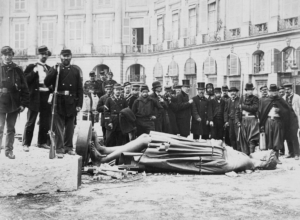
This happened on May 16 1871 during the Paris Commune after the painter, Citizen Courbet, the President of the Federation of Artists that was formed on April 15, persuaded the Commune to authorise the dismantling of the column. He described it as ‘a monument devoid of all artistic value, tending to perpetuate by its expression the ideas of war and conquest of the past imperial dynasty‘.

Courbet’s attack on the column was not universally supported by other artists. Daumier, the head of the Beaux-Arts section of the Federation, believed it should not be taken down. Perhaps this was why the 425 spiralling bas-relief bronze plates carried out by a team of 30 sculptors were removed and stored.

The column was replaced in 1874 with another copy of the imperial Napoleon at its top.

Key days in 1871

Chronology from Le Maitron of Key Dates in French Labour History

Authors: Stéphane Sirot, complétée par Michel Cordillot, René Lemarquis, Claude Pennetier and Céline Lenormand; italicised additions by Steve Jefferys

January

A Meunier chocolate factory building with a metal frame is erected by the architect Jules Saulnier at Noisel-sur-Marne.

January 5 Southern districts of Paris begin to be shelled by the Prussians. The siege began on September 18 1870.

January 6-7 Overnight a red poster signed by the Central Committee of Paris’ 20 arrondissements appears on walls all over Paris. It calls for the creation of an all-Paris Commune.

January 18 The proclamation of the German Empire occurs in the Mirror Gallery of the Versailles Château takes place before William I and Bismarck.

January 22 Parisian revolutionaries try to seize power for a Commune in Paris as part of the ‘action day’ protesting against the government of National Defence’s decision to offer to surrender Paris to Bismarck. A decision is taken to order the troops to fire on the crowd outside the Town Hall, allegedly (and probably fake news) given by Gustave Chaudey, a friend of Courbet.

January 23 Jules Favre, a leading republican who was Foreign Minister of the Government of National Defence in Bordeaux, begins peace talks with Bismarck. It is agreed by the government two days later, and signed by Favre and Bismarck in Versailles on January 27.

January 28 The official journal announces a 21-day armistice with Bismarck to allow national elections to take place to create an Assembly to meet in Bordeaux that would ratify the peace. Paris is instructed to surrender and to allow the Germans into the defensive forts around Paris. The Germans would be allowed to march through Paris in early March. Paris would have to pay for the siege.

February

February 6 Opposed to the decision to cease fighting, and aware of the pro-peace monarchist majority being elected, Leon Gambetta resigns from the government.

February 8 Elections for the National Assembly provide a right-wing monarchist majority (214 Orleanists, 182 Bourbonists, 20 Bonapartists) who want peace and are opposed to the majority republican deputies from Paris and other major cities.

February 15 The Paris battalions of the National Guard decide to combine under a single command and decide to reject the surrender.

February 17 Adolphe Thiers is elected head of the Executive by the National Assembly meeting in Bordeaux.

February 22 Jules Vallès launches the daily newspaper ‘Le Cri du peuple’, critical of Thiers and the monarchist National Assembly. It sells at 5 centimes and its print run is between 50,000 and 100,000, making it the most read newspaper during the Commune. 65 issues are produced between February 22 and March 12, when it is banned, and from March 21 to May 23, when it ceases publication with the start of the Bloody Week that ends the Commune.

February 24 Several battalions of the Paris National Guard march from the Place de la Bastille in commemoration of the 1848 February Revolution. They demand the continuation of the war and oppose the disarming of Paris. The demonstrations continue over the next few days.

March

March 1

The National Assembly in Bordeaux confirms the abolition of Napoleon III’s Empire and agrees to ratify the peace treaty by 546 votes to 107.

March 1 – 3 Prussian troops symbolically occupy parts of western Paris and hold a victory parade on the Champs-Élysées.

March 3 The Paris battalions of the National Guard meet in the Tivoli-Vauxhall dance hall (in what since 1970 is the Rue Léon-Jouhaux) and draw up new rules.

March 9 Universal male suffrage is granted to two ‘French’ communes (Saint-Louis and Gorée and extended later to Dakar and Rufisque) in Senegal. Their deputies will sit in the National Assembly.

March 10 The Bordeaux National Assembly decides to move to Versailles.

March 11 Vinoy, the government’s military commander of Paris, bans six republican newspapers.

March 15

The National Guard elects a Central Committee whose members install themselves in the Hotel de Ville.

Thiers and his government return to Paris.

March 17 Auguste Blanqui, who had left Paris because he was unwell, is arrested staying with a friend in the Dordogne.

March 18

The Paris Commune begins in response to an attempt by the Thiers government’s army to take control of the 227 canons stockpiled at Montmartre and Belleville.

The 88th regiment is surrounded by National Guardsmen and the crowd. Louise Michel among them. The soldiers start to fraternise. The officers are disarmed and their general and another former general who had played a part in the vicious suppression of the June 1848 workers’ insurrection are arrested and taken to the Chateau Rouge. The generals are shot later, despite the intervention of several leading Communards.

Thiers and the members of his government flee to Versailles.

March 19 The Central Committee of the National Guard announce communal elections for Paris.

March 22 The Paris National Guard dispersed a ‘Friends of Order’ demonstration in the Place Vendome, killing around ten of the demonstrators.

March 23 Communes are proclaimed in Lyon and Marseille.

March 24 An attempt to declare a Commune in Nîmes fails. Other Communes are declared in Narbonne and in Toulouse.

March 25 The Lyon mayor is able to end the Commune there by welcoming the soldiers returning from the siege of Belfort, who then put an end to the Commune at the town hall.

March 26

The results of the election for the Paris Commune are declared. 229 167 men had voted out of the 484 569 entitled to vote. Of the 80 members elected, 25 are workers. Among them are Eugène Varlin, Zéphirin Camélinat, Benoît Malon and  Léo Frankel, leading members of the International Working Men’s Association. Others elected included Charles Delescluze, one of around 20 admirers of the Jacobins, and Théophile Ferré, one of a dozen followers of the absent Blanqui . So too were some Proudhonista like Pierre Denis and a handful of independents like Gustave Courbet and Jules Vallès. Twenty of those elected were free masons.

In Creusot a Commune is declared by Jean-Baptiste Dumay.

28 mars.

The Communes in Creusot and Toulouse are overthrown.

The elected Paris Commune declares itself the government of Paris at the Hotel de Ville. It is given this authority by the National Guard’s Central Committee.

March 29 The Commune adopts the manifesto drafted by Pierre Denis, based on Proudhon’s philosophy of communal federalism.

March 31 The Commune of Narbonne fails

April

The Versailles Government commands the support of some 130,000 troops under the orders of MacMahon, the general who had been defeated at Sedan. Perhaps as many as half of these had been prisoners of the Prussians who agreed to their release so they could assist in the battle against the Paris Commune. The Commune was defended by approximately 20-30,000 members of the National Guard, most of whom had never been involved in military action.

April 2 Some 9,000 regular Versaillais army soldiers attack around 600 men defending a barricade of carts and wooden barrels at Courbeovie, to west of Neuilly. The Commune’s Federal soldiers retreat under artillery fire. Casualties are 5 killed and 21 wounded among the Versaillais and 17 killed and 25 captured among the ‘Fédérés’. Five Communards killed were prisoners who were immediately shot on the orders of General Vinoy.

April 3

The Commune decrees the separation of the Church from the State and ends the statement payment of priests.

Under the Blanquist Émile Eudes three loosely connected column of 10,000 Communard soldiers and 8 canon march on Versaillais, largely hoping the regular army will fraternise with them. Surprised by the artillery fire directed against them the Versaillais win both the Battle of Meudon and the Battle of Rueil. Having surrendered at Chatillon, Emile Victor Duval, is shot at Petit-Clamart on the orders of Vinoy as he was being taken to Versailles the following day. Unarmed, one of the Communard leaders at Rueil, Gustave Flourens, is executed on the spot by a gendarme captain.

Aril 4

The Marseille Commune fails.

An insurrection in Limoges initially stops troops being taken by train to Versaillais, but is then defeated.

April 5 The siege of Paris by the Versailles army begins. The Versaillais start shelling Paris. The Commune declares that Theirs and his government will be held responsible.

April 6 Following the summary executions of Duval and Flourens, the Commune passed the hostage decree. This stipulates that for every one Communard executed, three hostages will be executed. This is only put into effect during the Bloody Week from May 21. On May 14 the Commune proposed exchanging all 74 hostages against one man, Blanqui. This proposal was rejected by Thiers and finally on May 24 six hostages were executed, the Archbishop of Paris Georges Darboy, four other priests and the judge Louis-Bernard Bonjean.

April 8

The Commune passed a law stating that municipal councillors in communes of populations less than 20,000 could elect their mayors.

Shells hit the Arc de Triomphe.

April 11 Nathalie Lemel and Elisabeth Dmitrieff set up the ‘Women’s Union for the Defence of Parris and Care of the Wounded’.

April 16 The Commune decrees that any workshop abandoned by their owner should be requisitioned by their workers in order to become workers’ cooperatives that would pay an indemnity to their former owners.

April 19 The Commune issued its Declaration to the French People. It stood for: the consolidation of the republic, an association of autonomous communes throughout France, each of which would vote its budget, taxes and other key issues; the election or selection by competition with the right to recall of all justices, magistrates and communal functionaries; the guarantee of individual freedom of conscience and of the freedom to work; the organisation of an elected national guard whose job was to keep order.

April 24 Abandoned houses by those who had fled Paris were to be requisitioned to house those made homeless by the shelling.

April 27 The Commune outlaws fines and withholding of wages by employers; it bans night work for bakers, it establishes a commission to examine how to organise secular primary and professional education in Paris.

April 30, May 7 Municipal elections take place.

May

May 1 The Jacobins and Blanquists win a majority of 45 to 23 on the Commune to establish a Committee of Public Safety of five elected delegates in response to the multiple dangers faced by the Communards. The Proudhonists are opposed to this step. The role of the Committee is not defined, and a new Committee is elected on May 9.

May 10 The Versailles government signs the Treaty of Frankfort. Under it Germany annexes the Alsace and a significant part (the actual Moselle departmnet) of Lorraine. Some 160,000 inhabitants who refuse to become German leave their homes and move to other parts of France.

May 15 Twenty-one Commune delegates protest the authoritarian turn of the Committee of Public Safety.

May 16 The statue of Napoleon on the Vendome Column is pulled down. The decision was confirmed/accepted by Gustave Courbet.

May 18 The National Assembly in Versailles ratifies the Frankfort Treaty.

May 19 The Commune issues a decree requiring the secularisation of education.

May 21 to May 28 The Bloody Week

May 21 The Versailles troops enter Paris through the Saint-Cloud gate, and then start attacking the over 500 barricades that block most of the main streets.

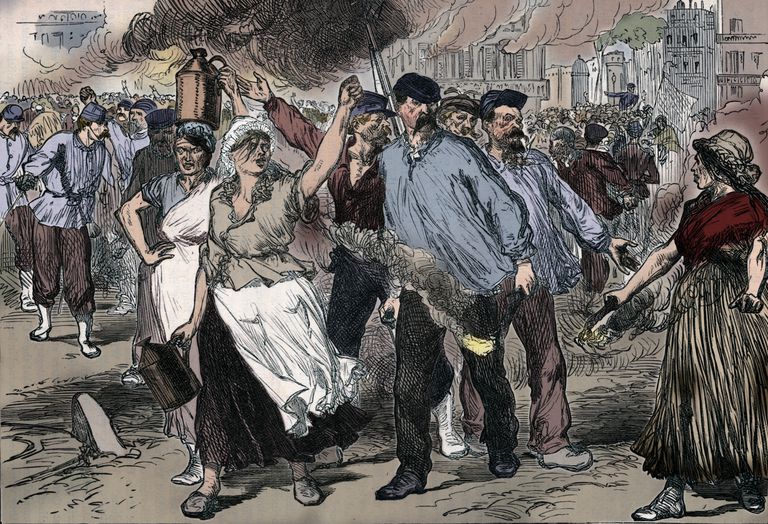
May 23 The Commune decides to set fire to several public buildings, including the Tuileries, the Hotel de Ville, the Cour des Comptes and the Conseil d’Etat on the ground floor of the Orsay Palace, and the Finance Ministry. Many other buildings are destroyed by shellfire from the Versaillais.

May 24 The six hostages, Darboy, Archbishop of Paris, four Jesuit priests and a judge, are executed at La Roquette prison.

May 24-May 25 484 Communard prisoners are executed by the Versailles soldiers in the Parc Monceau and in Montmartre.

May 26 In retaliation the Communards execute 52 Versaillais prisoners in the Rue Haxo.

May 27 The fighting ends in the Père-Lachaise cemetery.

May 28 The last barricade of the Commune at the Rue Ramponeau is overrun by the Versailles army.  Eugène Varlin, who lived in the Rue Dauphine, was totured and shot.

May 29 The Communards supporting garrison of the Vincennes Castle finally surrender.

By the end of this ‘bloody week’ the Versailles troops have retaken Paris. There are thousands of dead, tens of thousands of arrests. Many activists, followed by the police, flee Paris and try to escape in province or abroad. Estimates of those killed range from 6,000-7,500 (Robert Tombs) to 20,000-35,000 (Henri Rochefort).

June

22 military courts are set up in Versailles to try the 38,000 arrested insurrectionaries. 270 are condemned to death (23 death sentences are carried out); 410 are condemned to forced labour, 3,989 are sentenced to prison terms, 322 are exiled and 7,500 are deported to Algeria or New Caledonia. 56 children are jailed in houses of correction.

July

In partial elections in 47 departments the republicans secure support in 39, carrying 99 seats out of 114. These republican gains are repeated in municipal elections in Paris on July 23 and July 30.

August

August 7 The Versailles riding school sees the opening of the third military tribunal judging 17 leading Communards including Théophile Ferré and Gustave Courbet. Others tried included the elected Commune members Adolphe Assi, François Jourde, Paschal Grousset, Dominique Régère, Alfred-Édouard Billioray, Raoul Urbain, Victor Clément, Alexis Trinquet, Henry Champy, Paul Rastoul, Augustin Verdure, Baptiste Descamps and Ulysse Parent, as well as members of the National Guard’s Central Committee, Charles Lullier and Paul Ferrat.

September

September 2 The trial ended with sentences: two death sentences (Ferré was executed, Lullier spared); Urbain and Trinquet were given forced labour for life; seven were sentenced to deportation to overseas prisons, two to simple deportation, four to prison (six months for Courbet) and two (Descamps and Parent) were acquitted.

September 4 The 4th military tribunal trial opens of five women who were ambulance or canteen workers during the Commune. Élisabeth Rétiffe, Joséphine Marchais, Eugénie Suétens were sentenced to death, with the penalties commuted, Eulalie Papavoine was sentenced to deportation to a prison and Lucie Maris-Bocquin who with Rose Rétiffe had been seen building barricades in the Rue de Lille wearing a red scarf and carrying a rifle, was sentenced to ten years in jail and eventually released in 1878.

September 17-23 The International Workingmen’s Association (IWMA) meets in London. Karl Marx wins a vote to create a working class political party in all countries affiliated to the IWMA. The opposition comes from supporters of the more libertarian views of Proudhon and Bakunin.

October

The huge disinvestments that followed the payments of the war debt (25% of France’s GDP had to be borrowed) to Germany create a monetary crisis.

Émile Zola publishes the first of his 20 volume Rougon-Macquart series of books attacking the values and morality of France under the Empire. It’s called La fortune des Rougon.

October 8, October 15 Regional elections confirm the success of the Republicans.

November

November 7 Gambetta founds what became the most influential French newspaper, La Republique Francaise.

November 28 The only army officer to support the Commune, Louis Rossel, is executed at the Satory military camp at Versailles, along with Sergeant Pierre Bourgeois and Théophile Ferré.

November 30 Gaston Crémieux, a leader of the Marseille Commune, is executed after six months in prison.

December 23 The Circles of Catholic Workers come into existence.

Rue de la Clef / Sainte-Pélagie prison

Arrondissement 5

Number 56, site of Sainte-Pélagie prison

The Sainte-Pélagie prison in Rue de la Clef sketched in the 18th century before it became a welcomed prison of choice for 19th century political prisoners

In 1821 the songwriter and pamphleteer Pierre-Jean de Béranger spent three months at Sainte-Pélagie for an oblique political criticism of Louis XVIII. In 1832 Honoré Daumier is placed there. With cholera appearing in the prison a revolt organised by prisoners from the secret Society of the Friends of the People (Société des amis du people) that year led to one death. Hazan (WTP) writes that ‘under the Restoration and the July monarchy… all the opposition leaders passed’ through this prison.

Hazan (IOP) explains that when another prison to accommodate debtors was built in 1826 in the Rue de Clichy in the 9th arrondissement, ‘Creditors who requested the incarceration of a debtor were required to pay thirty francs a month for the prisoner’s maintenance’.

Honoré Daumier spent six months there in 1832 for his political caricatures attacking the new king Louis-Philippe.

Daumier was jailed for this 1831 and other cartoons suggesting King Louis Philippe is as good as his Bourbon cousins at impoverishing people

164 arrests of republicans were made after the riots that followed the rue Transonain massacre of April 1834. Among those jailed at Sainte-Pélagie were Arago, Victor Schoelcher, Barbès and Godefroy de Cavaignac. Barbès organised an escape by 28 of them through a tunnel in July 1835.

Pierre-Joseph Proudhon was a political prisoner held there from 1849 to 1852. After first fleeing to Belgium he returned to marry Euphrasie Piégard while still in jail.

Elisée Reclus was held there after the 1871 Paris Commune on his way to deportation. Gustave Courbet was jailed there from June 1871 to March 1872 after he was arrested at his hiding place in the Rue St Gilles.

Auguste Blanqui was held there in 1831, 1832 and 1836 and again from 1861 to 1865 when he escaped and went into exile in Belgium until the end of the Second Empire.

Sainte-Pélagie prison courtyard in 1880

Jules Guesde was held there in 1878 in the section of the prison called Pavillion des Princes, entered through 2-14 rue due Puits de l’Érmite (roughly where 3-15 rue Lacépède is today).

On 30 July 1891 Paul Lafargue lost his appeal against a year’s imprisonment for an ‘inflammatory’ speech made after the killing of 10 demonstrators by troops on a May Day march in the Northern textile town, Fourmies.

From the Concièrgerie, where he was held initially, Lafargue was finally sent to Sainte-Pélagie. This was to his great relief, since it was still a political prison. He had access to books and newspapers, and hot and cold water for washing and taking baths.

Sainte-Pélagie prison in 1898 shortly before its demolition

PLACES

Rue de l’École-de-Médecine

Arrondissement 6

Numbers: 5, 7, 12, 15-21, 18/20

Named after the Medical School which now occupies much of its length, it received its current name for the first time in 1792 after the nationalisation of the huge Cordeliers monastery complex of the Capuchin Franciscan friars. Before then it was the Rue des Cordeliers.

One branch of the Franciscan (followers of St Francis of Assisi) friars, the hood and beard wearing Minor Capuchins, was particularly important in pre-revolutionary France where it had 284 monasteries. In Paris their Couvent des Cordeliers monastery (possibly so-called after the cords the friars tied around their stomachs) was one of the biggest. It covered an area that stretched from today’s Rue Racine and Rue de La Harpe to approximately 15-21 Rue de l’École de Médecine.

Briefly, between 1793 and 1794 the road was renamed Rue Marat, after the revolutionary who lived and was assassinated there in July 1793. At the overthrow of Robespierre it was immediately renamed the Rue de l’École-de-Santé and then from April 20 1796 it regained its earlier (and current) name.

No. 5 was the location of Louis XV’s free boys’ Royal School for Art and Design from its inception in 1767 until 1928. From 1810 it was funded by the State. Fernand Léger studied there in 1901-1902 after he had stopped studying architecture. the school was built on a medieval Jewish cemetery.

The School of Art and Design at No. 5 and the amphitheatre at No. 7 it was allocated after the new medical school was finished on the other side of the road.

The road’s medical connection dates back to 1255 and in 1763 the Barber-Surgeons Guild funded the building of a small amphitheatre where students could watch them carry out operations at No. 7. The building was given its present columns and courtyard and extended in 1794.

The area became known as the Cordeliers district, and even before 1789 already had a radical tradition. Danton, Desmoulins and Marat all lived in the area. Marat in the Hôtel de Cahors roughly where Nos. 18-20 would have stood. This was where he was murdered on July 13 1793.

All of the Cordeliers monasteries were closed in 1790 and so, when the Paris Council abolished the Cordeliers district in the municipal reoganisation, Danton and other area leaders founded a club there in the monastery’s refectory on April 27 1790.

The refectory of the Cordeliers monastery at No 15 is the largest surviving building of the huge religious complex.

The club’s official name was Société des Amis des droits de l’homme et du citoyen (Friends of the Rights of Man and of the Citizen), but it was known as the Club des Cordeliers. Its motto, proposed by Antoine-Francois Momoro, became Liberté, égalité, fraternité or Death. On June 21 1791 it was the first club to call for the Constituent Assembly to proclaim a republic.

On July 17 1792 this was where, after the failure of Louis XVI’s escape bid, Marat proposed a petition declaring ‘royalty incompatible with freedom’. That night, after the Champs de Mars massacre, the constitutional monarchists ordered the closure of the Cordeliers club and its leaders went into hiding.

A year later, on July 16 1793, after his assassination, the monastery garden was where Marat was first buried.

The School of Medicine’s amphitheatres at No. 7 and No. 12 were used as meeting places by several revolutionaries in 1848. These included those involved in the Club des Homme lettrés , the Club central de l’Agriculture, the Club de l’École de Médecine and the Comité électoral du 11ème arrondissement.

The School of Medicine was not only used for anatomical observation. On January 19 1868 Nathalie Le Mel, Eugène Varlin and others met in the small amphitheatre to hold the General Meeting that created the food cooperative called ‘La Marmite‘ (the cooking pot).

The large amphitheatre at No. 12 witnessed the General Assembly of Lithograph Printers on 29 August 1869 when they decided to affiliate to the International Association of Working Men.

From October 1870 more and more meetings took place at No. 12. On April 12 1871 Gustave Courbet was one of 400 artists who met there to elect an Artists’ Committee for the Commune’s Republic (Comité des Artistes pour la République communale). Courbet and 46 others were elected.

Among the other artists attending to set up the Artists Federation were Aimé-Jules Dalou (who later sculpted the ‘Triumph of the Republic’ in the Place de la Nation) Honoré Daumier, Camille Corot, Édouard Manet, Claude Monet and Alexandre Falguière.

PLACES

Rue de la Gaîté

Arrondissement 14

Number 11bis, 20, 20bis, 21, 26, 31

Crammed full of smallish theatres since 1818, when the Montparnasse Theatre first opened its doors, the road ran along the outside of the Farmers’ General tax wall. This made it a good location to drink wine that was not subject to the Paris tax, and the numbers of music halls, theatres and restaurants that sprang up gave it its name. It was absorbed into Paris in 1863.

Sometimes political meetings were held in the cafés in the street. Gustave Courbet and many of Paris’ bohemian intellectuals and artists used to drink at the Café des Mille Colonnes, next to Bobino at No. 20bis, in the 1860s. On December 17 1904 all the Russian revolutionary groups in Paris met there together.

Bobino was the most famous music hall in the street. Lenin went often between 1909 and 1912. Edith Piaf sang there at the end of the 1930s and Georges Brassens had a five month residence there in 1976.

During 1870-1871 the dance hall, Bal du Jardin de Paris, at No. 21 was used to hold 30 public political meetings.

While Lenin was living in Paris in 1909-1912 he is recorded as seeing a friend, the singer-songwriter Montéhus appear at No. 26, the Théâtre de la Gaîté Montparnasse.

The Montparnasse Theatre you now see at No 31 was rebuilt in 1886 and is on the list of historic monuments. It staged the Paris premier of Berthold Brecht’s ‘Threepenny Opera’ (l’Opéra de Quat’sous) in 1928.

The writer Simone de Beauvoir spent the academic year of 1936-1937 based at the hotel then named Royal-Bretagne living there with Sartre when he was in Paris at No. 11bis. Today, this art-deco hotel has another name and looks more upmarket than it did in the 1930s.

The hotel where Simon de Beauvoir spent a year while teaching at the right-bank secondary school, the lycée Molière

Nearly opposite De Beauvoir’s hotel was the famous Bobino music hall at No. 20, sadly demolished in 1985 and turned into a Mercure hotel with a new Bobino now at the back. De Beauvoir and Sartre saw two singers there in 1932, singing anarchist and anti-militarist songs.

More Info

Plus d’informations

PLACES

Rue Hautefeuille

Arrondissement 6

Numbers: 13, 32

Gustave Courbet‘s workshop from 1848 up to the Paris Commune was based at No. 32. Among those who visited him here were Charles Baudelaire, who was born at No. 13 in a building that was knocked down when the Boulevard St Germain was driven through the Latin Quarter, and Emile Zola.

Painted between 1854 and 1855 in the former medical school in the Rue Hautefeuille,it’s full title is: ‘The Artist’s Studio, a real allegory summing up seven years of my artistic and moral life’. Rejected for the 1855 Paris World Fair, it now hangs in the Orsay Museum.

Plus d’informations

PLACES

Rue Laffitte

Arrondissement: 9

Numbers 1, 8, 16, 49

The view of the Sacré-Coeur being built above the Notre-Dame-de-Lorette church must have both annoyed and inspired the artistic and literary figures working on La Revue Blanche in the 1890s.

The street offers an extraordinary view, notes Hazan (WTP), of the Sacré-Coeur rising above the Notre-Dame-de-Lorette church. No better reason, perhaps for Fénéon to host the first Georges Seurat retrospective just a few months after the painter’s early death aged 32 at No. 1, the editorial offices of La Revue Blanche.

Toulouse-Lautrec was one of many leading artists who Feneon attracted to La Revue Blanche after becoming editor in 1895, just a year after he had been acquitted of an anarchist conspiracy to undertake a bombing campaign in Paris

Fénéon became La Revue Blanche’s editor in 1896 and committed it strongly to defending Dreyfus from 1897. He published many articles by Léon Blum, then a young lawyer who in his spare time reported on the trials taking place.

Fénéon, Zola, Proust, Sorel, Claude Monet, Emile Durkheim and Daniel Halévy were among the signatures organised from the offices of La Revue Blanche on 15 January 1898 to an early petition to reopen Drefyus’ trial.

No. 8 was the location of the picture gallery opened in 1863 by Alexandre Bernheim, who displayed the paintings of Gustave Courbet and Camille Corot, among others, and who was the organiser of Van Gogh’s first Parisan exhibition in 1901.

In 1872, after Courbet had spent 9 months in jail for his part in the Paris Commune, his work was rejected for display at that year’s Salon. The art dealer Paul Durand-Ruel then showed Courbet’s painting Fruits at the gallery he had opened at No. 16 in 1867.

Rejected by the Paris salon of 1872 Courbet’s Fruits that he painted in 1871-1872 while in jail, was exhibited by the dealer Durand-Ruel at No 16 Rue Laffitte.

In October 1906. after Marguerite Durand‘s La Fronde ceased publication in 1905, Jane Misme founded the weekly feminist 4-page journal, La Française: Journal de progrès féminin, whose offices were at No 49. It became the official outlet of the National Council of French Women (CNFF)

The feminist Jane Misme founded the journal in 1906. In 1909 it became the mouthpiece of the French Women’s Suffrage Union. Charlotte Bonnin‘s report on Equal Pay was published in it in 1929

Origins

The old street Rue d’Artois was renamed in 1897 after one of France’s most influential bankers, Jacques Lafitte (1767-1844). His first job was in the Perregaux Bank, whose international connections led it to become the bank of the French Revolution’s Committee of Public Security, and then financial advisers to Napoleon Bonaparte.

In 1814 Laffitte was asked to head up the Bank of France, which he did until 1820. In the July 1830 Revolution he was one of the most important figures aiming to thwart any move towards a new republic and instead to secure the crown for Louis-Philippe of the Orleans branch of the Bourbon family.

Laffitte became the president of the Chamber of Deputies which declared the throne vacant and that Louis-Philippe was the new king. Laffitte became both President of the governing council and minister of finance in November 1830. He lasted only until March 1831 when he resigned as it became clear that Louis-Philippe was going to try and maintain all the monarch’s power over government rather than move towards a parliamentary government system.

Jacques Laffitte the influential banker who believed a parliamentary system giving power to France’s new wealthy was needed rather than Bourbon and Orleans direct power.

PLACES

Palais du Louvre

Arrondissement 1

Rue de l’Amiral de Coligny

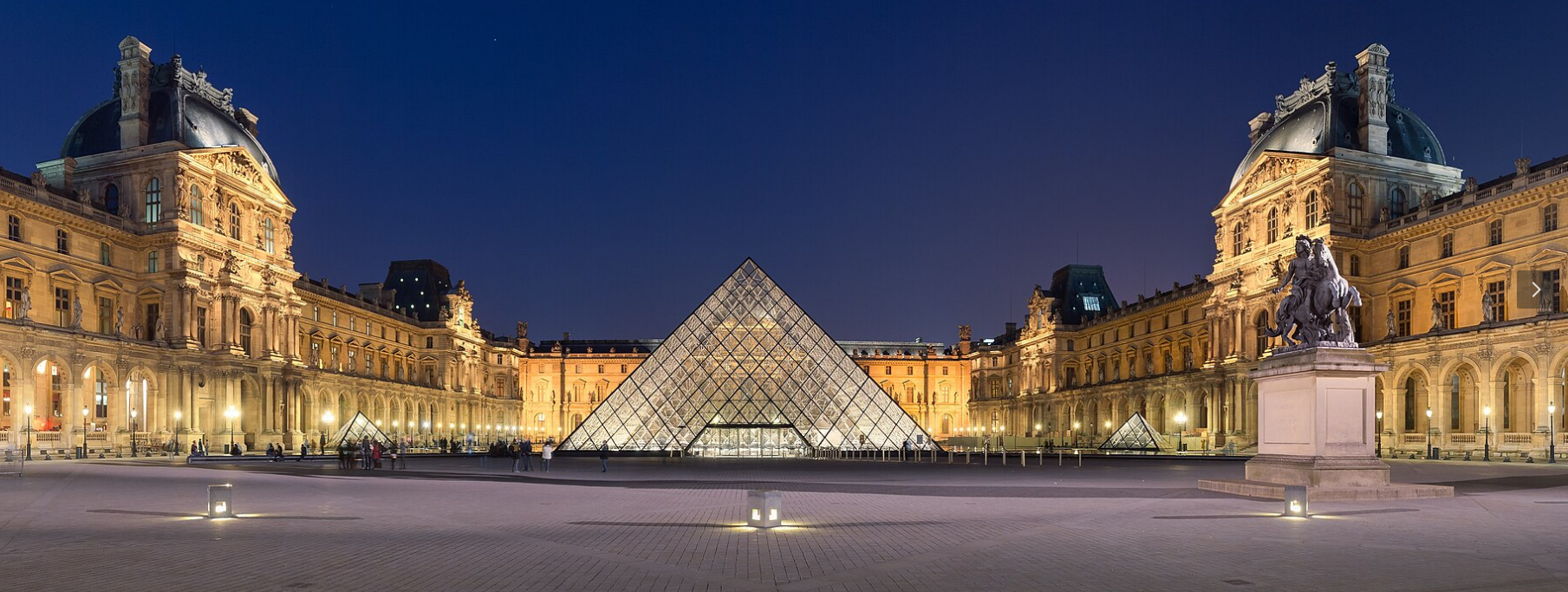
Louvre Palace from Rue de l’Amiral de Coligny

The Louvre Palace was built under Philip II in the late 12th to 13th century. By the 16th century it had ceased to be a fortress and became the primary palace of the French monarchy. Redesigned and extended often it became the home of the royal art collection from 1682 when Louis XIV moved the court to Versailles.

The Louvre played a major symbolic and organisational role in the people’s revolutionary explosions of the 18th and 19th centuries (1789-93, 1830 and 1871). In the 20th century it became associated with Resistance to German Occupation.

During the French Revoution it became a national art museum, largely of royal and confiscated church property.

During the July 1830 Revolution it witnessed the defeat of Charles X‘s Swiss guards on July 29, when a crowd, including many Polytechnic students, stormed it using a scaffolding for repairs that covered part of the colonnade.

July 29 1830 Left Bank students workers and shopkeepers cross the Pont Neuf to attack the Louvre. Painted anonymously by an eyewitness.

Louis Vaneau, one of the Ecole Polytechnique students killed in the 1830 fighting, had the Rue Vaneau renamed after him in 1870.

The Louvre Palace in January 2016 photographed from the Pont Neuf with the oldest part on the right in what had been the Rue de Louvre, but is now the Rue de l’Amiral Coligny. It was renamed in 1972 after the Protestant Huguenot prince who was assassinated by the Catholic Fronde on St Bartholomew’s Day 1572


After the 1870 Sedan defeat and the end of the Second Empire, Gustave Courbet chaired a meeting of Parisian artists at the Louvre on September 6 1870. It set up a Commission for the Protection of the Heritage of Paris’ museums.

The leading realist painter of the 19th century, Courbet, photographed by Nadar

On March 1 1871 a hostile crowd gathered at the Louvre to shout insults at the Prussian officers who came to visit their ‘captured’ monuments after Thiers and Favre in Versaiilais had signed an ignominious armistice to end the siege of Paris.

Two weeks later the Louvre was the headquarters of the military governor of Paris at the moment when the Versaillais government attempted to seize control of the canon that were defending Paris. This coup’s failure led to the formation of the Paris Commune on March 18 1871.

The Federation of Artists, including Aimé-Jules Dalou and Jules Héreau as well as Courbet, immediately moved into the Palace. On April 17 a meeting held in the Antiquities Room of the museum (off the Place du Carrousel) elected a 47-strong Committee of the Artists’ Federation.

On 24 May 1871, when the Versaillais troops took over the Louvre Palace, a solitary woman stood in front of them. She was put against the gate of the colonnade and shot.

After the Occupation of Paris by German troops on June 14 1940, several staff at the Louvre Museum formed a collective resistance team aiming to save as many art works as possible from destruction and pillage.

Under the Occupation Parisians were forbidden to enter. Only a handful of staff were allowed in. They included Jacques Jaujard, the existing Protestant-origin head of French national museums.

He used his knowledge of the underground storage beneath the Louvre to store the first leaflets produced by the Committee of Public Safety founded by Boris Vladimirovitch Vildé, an ethnologist and linguist at the Musee de L’Homme. The journal they produced from August 1940 was called Résistance.

Vildé and six other intellectuals and academics in the Groupe du musée de l’Homme were finally denounced by a Vichy supporter and shot at Fort Mont-Valérien in Suresnes, a western Paris suburb, where between 1,000 and 4,500 resisters were executed during the Occupation.

At the Louvre the three rooms taken over by the Germans to store the art and culture seized from Jewish families didn’t provide enough space, so Jaujard and Rose Valland, a graduate student of art history, suggested they use the Jeu de Paume museum in the Tuileries gardens from October 1940. This was where Valland had volunteered since 1932.

Rose Valland, who understood German, but kept that secret from them, then began working full-time alone at the Jeu de Paume, built under Napoleon III in 1861, and a gallery since 1909. While there she secretly kept notes on the over 20,000 works of art the Germans had looted and wherever possible, through talking to lorry drivers taking them onwards to railway stations, finding out where they were going to and in many cases to which individuals.

She was present when on May 3 1941 Hermann Göring made one of his 20 visits to the museum to choose paintings for his own private collection. The others were either sold through Switzerland, burned in a bonfire of ‘degenerate art’ on July 27 1942, or stored to be eventually housed in Hitler’s never-constructed Leader’s Museum in Linz.

Valland passed on information to the Resistance via Jaujard so that the trains east they were on would not be mistakenly blown up. In August 1944 this information was used to prevent the final attempts by the Germans to loot 148 crates of paintings containing in total 967 paintings, including works by Braque, Cézanne, Degas, Dufy, Gauguin, Modigliani, Picasso, Toulouse-Lautrec and Utrillo.

MAP

Rue des Poitevins

Arrondissement 6

Numbers: 4, 6

The street was named, it is believed, after the large numbers of students from Poitou who lived in the 13th century street. It became known as the Rue Poitevine in 1448.

In 1824 Pierre Leroux worked in the printshop belonging to Charles-Louis Panckoucke and founded the newspaper The Globe, that became the organ of the Saint-Simoniam utopian socialists from 1830. The printshop at No. 4 was in the Hotel de Thou, where Jacques Auguste de Thou, a president of the Paris parliament, had first established a major library there in 1587.

Rue des Poitevins photographed by Charles Marville in the early 1850s, a few years after Courbet roomed in the street in the early 1840s..

No. 6 was a lodging house and restaurant set up in 1840 and called the pension Laveur. It was based in a wing of Thou’s Paris mansion. Gustave Courbet, Elisee Reclus and many other 19th century political figures stayed and/or ate there as students or while first living in Paris – either at this address or at 20 Rue Serpente, where the pension Laveur moved to later.

Plus d’informations

PLACES

Rue Saint-Gilles

Arrondissement 3

Numbers: 12

If you happened to look like Gustave Courbet, or other well-known supporters of the Commune, on 24 May 1871 you could have been shot on the spot by the Versaillais troops – as happened to one unfortunate man in the 2nd arrondissement at 11, Rue de la Banque.

It was very dangerous to have even the closest resemblance to France’s best known painter in 1871

Courbet himself went into hiding at a musical instrument maker friend of his at No. 12 Rue St Gilles. This was where he was arrested on June 7 1871. The building had formerly been the Venice Embassy in Paris, and since very few people know this, I can also let you know that Jean-Jacques Rousseau spent a year working in the French embassy to Venice in 1743 to 1744.

No 12 St Gilles the former Venice embassy in Paris

In 1640 the narrow road was named after a statue of Saint Gilles placed at the end of the road, initially called the New St Gilles road.

Plus d’informations

PLACES

Boulevard Saint-Michel

Arrondissement: 6

Numbers: 31

In 1842 Gustave Courbet‘s first workshop was at 89 Rue de la Harpe which, after the Southern part of the Rue de la Harpe was knocked down, was approximately at the location of 31 Boulevard St Michel. This was where Courbet got to know Proudhon.

One of Baron George Haussmann’s objectives in tearing up much of old Paris after the 1848 Revolution was to try and eradicate the possibilities of street barricades and open resistance, or at least to ensure that the army and police would find suppressing it easier. The Latin Quarter and its student and poor working class inhabitants were a key target.

Hazan (IOP) quotes Haussmann as acknowledging his aim was to restructure Paris ‘strategically’:

“I read, in a book which enjoyed great success last year, that the streets of Paris had been enlarged to permit ideas to circulate, and, above all, regiments to pass. This malicious statement (which comes in the wake of others) is the equivalent of saying that Paris has been strategically embellished. Well, so be it . . . I do not hesitate to proclaim that strategic embellishments are the most admirable of embellishments.”

In 1851 Paris comprised 30,770 houses; by 1860, when he expanded Paris to include all the land within the 33km-long Thiers Wall, built between 1840 and 1844, he had already demolished 14% of them. Between 1852 and 1868 a grand total of 18,000 houses had been demolished.

Among the old narrow streets pulled down to make way for the Boulevard St Michel was part of the Rue Cujas. The Café Musain at No 22, then on the corner with the Boulevard, doubled as the headquarters of the Société des Amis du peuple (Society of the People’s Friends). This was the secret society run by Auguste Blanqui that played a part in the 1830 Revolution.

Victor Hugo in Les Misérables modelled his secret society, the ‘Friends of ABC‘ on the Blanqui club, suggesting it was their initiative to use the appearance of a red flag at the funeral of General Lamarque on June 5 1832 as the signal for that uprising.

Haussmann’s first idea for the Fountain at the Place St Michel, on the new North-South axis he had constructed through Paris, was for a giant Napoleon Bonaparte. Finally, the architect Gabriel Davioud designed the ‘Victory of Good over Evil’, with Saint Michael defeating the devil (or Louis-Napoleon Bonaparte defeating the 1848 Revolution) that was put in place in 1860, hiring nine different sculptors to sculpt its different elements.

Strategically, though, Boulevard Saint-Michel may be considered to have been more successful than the dreadful fountain. In May 1871 it took little time for the fragile barricades in the broad street to be broken.

On August 21 1944, the Boulevard Saint-Michel was again a key strategic route for the German occupiers to move their troops from the garrison at the Luxembourg Gardens to the right bank in the North.

The resistance built a barricade across it to the Café Cluny on the corner with the Boulevard Saint-Germain, on whose pavements in 1995 I first met Sylvie, a French doctoral student who became very close to me over the following two decades.

In August 1944 the strategic crossroad there quickly became known as the ‘crossroad of death’. In one account I read there was a suggestion that some Germans tied French men and women to the front of their tanks as human shields to go up Boulevard Saint-Michel.  

Insurgent Paris rarely sleeps long. On May 13 1968 ten years to the day after the Algerian generals’ coup d’état toppled the Fourth Republic, a one million strong trade union and student demonstration protesting police violence against students on the night of the barricades (May 10) marched down the Boulevard Saint-Michel and past the Place Saint-Michel over to the right bank. The following day factory occupations started to spread throughout France.

Back in London at the LSE in May 1968, we Socialist Society activists organised a sit-in in solidarity with French students and workers on the one day that week when we didn’t have exams. From the sublime …

Plus d’informations

PLACES

Place Vendôme

Arrondissement 1

Numbers: 1-2, 4, 6, 7, 8, 11-13, 23-26

On May 16 1871 Gustave Courbet endorsed the proposal by Félix Pyat to demolish the column in the centre of the Vendome Square and to melt down the bronze to use in making canon.

The statue of Napoleon had become the symbol of Napoleonic imperialism. It was first put up on August 15 1810 and was then taken down in 1814, replaced in 1831, thrown into the Seine in 1848 and finally restored by Napoleon III.

The column had been decorated in bronze melted down from the canons captured at the battle of Austerlitz. Its crowning figure, Napoleon, had not survived the Bourbon restorations of 1814-1815. Louis XVIII replaced it with the white Bourbon flag and then with the Fleur de Lys. He melted down Napoleon’s statue on top of the column to create the horse-backed Henry IV, founder of the Bourbon dynasty, on the Pont Neuf where it crosses the Island of the Cité.

Citizen Courbet pushing over the Vendome column as seen at the time by the latest version of the revolutionary satirical paper Le Pere Duchesne

During the defence of the Paris Commune in May 1871 a barricade defending the Headquarters of the National Guard at Nos. 11-17 was put up from No. 1 to No. 2 and across the Rue St. Honoré. The Versaillais troops took the barricades from the back by getting through the Hotel du Rhin at No. 4.

Félix Lepeletier, an aristocratic revolutionary, lived at No. 6 and allowed Babeuf, Buonarroti and others involved in leading the Conspiracy of Equals to meet there in March 1796. Félix’s older brother, Louis-Michel Lepeletier de Saint-Fargeau, had cast the deciding vote on the execution of Louis XVI, and that same evening, 20 January 1793, he was stabbed with a sword by one of the king’s former bodyguards.

Louis-Michel Le Peletier died soon after at his family house at No. 8 Place Vendôme. and his body was then draped over the pedestal of Louis XIV’s statue that had been pulled down in 1792. Louis XVI was guillotined the following morning.

The Jacobin painter, Jacques-Louis David, painted LePeletier on his death bed, and one of his students then produced this lithograph print of it. The sword pierces a piece of paper on which is written “I vote the death of the tyrant”, and as a tribute at the bottom right of the picture David placed the inscription “David to Le Peletier. 20 January 1793′

On 18 March 1871, when the Versaillais troops tried and failed to capture the canons stored on the Montmartre and Belleville hills, four battalions of National Guardsmen from Batignolles and Montmartre marched on the National Guard Headquarters at No. 7 and threw out the commanding officer put in place there on March 5, and installed their own commanders.

Jaroslaw Dombrowski, the Polish commanding National Guard General at its headquarters in the Ministry of Justice in Nos. 11-13, was mortally wounded on May 23 1871, when all the defenders were summarily killed.

One of the only 18 Paris barricades in May 1871 that was fortified with canons crossed from Nos. 23 to 26, the Barricade of the Rue de la Paix. It was defended by the 88th, 113th and 182nd National Guard battalions. Very few of the more than one thousand defenders survived the battle.

Chopin, the former lover of George Sand, died in his first floor flat overlooking the court at No. 12 in 1849.

The Ritz Hotel at No. 15, the former Hôtel de Gramont, was colonised by senior Germans and Vichy collaborators under the Occupation and its bar was famously liberated by Ernest Hemingway on August 26 1944, when he gave some American rifles to the arriving FTP. This was also where Princess Diana and Dodi Al-Fayed had their last meal together on August 31 1997.

MAP

Art

Gustave Courbet sketched this self-portrait at Sainte-Pélagie prison after the defeat of the Paris Commune in 1871. He was one of many artists who supported the Commune and is in a line of socialist, anarchist and communist artists who lived and/or worked in Paris and contributed their visions of a world transformed

References to include: Eugène Delacroix

In 1895 Toulouse-Lautrec painted one of a series he had begun in 1889 commissioned by the Moulin Rouge at the Place Blanche. In it he inserted (bottom right) tributes to the editor of La Revue Blanche, Félix Fénéon, and to his friend, Oscar Wilde (second bottom left), whom he had met and painted in London the day before Wilde was jailed for indecency.
Portrait of Felix Feneon by his former fellow political prisoner charged with anarchist sympathies Maximilien Luce. This was pained in 1901

Socialism

Accused of being drunkards in several areas of France the early SFIO campaigned against alcoholism as well as against capitalism

French socialism began to distinguish itself both from Proudhon’s anarchistic appeal to humanity’s moral responsibilities and from Blanqui’s insurrectionism in the 1890s. Founded by Blum, Jaures and Vaillant in 1905 in the aftermath of the Dreyfus affair, the SFIO united left reformist republicans and Marxist sectarians. The alliance broke up in 1920 when a majority at the Tours Conference voted to affiliate to the new Communist International.

Despite being a minority at that SFIO conference, the SFIO of left reformist socialism became the leading left political current through nearly all the interwar period. After the Communist Party ended Stalin’s ‘class against class’ propaganda against the Socialists and proposed a Popular Front alliance, Blum became prime minister in 1936.

Under the Fourth Republic its internal divisions over Algerian independence, with Mendes France and the challenge of the stronger Communist Party allowed De Gaulle to take power. In 1981 Mitterrand won a decisive majority on a left platform that he abandoned three years later. From then the Socialist Party became largely a party of elected national and local officials, without any real mass membership. In 2017, following five politically disastrous years under Hollande, the Socialist Party suffered a major defeat in both the presidential and National Assembly elections. A new left party, La France Insoumise (France untamed), did relatively well, with the Left Front’s presidential candidate getting 19.6% of the vote in the first round.

The vote for the La France Insoumise leader Mélenchon in the first round of the 2017 presidential elections shows stronger support in the less wealthy parts of Paris

Like the Socialists, though, Melonchon’s La France Insoumise has still virtually no local membership base. In the European elections of 2019, its share of the vote fell to 6%.

Work in progress