Place Vendôme

Arrondissement 1

Numbers: 1-2, 4, 6, 7, 8, 11-13, 24, 23-26

The Place Vendôme was built to celebrate France’s military might under Louis XIV, the Sun King. Begun in 1699 it was only finished in 1720. It was built on land that had belonged to the illegitimate son of Henry IV, the Duke of Vendôme.

Initially called the Place des Conquêtes (Conquests Square) it soon became the Place Louis-le-grand with a huge equestrian statue of Louis XIV in the middle.

During the French Revolution it was renamed the Place des Piques (Square of Pikes) and the statue was destroyed on August 16 1792 and replaced with a statue representing Liberty.

For most of the 18th century many of the flats in the square’s huge private mansions were occupied by financial speculators and/or tax farmers and relatives of the aristocracy, among whom were a handful of revolutionaries. The leadership of the 1796 Conspiracy of Equals, including Gracchus Babeuf and Philippe Buonarroti met at No. 6, the Hôtel Thibert des Martrais. This was also the address from which two years earlier the Tax Farmers Jacques Paulze and Antoine Laurent de Lavoisier were taken to the guillotine.

Another conspiracy, this time against Napoleon Bonaparte in 1812, two years after the construction of the Vendome Column, was ended when General Malet was arrested by Colonel Doucet and Lieutenant Colonel Laborde at No 7, the Hôtel Le Bas de Montargis. Among those executed a week later, on October 31 1812, was General Lahorie, the god-father of Victor Hugo and Hugo’s mother’s lover since 1802.

In 1871, under the Paris Commune, the square was renamed the Place Internationale.

Number 7 was the same mansion that under the siege of Paris saw the Versailles government’s Paris army General installing Louis d’Aurelle de Paladines as commander of the Paris National Guard against the wishes of the majority of its battalions on March 5 1871. With the failure of the Versailles attempt to remove cannons from Montmartre on March 18 1871, 2,000 men from the Batignolles and Montmartre battalions of the National Guard battalions then evicted de Paladines and took over the building.

This allowed Jules Bergeret to set up his staff headquarters at No. 7. On April 4, after being elected to the Commune’s Council, Bergeret was named Paris National Guard commander.

The square saw much blood spilt at its barricades defending these headquarters of the National Guard during the Paris Commune. On May 23 1871 a barricade at the angle between Nos 1 and 2 with Rue Saint-Honoré was finally captured after Versailles troops got into the square through No. 4 and attacked the barricade’s defenders from behind.

The Hôtel du Rhin at No. 4 was also where Louis-Napoléon Bonaparte had lived in 1848 after his return from exile in England and where he was visited by Victor Hugo who completely believed his assurances that he had no designs to become Emperor.

The second defensive barricade blocking access from the Rue de la Paix in May 1871, stretching across Nos 23-26, was also captured from behind. This was one of the just 18 barricades that had actually been defended with the Commune’s canons.

After the barricades were overwhelmed, the Versailles troops killed most of the survivors. On the following day a group of 30 Communard women were shot in the square.

The Hôtel de Chimay at No. 8 was a centre of the Saint-Jacques resistance network from the start of the 1940 occupation of Paris by the Germans. Radio communications from there to London by began in April 1941 after Maurice Duclos was parachuted into France in February.

During the French Revolution Nos 11-13 became the Ministry of Justice, with Georges Danton nominated as Minister in August 1792. A metre length was installed in the wall there in 1795. The only other remaining original metre length installed in Paris at the changeover to metric distancing is in the Rue de Vaugirard.

No 12, the Hôtel Baudard de Saint-James, was where Frédéric Chopin died supposedly of tuberculosis (although this diagnosis is now contested) on October 17 1849. He was buried in Père Lachaise cemetery. While from 1838 to 1847 Chopin had lived with George Sand, he had separated from her and spent just a month in the Place Vendôme before he died, thanks to a loan from Jane Stirling.

The former Hôtel de Gramont at No. 15 was transformed into a luxury hotel and opened by the Swiss hotelier César Ritz in 1898. During the occupation the most senior Germans lived there and had many ‘traitor lunches’ in its restaurant. On the 16 August 1944 Ernest Hemingway arrived at the Ritz and presented some American rifles to the resistance fighters who had just evicted the Germans. This was also where Coco Chanel lived for many years, including during the period she collaborated with the Germans.

The Hôtel de Boffrand at No. 24, has also become known outside France through its association with Anne Lister, the Gentleman Jack lesbian Calderdale landowner and diarist. She lived there with Maria Barlow in 1824-1825.

Changing statues

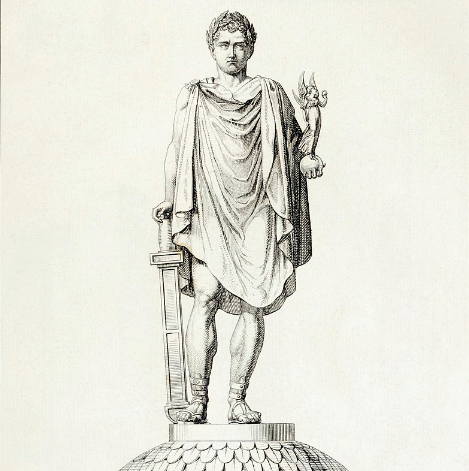
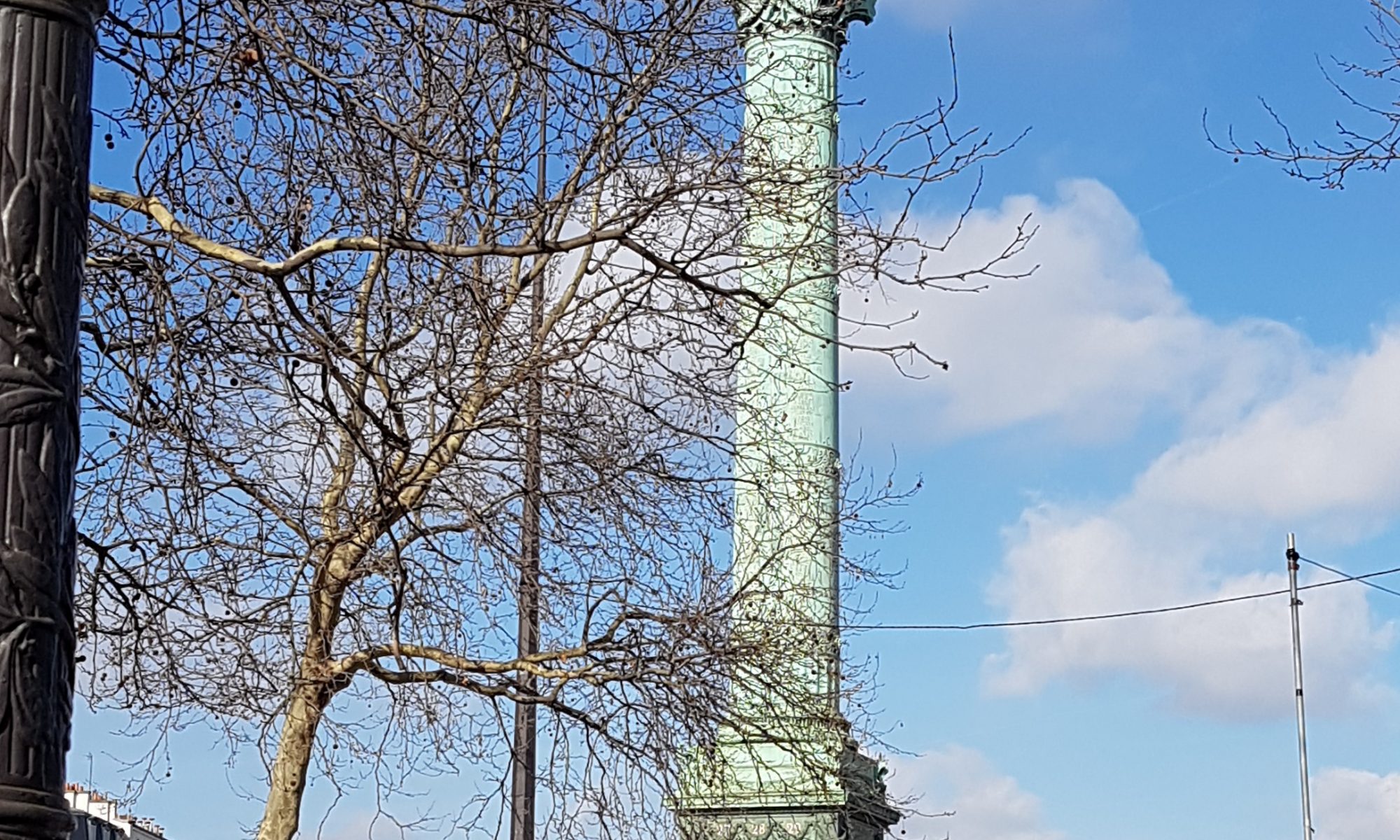
In 1806 Napoleon ordered the building of a huge column in the centre of the square to celebrate his military victory at Austerlitz. Ironically this military monument was situated at the end of the Rue de la Paix. Inaugurated on August 15 1810 it was covered in bronze plates featuring battle scenes made, it was said, from melting down foreign captured cannons.

Napoleon was put on top in Roman Emperor robes with a gold laurel wreath on his head. This lasted until April 4 1814 when the invading allies pulled Napoleon’s figure down. Four days later the white Bourbon flag fluttered over the renamed square.

In 1816 the Louis XVIII Restoration government melted Napoleon’s statue down to use its bronze for a new Henry IV statue on the Pont Neuf

For the following 15 years the position at the top of the column was not filled. But in 1833, after a Bonapartist demonstration on May 1 1831, the new King Louis-Philippe (the son of the executed Duke of Orléans, Philippe Égalité, a supporter of the French Revolution and a regicide), replaced Napoleon at the top. This time, however, not dressed as a Roman emperor, but as an army corporal, reflecting the new king’s desire to honour Napoleon, but not too much.

Napoleon did still not appeal to the revolutionaries of 1848, who took the corporal down and threw him into the Seine. Replacing the corporal did not appeal to nephew Louis Napoleon Bonaparte either. His third (and finally successful) military coup d’etat in 1851 led him to proclaim himself Napoleon III, Emperor of the French. In 1864 he placed a copy of the original Napoleon as Emperor statue back on the top of the column.

Karl Marx wrote one of his best political commentaries on contemporary events in 1852: The Eighteenth Brumaire of Louis Bonaparte. In it he compares Louis’ coup of 1851 with Napoleon Bonaparte’s of 1799, and presciently concluded that ‘if the Imperial mantle finally falls on the shoulders of Louis Bonaparte, the bronze statue of Napoleon will fall from the height of the Vendôme Column‘.

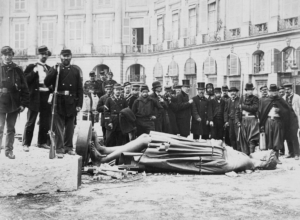
This happened on May 16 1871 during the Paris Commune after the painter, Citizen Courbet, the President of the Federation of Artists that was formed on April 15, persuaded the Commune to authorise the dismantling of the column. He described it as ‘a monument devoid of all artistic value, tending to perpetuate by its expression the ideas of war and conquest of the past imperial dynasty‘.

Courbet’s attack on the column was not universally supported by other artists. Daumier, the head of the Beaux-Arts section of the Federation, believed it should not be taken down. Perhaps this was why the 425 spiralling bas-relief bronze plates carried out by a team of 30 sculptors were removed and stored.

The column was replaced in 1874 with another copy of the imperial Napoleon at its top.

Pont Neuf

Arrondissement 1

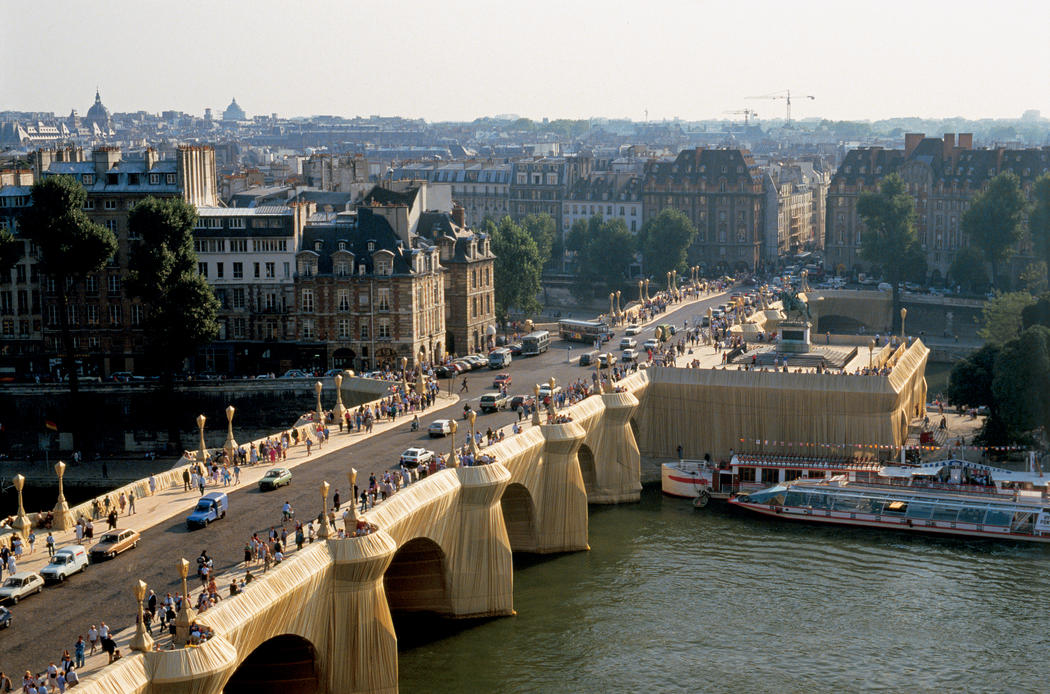
The oldest bridge in Paris, the Pont Neuf was its first bridge without houses and constructed entirely out of stone. It was also unique in having pavements and bastions to protect pedestrians from mud, horses and carriages. Hence it was always called ‘the New Bridge’.

Initial plans assumed it would be paid for by the owners of the houses built on it, as happened on the other mid-16th century bridges shown here in 1651. But it was eventually paid for by the founder of the Bourbon dynasty, Henry IV.

Building had begun in 1578 under Henry III, but was interrupted by the religious wars of 1588-1598 which, after Henry III’s murder, were finally ended by Henry IV’s conversion to Catholicism and his successful seige of Paris.

The bridge was finally completed in 1607. three years before Henry IV was assassinated by a Catholic opponent of the Edict of Nantes, guaranteeing religious liberty in France.

Henry IV’s widow, Marie de Medicis, ordered the erection of a statue to Henry IV to be erected on the bridge at the point where it crosses the Île de la Cité. The statue was finally put in place in 1614. It stood there until evidence appeared in 1792 during the French Revolution that the Bourbon king Louis XVI was corresponding with the Austrians encouraging them to invade France. It was then pulled down, the day after a similar fate happened to statues of Louis XVI.

In 1818 after the restoration of the Bourbons, Louis XVIII ordered a new bronze statue to be erected in the same place. It was claimed to have been made from a surviving original cast, although it is quite unlikely that one survived. The

The bronze for the new statue came from melting down two recent statues: the giant imperial statue of Napoleon on top of the Vendôme column and the statue of the French revolutionary general Louis Desaix on the Place Dauphine. Desaix was an aristocrat who had served in the Bourbon army before the Revolution who then supported the Republic and was killed in action in Italy in 1800. He was a model for the aristocratic but humane Republican general Gauvain in Victor Hugo‘s last novel, 1793.

The sixteen year old Victor Hugo joined a huge crowd cheering on the replacing of the Bourbon statue on the bridge. The next year he wrote a prize-winning poem celebrating the moment. It included the lines: Make no mistake, this august image’s aspect / Will lessen our ills and sweet our happiness.

On May 24 1871 a Versaillais agent was executed in the second niche from the right bank for accusing the Polish General Jaroslaw Dombrowski , the Commander in Chief of the Commune forces, of treachery. Dombrowski had been killed the previous day on the barricades.

Early in 1943 under the German occupation Marcel Rajman, the 19 year-old Jewish Communist member of the FTP (Francs-tireurs et partisans), held his first meeting with the leader of the FTP-MOI, the Armenian Missak Manouchian, in the fourth niche near the statue of Henry IV. Both were eventually caught by Vichy Government’s Brigades Spéciales and shot with 20 other resistance fighters on February 21 1944.

Rue Cujas

Arrondissement 5

Numbers: 11, 16, 17, 22

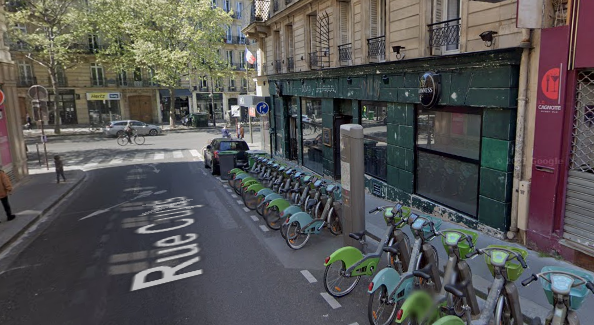
Named after the 16th century lawyer, Jacques Cujas, who exceptionally refused to take sides in the century’s religious wars, the road runs next to the Sorbonne’s law faculty. Close to the Pantheon it was the scene of barricades in June 1848 and of particularly fierce fighting around ones erected during the bloody week that ended the Paris commune of 1871.

During the first decade of the 20th century the French police archives record that many exiled Russian revolutionaries. particularly those from Georgia, used to hang out at the restaurant at No. 11.

In the early 19th century the painter Jacques-Louis David had a studio in the closed and ruined Cluny College (roughly number 16) where over the following two years he painted Napoleon crowning himself in 1805.

On May 1 1898 Charles Péguy, Lucien Herr and Georges Bellais set up a socialist bookshop and publisher at No. 17. It became the headquarters of the Dreyfusard supporters. Within a year Herr had brought several other socialists together to form the Bookshop and Publishers New Society there. Those involved included Léon Blum, Hubert Bourgin, Albert Monot, Mario Roques, Désiré Roustan and François Simiand.

Number 22 is a café, now called the ‘Mad Maker’. Back in 1830 it extended to the corner of Boulevard Saint Michel and was called the Café Musain. This was where Auguste Blanqui organised the Société des Amis du peuple (The People’s Friends), the insurrectionary group that played a role in the July Revolution, les trois glorieueses.

When Victor Hugo wrote Les Misérables, he used this revolutionary sect as a model for an equivalent group behind the 1832 insurrection, the Amis de l’ABC. Their initiative, to begin the insurrection by raising the red flag during the funeral procession of the Republican leader General Lamarque, on June 5 1832, saw several hundred killed in just a few hours.

Rue de Clichy

Arrondissement 9

Numbers: 21, 24, 39, 43, 54-68, 55

The present road follows almost exactly the old Roman ‘road to the sea’ to Harfleur (Caracotinum) in Normandy from Paris (Lutèce), and is named after the commune of Clichy to which it leads, some 6 km northwest of Paris.

Victor Hugo lived on the fourth floor of No 21 from 1874 to November 10 1878. He wrote his last great novel, Ninety-three, there before moving to the Avenue d’Eylau to live next door to his son’s widow and her children.

Between 1804 and 1806 Hugo had also lived with his mother (with frequent visits from her lover Lahorie) and two brothers at No. 24. In 1807 Sophie and the three boys undertook a long journey to Naples to see her officer husband, but where they spent one night before returning to Paris and moving into a fourth-floor apartment in the former monastery in the Rue des Feuillantines in February 1808.

The Clichy prosecutor, Bulot, lived on the second floor of No. 39. Bulot had called for the death penalty against three anarchists who had been shot at by police in Clichy after protesting the May 1 1891 mass shooting of 8-hour day demonstrators at Fourmies. After the trial led to two of them being given prison sentences of five and three years, Ravachol, an anarchist and burglar, left a bomb outside Bulot’s door at 8 am on the morning of March 27 1892. The bomb exploded a few minutes later wounding seven people and destroying the flat. Ravachol was arrested on March 30 and executed on July 11 1892.

The deputy for the Ain department from May 1849, a former army doctor who treated the poor, Jean-Baptiste Alphonse Baudin, lived at No. 43 during the Second Republic. He was one of several deputies who accompanied Victor Schœlcher to the barricade in the Saint-Antoine district to try and persuade soldiers from supporting Louis Napoleon’s seizure of power on December 2 1851. That was where he was shot dead, becoming a symbol of republican resistance to despotism. Buried secretly in the Montmartre Cemetery (27th division), Baudin’s remains were transferred to the Pantheon on August 4 1889, part of the celebrations of the centenary of the 1789 French Revolution.

The Clichy prison, known as the Debtors Prison from 1834 to 1867, was situated between Nos. 54 and 68. The private mansion originally at No. 54 was where the Royal Coach was hidden before taking Louis XVI and Marie-Antoinette to Varennes on their failed escape attempt of June 20 1791.

The Communard Sidonie-Marie Herbelin lived at No. 55. She was sentenced to deportation to a fortified prison in New Caledonia on May 13 1872. Witnesses said she had been carrying a red flag while encouraging others to loot the home of an absent Versaillais policeman. She was deported on the same boat as Louise Michel, but never returned to France, dying on March 24 1875.

Rue de la Roquette

Arrondissement 11

Numbers: 1, 17, 34, 75, 143-147,151

Probably named from the 15th century after the rocket plant that used to grow extensively hilly and rocky area, it became the place where many wealthy people built homes to be close to the capital.

The Roquette prisons were opened in 1830 and finally closed in 1974

A barricade from No 1 across the road to the Rue du Faubourg St Antoine saw bloody fighting on May 26 1871 when the defending Communards were attacked by the Versaillais soldiers. Their prisoners were systematically executed.

Another barricade crossed to the Rue Neuve de Lappe from No. 34. This was one of the very first barricades set up on the morning of March 18. In total 78 barricades were constructed in just the 11th arrondissement during the Commune.

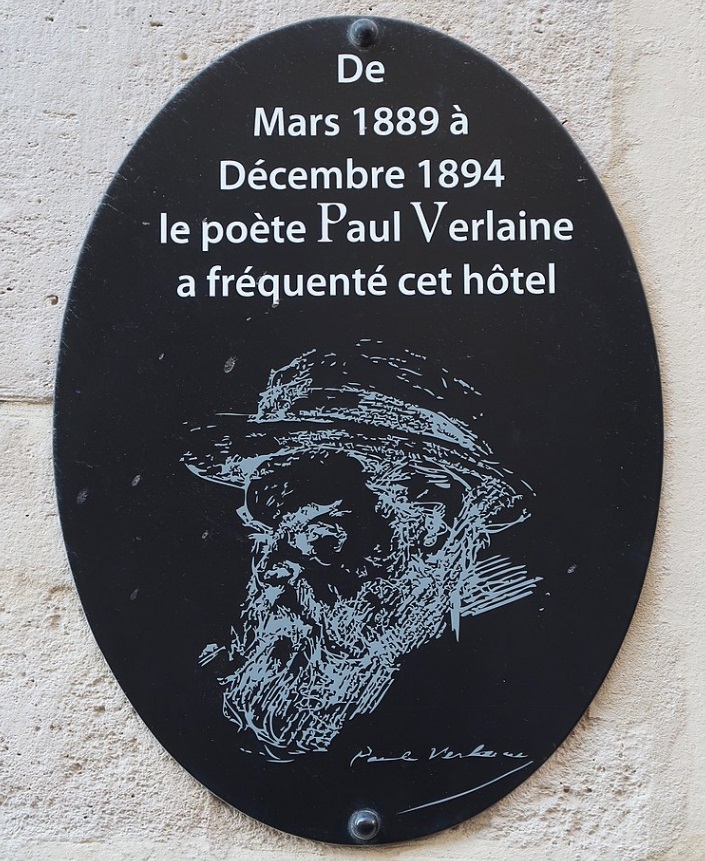
Paul Verlaine lived with his mother on the 5th floor of No 17 from 1883 to 1896, writing ‘The accursed poets’ there, first published in 1884 and then extended in 1888. In it he called the tribe of poets ‘the race that will always be cursed by the powerful ones of the earth‘.

The office of the Federation of French Workers’ Theatre was based at No 75 in 1931. It saw itself as a propaganda tool for the French Communist Party and its trade union organisation, the CGTU.

The Little Roquette Prison at Nos 143-147 was initially for young prisoners and became a women’s prison in 1932 . Outside its walls four of the Commune’s hostages were executed on May 27 1871. Later, after the suppression of the Commune this was where hundreds of young Communards taken to the prison were then executed.

On 25 February 1961 six Algerian and French supporters of the FLN escaped from the Little Roquette during the Algerian War. The escape was organised by Michel Pablo, the Greek Trotskyist who spent most of his life in France.

Hubertine Auclert, the editor of the Womens’ Suffrage Society paper, La Citoyenne, lived at No. 151 from 1892 to 1914.

Key dates 1831-1847

Chronology from Le Maitron of key dates in French labour history

Author: Stéphane Sirot, additional material by Michel Cordillot, René Lemarquis and Claude Pennetier with Steve Jefferys (italicised)

1831

January 15 Blanqui and other student leaders are arrested for organising violent demonstrations near the Sorbonne and judged by its Academic Council.

February 8 The clockmaker Charles Béranger‘s ‘A proletarian’s petition to the Chamber of Deputies’ was published by Le Globe, established by Pierre Leroux.

February 14-15 Anticlerical and anti-Bourbon riots take place in Paris after a Legitimist commemoration of the murder of the Duke de Berry at the Saint-Germain-l’Auxerrois church opposite the Louvre. This was occupied by republican demonstrators who then marched on the Archbishop’s palace near Notre Dame, pillaging and wrecking it. These riots were followed later in provincial France.

March 2 Republican riots break on in Paris after the acquittal of prisoners charged with infringing restrictions on press freedom. Protesting workers march on the Palais Royal, the Louvre and on the Town Hall. The Russians eventually take Warsaw on September 8.

March 9 Republicans riot in Paris on hearing the false news that the Russians had seized Warsaw. The windows of the Russian Embassy were stoned and the crowd sang the Marseillaise.

March – June Demonstrations take place against the introduction of machines in factories in Nantes, Saint-Étienne, Bordeaux and Le Havre.

April 6-10 Trial of 19 republican members of the Friends of the People Society, including Godefroi Cavaignac, arrested during the December 1830 riots. They are all acquitted by the jury on April 15/16, giving rise to several working class demonstrations.

April 9-12 Riots of Lyon silk workers (canuts).

May 5 A Bonapartist demonstration takes place at the Place Vendome on the anniversary of Napoleon’s death.

June Serious rioting in the Saint-Denis district resulting from the tough economic situation. The repression was very severe with many victims.

June 1 The Philanthropic Society of Parisian Working Tailors is established.

June 14-16 Riots in Paris put down by the National Guard and regular soldiers. Particularly heated fighting takes place in the Faubourg Saint-Denis and Boulevard Bonne-Nouvelle.

July 14 Working class riots. Republican attempt is made to plant an Equality Tree in the Place de la Bastille, at the Pantheon, in the Place de Grève and in the Place de la Concorde. The more than 1,500 demonstrators are dispersed by police dressed in disguise as workers. The publication Au Peuple is seized.

September 7 1,500 textile workers organise a demonstration, followed by riots in Paris that don’t end until September 17.

October The Saint-Simonian manifesto is published with a big propaganda campaign in the provinces.

October 30 The first issue of the Factory Echo (L’Écho de la Fabrique) appears in Lyon.

November The Saint-Simonians split. The most faithful will follow Prosper Enfantin to Egypt. Others, like Abel Transon and Jules Lechevalier, publicly turn to Fourierism.

November 14 Philipon draws and then publishes a cartoon of King Louis-Philippe as a pear. He is charged with ‘insulting behaviour towards the king’.

November 20-22 The Lyon silk workers revolt; the negotiations conducted by the prefect fail; an insurrection takes place. Hard repression led by Marshal Soult with 10,000 troops takes place and the revolt finally ends on December 3.

December 15 Daumier‘s cartoon of Louis-Philippe Gargantua is published in La Caricature.

1832

January 10-12. Trial of “The Fifteen” leaders of the SAP (Societe des Amis du Peuple). The accused (Auguste Blanqui, Bonnias, François, Guillaume Gervais, François-Vincent Raspail, Antony Thouret) defend themselves; they are found guilty and sentenced on 27 February, Blanqui was sentenced to a year in prison. The SAP was officially dissolved but it continued its activities.

February. Several newspapers are put on trial. A workers’ commission is set up within the SAP made up of Auguste Caunes senior, Gaussuron-Despréaux, François Sugier). Pierre Leroux and Jean Reynaud take over editorship of the Revue encyclopédique, organ of the neo-Saint-Simonians

February 6 The first cholera epidemic victim dies in Paris.

February 23 Daumier is sentenced to six months in prison and fined 500 francs for his Gargantua cartoon.

February 26 Chopin gives his first concert in Paris in the Pleyel‘s salon in the Rue Cadet.

March 29. Official announcement of a cholera epidemic in Paris.

April 1 Revolt by prisoners at Sainte-Pélagie, supported by several sections of the SAP. One death. A protest by Parisian chiffoniers (rag collectors) begins against the official collection of refuse introduced by the authorities to try to halt the spread of cholera.

April 20 Leroux’s newspaper Le Globe ceases publication.

End April. Commissions for the Rights of Man are set up within the Friends of the People Society (SAP).

May 16 The banker, mine owner and President of the Council of Ministers (Prime Minister) since March 13 1831, Casimir Perier, dies of cholera. He had visited ill patients in Paris’ principal hospital next to Notre-Dame, the Hotel Dieu. A conservative right-winger who had tried to keep Charles X in power he had accepted the position of prime minister only after Louis-Philippe had agreed to allow him to have more freedom of manoeuvre in government than the king.

June 1 Jean-Maximilien Lamarque dies of cholera at his house in the Rue St Honore. Promoted to General by Bonaparte in 1801, he again served with him during the Hundred Days of 1815. Exiled until 1818, he supported the liberal opposition to Louis XVIII and then Charles X. Elected a deputy in 1828, he reluctantly accepted the July Monarchy. His reputation was as someone who had fought both for the Republic and the Empire.

June 2 A large gathering of members of the Friends of the People (SAP) takes place at the funeral of the 20-year-old republican who posthumously become known as one of France’s leading mathematicians, Évariste Galois. He had been mortally wounded in a duel, and was buried in Montparnasse Cemetery.

June 5-6. Popular insurrection in Paris on the occasion of the funeral of General Lamarque. The last group of insurgents fight heroically around the cloisters of Saint-Merri in the Rue de St Martin. Casualities are very heavy: at least 150 are killed on the side of the insurgents, more than 400 are wounded and more than 1,500 arrested; 134 deaths and 326 wounded on the side of the police. A state of siege is declared in Paris that lasts until June 29.

Summer. Birth of the Society for the Rights of Man (SDH).

August 15 The first issue of La Femme libre (the Free Woman) appears. It was an answer by working class women to the Saint-Simonian ‘silence’ on the women’s question imposed by Prosper Enfantin. ‘Written and published by women’ from No. 17 Rue du Caire, it only gives the first names of one founder and one editor, .Jeanne-Désirée (Véret-Gay) and Marie-Reine (Guindorf). One other name appears in the single article in the first issue, that of Jeanne-Victoire (Deroin), a washerwoman who had become a teacher. Thirty-one issues of the paper appear until it ceases publication in 1834.

August 27 Daumier is imprisoned in Sainte-Pélagie.

August 27-28 Trial of the Saint-Simonians in the Court of Assizes in Paris for organising an illegal association and of publishing material offensive to public morality. Prosper Enfantin, Michel Chevalier and Charles Duveyrier are sentenced to one year in prison. Enfantin and Chevalier are imprisoned in Sainte-Pelagie on December 15.

October 23-31 Trial of the 22 charged with fighting on the barricade at cloisters of Saint-Merri. Charles Jeanne, who had been awarded the July 1830 decoration for his part in that insurrection, told the court he took full responsibility for his actions. He was sentenced to be deported, but instead, after being moved successively between various prisons he died in 1837.

November-December  Several groups of Saint-Simonian missionaries (40 altogether) move from Paris to Lyon to build a ‘workers peaceful army’ there.

December 1 Charles Philipon sets up Le Charivari, an illustrated daily satirical paper that later served as a model for Punch.

December 15. Opening of the trial of “The Association of Rights” against the SAP (Friends of the People). The SAP is definitively dissolved, but the acquittal of the accused enables it to survive for a little longer.

1833

January 25  La Tribune publishes a list of five great ‘patriotic’ (Republican) associations in Paris, including the Society of the Friends of the People (SAP) and the Society for the Rights of Man (SDH). With the exception of the Société Aide-toi, le Ciel t’aidera (Help yourself, God will help you) distant from the workers’ movement, the other associations for free public education and for press freedom played a significant part in encouraging republican ideas in working class areas of Paris.

February 1  Already imprisoned in Sainte-Pélagie for having published four lessons of a course on the history of France from 1789 to 1830 that ‘attacked the authority of the King, spread hatred of the government and of a class of people, calling for civil war and the pillage of private property and for an insurrection’ Albert Laponneraye publishes his Lettre aux prolétaires. It wil be followed by Deuxième lettre aux prolétaires dated 26 March. (The first of these letters will see the author be condemned on 27 June following). As a result he was only finally released in June 1837.

May 17-27  Insurrection of the Anzin coalminers after the launch of their ‘Four Sous’ strike which is put down by the army.

July 28 Napoleon’s statue is put back on top of the Vendome column.

September 1 Étienne Cabet publishes the weekly newspaper, Le Populaire that appears until October 1835.

September-October  Reorganization of the Société des droits de l’homme (SDH) with the far left ‘Montagnards’ becoming predominant after several months of internal conflicts. These were between the ‘Girondists’ (following Francois-Vincent Raspail) and the “Montagnards” (following Napoleon Lebon).

Within the Society, a Propaganda Committee in charge of education and organisation of workers, is founded. It gathers Neo-Babouvists like Lebon, Buonarroti and Marc Voyer d’Argenson, as well as workers like the tailor Alphonse Grignon and shoemaker Zael Efrahem.

Several of its members will be imprisoned in November as ‘instigators of combinations of workmen’. Important movements of the carpenters in Paris, tailors (who create a “national workshop” to provide work for the strikers), shoemakers and bakers. Creation of a Lyons section of the SDH. The SDH publishes its “Manifesto” in the La Tribune. Publication of Reflections of a Tailor by Alphonse Grignon, and On the Association of Workers of all Trades by Efrahem.

October 1  Creation of the Philanthropic Society of Tailors in Nantes. It will play an important part in the creation of a network of correspondents from Brittany to Bordeaux, as in Marseille. Its leadership were arrested and organisation destroyed on 20 February 1837.

December 11-22. “Trial of the 27” leaders of the Société des droits de l’homme (SDH) including Raspail are accused of having planned a riot in July to mark the third anniversary of the “Three Glorious Days.” They are all acquitted.

1834

1834 saw the founding of an Association of Goldsmiths that survives until 1873.

January 25 A republican François-Charles Dulong caustically heckled another deputy who was defending the government’s military severity in a debate in the Chamber of Deputies. Four days later he was mortally wounded in a duel in the Bois de Boulogne. His funeral at Père-Lachaise was attended by large numbers of republicans.

February 2  The first and only issue of Auguste Blanqui’s newspaper, Libérateur, appears.

February 14-24 A solidarity strike of workers who were members of mutual aid associations takes place in Lyon following wage cuts for coat makers. The general strike lasts approximately 10 days. Seventeen master silk weavers and three apprentices are arrested.

February 16 A law is passed suppressing town criers unless they had prior permission from the local authorities.

February 20-24 After a new press law and the suppression of unofficial town criers is passed, scuffles take place at night with the police in Paris, especially in the workers’ districts of Montmartre, Montorgueil, Saint-Martin, Bonne-Nouvelle and the Faubourg Saint-Denis. In the Place de la Bourse, one man is killed when the police and cavalry break up a demonstration.

February 22  Towards the end of the general strike in Lyon, a law is passed prohibiting associations organised in branches of less than 20 persons.

February 25 Nearly all the members of two republican clubs (Gracques and Cincinnatus) are arrested at the Café des Deux Portes on the Boulevard Saint-Denis. the next day saw the arrests of 73 members of the Society for the Rights of Man.

February 28 Étienne Cabet is sentenced to two years jail for breaking the press laws. For the next five years he lives in Britain.

April 6 A funeral procession in Lyon of a protestant master workman is followed by nearly 10,000 people.

April 9-14 After wages are lowered in response to falling demand, an essentially working class  insurrection breaks out in Lyon and Saint-Étienne, taking forms in Arbois, Épinal, Lunéville, Chalon, Grenoble, Vienne, Clermont-Ferrand, Marseille and Toulon.

April 10  A new law is passed limiting the right to form associations, in particular threatening workers’ mutual aid societies. It requires them to get official approval and only permits their existence if they are split into associations with fewer 20 members.

April 11 A massacre takes place in the rue Projetée in Lyon. More than 300 are killed and 600 wounded in Lyon with over 500 arrests during the insurrection.

April 12 150 republicans, including the leadership of the SDH, are arrested in Paris. La Tribune newspaper does not appear again until August 11.

April 14 Troops carry out the massacre of the Rue Transnonain. Riots are quickly repressed with very heavy causalities. Scores were killed in Paris and of the 2,500 arrested across France, half are in Paris.

June-September  Disorder and revolts in Sainte-Pélagie prison.

July-August.  Creation of the Société des Familles by Hadot-Desages, probably while he was imprisoned with other member of the SDH at Sainte-Pélagie, where he had recorded his profession as ‘proletarian’ . In order to avoid mass arrests of republicans in future, each ‘family’ had only five members, and only its head would know the heads of another family. It soon had between 900 and 1,600 members in Paris, including workers, students and some National Guard volunteers.

July 28 The Vatican adds the songs of Pierre-Jean de Béranger and Victor Hugo‘s Notre-Dame de Paris to the Catholic Index of forbidden books. The Index was begun in 1559 and was finally abandoned as an obligation on Catholics in 1966. Among others who were put on the list and who feature in LeftinParis are De Beauvoir, Sartre, Sand, Proudhon and Zola.

October 8 Raspail publishes the first issue of Réformateur.

1835

February 6 Members of the House of Lords (Chambre des Pairs) sign arrest warrants for more than 420 republicans over the 1834 insurrections. Defence committees are set up in Paris (Godefroi Cavaignac, Guinard, Auguste Blanqui, Vignerte…) and in Lyon (Baune, Lagrange, Caussidière…). There are disagreements between those taking a traditional defence (Jules Favre, Ledru-Rollin) and those who want to use the trial to build a movement.

April 17 The list of the lawyers chosen by the defendants appears in the press.

5 May  The ‘monster trial’ begins before the court of the Chamber of Peers. 121 are charged, of whom 59 are from Lyon, 5 from Saint-Etienne and the rest from Paris. after the withdrawal of charges, according to the Tableau drawn up by Caussidière. The defendants meet at Auguste Blanqui’s apartment.

May 8  A letter with several signatures defending the accused is published by the republican Ulysse Trélat who, with others who had defended the accused, was then tried by the court of the Chamber of Peers on May 29.

June 4  The sentence of the Chamber of Peers on Trélat is three years imprisonment, while Michel de Bourges. who had redrafted the letter first drafted by George Sand, is given one year.

July 13  The Society of Families organises the escape from Sainte-Pélagie prison of 25 to 27 prisoners accused of leading the 1834 insurrection.

July 28 Joseph Fieschi is arrested after an attempt to kill Louis-Phillippe on the anniversary of the 1830 Glorious Revolution. He missed the King but killed 18 others. His accomplices, Theodore Pepin and Pierre Morey, were dedicated republicans. All three were guillotined on February 19 1836.

August 13 The Chamber of Peers court convicts 72 (of whom 22 in their absence) with the sentences announced over the next five months.

September 9  Three laws are passed to ensure the security of the state. Called the September laws they strongly restrict the freedom of the press and the theatre to make any comment that could encourage attacks on the king or the government, making it an offence to declare oneself a republican. They increase the powers of the prosecutors in cases of rebellion or of holding illegal weapons and reduce the two-thirds jury majority needed to find accused people guilty to a simple majority of 7 to 5.

December 7 and 28 The Chamber of Peers court convicts 25 of the accused from Lunéville, Saint-Étienne, Grenoble, Marseille, Arbois and Besançon.

1836

January 23 The ‘monster trial’ finally ends with 40 Parisian republicans found guilty by the Chamber of Peers.

February 19  Fieschi, Pépin and Morey are guillotined.

March 8  The government uncovers an ‘Explosives Conspiracy’. Eustache Beaufour is arrested with five other republicans in the Saint-Marceaux district while making gun powder. Two days later Armand Barbès and Auguste Blanqui are arrested followed by another 200 republicans.

June 2 A secret gunpowder store in the Rue Dauphine is raided and several members of the Society des Familles who were making cartridges were arrested.

July 11 Louis Alibaud, a militant republican, is executed for an attempt to kill the King on June 25.

August 2-11  The ‘Explosives Conspiracy Trial’ of 43 Family Society members takes place, ending with Armand Barbès, Auguste Blanqui and Beaufort being sentenced to two years in jail.

October 17-23 Most of those convicted in the ‘Explosives Conspiracy Trial’ have their appeals rejected.

December 27 A 22-year-old republican Meunier shoots at Louis-Philippe but misses. His plea for mercy is accepted by the King in April 1837 and he is exiled to the United States.

1837

January 6-18 The jury in the trial of those who had supported the failed October 30 1837 uprising in Strasbourg organised by Louis-Napoleon Bonaparte acquits all the accused.

April-July  Republicans organise a campaign, with 7 posters from the ‘Printworks of the Republic’. The first was called ‘To the People’ (Au Peuple). They announce the Reorganization of the Société des Familles into teams called ‘Pelotons’

May 8 An amnesty is granted to political prisoners to mark the marriage of the King’s son, the Duke of Orléans. Those convicted in their absence or who had escaped prisoners are excluded.

June The clandestine republican Family Association (Société des Familles) is replaced by the Seasons Association.

August 7 The 17-year-old Eugène Fombertaux is arrested for putting up the seditious poster, To the People, calling of a workers’ uprising and announcing the imminent appearance of the Moniteur républicain.

November  First issue of the Moniteur républicain appears. It is dated ‘3 frimaire an XLVI’ according to the Revolutionary Republican calendar The 8th and last number was published in July 1838.

December  A plot against the government is uncovered involving Seasons Association members Aloys Huber, Jacob Steuble and one of the leading women republicans, Laure Grouvelle. Convicted on May 25 1838, Huber is sentenced to deportation. The others to five years in prison. Steuble commits suicide at Mont-Saint-Michel prison on December 30 1838; Grouvelle eventually goes from prison to being held in a lunatic asylum that in 1844 also held Auguste Blanqui, but where she dies.

1838

August 24 The Paris municipal police is set up. It comprises 1,444 men and 432 horses with its object the maintenance of order in Paris and the repression of riots and uncovering of anti-government plots.

August-September. Publication of four numbers of L’Homme libre, followed by the arrest of Antoine Fomberteaux and of the printers Eugène Fombertaux, Jean-Baptiste Guillemin and Lecomte Minor, who was sentenced to five years at Mont-Saint-Michel in June 1839.

1839

May 12-13  An attempted insurrection led by Armand Barbès, the printworker Martin Bernard and Auguste Blanqui through the Société des Saisons fails. Barbès, who was wounded in the fighting is arrested; the other two manage to elude the police until June 21 and October 14 respectively. There were 77 killed and at least 51 wounded on the side of the insurgents, 28 and 62 on the other side. More than 750 republicans are brought to trial.

June 11-July 12  The trial takes place of the first 19 of the May insurgents. Faithful to the Carbonari and secret society traditions, Armand Barbès and Martin Bernard refuse to defend themselves. Bernard is condemned to deportation and Barbès to death. Without his knowledge, Barbès’ sister gets the commutation of his sentence from the king to forced labour for life and then on December 31 to deportation .

October 14  Blanqui and five others are arrested. Charges against the five are not pursued.

November  Saint-Simonian workers (including the singer song-writer Jules Vinçard, L.-J. Vannostal, and others) set up La Ruche populaire (‘The working class beehive’) with the Fourierists (like Henri Fugère) and the ‘Democrats’ (like the worker-poet J. Gilland) although these soon withdraw from the newspaper. Its publication will be stopped in 1842, before being followed by L’Union from 1843 to 1846.

November 28 A bomb explodes near the Palais-Royal. The police already held republican suspects including Pierre Béraud who had been arrested following the discovery on October 29 of 80kg of gunpowder at another recently released republican prisoner’s house, that of Mathieu d’Épinal. The accused are sentenced to two years imprisonment for possession of gunpowder on May 16 1840.

December The Nouvelles saisons society is set up by Henri Dourille and Lucien Delahodde, a police informer.

December 4 The second trial of the May insurgents opens in the court of the Chamber of Peers.

1840

January First edition (without the name of the author) of Voyage en Icarie by Étienne Cabet. It gives birth to the Icarian utopian Communist movement that attracts increasing support leading to the decision to leave France to found a Communist colony in Texas is taken at the end of 1847.

Formation of the ‘Egalitarian Workers’, a neo-Babouvist communist tendency.

January  1 The definitive change from the old systems of measurement to the metric system (first introduced on August 1 1793, then reestablished by Napoleon on February 12 1812, and finally passed into law on July 4 1837.

January 13-31 Trial by the Chamber of Peers of 34 of the May 1839 insurrectionaries. Auguste Blanqui refuses to defend himself. He is condemned to death on 31 January. On February 1, after the intervention of his wife and without his knowledge (like Barbès and because of the precedent set by Barbès), his sentence is commuted to forced labour for life and then to deportation. He will join Barbès and the others in Mont-Saint-Michel prison.

April 27  Those tried in their absence or were prisoners who had escaped like Godefroi Cavaignac and Édouard Colombat had not been amnestied in May 1837 are now amnestied.

June 

Pierre-Joseph Proudhon pronounces his celebrated maxim: ‘Property is theft.’

An important strike movement by tailors led by André Troncin, the republican and president in 1833 of the Philanthropic Society of Working Tailors, begins against the workers’ passbook (livret ouvrier). The strike became more extensive over the following months extending to other trades. Troncin is jailed on October 14 for possessing strike funds and sentenced to five years in prison. He dies just days after his release on December 24 1845. Some 2,000 workers attend his funeral.

July 1  A communist banquet is organised in Belleville by a member of the Society of Seasons, Jean-Jacques Pillot. Police spies reported that 1,200 attended, mainly members of secret societies.

September 

The utopian Christian socialist newspaper L’Atelier, written entirely by workers influenced by Philippe Buchez, is launched. It appear regularly until July 1850.

Louis Blanc publishes his book The Organisation of Work (L’Organisation du travail) that has nine editions up to 1850. It sparks furious debates that continue right up to the end of the Second Republic.

Early September  Almost 30,000 workers are on strike against the workers’ passport, the hated livret ouvrier. Over 400 arrests take place.

September 4 A riot takes place around the Place de La Bastille with a gun shop being pillaged by unemployed workers.

September 7 Woodworkers in the Faubourg Saint-Antoine district erupt in response to the severe economic situation and meet with government repression.

October 15  Edmond Darmès, a 43-year-old communist republican, tries to kill Louis-Phillipe in his carriage on the Tuileries Terrasse. quai. Overloaded, his pistol exploded. A member of the Egalitarian Workers since 1839 he had participated in Pillot’s communist Belleville banquet. His trial highlights the existence of secret societies of revolutionary repubicans. Darmes is sentenced to death by the Chamber of Peers and executed on May 31 1841.

December 15 Napoleon’s ashes are taken to Les Invalides in the presence of Louis-Philippe and his family.

1841

March 14  Étienne Cabet relaunches Le Populaire. He had first founded this newspaper in 1833, but was exiled for five years in 1839. The paper survives until 1850, but its name is revived in 1916 by socialist opponents of the First World War, including Jean Longuet.

March 22  Following the 1840 publication of Louis René Villermé‘s report on the physical and moral state of workers in the cotton, wool and silk factories, a law is passed limiting child labour in factories. Children under the age of eight are forbidden to work in factories employing 20 or more workers, the working day is restricted to eight hours for 8 to 12 year-olds and to 12 hours for 12 to 16 year-olds. Night work (9pm-5am) is forbidden for children under 13 years, and for all ages, two nightwork hours will count as three. A child labour inspectorate is established comprising well-heeled and financially needy upper class friends of the employers.

May

Richard Lahautière launches the neo-Babouvist newspaper, La Fraternité.

July 11 The first edition of L’Humanitaire, a materialist-communist journal is launched by the hat-maker brothers turned book sellers, Jean and Gabriel Charavay. This was the first libertarian communist publication in France. The paper was supported by the former young farm workers, Jean Joseph May, and the jewelry worker Antoine Pierre Page. Page was among the 20 arrested on September 12 and jailed for six months for illegal association.

A letter to L’Humanitaire by the Robert Owen-influenced Jules Gay found by the police when they arrested Charavay attacked the historical obsessions of ‘the altar the throne, private property and the family’ and criticised anti-equality and non-fraternal Republicans for substituting the throne for a new fetish, the fatherland (la patrie). This letter was used to promote a witchhunt against all Republicans as anti-patriotic extremists.

August 1  The daily Fourierist newspaper, La Démocratie pacifique, that appears from 1843 to 1851, begins life as a newssheet appearing three times a week. It does so thanks to a wealthy British backer, Arthur Young.

September 11 300 mainly young demonstrators gather in the Place du Châtelet chanting republican anti-royalist and anti-government slogans. The demonstrations continue over the following week.

September 13  Francois Quénisset uses a pistol to shoot at the Duc d’Aumale, the fifth son of the King Louis-Philippe, who at the age of eight had inherited France’s biggest fortune. The Duke was riding at the head of his troops in the Rue du Faubourg Saint-Antoine returning from a stint in the Algerian war. Two horses were wounded. His trial in front of the House of Lords was turned into a trial of the Société des Travailleurs égalitaires (The Association of Workingmen for Equality) that he had joined in August. Condemned to death his sentence was commuted to life-long exile.

October

A petition initiated by Armand Barbès‘ sister and drafted by Fulgence Girard with the agreement of Auguste Blanqui and other prisoners protests the cell confinement regime for poltiical prisoners at Mont-St-Michel. The press campaign is picked up in the Journal du Peuple, Le National, and later La Réforme. The issue culminates in a debate in the Chamber of Deputies.

November 1  The 300-page monthly Revue indépendante  (1841-1848) based in the rue des Saints-Pères is set up by Pierre Leroux, George Sand and the art critic and theatre director Louis Viardot. In December 1842 it becomes a fortnightly publication and early in 1844 its editorial address moves to the Rue de Richelieu.

1842

November

Théodore Dezamy finishes his Code de la Communauté that is published in full the following month. Influenced by Robert Owen and Buonarroti, a critic of Fourier, he broke with the utopianism of Cabet. He was credited by Marx as having developed the most advanced theoretical work of French materialist communism at the time. Others argue that his summary arguments about property, work and the family helped convince many Parisian workers of the merits of a communist solution to their problems.

December

There is a spike in unemployment leading to some 150 000 Parisian workers having no work.

1843

May 

Six months after the success of her ‘Walks in London‘ that was dedicated ‘To the working classes’, Flora Tristan publishes L’Union ouvrière, making the case for a united working class response to capitalism. Influenced by the ideas of Fourier and Owen, she made contact with a large number of workers and with people like the song-writer Jules Vinçard and the carpenter Agricol Perdiguier. Flora Tristan was actively preparing for a Tour of France destined to popularise her project to set up local circles of the L’Union ouvrière. Exhausted, she died at Bordeaux in November 1844.

July 5  Alexis de Tocqueville reported on French prisons supporting the use of solitary confinement.

July 10  The Parisian Typographers’ Society, founded in 1839, signed the first wage agreement with the print employers association. This was effectively the very first French collective agreement.

July 29  Alexandre Ledru-Rollin funds the La Réforme newspaper. for which virtually every French leftist contributed during the mid and late 1840s. It was banned after the 1850 coup d’etat.

1844

February-December

The press campaign in support of political prisoners is buoyed by debates in the Chamber of Deputies in April and May around the prison laws. It continues until December,

February 25 The first issue of Annales franco-allemandes for which Karl Marx had moved to Paris to co-edit with Arnold Ruge is published.

March 31  A miners’ strike begins in Rive-de-Gier on the Loire as a response to an employers’ coalition aiming to reduce wages and increase working time.

April 5 300-400of the Loire striking miners try to free 17 arrested miners being transferred to another prison. The troops open fire and kill one 18-year-old miner. The strike ends after two months in a failure for the miners except in one small mine.

August 14 French occupying forces defeat the Algerians at the Battle of Isly.

October 8-14 Louis-Philippe visits Queen Victoria in England.

October 18 To counter the unpopularity of his foreign policy, Louis-Philippe grants most political prisoners limited pardons. Armand Barbès, Martin Bernard, Auguste Blanqui and some 32 others are excluded. These ‘pardons’ are, however, only ‘remise de peine‘, sentence reductions rather than a full amnesty. Those released would be denied the possibility of recovering their full rights as citizens. The government additionally hints that an amnesty would be proclaimed on November 25 when the Louis-Philippe’s fifth son gets married, although this does not actually happen.

December 9  Auguste Blanqui in the Tours hospital prison is finally given a pardon but he rejects it and it is never ratified by the Court. Blanqui stays a prisoner.

December 29  Conseils des prud’hommes ( a cross between Conciliation Boards and Employment Tribunals) are set up in Paris to over the engineering sector.

1845

January

La Réforme newspaper launches ‘The Workers’ Petition’ in the workshops of Paris.

January 9 The first issue of a communist newspaper, La Fraternité, appears in Paris. Its first editor is Brige, an activist who had been involved in the Owenite-Communist group around Jules Gay and Desiree Viret-Gary and with Flora Tristan. André Savary becomes the paper’s editor in 1846.

February 3 Marx is ordered to leave Paris because of his revolutionary activities. He moves to Brussels.

March 11 A Paris-wide employment tribunal/conciliation board (Conseil de prud’hommes) is set up in the Palais de Justice.

June 9 A strike of Parisian carpenters for a wage rise begins. For the first time, the military are placed at the disposal of the employers.

June 18-19 In Algeria General Pélissier murders a thousand men women and children by smoking them to death while they were hiding in caves in the mountainous area of Dahra on Algeria’s Mediterranean coast.

July 5 Victor Hugo, who had just been elevated to the Peerage on April 13 1845, was discovered in bed with Léonie d’Aunet, the wife of a painter who has her followed after she asks him to agree a ‘separation of they body’ – divorce still being illegal. She is jailed for adultery in Saint-Lazare prison, while Huge is released because as a peer he cannot be arrested.

October 5 Pierre Leroux publishes the first issue of the ‘Revue sociale, ou Solution pacifique du problème du prolétariat’ (A labour review, or a peaceful solution to the proletariat issue).

1846

March 30   Without being ordered, troops fire on a demonstration of strikers in front of the Outre-Furan town hall near Saint-Étienne. The strike was to get a wage increase for the miners carrying out the hardest and most dangerous work in the local pits. The official prosecutor had arrested five of the miners. Four men and two women are killed and many are wounded by the 400-500 rounds fired. The strike then spread rapidly but the movement ended nearly three weeks later.

May 22  Textile workers at Elbeuf in Normandy demonstrate calling for the destruction of machines that are causing unemployment. Since 1667 the works there had been supported by Colbert who set up the Royal Elbeuf Sheet Making Factory.

June 20-21 Troops kill three people during bread riots in Nancy.

July 

Théodore Dezamy dissolves the Communistes égalitaires. They are still arrested and tried for their views the following year.

July 29 A metal worker whose trade is making fantasy objects in steel, Joseph Henry, fires his pistol at Louis-Philippe, who was standing on the balcony of the Tuileries Palace with his family, but misses. Henry was sentenced to hard labour for life in his August 25-27 trial before the House of Lords where Hugo had spoken in favour of leniency.

August

A new economic crisis moves towards creating starvation.

September 30 Troops restore order after demonstrators in the Saint-Antoine district protest against increases in the price of bread. The protest continue until October 3. Some rioters are jailed.

October 15 Proudhon‘s ‘Poverty of Philosophy’ subtitled ‘The System of Economic Contradictions’ is published.

November 21-23  Bread riots in Tours are accompanied by the arrest of several members of workers’ unions such as Jean-François Béasse, Étienne Bonnin, Pierre Boucher, Louis Desmoulins and Eugene Vieillefond.

November 25 A potato riot takes place at Boulogne.

1847

January 13-14 Peasant riots in Buzançais (Indre) as starvation bites. A crowd seizes corn and one of them is killed by a landowner. Two of the landowners are then killed by the crowd. The government demands exemplary punishment. 26 villagers are arrested and tried between February 25 and March 4. three are condemned to death and executed on April 16. Four others are sentenced to a life of forced labour and 12 are given prison terms of five to ten years. Those jailed are freed during the 1848 Revolution.

April 26-29  Blanqui is tried at Blois for alleged involvement in the Buzançais corn riots and acquitted. But he refuses to be set free and remains in Blois, staying at a friend (Édouard Gouté) until February 25 1848 when he returns to Paris.

June 8  The democratic opposition, arguing for the extension of the suffrage, issue an initial manifesto prior to the Banquet Campaign. Having huge meals across France would enable them to get round the ban on holding political meetings by having speakers give highly political toasts.

June 27  The ‘Bakers’ Party’ riot takes place in Mulhouse after increases in bread prices. Several bakeries are pillages and several soldiers and police are hit by the crowd throwing stones. The troops open fire killing four people and wounding 11. The agitation goes on until August 9, when a trial of those arrested takes place.

July 9  2,200 people attend the first reformist banquet in the democratisation campaign held in the garden of Montmartre’s Château Rouge. Between July and December some 70 banquets are held throughout France.

July 18 Lamartine speaks at a literary banquet in Mâcon as part of the campaign.

August 31 – September 7 A week of working class riots break out in therue Saint-Honoré in Paris.

October 10 A meeting of 150 people in the office of Le Populaire votes in favour of the Icarian Constitution, and elect Cabet as their president with an Icarian Immigration Office

November 7 At a republican banquet in Lille, Alexandre Ledru-Rollin demands universal suffrage.

November 21 At a reformist banquet in Dijon, Ledru-Rollin proposes a toast to the sovereignty of the people and speaks about the symbols of ‘Liberté, égalité, fraternité’. 

PLACES

1848-1870

Second Empire, Coup d’État, pomp and defeat

Louis-Napoléon was mercilessly caricatured by Daumier and others

Coup d’état, Second Empire, Haussmann, Colonialism, Sedan, National Government – in progress

The topography of Paris changed dramatically under the Second Empire. Driven by dual needs to re-engineer whole areas to facilitate military intervention against resistors and to create and sustain housing speculation, Louis-Napoléon’s Paris prefect, Georges-Eugène Haussmann, invested public funds massively in renovating Paris.

Near the very beginning of this process, the realisation by some commercial entrepreneurs that the developing railway system made it possible to put on sale together a wide variety of national and international manufactured products and foodstuffs led to the establishment of what we now call Department stores. Huge stores that sold many different products rather than just one type of good or service catered for Paris’s growing wealthy upper and middle classes.

On November 18 1852 the Bon Marché store opened its doors on the Rue de Sèvres. With its fixed prices, acceptance of returns and advertising it revolutionised the shopping habits of well-to-do Parisians.

Four years later the second oldest surviving department store was opened on the rue Rivoli. At first it was called ‘The Parisian Bazar’, and from 1856 it was renamed the ‘Bazar Napoléon’ before the end of the Second Empire in 1870 led to its current name BHV (Bazar de l’Hôtel de Ville). In 1865 Le Printemps was opened on the corner of the Boulevard Haussmann and the Rue du Havre, close to the busy Gare St Lazare, the capital’s first railway station built in 1837.

Rue des Archives

Arrondissement 3

Numbers: 48, 58, 76

The Brasserie du Commerce and its Auger Restaurant at No. 48 were a regular meeting place for left groups in the mid and late 1930s. The Young Socialists (Jeunesses socialistes), ‘Bolshevik-Leninists around ‘Truth‘, and the Communist-dominated Secours Rouge (Red Cross) that changed its name to Secours populaire (People’s Help) all used to meet there.

It was at the Brasserie du Commerce that Marceau Pivert, Daniel Guérin and the Luxemburgist René Lefeuvre drew up the constitution of the ‘Revolutionary Left’ tendency within the SFIO on September 25 1935.

No 48 was also the place where Pivert’s new left revolutionary socialist party, the PSOP, decided to exclude the small numbers of Trotskyists including Lambert who had started to ‘enter’ it in 1939.

In 1808 the National Archives were placed in the Hôtel de Clisson at No. 58. It was built first in 1371 (its turreted gateway survives) and then acquired by the Duke of Guise who changed the name to the Hôtel de Soubise.

One of the barricades erected during the brief insurrection of May 12 1839 by the Seasons Club led by Blanqui and Barbes was based at No. 76, across the road at what was then the junction of 18 Rue du Grand Chantier with the Rue Pastourelle.

Plus d’informations

PLACES

Place de la Bastille

Arrondissements 4, 11, 12

Numbers: 12

Called after the ‘small fort’ originally built next to the St Antoine gate into Paris and then turned into a stone fort in 1370, the Bastille soon became a six tower fortress with thick walls and a moat. By 1553 it was an eight-tower fortress with a copper-bottomed moat. In the 17th century it was turned into the prison that was eventually taken by Paris’ newly-formed militia and local people on July 14 1789.

One of the wine merchants, Claude Cholat, who participated in the storming of the Bastille sketched the scene from memory a few days later

Demolition began almost immediately. Voltaire’s coffin was symbolically brought there on its way to the Pantheon on July 11 1791.

In 1792 it was decided to turn it into a huge square, the Place Antoine. The Marseillais volunteer national guardsmen arrived there singing the song that became the national anthem on July 30 1792.

From June 9 to June 14 1794 the guillotine was installed in the ruins of the fort. But after killing 73 people in less than three days the local shopkeepers complained so much (about the smell and those who had come to watch) that it was moved to what is now called the Place de la Nation, and was then the Square of the Overthrown Crown.

After the 1830 Revolution the new King Louis-Philippe decided to erect a column in the middle of the square to honour the 615 victims of the ‘Trois Glorieuses‘ Revolution – the Three Glory Days. It was inaugurated in 1840.

On April 13 1834 barricades went up in the square as local workers rioted in support of the silk workers’ insurrection in Lyon.

On February 24 1848 Louis-Philippe’s throne was taken from the Tuileries Palace and ceremoniously burnt at the foot of the July column. Three days later the 196 dead in the February Revolution were buried in the crypt beneath the column, and the Second Republic was officially proclaimed there.

On June 24 1848, when the new right-wing government announced the dissolution of the National Workshops, the Bastille square was entirely circled by barricades, and a red flag placed in the hands of Dumont’s 1836 allegorical statue le Génie de la Liberté flew briefly from the top of the July Column to accompany the flame of freedom and the broken chains of despotism.

Dumont’s statue is of a winged male god – chosen probably precisely because it was not the traditionally feminine revolutionary with a phrygian gap – in keeping with the rightward direction of the Orleans monarchy. The names carved on the column are of the dead of 1830.

A red flag flew again on top of the column on February 24 1871, when 14 battalions of the National Guard marched by in a commemoration of the 1848 revolution. The government’s attempt to replace the flag by the Tricolour on February 26 and March 9 1871 both failed.

During the 1871 Paris Commune three local sections of the International Workingmen’s Association used to meet in the Cour Damoye at No. 12.

On May 25 1871 when the Versaillais troops entered Paris the Communards tried to blow up the column by setting fire to five oil delivery barges in the tunnel that runs beneath it. This failed, and the column was also missed by shells fired at it, although nearby buildings were hit.

The Communards fought hard to defend the symbol of revolutionary liberty, but were eventually overrun by the Versaillais. During the bloody week of May 1871 nearly all were killed in the fighting or shot afterwards.

The Place de la Bastille became the symbol of left and republican resistance.

The first Parisian demonstration of Communards after the suppression of the Commune took place at the Bastille square on May 9 1880.

In 1935 two major demonstrations took place there. On International Women’s Day 1935, feminists led by Louise Weiss and Cecile Brunschvicg symbolically burnt chains of male dominance in the square.

On July 14 1935 a demonstration that brought together both Socialists and Communists marched from the Bastille to Vincennes. This was called under the name of ‘People Together’ (Rassemblement populaire) that became the Popular Front that won the 1936 parliamentary elections.

On May 29 1968, the day De Gaulle temporarily left France, the CGT trade union organised a mass demonstration against his government, shown here in a police surveillance photograph passing the Place de la Bastille

Since 1991 the Marche de les Fiertes have usually begun or ended at the Place de la Bastille. In the 21st century they have usually attracted at least half a million people. There were certainly about that number when Marian and I watched for hours as the marchers went by.

The 50th anniversary Paris gay pride march June 24 2017
The first Gay Pride march in Paris in 1981 passed through the Place de la Bastille.

PLACES

Rue du Cherche-Midi

Arrondissements 6. 15

Numbers: 37, 38, 39, 44, 47, 91

Named in 1832 after a shop sign showing a painted mediaeval sun dial with people looking for midday at 2 pm in the afternoon, the road brought together three shorter streets.

The headquarter building of the French Army War Council was at No. 37, known as the Toulouse Mansion. This was where the ‘girl next door’ Adèle Foucher was living when Sophie Trebuchet, Victor Hugo‘s mother, moved with her sons into No. 44 in 1813.

Victor (20) and Adèle (19) married on October 12 1822 at the third largest church in Paris, Saint-Sulpice, after Sophie’s premature death in 1821 removed her opposition. With very little money the young couple moved into the Foucher family apartment in the Army War Council’s linked house at No. 39 and shared the flat with them for the next 18 months.

The Cherche-Midi military prison on the opposite side of the road at No. 38 (at the angle with 54 Boulevard Raspail) had originally been the convent of the Daughters of the Good Shepherd (built on land sequestrated from a Calvinist by Louis XIV in 1688. The sisters’ religious order, whose mission aimed to house and rehabilitate up to 200 ‘fallen’ but penitent women, was suppressed at the Revolution in 1790. It then became a factory making army uniforms and then a supply depot for troops based in Paris.

It was largely demolished in 1847 although the trials of many of those arrested in the workers’ uprising of June 1848 still took place there.

A new army prison with 200 individual cells was built there in 1853. Prisoners were forced to work in silence during the day and were isolated in their cells at night. On May 30 1871 several Communard prisoners were murdered in the cellars there during the Bloody Week suppression of the Paris Commune. Those killed were mainly soldiers and foreigners who had fought for the Commune.

The Cherche-Midi Prison was also where Captain Alfred Dreyfus was imprisoned for four months in solitary confinement from his arrest on October 15 1894 to February 20 1895 when he was deported.

The French Army’s War Council used to meet on the other side of the street at No. 37 and this was where on December 22 1894 after a three day trail held in secret before the Army Council unanimously found Dreyfus guilty of treason. Since he refused to confess any guilt, the Army then ordered a public spectacle of his degrading to be held outside the École militaire on January 5 1895.

On November 11 1940 the students arrested at the Armistice Day demonstration at the Place de l’Étoile were imprisoned here by the Germans who had taken the prison over.

In a bad state of repairs it stopped being used for military prisoners in 1947, after which it was only used for military tribunals. On 22 September 1949 a demonstration outside the prison took place in support of the 16 court-martialed and jailed conscientious objectors, who refused to fight in the French army.

On September 5 1960 the court martial took place here of six Algerian FLN fighters and 18 members of the Jeanson French support network.

The prison was finally demolished in 1966 and the Human Sciences building finished in 1970, which it now shares with the School for Advanced Studies in Social Science.

Paul Lafargue and Laura Marx moved into No. 47 on December 1 1868 soon after their marriage. Karl spent six days with them in July 1869 under the false identity of Alan Williams. This address was where the couple committed suicide together in 1911.

When she arrived in Paris in 1861 from Brittany, Nathalie Le Mel worked at the Angel Entreprise at No. 91. She was one of the first women to join the International Workingmen’s Association.

Plus d’informations

PLACES

Rue des Feuillantines

Arrondissement 5

Numbers: 5, 8-12, 17

Two of France’s greatest writers are associated with this road along with a Russian revolutionary.

The road’s name dates back to the convent built in 1622 for an extremely strict Bernardine order, the Feuillantines, brought to Paris and funded by Anne of Austria at the request of Anne Gobelin, daughter of the textile dyer Gobelin family. The order, which wore a white dress and a black veil, was dissolved in the French Revolution.

As a child Victor Hugo lived from 1808-1813 in the old Bernardine (White Nuns) monastery that occupied the area between Nos. 8-12, that had been dissolved in the Revolution.

From the end of 1863 until early 1864 Émile Zola lived with his mother at No. 5.

From January 1914 until September 1916 at No. 17 Trotsky edited with Julius Martov (until he broke with it in 1915) the newspaper called successively ‘The Voice’, ‘Our Word’ and finally ‘The Beginning’. Its opposition to the First World War was followed closely by Monatte and Rosmer.

The paper was supported financially by the Bulgarian socialist Christian Rakovski (1873-1941) who was present at the Zimmerwald Conference of 1915 and was a founder member of the Communist International. Rakovski was a friend of Trotsky and was finally imprisoned and executed in Russia in 1941. Lucky man, he was rehabilitated in 1988!

PLACES

Rue des Mathurins

Arrondissements 8, 9

Number: 10, 26, 38

For centuries before 1881 its name was the New Road of the Mathurins (rue Neuve-des-Mathurins) after a farm that had belonged to Mathurin monks who took the name of the 4th century martyr, Mathurin of Larchant. This Saint was very very popular in the Middle Ages, supposedly because of his prowess in healing madness and anxiety, and was the patron saint of clowns.

Daniel Stern, author of the History of the 1848 Revolution, was Marie d’Agoult. Under the July monarchy (1830-1848) she used to host a salon at No. 10 that was frequented, among many others, by Victor Hugo.

George Sand was living at the Florence private house at No. 26 with Baron Casimir Dudevant when she gave birth to her son, Maurice, on June 30 1823. At the time it was owned by the former head chef of Napoleon. It is now a 3-star hotel called George Sand.

The Michel Theatre founded by Michel Mortier was in the basement of No. 38.

This was frequented by Aragon and Picasso who witnessed a fight there on July 6 1923 when Breton (a future surrealist) broke the arm of Tzara, the leading Dadaist .

Plus d’informations

Parisrevolutionnaire

PLACES

Panthéon, La Place du

Arrondissement 5

Place du Panthéon: 9, 10, 12, 17

The Panthéon dome (actually three in one like a Russian doll) is one of Paris’ landmarks. Jacques-Germain Soufflot’s Church of Saint-Genevieve  on the hill to the South of the River Seine was built on a grand scale between 1755 and 1790 – and being completed only shortly after the French Revolution began.

Pantheon

Almost immediately the National Constituent Assembly decided to use the model of the Roman Pantheon and to install statues of great Frenchmen in it.

The slogan, ‘A grateful nation honours its great men‘, was put over the entrance and on April 4 1791 Mirabeau became its first brief resident (his ashes were taken away on November 25 1793), followed by Voltaire (July 11 1791), Rousseau (October 11 1794) and then several executed revolutionaries, including Jean-Paul Marat (September 21 1794 – and then thrown into the gutters by the Muscadins on February 26 1795).

Rousseau’s statue in the square put up in 1889 was destroyed under the German Occupation in 1942.

Under Napoleon Bonaparte who gave it back to the Catholic Church, its crypt was stuffed with 41 mainly military figures. After the July Revolution it reverted to being a secular Pantheon on August 26 1830, but no more ‘great men’ were inserted there under Louis-Philippe who kept the crypt closed.

The square in front of the Panthéon became the meeting place for hundreds of demonstrations and pitched battles in the 19th and 20th centuries. One riot under a black flag started there on 21 December 1830 in protest against the light sentences given to the reactionary government ministers of Charles X.

On 22 February 1848 a student demonstration against the banning of university courses by Quinet and Michelet left from there for the Madeleine. Soon after the Panthéon was renamed ‘The Temple of Humanity’, with the intention of turning it into a monument to human progress. The Law School at No. 12 hosted the revolutionary Soufflot Club in March 1848.

On June 22 1848 the square was the meeting place of thousands of workers protesting the closure of the National Workshops who then organised the building of barricades and the call for an armed insurrection. It was one of the three main centres of resistance, with the barricade at the Rue d’Ulm being one of the most important.

The National Guard used canon to burst through the doors of the Panthéon on 25 June 1848 to dislodge the workers inside.

Following Louis Napoleon’s 1852 coup-d’état  the building was returned to the Church again, now the ‘National Basilica’, and the surviving bits of the nun Genevieve’s 1,350-year-old corpse stuck together in a new tomb.

From September 4 1870 the Town Hall of the 5th Arrondissement at No. 21 became the recruiting office for the National Guard defending Paris. with 12 separate offices interviewing recruits. Between 200 and 300 summary executions of Communards took place there on 24 May 1871.

The Panthéon itself was shelled during the Franco-Prussian war and became the scene of a major battle between the Communards and the Versaillais army. On 31 March 1871 a red flag was attached to the sawn off wooden cross that had been erected on top of the building on the orders of Napoleon III. Jean Allemane spoke on the steps supporting the raising of the red flag.

The Law School at No. 12 was where the ‘Democ-Socs‘, the 5th arrondissement’s Democratic-Socialist Club was based in 1870-1871. Many were massacred here on May 24 1871 as the Army burst through to attack those defending the Panthéon via a side door.

Before the ‘Bloody Week’ of the Commune a communist and atheist newspaper l’Éducation républicaine was published at No. 9, being used by a revolutionary club called ‘The Democratic Association of Masters of Study‘.

The Panthéon finally returned to its role as resting place for the ‘great men’ of France on June 1 1885, after the government inserted Victor Hugo‘s body into the crypt.

On June 4 1908 Alfred Dreyfus was wounded in an attack on him when he attended the ceremony installing Émile Zola‘s body into the Panthéon.

The Ste Geneviève Library where Lenin researched ‘Materialism and Empiro Criticism’ in 1908, was based at No. 10.

The Hôtel des Grands Hommes at No. 17 saw André Breton with Louis Aragon, Paul Éluard and others launch the Surrealist movement there on September 17 1919.

In 1920, as part of the celebration of the German defeat, Sicard was commissioned to produce an altar dedicated to the National Convention that declared the First Republic in 1792.

The space for the intended religious altar in the centre of the Panthéon was finally filled by Sicard’s secular monument to the glory of the National Convention in 1920.

On July 16 1942 the Police Station based in the Town Hall at No. 21 was used at a primary collection point for Jews being arrested for deportation by the Paris police in the entirely French-run exercise called ‘The Vel’ d’Hiv Roundup‘ (Rafle du Vélodrome d’Hiver).

In some form of recompense, on May 27 2015, Jean Zay‘s remains were transferred to the Pantheon, along with the resistance fighter Pierre Brossolette, and soli from the graves of two women heros of the Resistance who survived the occupation, Geneviève de Gaulle-Anthonioz, and Germaine Tillion.

More info / Plus d’informations

PLACES

Rue Rambuteau

Arrondissements 1, 3, 4

Numbers: 19, 54, 102, 108

Rambuteau around 1900

The road runs West to East from the Sainte-Eustache church (shown above at 6 am in the morning in 1900 looking up the road from the northern edge of Les Halles) to the Rue des Archives.

Building began in 1838 and in 1839 it was formally named the Rue Rambuteau to honour the Seine department Prefect from 1833 to 1848. Claude-Philibert Barthelot de Rambuteau who initiated its construction with the widening of streets in central Paris to 13m.

The kilometre-long east-west was conceived after the 1832 cholera epidemic had proved the case made by the hygienists to pull down many of the Paris’ narrow medieval streets. Its tearing up a sizeable area of old Paris stimulated one of the first Parisian housing speculation spikes.

One of the original Rambuteau-prescribed street number tiles (white numbers on a blue background) is still above the door at No. 58

One of the streets knocked down and merged into the road was the Rue de la Chanverrerie where, at the junction with Rue Mondétour, at approximately No. 102 Rue Rambuteau, a barricade was built on June 6 1832. This was where Victor Hugo placed the Caberet Corinthe and the death of Enjoiras in Les Misérables.

Several other barricades appeared in the road in the early days of the February Revolution and again during the June days of 1848. Fighting also broke out on December 3 1851 as some tried to resist the seizure of power by Louis-Napoléon Bonaparte. 

The cafe on the corner with the Rue du Temple at No. 19 used to be a favourite restaurant of Russian Nihilist exiles in the late 19th century. Trotsky and Lenin met there early in 1903.

On April 28 1848, after the shift against radical republicanism, Armand Barbès held a meeting of the Club de la Revolution at No. 54, the home of Citizen Furet. Barbès had set up as a more ‘moderate’ alternative to Blanqui‘s more insurrectional Société républicaine centrale, and this meeting discussed the election results and set in motion the attempted insurrection of May 15.

A personal interest of mine is that No. 108 was built on the birthplace of the adventurer cum comic poet Jean-François Regnard. On August 10 1779 his name was given to the second shortest-street in Paris next to the newly-built Odéon Theatre. This street was where my father James Jefferys (1914-1996) lived nearly half his life.

Plus d’informations

PLACES

Rue Saint-Jacques

Arrondissement 5

Numbers: 2, 10, 44-46, 54, 115-123, 158, 176, 216, 241, 260, 272, 277, 278

One of Paris’ oldest streets the road was the main north-south route through Paris under the Romans, who paved it and widened it (to half its present 20 metre width).

Use of St Jacques in the road’s name dates from the 1218 founding of a monastery of Dominican ‘brother preachers’ with a Saint-Jacques chapel. The location of the Jacobin brothers’ monastery was approximately around No. 158. It was closed in 1790 and its building gradually demolished over the first half ot the 19th century. In the early 17th century a second monastery for ‘reformed Jacobins’ was built on the Rue Saint-Honoré.

Pre-revolutonary Paris showing the Rue St Jacques from left to right with the College de Plessis, the Sorbonne University and the Jacobin monastery

The road was definitively named the Rue Saint-Jacques in 1806 and variously widened and extended out to the Boulevard de Port Royal in the 1860s and 1900s.

No. 2 used to stand with other houses and shops in front of the Saint-Sevérin church was finally pulled down in 1907 for the last road-widening.

Saint Sevérin church with about-to-be demolished houses and shops in front of it in 1907 before the road’s definitive widening at its northern end close to the Seine (and the tourists).

But on June 23 1848 workers resisting the closure of the world’s first workshops for the unemployed took shelter in the novelty shop No. 2 (not unlike the one I photographed in 2017 in the Rue des Petits Ponts a few metres away and shown here). The bourgeois armed guard entered the shop after them and massacred all of them.

A small narrow shop like this one a few metres to the north of the Rue St Jacques was the scene of a summary execution of those fighting to defend the first ever unemployment pay system.

The Saint-Sevérin church itself at No. 10 witnessed the summary execution of Communard supporters within the Church’s domed apse on May 24 1871. Many had been defending the barricade across the street at No 54 that was helping protect the Versaillais troops from attacking the Panthéon further up the hill.

Another barricade across the road at No. 195 was bypassed by the Versaillais troops and all its defenders killed on that same day during the ‘bloody week’ of the Commune.

The first student demonstration against the German occupation took place on 8 November 1940, when students gathered at the cross roads of the Rue des Écoles and Nos. 44-46 Rue St Jacques to protest against the arrest of Paul Langevin.

The Jesuit-origin Lycée Louis-le-Grand  at No 123 has helped train French ruling elites since the 17th century now includes the site of the old Collège du Plessis at No. 115.

From 1792 to 1799 the Collège de Louis-le-Grand was renamed the Collège de l’Égalité. Its alumini included Danton, Desmoulins and Robespierre, but also before the Revolution, Moliere, Voltaire, Sade and after Victor Hugo, Delacroix and Marc Bloch.

Part of the Plessis college was used as a prison, initially keeping those sent to Paris to be tried or executed by provincial towns lacking a guillotine, and then as an overflow. It was here that Babeuf met and influenced Buonarroti, Joseph Bodson (or William Bodson), Claude Fiquet, Jean-Baptiste-Antoine Lefranc, Morel, Claude Menessier, Jean-Baptiste Cazin, Guillaume Massart and Mathurin Bouin and other future members of Babeuf’s “conspiracy”. They were rounded up as Robespierre’s supporters in the summer of 1794 but used the months together to develop a more radical, communistic revolutionary politics.

The Academie d’ Absinthe café used by Arthur Rimbaud and Paul Verlaine was situated at No. 176. Absinthe was banned in 1914 in France but it remained the only European country not to allow the name to be used when it was approved by the European Union in 1988.

In 1888 Verlaine restarted his Wednesday literary meetings at the Grand Hôtel des Nations at No 216 where he was living. Later, in 1891, he lived at the dancer Eugénie Krantz’s flat at No 272 before moving to No. 187, which was where in 1893 he asked her to come and live with him.

When she came back to France in October 1910, the Bolshevik Inessa Armand first lived at No. 241 before moving to a flat next to Lenin’s in the Rue Marie-Rose.

Half a century earlier, No. 241 had also been one of the addresses where the teenage Emile Zola had stayed in 1859-1860 soon after arriving in Paris.

Zola moved to the sixth floor of No. 278 in 1864-1865 when he was 24 and worked in a bookshop. This was where his first novel, Contes à Ninon (Stories for Ninon), was published.

The school for deaf children founded by Charles-Michel de L’Épée at No 254 became a centre for revolutionary republican clubs in 1848. Those based here included: the Club des Intérêts du Peuple, the Club démocratique Ibérique and the Comité électoral démocratique du 11ème arrondissement.

The plaque at No 254 recalls the Institute’s history of welcoming pilgrims on their way to St Jacques de Compostelle in the Middle Ages, but not its revolutionary credentials in 1848.

Further south down the street is a plaque outside No 260/262. This honours Emile Durkheim, the ‘founder of sociology’, who lived there from 1902 to 1912.

The military hospital, Val de Grâce, at 277bis, now houses an interesting museum. During the First World War Apollinaire was a patient there, while Louis Aragon and André Breton first met when they were stationed there.

In 1979 the military teaching hospital in the old abbey was moved to a new building with an entrance in the Boulevard de Port-Royal. It was finally closed in 2016, after having treated people like Jacques Chirac, Nicolas Sarkozy and the Algerian president from 1999 to 2019, Abdelaziz Bouteflika. Marc Blondel died there in 2014.

Today outside the Val de Grace hospital the authorities have hung a copy of De Gaulle’s 18 June 1940 proclamation calling for the French to fight together to ‘Save France’.

Plus d’informations

PLACES

Rue de Saint-Martin

Arrondissement 3

Nos 1-2, 8, 30, 78, 135, 145, 159, 270

Delacroix shows all social classes supporting the July Revolution of 1830

Eugène Delacroix (1798-1863) showed his bare-breasted Liberty-Marianne in a Phrygian cap walking across a barricade thought to have been at 8 Rue de Saint-Martin in his iconic painting Liberty guiding the People. He wrote to his brother soon after the July 1830 Glorious Revolution:

‘I’ve embarked on a modern subject—a barricade. And if I haven’t fought for my country at least I’ll paint for her.’

Delacroix’s painting was shown in the Salon of 1831 and bought by the French government. Its intention was to hang it in the throne room of the Luxembourg Palace. But after the June 1832 insurrection it was returned to Delacroix as being ‘too revolutionary’. It was only exhibited again briefly after the February 1848 Revolution, and then next in the Salon of 1855.

John, the designer of Left in Paris, borrowed from Delacroix the bearded rifle-wielding bourgeois revolutionary and the pistol-waving working-class teenager seen on our menu pages.

Hazan (WTP) tells us that the two-day 1832 Republican insurrection that followed the dispersal of the huge crowd behind a red flag at the Republican General Lamarque’s funeral on June 5 saw the first use of artillery against Parisian insurgents. The demonstrations followed opposition deputies accusing the government of breaking its promises and refusing to support oppressed people like those in Poland.

George Sand painted by Delacroix in 1838, about the time she was working on the novel referring to Rue Saint-Martin

There were three barricades protecting the Rue de Saint Martin headquarters of the Republicans at what was then number 30. Writing a novel about the events ten years later George Sand makes this address the home of her working-class hero.

The reality was that the defenders of the 1832 barricades killed around 75 soldiers and National Guardsmen sent by Louis-Philippe. Over 90 insurgents were killed, 200 wounded and 1,500 prisoners were taken. Eighty-two people were subsequently deported.

Victor Hugo’s Les Misérables fiction places Gavroche’s death at 107 Rue de Saint Martin at the barricade with the Rue Aubry le Boucher. In his Comédie humaine Balzac (1799-1850) has the republican Michel Chrestien killed at the Rue Saint-Merri barricade across the street.

Louis-Auguste Blanqui’s first insurrectionary attempt was made in 1839 with the Society of the Seasons, and its first barricade built was across the entrance to the Rue de Saint Martin, from numbers 1 to 2 on 12 May 1839. The conspirators used to meet in a wine seller’s shop at 10 Rue de Saint Martin.

Blanqui and Armand Barbès were also present at what was probably the most important barricade erected in 1839, at number 78 Rue de Saint-Martin, the St Merry barricade. Barbès was wounded outside number 248 and arrested at the end of the insurrection.

Another barricade appeared at the beginning of Rue de Saint-Martin during the workers’ uprising against the closing down of the schemes for unemployed workers on 23 June 1848.

In July 2018 I spent a couple of days at a sociological conference at the Conservatoire des Arts et Métiers at 270-272 Rue St Martin. A 19th century costumed film was being shot there using the 19th century buildings as a backdrop, with a portable guillotine added for good measure. Strange to think that Karl Marx supposedly gave a speech there on March 5 1848 to the Central branch of the Rights of Man and of the Citizen Club immediately after his explusion from Brussels.

The Conservatoire (before 1794 the priory of Saint-Martin-des-Champs) was also the location of the National Convention organised by Ledru-Rollin a year later, on 13 June 1849, to try and stop the war on the Republic of Rome.

Further up the street, the old Molière Theatre at No 159 provided a venue for many meetings and organisations. Ledru-Rollin and Barbès were among those who held meetings of the Revolutionary Committee for the elections to the Constituent Assembly in March 1848. On November 14 1869 the Parisian Federation of Workers Societies was formed there.

During the bloody week of May 1871 the Conservatoire was fortified, and the last fighter is supposed to have been a woman defending it with a machine gun. Another barricade that saw fierce fighting was built at 145 Rue de Saint-Martin.

One of the 600 barricades built in August 1944 in answer to the FFI call to make German troop movements in Paris as difficult as possible

The street’s cobblestones again came in handy in August 1944. One photograph looking down Rue St Martin shows the barricade built outside number 135 (now next to a Monoprix shop). It was one of some 600 built in Paris after the resistance FFI (French Forces of the Interior) called for them to be built on August 19 to stop German troop movements.

Today, the left side of the street exists no longer: it was demolished to make room for the Beaubourg (Pompidou Centre) as was the 1832 battleground of the Rue Saint-Merri. From barricades to shopping opportunities.

But at least there is still some art nearby – although as Hazan (WTP) reminds us, the architects’ original democratic, accessible concept for Beaubourg “for people to meet here, in a certain everyday way, without having to pass through a gate and being checked like in a factory” has now been ‘renovated’ out of existence. Today access is only for ‘the right class of people’.

PLACES

Boulevard Saint-Michel

Arrondissement: 6

Numbers: 31

In 1842 Gustave Courbet‘s first workshop was at 89 Rue de la Harpe which, after the Southern part of the Rue de la Harpe was knocked down, was approximately at the location of 31 Boulevard St Michel. This was where Courbet got to know Proudhon.

One of Baron George Haussmann’s objectives in tearing up much of old Paris after the 1848 Revolution was to try and eradicate the possibilities of street barricades and open resistance, or at least to ensure that the army and police would find suppressing it easier. The Latin Quarter and its student and poor working class inhabitants were a key target.

Hazan (IOP) quotes Haussmann as acknowledging his aim was to restructure Paris ‘strategically’:

“I read, in a book which enjoyed great success last year, that the streets of Paris had been enlarged to permit ideas to circulate, and, above all, regiments to pass. This malicious statement (which comes in the wake of others) is the equivalent of saying that Paris has been strategically embellished. Well, so be it . . . I do not hesitate to proclaim that strategic embellishments are the most admirable of embellishments.”

In 1851 Paris comprised 30,770 houses; by 1860, when he expanded Paris to include all the land within the 33km-long Thiers Wall, built between 1840 and 1844, he had already demolished 14% of them. Between 1852 and 1868 a grand total of 18,000 houses had been demolished.

Among the old narrow streets pulled down to make way for the Boulevard St Michel was part of the Rue Cujas. The Café Musain at No 22, then on the corner with the Boulevard, doubled as the headquarters of the Société des Amis du peuple (Society of the People’s Friends). This was the secret society run by Auguste Blanqui that played a part in the 1830 Revolution.

Victor Hugo in Les Misérables modelled his secret society, the ‘Friends of ABC‘ on the Blanqui club, suggesting it was their initiative to use the appearance of a red flag at the funeral of General Lamarque on June 5 1832 as the signal for that uprising.

Haussmann’s first idea for the Fountain at the Place St Michel, on the new North-South axis he had constructed through Paris, was for a giant Napoleon Bonaparte. Finally, the architect Gabriel Davioud designed the ‘Victory of Good over Evil’, with Saint Michael defeating the devil (or Louis-Napoleon Bonaparte defeating the 1848 Revolution) that was put in place in 1860, hiring nine different sculptors to sculpt its different elements.

Strategically, though, Boulevard Saint-Michel may be considered to have been more successful than the dreadful fountain. In May 1871 it took little time for the fragile barricades in the broad street to be broken.

On August 21 1944, the Boulevard Saint-Michel was again a key strategic route for the German occupiers to move their troops from the garrison at the Luxembourg Gardens to the right bank in the North.

The resistance built a barricade across it to the Café Cluny on the corner with the Boulevard Saint-Germain, on whose pavements in 1995 I first met Sylvie, a French doctoral student who became very close to me over the following two decades.

In August 1944 the strategic crossroad there quickly became known as the ‘crossroad of death’. In one account I read there was a suggestion that some Germans tied French men and women to the front of their tanks as human shields to go up Boulevard Saint-Michel.  

Insurgent Paris rarely sleeps long. On May 13 1968 ten years to the day after the Algerian generals’ coup d’état toppled the Fourth Republic, a one million strong trade union and student demonstration protesting police violence against students on the night of the barricades (May 10) marched down the Boulevard Saint-Michel and past the Place Saint-Michel over to the right bank. The following day factory occupations started to spread throughout France.

Back in London at the LSE in May 1968, we Socialist Society activists organised a sit-in in solidarity with French students and workers on the one day that week when we didn’t have exams. From the sublime …

Plus d’informations

PLACES

Rue de Vaugirard

Arrondissements 6, 15

Numbers: 1-3, 4, 7, 9, 10, 15-17, 36, 85, 86-88, 93, 102, 150, 393, 399

The Luxembourg Palace (Nos. 15-17) is the most well-known building in the old Roman road that is the longest street in Paris. The road now stretches 4.360 Km westwards from the Boulevard Saint Michel to the junction of the Boulevards Lefebvre and Victor on the inner ring-road called the ‘Petite Ceinture‘ on which route a small train used to run round Paris.

Rue Vaugirard is so well known that it also features as a possible building or hotel site in the French version of Monopoly.

The western end of the road was where, at Nos. 393 and 399 barricades were built across the street in March 1871 to prevent the Versaillais troops from entering.

The road’s name comes from the ancient village of Vaugirard, called after the mid-13th century owner of the land there, ‘Val du Girard’.

Among the tens of thousands who have lived in this old road are some who we feature in Left in Paris, often living alongside forgotten bits of left history.

The Trianon-hôtel, for example, at No. 1- 3 witnessed one of the first attacks by the resistance against a hotel requisitioned by the German army. The bombing took place on 14 November 1942 organised by the largely foreigner and Jewish Francs-tireurs et partisans – main-d’œuvre immigrée (Fighters and partisans – Migrant Workers) group.

At No. 4, then called the Hôtel Lisbonne, Paul Verlaine lived off and on between periods in hospital from 1889 to 1894.

Today the hotel boasts of its earlier desperately poor and severely ill guest, and calls itself the Hôtel Fontaines du Luxembourg.

From 1906 Jacques Prévert lived at No. 7 and went to the school next door, No. 9.

I’ve very fond memories of the Vaugirard school where my son Michael spent a happy four months when he was ten. The area has completely changed since then. The school was constantly complaining about the bourgeois dog owners who allowed their absurdly small animals to deposit all over the surrounding streets as they walked them to the Luxembourg Garden. The disappearance of less well off and younger residents has led the authorities to close the whole school down in 2019.

The only good news is that the building hasn’t been sold off to developers. In 2023 the school is being occupied by the Cité Audacieuse and the ground floor and playground of the school is being run four days a week as a cafe by a feminist collective.

Émile Zola lived in rooms at No 10 in 1866 with Alexandre Meley whom he married in 1870.

After the 5 metre high and 24km long tax wall was built under Louis XVI there were two customs posts across Rue Vaugirard. One was at No. 102 and another (la barrière du Maine) from Nos. 111-132. While unused during the Revolution, they were reinstated after the 1815 Restoration and only finally largely demolished in 1860 with the expansion of Paris to the Thiers walls, built in the early 1840s roughly 5km from the city centre.

Victor Hugo and his wife Adèle lived together at what was 90 rue de Vaugirard before the Rue de Rennes was built (after sharing with the in-laws in the Rue du Cherche-Midi). they lived from 1824 to 1827 in the bit of the road now numbered 86-88. This period of his life followed the anonymous publication of the 21-year-old’s first novel, Han d’Islande set in 17th century Norway.

In 1826 Hugo wrote and published his second romance novel, Bug Jarval, featuring exceptionally for the time a black slave insurrectionist in St Domingo as its hero who falls passionately in love with a white women.

Lenin sat for Naoum Aronson in his studio at 93 rue Vaugirard on December 10 1904. The bust was subsequently displayed in the Soviet pavilion at the 1937 World Fair in Paris.

On December 10 1904 Lenin sat for the Russian sculptor, Naoum Aronson (1872-1943) at his studio in No. 93.

When she first arrived in Paris around 1860, the feminist bookbinder and Communard Nathalie le Mel mother of three worked at Pasquier et Vigneau’s bookbinding works at No. 150 (in the 15th arrondissement).

A long way along the road was also where Michel Foucault lived, at no. 289 from 1970 until his death in 1984.

French measurements of distance

MËtre Ètalon par Chalgrin

For the real historical nerds among us, in the wall at No. 85 is an early 18th century ‘half-league stone’. The Fleur de Lys on it was removed during the French Revolution. The marker (borne) indicates the first half-league (lieue) – that is 500 toises.

A toise was the distance between a man’s outstretched arms, approximately 6 feet) or 2 Km from the entrance to Notre-Dame cathedral. 1 lieue = 1,000 toises, or approximately 4 Km. A toise is the equivalent of the fathom in English, but in France it was used both on land and at sea.

At the French Revolution France still used hundreds of different weights and measures, originally derived from Roman units where the leuga (lieue/league) was the distance that a man can run in an hour. King Charlemagne (742-814) had added the pied du Roi (the King’s foot) and the toise. The pouce (inch) was the width of a human thumb, and was 1/12th of the pied du roi. The ligne (line) was 1/12th of a pouce, and the point (Truchet point in English) was 1/12th of a ligne.

After Charlemagne the fragmentation of France and of Europe accelerated. So distances varied from town to town, with the variation in 1 league (lieue) being from 3.268 km to 5.849.

On August 4 1789 a successful resolution from the Jacobin Club at the Constituent Assembly abolished all the privileges of the Crown, including its right to determine measures of distance and weight.

In 1790 Talleyrand proposed the drawing up of a Universal Measure, and the National Assembly proposed doing this jointly with the United Kingdom, who refused.

In 1791 a law established a Commission to establish the universal measure. They decided it should be based on a quarter of the length of a meridian and gave two geographers the task of measuring it exactly. They took seven years to measure the distance between Barcelona and Dunkerque.

This exercise was considered too long-winded for both military and political reasons. So on August 1 1793 the National Convention passed a decree determining the ‘provisional’ length of what in 1795 was named the metre. This was based on a millionth of the 1739-1740 distance measured by Lacaille from the North Pole to the Equator. It was exactly 3 pieds, 11 lignes and 44 hundredths of the principal toise then used in Paris.

Finally, on 7 April 1795, the new system of weights and measures adopted by the French National Convention were named: metres and grams. A metal metre-long yardstick embedded in marble was then placed in the wall at no. 36 rue de Vaugirard. And in a shop window at No. 215 there is an 1840 cast iron kilometre stone marking 3.5 km from the centre of Paris.

The old and new systems were used concurrently in France over the next half century. Metric leagues were used from 1812 to 1840 with one metric lieue = 4000 metres or 4 Km. The use of the old system was finally ended across the whole of France by the law of 1837.

But when in 1988 Joe, Joan and I bought a half-finished farm/barn in the Haute Savoie, and I had to finish off the plumbing, I can still remember the plumbing shop in Thonon-les-Bains where the width of copper pipes and joints were still in pouces (inches). In the UK metrication became government policy under Wilson in 1965 and in 1973, with accession to the European Economic Community, the UK was given 5 years to adopt metric units and by 1980 virtually no schools continued to teach in feet and inches.

PLACES

Avenue Victor Hugo

Arrondissement 16

Numbers: 14, 60, 69, 72, 124

This, the second longest of the twelve roads leading out from what is since 1970 the Place Charles-de-Gaulle (previously the place de l’Étoile), was renamed three times before Victor Hugo moved and died there. In 1840 it was simply called Departmental Road 64, and then after land speculators took over in 1850 it was the avenue de Saint-Cloud and subsequently, at the time Victor Hugo moved in, the Avenue d’Eylau. This name dated from the Third Empire and was its attempt to associate itself with Napoleon I’s military successes, even including the inconclusive Battle of Eylau of 1807.

As a continuation of the same attempt to weaken the anti-Republican monarchists and Bonapartists by celebrating France’s biggest-ever Republican celebrity, the road’s present name was adopted on Victor Hugo‘s 79th birthday in 1881.

Number 14 was where Guy de Maupassant, the author of Boule de Suif (The Dumpling), lived from 1889-1890.

The office organising the recruitment of French citizens into the Waffen SS was based at No. 60. Pierre Laval signed the decree, which led to some 2,740 French joining up by 1944. Laval was one of just three French men executed by the French High Court in 1945.

In August 1940 Laval ordered the arrest of Georges Mandel, who had lived at No. 69. A Radical Party deputy in the National Assembly he had opposed the Vichy regime and was deported to Buchenwald. Returned to Paris as a hostage in 1944 he was seized by the French Milice and shot in the Fontainbleau Forest on July 7 1944. The Milice’s leader, Joseph Darnand, was tried and executed in 1945. Thousands of other Milice members were never caught or tried.

The former fascist founder of the resistance Hector escape network and the Civil and Military Organisation, Jacques Arthuys, lived and was arrested at No. 72. He was killed in December 1941 at the Hinzert concentration camp.

Hugo on the lintel above 124 avenue Victor Hugo, sculpted by Marcel Fonquergne from a photograph

The building at No. 124 was built in 1907 on the site of the previous home of Hugo and Juliette Drouet, who moved there together in 1878. This was where Juliette died on May 11 1883.

On February 28 1882, on the initiative of a journalist and political exile from 1871 to 1877, Edmond Bazire, a huge 600,000 strong celebration of Hugo’s 80th birthday took place outside his home. Victor Hugo died there on 22 May 1885.

Parisrevolutionnaire

PLACES

Place des Vosges / Place Royale

Arrondissement 4

Numbers: 6, 14

When this impressive square was first built under Henri IV between 1605 and 1612 in the then fashionable aristocratic Marais part of Paris, it was called la Place Royale. The King’s mansion on the south side and the Queen’s on the north (although they never lived in them) were higher than the 36 private mansions around the rest of the square . All of the other houses had similarly designed fronts.

During the French Revolution the square was renamed several times. The names changed from the Fédérés  square (after the 1790 Federation celebration on the first anniversary of the storming of the Bastille), to « place du Parc-d’Artillerie and then Place de la Fabrication-des-Armes, and then Place de l’Indivisibilité (referring to the administrative unification of four Paris districts in 1795).

Finally, in 1800 it was given its current name Place des Vosges in honour of the French Vosges Department that had been the first in 1792 to send the taxes it owed to the republican government. During the Restoration (1815-1830) and under Louis-Napoléon’s Second Empire (1852-1870) the name went back to Place Royale, and from March 20 1848 until 1852 it was known as the Place de la République.

In February 1871 several canon were moved for safe-keeping by the National Guard into the square. On March 11 1871 Jean Allemane persuaded the National Guard not to allow the Versailles troops to take the artillery back under their control. The same thing happened again on March 14 and on March 16.

Victor Hugo lived at No. 6, now a fascinating museum, from October 1832 until 1848. The American author with an amazing knowledge of Paris, Cara Black, reproduces a common error concerning Hugo. In her opening tour of Paris novels, Murder in the Marais, her super impressive detective Aimée Leduc hides in the museum at No. 6. Black writes: ‘The (dining) room captured his essence, dark and narcissistic. The only touch that could be called socialist was the heavy peasant glassware on a mahogany sideboard’. Hugo was actually a royalist who converted to becoming a principled republican. His wife Adèle Foucher (1803-1868) lived at No. 6 with him. On February 16 1833 he began a life-long relationship with Juliette Drouet (1806-1883).

The town hall (from 1793 to 1860) at No. 14 of what was in 1848 the 8th arrondissement was taken over by the insurrectionaries on February 24 1848, supported by the local National guard. They disarmed the municipal police.

Four months later, on June 23 during the workers’ insurrection against the closure of the National Workshops, the insurrectionaries again took over the Town Hall and raised a Red Flag over it. Some 350 regular soldiers put down their weapons.

My father, whose dying wish was to for me to get him a copy of a late Georges Simenon novel that had finally appeared in paperback, probably didn’t know that before the Second World War when Simenon had lived at No. 21 (first on the ground and then on the first floor), his neighbour was called Maigret.

On June 8 1942 two members of the Second Jewish Section of the FTP-M.O.I, Léon Pakin and Élie Wallach, were arrested in the Square as they prepared to sabotage a furrier’s workshop who was supplying the German army. Pakin and Wallach were shot on July 27 at the Mont-Valérien prison fort.

Plus d’informations

PLACES

Literature

Twenty 19th century French writers, including George Sand, Victor Hugo, Arthur Rimbaud, Paul Verlaine and Émile Zola

Those referenced will include 20th century leftist writers (novelists, poets, song-writers, philosophers such as: Aimé Césaire, Jean-Paul Sartre, Victor Serge, Ernest Hemingway, Andre Breton, Louis Aragon, Guillaume Apollinaire, Georges Brassens, Marc Bloch, Pierre Bourdieu, Louis Althusser, Andre Gorz, Daniel Bensaid, Simone de Beauvoir, Frantz Fanon, Benoite Groult, Andre Malraux as well as many 19th century republicans and socialists such as Victor Hugo, Daniel Stern, George Sand, Flora Tristan, Alphonse de Lamartine, Emile Zola, Guillaume Apollinaire, Paul Verlaine, Arthur Rimbaud, Stephane Mallarme …

Poems from the left