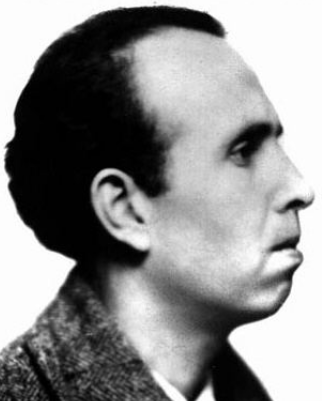
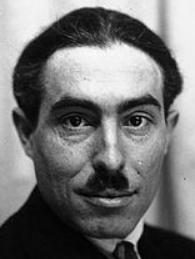
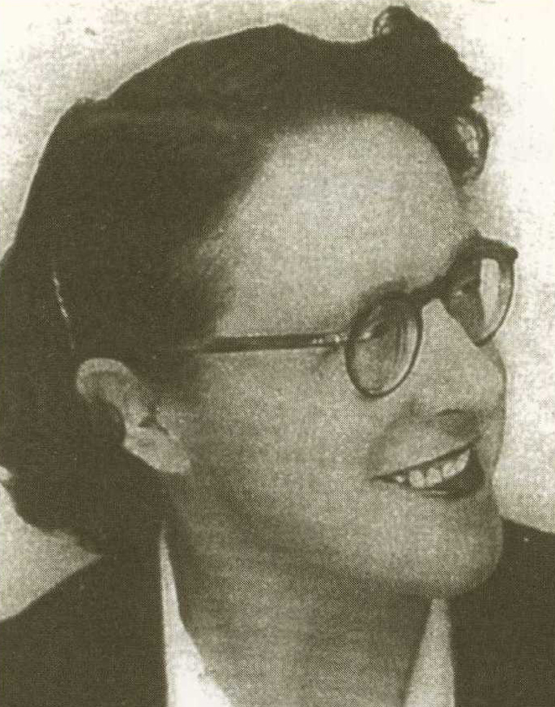
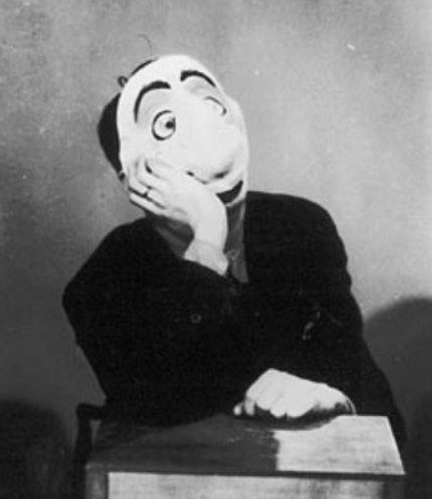
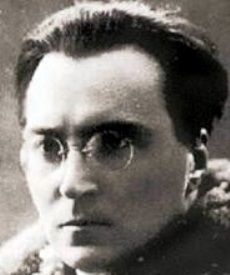
Pierre Monatte

1881 – 1960 • France

Communism • Trade unionism • Trotsky

A highly influential figure in French revolutionary syndicalism from 1905 to 1925, Monatte was an opponent of the First World War from the start. In the 1920s he joined the Communist Party briefly but was expelled after opposing its shift towards Stalinism. He remained a principled socialist throughout his life.

Anti-war activists were few in number in August 1914.

August 2 1914 outside the Gare de l’Est saw a popular mass mobilisation for the war against Germany

Why was the 32-year-old proof-reader, red-haired Pierre Monatte, against the war from the start?

Monatte had become a leftist while reading Les Misérables by Victor Hugo at school at the age of 13. In 1902 after working as a teaching assistant for two years, he moved to Paris. He was just 20. The Dreyfus Affair was sharpening left-right political divisions across France. Working for various left papers as a proof-reader he then joined the proof-readers’ trade union, where his latent libertarianism shifted towards revolutionary syndicalism.

In 1905 he walked alongside socialists and anarchists in the funeral procession of Louise Michel from the Gare de Lyon, where the Communard’s body arrived on a train from Marseille.  Another demonstrator suggested he take up a temporary post editing the 5,000-circulation paper, L’Action syndicale. The four-page weekly focusing on miners’ problems was based in Lens, in France’s northern coalfields.

On March 10 1906 Europe’s biggest ever-mining disaster took place at the Courrières company pits at Lens. 1,099 miners were killed. Then, 17 days after the company had stopped trying to rescue surviving miners and started trying to save its mines, first 13 miners emerged alive and then another three days later, another man emerged unaided.

Europe’s worst mining disaster killed 1,099 miners in Lens, northern France on 10 March 1906. There were only 600 survivors.

Cries of ‘Assassins’ greeted the company directors at the funerals. The shock and the scandal unleashed a wave of strikes by 60,000 miners. Within days Monatte and 40 others were arrested and charged with plotting against the Republic.

Released after a month in jail Monatte attended the Amiens Congress of the CGT (Confédération Générale du Travail) in October 1906. He was one of the 840 (to 8) delegates who voted for the independence of the trade union from the political parties and the sects. He was now less an anarchist and much more a revolutionary syndicalist, believing, through the amazing miners’ actions following Courrières, that social transformation could occur very rapidly.

In 1907 he developed his analysis of revolutionary syndicalism at the Amsterdam conference of the Anarchist International.

In 1908 Monatte, then living in Rue Daubenton narrowly escaped arrest with the other main leaders of the CGT for organizing a huge demonstration for the 8-hour day, where four demonstrators were killed by the army. He went into exile disguised as a clergyman and changed train stations in Lyon thanks to the secretary of the taxi trade union. He lived under a pseudonym in Switzerland until the failure of the case against the other CGT leaders allowed him to travel back to Paris.

In 1909 he married. The same year he founded the fortnightly CGT paper, la Vie ouvrière (Worker’s Life), editing it from his flat in Rue Dauphine. The numbers of its subscriptions rose from 500 in 1909 to 2000 in 1914 before it was banned. It expanded from 64 to 80 pages. It was read widely among the most active and leading trade unionists.

In November 1914 Trotsky and Julius Martov met Pierre Monatte, Alfred Rosmer and a handful of French socialists who opposed the First World War from the very start at the anarchist Librarie du Travail bookshop on the Quai de Jemmapes.

In December 1914 Monatte became the first trade unionist to resign publicly from the Federal Committee of the CGT, in protest against the French union’s refusal to support a meeting of the Socialist international being organized by Swedish socialists. His close friend and collaborator, Alphonse Merrheim, signed the anti-war Zimmerwald Manifesto in 1915.

‘Irrespective of the truth as to the direct responsibility for the outbreak of the war, one thing is certain. The war which has produced this chaos is the outcome of imperialism, of the attempt on the part of the capitalist classes of each nation, to foster their greed for profit by the exploitation of human labor and of the natural treasures of the entire globe.’


1915 Zimmerwald declaration

Lenin, Zinoviev, Radek, Warski and Trotksy were among the 42 delegates from 11 countries who unanimously passed a resolution of sympathy for the victims of the war and of persecution by the belligerent governments. This mentioned the fate of the Poles, Belgians, Armenians and Jewish peoples, the exiled Duma members, Karl Liebknecht, Klara Zetkin, Rosa Luxemburg and Pierre Monatte. In January 1915 Monatte had been conscripted in the 252nd Regiment, and would shortly spend two years at the front.

Demobilised in March 1919, Monatte quickly re-launched La Vie Ouvrière, this time as a weekly. He also organised and then led the left minority at the CGT Congress in September 1919, criticising the Federal Executive for its ‘holy union’ wartime policy and its weak support for the Russian Revolution. In 1920 he was elected Secretary of the Revolutionary syndicalist committees, launched by the left minority, which decided to affiliate to the Communist (Third) International.

Monatte became a leading figure of the workers’ left after the war, challenging both the anarchists and the shift towards Stalinism. He resigned from the CGT’s La Vie Ouvrière and in March 1922 became the labour correspondent for l’Humanité, that had become the new Communist Party’s daily paper. Two years later, having constantly been attacked as a left supporter of Trotksy by Albert Treint, Monatte first resigned from the paper and was then expelled from the PCF in November 1924.

Robert Louzon (1882-1976), who had helped produce the first Arabic language Communist daily paper in Tunisia in 1921, resigned from the PCF when his friends Monatte and Rosmer were expelled. In 1936, aged over fifty, Louzon fought at the front with Republican forces in Spain. And in 1960 with Rosmer, he signed the Manifesto of 121.

In January 1925 Monatte responded to his expulsion with the first issue of a monthly called Révolution prolétarienne including a second letter by him and Alfred Rosmer to Communist Party members.

In January 1925 Monatte responded with a second (equally unsuccessful) appeal signed by him and Alfred Rosmer to Communist Party members to challenge the growing Stalinisation of the PCF. This revolutionary syndicalist journal ran until 1939 and is still in existence today after Monatte relaunched it in 1947 (although he ceased to play an active part in 1951 when he objected to its occasional pro-American positions).

From 1925 to 1952 Monatte worked as a proof reader, but through his RP articles, contacts and correspondence he continued to be a voice on the left attacking both the reformist CGT and the descent into Stalinism. He was one of the few French anti-colonialism campaigners.

During the German occupation Monatte believed it was necessary to struggle against the occupiers, but to guard against nationalism and the idea of a ‘holy alliance’.

The Maitron, France’s national labour dictionary, ends its biography of Pierre Monatte like this:

‘Few who got close to him were not influenced by his personality. He remained resolutely optimistic about the future of the working class, believing that while the revolutionary flame could dim, it would not go out’.
More info

Gaston Monmousseau

1883 – 1960 • France

Revolutionary syndicalist • Trade unionism • Communism

A leader of the small group of revolutionary syndicalists who opposed the First World War, in 1922 he became General Secretary of the minority CGTU trade union that affiliated to the Communist International. Elected a Communist deputy in 1936 he tried to get a law passed to provide national unemployment pay.

Monmousseau was jailed five times between 1921 and 1931 in the Prison de la Santé

The Prison de la Santé was opened in 1867. Photographed here by Charles Marville (1813-1879)

More info

George Orwell

1903 – 1950 • India

Author • Literature

Eton-educated Orwell ran out of money in Paris soon after arriving there in 1928. His job as a bottle-washer lasted 18 months and became the basis of his first book, ‘Down and Out in Paris and London’, published in 1933.

Locations

  • 6 Rue du Pot de Fer

More info

Michel Pablo (Raptis)

1911 – 1996 • Egypt

Communism • Trotskyism • Fourth International

Pablo grew up in Greece, where he became a Trotskyist as a student in Athens, but was first jailed and then expelled in 1937 by the Metaxas dictatorship.  He came to Paris in 1938 and attended the founding conference of the Fourth International in Alfred Rosmer‘s house in Périgny in the Paris suburbs. During the German Occupation he was involved with attempts to organise among German soldiers with the publication Arbeiter und Soldat (Worker and Soldier) – this was extremely dangerous work and several of those involved were killed by the Germans.

One of those killed was Martin Monath (1912-1944) , a German Jew who had left Germany in 1938 for Belgium, where he worked with Ernest Mandel. In 1943 he was sent to Paris and once or twice a week he travelled to Brest to make contact with a small group of German soldiers. He was arrested, shot and left for dead in the Bois de Vincennes, but survived to be taken to hospital where the Gestapo captured him again and hanged him.

Another one of those undertaking this dangerous work, was Jean-René Chauvin (1918-2011). Arrested in Paris on February 15 1943, the French police passed him on to the Gestapo. Deported he survived Mauthausen, Auschwitz and Buchenwald. Throughout his life he kept his concentration camp number tattooed on his forearm. [Later he was a member of the Voix communiste, which gave active support to the Algerian FLN and then of the PSU and Ligue Communiste revolutionnaire].

Pablo played a key role in uniting three factions of French Trotskyists into the Parti communiste internationaliste (PCI).

In 1946 he was elected General Secretary of the Fourth International, based in Paris, where the PCI journal, ‘Workers’ Truth’ (La Vérité des travailleurs) was based at 64 Rue de Richelieu.  By the early 1950s he began to develop a distinctive political perspective. Believing that a Third World War was imminent, he argued that in this war the class struggle would acquire the new form of a conflict between blocs of states.  He therefore argued that Trotskyists must enter the mass working‑class parties in order to intervene in the new situation.

But entering the French Communist Party, with its tight organisation and a phobia of Trotskyists, was not easy – only seven Trotskyists succeeded. One of those who did, from 1953, was Denis Berger (1932-2013). He was later the founder in 1958 of the review called ‘The Communist Path’ (La Voie communiste) and also the organiser of the escape on February 25 1961 from La Roquette prison of five women members of the Jeanson Network from ten year prison sentences for supporting the FLN.

But Pablo’s strategy led to an acrimonious split in the PCI, with two organisations emerging, one led by Pierre Frank [1905-1984] and one by Pierre Lambert [1920-2008]. 

There was also an international split in the Fourth International, with James P Cannon in the USA and Gerry Healy in Britain denouncing Pablo for abandoning the building of revolutionary organisation. The word “Pabloism” became a term of abuse for some political currents.

But Pablo was also very much aware of the significance of revolutionary movements in the so-called “Third World”. He was one of the first to make contact with the Algerian National Liberation Front (FLN) and began to organise solidarity action (the so-called “suitcase carriers” who assisted the FLN with publications and transferring funds.

One of the ‘bag carriers’ was Jakob Moneta (1914-2012), who was a Trotskyist employed as the trade union representative at the West German embassy at 28 Rue Marbeau. He used his ‘diplomatic bag’ to transport documents for the FLN.

Pablo was personally involved with two more ambitious ventures – setting up an arms factory in Morocco where Trotskyist engineering workers from France and elsewhere worked, and a project for forging currency; for the latter he was arrested and jailed in the Netherlands in 1960.

After Algerian independence in 1962 Pablo became an adviser to Ben Bella until his being overthrown in 1965.

Subsequently he only visited Paris briefly. He was marginalised from the Fourth International which he left in order to build his own tendency; he travelled widely before returning to his native Greece, where he advised Andreas Papandreou.

More info

Pablo Picasso

1881-1973 • Spain

Art • Communism • Spanish Civil War

Picasso visited Paris often between 1900 and 1904 when he settled there. From 1935 he associated with many of the left surrealists and in 1937 painted Guernica. He joined the French Communist Party in October 1944, gave money to it, and remained a member until his death.

Picasso aged 56. The self-portrait was painted a year after Guernica.

More info

L’abbé Pierre / Henri Grouès

1912 – 2007 • France

Resistance • Christian socialism • Human rights

Using his wartime pseudonym, L’abbé Pierre, the Catholic priest Henri Grouès helped establish the resistance movement in the Vercors during the Second World War. From 1945 to 1951 he was elected as an MRP deputy, a Christian-socialist group, and In 1949, he established the Emmaüs international charity.

Grouès campaigned for the right of conscientious objectors to refuse to fight in Algeria and after 1954 became known as a tireless campaigner against poverty and homelessness. He was identified as a key supporter of the homeless occupation of the 7 rue du Dragon mansion in 1995.

After his death seven women reported that Grouès had been sexually assaulted or harassed by them, including one who had been under the age of consent at the time. The attacks took place between 1970 and 2005. Finally breaking their silence on what is now known as a poorly-kept secret, a joint statement by Emmaus and the Fondation Abbé Pierre in July 2024 commented: “Our organisations celebrate the courage of the people who have given testimony and, through their words, allowed these facts to come to light. We believe them.” 

Following this publicity Emmaus commissioned a further study by Egaé that by September 2024 found a further 17 women who reported Grouès assaults in a range of different countries, ranging from touching, groping, kissing and fellatio over the half a century from 1950 to 2000. One of them was a girl aged nine. Two of these assaults were reported to senior Emmaus managers in 1992 and 1995 without any further action being taken by them. A nurse looking looking after him at the age of 93 in a military hospital in Paris said she and other nurses had also been assaulted by him.

Yet it was not only the Charity and the Foundation that took no action. In 1959 the Vatican was made aware of abbé Pierre’s ‘doubtful comportments’ with women, just a year after he was elevated to the top rank of French cardinals and archbishops. If the French Catholic Church and the Vatican had acted in the 1950s, Grouès’ serial predatory behaviour would have been stopped in its tracks.

On May 15 1990 a Swiss television channel had shown a documentary reporting a former prostitute turned writer providing evidence of Grouès’ frequent visits to a hotel brothel in Geneva. Followed up by the Swiss press, the issue was kept out of French newspapers and television.

The details in French of the report by the two charities on July 17 2024 are available here and a Wikipedia summary of all the reports in French can be accessed below.

More info

https://fr.wikipedia.org/wiki/Abus_sexuels_de_l%27abb%C3%A9_Pierre

Locations

Madeleine Pelletier

1874 – 1939 • France

Feminism

On Saturday, December 9 2017, the Library of Parisian History reopened after an 11-month refurbishment in the stunning 16th century Lamoignon Hotel. One of the displays at the packed open day showed this torn copy of the front page of the first issue of La Suffragiste.  It was edited by Madeleine Pelletier from 1907 to 1914.

A slightly torn copy of La Suffragiste from December 1907

In 1904 Madeleine Pelletier was the first woman to be allowed to work as a psychiatric ‘docteur’ inside France’s mental health asylums after she had forced a change in the law. But when we visited the site of her medical practice in the interwar years just south of Gare Montparnasse, the plaque finally agreed to by the co-owners of the building at 80–82 rue de Gergovie in 2011 says, ‘Doctoresse’ instead.

Pelletier did however sign herself ‘doctoresse’ once before in an article denouncing false internments. Ironically, she then died an internee herself, inside the Perray-Vaucluse asylum on December 29 1939 aged 65. She was completely sane, held as a feminist political prisoner. She was placed there by a judge who decided to shut her up rather than allow her trial to continue on a charge of carrying out an abortion on a 13-year-old raped by the child’s brother.

Pelletier had campaigned for the previous 35 years for women’s contraception and the right to an abortion. Half paralysed after a stroke in 1937 she was clearly not guilty as charged (abortion was only finally legalized in France in 1974).

Pelletier began writing for La Fronde (The wind of change/Insurrection) that Marguerite Durand had launched in 1897.

In 1907 she launched the Suffragiste after attending the first Women’s Socialist International Conference in Stuttgart in August. She was part of an 8-strong delegation from the Paris SFIO.  Out of a total of 58 delegates from 15 countries she was one of the 11 who voted against Klara Zetkin’s formulation that ‘the struggle for voting rights for women workers is not separate from the class struggle’.

For Zetkin, the main task was to integrate women into all aspects of the class struggle, and to bring socialist ideas to the attention of working-class women. Zetkin argued that while social democrats should support women’s franchise, ‘we are not so politically uneducated as to demand that the socialist parties of every country, in every struggle for electoral reform and in all circumstances make the demand for voting rights for women the cornerstone, the deciding factor in their struggle.’
Pelletier and the 10 other women delegates were described as having a ‘bourgeois’ position for arguing that the right to vote for women was a central political right that socialists should fight for the hardest. Like Sylvia Pankhurst, Pelletier believed the struggle for the democratic right to vote for women was a key part of the struggle for socialism.


Pelletier argued ‘Certainly, with socialism a woman in poverty would gain materially, she would no longer be hungry and cold. But the yoke of the male would still extend over everything. Besides giving love and motherhood, there would still be no place for women in society. It is therefore essential that the emancipation of women be realized today; this struggle will thus present the society of tomorrow with a fait accompli.’

In 1905, Pelletier joined the SFIO, the French Socialist Party, to press the feminist case. In 1906 she became Secretary of the Women’s Solidarity feminist group. She was one of the leading feminists in France before the First World War. In the March 1908 Paris local elections Pelletier and two other leading feminists overturned ballot boxes in the 4th arrondissement and broke windows at another polling station. In June 1908 she travelled to London to participate in the half a million strong ‘Women’s Sunday’ Hyde Park demonstration organized by Womens’ Politicial and Social Union.

In 1910 the SFIO agreed to nominate Pelletier and some other women illegally as a parliamentary candidate (although in an unwinnable seat). She got 340 votes (4%), more than the previous male Socialist candidate had done.

One of two surviving (out of 12) children of a royalist vegetable stall-holder mother, her cab-driving republican father’s stroke when she was four that left him in a wheelchair, gave her someone to argue with. The building, 38, rue des Petits Carreaux in the working-class 2nd arrondissement, where she lived was so badly built it fell down in the mid-1930s (and is now the site of the amazing vertical green wall pictured here).

A living wall now occupies the site of Madeleine Pelletier’s home at 38, Rue des Petits Carreaux

Pelletier left school at 12 and after work escaped to local libraries and feminist and anarchist groups, meeting Louise Michel. Her reading gave her a life-time’s feminist, communist and libertarian principles. She took the name Madeleine instead of her militantly Catholic’s mother’s name, Anne.

At 22 and 23 Pelletier sat and passed the baccalauréat (A-levels). In 1899, when there were just 29 French women out of 4,500 medical students, she won a City of Paris grant to study medicine. After a feminist-led newspaper campaign in 1904 the law was changed so she could work inside the Paris Villejuif asylum. In 1906 she became France’s first qualified woman psychiatric doctor.

She cut her hair short and dressed like a man.

‘If I dress as I do,’ she wrote, ‘it’s because it’s convenient, but above all it’s because I’m a feminist; my suit speaks to a man: “I am your equal”’ ‘I will show mine (breasts) as soon as men start to dress in a kind of trousers that shows their…’

In 1914 she was one of the rare French socialists to denounce the First World War as imperialist, and volunteered to work for the Red Cross, on condition she would be allowed to provide health care to both French and Germans without distinction.

In 1920 Pelletier attended the Tours Conference of the SFIO where she supported the formation of the French Communist Party, which included equality of the sexes in its programme. In July 1921 she travelled illegally to Russia to attend the Second International Congress of Women Communists.

The anarchist freethinkers’ journal, Idée Libre, April 1926, which Pelletier contirbuted to occasionally between 1912 and 1924

By 1926 she had broken with the Communist Party, arguing consistently that communism must include freedom. In 1932 Pelletier joined a left group called ‘Party of Proletarian Unity’. In 1936 she applauded the appointment of the first women ministers in the Popular Front government of Leon Blum.

She lived and worked in the 1920s and early 1930s in the Rue de Gergovie, but then moved out to Gif-sur-Yvette to the South of Paris where she learned to drive a car and continued to campaign against fascism, for the right to abortion, contraception and women’s right to vote, writing novels, plays, and a biography.  Many of these were for the L’Idee Libre, an anarchist journal whose April 1926 front page is pictured here.

More info

Fernand Pelloutier

1867 – 1901 • France

Revolutionary syndicalist • Trade unionism


A journalist who became General secretary of the Labour Exchange movement (Bourses du travail) from 1895 a leading revolutionary syndicalist and advocate of using a general strike to expropriate the capitalist class.

Born in Paris at 81 Rue de Courcelles with a father who had wanted to be a journalist but had become a post office manager and an ardent republican grandfather, Fernand lived there initially until he was 13. The family then moved to Nantes.

In 1893 Fernand Pelloutier moved back to Paris, living with his younger brother (and later biographer) Maurice and Maurice’s wife, Berthe, in a flat at 32, Rue Levert. he then began a relationship with Berthe’s sister, Maria Ridel, that lasted until Pelloutier’s early death in 1901. In 1899 when Pelloutier was already seriously ill, the two couples moved 10 kilometers out of Paris to Sevres, then in the country, in the hope he might recover.

Moer info / Plus d’informations

Marceau Pivert

1895 – 1958 • France

Socialism • Revolutionary Left • Workers and Peasants’ Socialist Party

An SFIO member from 1924 and a teachers’ trade union leader in the 1930s, Pivert was the leader of a faction within the SFIO known as the ‘Revolutionary Left‘.

In 1935 the group’s publication was based at 23 Rue Mouffetard. He wrote an article ‘Everything is Possible‘ in May 27 1936 urging, without success, the Popular Front’s Prime Minister Blum to break with capitalism.

Pivert broke with the SFIO in 1938 and formed the Workers and Peasants’ Socialist Party.

More info

Émile Pouget

1860 – 1931 • France

Revolutionary syndicalist • Anarchism • Anti-semitism

A leading revolutionary syndicalist, organiser and advocate of the general strike. Jailed with Louise Michel in 1883 he later became an influential journalist and propagandist for worker resistance, in particular for the general strike and direct action.

Pouget was, however, also anti-semitic, calling Dreyfus a ‘rich yid’.

In 1889 Pouget founded the anarchist weekly, Le Père Peinard. This was effective in denouncing contemporary capitalism, the military and the clergy. It advocated direct action to change the system. It became one of the principle targets of the 1893 lois scélérates, a series of laws making it illegal to support ‘propaganda by the deed‘ in the press and encouraging spies to inform on the activities of anarchist groups.

A leading left activist, Robert Louzon said that after finding Pouget’s paper at a newspaper kiosk he found Le Père Peinard ideas matched his own. In 1906, then an engineer with a good income, he loaned the CGT enough money to buy its headquarters in the Rue de la Grange-aux-Belles. When his employer, the Paris Gas company found out, Louzon was sacked on the spot.

In 1924 Louzon worked with Monatte to found the Révolution prolétarienne. Later in life, Louzon launched the first daily Communist paper in the Arabic language.

More info

Jacques Prévert

1900 – 1977 • France

Poet • Literature • Surrealism • Communism

Surrealist, briefly Communist, film director and major 20th century poet, he opposed of the forces of law and order in 1968 and supported Angela Davis in 1970.

A member of the Surrealist Group from 1926 to 1929, he became increasinglly interest in film-making with the introduction of sound. For four years from 1932 to 1936 he was the principal organiser of the theatre group called October.

He lived in Rue Vaugirard as a child and went to the primary school next door. in 1907.

More info

Pierre-Joseph Proudhon

1809-1865 * France

Anarchist • Cooperatism • Socialism

Proudhon was the major influence on the core beliefs of French left in the 19th and early 20th centuries. His ideas can be seen to have shaped anarchists, socialists, utopian communists, cooperatists and revolutionary syndicalists and created a backcloth of sympathy and support for a democracy involving working people that kept attracting artists and writers to the left throughout the century following his first major work ‘What is Property’ in 1840.

When Marx was in Paris in 1843-1845 Proudhon discussed politics with him frequently in a bar in the Rue Coquillière and at their respective homes in the Rue Vaneau and 36 Rue Mazarine. Proudhon later moved to 70 rue Mazarine where he was living in 1847 and in the revolutionary year 1848.

In 1849 he was jailed in St Pélagie prison, where he was kept until 1852. He was out on parole at the moment of Louis-Napoleon’s 2 December 1851 coup d’etat. He had to inform Victor Hugo regretfully that as a result he was not in a position at that moment to defend the Republic.

locations

  • 55 Quai des Grands Augustins 6 arr. Printshop where Proudhon is supposed to have worked briefly, meeting Fourier in 1828, before returning to Besançon ;
  • 31 Boulevard St Michel , 6 arr. Courbet’s first Parisian workshop (at the time the location of the demolished 89 rue de la Harpe) where he met Proudhon in 1842;
  • 4 Rue de Bourgogne, 7 arr. Proudhon often used to meet Bakunin at his lodgings in a Slave enclave between 1844 and 1847;
  • 14 Rue des Moulins, 1 arr. Proudhon attended the meetings of the editorial committee of the Franco-German Annals journal held here with Marx in 1844;
  • 154 Rue Montmartre, 2 arr. Proudhon’s first newspaper ‘The people’s representative‘ was produced here, appearing first on 27 February 1848 and running until August 1848;
  • 23 Rue du Faubourg St Denis, 10 arr. The site of the short-lived People’s Bank established by Proudhon to try and put his ideas into practice in 1849.
  • 46 Rue Boulard, 14 arr. Proudhon lived here first after his release from jail in 1852
  • 83 Avenue Denfert-Rochereau 14 arr. was where Proudhon moved to in the mid 1850s,
  • 14 Rue Jacob, 6 arr. in 1862 Proudhon lived in a house off the back of the yard behind the building here.
  • 12 Rue de Passy, 16 arr. Where Proudhon lived for the last few years of his life and died on 19 January 1865.

More info / Plus d’informations

PLACES

Élisée Reclus

1830 – 1905 • France

Anarchism • Ecology • Geographer

Member of the First International Reclus was influenced by Bakunin. A Communard fighter in 1871 who was expelled in perpetuity from France aged 41, he became the most prominent French 19th century geographer and an early ecologist and environmentalist.

Reclus was the major geographer of the late 19th century focusing on ecology

Reclus was an engaged anarchist, a vegetarian and a naturist, and in his professional life a leading academic geographer. He described how he reconciled anarchism and scientific study in the 1880s and 1890s when ‘propaganda by the deed’ was being denounced everywhere in Third Republic political life and in the French media in this letter to his fellow anarchist geographers:

Great enthusiasm and dedication to the point of risking one’s life are not the only ways of serving a cause. The conscious revolutionary is not only a person of feeling, but also one of reason, to whom every effort to promote justice and solidarity rests on precise knowledge and on a comprehensive understanding of history, sociology and biology

Quoted in David Harvey “Listen, Anarchist!” A personal response to Simon Springer’s “Why a radical geography must be anarchist”
Élisée Reclus photographed by the son of his old friend and fellow Communard, Félix Nadar

More info / Plus d’informations

Locations

  • 77 Rue Claude Bernard. Arr5. The three Reclus brothers, Élie, Élisée and the surgeon Paul  lived here in the 1860s, where they were visited among others by Courbet, Proudhon, Nadar, Bakunin and Michelet.
  • 140 Rue Mouffetard. Arr5. This was the editorial office of the anarchist journal ‘La Révolte‘ launched by Kropotkin on 1 February 1885. Reclus, Pouget and Monatte wrote for it or were influenced by it. Elsewhere in the road, Élie Reclus, the eldest brother, who had been nominated Director of the National Library under the Commune, was hidden after its defeat by a family friend living in the road . From there he was able to escape to England.
  • 32 Rue Gabrielle. Arr18. The journal ‘La Revue anarchiste that Reclus’ wrote for in the early 1890s was based here.
  • Jardin du Luxembourg Arr6. In 1906 Émile Derré‘s sculpture, ‘The column of kisses’, originally called ‘Dream for a People’s House’, featuring Louise Michel kissing Élisée Reclus in one scene and August Blanqui in another, was installed in the Luxembourg Gardens. It stayed there until 1984 when it was replaced with a statue of Pierre Mendes France. The original sculpture is now outside the town hall in Roubaix.
  • Avenue Élisée Reclus. Arr7. When the Champ-de-Mars public garden stretching from the Eiffel Tower to the Military School (Hotel des Invalides was revamped in 1907, a section of its North-Eastern side was sold to become a tree-lined avenue for wealthy Parisians named, nearly uniquely in Paris, after a man who had fought for the Paris Commune. Five years later the section still called Reclus was reduced in length by two-thirds to honour a more conservative Republican politician and academic whose son would briefly become President of France in 1920.

Élisée Reclus places

Diego Rivera

1886 – 1957 • Mexico

Art • Communism • Trotskyism

Awarded a scholarship to visit Europe Rivera became a major figure in Montparnasse’s artistic and literary life. He is believed to have met Trotsky and Lenin during the nearly ten years he lived in the city. He first joined the Mexican Communist Party in 1922.

More info

Michel Rocard

1930 – 2016 • France

Socialism • PSU • Algeria

A product of the elite adminstrative education, ENA, established by De Gaulle, Rocard opposed the Algerian War. He joined the United Socialist Party (the new left PSU), and was its candidate in the 1969 presidential election.

More info

Waldeck Rochet

1905 – 1983 • France

Communist • Resistance


A Communist Party member from 1924 he was given political training in Moscow, and from 1934 he was one of the handful of PCF leaders. Elected deputy in 1936 he was jailed by Vichy and then in 1943 represented the PCF in London. From 1964 to 1969 he was General Secretary of the PCF. He reoriented the PCF towards a democratic road to socialism and criticised Russia for the invasion of Czechoslovakia and then fell ill in 1969 after a visit to the USSR.

More info

Pauline Roland

1805-1852 • France

Feminism • Socialism • Trade unionism

In 2016 I followed the Parisian footsteps today of an amazing early French socialist, trade unionist and feminist who was effectively judicially murdered at the age of 47 by the populist dictator Napoleon III.

Pauline Roland was a contemporary and friend of George Sand, Flora Tristan and of Pierre Leroux, a printworker and socialist. After Roland’s premature death Victor Hugo, in exile in Jersey in protest against the dictator Louis Bonaparte, wrote a poem called ‘Pauline Roland’.
Very few French people have heard of her today, although the oldest women and children’s refuge in Paris (dating form 1890) is named after her. Only one of the houses she actually lived in and organized from is still standing (near St Germain des Prés, at 10 rue Jacob in the same street where Simone de Beauvoir later attended secondary school). The others I walked to today had all been knocked down and rebuilt between the 1890s and 1960s.

Pauline Roland sketched in 1830 at Falaise aged 25 before she left for Paris in 1832

Roland supported herself from the age of 20 when she started working in a bookshop. From the age of 28 (in 1833) to 40 (in 1845) she had an open relationship with another Sainte-Simonian socialist man, Jean Aicard, in Paris, had two children with him, and another child with another father. She insisted all the children carry her name and must be financially raised by her.

‘I will never agree to marry a man in a society that cannot recognize my absolute equality with the person I am forming a union with,’ she argued.

She survived financially by also writing for feminist newspapers and writing histories of France, England, Scotland and Ireland. In 1847 she worked as a teacher at the socialist Saint-Simonian Community established by Pierre Leroux at Boussac (in the Limousin in central France) with funding from George Sand.


Roland was a Republican, a trade unionist and a leading feminist. During the 1848 Revolution she became the leader of the Women’s Republican Club (at 8 rue de Trevise).

A year later she founded and led the Fraternal Association of Socialist Male and Female Teachers and Professors (at 21 rue Henri Monnier). Its programme stressed gender equality, called for universal education until 18 and for women to remain in the labour force.


Her next crime in the eyes of the dominant political conservatives was to play a key part in organising a Union of Workers’ Associations. In October 1849 delegates from 100 trades elected Roland to its central committee. Six months later she was one of 30 people arrested after a government clamp-down on organised dissent.
But an even bigger crime in the eyes of the judges was her feminism. She was charged with ’socialism, feminism and debauchery’. She spent the first seven months of 1851 in jail.

A sketch of Pauline Roland drawn in the late 1840s


On December 2 1851 Louis-Napoleon Bonaparte realised he would lose upcoming elections and organized a coup d’état to seize power and declare himself Emperor. Roland, despite coming out of prison in poor health, threw herself into the resistance movement. It failed, she was rearrested early in 1852 at her home at 106 rue du Bac, and sentenced to 10 years’ deportation to the recently invaded (1830) French colony of Algeria.


Unlike many other political prisoners Roland refused to ask for a pardon from the dictator-Emperor. She was transported and forced to do hard labour and cleaning work when she got to Algeria. Three months later, her friends George Sand and the biggest singer song-writer of the day (Beranger) persuaded Louis Bonaparte to release her. Too late. She died at Lyon in December 1852 on her way home to Paris.

In March 1853 Victor Hugo wrote the poem, Pauline Roland, that was published in ‘Punishments‘ (Les châtiments), his collection of 90 poems denouncing Louis Bonaparte for murdering her and thousands of other republicans.


More info

Alfred Rosmer/Griot

1877-1964 • USA

Trade unionism • Communism • Trotskyism

Aged 7 Alfred Griot returned with his family from Patterson, New York, where his father was a barber. Alfred spoke good English, a facility that helped shape his revolutionary life as an internationalist. Griot’s father was a Dreyfusard and Alfred Griot attended revolutionary socialist and anarchist meetings as a teenager.

He became a trade unionist in 1899, joining the municipal workers’ union. In 1910 he was asked by his then anarchist friend Amédée Dunois to act as an interpreter for Pierre Monatte, founder of La Vie ouvrière at its office at 42 Rue Dauphine in a meeting with an American IWW member, William Z Foster.

Griot was a keen theatre-goer and in 1911-12 took his pseudonym Rosmer from an Ibsen character, and used this when he replaced Dunois as editor of the daily CGT trade union newspaper, La Bataille syndicaliste, printed at the Union Printworks at 40 Boulevard Arago.

Classified as ‘auxiliary service’ rather than conscripted during the First World War he was one ot the handful of trade unionists most present in Paris. He spent many of his Sundays at Trotsky‘s changing addresses. Trotsky and Martov, regularly attended the continuing La Vie ouvrière meetings that took place even after they stopped publishing it, at 96 Quai de Jemmapes, whose ‘Labour’ bookshop had been closed by the CGT that supported the war effort and the ‘holy union’..

In 1916 Rosmer, reporting back on the Zimmerwald Conference, met the anti-war activist, Marguerite Thévenet, who became his lifelong partner, marrying in 1932.

Having begun work as a clerk in the Paris-Orléans railway company, Thévenet’s experience there, and subsequently working for a Protestant holiday camp organisation (colonies de vacances) led her to become an expert at smuggling subversive literature and revolutionary activists across frontiers.

Thévenet first met revolutionary syndicalists when her childhood friend, Léontine Valette, met and married Pierre Monatte in 1909. When Monatte resigned from the leadership of the CGT she wrote strongly congratulating him. Member of the Rue Foudary pacificist group she met Rosmer at a meeting reporting on Zimmerwald in March 1916.

In May 1919 the French Committee for the Third International decided to send Rosmer to Moscow, where he played a big part in the Second Congress of the Comintern. In February 1921 he spoke at the funeral of Peter Kropotkin.

Still in France, Thévenet may have helped organise the illegal presence of Clara Zetkin at the Party’s founding congress in 1920.

Partners in seeking to change the world for nearly half a century Marguerite and Alfred Rosmer

Rosmer was back in France in 1921-22 where he joined the PCF but did not support the idea of trade unions affiliating to a single Communist international. Back in Moscow in May 1923 he became increasingly disquiet at the direction of the political infighting there, and after circulating Lenin’s Testament in France he, Monatte and others were expelled from the Communist Party.

In 1924 with Pierre Monatte he founded La Révolution prolétarienne, but he became less active in the anti-Stalinist opposition and had doubts about the possibility of creating a ‘Fourth International’.

Rosmer did support the idea of producing a journal to keep the militants together and informed, and he became the editor of the weekly Trotskyist paper The Truth first published by on 15 August 1929 at 23 rue des Vinaigriers. The editorial office of the weekly Trotskyist paper The Truth published by the Communist League on 15 August 1929. In April 1930 it led to the creation of the Communist League with which the Rosmers were involved along with Pierre Frank, Pierre Naville and Marthe Bigot.

Within nine months, however, Rosmer resigned from the editorial committee of The Truth. He had supported the idea of carrying out trade union work without party interference, a view Trotsky considered ‘rightist’ and detested the bullying of the League’s leader, Raymond Molinier. Trotsky then broke all contact with the Rosmers, even when he was in Paris for nearly two years in 1932-33.

The Rosmers survived on Marguerite’s work organising children’s holiday camps, and Alfred’s job as a proof-reader. Alfred was active in exposing the fraudulent nature of the Moscow trials, and working with the Dewey commission in 1937 in the US.

After the murder of his eldest son, Léon Sedov, in Paris in February 1938 Trotsky asked the Rosmers to find his grandson Sieva and bring him to Mexico to join him and Natalia. It took them a year of legal and police action (opposed by Sedov’s partner) before they succeeded – in a trip paid for by the royalties of the sale of the French edition of Trotsky’s book Stalin.

Friends of Trotsky’s assassinated son, Lev, Marguerite and Alfred took Trotsky’s daughter’s (Volkova) son Esteban (Seva) to Mexico to live with Trotsky in 1939. Seva is on the left in this photograph with Marguerite Rosmer and Natalia standing above Trotsky and Alfred Rosmer.

After the declaration of war the Rosmers decided to leave Coyoacan for New York, where Marguerite gave French lessons and Alfred resumed work as a proof-reader (initially on the bible thanks to work passed his way by Max Eastman).

They returned to France in the summer of 1946 and in 1947 resumed writing and supporting La Révolution prolétarienne, struggling for socialism against Stalinism without falling into the American camp.

In 1946 Natalia Trotsky gave the Alfred Rosmer authority to publish Trotsky’s works and he carried out this extremely difficult task for the rest of his life.

Maurice Nadeau (1911-2013), who had helped to organise an International Federation of Independent Revolutionary Artists in the 1930s with the support of André Breton and Diego Rivera gave Rosmer a great deal of support in publishing Trotsky. In 1960 he played a key role in organising the Manifesto of the 121 unequivocally supporting those who refused to fight against Algerian independence.

The Manifesto was signed, naturally, by Rosmer, but also by De Beauvoir, Sartre, Breton and Guerin featured in Left in Paris. His office at Les Lettres nouvelles at 3 Rue Malebranche was searched as a result and Nadeau questioned by the police.

It became easier after the Khruschev revelations of 1956, and the royalties he sent to Natalia became larger. Natalia and Marguerite died a week apart in 1962, and Alfred two years later after a fall in which be broke his femur.

More info / Plus d’informations

Nelly Roussel

1878 – 1922 • France

Feminism, Birth control

One of many neo-malthusians before the First World War, she was an activist for birth control and was one of the first women to demand the right of women to control their bodies.

More info

Louis Saillant

1910 – 1974 • France

Trade unionism • Resistance • World Federation of Trade Unions

One of 12 leading trade unionists who publicly opposed the dissolution of the trade unions in November 1940 and then joined the resistance, where he helped reunite the divided CGT. He represented the CGT on the National Resistance Council. In 1946 he became General Secretary of the World Federation of Trade Unions, and kept the post until 1968 – an extraordinary feat for a non-Communist.

Plus d’informations

George Sand

1804-1876 • France

Feminist • Novelist • Socialist

George Sand was a feminist and republican who described herself as a communist in 1848, when she worked in the Workers’ Commission in the Luxembourg Palace. Many French feminists wanted George Sand to stand in the 1849 presidential elections when universal suffrage still excluded women.

More info

Jean-Paul Sartre

1905-1980 • France

Existentialism • Literature • Communism • Philosopher

A major philosopher of existentialism, he described it as a form of humanism. In 1941 he helped found ‘Socialism and Liberty’ with Simone de Beauvoir to bring together various intellectuals in a resistance organisation. His support for Algerian independence saw the OAS choose to place a plastic bomb outside his door in the Rue Bonaparte.

More info

Louise Saumoneau

1875 – 1950 • France

Feminism, Socialism, Trade unionism

A working class seamstress, Louise Saumoneau moved from being a militant feminist to becoming a leading socialist.

She founded a trade union for seamstresses and led a strike in 1901. This convinced her of the need to involve male workers and she became a supporter of Klara Zetkin’s position calling for women to become socialists. Arrested for her opposition to World War 1, she joined the SFIO and edited La Femme Socialiste.

Louise Saumoneau moved from being a militant feminist to becoming a leading socialist

More info

Victor Schoelcher

1804 – 1893 • France

Human rights • Anti-slavery campaigner • Republican

This revolutionary republican campaigner against slavery was born in Paris in what was then the 5th arrondisement and is now in the 10th, at 60 Rue du Faubourg-Saint-Denis.

His father was a wealthy owner of a porcelain factory who was well able to afford to send his son to the Lycée Condorcet that opened in 1803 in what is now 8 Rue du Havre, the monastery built just before the Revolution in the 1780s. When Schoelcher was there it changed its name. It had been called the Lycée impérial Bonaparte from 1805 to 1815 and then became the Collège royal de Bourbon from 1815 until February 1848.

As a wealthy young man Schoelcher entered the circles where got to know George Sand, Hector Berlioz and Franz Liszt. In 1828 his father sent him off to represent the business in Mexico and the United States and then to Cuba in 1829 where he found slavery absolutely abhorrent.

Returning to France in 1830 Schoelcher became a journalist and art critic and well as a lifelong campaigner against slavery. In 1832 he sold the business he inherited from his father to enable him to concentrate on journalism and politics.

In 1833 his first book, On the slavery of Black people and Colonial Law was an indictment of slavery and called for its abolition. It also argued that although the workers had made the 1830 Revolution, they were being deprived of their rights.

In 1834 he was one of a large number of young republicans who were jailed at Sainte-Pélagie prison after the Rue Transonain massacre in April.

Elected to the National Assembly after the 1848 February Revolution he drafted the bill abolishing slavery.

On December 3 1851 he went to the barricade at the corner of the then Rue Sainte-Marguerite (now Rue Trousseau) with the Rue du Faubourg-Saint-Antoine. He and other deputies such as Alphonse Baudin wanted to strengthen the mobilsation of workers protesting Louis-Napoleon Bonaparte’s coup d’État of the previous day.

Schoelcher then led several of the unarmed deputies out to talk with the soliders sent to suppress the revolt. Alphonse Baduin, jumped up to the top of barricade with a flag and was immediately shot dead.

Exiled from 1851 to 1870 during the Second Empire of Napoleon III, he later wrote a biography of Toussaint Louverture, the inspirational leader of the Saint-Domingue (Haiti) slave revolution who was captured, forcibly taken to France where he was imprisoned and effectively murdered in April 1803 by Napoleon I. Finally, it took until 1998 before France finally recognised Toussaint. A few bits of dust taken from the Jura’s Fort de Joux prison chapel burial area were placed downstairs in the Pantheon. No mention is made on the plaque of his imprisonment and his being frozen to death.

After his return to France in 1870 Schoelcher was elected to the National Assembly and sat on the extreme left of the deputies in Versaillais during the Commune. In 1875 he was elected a senator for life.

Schoelcher photographed by Nadar in the 1870s

More info / Plus d’informations

Georges Séguy

1927 – 2016 • France

Trade unionism • Communism • Resistance

One of the less Stalinist CGT leaders of the post-war period, Georges Séguy, died aged 89 in 2016.

Among his experience as a life-long PCF member was attending the 1956 Russian Communist Party conference where Khruschev outlined Stalin’s crimes.

In 1968, as General Secretary of France’s then biggest trade union, the Communist-dominated CGT, he participated in the famous Grenelle negotiations in May 1968 whose agreements created an amazing advance in working class lives in France. But in failing to lead on to a revolution, his participation and not calling for a General Strike, made Séguy the object of much (unfair in my view) criticism from French Maoists and Trotskyists alike (and, to be fair, from many ordinary workers who believed still more could have been won).

Séguy’s father had been a founder member of the French Communist Party, and Georges was arrested as a member of the CP-led French Free Fighters and Partisan (FTPF) resistance at 17 years old in 1944 and deported to Mauthhausen in Austria. When he returned to France he identified the person who had denounced him, who was then tried and shot.

In 1978 he attempted to win over the CGT to form a united front with the formerly Catholic, then radical, CFDT union, but failed in the face of French CP opposition. He resigned aged 55 (the retirement age of the railwaymen he had been since 1946).

Plus d’informations

Victor Serge

1890-1947 • Belgium

Anarchism • Literature • Trotsky

Serge lived in Paris from 1909 and jailed for five years for his writing about the Bonnot gang, he was an independent socialist. His life took him from anarchist, to Bolshevik, jailed under Stalin. and associate of Trotsky. Back in Paris at the end of the 1930s he eventually escapes to the US, and then Mexico. He was a journalist and novelist.

More info