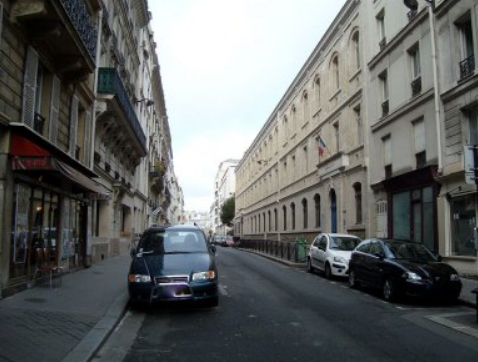
A very old street that first appears on the records in 1267. It finally got its present name (‘spur’ in English) from a shop sign in 1637.
Its principal claim to fame is at No. 2, theLycée Fénelon. This was the first secondary and higher school for girls in Paris. It was set up in 1892 in 19th century buildings used to prepare young men to enter the competition for the elite École normale supérieure.
It was named after the Archbishop of Cambrai (François de Salignac de La Mothe-Fénelon known succinctly as Fénelon, 1695-1715) who had written extensively on women’s education.
The Lycée became entirely mixed in 1979.
Among its better known students was Simone Weil and while some sources suggest Simone de Beauvoir was a student there, others (more probably in my view) suggest this was one of the Lycées where she taught. Another teacher there, notable for the wrong reasons was Marcel Déat (1894-1955), the fascist whose political career ended up as Minister of Labour and National Solidarity under the Vichy government in 1944.
A print from 1633 of the torture used commonly across Europe the strappado (estrapade in French) by the medieval inquisition and several governments from the 12th to the 18th centuries.
The street finally took its current name in 1881. It roughly translates as ‘the street of torture’. The strappado is where the victim has their hands tied behind their back and they are dropped from a height, sometimes with weights added to the body to increase the pain. In English the word ‘estrapade’ has come to mean where a horse rears and plunges and kicks to try and unseat its rider. This is because it was the site of an ancient deep ditch dug outside Paris’ oldest medieval Wall that was constructed on Philippe Auguste’s order from 1190 to 1215.
Hazan (IOP) describes the Wall’s left-bank route as a ‘semi-eclipse that essentially encompasses the Latin Quarter. Starting at the Seine, where the Institute of France now stands, going up the rue Mazarine to the Porte de Buci, the old wall went along rue (formerly Fossés-) Monsieur-le-Prince up to the top of the Montagne Saint-Geneviève (now the Panthéon) where ‘the names of streets and squares still perpetuate its memory: Fossés-Saint-Jacques, Estrapade, Contrescarpe. It then descended towards the Seine in a straight line, following the rue des Fossés-Saint-Victor (now Cardinal-Lemoine) and rue des Fossés-Saint-Bernard, reaching the river at the tower of La Tournelle.’
On June 24 1848, the workers’ barricade across the rue de l’Estrapade could be taken only after the Panthéon had been captured. To do this canons were placed in the rue Soufflot. Then soldiers who had got through to the square through a backdoor in the law school entered the Panthéon, where they took prisoners before executing them and then attacking and overwhelming the rue de l’Estrapade barricade.
Lenin and Krupskaya stayed here in 1902. The plaque on the wall in the photo isn’t about them.
Number 3, five minutes’ walk to the rue des Écoles where Lenin was lecturing, was where he and Krupskaya were put up by another Russian exile in 1902. The plaque on the wall confirms that Denis Diderot lived at the same address from 1747 to 1754 while he was publishing his enlightenment Encylopedia, whose aim was ‘change the way people think‘.
The word faubourg derives from old French meaning ‘outside the village/town/abbey). Saint-Antoine was the name of the hamlet built outside the 13th century Saint-Antoine-des-Champs abbey walls, on whose site stands the Saint-Antoine Hospital.
The abbey brought in the carpenters, varnishers, tapestry-makers, glass makers (Saint-Gobain started here in 1665 thanks to Colbert) that made the area the most populated in Paris in the 18th century.
The Caplain factory employed many women workers manufacturing gas masks during the First World War
It was also the most revolutionary, with its workers forming the biggest contingent among those who attacked the Bastille prison and armoury in 1789. On July 30 1792, when the Marseillais volunteers marched into Paris along the road singing theChant de marche pour l’armée du Rhin, they had no idea that this song by Claude Joseph Rouget de Lisle would become the French national anthem for the first time in 1795.
At an address in the road that is unknown, Pierre-Jean Beranger lived with his grandfather in the 1780s, before being taken by him to see the storming of the Bastille in 1789. This influence, and that of an uncle, mitigated against that of his father, and put Beranger on the side of ordinary people for most of his life.
One of the few barricades in the insurrection of June 6 1832 that followed the funeral of the republican sympathiser General Lamarque was outside No. 2. This short-lived insurrection was made famous by Victor Hugo in Les Misérables in his description of the barricade in the Rue Saint- Martin.
On June 25 1848 some 29 barricades were erected in the Sainte-Antoine district. The one across the road between No. 1 and No. 2 was where the Archbishop of Paris, Denys Affre, was mortally wounded by Cavaignac‘s soldiers when he tried to persuade both sides to stop fighting. The barricade fell shortly afterwards.
In 1871 the road was once more barricaded by the citizen-soldiers of the National Guard, called the fédérés. One of the most important again was built on March 18 1871 to block the road between No. 1 and No. 2 and prevent access to the Bastille square. Over 100 Communards were killed in the battle before it was taken by the Versaillais army on May 26 1871.
A barricade across Rue du Faubourg Saint-Antoine in May 1871 defended by the National Guard. It is photographed from the Eastern side from where the Versaillais troops were expected to come.
Another barricade in the road in May 1871 ran across the Rue de Charonne from No. 63. This was where Marx’s personal envoy to the Commune, Elisabeth Dmitrieff, helped the Hungarian member of the First International, Léo Fränkel who was wounded on the barricade there on May 25 1871.
On December 3 1851 it was at a barricade crossing from what is now the Rue Trousseau at No. 151 that Victor Schoelcher joined the protest against the seizure of power by Louis-Napoleon and tried to raise a revolt in a working class area. He saw his fellow deputy, Alphonse Baudin, shot dead. The 20 deputies who had come to the barricade had met first at the Café des Peuples at No. 157.
On the second floor of 151 Rue du Faubourg Saint-Antoine this plaque is all that records the location of the young deputy’s death defending democracy in 1851
A later use of No. 157 was made by the publication the Cooperation of Ideas there in 1899. It had then become the venue of the Theatre of the People
This was also where the Club of the Faubourg (Club du Faubourg) used to meet in 1919 and 1920. One of the regular visitors to the Club at No. 157 in 1919 was Nguyên Tat Thanh, alias Nguyên Ai Quôc, Ho Chi Minh.
The cooperative connection was continued further down the road in No. 185. In the ealry 20th century ‘The Family of the 11th Arrondissement’ cooperative shop was also a bulk distribution centre for socialist cooperatives.
The Family of the 11th Arrondissement socialist cooperative on the corner with the Rue Saint-Bernard photographed in the early 20th century
This is the old royal road into Paris that linked the Saint-Denis basilica in the north to the Rue Saint-Denis in the South. Whenever the Bourbons and earlier kings entered Paris this is how they got directly to first their fortified palace on the island of the Cité , and later to their Louvre Palace in the heart of Paris.
In 1849, No. 23 was the location of the People’s Bank experiment set up by Proudhon to allow ordinary people to exchange work and goods. It only lasted four months.
From 1862 until 1871 this address was where Fortuné Henry, a supporter of Fourier who lived with his aunt, before becoming a well-known member of the Commune.
After Fortuné Henry’s death the portrait of him by the anarchist sympathising Swiss-born artist by Félix Vallotton was published in 1897 in La Revue Blanche edited by Félix Féneon
Paul Éluard lived in 1909 to 1909 No. 58 (then taking the name of his grandmother, Grindel).
The house at No. 60 was the birthplace in 1804 of Victor Schoelcher, who from wealthy origins became a lifelong campaigner against slavery as well as a left republican.
Maurice Feld, one of the first young communists to be shot for attacks on the Germans on August 22 1942, was aged just 17. He lived at No 83 and is remembered by a plaque there.
The St Lazare prison was at No. 107. The barricade across the road was taken from behind by the Versaillais troops in May 1871. Seventeen Communards who were captured after refusing to surrender were put up against the prison wall and shot on 25 May 1871.
Louise Saumoneau, the seamstress turned feminist and pacifist journalist was jailed at Lazare for making anti-war propaganda on October 2 1915.
A rare Communist Party demonstration took place under the German occupation at No 122, on the corner with the Boulevard Magenta on 1 July 1944.
On June 23 1848 a barricade was put up across the road at No. 125 where it meets the Rue de Chabrol. This was one of the three major centres of the workers’ uprising in Paris and the last to be crushed on June 25.
The fin de sècle Comic Opera theatre in a street named after the early comic opera/vaudeville writer, Charles-Simon Favart, has a lengthy history. Lenin and Trotksy saw a show together there in 1902.
The Comic Opera, set up by Louis IV in 1714, had the first Favart Theatre built for it in 1783, when it was inaugurated in the presence of Marie-Antoinette. Charles-Simon Favart (1710-1792) was a popular playwright who helped inaugurate the comic opera vaudeville style.
Charles-Simon Favart began life as a pastry cook. Aged 24 he produced his first vaudeville theatre.
The first theatre in Rue Favart was destroyed by fire in 1838, and a new one built on the same site in 1840. The building was burnt down again in 1887 with nearly 100 people in the audience killed.
In 1898 the third Opéra Comique theatre was
opened in Rue Favart in the presence of the French President, Félix Faure. It
was the major work of architect, Louis Bernier (1845-1919).
Four years laterLeninloaned Trotskya pair of respectable shoes so the two couples (Vladimir and Krupskaya, Natalya and Leon) could go along to a show, but Trotsky kept complaining the shoes were too tight.
Two of France’s greatest writers are associated with this road along with a Russian revolutionary.
The road’s name dates back to the convent built in 1622 for an extremely strict Bernardine order, the Feuillantines, brought to Paris and funded by Anne of Austria at the request of Anne Gobelin, daughter of the textile dyer Gobelin family. The order, which wore a white dress and a black veil, was dissolved in the French Revolution.
As a child Victor Hugo lived from 1808-1813 in the old Bernardine (White Nuns) monastery that occupied the area between Nos. 8-12, that had been dissolved in the Revolution.
From the end of 1863 until early 1864 Émile Zola lived with his mother at No. 5.
From January 1914 until September 1916 at No. 17 Trotsky edited with Julius Martov (until he broke with it in 1915) the newspaper called successively ‘The Voice’, ‘Our Word’ and finally ‘The Beginning’. Its opposition to the First World War was followed closely by Monatte and Rosmer.
The paper was supported financially by the Bulgarian socialist Christian Rakovski (1873-1941) who was present at the Zimmerwald Conference of 1915 and was a founder member of the Communist International. Rakovski was a friend of Trotsky and was finally imprisoned and executed in Russia in 1941. Lucky man, he was rehabilitated in 1988!
The street leads up to the garden deliberately renamed Square Louise-Michel just below her antithetical Sacré Coeur (built to celebrate the massacres of the Communards). It is an old winding street leading up Montmartre Hill.
Rosa Luxemburg lived at No. 21 when she first came to Paris in 1893 to start researching her doctorate and to edit the Polish Social Democratic party newspaper, The Workers’ Cause.
Adolf Warski, leader of the Polish Communist Party murdered by Stalin in 1937
Aged 23, she stayed initially in Paris with the 26-year-old Adolf Warski (Warszawski) and his wife. Warski was the theoretician of Polish communism and founder of the Polish Communist Party (KPP) from 1918.
In 1929, with Marshal Piłsudski’s dictatorship tightening, Warski left Poland for Moscow. A critic of Stalinisation, he was arrested and executed the same day, August 21 1937.
A plaque was put on No 21 rue Feutrier on International Women’s Day 2010. Luxemburg could not study in Poland because she was Jewish and she was in Paris to research Polish industrialisation
A memorial plaque to Rosa Luxemburg was erected on the house on International Women’s Day 2010 with the support of the Socialist majority on the Paris City Council.
Ironically, the road these revolutionaries lived in was named after the rich bishop of Beauvais, Jean-François-Hyacinthe Feutrier (1785-1830). He had owned the land on which the road was first built in 1835 and was also a curé at the church of the Madeleine.
Unemployed marchers stole bread from three bakeries here in 1883. In 1943 No. 48 witnessed the first full meeting of the united French resistance under Jean Moulin.
The communal bread oven (four) belonging to the Abbey Saint-Germain was situated at what is now No. 43, and so gave its name to this 13th century road. In 1470 under King Louis XI (‘Louis the Prudent’) all the inhabitants were required to use this oven.
François-Vincent Raspail published his newspaper, L’Ami du Peuple (‘The People’s Friend’) at No 40 between February and May 1848.
On 9 March 1883 the street witnessed the end of the unemployed march led by Louise Michel with a black, anarchist flag. Three bakeries were entered and bread stolen. Michel was later sentenced to 6 years in jail as a result, while Emile Pouget, who supported her and (allegedly) took a pistol away from her before her arrest, was too.
In 1943 Jean Moulin organised the National Resistance Council bringing together the main groups from the Occupied and Vichy halves of France. Its first meeting was in rue du Four in Paris.
On May 27 1943 the National Council of the Resistance met secretly at No. 48 in the flat belonging to René Corbin . Those attending were: Jean Moulin (1899-1943), Roger Ginsburger (Pierre Villon, FN), Roger Coquoin (Ceux de la Libé), Jacques Lecompte-Boinet (Ceux de la Rés), Charles Laurent (Libération-Nord), Jacques-Henri Simon (OCM), Eugène Claudius-Petit (Franc-Tireur) and Claude Bourdet (Combat).
The road gets its name from the alms houses for the respectable poor whose income was too low to pay taxes – the ‘road of the well-to-do who were too poor to pay taxes’. They were built where Nos. 32 to 36 are today, probably in the 17th century. Before then it was called the road of old pulleys (Rue des Viez-Poullies). Part of the road was renamed the Rue des Francs-Citoyens during the French Revolution.
The road still shows off several of Paris’ oldest buildings and now separates the third and fourth arrondissements. At Nos. 14-18 you find the Carnavalet Museum of Paris’ historical collections the museum’s official address is at No. 23 Rue de Sévigné.
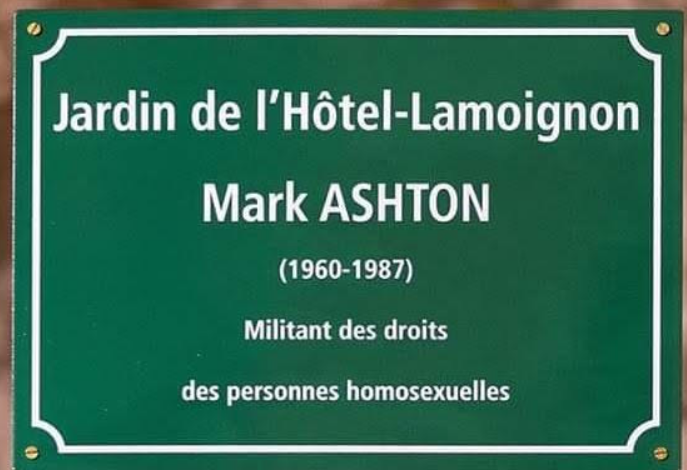
No. 25 is the best-preserved huge aristocrats’ town house, the Hôtel de Lamoignon. It is now a public library of the history of Paris, and its garden, first opened to the public in 1969, was renamed on September 25 2018, my life-long friend Rich Clarke points out, the Jardin de l’Hôtel-Lamoignon – Mark-Ashton.
Most of Ashton’s admirers overlook his strong Communist beliefs and his being active in Red Wedge and then becoming virtually the last General Secretary of the British Young Communist League in 1985.
Mark Ashton was a member of the Islington Branch of the CPGB before the 1984-5 miners’ strike, when he founded Lesbians and Gays Support the Minters the British founded. The garden at No. 25 was renamed in his honour by the Paris Municipal Council on a motion moved by its French Communist Party members.
The street displays vestiges of the Philippe August wall at Nos. 31-33 and No. 57 and several other grand town houses.
On May 12 1839 what was then the Town Hall of the 7th arrondissement at No. 43 was caputred by the Society of Seasons insurrectionaries. Barbès, Blanqui,Martin Bernard and Albert Laponneraye are all linked to its seizure.
When the SFIO and then PCF theoretician Charles Rappoport first arrived in Paris from Russia in 1895 he lived at No. 50.
The magnificent private mansion built on the site of the Hôtel de Guise at No. 60 was known as the Hotel de Soubise. It became the National Archives in 1794 and was saved from being burnt down by shell fire from the Versaillais troops attacking the barricade at No. 61, and by the 125th battalion of the National Guard of the on May 25 1781 by Louis-Guillaume Debock and André Alavoine. They were later pardoned for their support of the Commune because of their actions that day.
While he was studying at the Lycee Charlemagne in the 1880s, Leon Blum lived as a boarder in the Rue des Francs-Bourgeois.
Named in 1863 after the first name of a wife of one of the owners the road was first opened in 1840, initially being called the Rue Neuve-Saint-Paul and then in 1843 the Rue Bénédict.
Picasso lived at No. 49 with his friend Carlos Casagemas from October to December 1900. This was Picasso’s first studio in Paris, but after they returned to Spain for Christmas, Carlos returned on his own to Paris where he committed suicide early the next year. Another painter, an American or Bulgarian origins, Jules Pascin took over the studio there in 1909.
La Vie painted by Picasso in 1903 features his friend Carlos Casagemas who committed suicide in 1901 after falling into a deep depression due, it is believed, to his impotence.
Fifty years earlier Paul Verlaine first met his future wife, the 16-year-old Mathilde Mauté de Fleurville at No. 19.
Crammed full of smallish theatres since 1818, when the Montparnasse Theatre first opened its doors, the road ran along the outside of the Farmers’ General tax wall. This made it a good location to drink wine that was not subject to the Paris tax, and the numbers of music halls, theatres and restaurants that sprang up gave it its name. It was absorbed into Paris in 1863.
Sometimes political meetings were held in the cafés in the street. Gustave Courbet and many of Paris’ bohemian intellectuals and artists used to drink at the Café des Mille Colonnes, next to Bobino at No. 20bis, in the 1860s. On December 17 1904 all the Russian revolutionary groups in Paris met there together.
Bobino was the most famous music hall in the street. Lenin went often between 1909 and 1912. Edith Piaf sang there at the end of the 1930s and Georges Brassens had a five month residence there in 1976.
During 1870-1871 the dance hall, Bal du Jardin de Paris, at No. 21 was used to hold 30 public political meetings.
While Lenin was living in Paris in 1909-1912 he is recorded as seeing a friend, the singer-songwriter Montéhus appear at No. 26, the Théâtre de la Gaîté Montparnasse.
The Montparnasse Theatre you now see at No 31 was rebuilt in 1886 and is on the list of historic monuments. It staged the Paris premier of Berthold Brecht’s ‘Threepenny Opera’ (l’Opéra de Quat’sous) in 1928.
The writer Simone de Beauvoir spent the academic year of 1936-1937 based at the hotel then named Royal-Bretagne living there with Sartre when he was in Paris at No. 11bis. Today, this art-deco hotel has another name and looks more upmarket than it did in the 1930s.
The hotel where Simon de Beauvoir spent a year while teaching at the right-bank secondary school, the lycée Molière
Nearly opposite De Beauvoir’s hotel was the famous Bobino music hall at No. 20, sadly demolished in 1985 and turned into a Mercure hotel with a new Bobino now at the back. De Beauvoir and Sartre saw two singers there in 1932, singing anarchist and anti-militarist songs.
Named in 1893 after Léon Gambetta, a republican who was elected for Belleville in 1869 and who was in Spain during the repression of the 1871 Paris Commune, in 1870 it had previously been called the Place des Pyrénées and during the Commune, the Place de Puebla. On March 15 the canons in the Place des Vosges were moved there, and the square saw violent fighting during the ‘Bloody week’ of the Commune.
The Town Hall at No. 6 was the first in Paris to have a Communard elected to its Municipal Council before the June 21 1880 amnesty was announced. The cobbler, Alexis Trinquet, who had made an unsuccessful escape bid from exile in New Caledonia with Jean Allemane on November 23 1876, was elected on June 20 1880.
The Town Hall of the 20th arrondissement photographed for a postcard in 1908. It was built between 1867 and 1877.
Jean Allemane married the seamstress, Adèle Quénot, ten years younger than him with whom they already had two children, at the Town Hall on May 15 1880, one week after he was finally amnestied.
The Square is currently (from 2019) undergoing a major transformation. Unfortunately it is only designed to increase the space for pedestrians by 60%, unlike some of the other six squares being redesigned. And the old Wallace Fountain that features in early 20th century photographs will not be restored.
On his first visit to Paris in 1902, Natalia Sedova found Trotksy a place to live at No 46. near her flat in Rue Lalande. The 14th arrondissement was a frequent choice of destination for the Russian social democrats of the late 19th century and early 20th century. One source suggests Trotksy was living there when he married Natalia in 1903.
The street was constructed in 1887 and given the name of the Pierre Gassendi (1592-1655), a mathematician, astronomer and philosopher.
In 1999 a public library was opened at No. 36 and named after the anarchist, poet and singer, Georges-Brassens.
Since 1948 the Avenue is now named after Philippe Leclerc de Hauteclocque, the first French general to arrive in Paris in August 1944 – in American-loaned tanks and armoured vehicles and wearing American helmets with the Croix de Lorraine painted on their sides. He died in a plane crash in 1947 just as he was about to argue the case for French withdrawal from Indochina – before the wars of national liberation in the region had really started.
From 1863 to 1948 the tree-lined avenue was called the Avenue d’Orléans, running from the Denfert-Rochereau Square to the southern ‘ entrance to Paris (Porte d’Orléans), at the huge roundabout now called the Place du 25 Aout 1944, commemorating the Liberation of Paris.
It is one of Paris’ oldest roads, down which pilgrims used to follow what the Pope officially called one of the three most important pilgrimages for Christians in 1492 to the cathedral of Saint Jacques de Compostelle in Spain. This pilgramage had begun as early as the 9th century AD.
In the days when it was still the Avenue d’Orléans Lenin was often seen in the Café du Lion at No. 5 , where he organised meetings of the Bolshevik faction of the Russian social democrats.
Lenin might well turn in his Moscow mausoleum. His old meeting place is now a McDonald’s with a tiny Lion tobacco shop adjoining it that still bears the name of the original Lion cafe.
The French police estimated there were around 25,000 Russians in Paris around 1910, of whom 1,000 were revolutionary socialists and 500 anarchists. They were being watched both by the French police and by the Czar’s secret police, the Okhrana. On one occasion an agent spying on them was chased by Lenin and other Bolsheviks along the pavement in front of No. 101.
In 1911 a meeting of the Bolshevik faction organised by Lenin in the first floor room at the Café Les Manilleurs at No. 11 saw a near physical fight between them and Anatoli Lunacharsky and other followers of his brother-in-law, Bogdanov in the Vpered faction.
In December 1908 Lenin opened a bank account at the Crédit Lyonnais bank branch at No. 19.
Lenin and Inessa Armand used to frequent the old Cafe d’Orleans at No. 43 in 1910-1912. This is the new one, even closer to Rue Marie-Rose where the lovers lived. And still good for a drink after a long walk.
During his time in the area, Lenin used occasionally to be seen at the music hall called the Fantaisies de Montrouge at No 70. It was converted from being a theatre to the Grand-Cinéma that re-opened there in September 1911. That building was knocked down and rebuilt in reinforced concrete in 1922 and then became the 1,300-seater cinema the Mistral. Gaumont finally closed it in July 2016 and sold it to a housing developer.
The headquarters of the Russian Social Democrats on the first floor and the printworks of the ‘Social Democrat’ paper in a office in the back of the yard, were at No 110. Among those regularly present between 1909 and 1912 were Lenin, Zinoviev, and Kamenev.
In the 1930s the consulting room of Madeleine Pelletier were based here at 80-82 rue de Gergovie. Since 2011 there is a discrete plaque by the side of the door.
Named after the defeat of Julius Caesar in 52BC at the battle of Gergovia, won by Vercingétorix whose name adorns another local street, it has two historical connections with the left.
Outside her 1930s office I photographed this rare plaque to a leftist in 2017. I’m not convinced Pellettier would have approved the term ‘doctoresse’ instead of Doctor.
In 1892, No 23 used to be the site of a workers’ cooperative making paper bags.
In 1826 under Charles X a royal decree allowed the joint owners (M. Geoffroy and M. Godefrey) of land to the south of Paris, to build a 13m-wide road between the Customs Office at the Place d’Italie to the Customs Office at the Gobelins. The street was therefore called rue Godefroy. today it runs from the Place des Alpes to the Place d’Italie.
Zhou Enlai lived at No. 17 in a now demolished hotel from 1922-1924, sharing a room for some of the time with Deng Xiaoping.
A rare plaque on No 17 remembers a revolutionary who became a leading political figure in China and who then participated in many of the regime’s crimes against humanity
This quay was Paris’ first. It was built to prevent continuous flooding by the Paris merchants on the orders of King Philippe and finished in 1389.
George Sand lived on the fifth floor at No. 21 when she first arrived in Paris in 1831.
No. 35 (at the time No. 40) is the site of the bar run by Pierre Leroux‘s parents and where the future first author of the word ‘socialism‘ was born on April 7 1797.
In 1871 the Communard delegates from the Police Headquarters used to meet at the Lapérouse restaurant at No. 51 that dates from 1766 and had been a favourite haunt of Victor Hugo before he went into exile in 1851.
The Communist poet, Paul Éluard spent part of the German occupation of Paris in hiding in the flat belonging to Michel Leiris at No. 53 bis. The flat was also where Picasso‘s surrealist farce, ‘Desire caught by the Tail‘ was first performed on March 19 1944, with the parts being read by de Beauvoir, Sartre, Queneau and Picasso, while being directed by Camus.
In 1828 the young Proudhon was working briefly at the Gauthier printworks in No. 55, the site of the old Augustin monastery that gave the quay its name. This was where Proudhon met Charles Fourier and became aware of his ideas.
The entrance to No. 55, within which in 1828 Proudhon worked briefly as a proof reader and typesetter
This 100m-long street, named from 1839 after Louis XIII’s doctor (1586-1641) who planted up the nearby Jardin Royal with medicinal plants from 1635. It is now known as the Jardin des Plantes. The street runs from the Rue Jussieu to the Rue Linné.
In 1928 the International Quaker Centre of the Society of Friends in Paris opened an International Youth Circle at No. 12. Every Tuesday it used to hold meetings with a range of pacifist, trade union, religious and political figures speaking.
Lucie Bernard used to attend the Tuesday evening meetings held at the ‘Cercle international de jeunesse’ set up by the Quakers here in 1928
One of those who started to attend in the early 1930s was Lucie Bernard (Aubrac). Among the speakers were Gandhi, Ilya Ehrenbourg, Jean Zay and René Belin, the anti-Communist trade unionist who became Minister of Labour under the Vichy Government and who after the war helped to rebuild ‘yellow unions’ in France.
Léon Blum moved in to No 36 Rue du Luxembourg in 1896 upon his marriage to Lise Bloch. In 1898 the young lawyer began to support the Dreyfus campaign.
Léon Blum lived here in 1898, helping Émile Zola’s defence team, as the Dreyfus campaign was at its height. A qualified lawyer, Blum carried out legal research for Zola’s defence and also wrote a column on each day’s events. He lived here with his wife, Lise Bloch, whom he had married two years earlier.
The street was called the rue du Luxembourg when Blum and Lise Bloch lived here. It was renamed in 1918 in honour of Georges Guynemer, a 23-year-old French fighter pilot killed in combat in 1917.
A more interesting World War 1 fighter pilot for the left than Guynemer was the first black fighter pilot, Eugene Jacques Bullard. Despite being awarded the Legion d’Honneur (Chevalier) in 1959 for service to France in two world wars, there is no street named after him that I can find in France. I have found, however, a reference to him drinking and deciding to become a pilot at the Coupole brasserie on the Boulevard du Montparnasse in 1916.
A more realistic photograph of the World War 1 fighter pilot Bullard appears in Aviation History
The street was opened in 1780 and named after a nearby building called the Hanover Villa that was build by the 3rd Duke of Richelieu with the profits he made from the 1757 invasion of Hanover during the Seven Years’ War.
6 rue de Hanovre
Blanqui was involved in the fighting in this street in July 1830. No. 6 is its only notable building, an office block now listed as a historic monument, thanks to its art nouveau style. It was built in 1907.
During his final years Paul Verlaine lived in the Hotel de la Harpe at No 6, shown here as the mauve building on the right.
Before the construction of the boulevards Saint-Germain and Saint-Michel, the 13th century narrow road went all the way to the southern gates of Paris (today’s Place Edmond-Rostand). It was named after a café sign of a harp.
Towards the end of his life the poet elected ‘Prince of Poets’ by the French literary world, Paul Verlaine (1844-1896), lived in poverty at the Hôtel de la Harpe at No. 6.
In the remaining old part of the street at No. 11, Philippe Buonarroti often visited his editor in 1830 as they prepared the publication of Babeuf’s political legacy.
No 11 was a very old bookshop and printworks, where Philippe Buonarroti printed his influential works on Babeuf in 1830. Blanqui lived at No. 85 rue de la Harpe while fighting in the 1830 Revolution. Much earlier, in 1746, another printworks, Le Breton, at No. 16, printed the first volume of Diderot’s Encyclopedia.
Gustave Courbet‘s first Paris studio was at No. 89 in 1842, and was where he became friendly with Proudhon.
The 1848 Jacobin club used to meet at 63 rue de la Harpe during the 1848 revolution.
Gustave Courbet‘s workshop from 1848 up to the Paris Commune was based at No. 32. Among those who visited him here were Charles Baudelaire, who was born at No. 13 in a building that was knocked down when the Boulevard St Germain was driven through the Latin Quarter, and Emile Zola.
Painted between 1854 and 1855 in the former medical school in the Rue Hautefeuille,it’s full title is: ‘The Artist’s Studio, a real allegory summing up seven years of my artistic and moral life’. Rejected for the 1855 Paris World Fair, it now hangs in the Orsay Museum.
Leading up to the Saint-Lazare station built in 1837 the road was called du Havre in 1845 after the port in Normandy that the station served. The name was extended to include a section of the Rue de la Chaussée-d’Antin with its reference to the Duke of Antin whose town mansion was built there.
The earlier name had been changed during the French Revolution first to Rue Mirabeau le Patriote from 1791 to 1793 and then to Rue du Mont-Blanc from 1793 to 1816. With the Bourbon restoration it had gone back to Chaussée-d’Antin.
The odd numbers in the road are in the 9th arrondissement and the even numbers in the 8th.
Zola met Jeanne Rozerot in 1888 when he was 48 and she was 21. Their children were born in 1889 and 1891. This photograph was taken in 1893, two years after Zola’s wife found out about the relationship.
Emile Zola was often seen walking in this road, since in 1897 he rented an apartment at No. 3 for Jeanne Rozerot, his mistress and mother of his two children.
At No. 8 the Lycée Condorcet, opened in 1803, in the relatively recent monastery of the Capucin monks built in 1780 and nationalised in the Revolution, is one of the four oldest secondary schools in Paris.
Besides three former presidents of the Republic, among the leftists who were educated there were Victor Schoelcher and Paul Verlaine, and much more recently Alain Krivine. Jaurès and Sartre both briefly taught philosophy there while Mallarmé taught English.
Hospitals often have strange stories to tell. The former gunpowder factory and prison that became the Salpêtrière hospital at No. 47 was where Joseph Ignace Guillotin practised his ‘more humane’ method of execution (than hanging or shooting) on the hospital’s dead bodies on April 15 1792.
Six months after Dr Guillotin was there, 35 women common prisoners held there were murdered in the panic of the September massacres to which the revolutionary Jacobin leaders turned a blind eye.
Six months after Dr Guillotin was there, 35 women common prisoners held there were murdered in the panic of the September massacres to which the revolutionary Jacobin leaders turned a blind eye.
Much further along the Boulevard, on March 25 1920 the future Ho Chi Minh attended an anti-colonial conference based on Lenin’s support for national independence at No. 127.
In the interwar years the Communist Party organised many meetings at the Trade Union Centre at No. 163 of groups such as the Women’s Union, the Humanity Defence Committee and the Red Campers.
The Hôpital de la Pitié-Salpêtrière at No. 47 was requisitioned by the Germans in 1940, and was where they used to bring tortured resistance fighters or their dead bodies.
The statue of the neurologist Jean-Martin Charcot erected outside the hospital on December 4 1898 was melted down for guns in 1942 to help the German war effort, as were 100 others under the law of October 11 1941 passed by the Vichy Government.
The Boulevard was the route taken by the 9th company of Leclerc’s 2nd battalion on its way into Paris on 24 August 1944. Among the troops were 130 Spanish republicans whose armoured vehicles had been given names like Guadalajara, Teruel and Guernica.
Much later, this was where France’s first artificial heart was implanted in 1986, nearly twenty years after the first heart transplant in France took place there.
Two years earlier, in 1984, the hospital saw the deaths of two very different contributors to Paris’ left culture: Michel Foucault and Pierre Frank.
Louise Michel lived here at No 24 above what is now a café from 1865 to 1871 while running her own day school in the Rue des Cloÿs
This street changed its name at the French Revolution from ‘Petite Rue Royale’ – as a continuation of the Rue Royale which used to be the name of the current rue Jean-Baptiste-Pigalle. It was first called Rue Nationale and then the Rue de lÉgalité.
After the annexation of Montmartre to Paris in 1860 it was given the name of the French sculptor, Jean-Antoine Houdon, known as the ‘Sculptor of the Enlightenment’. In 1785, after the American war of Independence, Houdon travelled to the newly independent United States of America and sculpted a statue of George Washington.
He is known for his busts of Benjamin Franklin, Thomas Jefferson and Napoléon Bonaparte.
Louise Michel lived at No. 24 in 1865 at a time when she was beginning to secure a reputation as a feminist and republican.
During the Paris Commune, artillery was placed across the street between Nos. 1 and 2, its corner with the boulevard de Clichy, to protect the hill.
Auguste Renoir and Aline Charigot, who began modelling for him in 1880, lived at 18 rue Houdon at the time their first son, Pierre-Auguste, was born in 1885. They married in 1890 and had two more sons together.
Outside the Houdon Primary School at No 15 is one of the many plaques commemorating the deportation of Jewish children from Paris between 1942 and 1944. Carried out by French police these memorials were only put up after post-war Paris first elected a socialist mayor Bertrand Delanoë in 2001.
At No 15 a plaque on the outside of the school informs us that 700 Jewish children from the area were deported under the German occupation, and inside the school another plaque makes it precise: 13 children on the school registers of the 1940s were deported and never returned.
The metro station and huge roundabout at the Place d’Italie
The present Place d’Italie stands on the site of two tax collectors’ buildings on the Farmers’ General tax wall built from 1784 to 1791 to increase the tax collectors’ incomes. One of them was burnt down in 1789.
The Fontainebleau gate was the one through which Napoléon Bonaparte reentered Paris on 21 March 1815 after his return from Elba.
On the 23 June 1848 the first of hundreds of barricades were erected by workers in an insurrection that divided Paris between its wealthier West and its impoverished East.
The Place d’Italie was completed by Haussmann in 1865, leaving the two Farmers’ General tax pavillions in place. A huge barricade was built between them in 871.
At the Place d’Italie, known then as the Fontainbleau barrière a barricade was built between the old toll buildings – shown still standing in this 1865 picture. The one on the left was used as the 13th arrondissement town hall from 1860 until 1873 when it was demolished and rebuilt on a much grander scale.
The barricade blocked the principal entrance to Paris from the South. An army general was killed by the workers as he was attempting to persuade them to surrender. Many of its defenders were then among the estimated 3,000-5,000 workers massacred.
In October 1870, when Thiers began negotiating the surrender of Paris with Bismarck, the town hall was occupied by soldiers of the 101st battalion of the National Guard, who hoisted a red flag over the building.
On April 17 1871 the Paris Commune renamed it La Place Emile Duval after the 31-year-old revolutionary socialist who was captured and shot without trial by the Versaillais on April 4.
The 2016 unofficial renaming of Place d’Italie with the name it was given during the Commune
During the ‘bloody week’ of May 1871 when the Paris Commune was brutally suppressed the barricades here held out until surrounded on all sides. Finally, they succumbed to machine gun fire. A renaming event in honour of all those killed here took place in 2016.
A Café on the Place d’Italie was where Brassai took this picture showing a wonderfully happy woman and a calculating man in 1932
Hazan (IOP) tells the story of the surrealist Brassai’s 1932 photo taken here and ‘titled with a certain cruelty A Pair of Lovers in a Small Paris Café’.
It was the Place d’Italie, too, where Hazan (WTP) records the sculptor Giacometti as being knocked down by a car and being left with a limp for the rest of his life.
Boulevard des Italiens by Gustave Caillebotte (1880)
One of the ‘Great Boulevards’ in a wealthy part of Paris, it was built on the allotments outside the city when in 1670 Louis XIII’s wall around Paris was declared obsolete. Initially called the ‘New Boulevard’ and then the ‘Depot Boulevard’ (after the 1764 regimental arms depot there). It was finally named after the Italian Theatre built there in 1783 that is now occupied by the Comic Opera.
Even numbers are in the Ninth arrondissement, while odd numbers are in the Second.
From December 1919 to 1923 Louis Aragon and André Breton with other surrealists used to meet regularly in the Café Certà at No. 2. This address was in the ‘Passage de l’Opéra‘ – two parallel galleries of cafés and shops first built in 1822 and demolished in 1925.
The Mulhouse bar was based at No. 8. In March 1848 meetings of the German democratic association used to take place here, attended, among others by Karl Marx and Ludwig Feuerbach.
Ironically, on the other side of the Boulevard, at No. 9, in 1942 to 1943 the Vichy government tried unsuccessfully to recruit French workers to work voluntarily in Germany.
Crédit Lyonnais’s headquarters was built between 1876 and 1913 in the grand Haussmann style. This didn’t stop it experiencing a strike and occupation in 1968
Arlette Laguiller, who became the first woman to stand for President of France as a candidate of the Trotskyist Lutte Ouvriere sect in 1974, led a strike and occupation in 1968 at the Credit Lyonnais headquarters at No. 19 in 1968. The building had been the first in Paris to be lit by electricity in 1876.
Louis Blanc lived above the Tortoni café at No. 22 for a period.
No. 30 was the site of a bomb left by the anarchistsAction Directe against the Israeli Leumi bank on 13 April 1985.
The avenue d’Ivry runs south to external limit of the 20 arrondissements in today’s Paris. Hazan (WTP) suggests this boundary presents a false image: by confining Paris to the twenty arrondissements, it contributes to the image of a city that is mummified and museum-ified, in which working class life is reduced to a narrow sector.
The Panhard & Levassor factory gate at 19 Avenue d’Ivry in 1900
Hazan (WTP) also explains the origins of the Asian ethnicity of the area: during the First World War, Panhard & Levassor, like Citroen and Renault, employed workers brought from Indochina, or recruited in China, to replace Frenchmen sent to the front. This is said to be the origin of the Chinese quarter in the 13th arrondissement, which grew in the 1970s with the arrival of the “boat people”.
Towards the circular Boulevard Périphérique the Avenue has since the 1990s become a centre of modern business buildings.
Initially called the Rue des Deux Moulins (the Two Mill road) the road at the bottom left of this image was extended to the Boulevard Massena by Haussmann in 1863 and then renamed the Rue Nationale in 1870. This south-facing photograph shows its junction with the Avenue d’Ivry on the right of the red building, built on the site of the Panhard & Levassor factory.
The Ivry-sur-Seine commune to which the
avenue leads is just 3.3 miles (5.3 km) from the centre of Paris. Ivry used to
stretch down to the Seine and included the land on which the new Mitterrand
national French library was build. A third of Ivry was annexed by Paris in 1860.
Hazan (IOP) draws a political line of
Resistance Paris based on those who were shot or deported between 1940 and 1944.
In Paris it runs from the Porte de Clignancourt to the Porte de Vincennes,
broadly the poorest, more working class areas, and then into what became known
as the ‘Red Belt’ around Paris, ‘to Montreuil [in the East] and Ivry [to the
South East].’
Ivry was the cradle of Municipal Communism. Georges Marrane was its Communist mayor from 1935 to 1965. In the 2017 general election Ivry still voted for the left France Insoumise parliamentary candidate and had a Communist mayor. The Red Belt’s population today is, Hazan (IOP) writes ‘now for the greater part ‘of immigrant origin’, i.e., made up of Blacks and Arabs, the very people (or their relatives) who had been driven out of the city by renovation and rising rents.’
The Square covers part of the site of the major cemetery within the Paris walls from the Middle Ages to the end of the 18th century. In 1786 the bones from the Innocents Cemetery were transferred to the Paris catacombs, the Church of the Innocents was demolished, and the site became the Market of the Innocents.
During the 1830 Glorious Revolution it witnessed violent clashes between the insurgents and the army.
Charles Marville photographed the Marché des Innocents and its 16th century fountain in 1858, just two years before the fruit and vegetable market was moved to Les Halles that closed in its turn in 1971.
In 1985 the remaining half of the area that had not been bought and built on in 1860 was named after the 19th century poet, Joachim du Bellay (1522-1560) – a contemporary of its 16th century Fountain.
The outside of the Cours Desir during the great flood of 30 January 1910
This old narrow street running parallel to the Seine has both an international and a significant left history. It also used to flood when the Seine got very high, as it did in 1910.
In 1783 the British embassy was located at No. 44, and this was where Benjamin Franklin negotiated the American Independence Treaty from Britain. He refused, however, to sign it on British territory, so on September 3 1783 he and John Adams signed the treaty at the York Hotel where Franklin was staying at No. 56.
No. 44 became the Hôtel d’Angleterre and then the Hôtel Jacob, and this was where Hemingway and his wife Hadley stayed at first on their arrival in Paris on 22 December 1921.
Anne Pingeot used to live at No 40, where she was visited very regularly by the French deputy and future president, François Mitterrand.
Louise Michel spent her last years from 1897 to 1904 at No. 2. The Cronstadt hotel was then demolished in 1944 leaving a little garden.
Louise Michel lived in the building that once occupied this small garden site from 1897 until leaving for her last speaking tour in 1905.
In 1832 the independent Saint-Simonien, Pauline Roland lived in a flat at No. 10 with Pierre Leroux, who was then a foreman at the Panckoucke printers where the paper he helped found, Le Globe, was being printed.
After returning from exile in Belgium in 1862, Pierre-Joseph Proudhon returned to Paris and lived in an apartment at the back of the courtyard of No. 14 rue Jacob. An earlier resident, Richard Wagner, who stayed there from 1841-1842, has a plaque to his memory on the wall.
A view of an old entrance into No. 10 rue Jacob taken from the courtyard inside No. 12
At the end of the Second World War some leftist writers who had organised together before the war in the October Group led by Jacques Prévert, set up ‘Le Bar Vert’ (Green Bar) at No. 10. The first ‘American bar’ in Paris it stayed open all night, and it attracted many literary names including Raymond Queneau, Roger Vailland, Maurce Merleau-Ponty Juliette Greco and occasionally Jean-Paul Sartre.
The inside court of the Cour Desir during the great flood of 30 January 1910
Simone de Beauvoir went to the private Catholic secondary school at the Institut Désir at Nos. 37, 39, 41 and 45. The school’s buildings were partly taken over to build a new Medical Faculty in the the early 1950s and it moved away.
No. 60 used to host the Restaurant Michaud (later known as the Comptoir des Saints Pères), frequented by the ‘Lost generation’ of the 1920s such as Hemingway, Joyce and Scott Fitzgerald.