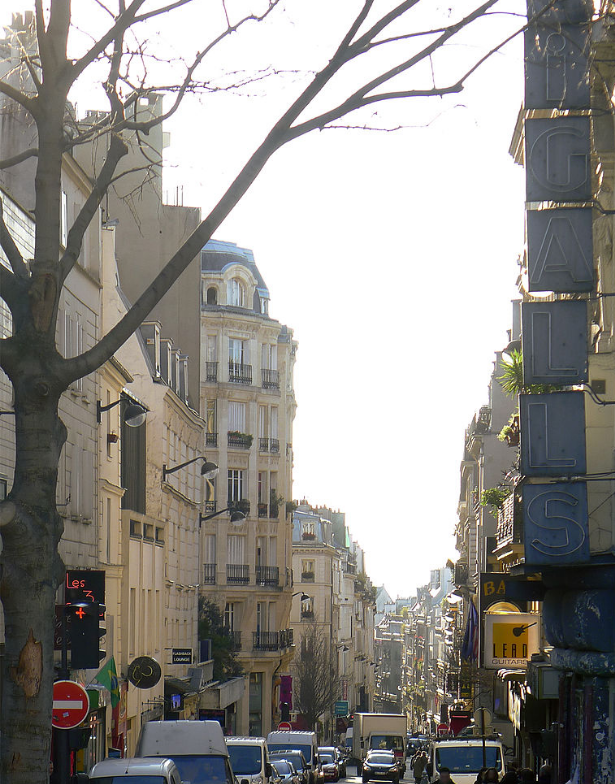
An unusual due North-South road for Paris it was called the Rue Royale in 1772 and during the French Revolution, first Rue de la Republique, then Rue de l’an VIII, and finally Rue Pigalle in 1803, when Napoleon was unchallenged as First Consul.
It was named after the 18th century sculptor Jean-Baptiste Pigalle, who used to live at No. 1 and had a workshop at No. 17 where he sculpted a famous bust of Voltaire. His first name was added in 2020 to balance the adding of a female first name to that of the nearby rue de la Rochefoucauld.
In 1841 to 1842 George Sand lived with her lover Frederik Chopin in one of two small houses she rented at No 16.
Julliete Drouet had a flat at no. 55 from 1871-1874 near her lover, Victor Hugo, who stayed there with her briefly early in 1874 while his son, François-Victor Hugo, was dying aged 45 from tuberculosis.
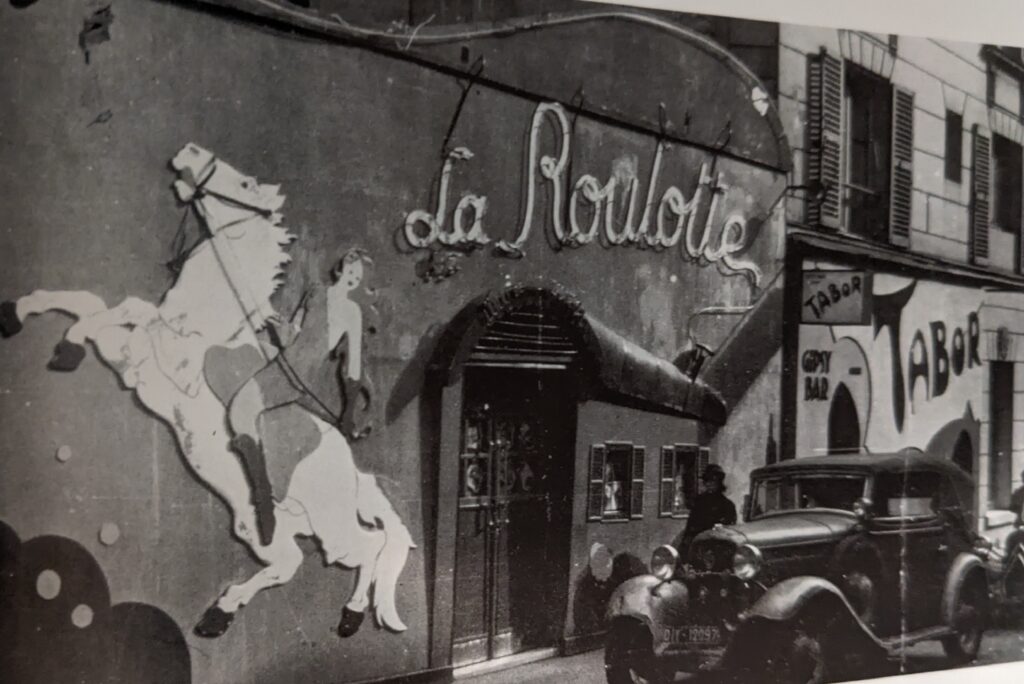
Django Reinhardt often played at La Roulette, one of several well-known jazz clubs in 1930s Paris at No. 62.
Henri de Toulouse-Lautrec famously painted Madame Armande, the owner of the lesbian-associated Hanneton Caberet at No. 75 around 1897-1898.
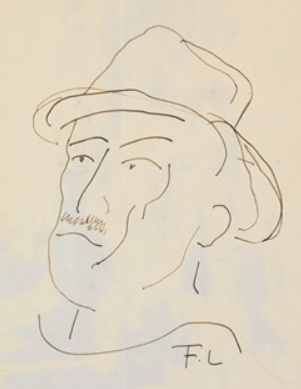
Already a well-known artist, in the 1930s Fernand Léger participated in anti-fascist marches and meetings, supported the Popular Front and joined the Communist Party aged 64 in 1945.
He trained at well known painting school, at 14 Rue de la Grande Chaumière, at the turn of the 20th century. Others who were trained there included Modigliani and Matisse.
By 1910 he had a studio in the Rue de l’ Ancienne Comédie, and was meeting other cubists every Tuesday at the Closerie des Lilas in the Boulevard du Montparnasse.
His interest in working people, and his concern about the need for mass education, emerged during his time in the trenches in the First World War. He wanted museums to open at night so ordinary people could visit them.
After nearly dying in a German mustard gas attack at Verdun Léger was demobilised and returned to live in Paris at 86, Rue Notre-Dame des Champs, where he lived for the rest of his life.
He joined the Association of Revolutionary Writers and Artists (AEAR) in December 1932. On 21 March 1933 he spoke at a meeting held in the masonic hall at 16, rue Cadet chaired by André Gide, protesting against the Nazi terror imposed after the Reichstag Fire of February 27.
In 1935 and 1936 he debated with Aragon about the direction of painting, arguing that there had to be a ‘new realism’ with its origins in modern life. Leger always defended individual creativity.
At the International exhibition of 1937 a huge mural of his was displayed at the Pavilion of Discovery.
Léger’s optimism for humanity is suggested in his 1937 mural ‘The Transport of Powers’
Another massive paintings was on display at the Solidarity Pavilion. It was called ‘The CGT’s working class trade unionism’. I can’t find it anywhere, but that same year he produced an office ground plan for the Popular Front’s Minister of Education, Jean Zay.
Drawing by Leger of ground plan for the office of Jean Zay in 1937
All through the pre-war period Léger attended demonstrations and signed petitions against fascism, so in October 1940, he went to the US, believing he could not continue to paint under the German Occupation.
He returned to France in December 1945 and immediately joined the French Communist Party – an action that coincided with Picasso‘s similar decision that naturally made much bigger headlines.
While accepting his membership, Léger remained trebly suspect to the PCF. Not only, like Picasso, did he not paint to political orders, and often produced what the PCF considered ‘art that was inaccessible to the workers’; but also, unlike Picasso, he had left France between 1940 and 1945; and he had gone to live and work in the United States.
With his second wife, one of his pupils, Nadia Khodossievitch, he opened a studio and art school at 104, Boulevard de Clichy. His last ten years saw him paint prolifically and gain an international reputation.
In 1947 Fernand Léger painted this portrait of Paul Eluard author of the 1942 poem, ‘Liberty I write your name’
Despite being overshadowed within the peace movement by Picasso’s dove, Léger, whose left political leanings and anti-fascist record resonated in the inter-war decades, continued to support the Communist-inspired peace movement and the Communist Party up to his death in 1955. while all the time refusing to paint in the ‘socialist realist’ style the PCF, following Stalin, preferred.
French generals in Algeria lead a coup d’état on May 13 1958 that overthrows the government of the fourth Republic and installs General De Gaulle in power in France
De Gaulle, Coup d’état, Nuclear weapons, Algerian War, Miners’ strike – in progress
The road was named ‘Brittany’ after a never completed project of Henry IV to build a great square into which several streets would run, each with the name of a different province. After two streets were merged in 1851 the road is nearly half a kilometre in length. The even-numbered side of the road was demolished in 1920 to widen the road to its present width.
No. 14 was where the first issue of the centre-left newspaper Libération was prepared and published on April 18 1973.
The oldest covered market in Paris at No. 39, the Market of the Red Children (Le marché des Enfants Rouges), was established in 1628 near an orphanage whose children were dressed in red, the colour of charity). During the ‘Bloody week’ at the end of the Paris Commune in May 1871 the market was fortified and defended.
On January 2 1910 Lenin attended a revolutionary ‘goguette‘ – a kind of drinking + sing-song / poetry-and-literature dinner with roughly 20 people – organised by La Muse Rouge in a room on the first floor of No. 49. We don’t know if he was accompanied by Krupskaya or Inessa.
No 49
The venue (shown in the photograph taken in the 1910s) was the Third arrondissement’s communal building. At the time there were hundreds of these goguette events being organised regularly in Paris. The Muse Rouge theatre group was expelled by the PCF in 1925.
By 1921 the building included the office of the Paris Federation of the SFIO (Socialists) and this was where Breton and Aragon came to apply to join the new French Section of the Communist International, less than a week after the majority of socialists had voted at the Tours Congress to affiliate to the Third International.
In 1922 the cooperative workers’ restaurant and café La Famille Nouvelle based at No. 49 was visited by many leftists including Ho Chi Minh. Many left events took place, including monthly dinners of the Revolutionary Esperantists, who were entertained by the Socialist Federation’s choir.
On September 1 1939 Palmiro Togliatti was arrested by the French police and taken to the Police Station at No. 62. They didn’t find out his true identity and he was jailed only for holding false papers and finally released in February 1940.
In the bloody week of May 1871 a barricade across the road at No. 71 defended by the 86th National Guard battalion mounted strong resistance to the Versaillais troops. This was also the address where Sylvain Maréchal, who drafted the Equality Manifesto of April 1796 is supposed to have lived.
In the 17th century it was called ‘The rubbish dump path’ (chemin de la Voirie), but when in the 18th century it graduated to being a road it was given the name of the Cadet family who owned some of the land it crossed.
In 1820 the road also housed the Bazar francais, a shop that served as a meeting place for several disgruntled army officers who planned unsuccessfully to overthrow the Bourbons and bring Napoleon’s son to the French imperial throne.
On March 15 1917 the first issue of a new literary review founded by Pierre Reverdy appeared in Paris called ‘North-South‘. Its title indicated a rapprochement between the artistic and literary colonies in the Montmartre and Montparnasse areas, connected directly by the metro.
The review’s first office was at No. 12, and virtually all the later surrealists and Dadaists wrote for and/or attended meetings there: Aragon, Breton, Éluard, Tzara and Duchamp. Georges Braque and Fernand Leger also produced drawings for it.
An illustration by Fernand Leger in 1918 for the Nord-Sud review
The Lodge of France’s oldest, traditional liberal Masonic order, the Grand Orient of France, was based at No. 16. This was where many political events took place. These included the founding of the League for the Rights of Man in 1888 and the first show in 1933 of the October Group’s play supporting the Scottsborough Boys, the young black men wrongly found guilty of rape in 1931.
Rue Cadet no 16 Masonic grand order
French Masonic orders were banned in 1940 under the German Occupation , and the offices of the Grad Orient taken over by the French police’s intelligence unit tracking down secret societies. One hundred agents worked there under the direction of the Gestapo. On August 11 1941 a second law was added to permit the seizure and sale of all Masonic temples and goods belonging to individual Masons. The photo of the entrance to the Lodge above was taken in 1941.
After Jules Vallès gave a lecture on Balzac at the Casino Hall at No. 18 on January 15 1865, Vallès was fired from his job in the Vaugirard Town Hall for having criticised the Second Empire.
A road to find cheap places to live for over a century it attracted many artists and writers like Modigliani who painted at No. 3 after he moved to Paris in 1906. Rosalie Tobia who the restaurant Chez Rosalie there was one of Modigliani’s models.
The road was named ‘First Campaign’ by a local landowner, Alexandre Camille Taponier. In 1793 he was a regular army sergeant who was present at the seizure of the Bastille in 1789. He was promoted to divisional general after distinguishing himself at the first battle of Wissembourg in October 1793, his first campaign.
From 1929 to 1935 Louis Aragon and Elsa Triolet lived together at No. 5 after sharing the same artists and writers’ house at No. 29 from 1924.
Elsa lived in room 12 at what is now the Hotel Istria, while other poets, artists and writers who came and went included Vladimir Mayakovsky, Marcel Duchamp and Man Ray (whose studio was at No 31bis, where he was visited by many other artists including Dora Marr, who came to Paris in 1926 to study photography).
Jules Vallès, the editor of the highly popular newspaper during the Commune, the Cri du Peuple, was hidden for three months by a sculptor friend, François Roubaud, at No. 21 before escaping from France. He returned only after the general amnesty of July 11 1880.
The shortest of the 12 roads leading like star bursts from the Arc de Triomphe, it was partly built in 1840 , added to in 1854 to provide symmetry around the Place de l’Étoile, and extended to its present 300m length in 1867. It was named Carnot instead of the Avenue of Acacias in 1880.
Lazare Carnot was not only a mathematician and doctor. Crucially for the bourgeois politicians who ran the Third Republicand who wished to reaffirm their republicanism he was a regicide and the successful General at the Battle of Wattignies on October 15-16 1793 that finally ended the series of defeats for France’s revolutionary armies.
From 1899 to 1904 Aragon’s mother, Marguerite Toucas, ran a family boarding house at No. 20, providing her, her mother and the young Louis with an income. It is likely that it was Aragon’s father who purchased the small business on behalf of the much younger woman who had fathered his son.
It was only when he was 19 that Aragon was told that the woman he believed was his mother was actually his grandmother and the woman he thought was his sister his mother.
The photograph above was taken in 1900. It captures the wealth of the Avenue at the time Aragon lived there, with a motor car in the very wide street, and delivery routes just in front of the houses.
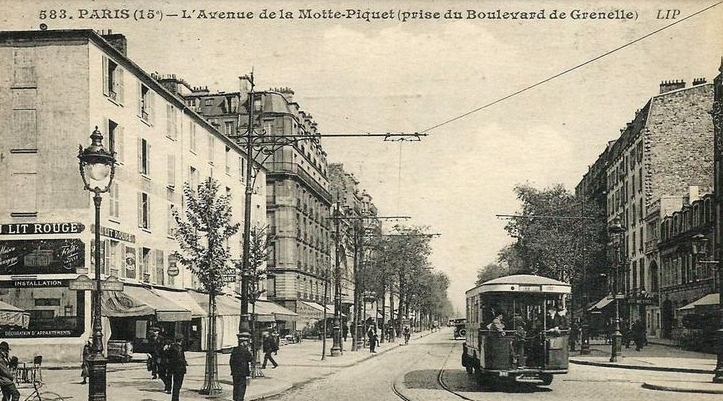
The road was named because it used to lead up to a small Château that was finally demolished in 1898. The so-called Château du Maine was the name given to a three story private town house built around 1730 also known as ‘Fantasie’ and finally demolished in 1898. The house itself was situated at what is now roughly No. 142 Rue du Château.The eastern part of the road, with numbers between 2 and 80, also appear to have been demolished roughly a century later.
Around 1867 when the International Association of Working Men was banned by Napoleon III, its supporters, including Nathalie Le Mel launched several cooperative restaurants. La Marmite (cooking pot) at No. 47 was one of these, part;y acting as a cover for continued political organisation.
South of Montparnasse station it was a working class street with cheap rents and poor quality housing (see picture above from the 1900s), most of which was pulled down if it didn’t fall down towards the end of the 29th century.
The Bar du Chateau at No. 53 was a regular meeting place for the surrealist group. This (largely male) group included André Breton, Louis Aragon, Benjamin Péret, Raymond Queneau and Max Morise were among those attending. One meeting on March 11 1929 saw three members including Roger Vailland breaking away after rejecting the supportive line for Stalin taken by a majority.
From 1924 to 1928 the poet Jacques Prévert lived in a creative colony at No. 54 with Yves Tanguy in a flat belonging to Marcel Duhamel. Duhamel sold it in 1928 to Louis Aragon, who moved in and was joined by Elsa Triolet in January 1929.
Two resistance fighters lived at No. 114 with their daughter in 1943. Olga Bancic was a 32-year-old Romanian Jewish Communist. She was captured on November 6 1943 and sentenced to death with the others in the Manouchian group.
French law did not allow the execution of women so Olga Blancic was deported to Stuttgart and her head hacked off with an axe
Boulevard des Italiens by Gustave Caillebotte (1880)
One of the ‘Great Boulevards’ in a wealthy part of Paris, it was built on the allotments outside the city when in 1670 Louis XIII’s wall around Paris was declared obsolete. Initially called the ‘New Boulevard’ and then the ‘Depot Boulevard’ (after the 1764 regimental arms depot there). It was finally named after the Italian Theatre built there in 1783 that is now occupied by the Comic Opera.
Even numbers are in the Ninth arrondissement, while odd numbers are in the Second.
From December 1919 to 1923 Louis Aragon and André Breton with other surrealists used to meet regularly in the Café Certà at No. 2. This address was in the ‘Passage de l’Opéra‘ – two parallel galleries of cafés and shops first built in 1822 and demolished in 1925.
The Mulhouse bar was based at No. 8. In March 1848 meetings of the German democratic association used to take place here, attended, among others by Karl Marx and Ludwig Feuerbach.
Ironically, on the other side of the Boulevard, at No. 9, in 1942 to 1943 the Vichy government tried unsuccessfully to recruit French workers to work voluntarily in Germany.
Crédit Lyonnais’s headquarters was built between 1876 and 1913 in the grand Haussmann style. This didn’t stop it experiencing a strike and occupation in 1968
Arlette Laguiller, who became the first woman to stand for President of France as a candidate of the Trotskyist Lutte Ouvriere sect in 1974, led a strike and occupation in 1968 at the Credit Lyonnais headquarters at No. 19 in 1968. The building had been the first in Paris to be lit by electricity in 1876.
Louis Blanc lived above the Tortoni café at No. 22 for a period.
No. 30 was the site of a bomb left by the anarchistsAction Directe against the Israeli Leumi bank on 13 April 1985.
The very short road was opened and named in 1912 after the engraver, Jacques Callot, who lived for about a year in Paris in 1629. It was built on an old alley-way to the Pont Neuf opened in 1823.
Its principal feature is the Café La Pallette (shown above) whose second back room is decorated with ceramics from the 1930s. Close to the Beaux-Arts de Parisinstitution the doorway next to it at No. 16 included the office of the review Le Paria edited by Ho chi Minh who, in respone to the police watching him, wrote to the Minister of the Colonies in August 1922 telling him what he was doing there.
No 16
In the early 1920s No. 16 was also the address of the literary review, Clarté, founded in 1919 by Henri Barbusse.
On October 15 1925 Clarte published the surrealist manifesto drafted by Breton called ‘The Revolution First and Always’ in response to French involvement in the Moroccan war. It was also signed by Aragon and Éluard
In the Spring of 1926 Breton and Aragon and Naville opened the Surrealist Gallery in the former office of the Clarté. And in December that year Pierre Naville described Breton bringing Léona Delcourt (Nadja) there at the end of Breton’s relationship with her.
For centuries before 1881 its name was the New Road of the Mathurins (rue Neuve-des-Mathurins) after a farm that had belonged to Mathurin monks who took the name of the 4th century martyr, Mathurin of Larchant. This Saint was very very popular in the Middle Ages, supposedly because of his prowess in healing madness and anxiety, and was the patron saint of clowns.
Daniel Stern, author of the History of the 1848 Revolution, was Marie d’Agoult. Under the July monarchy (1830-1848) she used to host a salon at No. 10 that was frequented, among many others, by Victor Hugo.
George Sand was living at the Florence private house at No. 26 with Baron Casimir Dudevant when she gave birth to her son, Maurice, on June 30 1823. At the time it was owned by the former head chef of Napoleon. It is now a 3-star hotel called George Sand.
The Michel Theatre founded by Michel Mortier was in the basement of No. 38.
This was frequented by Aragon and Picasso who witnessed a fight there on July 6 1923 when Breton (a future surrealist) broke the arm of Tzara, the leading Dadaist .
The Chilean embassy is in a prime location at No. 2. It had previously been the private mansion of the Tour-d’Auvergne family.
Built in 1907 for Prince Henri de La Tour-d’Auvergne it was rented to the US Embassy until 1929 and then sold to Chile to become its Embassy
The Chilean Embassy was where Louis Aragon was allowed to take refuge for a few days on August 28 1939 by fellow poet and Communist, but also a diplomat there at the time, Pablo Neruda. Aragon had been attacked in the street by the extreme right-wing after the French Communist Party had been banned on August 25, two days after the 1939 Hitler-Stalin ‘Non-aggression Pact’.
Between 1971 and 1973 Neruda was made Chili’s Ambassador to France by Salvador Allende. Back in Chili Neruda witnessed the September 11 1973 Pinochet coup d’etat (protests outside the Paris embassy pictured here). But 12 days later Neruda died of ‘heart failure’. 21st century scientific analysis has suggested he could have been murdered in hospital through being injected with botulism.
Jean Jaurès, the leader of the Socialist Party before World War I, lived at No 19 for a period of time according to Paris Revolutionnaire, but we still need to check out the source for this and the time he spent there.
The French Jewish 20-year-old Louise Alcan lived at No. 48 and became a supporter of resistance in 1940. She later moved to Vichy France but was denounced and arrested in December 1943 in Marseille after the Germans moved to occupy the whole of France.
Louise was first taken to the Drancy transit camp and then deported in Convoy 64 to Auschwitz-Birkenau in February 1944. She later escaped from the Ravensbruck Death March of April 1945.
Further down the road at No. 52 there are several connections to the resistance. This was where the leading Catholic resistance organiser from De Gaulle’s secret service in London, Gilbert Renault known as Colonel Rémy, lived from December 1941 to June 1942. With a month of the 1940 defeat he returned from London and with Louis de La Bardonnie set up the Confrérie Notre-Dame (later called the CND-Castille). Two of Renault’s sisters, Maisie and Madeleine, also joined the CND and were arrested at No. 52 on June 13 1942. But they were able to ensure Gilbert’s escape.
Maisie Renault (1907-2003) was first taken to the Santé prison and then to Fresnes until March 1943. She was next moved to the Romainville Fort and on August 15, after D-Day, she and her married sister Madeleine were deported with 550 others to Ravensbruck. They were among the 17 from that convoy who survived to be liberated on April 22 1945.
Outside No. 52 Roland Abon, a resistance fighter aged 19 was killed fighting for the liberation of Paris on August 25 1944.
Rue de l Odeon photographed in 1905 from the steps of the Theatre. The bust of the playwright Emile Augier in the centre of the square was melted down in 1942 to be turned into German guns
The gently climbing slope from the crossroads with the Boulevard St Germain up to what is now called the Odéon-Théâtre de l’Europe, was opened up in 1779 as the rue du Théâtre Français. The theatre at the southern top of the slope was built between 1779 and 1782 in the garden of the huge Hôtel de Condéprivate house, owned by a junior branch of the Bourbons.
Thanks to the opening of the theatre, in 1782 the road was the very first in Paris to be given pavements with gutters running next to them. It was given its current name in 1797 under the Directorate.
A watercolour and ink painting by a contemporary JD Periel of the fire at the Odeon Theatre on March 20 1818
The surrealist poets André Breton and Louis Aragon first met each other in 1917 at No. 7, the bookshop called ‘The Friends of Books’ (Maison des Amis des Livres). This bookshop was also frequented by Jacques Prévert. On March 19 1918 Breton and Aragon launched their magazine, Littérature, from there. Among the other literary left figures who wrote for it were André Gide and Paul Valéry.
The bookshop’s owner, Adrienne Monnier, held a launch party at No. 7 for James Joyce‘s novel Ulysses on December 7 1922.
No. 10 was where Thomas Paine lived from 1797 to 1802, when, describing Bonaparte ‘as the biggest charlatan the world as ever seen’, he took the opportunity of a brief peace with England to leave Paris for America.
Tom Paine lived for five years at No. 10 Rue de l’Odeon. While initially hoping Bonaparte would spread freedom throughout Europe he quickly became disillusioned, and left France at the earliest opportunity in 1802.
Next door was another famous bookshop. No 12 was the first site of the English-language bookshop Shakespeare & Company. Owned by an American, Sylvia Beach, it became a major draw for radical writers living in Paris in the interwar years such as Hemingway, James Joyce and Simone de Beauvoir.
Shakespeare and Co at No 12 with Sylvia Beach and Ernest Hemingway on the right around 1922
Further up the street, on March 31 1794, this was where at No. 22 rue du Théâtre Français that Camille Desmoulins was arrested. He had lived there since 1782. He was executed with Danton on April 5. His wife, Lucile, was executed a week later. They had married in 1790 with Robespierre a witness who in 1792 became their son’s godfather.
The Panthéon dome (actually three in one like a Russian doll) is one of Paris’ landmarks. Jacques-Germain Soufflot’s Church of Saint-Genevieve on the hill to the South of the River Seine was built on a grand scale between 1755 and 1790 – and being completed only shortly after the French Revolution began.
Almost immediately the National Constituent Assembly decided to use the model of the Roman Pantheon and to install statues of great Frenchmen in it.
The slogan, ‘A grateful nation honours its great men‘, was put over the entrance and on April 4 1791 Mirabeau became its first brief resident (his ashes were taken away on November 25 1793), followed by Voltaire (July 11 1791), Rousseau (October 11 1794) and then several executed revolutionaries, including Jean-Paul Marat (September 21 1794 – and then thrown into the gutters by the Muscadins on February 26 1795).
Rousseau’s statue in the square put up in 1889 was destroyed under the German Occupation in 1942.
Under Napoleon Bonaparte who gave it back to the Catholic Church, its crypt was stuffed with 41 mainly military figures. After the July Revolution it reverted to being a secular Pantheon on August 26 1830, but no more ‘great men’ were inserted there under Louis-Philippe who kept the crypt closed.
The square in front of the Panthéon became the meeting place for hundreds of demonstrations and pitched battles in the 19th and 20th centuries. One riot under a black flag started there on 21 December 1830 in protest against the light sentences given to the reactionary government ministers of Charles X.
On 22 February 1848 a student demonstration against the banning of university courses by Quinet and Michelet left from there for the Madeleine. Soon after the Panthéon was renamed ‘The Temple of Humanity’, with the intention of turning it into a monument to human progress. The Law School at No. 12 hosted the revolutionary Soufflot Club in March 1848.
On June 22 1848 the square was the meeting place of thousands of workers protesting the closure of the National Workshops who then organised the building of barricades and the call for an armed insurrection. It was one of the three main centres of resistance, with the barricade at the Rue d’Ulm being one of the most important.
The National Guard used canon to burst through the doors of the Panthéon on 25 June 1848 to dislodge the workers inside.
Following Louis Napoleon’s 1852 coup-d’état the building was returned to the Church again, now the ‘National Basilica’, and the surviving bits of the nun Genevieve’s 1,350-year-old corpse stuck together in a new tomb.
From September 4 1870 the Town Hall of the 5th Arrondissement at No. 21 became the recruiting office for the National Guard defending Paris. with 12 separate offices interviewing recruits. Between 200 and 300 summary executions of Communards took place there on 24 May 1871.
The Panthéon itself was shelled during the Franco-Prussian war and became the scene of a major battle between the Communards and the Versaillais army. On 31 March 1871 a red flag was attached to the sawn off wooden cross that had been erected on top of the building on the orders of Napoleon III. Jean Allemane spoke on the steps supporting the raising of the red flag.
The Law School at No. 12 was where the ‘Democ-Socs‘, the 5th arrondissement’s Democratic-Socialist Club was based in 1870-1871. Many were massacred here on May 24 1871 as the Army burst through to attack those defending the Panthéon via a side door.
Before the ‘Bloody Week’ of the Commune a communist and atheist newspaper l’Éducation républicaine was published at No. 9, being used by a revolutionary club called ‘The Democratic Association of Masters of Study‘.
The Panthéon finally returned to its role as resting place for the ‘great men’ of France on June 1 1885, after the government inserted Victor Hugo‘s body into the crypt.
On June 4 1908 Alfred Dreyfus was wounded in an attack on him when he attended the ceremony installing Émile Zola‘s body into the Panthéon.
The Ste Geneviève Library where Lenin researched ‘Materialism and Empiro Criticism’ in 1908, was based at No. 10.
In 1920, as part of the celebration of the German defeat, Sicard was commissioned to produce an altar dedicated to the National Convention that declared the First Republic in 1792.
The space for the intended religious altar in the centre of the Panthéon was finally filled by Sicard’s secular monument to the glory of the National Convention in 1920.
On July 16 1942 the Police Station based in the Town Hall at No. 21 was used at a primary collection point for Jews being arrested for deportation by the Paris police in the entirely French-run exercise called ‘The Vel’ d’Hiv Roundup‘ (Rafle du Vélodrome d’Hiver).
In some form of recompense, on May 27 2015, Jean Zay‘s remains were transferred to the Pantheon, along with the resistance fighter Pierre Brossolette, and soli from the graves of two women heros of the Resistance who survived the occupation, Geneviève de Gaulle-Anthonioz, and Germaine Tillion.
On the St Louis island this very narrow street was built between 1614 and 1646 and named after François Le Regrattier, the wealthy treasurer of the Swiss Guards, the mercenary soldiers who served the kings of France from 1471 to 1830. He and two developers were awarded the contract to build on the Island. Its current length was decreed in 1868 when it incorporated the ‘Headless Woman Road’ (La rue de la Femme sans Tête).
1 Rue Le Regrattier
No. 1 at the southern side of the Island, in a prime location with a view of Notre-Dame, contained the apartment belonging to the heiress of the Cunard Lines, Nancy Cunard. She had many lovers and from 1925 to 1928, Louis Aragon was largely living there with her.
Jules Guesde has one of the rare plaques for leftists in Paris, probably because he moved from being a ‘doctrinaire’ Marxist to joining the war government in 1914.
The founder of the French Workers’ Party. Jules Guesde (then Jules Bazile), was born in No. 22 on November 11 1845.
The 2.5 kilometre road was named Rue Saint-Dominique in 1631 after the Dominican order set itself up on what had been a long path leading to the Saint-Germain-des-Prés Abbey complex.
The Hotel de Brienne at No. 14 (see entrance above) had been bought by Louis XVIII in 1817 to house the Ministry of War. In April 1871 Gustave Cluseret installed the Central Committee of the National Guard in the War Ministry. Its last meeting there took place on May 23.
The Ministry of Public Works at No. 62 was the location of efforts by the Paris Commune first, on May 10 1871, to discuss workers’ conditions and second, on May 15, to create an enquiry made up of 11 trade associations and the Women’s Union into abandoned workshops.
At an unknown location in the road a barricade was erected rapidly on May 22 1871 when the news arrived that the Versaillais troops had entered Paris. This was one of the 900 estimated by Robert Tombs (1971) to have been erected by the Commune’s defenders.
After the April 4 1894 bombing in the Rue de Conde, the police searched Félix Fénéon‘s office at the Ministry of War in , finding enough evidence of his complicity to put him on trial with the others in the August show trial of 30 anarchists.
The Ministry of War also was where Alfred Dreyfus was arrested on October 15 1894. The campaign for his innocence was largely responsible for creating the unity of the left in the early 20th century.
Charles Marville’s (1813-1879) photographic studio was at No. 27. We have used several of his pictures to illustrate Leftinparis since he was the photographer contracted by Hausmann to take pictures of the streets that would disappear in the remodelling of Paris.
In 1929 No. 28, a huge early 18th century mansion belonging to La Rochefoucauld d’Estissac was bought by the Chemical Industry Foundation and turned into the Maison de la Chimie (Chemistry House).
This was the venue for the trial by German court martial of 27 Resistance fighters from the PCF’s Youth Battalions (16) and Special Organisation (9) from April 7 to 14 1942. The 28th fighter arrested, the Catalan communist Conrad Miret i Musté, was tortured to death at the Santé prison on February 27. All except four were shot at the Mont-Valérien fort on April 17. One of them, a 22-year-old Polish-origin Jewish woman, Simone Schloss, was guillotined on July 17 1942 in Cologne. Her name is among the list of those shot on the plaque on the wall at No 28 opposite the Maison de la Chimie.
At the end of the German occupation De Gaulle set up his Provisional Government on 25 August 1944 in the War Ministry. This was where he dissolved the Paris Resistance movement on August 28 1944, calling the 20 major Resistance leaders ‘secondhand officers’.
The meeting helped organise the legal defence of the five women who were tried at Bobigny on November 8 for having supported a 16-year-old who had had an abortion after being raped. De Beauvoir, president of Choisir, gave evidence attacking the 1920 law that outlawed abortion and made any mention of it in the press illegal. The action and publicity surrounding this trial was a key turning point in the campaign to legalise abortion in France.
One of Paris’ oldest streets the road was the main north-south route through Paris under the Romans, who paved it and widened it (to half its present 20 metre width).
Use of St Jacques in the road’s name dates from the 1218 founding of a monastery of Dominican ‘brother preachers’ with a Saint-Jacques chapel. The location of the Jacobin brothers’ monastery was approximately around No. 158. It was closed in 1790 and its building gradually demolished over the first half ot the 19th century. In the early 17th century a second monastery for ‘reformed Jacobins’ was built on the Rue Saint-Honoré.
Pre-revolutonary Paris showing the Rue St Jacques from left to right with the College de Plessis, the Sorbonne University and the Jacobin monastery
The road was definitively named the Rue Saint-Jacques in 1806 and variously widened and extended out to the Boulevard de Port Royal in the 1860s and 1900s.
No. 2 used to stand with other houses and shops in front of the Saint-Sevérin church was finally pulled down in 1907 for the last road-widening.
Saint Sevérin church with about-to-be demolished houses and shops in front of it in 1907 before the road’s definitive widening at its northern end close to the Seine (and the tourists).
But on June 23 1848 workers resisting the closure of the world’s first workshops for the unemployed took shelter in the novelty shop No. 2 (not unlike the one I photographed in 2017 in the Rue des Petits Ponts a few metres away and shown here). The bourgeois armed guard entered the shop after them and massacred all of them.
A small narrow shop like this one a few metres to the north of the Rue St Jacques was the scene of a summary execution of those fighting to defend the first ever unemployment pay system.
The Saint-Sevérin church itself at No. 10 witnessed the summary execution of Communard supporters within the Church’s domed apse on May 24 1871. Many had been defending the barricade across the street at No 54 that was helping protect the Versaillais troops from attacking the Panthéon further up the hill.
Another barricade across the road at No. 195 was bypassed by the Versaillais troops and all its defenders killed on that same day during the ‘bloody week’ of the Commune.
The first student demonstration against the German occupation took place on 8 November 1940, when students gathered at the cross roads of the Rue des Écoles and Nos. 44-46 Rue St Jacques to protest against the arrest of Paul Langevin.
The Jesuit-origin Lycée Louis-le-Grand at No 123 has helped train French ruling elites since the 17th century now includes the site of the old Collège du Plessis at No. 115.
From 1792 to 1799 the Collège de Louis-le-Grand was renamed the Collège de l’Égalité. Its alumini included Danton, Desmoulins and Robespierre, but also before the Revolution, Moliere, Voltaire, Sade and after Victor Hugo, Delacroix and Marc Bloch.
Part of the Plessis college was used as a prison, initially keeping those sent to Paris to be tried or executed by provincial towns lacking a guillotine, and then as an overflow. It was here that Babeuf met and influenced Buonarroti, Joseph Bodson (or William Bodson), Claude Fiquet, Jean-Baptiste-Antoine Lefranc, Morel, Claude Menessier, Jean-Baptiste Cazin, Guillaume Massart and Mathurin Bouin and other future members of Babeuf’s “conspiracy”. They were rounded up as Robespierre’s supporters in the summer of 1794 but used the months together to develop a more radical, communistic revolutionary politics.
The Academie d’ Absinthe café used by Arthur Rimbaud and Paul Verlaine was situated at No. 176. Absinthe was banned in 1914 in France but it remained the only European country not to allow the name to be used when it was approved by the European Union in 1988.
In 1888 Verlaine restarted his Wednesday literary meetings at the Grand Hôtel des Nations at No 216 where he was living. Later, in 1891, he lived at the dancer Eugénie Krantz’s flat at No 272 before moving to No. 187, which was where in 1893 he asked her to come and live with him.
When she came back to France in October 1910, the Bolshevik Inessa Armand first lived at No. 241 before moving to a flat next to Lenin’s in the Rue Marie-Rose.
Half a century earlier, No. 241 had also been one of the addresses where the teenage Emile Zola had stayed in 1859-1860 soon after arriving in Paris.
Zola moved to the sixth floor of No. 278 in 1864-1865 when he was 24 and worked in a bookshop. This was where his first novel, Contes à Ninon (Stories for Ninon), was published.
The school for deaf children founded by Charles-Michel de L’Épée at No 254 became a centre for revolutionary republican clubs in 1848. Those based here included: the Club des Intérêts du Peuple, the Club démocratique Ibérique and the Comité électoral démocratique du 11ème arrondissement.
The plaque at No 254 recalls the Institute’s history of welcoming pilgrims on their way to St Jacques de Compostelle in the Middle Ages, but not its revolutionary credentials in 1848.
Further south down the street is a plaque outside No 260/262. This honours Emile Durkheim, the ‘founder of sociology’, who lived there from 1902 to 1912.
The military hospital, Val de Grâce, at 277bis, now houses an interesting museum. During the First World War Apollinaire was a patient there, while Louis Aragon and André Breton first met when they were stationed there.
In 1979 the military teaching hospital in the old abbey was moved to a new building with an entrance in the Boulevard de Port-Royal. It was finally closed in 2016, after having treated people like Jacques Chirac, Nicolas Sarkozy and the Algerian president from 1999 to 2019, Abdelaziz Bouteflika. Marc Blondel died there in 2014.
Today outside the Val de Grace hospital the authorities have hung a copy of De Gaulle’s 18 June 1940 proclamation calling for the French to fight together to ‘Save France’.
The short, narrow road existed already in 1640 when it was named after a Monsieur Sage from La Sourdière, whose house and gardens it ran by.
Daniel Stern (Countess Marie d’Agoult) and Franz Liszt first lived together in this narrow Paris road in 1833.
18 Rue de la Sourdiere
In February 1935 Aragon and ElsaTriolet moved into No. 18. They lived in one of the flats off the still-existing courtyard there until Aragon was called up as a medical reservist in September 1939.
As the political disagreements between Breton and Aragon deepened from 1929 onwards an emergency meeting of the organisers of the International Writers Conference took place there that brought them to a head. Breton had smacked Ilya Ehrenburg across the face for having written that all surrealists were ‘pedarists’, and the Conference committee on June 14 1935 decided to exclude Breton from the official speakers.
This street is best known for No. 57, the Matignon Palace. The hôtel Matignon has been the official home of French prime ministers since 1922. In 1914, then the Austrian Embassy, it had been sequestered by the government who then bought it and what was Paris’ largest private garden in 1922.
Louis Aragon and Elsa Triolet rented a flat at No. 56, the Hôtel Gouffier de Thoix, from 1960 until Aragon’s death in 1982. The town house was built for the sister of the mistress of England’s Charles II between 1719 and 1727. Nationalised as the goods of foreigners during the French revolution, and then rented out, today it is used by the prime minister’s office.
From 1960 Louis Aragon and Elsa Triolet used their flat in the Hôtel Gouffier de Thoix at No. 56 as their Paris base, while spending much of their time at the old Villeneuve watermill that Aragon bought for Elsa in 1953 in the ancient Rambouillet forest to the West of Paris.
Under the Occupation, the German Military Court was based at No. 12.
Nearly a kilometer long this street is filled with huge 18th century private houses that have become government buildings, embassies and the house at No. 77, now a museum, where Rodin lived, in the hôtel Biron. This was built for a former wig-maker who became a housing speculator in 1727-1728, and was sold to the hero of the 1745 battle of Fontenoy, the General Biron in 1753. His nephew ended up on the guillotine in 1793.
Under the restoration the building was given to the catholic girls school, the Ladies of the Sacré-Cœur, and then taken back by the state in 1905. By then it was nearly falling down and scheduled for demolition.
77 rue de Varenne around 1900,. It was then a convent school. This was shortly before it was returned to the French state after the 1905 legal separation of the Church from Government.
Several artists then moved in temporarily, including Matisse and Jean Cocteau, as well as Isadora Duncan’s Dance School.
In 1908 Auguste Rodin moved in. In 1916, the year before his death, he promised to give his entire works to the state if it transformed the building into the Musée Rodin, and this was then voted on by the National Assembly and by the Senate. Rodin died in 1917.
Most probably the street’s Varenne name comes from a corruption of the French word garenne meaning a hunting reserve, suggested also by the nearby Rue de Bellechasse (the ‘great hunting’ street. In the 16th century the area was part of the forest attached to the Louvre Palace. it was originally cut through in the early 17th century, got its name in 1651 and was extended to its present length in 1850.
It is noteworthy here solely because it was where Louis Aragon‘s mother gave birth to him at No. 11bis, being ‘modernised’ in the Google Street picture of 2019 shown above, but still looking quite ‘posh’.
It is quite probable that Louis’ 57-year-old politically important father, the politician, prefect and deputy judge, Louis Andrieux, paid for the 24-year-old Marguerite Toucas to live there in 1898 to give birth to his illegitimate son.
Communism as an international struggle for freedom. This 1951 socialist realist painting by Boris Taslitkzy shows French dockers fighting to stop arms going to French Indochina
What is shared between those who define themselves or are defined by others as ‘communist’? And how may ‘Communism’ be distinguished both from French anarchism and French socialism, with which it shared much common history and ground?
Babeuf was guillotined on 27 May 1797 as leader of the Conspiracy of Equals against the Directorate
Manifesto
of Equals
The 1795 Paris revolutionary ‘Manifesto of Equals’ inspired by François-Noel Babeuf and rescued from oblivion by Philippe Buonarroti (1761-1837) summarised what remained (and remains) common to nearly all those who described themselves as communist across the following two hundred and some years:
‘We need not only that equality of rights written into the Declaration of the Rights of Man and Citizen; we want it in our midst, under the roofs of our houses… We lean towards something more sublime and more just: the common good or the community of property! No more individual property in land: the land belongs to no one. We demand, we want, the common enjoyment of the fruits of the land: the fruits belong to all.
We declare that we can no longer put up with the fact that the great majority work and sweat for the smallest of minorities. Long enough, and for too long, less than a million individuals have disposed of that which belongs to 20 million of their kind, their equals.
Let it at last end, this great scandal that our descendants will never believe existed! Disappear at last, revolting distinctions between rich and poor, great and small, masters and servants, rulers and ruled.’
After agreeing to this general statement of belief, communists had much more to disagree with each other upon.
We have divided the considerable history of Communism in France into five periods:
The one who believed in heaven The one who didn’t Both loved the beauty Imprisoned by soldiers Which climbed the ladder? And which stood guard below?
The one who believed in heaven The one who didn’t? What matters the name of This light on their steps? that one was of the church And the other baulked from it?
The one who believed in heaven The one who didn’t? Both were faithful with their lips, heart, arms And both said that she will live, time will tell
The one who believed in heaven The one who didn’t When the wheat is under the hail Fool who is fussy Fool who think of his little quarrels In the heart of the common combat?
The one who believed in heaven The one who didn’t From the height of the citadel The sentinel shot Twice and one staggers the other falls who will die?
The one who believed in heaven The one who didn’t? They are in prison Who has the sadest pallet Who freezes more then the other Who prefers the rats?
The one who believed in heaven The one who didn’t? A rebel is a rebel Two sobs make a single knell And when the cruel dawn arrives They pass on
The one who believed in heaven The one who didn’t Repeating the name of the beauty Neither of the two betrayed And their blood runs red Same colour same vividness
The one who believed in heaven The one who didn’t It runs, and runs, and mingles Into the earth it loved So in the new season Muscat grapes would ripen
The one who believed in heaven The one who didn’t One runs and the other flies From Brittany or Jura And raspberries or plums Crickets will sing again Flute or cello, tell the story of This double love that burnt The lark and the swallow The rose and the reseda
Here in this gutter let me die: Weary and sick and old, I’ve done. “He’s drunk,” will say the passers-by: All right, I want no pity–none. I see the heads that turn away, While others glance and toss me sous: “Off to your junket! go!” I say: Old tramp,–to die I need no help from you.
Yes, of old age I’m dying now: Of hunger people never die. I hoped some almshouse might allow A shelter when my end was nigh; But all retreats are overflowed, Such crowds are suffering and forlorn. My nurse, alas! has been the road: Old tramp,–here let me die where I was born.
When young, it used to be my prayer To craftsmen, “Let me learn your trade.” “Clear out–we’ve got no work to spare; Go beg,” was all reply they made. You rich, who bade me work, I’ve fed With relish on the bones you threw; Made of your straw an easy bed: Old tramp,–I have no curse to vent on you.
Poor wretch, I had the choice to steal; But no, I’d rather beg my bread. At most I thieved a wayside meal Of apples ripening overhead. Yet twenty times have I been thrown In prison–’twas the King’s decree; Robbed of the only thing I own: Old tramp,–at least the sun belongs to me.
The poor man–is a country his? What are to me your corn and wine, Your glory and your industries, Your orators? They are not mine. And when a foreign foe waxed fat Within your undefended walls, I shed my tears, poor fool, at that: Old tramp,–his hand was open to my calls.
Why, like the hateful bug you kill, Did you not crush me when you could?
Or better, teach me ways and skill To labor for the common good?
The ugly grub an ant may end, If sheltered from the cold and fed.
You might have had me for a friend: Old tramp,–I die your enemy instead.
Hear the poem read in French by Yvon Jean https://www.youtube.com/watch?v=LqkdoIdaT64
Pauline Roland Poète : Victor Hugo (1802-1885) Recueil : Les châtiments (1853).
Elle ne connaissait ni l’orgueil ni la haine ; Elle aimait ; elle était pauvre, simple et sereine ; Souvent le pain qui manque abrégeait son repas. Elle avait trois enfants, ce qui n’empêchait pas Qu’elle ne se sentît mère de ceux qui souffrent. Les noirs événements qui dans la nuit s’engouffrent, Les flux et les reflux, les abîmes béants, Les nains, sapant sans bruit l’ouvrage des géants, Et tous nos malfaiteurs inconnus ou célèbres, Ne l’épouvantaient point ; derrière ces ténèbres, Elle apercevait Dieu construisant l’avenir. Elle sentait sa foi sans cesse rajeunir De la liberté sainte elle attisait les flammes Elle s’inquiétait des enfants et des femmes ; Elle disait, tendant la main aux travailleurs : La vie est dure ici, mais sera bonne ailleurs. Avançons ! — Elle allait, portant de l’un à l’autre L’espérance ; c’était une espèce d’apôtre Que Dieu, sur cette terre où nous gémissons tous, Avait fait mère et femme afin qu’il fût plus doux ; L’esprit le plus farouche aimait sa voix sincère.
Tendre, elle visitait, sous leur toit de misère, Tous ceux que la famine ou la douleur abat, Les malades pensifs, gisant sur leur grabat, La mansarde où languit l’indigence morose ; Quand, par hasard moins pauvre, elle avait quelque chose, Elle le partageait à tous comme une sœur ; Quand elle n’avait rien, elle donnait son cœur. Calme et grande, elle aimait comme le soleil brille. Le genre humain pour elle était une famille Comme ses trois enfants étaient l’humanité. Elle criait : progrès ! amour ! fraternité ! Elle ouvrait aux souffrants des horizons sublimes.
Quand Pauline Roland eut commis tous ces crimes, Le sauveur de l’église et de l’ordre la prit Et la mit en prison. Tranquille, elle sourit, Car l’éponge de fiel plaît à ces lèvres pures. Cinq mois, elle subit le contact des souillures, L’oubli, le rire affreux du vice, les bourreaux, Et le pain noir qu’on jette à travers les barreaux, Edifiant la geôle au mal habituée, Enseignant la voleuse et la prostituée.
Ces cinq mois écoulés, un soldat, un bandit, Dont le nom souillerait ces vers, vint et lui dit — Soumettez-vous sur l’heure au règne qui commence, Reniez votre foi ; sinon, pas de clémence, Lambessa ! choisissez. — Elle dit : Lambessa.
Le lendemain la grille en frémissant grinça, Et l’on vit arriver un fourgon cellulaire. — Ah ! voici Lambessa, dit-elle sans colère. Elles étaient plusieurs qui souffraient pour le droit Dans la même prison. Le fourgon trop étroit Ne put les recevoir dans ses cloisons infâmes Et l’on fit traverser tout Paris à ces femmes Bras dessus bras dessous avec les argousins. Ainsi que des voleurs et que des assassins, Les sbires les frappaient de paroles bourrues. S’il arrivait parfois que les passants des rues, Surpris de voir mener ces femmes en troupeau, S’approchaient et mettaient la main à leur chapeau, L’argousin leur jetait des sourires obliques, Et les passants fuyaient, disant : filles publiques !
Et Pauline Roland disait : courage, sœurs ! L’océan au bruit rauque, aux sombres épaisseurs, Les emporta. Durant la rude traversée, L’horizon était noir, la bise était glacée, Sans l’ami qui soutient, sans la voix qui répond, Elles tremblaient. La nuit, il pleuvait sur le pont Pas de lit pour dormir, pas d’abri sous l’orage, Et Pauline Roland criait : mes soeurs, courage ! Et les durs matelots pleuraient en les voyant.
On atteignit l’Afrique au rivage effrayant, Les sables, les déserts qu’un ciel d’airain calcine, Les rocs sans une source et sans une racine ; L’Afrique, lieu d’horreur pour les plus résolus, Terre au visage étrange où l’on ne se sent plus Regardé par les yeux de la douce patrie.
Et Pauline Roland, souriante et meurtrie, Dit aux femmes en pleurs : courage, c’est ici. Et quand elle était seule, elle pleurait aussi. Ses trois enfants ! loin d’elle ! Oh ! quelle angoisse amère ! Un jour, un des geôliers dit à la pauvre mère Dans la casbah de Bône aux cachots étouffants : Voulez-vous être libre et revoir vos enfants ? Demandez grâce au prince. — Et cette femme forte Dit : — J’irai les revoir lorsque je serai morte. Alors sur la martyre, humble cœur indompté, On épuisa la haine et la férocité. Bagnes d’Afrique ! enfers qu’a sondés Ribeyrolles ! Oh ! la pitié sanglote et manque de paroles. Une femme, une mère, un esprit ! ce fut là Que malade, accablée et seule, on l’exila.
Le lit de camp, le froid et le chaud, la famine, Le jour l’affreux soleil et la nuit la vermine, Les verrous, le travail sans repos, les affronts, Rien ne plia son âme ; elle disait : — Souffrons. Souffrons comme Jésus, souffrons comme Socrate. — Captive, on la traîna sur cette terre ingrate ; Et, lasse, et quoiqu’un ciel torride l’écrasât, On la faisait marcher à pied comme un forçat. La fièvre la rongeait ; sombre, pâle, amaigrie, Le soir elle tombait sur la paille pourrie, Et de la France aux fers murmurait le doux nom. On jeta cette femme au fond d’un cabanon. Le mal brisait sa vie et grandissait son âme. Grave, elle répétait : « Il est bon qu’une femme, Dans cette servitude et cette lâcheté, Meure pour la justice et pour la liberté. »
Voyant qu’elle râlait, sachant qu’ils rendront compte, Les bourreaux eurent peur, ne pouvant avoir honte Et l’homme de décembre abrégea son exil. « Puisque c’est pour mourir, qu’elle rentre ! » dit-il. Elle ne savait plus ce que l’on faisait d’elle. L’agonie à Lyon la saisit. Sa prunelle, Comme la nuit se fait quand baisse le flambeau, Devint obscure et vague, et l’ombre du tombeau Se leva lentement sur son visage blême.
Son fils, pour recueillir à cette heure suprême Du moins son dernier souffle et son dernier regard, Accourut. Pauvre mère ! Il arriva trop tard.
Elle était morte ; morte à force de souffrance, Morte sans avoir su qu’elle voyait la France Et le doux ciel natal aux rayons réchauffants Morte dans le délire en criant : mes enfants ! On n’a pas même osé pleurer à ses obsèques ; Elle dort sous la terre. — Et maintenant, évêques, Debout, la mitre au front, dans l’ombre du saint lieu, Crachez vos Te Deum à la face de Dieu !
Jersey, le 12 mars 1853.
Victor Hugo. À découvrir sur le site https://www.poesie-francaise.fr/victor-hugo/poeme-pauline-roland.php
Allons enfants de la Patrie, Le jour de gloire est arrivé ! Contre nous de la tyrannie L’étendard sanglant est levé, (bis) Entendez-vous dans les campagnes Mugir ces féroces soldats ? Ils viennent jusque dans vos bras Égorger vos fils, vos compagnes !
Refrain : 𝄆 Aux armes, citoyens, Formez vos bataillons, Marchons, marchons ! Qu’un sang impur Abreuve nos sillons ! 𝄇
Que veut cette horde d’esclaves, De traîtres, de rois conjurés ? Pour qui ces ignobles entraves, Ces fers dès longtemps préparés ? (bis) Français, pour nous, ah ! quel outrage Quels transports il doit exciter ! C’est nous qu’on ose méditer De rendre à l’antique esclavage !
Refrain
Quoi ! des cohortes étrangères Feraient la loi dans nos foyers ! Quoi ! Ces phalanges mercenaires Terrasseraient nos fiers guerriers ! (bis) Grand Dieu ! Par des mains enchaînées Nos fronts sous le joug se ploieraient De vils despotes deviendraient Les maîtres de nos destinées !
Refrain
Tremblez, tyrans et vous perfides L’opprobre de tous les partis, Tremblez ! vos projets parricides Vont enfin recevoir leurs prix ! (bis) Tout est soldat pour vous combattre, S’ils tombent, nos jeunes héros, La terre en produit de nouveaux, Contre vous tout prêts à se battre !
Refrain
Français, en guerriers magnanimes, Portez ou retenez vos coups ! Épargnez ces tristes victimes, À regret s’armant contre nous. (bis) Mais ces despotes sanguinaires, Mais ces complices de Bouillé, Tous ces tigres qui, sans pitié, Déchirent le sein de leur mère !
Refrain
Amour sacré de la Patrie, Conduis, soutiens nos bras vengeurs Liberté, Liberté chérie, Combats avec tes défenseurs ! (bis) Sous nos drapeaux que la victoire Accoure à tes mâles accents, Que tes ennemis expirants Voient ton triomphe et notre gloire !
Refrain
Couplet des enfants:[c] Nous entrerons dans la carrière Quand nos aînés n’y seront plus, Nous y trouverons leur poussière Et la trace de leurs vertus (bis) Bien moins jaloux de leur survivre Que de partager leur cercueil, Nous aurons le sublime orgueil De les venger ou de les suivre.
Refrain
Arise, children of the Fatherland, The day of glory has arrived! Against us stands tyranny Her bloody standard has been raised, (repeated) Do you hear, in the countryside, The roar of those ferocious soldiers? They come right into your arms To tear the throats of your sons, your wives!
Refrain: 𝄆 To arms, citizens, Form your battalions, Let’s March, let’s march! So that an impure blood waters our furrows! 𝄇
What does this horde of slaves Of traitors and invented kings want? For whom have these vile chains These irons, been long prepared? (repeated) Frenchmen, for us, ah! What outrage What furious action it must arouse! It is for us they dare plan A return to the old slavery!
Refrain
What! Foreign cohorts! Would make the law in our homes! What! These mercenary phalanxes Would strike down our proud warriors! (repeated) Great God! By chained hands Our brows would yield under the yoke Vile despots would themselves become The masters of our destinies!
Refrain
Tremble, tyrants and you traitors The shame of all parties, Tremble! Your parricidal schemes Will finally receive their prize! (repeated) Everyone is a soldier to combat you, If they fall, our young heroes, Will be produced anew from the ground, Ready to fight against you!
Refrain
Frenchmen, as magnanimous warriors, Bear or hold back your blows! Spare those sorry victims, For regretfully arming against us (repeated) But these bloodthirsty despots These accomplices of Bouillé All these tigers who, mercilessly, Tear apart their mother’s breast!
Refrain
Sacred love of the Fatherland, Lead, support our avenging arms Liberty, cherished Liberty Fight with your defenders! (repeated) Under our flags may victory Hurry to your manly accents So that your expiring enemies See your triumph and our glory!
Refrain
Children’s verse: We shall enter the (military) career When our elders are no longer there There we shall find their dust And the trace of their virtues (repeated) Much less keen to survive them Than to share their coffins We shall have the sublime pride To avenge or follow them.
Refrain
A shortened version of the bloodthirsty words of this xenophobic song can be heard on https://www.youtube.com/watch?v=5rrxEpoLhPc